

The ford pinto lawsuit stands as one of the most infamous product liability cases in American history. Ford knowingly sold a car with a deadly fuel tank defect and then used a cost-benefit memo to justify not fixing it.
Between 1971 and 1980, the Pinto’s design flaw led to hundreds of fire-related deaths and injuries after rear-end collisions. The lawsuits that followed reshaped how courts handle corporate negligence.
In this article, you will find every major detail about the case. That includes the design defect itself, the secret memo, the landmark Grimshaw verdict, Ford’s criminal trial, actual settlement amounts, and why all of this still matters to consumers in 2026.
Here is one fact that still shocks people: Ford estimated each human life was worth $200,000 in its internal analysis. The company decided paying wrongful death claims was cheaper than spending $11 per car to fix the problem.
Ford Pinto Lawsuit
The ford pinto lawsuit refers to a series of legal actions filed against Ford Motor Company from the mid-1970s through the early 1980s. These cases alleged that Ford designed, manufactured, and sold the Pinto with a known fuel tank defect that caused fires and explosions during rear-end collisions.
The lawsuits were not one single case. They included individual wrongful death claims, personal injury suits, and even a criminal prosecution in Indiana.
What made these cases extraordinary was the evidence. Internal Ford documents showed the company knew about the defect before the car went on sale. Engineers had flagged the problem during pre-production testing.
Ford chose not to redesign the fuel system. Instead, the company performed a cost-benefit analysis and decided it was cheaper to pay off crash victims than to recall and fix every Pinto on the road.
| Key Detail | Information |
|---|---|
| Years Affected | 1971 to 1976 model years (primary) |
| Vehicle | Ford Pinto (also Ford Bobcat/Mercury Bobcat) |
| Core Defect | Rear-mounted fuel tank prone to rupture |
| Number of Lawsuits | Dozens of individual and class claims |
| Most Famous Case | Grimshaw v. Ford Motor Co. (1981) |
| Criminal Case | State of Indiana v. Ford Motor Co. (1980) |
These lawsuits collectively became a turning point. They forced automakers to take safety defects seriously, and they gave courts new tools to punish corporate recklessness.
Ford Pinto Case Summary
The Ford Pinto case is a product liability story about a car company that chose profits over people. Ford rushed the Pinto to market in 1970 to compete with small imports from Japan and Germany.
Lee Iacocca, then Ford’s president, pushed for a subcompact car weighing under 2,000 pounds and costing under $2,000. The development timeline was cut nearly in half. Standard development took about 43 months; the Pinto got roughly 25.
That compressed schedule left little room for safety testing. Engineers discovered during crash tests that rear-end impacts at speeds as low as 20 mph could rupture the fuel tank. Bolts on the rear axle would puncture the tank, and fuel would spill into the passenger compartment.
Ford went ahead with production anyway.
- The Pinto launched in September 1970 as a 1971 model
- Over 3 million units were sold during its production run
- Reports of fire-related deaths began surfacing within a few years
- NHTSA opened a formal investigation in 1977
- Ford issued a recall in June 1978
The case summary boils down to this: Ford knew the car could kill people in common crash scenarios. The company had the data. It had the engineering solutions. It chose not to act until lawsuits and public pressure forced its hand.
Ford Pinto Fuel Tank Defect
The Ford Pinto fuel tank defect was a design flaw that placed the gas tank between the rear axle and the rear bumper. In a rear-end collision, the tank had almost no structural protection.
During impact, several things happened simultaneously. The fuel tank would crumple against the rear axle housing. Bolts protruding from the axle differential would puncture the tank’s surface. The filler neck connecting the tank to the gas cap would often separate, creating an open fuel spill.
This was not a manufacturing error on random vehicles. Every single Pinto had the same design.
The fuel would then pool inside and around the passenger cabin. A single spark from metal scraping on pavement or from the electrical system could ignite the spill. Doors often jammed on impact, trapping occupants inside a burning car.
| Defect Component | What Went Wrong |
|---|---|
| Fuel Tank Location | Positioned behind rear axle with minimal clearance |
| Rear Axle Bolts | Punctured tank wall on impact |
| Filler Neck | Disconnected during collision, spilling fuel |
| Bumper Design | Offered almost no impact absorption |
| Door Latches | Often jammed after rear-end hits, trapping occupants |
Ford’s own engineers proposed fixes. These included a rubber bladder inside the tank, a piece of metal shielding between the axle and tank, and repositioning the tank above the axle. Each fix cost between $5.08 and $11 per vehicle. Ford rejected them all during the initial production run.
Key Takeaway: Ford designed and sold the Pinto knowing its fuel tank could rupture in low-speed collisions, and the company had cheap fixes available that it chose not to implement.
Why Was the Ford Pinto Dangerous
The Ford Pinto was dangerous because it could turn a survivable fender-bender into a fatal fire. Rear-end crashes that would cause only minor damage in most cars could trigger a catastrophic fuel explosion in a Pinto.
This was not about high-speed highway wrecks. Tests showed the fuel tank could fail at impact speeds as low as 20 to 30 mph. That is the speed of a car backing out of a parking spot aggressively or a slow collision at a traffic light.
Three specific design choices made the Pinto uniquely dangerous:
- No reinforcement between the bumper and the fuel tank
- Sharp bolt heads on the rear axle positioned directly behind the tank
- Weak filler tube that separated easily, acting like an open fuel line
Most subcompact cars of the era had safety issues. But the Pinto’s problem was worse than its competitors because Ford’s design left the tank completely exposed. The Chevrolet Vega, for example, mounted its fuel tank above the rear axle where it had more protection.
What made the danger unforgivable was that Ford had evidence of the problem before selling a single unit. Crash test films showed the tank failing. Ford’s own engineers documented the failures. The company possessed internal reports confirming the risk.
Yet the Pinto stayed on dealer lots for years without any modification.
Ford Pinto Cost Benefit Analysis Memo
The Ford Pinto cost benefit analysis memo is one of the most cited corporate documents in legal history. It calculated whether fixing the fuel tank defect or paying death claims would cost Ford less money.
This document, often called the “Pinto Memo,” was not originally about the Pinto specifically. It was created by Ford engineer E.S. Grush for NHTSA regulatory discussions about a proposed fuel system integrity standard called FMVSS 301. However, courts and journalists applied its logic directly to Ford’s decision-making on the Pinto.
The numbers in the memo were staggering:
| Category | Ford’s Calculation |
|---|---|
| Cost to Fix Per Vehicle | $11 per car |
| Total Vehicles Affected | 12.5 million (cars and trucks) |
| Total Repair Cost | $137 million |
| Estimated Deaths Per Year | 180 |
| Value Per Death | $200,000 |
| Estimated Injuries Per Year | 180 serious burn injuries |
| Value Per Injury | $67,000 |
| Estimated Burned Vehicles Per Year | 2,100 |
| Value Per Vehicle | $700 |
| Total “Benefits” of Not Fixing | $49.5 million |
Ford’s math was simple. Paying death and injury claims would cost about $49.5 million. Fixing every vehicle would cost $137 million. The company concluded it was cheaper to let people die.
This memo became the most damaging evidence in nearly every Pinto lawsuit. It showed that Ford did not just fail to act. The company actively chose the option that killed people because it saved money.
Mark Dowie of Mother Jones magazine first exposed this analysis in a 1977 article titled “Pinto Madness.” That article turned the Pinto from a mediocre car into a national scandal.
Grimshaw v Ford Motor Company
Grimshaw v. Ford Motor Company is the landmark 1981 California appellate court case that became the most famous Ford Pinto lawsuit. It established critical precedents for punitive damages in product liability cases.
The facts of the case were horrifying. On May 28, 1972, Lilly Gray was driving her 1972 Ford Pinto on a highway in San Bernardino County, California. Her passenger was 13-year-old Richard Grimshaw. The Pinto stalled on the road and was struck from behind by another vehicle.
The fuel tank ruptured. The car burst into flames.
Lilly Gray died from her burn injuries. Richard Grimshaw survived but suffered devastating burns over 90 percent of his body. He lost his nose, his left ear, and much of his left hand. He underwent more than 60 surgeries.
The jury heard evidence about Ford’s internal crash tests, the cost-benefit memo, and testimony from former Ford engineers. The verdict was massive:
- $2.5 million in compensatory damages to Grimshaw
- $125 million in punitive damages against Ford (largest punitive award at that time)
- $559,680 in compensatory damages to the Gray family
The trial judge later reduced the punitive damages to $3.5 million. Ford appealed, but the California Court of Appeal upheld the reduced award in 1981 in a decision that became required reading in law schools across the country.
| Case Detail | Grimshaw v. Ford Motor Co. |
|---|---|
| Court | Orange County Superior Court, California |
| Incident Date | May 28, 1972 |
| Vehicle | 1972 Ford Pinto |
| Plaintiff (Survivor) | Richard Grimshaw (age 13) |
| Plaintiff (Deceased) | Lilly Gray |
| Original Punitive Award | $125 million |
| Final Punitive Award | $3.5 million (reduced by judge) |
| Appellate Decision | Affirmed (1981) |
This case proved that juries would severely punish companies that knowingly sold dangerous products.
Key Takeaway: The Grimshaw verdict sent a clear message to every manufacturer in America: if you know your product is deadly and you sell it anyway, courts will make you pay far beyond the actual damages.
Ford Pinto Punitive Damages
Ford Pinto punitive damages are what made these lawsuits famous. The massive dollar amounts were designed not to compensate victims, but to punish Ford for reckless corporate behavior.
Punitive damages serve a specific legal purpose. They exist to deter companies from repeating dangerous conduct. In the Pinto cases, courts found that Ford’s behavior met the legal threshold for “conscious disregard” of public safety.
The Grimshaw case set the tone. That jury originally awarded $125 million in punitive damages, a figure that reflected the jury’s outrage at Ford’s cost-benefit memo. Even after the judge reduced it to $3.5 million, the message was clear.
Across all Pinto-related litigation, punitive damages appeared in multiple verdicts:
- Grimshaw v. Ford (1978 verdict): $125 million (reduced to $3.5 million)
- Multiple other individual lawsuits included punitive awards ranging from hundreds of thousands to millions of dollars
- Ford faced an estimated $50 million or more in total punitive damages across all Pinto cases
The legal standard that emerged from these cases was significant. Courts held that when a company:
- Knows about a defect
- Has the ability to fix it
- Chooses not to fix it based on cost
- People die as a result
That company has acted with “malice” or “conscious disregard,” justifying punitive damages.
This standard is still applied in product liability cases today. Every time a jury awards punitive damages against an automaker in 2026, the legal reasoning traces back to what happened with the Pinto.
Ford Pinto Wrongful Death Lawsuits
Ford Pinto wrongful death lawsuits were filed by families of people killed in Pinto fires across the United States. These individual claims formed the backbone of the legal assault on Ford during the late 1970s and early 1980s.
The exact number of wrongful death cases is difficult to pin down. Ford faced lawsuits from families in California, Indiana, Texas, and other states. Each case had its own set of circumstances, but they all shared the same core allegation: Ford’s defective fuel tank design killed their loved ones.
One of the most heartbreaking cases involved the Ulrich sisters. On August 10, 1978, Judy Ann Ulrich (age 18), her sister Lyn (age 16), and their cousin Donna (age 18) were driving a 1973 Ford Pinto near Elkhart, Indiana. A van rear-ended their Pinto. The fuel tank ruptured and the car exploded.
Judy Ann and Donna died at the scene. Lyn died in the hospital shortly after.
This case led directly to the criminal prosecution of Ford in Indiana.
Other wrongful death cases included:
- Lilly Gray: Died from burns after the 1972 crash that also injured Richard Grimshaw
- Families across multiple states filed suits through the late 1970s
- Many cases settled out of court, with Ford paying confidential amounts
- Some went to trial and produced substantial jury verdicts
| Wrongful Death Case | Outcome |
|---|---|
| Gray Family (Grimshaw case) | $559,680 compensatory damages at trial |
| Ulrich Family | Led to criminal charges; civil claims settled |
| Multiple Other Families | Mix of settlements and verdicts; many amounts undisclosed |
Ford’s legal strategy in many of these cases was to settle quietly and include confidentiality agreements. The company wanted to avoid more public trials that would expose the cost-benefit memo to new juries.
Ford Pinto Criminal Case
The Ford Pinto criminal case was the first time in American history that a corporation faced criminal homicide charges for a defective product. The State of Indiana prosecuted Ford Motor Company for reckless homicide in 1980.
Elkhart County prosecutor Michael Cosentino brought three counts of reckless homicide against Ford after the Ulrich sisters’ deaths in August 1978. This was unprecedented. No major corporation had ever been charged with a crime for selling a dangerous product.
The case was tried in Winamac, Indiana, starting in January 1980. Judge Harold Staffeldt presided over a trial that lasted about 10 weeks.
Ford assembled a massive legal defense team. The company reportedly spent $1 million or more on its defense. Ford’s lawyers argued that the Ulrich Pinto had been modified by a previous owner and that the crash was caused by the van driver’s recklessness, not the car’s design.
| Criminal Case Detail | Information |
|---|---|
| Case Name | State of Indiana v. Ford Motor Co. |
| Court | Elkhart County Circuit Court, Indiana |
| Charges | Three counts of reckless homicide |
| Victims | Judy Ann Ulrich, Lyn Ulrich, Donna Ulrich |
| Crash Date | August 10, 1978 |
| Verdict | Not guilty (March 13, 1980) |
| Prosecution Cost | Approximately $20,000 |
| Ford Defense Cost | Estimated $1 million plus |
The jury acquitted Ford on March 13, 1980. The not guilty verdict disappointed many safety advocates, but the trial itself was considered a victory. It demonstrated that corporations could be brought into criminal court for product decisions.
The prosecution faced a steep uphill battle. Indiana’s reckless homicide statute had never been applied to a corporation. The legal framework was untested, and Ford had vastly more resources than the small county prosecutor’s office.
Despite the acquittal, the case sent a powerful signal. After the trial, automakers began taking NHTSA investigations and recall requests far more seriously.
Key Takeaway: Even though Ford was acquitted in the criminal trial, the fact that a corporation was prosecuted for homicide over a product defect changed how every major manufacturer thinks about safety decisions.
Ford Pinto Recall 1978
The Ford Pinto recall of 1978 covered approximately 1.5 million vehicles and came after years of mounting evidence, lawsuits, and public pressure. Ford announced the recall on June 9, 1978.
NHTSA had opened a formal investigation into Pinto fuel tank fires in 1977. The agency was responding to reports of fatal fires in rear-end collisions involving 1971 through 1976 model year Pintos and the related Mercury Bobcat.
Before the recall, Ford publicly insisted the Pinto was safe. The company fought NHTSA’s investigation and questioned the agency’s data. But the combination of the Mother Jones expose, ongoing lawsuits, and growing media coverage made Ford’s position untenable.
The recall covered these vehicles:
- 1971 to 1976 Ford Pinto sedans and hatchbacks
- 1975 to 1976 Mercury Bobcat sedans and hatchbacks
- Approximately 1.5 million vehicles total
The fix was straightforward. Ford installed a polyethylene shield over the fuel tank to prevent bolt punctures and lengthened the filler neck to prevent separation during impact. The cost per vehicle for the actual repair was modest.
| Recall Detail | Information |
|---|---|
| Recall Announcement | June 9, 1978 |
| Vehicles Covered | 1971 to 1976 Pinto, 1975 to 1976 Bobcat |
| Number of Vehicles | Approximately 1.5 million |
| Defect Addressed | Fuel tank vulnerability in rear-end collisions |
| Fix Applied | Polyethylene shield and improved filler neck |
| NHTSA Investigation Opened | 1977 |
The recall came too late for the Ulrich sisters. Their fatal crash happened on August 10, 1978, just two months after the recall was announced. Their 1973 Pinto had not yet been repaired.
Critics pointed out that if Ford had spent $11 per car during production, the recall would never have been necessary. The company could have prevented deaths, injuries, and the massive legal and reputational costs that followed.
Ford Pinto Lawsuit Settlement Amounts
Ford Pinto lawsuit settlement amounts varied widely depending on the severity of injuries, whether the case went to trial, and what state the lawsuit was filed in. Most individual settlements were kept confidential by Ford.
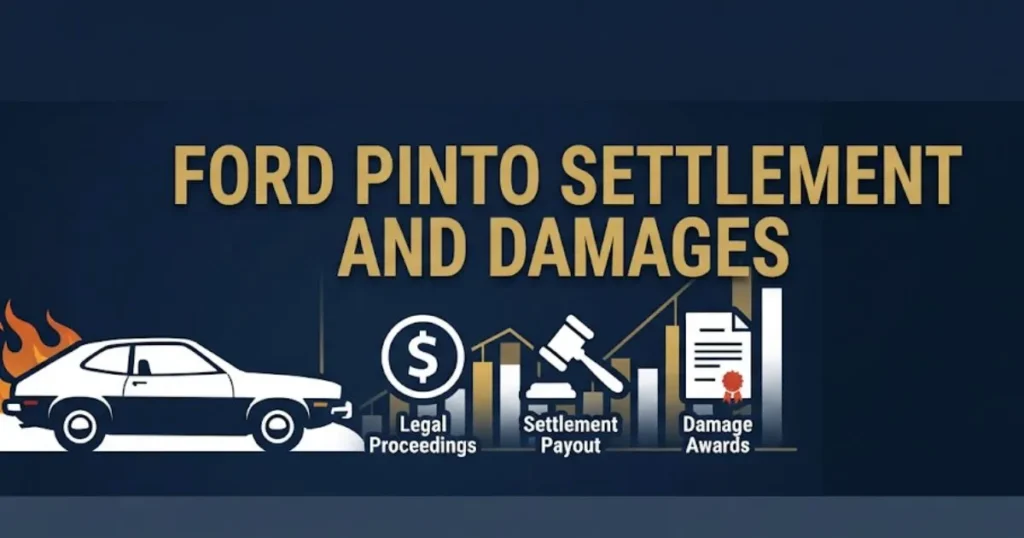
The company’s legal strategy heavily favored out-of-court settlements with strict confidentiality clauses. Ford wanted to avoid the publicity of trials and prevent the cost-benefit memo from being entered into evidence repeatedly.
What is known about the financial outcomes:
- Grimshaw v. Ford: $2.5 million compensatory damages to Grimshaw, $559,680 to the Gray family, and $3.5 million in punitive damages (reduced from $125 million)
- Individual wrongful death settlements: Estimated in the range of $100,000 to several hundred thousand dollars each, though exact figures for most cases remain sealed
- Total litigation costs for Ford: Estimated at well over $100 million when combining settlements, verdicts, legal fees, and recall expenses
| Settlement Category | Estimated Range |
|---|---|
| Wrongful Death Settlements (Individual) | $100,000 to $500,000+ (most confidential) |
| Serious Burn Injury Cases | $500,000 to $3.5 million |
| Grimshaw Verdict (Final) | $6.5 million total (compensatory + punitive) |
| Ford’s Total Litigation Costs | Over $100 million (estimated) |
| Recall Costs | Tens of millions additional |
It is worth noting that $3.5 million in 1981 dollars is equivalent to roughly $12 million in 2026 dollars when adjusted for inflation. The original $125 million punitive award would be about $430 million today.
Ford settled many cases quickly and quietly. The company understood that every trial risked a repeat of the Grimshaw scenario, where a sympathetic plaintiff and the explosive cost-benefit memo could produce another enormous punitive award.
Ford Pinto Verdict and Damages Awarded
The Ford Pinto verdicts and damages awarded across multiple cases reflected how strongly juries reacted to Ford’s conduct. Jurors consistently expressed outrage when they learned that Ford had placed a dollar value on human life.
The Grimshaw trial produced the most documented verdict. The jury deliberated and returned with awards that shocked the legal world.
In that case alone:
- $2.5 million compensatory damages for Richard Grimshaw’s injuries
- $125 million punitive damages against Ford (the largest punitive award in history at that time)
- $559,680 compensatory damages to the estate of Lilly Gray
The trial judge, recognizing that $125 million was unprecedented, used a legal tool called remittitur to reduce the punitive damages to $3.5 million. Ford appealed the entire verdict. The California Court of Appeal affirmed the reduced amounts in 1981.
Other Pinto cases produced notable verdicts as well, though they received less media attention. Juries in multiple states awarded both compensatory and punitive damages after hearing evidence of Ford’s internal knowledge of the defect.
| Grimshaw Verdict Breakdown | Amount |
|---|---|
| Grimshaw Compensatory Damages | $2,500,000 |
| Gray Family Compensatory Damages | $559,680 |
| Original Punitive Damages | $125,000,000 |
| Reduced Punitive Damages | $3,500,000 |
| Total Final Award | Approximately $6,559,680 |
| 2026 Inflation-Adjusted Value | Approximately $22 million |
The Grimshaw verdict established a principle that remains active in product liability law. When a company’s internal documents show it knowingly chose to endanger the public, juries have the authority to impose damages that go far beyond the actual financial harm.
Key Takeaway: Jury verdicts in the Pinto cases proved that internal corporate documents showing knowledge of deadly defects can lead to punitive awards in the hundreds of millions, even if judges later reduce them.
How Much Did Ford Pay for Pinto Lawsuits
Ford paid an estimated $100 million or more across all Pinto-related lawsuits, settlements, recall costs, and legal defense expenses. The exact total is impossible to calculate because most individual settlements included confidentiality agreements.
Breaking down Ford’s total financial exposure:
Direct Legal Costs:
- Grimshaw verdict (final): approximately $6.5 million
- Individual wrongful death and injury settlements: estimated $20 million to $50 million total
- Criminal trial defense costs: estimated $1 million or more
- Attorney fees across all cases: tens of millions
Recall Costs:
- Physical repair of 1.5 million vehicles
- Administrative and logistics expenses
- Estimated total recall cost: $30 million to $40 million
Indirect Costs:
- Lost sales from negative publicity
- Brand reputation damage
- Increased insurance premiums
- Engineering changes to future models
| Cost Category | Estimated Amount |
|---|---|
| Trial Verdicts | $6.5 million+ (Grimshaw alone) |
| Out-of-Court Settlements | $20 million to $50 million |
| Legal Defense Fees | Tens of millions |
| Recall Expenses | $30 million to $40 million |
| Total Estimated Cost | $100 million to $150 million+ |
| 2026 Inflation-Adjusted Total | $350 million to $500 million+ |
In today’s dollars, Ford’s Pinto liability likely exceeded $350 million to $500 million or more. Compare that to the original cost-benefit calculation: fixing every vehicle during production would have cost $137 million in 1970s dollars.
Ford’s own math proved catastrophically wrong. The company thought it could save money by not fixing the defect. Instead, the lawsuits, recall, and reputational destruction cost far more than the repair ever would have.
That lesson is still taught in business schools and law schools in 2026.
Ford Pinto Scandal Explained
The Ford Pinto scandal is the story of how one of America’s largest corporations decided that paying for dead customers was cheaper than making a safe car. It remains the textbook example of corporate negligence.
The scandal unfolded in stages. First, Ford rushed the Pinto to market between 1968 and 1970 under Lee Iacocca’s aggressive timeline. Engineers flagged safety problems with the fuel tank, but management overruled their concerns.
Then came the deaths. Throughout the early and mid-1970s, Pinto occupants died in rear-end collision fires. Families filed lawsuits. Ford settled quietly and hoped the problem would go away.
The scandal went public in August 1977, when investigative journalist Mark Dowie published “Pinto Madness” in Mother Jones magazine. Dowie obtained Ford’s internal cost-benefit analysis and published it for the world to see.
The public reaction was fierce. The idea that a major corporation had literally calculated the dollar value of a human life, and decided that paying death claims was the better business decision, horrified Americans.
Events that followed in rapid sequence:
- NHTSA formally demanded a recall
- Ford issued the recall in June 1978
- The Ulrich sisters died in August 1978
- Indiana filed criminal charges against Ford
- The criminal trial took place in early 1980
- Ford was acquitted but permanently damaged
The scandal changed how Americans thought about corporations and safety. Before the Pinto, most people trusted that automakers would not knowingly sell a car that could kill them. After the Pinto, that trust was broken.
Think of it like the moment a restaurant gets caught knowingly serving contaminated food. The specific product gets recalled, but the real damage is to the entire industry’s credibility.
Ford Pinto Case Impact on Product Liability Law
The Ford Pinto case transformed product liability law in ways that still protect consumers in 2026. It established legal precedents that courts and attorneys rely on every time a defective product injures someone.
Before the Pinto cases, punitive damages in product liability lawsuits were relatively rare and modest. The Grimshaw verdict showed that juries were willing to impose enormous punitive awards when corporate conduct was egregious enough.
Specific legal impacts include:
- Punitive damages standard: The Pinto cases helped define “conscious disregard for safety” as a threshold for punitive damages in product cases
- Internal document discovery: Courts became more willing to compel production of internal corporate safety analyses, memos, and test results
- Cost-benefit scrutiny: Using a cost-benefit analysis to justify not fixing a known defect became legally toxic evidence
- Corporate criminal liability: The Indiana case established that prosecutors could charge corporations with crimes for product decisions, even if the specific prosecution failed
The Pinto case also influenced regulatory behavior. NHTSA became more aggressive in investigating complaints and demanding recalls. The agency’s power grew partly because the Pinto scandal showed what happened when regulators were too slow.
| Legal Change | How the Pinto Case Contributed |
|---|---|
| Punitive Damages in Product Cases | Grimshaw set precedent for massive punitive awards |
| Discovery of Internal Safety Documents | Courts required disclosure of cost-benefit analyses |
| Corporate Criminal Prosecution | Indiana case opened the door to charging companies with crimes |
| NHTSA Enforcement Power | Public outrage strengthened the agency’s hand |
| Design Defect Standards | Courts refined the risk-utility test for product design |
Law professors still use the Pinto case as the primary teaching example in torts and product liability courses. If you attend law school anywhere in the United States, you will read Grimshaw v. Ford Motor Co.
Key Takeaway: The Ford Pinto lawsuits created the legal framework that allows consumers to hold corporations accountable for knowingly selling dangerous products, and that framework remains the foundation of product liability law in 2026.
Famous Product Liability Cases Like Ford Pinto
Famous product liability cases like the Ford Pinto share a common thread: a company knew about a danger, failed to act, and people got hurt or died. The Pinto was a pioneer in this category, but it was far from the last.
Several cases echo the same pattern:
General Motors Ignition Switch Defect (2014)
GM knew for over a decade that faulty ignition switches could shut off engines during driving, disabling airbags. At least 124 deaths were linked to the defect. GM paid a $900 million criminal fine and over $2 billion in civil settlements.
Takata Airbag Recalls (2013 to present)
Takata’s defective airbag inflators could explode and send metal shrapnel into vehicle occupants. At least 27 deaths worldwide and hundreds of injuries resulted. The recall covered over 67 million vehicles in the U.S. alone. Takata went bankrupt in 2017.
Toyota Unintended Acceleration (2009 to 2014)
Toyota faced allegations that certain vehicles could accelerate without driver input. The company paid over $1.2 billion in a criminal settlement and hundreds of millions more in civil claims.
| Case | Company | Defect | Deaths | Financial Outcome |
|---|---|---|---|---|
| Ford Pinto (1970s) | Ford | Fuel tank rupture | Estimated 27 to 180+ | $100M+ in total costs |
| GM Ignition Switch (2014) | GM | Engine shutoff/airbag failure | 124+ | $2B+ in settlements |
| Takata Airbags (2013+) | Takata | Exploding inflators | 27+ worldwide | Bankruptcy, billions in claims |
| Toyota Acceleration (2009) | Toyota | Unintended acceleration | Dozens | $1.2B criminal penalty |
Each of these cases shares the Pinto’s DNA. A manufacturer identified a problem internally. It calculated whether fixing the problem was worth the cost. In each case, the company delayed action, and people died as a result.
The Pinto set the template that lawyers use to this day when pursuing these cases.
Ford Pinto Lawsuit Lessons for Consumers Today
The Ford Pinto lawsuit teaches consumers lessons that are just as relevant in 2026 as they were in the 1970s. Companies still make cost-benefit calculations about safety, and consumers still need to stay informed and vigilant.
Lesson 1: Recalls matter. Act on them.
The Ulrich sisters died because their Pinto had not yet been repaired under the recall. When you receive a recall notice for any product, respond immediately. It could save your life.
Lesson 2: Internal documents tell the real story.
The Pinto memo proved that what companies say publicly and what they know internally are often very different things. In modern lawsuits, discovery of internal emails, Slack messages, and test data continues to be the most powerful evidence.
Lesson 3: Punitive damages exist for a reason.
Some people criticize large jury awards as excessive. The Pinto case shows why they are necessary. Without the threat of punitive damages, companies might still calculate that paying off victims is cheaper than fixing defects.
Lesson 4: Regulatory agencies need public pressure.
NHTSA did not act on the Pinto until media coverage and lawsuits forced the issue. In 2026, consumer complaints filed with NHTSA, the CPSC, and the FDA still drive investigations.
Lesson 5: You have legal rights when products fail.
If a product you purchased causes injury because of a design or manufacturing defect, you have the right to pursue a product liability claim. The Pinto cases established that manufacturers cannot hide behind cost-benefit math to avoid responsibility.
| Consumer Lesson | Modern Application |
|---|---|
| Act on recalls immediately | Check NHTSA, CPSC, and FDA recall databases regularly |
| Internal documents matter | Support legal discovery and transparency rules |
| Punitive damages protect you | They deter reckless corporate behavior |
| Report safety issues | File complaints with federal agencies |
| Know your product liability rights | Design defect claims remain viable in every state |
The Pinto lawsuit was not just a 1970s story. It built the legal and regulatory structure that protects every consumer who buys a product in 2026.
Key Takeaway: Every consumer protection tool you have today, from recalls to punitive damages to NHTSA investigations, was shaped or strengthened by the Ford Pinto lawsuits.
Frequently Asked Questions
What was the Ford Pinto lawsuit about?
The Ford Pinto lawsuit was about a design defect in the car’s fuel tank that caused fires and explosions during rear-end collisions.
Ford knew about the defect and chose not to fix it because paying death claims was cheaper than the repair.
The lawsuits included personal injury claims, wrongful death cases, and a criminal prosecution.
How many people died because of the Ford Pinto defect?
Estimates of deaths linked to the Ford Pinto fuel tank defect range from 27 to over 180, depending on the source.
NHTSA confirmed at least 27 deaths in Pinto fuel tank fires.
Some researchers and journalists have placed the total much higher based on unreported cases and fires not officially linked to the defect.
How much did Ford pay in the Pinto lawsuit?
Ford paid an estimated $100 million or more across all Pinto-related litigation, settlements, and recall costs.
The single largest known verdict was the Grimshaw case, which resulted in $6.5 million in final damages.
Most individual wrongful death settlements were confidential.
Was Ford criminally charged for the Pinto?
Yes, Ford Motor Company was charged with three counts of reckless homicide by the State of Indiana in 1980.
This was the first time a major American corporation faced criminal charges for a product defect.
Ford was acquitted on March 13, 1980, but the prosecution changed how courts and regulators viewed corporate accountability.
How did the Ford Pinto case change product liability law?
The Pinto case established that courts can impose massive punitive damages when companies knowingly sell dangerous products.
It made internal cost-benefit analyses powerful evidence in product liability trials.
The case also demonstrated that corporations could face criminal prosecution for product decisions, expanding the legal tools available to protect consumers.
The Ford Pinto lawsuit remains the single most important product liability case in American legal history. Its lessons about corporate accountability, consumer safety, and the power of the legal system to punish reckless behavior are still shaping lawsuits in 2026.
If you believe a defective product has harmed you, understanding your rights is the first step. The legal protections that exist today were built, in large part, because of what happened with the Pinto.
Stay informed. Act on recalls. Know that the law is on your side.







