

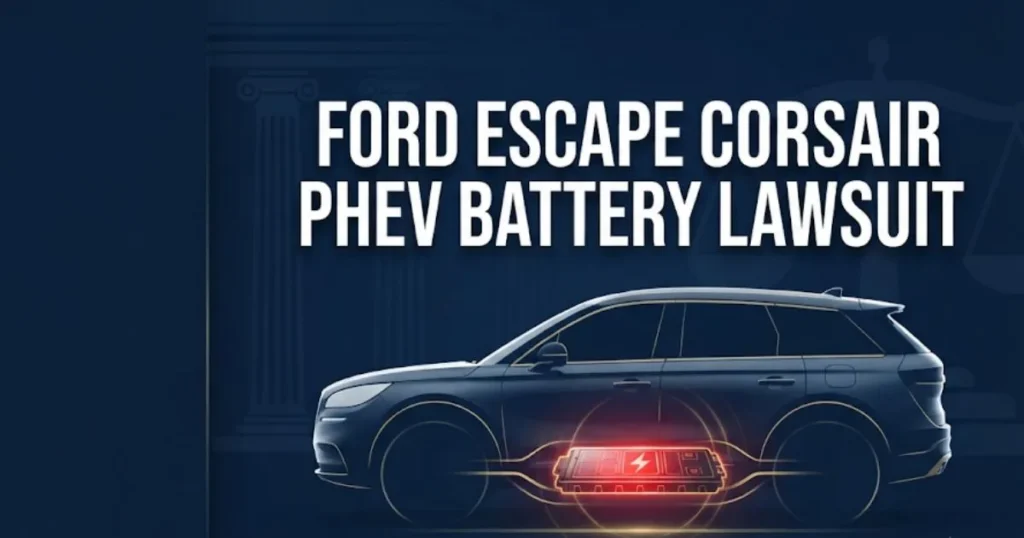
The Ford Escape Corsair PHEV battery lawsuit is an active class action in 2026, targeting defective high-voltage battery packs in Ford’s plug-in hybrid vehicles. Thousands of owners have reported sudden battery failures, fire risks, and total loss of electric propulsion power.
If you own a 2020 to 2024 Ford Escape PHEV or a 2021 to 2024 Lincoln Corsair Grand Touring, this lawsuit could affect you directly. Some owners have paid $15,000 or more out of pocket for battery replacements that should have been covered.
This guide covers every detail you need for 2026. You will learn the current case status, which vehicles qualify, estimated payouts, filing steps, and whether a lemon law claim makes more sense for your situation.
The numbers are staggering. NHTSA has received hundreds of complaints about these vehicles, and the legal pressure on Ford keeps building.
Ford Escape Corsair PHEV Battery Lawsuit Overview
The Ford Escape Corsair PHEV battery lawsuit is a class action alleging that Ford sold plug-in hybrid vehicles with defective lithium-ion battery packs. Plaintiffs claim Ford knew about the battery problems and sold the vehicles anyway.
The lawsuit names both the Ford Escape PHEV and the Lincoln Corsair Grand Touring as affected models. These vehicles share the same plug-in hybrid powertrain and the same battery supplier.
Owners report a range of failures. Batteries lose charging capacity rapidly. Warning lights appear suddenly. Some vehicles have caught fire while parked.
The core legal claims include breach of warranty, fraudulent concealment, and violations of state consumer protection laws. Plaintiffs argue Ford’s marketing promised reliable electric range that the battery packs simply cannot deliver long-term.
| Detail | Info |
|---|---|
| Lawsuit Type | Class Action |
| Defendant | Ford Motor Company |
| Vehicles | Ford Escape PHEV, Lincoln Corsair Grand Touring |
| Model Years | 2020 to 2024 |
| Key Allegations | Defective battery, fire risk, concealment |
| Status in 2026 | Active litigation |
Multiple law firms across the country are handling these claims. The cases are being coordinated in federal court, though individual state-level cases continue as well.
Ford has denied wrongdoing publicly. But the company has also issued technical service bulletins and recalls that suggest it recognized the problems internally long before owners started filing lawsuits.
Ford Escape Class Action Lawsuit Explained
The Ford Escape class action lawsuit is a legal action filed on behalf of all affected owners rather than each person suing individually. This means one case represents thousands of people with the same complaint.
Class actions work well when many consumers suffer the same type of harm from the same product defect. In this case, the common thread is a battery pack that fails prematurely and sometimes dangerously.
Here is how a class action differs from other legal options:
- Class action: One lawsuit represents all affected owners. Payouts are typically smaller per person but require less individual effort.
- Individual lawsuit: You sue Ford alone. Potentially larger payout, but more expensive and time-consuming.
- Lemon law claim: State-specific. Can result in a vehicle buyback or replacement.
The named plaintiffs in the Ford Escape class action are individual owners who agreed to represent the larger group. Their experiences are detailed in court filings and mirror what thousands of other owners have gone through.
If the class gets certified by the court, every qualifying owner will have the option to participate. You typically do not need to do anything to stay in the class unless you choose to opt out and pursue your own claim.
Class certification is a major milestone. As of early 2026, plaintiffs are pushing for this step. Ford is expected to fight certification by arguing that individual circumstances vary too much for class treatment.
Ford PHEV Lawsuit Update for 2026
The lawsuit entered 2026 with significant momentum. Discovery is underway, meaning both sides are exchanging internal documents, engineering reports, and warranty claim data.
Several key developments have shaped the case this year:
- Early 2026: Plaintiffs filed amended complaints adding new model years and additional state law claims.
- Spring 2026: Discovery disputes arose over Ford’s internal battery testing documents.
- Mid-2026: Settlement discussions are reportedly underway, though no deal has been announced.
The judge overseeing the case has set a schedule that could lead to a class certification ruling by late 2026. That ruling will determine whether the case proceeds as a class action or gets broken into individual lawsuits.
| 2026 Milestone | Expected Timing |
|---|---|
| Amended Complaint Filed | Q1 2026 |
| Discovery Phase | Ongoing through Q3 2026 |
| Class Certification Motion | Q3 to Q4 2026 |
| Settlement Talks | Ongoing |
| Potential Trial Date | 2027 if no settlement |
Ford’s legal team has been aggressive in trying to dismiss certain claims. So far, the court has allowed most allegations to move forward.
Industry watchers believe a settlement is more likely than a trial. Ford has a financial incentive to resolve this before a jury hears testimony about internal emails and engineering reports.
Key Takeaway: The Ford Escape Corsair PHEV battery lawsuit is actively progressing in 2026, with class certification and potential settlement talks on the horizon before year’s end.
What Is the Ford Escape PHEV Battery Defect?
The defect centers on the high-voltage lithium-ion battery pack that powers the electric drivetrain in Ford’s plug-in hybrid vehicles. The battery cells degrade much faster than Ford’s marketing promised.
Owners were told their PHEV would deliver roughly 37 miles of electric-only range. Many found that range dropping to single digits within two to three years of ownership.
But range loss is only part of the problem. The battery management system (BMS) also fails to properly regulate charging and discharging cycles. This leads to overheating, which creates a cascade of electrical failures.
Here are the most commonly reported symptoms:
- “Stop Safely Now” warning appearing without warning
- Complete loss of electric propulsion
- Battery refusing to charge
- Check engine lights tied to high-voltage battery codes
- Burning smell from the battery compartment
- Vehicle stalling in traffic
The battery pack sits beneath the rear seats and cargo area. When it fails, the repair is not simple. The entire pack often needs replacement because individual cell replacement is not offered at most dealerships.
Engineers and independent automotive analysts have pointed to potential issues with the thermal management system. If the battery coolant loop does not function correctly, cells overheat during charging. Over time, repeated thermal stress causes permanent damage.
Ford has issued technical service bulletins (TSBs) related to battery software updates. But owners report that software fixes rarely solve the underlying hardware problem.
Ford PHEV Battery Fire Risk and Safety Concerns
The fire risk is the most alarming aspect of this defect. Multiple owners have reported their Ford Escape PHEV or Lincoln Corsair catching fire while parked and charging in their garage.
A lithium-ion battery fire is not like a gasoline fire. It involves a process called thermal runaway, where one failing cell heats up neighboring cells in a chain reaction. These fires burn extremely hot and are very difficult to extinguish.
NHTSA complaint data shows fire-related reports beginning as early as 2021. The pattern has intensified as more vehicles age beyond warranty coverage.
| Fire Risk Factor | Detail |
|---|---|
| Root Cause | Thermal runaway in battery cells |
| Trigger | Charging, especially at higher ambient temperatures |
| Burn Temperature | Can exceed 1,000 degrees Fahrenheit |
| Extinguishing Difficulty | Requires specialized suppression; water alone is insufficient |
| Reported Incidents | Multiple across NHTSA database |
Some owners have been told by Ford dealers to avoid charging their vehicle in a garage until a fix is available. Think about that for a moment. A plug-in hybrid you were told to plug in is now too dangerous to plug in at home.
The fire risk has also affected resale values. Potential buyers are wary, and trade-in offers for affected models have dropped significantly compared to non-PHEV versions of the same vehicles.
Ford has not issued a formal stop-drive order for these vehicles. But the growing number of fire reports puts pressure on both NHTSA and Ford to take more aggressive action.
Lincoln Corsair PHEV Battery Problems Reported
The Lincoln Corsair Grand Touring shares the same PHEV powertrain as the Ford Escape plug-in hybrid. That means it shares the same battery defect, the same fire risk, and the same owner frustrations.
Lincoln Corsair owners have reported identical symptoms: sudden range loss, charging failures, warning messages, and in some cases, smoke or fire. The Corsair is a more expensive vehicle, often purchased or leased at prices above $50,000, making the financial sting even sharper.
Specific complaints from Corsair owners include:
- Battery pack failure within 18 to 24 months of purchase
- Dealer wait times of 3 to 6 months for replacement batteries
- Out-of-pocket repair bills exceeding $18,000 when warranty coverage is denied
- Loss of the electric-only driving mode that was a primary selling point
The Corsair Grand Touring was marketed as a luxury plug-in hybrid with a smooth, quiet electric driving experience. For many owners, that promise fell apart quickly.
Lincoln dealers have sometimes handled these complaints differently than Ford dealers. Some Corsair owners report being offered loaner vehicles during extended repair waits. Others say they were simply told to wait with no alternative transportation.
The class action includes Corsair owners alongside Escape PHEV owners. The shared platform and shared defect make them natural partners in the litigation.
Key Takeaway: Both the Ford Escape PHEV and Lincoln Corsair Grand Touring suffer from the same battery defect, meaning owners of either vehicle should pay close attention to this lawsuit.
Ford Corsair PHEV Overheating Battery Issues
Overheating is the primary failure mode driving both the safety concerns and the legal claims. The battery pack in these vehicles does not manage heat effectively under real-world conditions.
The battery thermal management system uses a liquid coolant loop to regulate temperature during charging and driving. When this system underperforms, cell temperatures climb above safe operating limits.
Several factors contribute to the overheating problem:
- Inadequate coolant flow through the battery pack
- Software calibration errors in the battery management system
- Ambient temperature sensitivity, with failures spiking in warmer climates
- Repeated fast charging cycles accelerating thermal degradation
Owners in southern states like Texas, Florida, and Arizona have reported higher rates of battery failure. Heat stress compounds the existing design weaknesses.
| Overheating Symptom | What Happens Next |
|---|---|
| Battery temp warning light | Vehicle limits power output |
| Charging interrupted | Battery refuses to accept charge |
| Repeated thermal events | Permanent cell damage |
| Thermal runaway | Potential fire |
Ford’s software updates have attempted to address overheating by limiting charging speeds and capping battery capacity. But many owners see this as Ford reducing their vehicle’s capability rather than fixing the root cause.
It is like a car company responding to an engine that overheats by putting a speed limiter on it. The symptom gets managed, but the defect remains.
Some independent mechanics and EV specialists have found evidence of coolant leaks within the battery enclosure. A coolant leak near high-voltage components is a serious safety hazard on its own.
Ford Escape PHEV Safety Complaints Filed With NHTSA
NHTSA (National Highway Traffic Safety Administration) has received hundreds of safety complaints related to Ford Escape PHEV battery issues. These complaints form a critical part of the evidence in the class action.
Each NHTSA complaint is a public record. Owners describe their experience in their own words, creating a detailed picture of how widespread the problem is.
Common themes across NHTSA complaints include:
- Sudden loss of power while driving on highways
- “Stop Safely Now” warnings appearing at dangerous moments
- Vehicles stalling in intersections
- Fire or smoke while charging overnight
- Dealers unable to diagnose or repair the issue
As of early 2026, NHTSA has opened a preliminary evaluation into the battery issues. This is the first formal step toward a potential federal investigation or mandatory recall.
| NHTSA Activity | Status |
|---|---|
| Owner Complaints Filed | Hundreds on record |
| Preliminary Evaluation | Opened |
| Engineering Analysis | Pending |
| Recall Order | Not yet issued |
| Investigation Scope | 2020 to 2024 Escape PHEV, 2021 to 2024 Corsair GT |
NHTSA complaints carry real weight in court. When a plaintiff’s attorney can show that Ford received the same complaint from dozens or hundreds of owners, it becomes very hard for Ford to argue it did not know about the problem.
If NHTSA upgrades its evaluation to a full engineering analysis, Ford could face a mandatory recall. That would be separate from the lawsuit but would bolster the legal claims significantly.
Ford PHEV Battery Lawsuit Eligibility Requirements
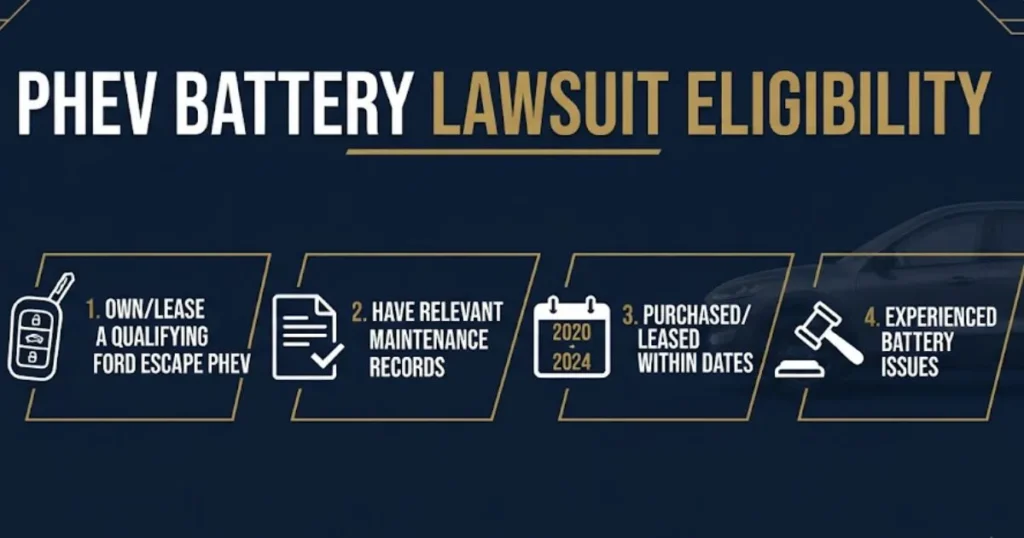
You are likely eligible if you own or lease a 2020 to 2024 Ford Escape PHEV or a 2021 to 2024 Lincoln Corsair Grand Touring. You do not need to have experienced a fire to qualify.
The class definition in the lawsuit is typically broad. It covers anyone who purchased or leased one of the affected vehicles in the United States during the relevant model years.
Here are the general eligibility criteria:
- Vehicle ownership or lease: You must currently own, lease, or have previously owned/leased a qualifying vehicle.
- Model years: Ford Escape PHEV 2020, 2021, 2022, 2023, or 2024. Lincoln Corsair Grand Touring 2021, 2022, 2023, or 2024.
- Location: Purchased or leased in the United States.
- Defect experience: Not strictly required for class membership, but documented issues strengthen your individual claim.
| Eligibility Factor | Requirement |
|---|---|
| Vehicle | Ford Escape PHEV or Lincoln Corsair GT |
| Model Years | 2020 to 2024 (Escape), 2021 to 2024 (Corsair) |
| Purchase Location | United States |
| Current Ownership | Current or former owners/lessees |
| Documented Defect | Helpful but not always required |
Even if your battery has not failed yet, you may have a claim based on diminished vehicle value. The argument is that your vehicle is worth less because it contains a known defective component.
If you sold the vehicle at a loss because of battery concerns, that financial harm could also qualify you. Keep all purchase records, sale documents, and repair invoices.
Key Takeaway: Most owners of 2020 to 2024 Ford Escape PHEVs and 2021 to 2024 Lincoln Corsair Grand Tourings qualify for the class action, even if their battery has not failed yet.
How to Join the Ford Escape Class Action
Joining the Ford Escape class action is straightforward in most cases. If the class is certified, you are typically included automatically unless you choose to opt out.
Here is what you should do right now to protect your interests:
- Gather your documents: Purchase or lease agreement, vehicle registration, all repair invoices, and any correspondence with Ford or your dealer about battery issues.
- Document your experience: Write down what happened, when symptoms started, and how the defect affected you.
- File an NHTSA complaint: This creates a public record of your experience and strengthens the overall case.
- Contact a participating law firm: Firms handling the case can register you as a potential class member. You typically pay nothing upfront.
- Keep your vehicle records updated: If new problems develop, document them immediately.
| Step | Action | Why It Matters |
|---|---|---|
| 1 | Collect purchase/lease documents | Proves ownership |
| 2 | Save all repair records | Shows financial harm |
| 3 | File NHTSA complaint | Creates public record |
| 4 | Contact class action attorneys | Registers your claim |
| 5 | Document ongoing issues | Strengthens your case |
You do not need to hire your own attorney to participate in the class action. Class counsel represents all members. There is no fee unless the case results in a recovery.
If you have already sold the vehicle, you can still participate. Former owners are typically included in the class definition. Your claim would focus on the money you lost on the sale and any repair costs you paid before selling.
Acting sooner is better than waiting. Early documentation creates a stronger record. And if settlement discussions are already happening, having your name on file with class counsel means you will not be left out.
Ford Escape PHEV Settlement Amount Expectations
No settlement has been finalized as of mid-2026, but industry analysts and legal experts have provided some educated estimates based on similar automotive defect cases.
Settlement amounts in battery defect class actions typically fall into tiered categories based on the severity of harm each owner experienced.
| Tier | Description | Estimated Range |
|---|---|---|
| Tier 1 | Battery failed; owner paid for replacement | $8,000 to $18,000 |
| Tier 2 | Battery degraded significantly; reduced range | $2,000 to $6,000 |
| Tier 3 | No failure yet; diminished value claim | $500 to $2,000 |
| Tier 4 | Fire or safety incident | Case-by-case; potentially much higher |
These numbers are estimates based on comparable cases. The Hyundai/Kia EV battery settlement and other recent automotive battery class actions provide useful reference points.
Owners who paid out of pocket for battery replacements stand to recover the most. If your dealer charged you $15,000 for a new battery pack that should have been covered under warranty, that is a clear and documentable financial loss.
Those with diminished value claims will likely receive less per person, but the total number of claimants in this tier could be very large. That volume gives plaintiffs leverage in settlement negotiations.
Any settlement will need court approval. The judge will review the terms to make sure they are fair to all class members. This process typically takes several months after a deal is reached.
Ford PHEV Class Action Payout Estimate for 2026
Realistically, payouts are unlikely to arrive before late 2026 or early 2027. Class action settlements take time to finalize, gain court approval, and distribute funds.
Here is a realistic timeline for when you might see money:
| Phase | Estimated Timing |
|---|---|
| Settlement reached | Late 2026 (if talks succeed) |
| Preliminary court approval | Q4 2026 or Q1 2027 |
| Notice to class members | 60 to 90 days after preliminary approval |
| Objection/opt-out period | 30 to 60 days |
| Final approval hearing | Q2 2027 |
| Checks mailed | Q3 2027 |
If the case does not settle and goes to trial, the timeline extends into 2028 or beyond. Trials involve appeals, and appeals can add years.
The total settlement fund in a case like this could range from $100 million to $500 million depending on the number of affected vehicles and the strength of the evidence. That is a wide range, but battery defect cases involving fire risk tend to push toward the higher end.
Your individual payout depends on which tier you fall into, what documentation you have, and the final settlement terms. Owners with receipts for battery replacement, tow bills, and rental car costs will receive more than those with only a diminished value claim.
Think of it like an insurance claim. The more you can prove, the more you get. Hang on to every receipt and every piece of communication with Ford or your dealer.
Key Takeaway: Settlement payouts will likely be tiered based on severity of harm, with battery replacement owners recovering the most and payments not expected before late 2026 at the earliest.
Ford Escape PHEV Battery Replacement Cost Breakdown
A Ford Escape PHEV battery replacement typically costs between $12,000 and $20,000 at a dealership. That price tag is one of the biggest reasons owners are joining the lawsuit.
The cost breaks down into several components:
| Cost Component | Estimated Amount |
|---|---|
| Battery pack (parts) | $8,000 to $14,000 |
| Labor (removal and installation) | $2,000 to $4,000 |
| Diagnostic and calibration fees | $500 to $1,000 |
| Coolant system service | $200 to $500 |
| Towing (if vehicle was disabled) | $150 to $500 |
| Total | $10,850 to $20,000 |
These costs are staggering for a vehicle that may have only cost $35,000 to $45,000 new. Paying half the vehicle’s value to replace a component that should last the vehicle’s lifetime is not something any buyer signs up for.
Many owners report that Ford dealers initially promised warranty coverage, only to later deny the claim based on technicalities. Common denial reasons include “out of warranty,” “customer-caused damage,” or “environmental factors.”
Independent repair shops generally cannot perform these replacements. The high-voltage battery work requires specialized training and equipment that most shops do not have. This forces owners back to dealerships, where pricing is non-negotiable.
Some owners have explored used battery packs from salvage yards. But used PHEV batteries carry their own risks, and Ford does not support third-party battery installations under warranty.
Ford Escape PHEV Lemon Law Claim Options
A lemon law claim is a separate legal path from the class action, and for some owners, it may produce a better outcome. Lemon laws exist in every state and are designed to protect buyers who get stuck with defective vehicles.
Under most state lemon laws, if a manufacturer cannot fix a substantial defect within a reasonable number of attempts (usually 3 to 4 repair attempts or 30 or more days in the shop), the buyer is entitled to a replacement vehicle or a full refund.
Here is how a lemon law claim compares to the class action:
| Factor | Class Action | Lemon Law Claim |
|---|---|---|
| Individual effort required | Low | Moderate |
| Potential payout | Lower per person | Higher (vehicle buyback possible) |
| Timeline | 1 to 3 years | 3 to 12 months |
| Attorney fees | Paid from settlement fund | Typically paid by manufacturer |
| Best for | Owners with moderate harm | Owners with repeated repair failures |
If your Escape PHEV or Corsair has been in the shop multiple times for the same battery issue, a lemon law claim could result in Ford buying back your vehicle at the original purchase price minus a mileage deduction.
You can pursue a lemon law claim and remain in the class action in some cases, though the outcomes cannot overlap. An experienced attorney can advise on which path maximizes your recovery.
State deadlines vary. Most lemon laws require you to file within 1 to 4 years of the purchase date or within the warranty period. Check your state’s specific statute of limitations.
Ford Escape Plug-In Hybrid Recall Updates for 2026
Ford has issued multiple recalls affecting the Escape PHEV and Corsair Grand Touring, though none have fully addressed the battery defect at the center of the lawsuit.
Here are the relevant recall actions as of 2026:
- 2022 Recall (22S44): Addressed a risk of under-hood fire in certain 2020 to 2022 Escape PHEVs. Ford recommended dealers inspect and potentially replace battery-related components.
- 2023 Recall Update: Expanded the previous recall scope. Added software updates for the battery management system.
- 2024 TSB (Technical Service Bulletin): Not a formal recall but acknowledged battery degradation issues and authorized extended diagnostic procedures.
- 2025 to 2026: NHTSA evaluation opened. Additional recall action possible depending on investigation findings.
| Recall/TSB | Year | Scope | Fix Offered |
|---|---|---|---|
| 22S44 | 2022 | Under-hood fire risk | Inspection, parts replacement |
| Software Update TSB | 2023 | Battery management | Software recalibration |
| Diagnostic TSB | 2024 | Battery degradation | Extended diagnostics |
| NHTSA Evaluation | 2025 to 2026 | Full battery system | Pending |
A recall does not prevent you from joining the lawsuit. In fact, an incomplete or ineffective recall actually strengthens the legal argument. It shows Ford acknowledged the problem but failed to truly fix it.
If you receive a recall notice, take your vehicle to the dealer. Get the recall work done. But also save the paperwork, because it becomes evidence that the defect existed and was not fully repaired.
Some owners have reported that recall repairs temporarily improved their battery performance, only for the same issues to return within months. This pattern of repeated failure is exactly what plaintiffs’ attorneys point to in court.
Key Takeaway: Ford’s recalls and service bulletins have not fully fixed the PHEV battery defect, and incomplete recall repairs actually strengthen the legal case for affected owners.
Ford Escape Hybrid Battery Warranty Coverage
The Ford Escape PHEV battery warranty covers the high-voltage battery components for 8 years or 100,000 miles, whichever comes first, on most model years. Lincoln Corsair Grand Touring batteries carry a similar warranty.
This warranty coverage sounds generous on paper. In practice, many owners have found it difficult to get Ford to honor the warranty when battery problems arise.
| Warranty Component | Coverage |
|---|---|
| High-Voltage Battery Pack | 8 years / 100,000 miles |
| Hybrid Powertrain Components | 8 years / 100,000 miles |
| Battery Management System | Varies by model year |
| General Bumper-to-Bumper | 3 years / 36,000 miles |
| Powertrain (non-hybrid) | 5 years / 60,000 miles |
Common reasons dealers deny warranty battery claims:
- Mileage exceeds 100,000: Even if the vehicle is only 3 years old
- “Normal degradation”: Ford argues that some capacity loss is expected
- Aftermarket modifications: Any non-Ford accessory can be used as a denial reason
- Missed maintenance: If scheduled service was not performed at a Ford dealer
The lawsuit alleges that Ford’s warranty practices are part of the problem. Plaintiffs claim Ford trained dealers to deny battery warranty claims using narrow interpretations of what qualifies as a “defect” versus “normal wear.”
Federal law, specifically the Magnuson-Moss Warranty Act, protects consumers against unfair warranty denials. If Ford promised 8 years of coverage and then refuses to honor that promise when the battery fails at year 4, the law provides remedies.
If your warranty claim was denied, save the denial letter. That document is valuable evidence in both the class action and in any individual warranty claim you might pursue.
Some states have their own warranty protection laws that go beyond federal standards. California, for example, requires manufacturers to honor implied warranties for the reasonable expected life of the product.
Do not assume a warranty denial is the final answer. Push back. Escalate to Ford’s regional customer service office. And if that fails, the lawsuit is designed to hold Ford accountable for exactly this kind of behavior.
Frequently Asked Questions
Is there a class action lawsuit against Ford for PHEV battery defects in 2026?
Yes, an active class action targets Ford Escape PHEV and Lincoln Corsair Grand Touring models for defective high-voltage batteries.
The case is in the discovery and class certification phase as of 2026.
Settlement discussions are reportedly underway.
Which Ford Escape and Lincoln Corsair model years are covered by the battery lawsuit?
The lawsuit covers 2020 to 2024 Ford Escape PHEV and 2021 to 2024 Lincoln Corsair Grand Touring models.
Both vehicles share the same plug-in hybrid battery platform.
All U.S. purchasers and lessees of these model years may qualify.
How much money can I get from the Ford PHEV battery lawsuit?
Estimated payouts range from $500 to $18,000 depending on the severity of your battery issue.
Owners who paid for battery replacement out of pocket stand to recover the most.
Final amounts depend on the settlement terms approved by the court.
What is the deadline to join the Ford Escape PHEV class action?
No firm filing deadline has been set as of mid-2026 because the class has not yet been formally certified.
Once certified, a notice period will give class members time to decide whether to participate or opt out.
Acting now to register with class counsel is recommended.
Can I file a lemon law claim instead of joining the Ford class action?
Yes, lemon law claims are a separate legal option available in every state.
They can result in a full vehicle buyback or replacement if the defect was not fixed after multiple repair attempts.
You may be able to pursue both a lemon law claim and remain in the class action, depending on your state’s laws.
What You Should Do Right Now
This lawsuit is not going away. If you own or owned an affected Ford Escape PHEV or Lincoln Corsair Grand Touring, now is the time to gather your records and get your name on file.
Document everything. Save every repair receipt, every dealer communication, and every photo of warning lights or damage. File an NHTSA complaint if you have not already.
Stay informed as the case moves toward class certification and potential settlement. Your vehicle’s defective battery is Ford’s responsibility, and the legal system is working to make that right.







