

FedEx is facing lawsuits on multiple fronts in 2026. A fedex lawsuit can involve anything from contractor misclassification to truck accidents, discrimination, or lost packages. Some of these cases have already produced settlements worth millions.
Whether you’re a former driver, a current employee, or a customer burned by a bad delivery, this guide breaks it all down. You’ll learn which cases are active, how much people are getting paid, who qualifies, and exactly how to file.
One fact worth knowing: FedEx Ground has paid out over $500 million in contractor misclassification settlements since the mid-2010s. And the legal pressure is not slowing down.
This article covers every major FedEx lawsuit category in 2026 with real numbers, real deadlines, and real answers.
FedEx Lawsuit 2026: What You Need to Know Right Now
FedEx faces several active lawsuits in 2026 spanning employment disputes, accident claims, discrimination cases, and consumer complaints. The company’s legal exposure has grown as courts continue scrutinizing its business model, particularly around how it classifies workers.
The biggest area of litigation remains FedEx Ground. Drivers and delivery contractors across multiple states have filed or joined lawsuits claiming they were misclassified as independent contractors. That single issue has cost FedEx hundreds of millions in past settlements and remains unresolved in several jurisdictions.
On the consumer side, lawsuits over lost, damaged, or stolen packages are also active. Some involve claims that FedEx imposes unfair liability limits that prevent customers from recovering the full value of shipped goods.
| Category | Status in 2026 | Key Issue |
|---|---|---|
| Contractor Misclassification | Active in multiple states | Worker reclassification claims |
| Discrimination | Pending EEOC and court cases | Race, gender, disability bias |
| Truck Accidents | Ongoing personal injury claims | Negligence, driver fatigue |
| Consumer Delivery Claims | Active small claims and class actions | Lost or damaged packages |
| Wrongful Termination | Various state filings | Retaliation and unfair firing |
FedEx typically fights hard before settling. But the sheer volume of cases in 2026 suggests the company is under serious legal strain. If you think you have a claim, this is the year to pay attention.
FedEx Class Action Lawsuit: Active Cases This Year
A FedEx class action lawsuit allows a group of people with similar claims to sue together. Several of these cases are active or pending in 2026, covering employment issues, shipping practices, and safety violations.

The most significant class actions target FedEx Ground’s contractor model. In states like California, Oregon, and Kansas, courts have previously certified classes of drivers who argued they were treated as employees but denied benefits. Some of these class actions resulted in settlements. Others are still winding through the appeals process.
Employment-related class actions also include wage and hour violations. Groups of FedEx warehouse workers and handlers have filed collective actions under the Fair Labor Standards Act, claiming they were not paid for overtime or were forced to work off the clock.
- California contractor class action: Resulted in a $228 million settlement in prior years; related claims still active
- Kansas driver misclassification case: Class certified; litigation ongoing in 2026
- Wage and hour collective actions: Filed in multiple federal districts by warehouse and sort facility workers
- Consumer overcharge class actions: Allegations that FedEx applied hidden surcharges or inflated declared value fees
To join an active class action, you generally don’t need to do anything until a settlement is reached. At that point, a claims administrator will notify eligible members. But if you want to file a new class action, you’ll need an attorney who specializes in this area.
FedEx Settlement: Recent and Pending Agreements
FedEx has agreed to multiple settlements in recent years, with some funds still being distributed in 2026. The largest settlements stem from the independent contractor misclassification litigation that began over a decade ago.
In the landmark multi-district litigation (MDL) involving FedEx Ground drivers, FedEx settled for a combined total exceeding $365 million across various state-specific cases. California’s share was the largest single settlement at $228 million, approved in 2016, with related claims generating additional payouts in subsequent years.
Smaller settlements have also been finalized. A 2023 settlement involving FedEx Freight workers in the Midwest resolved wage theft claims for approximately $12.5 million. In 2024, a racial discrimination settlement paid out $3.5 million to affected employees at a Memphis sorting facility.
| Settlement | Amount | Year Finalized | Claim Type |
|---|---|---|---|
| California Contractor MDL | $228 million | 2016 | Misclassification |
| Multi-State Ground Drivers | $137 million+ | 2016-2020 | Misclassification |
| FedEx Freight Wage Claims | $12.5 million | 2023 | Wage theft |
| Memphis Discrimination Case | $3.5 million | 2024 | Racial discrimination |
| Pending 2026 Cases | TBD | Expected 2026 | Various |
Several pending cases could produce new settlements in 2026. FedEx has a pattern of settling before trial when the evidence is strong and the class size is large. Keep checking case updates if you believe you’re part of an open settlement class.
Key Takeaway: FedEx has paid out hundreds of millions in lawsuit settlements, and several active cases in 2026 could produce new payouts for eligible claimants across multiple categories.
FedEx Lawsuit Payout: What Are People Getting Paid?
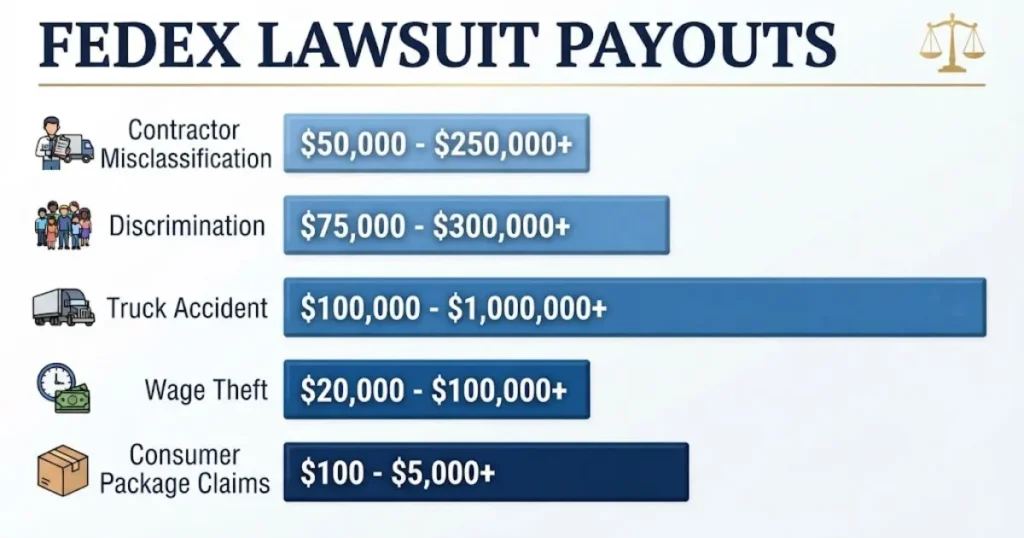
FedEx lawsuit payouts vary widely depending on the type of case. Contractor misclassification claims have generated the largest per-person payments, while consumer claims tend to produce smaller amounts.
In the California contractor case, individual payouts ranged from a few hundred dollars to over $20,000 per driver, depending on how long they worked and how much they earned. Drivers who worked longer routes for multiple years received the highest checks.
For employment discrimination and wrongful termination cases, individual payouts have ranged from $5,000 to $100,000 or more, depending on the severity of the claim and whether the case went to trial or settled. Some high-profile single-plaintiff discrimination verdicts against FedEx have exceeded $1 million, though these are rare.
Accident and personal injury payouts follow a different scale entirely. FedEx truck accident claims involving serious injuries have settled for amounts between $50,000 and several million dollars. Fatal accident cases have resulted in wrongful death settlements exceeding $5 million in some instances.
- Contractor misclassification: $500 to $20,000+ per driver
- Wage and hour claims: $1,000 to $15,000 per worker
- Discrimination claims: $5,000 to $100,000+ per person
- Truck accident injuries: $50,000 to $5 million+
- Consumer package claims: $50 to $500 per claim (class action payouts)
The amount you receive depends on your specific damages, the strength of your evidence, and whether you’re part of a class or filing individually.
FedEx Settlement Payout Amounts: A Full Breakdown
FedEx settlement payout amounts depend on several factors, including claim type, duration of harm, and the total settlement fund size. Knowing the math behind these payouts helps set realistic expectations.
In class action settlements, the total fund is divided among all eligible class members. Attorneys typically take 25% to 33% of the fund, and administrative costs eat up another 5% to 10%. What’s left gets split based on each person’s individual claim value.
For the California contractor settlement, the $228 million fund served approximately 12,000 drivers. After legal fees and costs, the average per-driver payout landed around $8,000 to $12,000. But the range was wide. Some got less than $1,000 while others received over $20,000.
| Claim Type | Settlement Range Per Person | Factors Affecting Amount |
|---|---|---|
| Contractor Misclassification | $500 to $20,000+ | Years worked, route value, state |
| Wage and Hour | $1,000 to $15,000 | Hours unpaid, duration of employment |
| Discrimination | $5,000 to $100,000+ | Severity, evidence, emotional distress |
| Wrongful Termination | $10,000 to $250,000+ | Lost wages, length of employment |
| Truck Accident | $50,000 to $5,000,000+ | Injury severity, medical costs |
| Package/Consumer | $50 to $500 | Value of lost/damaged item |
Individual lawsuits (not class actions) generally produce larger payouts because you’re not splitting a fund. But they also cost more to pursue and carry more risk. Think of it like the difference between splitting a pizza with 12 people versus eating the whole thing yourself, but you had to hunt, catch, and cook the animal first.
FedEx Ground Lawsuit: Cases Targeting the Ground Division
FedEx Ground lawsuits represent the largest category of litigation against FedEx. The Ground division’s business model, which relies heavily on contracted drivers and Independent Service Providers (ISPs), has been the source of legal battles for over 15 years.
The core issue is simple. FedEx Ground classified its drivers as independent contractors rather than employees. This meant drivers didn’t receive benefits like health insurance, overtime pay, workers’ compensation, or unemployment insurance. Courts in multiple states ruled that FedEx exerted enough control over these drivers that they should have been classified as employees.
California, Oregon, Montana, New Hampshire, and several other states have ruled in favor of drivers on this issue. The results triggered the massive settlement payouts discussed earlier.
In 2026, the landscape continues to shift. FedEx transitioned to an ISP model in 2019, where it contracts with small businesses that hire their own drivers rather than contracting with individual drivers directly. But lawsuits are now testing whether this new model still amounts to misclassification, just with an extra layer in between.
- FedEx Ground generates roughly $50 billion in annual revenue
- The division employs tens of thousands of contracted drivers through ISPs
- State labor departments in California, New York, and New Jersey continue investigating contractor classifications
- New lawsuits in 2026 focus on whether ISP owners themselves are being misclassified
If you drove for FedEx Ground at any point in the last five to ten years and were classified as a contractor, you may still have a viable claim depending on your state.
Key Takeaway: FedEx Ground’s contractor model remains the company’s biggest legal vulnerability, with new lawsuits in 2026 challenging even the restructured ISP system that FedEx adopted to reduce legal exposure.
FedEx Independent Contractor Lawsuit: The Misclassification Fight
The FedEx independent contractor lawsuit centers on whether delivery drivers were wrongly classified as contractors instead of employees. This single legal question has cost FedEx more money in settlements than any other type of litigation.
Misclassification matters because it directly affects a worker’s paycheck. Employees get overtime, minimum wage protections, benefits, and workers’ compensation. Independent contractors get none of that. When a company calls you a contractor but treats you like an employee, it’s saving money at your expense.
Courts use various tests to determine classification. The IRS uses a 20-factor test. California uses the ABC test under AB5. Most tests look at how much control the company has over the worker’s schedule, appearance, route, and methods.
In FedEx’s case, courts found that the company:
- Required drivers to wear FedEx uniforms
- Dictated delivery routes and schedules
- Required the use of FedEx scanners and technology
- Set performance standards and grooming policies
- Controlled virtually every aspect of the driver’s workday
That level of control screams “employee,” not “contractor.” And that’s exactly what judges found in state after state.
| State | Court Ruling | Outcome |
|---|---|---|
| California | Drivers are employees | $228 million settlement |
| Oregon | Drivers are employees | $38.9 million settlement |
| Kansas | Class certified | Ongoing litigation |
| New Hampshire | Drivers are employees | Settlement reached |
| Montana | Drivers are employees | Settlement reached |
| Indiana | Mixed ruling | Partial settlement |
The fight isn’t over. New cases in 2026 are pushing the same arguments against the ISP model. If you operated under an ISP contract, watch this space closely.
FedEx Discrimination Lawsuit: Race, Gender, and Disability Claims
FedEx discrimination lawsuits allege the company engaged in bias based on race, gender, disability, or other protected characteristics. Several of these cases have resulted in EEOC actions and private settlements.
One of the most notable cases involved allegations of systemic racial discrimination at FedEx sorting facilities. Black employees reported being passed over for promotions, assigned to less desirable shifts, and subjected to a hostile work environment. The EEOC investigated and facilitated a $3.5 million settlement at a Memphis facility in 2024.
Gender discrimination claims have also surfaced. Female FedEx employees in management and operations roles have alleged pay disparities and denied advancement opportunities. Some of these cases are individual lawsuits while others have been filed as collective actions.
Disability discrimination is another active area. FedEx has faced claims under the Americans with Disabilities Act (ADA) from employees who said the company refused reasonable accommodations or terminated them after a medical leave.
- Race discrimination: EEOC complaints and private lawsuits in multiple states
- Gender pay gap claims: Allegations of unequal pay for equal work
- ADA violations: Failure to accommodate disabilities or medical conditions
- Retaliation claims: Employees fired or demoted after filing discrimination complaints
- Age discrimination: Older workers replaced by younger, lower-paid staff
If you experienced discrimination while working at FedEx, you generally need to file an EEOC charge before you can sue. The EEOC filing deadline is 180 to 300 days from the discriminatory act, depending on your state.
FedEx Wrongful Termination Lawsuit: Fired Without Cause?
A FedEx wrongful termination lawsuit claims the company fired an employee for illegal reasons, such as retaliation, discrimination, or violation of public policy. These cases are surprisingly common against large employers like FedEx.
Wrongful termination doesn’t mean “unfair” firing. It means the firing broke a specific law. You can be wrongfully terminated if FedEx fired you for reporting safety violations, filing a workers’ comp claim, complaining about discrimination, or refusing to do something illegal.
Several FedEx wrongful termination cases in recent years have involved retaliation. Drivers and warehouse workers reported unsafe conditions, like overloaded trucks or forced overtime that violated hours-of-service rules, and were terminated shortly after. Courts have found that the timing of the firing, combined with the employee’s protected activity, supported retaliation claims.
| Wrongful Termination Basis | Legal Protection | Common Evidence |
|---|---|---|
| Retaliation for safety complaints | OSHA whistleblower protections | Timing of firing after complaint |
| Discrimination-based firing | Title VII, ADA, ADEA | Disparate treatment patterns |
| Workers’ comp retaliation | State workers’ comp laws | Firing shortly after filing claim |
| Violation of public policy | State common law | Refusing illegal order, then fired |
| Breach of contract | Contract law | Written employment agreement violated |
Payouts in wrongful termination cases against FedEx range from $10,000 to over $250,000, depending on lost wages, emotional distress, and whether punitive damages apply. Juries tend to be sympathetic to workers who lost their livelihoods for doing the right thing.
Think of it this way: if you pulled a fire alarm because the building was actually on fire, and your boss fired you for disrupting the workday, most people would call that outrageous. That’s essentially what retaliation-based wrongful termination looks like.
Key Takeaway: FedEx faces active discrimination and wrongful termination lawsuits in 2026, with EEOC involvement in several cases and individual payouts reaching six figures for employees who can prove illegal firing or workplace bias.
FedEx Accident Lawsuit: Injuries Caused by FedEx Operations
A FedEx accident lawsuit involves injuries caused by FedEx vehicles, employees, or operations. These personal injury cases can result in significant compensation because FedEx, as a large corporation, carries substantial insurance and bears a high duty of care.
FedEx accident lawsuits fall into several categories. The most common involve vehicle collisions, but injuries also occur at FedEx facilities, on customer properties during deliveries, and from falling packages or improperly secured cargo.
The legal theory in most accident cases is negligence. You must prove that FedEx or its agents owed you a duty of care, breached that duty, and caused your injuries as a result.
- Vehicle accidents: Collisions with FedEx trucks, vans, or contractor vehicles
- Premises liability: Injuries at FedEx drop-off locations or facilities
- Delivery-related injuries: Tripping hazards from packages left in walkways
- Cargo accidents: Falling or shifting packages during loading and transit
- Workplace injuries: Sorting facility accidents involving conveyors, forklifts, or heavy packages
One complication with FedEx accident cases involves the contractor issue. If the driver who caused your accident was an independent contractor, FedEx may argue it’s not liable. However, courts have increasingly applied a legal doctrine called “vicarious liability” or “respondeat superior” to hold FedEx responsible anyway, especially when FedEx controls the driver’s route, schedule, and vehicle branding.
Average settlements in FedEx accident cases range from $50,000 for minor injuries to several million dollars for catastrophic injuries or death. The value depends on medical expenses, lost income, pain and suffering, and the degree of FedEx’s fault.
FedEx Truck Accident Lawsuit: Crashes Involving FedEx Vehicles
FedEx truck accident lawsuits involve collisions with FedEx commercial vehicles, including the large freight trucks, smaller delivery vans, and contracted ISP vehicles. These cases often produce large settlements because commercial truck accidents tend to cause severe injuries.
FedEx operates one of the largest commercial vehicle fleets in the world. According to FMCSA data, FedEx vehicles are involved in thousands of crashes annually. In 2023, FedEx Ground and FedEx Freight combined had over 3,000 reported crashes, with hundreds involving injuries and dozens involving fatalities.
Driver fatigue is a leading factor. FedEx drivers, especially those working for ISP contractors, frequently report being pressured to complete routes that require 10 to 14 hours of driving. Federal hours-of-service rules limit commercial drivers to 11 hours of driving within a 14-hour window, but violations are common.
| Accident Factor | Details |
|---|---|
| Driver fatigue | Routes requiring extended hours; HOS violations |
| Distracted driving | Scanner use, phone navigation while driving |
| Poor vehicle maintenance | Brake failures, tire blowouts on contractor vehicles |
| Speeding/Rushing | Pressure to meet delivery windows |
| Weather conditions | Driving in unsafe conditions to meet deadlines |
To file a FedEx truck accident lawsuit, you need to preserve evidence quickly. Get the police report, photograph the scene, collect witness information, and request FedEx’s electronic logging device (ELD) data. ELD data shows exactly how long the driver was on the road.
Fatal FedEx truck accident settlements have exceeded $5 million in some cases. Serious injury cases involving spinal cord damage, traumatic brain injury, or permanent disability regularly settle in the $1 million to $3 million range. Even moderate injury cases can reach $100,000 to $500,000.
Can I Sue FedEx? Your Legal Options Explained
Yes, you can sue FedEx if you have a valid legal claim. The question is what type of claim you have and which legal path gives you the best shot at compensation.
Your ability to sue depends on your relationship with FedEx. Customers, employees, contractors, and bystanders all have different legal rights and face different procedural hurdles.
For customers with package issues, your first step is usually a claim through FedEx’s internal process. If FedEx denies your claim or offers inadequate compensation, you can file a lawsuit in small claims court or regular civil court depending on the dollar amount.
For employees, you may need to check whether you signed an arbitration agreement. FedEx requires many employees to agree to mandatory arbitration, which means you waive your right to sue in court. However, arbitration agreements have been challenged and invalidated in some cases, particularly for discrimination and wage theft claims.
For accident victims, you can sue FedEx directly in civil court for negligence. No arbitration clause applies to non-employees injured by FedEx vehicles or operations.
- Customers: Can sue for lost, damaged, or stolen packages; shipping overcharges; contract breaches
- Employees: Can sue for discrimination, harassment, wage theft, wrongful termination (subject to arbitration clause review)
- Contractors: Can sue for misclassification, unpaid wages, denied benefits
- Accident victims: Can sue for personal injury, property damage, wrongful death
The statute of limitations varies by claim type and state. Most personal injury claims have a two to three year deadline. Employment claims may have shorter windows, especially if an EEOC filing is required first.
Key Takeaway: You can sue FedEx as a customer, employee, contractor, or accident victim, but your path depends on the type of claim and whether an arbitration agreement applies, so identifying your category early is essential.
How to File a Lawsuit Against FedEx: Step by Step
Filing a lawsuit against FedEx starts with documenting your claim and choosing the right legal venue. The process differs based on whether you’re filing individually, joining a class action, or going through arbitration.
Here is a step-by-step overview of the general process:
Step 1: Document Everything
Gather all evidence related to your claim. For employment cases, this means pay stubs, schedules, emails, and HR communications. For accidents, get the police report, medical records, and photographs. For package claims, save your shipping receipts, tracking information, and damage photos.
Step 2: File Any Required Administrative Complaints
Discrimination claims require an EEOC charge first. Workplace safety claims may need an OSHA complaint. Some states require you to file with a state labor agency before going to court.
Step 3: Determine Whether Arbitration Applies
Check your employment agreement. If you signed a mandatory arbitration clause, you may be required to pursue your claim through arbitration instead of court. An attorney can help you evaluate whether the clause is enforceable.
Step 4: Choose Your Legal Path
| Path | Best For | Typical Cost |
|---|---|---|
| Small claims court | Package disputes under $5,000 to $10,000 | $30 to $100 filing fee |
| Individual lawsuit | Serious injury, wrongful termination, discrimination | Attorney works on contingency (25% to 40% of recovery) |
| Class action | Joining an existing case with many plaintiffs | Usually no upfront cost |
| Arbitration | Required by employment contract | Varies; employer may cover filing fees |
Step 5: File the Complaint
Your attorney drafts and files a complaint in the appropriate court. FedEx will be served and must respond, usually within 20 to 30 days. From there, the case enters discovery, negotiation, and potentially trial.
Most FedEx lawsuits settle before reaching a courtroom. Discovery is where FedEx feels the most pressure, because internal documents, emails, and data often reveal damaging information.
FedEx Lawsuit Eligibility: Who Qualifies to File or Join?
FedEx lawsuit eligibility depends on what happened to you, when it happened, and where you are located. Different types of claims have different qualifying criteria.
For contractor misclassification lawsuits, you generally qualify if you drove for FedEx Ground as a contracted driver during the relevant time period (which varies by case and state). Some cases cover drivers from as far back as 2000, while newer cases focus on the ISP model from 2019 onward.
For employment lawsuits (wage theft, discrimination, wrongful termination), you qualify if you were a W-2 employee of FedEx and experienced the specific harm alleged in the lawsuit. You must typically file within the statute of limitations, which ranges from 180 days (EEOC complaints) to three years (FLSA wage claims).
For accident lawsuits, anyone injured by a FedEx vehicle or at a FedEx facility may qualify, regardless of their relationship with the company. The statute of limitations for personal injury is usually two to three years from the date of injury.
| Claim Type | Who Qualifies | Time Limit |
|---|---|---|
| Contractor Misclassification | FedEx Ground drivers (past and present) | Varies by state; often 3 to 6 years |
| Wage and Hour | W-2 employees denied overtime or wages | 2 to 3 years (FLSA) |
| Discrimination | Employees subjected to bias | 180 to 300 days (EEOC), then 90 days to sue |
| Wrongful Termination | Employees fired for illegal reasons | 1 to 3 years depending on state |
| Truck/Vehicle Accident | Anyone injured by FedEx vehicle | 2 to 3 years from injury date |
| Package Claims | Customers with lost/damaged shipments | Varies by contract terms |
If you’re unsure whether you qualify, most attorneys who handle FedEx cases offer free consultations. They can review your situation and tell you within minutes whether you have a viable claim.
FedEx Employee Lawsuit: Wage, Hour, and Workplace Claims
FedEx employee lawsuits cover a range of workplace issues, with wage and hour violations being the most common. W-2 employees at FedEx sorting facilities, call centers, and office locations have filed numerous claims over the years.
The most frequent wage claims involve unpaid overtime. FedEx sort facility workers have alleged they were required to go through lengthy security screenings after clocking out, effectively working unpaid time. Similar claims have been filed by drivers who spent time on pre-trip inspections and vehicle loading without compensation.
Under the Fair Labor Standards Act (FLSA), non-exempt employees must be paid time and a half for any hours worked beyond 40 in a week. California law is even stricter, requiring overtime after 8 hours in a single day.
- Unpaid overtime: Working beyond scheduled hours without extra pay
- Off-the-clock work: Security screenings, vehicle inspections, loading not compensated
- Meal and rest break violations: Required breaks not provided or interrupted (especially in California)
- Minimum wage violations: Rare but reported in some contractor-to-employee reclassification cases
- Tip and bonus withholding: Allegations of withheld performance bonuses
FedEx has also faced lawsuits from employees alleging unsafe working conditions. Sort facility workers have reported injuries from repetitive lifting, conveyor belt accidents, and forklift collisions. When FedEx fails to provide a safe workplace and someone gets hurt, that can support both a workers’ compensation claim and a separate personal injury lawsuit if gross negligence is involved.
It’s like being told to juggle flaming torches without gloves. If you get burned, the person who handed you the torches bears some responsibility.
Key Takeaway: FedEx employees have multiple legal avenues for claims involving unpaid wages, overtime violations, unsafe conditions, and denied breaks, with the FLSA and state labor laws providing strong protections for workers who were shortchanged.
FedEx Delivery Lawsuit: Problems With Your Shipment?
FedEx delivery lawsuits arise when the company fails to meet its shipping obligations. These cases involve late deliveries, misdelivered packages, signature violations, and breaches of guaranteed service agreements.
Most consumers don’t realize they can take legal action over a botched delivery. FedEx’s service agreements create a contract between you and the company. When FedEx guarantees delivery by a certain date and fails to meet it, that’s a breach of contract. When FedEx leaves a package requiring a signature at your door without one, that violates its own policies and potentially opens the door to a claim.
The most common delivery-related legal claims include:
- Late delivery of time-sensitive shipments: Medical supplies, legal documents, perishable goods
- Misdelivery: Package delivered to wrong address and not recovered
- Signature release violations: Packages left without required signature
- Guaranteed service refund denials: FedEx refusing money-back guarantees on late Priority Overnight or Express shipments
- Shipping insurance disputes: FedEx denying declared value claims or offering lowball payouts
For most consumers, small claims court is the most practical option. Filing fees are low, usually $30 to $75, and you don’t need an attorney. You bring your tracking records, receipts, and proof of loss, and a judge decides.
| Delivery Issue | Legal Claim | Best Forum |
|---|---|---|
| Late guaranteed shipment | Breach of contract | Small claims court |
| Package left without signature | Negligence, breach of policy | Small claims or demand letter |
| Misdelivered package | Negligence | Small claims court |
| Denied insurance payout | Bad faith, breach of contract | Small claims or civil court |
FedEx does settle many delivery disputes through its internal claims process. But if that process fails you, the courthouse is always an option.
FedEx Package Lawsuit: Damaged, Lost, or Stolen Items
FedEx package lawsuits involve claims for items that arrived damaged, never arrived at all, or were stolen during transit. These cases are among the most common consumer complaints against FedEx.
When FedEx accepts your package for shipping, it assumes a duty of care. If the package is lost, damaged, or stolen while in FedEx’s possession, the company is generally liable for the value of the contents, up to the declared value or coverage limit.
Here’s where it gets tricky. FedEx limits its liability to $100 per package by default unless you purchase additional declared value coverage. Many consumers don’t realize this until they file a claim and learn that their $3,000 laptop is only covered for $100.
This liability cap has been challenged in court. Some plaintiffs have argued that FedEx’s terms of service are unconscionable or that the limitation was not clearly communicated at the time of shipping. Results have been mixed, but courts in a few jurisdictions have allowed claims to proceed beyond the declared value cap.
- Standard liability: $100 per package unless additional coverage purchased
- Declared value coverage: Available up to $50,000 for an additional fee
- Stolen packages: FedEx may deny claims if tracking shows “delivered”
- Damaged items: Must be reported within 60 days of delivery
- Filing deadline for claims: 21 days for visible damage, 60 days for concealed damage
Quick Facts:
| Detail | Info |
|---|---|
| Default Coverage | $100 per package |
| Maximum Declared Value | $50,000 |
| Visible Damage Claim Deadline | 21 days |
| Concealed Damage Claim Deadline | 60 days |
| Claims Filed Online | Via FedEx claims portal |
If FedEx denies your claim or offers less than your item’s value, you have the right to pursue legal action. For high-value items, a small claims filing is often the push that makes FedEx offer a fair resolution.
FedEx Lawsuit Update 2026: The Latest Developments
The most important FedEx lawsuit update for 2026 involves ongoing contractor reclassification cases, new discrimination filings, and several large personal injury claims moving toward trial or settlement.
On the contractor front, at least three states have active litigation challenging the ISP model that FedEx adopted in 2019. The central question: does routing work through an intermediary business (the ISP) genuinely change the employment relationship, or is it just the same old misclassification with extra paperwork? Courts are split, and rulings expected in 2026 could set important precedents.
The EEOC has indicated it is pursuing additional investigations into FedEx’s employment practices, particularly around racial disparities in promotion rates and disciplinary actions at hub facilities. While specific case details remain confidential during investigation, enforcement actions could result in new lawsuits or consent decrees.
Several FedEx truck accident cases are also approaching trial dates in 2026. Notably, a wrongful death case in Texas involving a FedEx Ground contractor vehicle is scheduled for trial in the second half of the year. The outcome could influence how courts handle liability when contractor-operated vehicles cause fatal accidents.
- ISP Model Lawsuits: Active in California, New York, and Illinois
- EEOC Investigations: Focused on racial disparities at hub facilities
- Wrongful Death Trial: Texas case expected in late 2026
- Wage Theft Class Actions: New filings in Ohio and Pennsylvania
- Consumer Overcharge Cases: Pending in federal court
This is a year where several threads could come together. If you’re monitoring a FedEx case or considering filing one, staying on top of these developments matters.
Key Takeaway: 2026 is shaping up as a pivotal year for FedEx litigation, with ISP model challenges, EEOC investigations, and major trial dates that could reshape how the company handles worker classification and accident liability going forward.
Frequently Asked Questions
How much money can you get from a FedEx lawsuit in 2026?
Payouts range from $50 for consumer claims to over $5 million for fatal accident cases.
Contractor misclassification settlements have averaged $8,000 to $12,000 per driver in past cases.
Your specific amount depends on claim type, evidence strength, and damages.
Is there a FedEx class action lawsuit I can join right now?
Yes, several FedEx class actions are active in 2026 covering contractor misclassification, wage theft, and discrimination.
You typically don’t need to take action until a settlement is approved and a claims administrator sends notice.
Check with a class action attorney to confirm whether you’re part of an existing class.
Can FedEx drivers sue for being classified as independent contractors?
Yes, and many already have.
Courts in California, Oregon, and other states have ruled that FedEx Ground drivers were misclassified.
If you drove for FedEx Ground as a contractor, you may still be eligible to file or join a claim.
What is the deadline to file a FedEx lawsuit in 2026?
Deadlines vary by claim type and state.
Personal injury claims generally have a two to three year statute of limitations.
Employment discrimination claims require an EEOC charge within 180 to 300 days of the discriminatory act.
Does FedEx settle lawsuits or go to trial?
FedEx settles the vast majority of its lawsuits before trial.
The company has paid over $500 million in settlements across contractor, employment, and accident cases.
However, FedEx does take some cases to trial, especially when it believes the precedent could affect future litigation.
The bottom line is this: FedEx faces real legal accountability in 2026 across worker classification, discrimination, accidents, and consumer complaints. If any of these situations affect you, now is the time to gather your documents and explore your options.
Check whether you fall into an active class action or need to file independently. Deadlines are real, and missing them means losing your right to compensation.
Your claim has a shelf life. Don’t let it expire.







