

An excessive force lawsuit gives you the power to hold police accountable when they cross the line. If an officer used more physical force than the situation required, you may have a valid claim worth tens of thousands to millions of dollars.
This isn’t rare. Cities across America pay out hundreds of millions in excessive force settlements every single year. In 2024 alone, major cities like New York, Chicago, and Los Angeles collectively paid over $400 million in police misconduct payouts.
Right here, you’ll learn exactly what counts as excessive force in 2026. You’ll see real settlement figures, filing deadlines, evidence requirements, and how qualified immunity works.
Whether you were roughed up during a traffic stop or seriously injured during an arrest, this guide covers everything you need to know to protect your rights.
Excessive Force Lawsuit in 2026
An excessive force lawsuit is a civil rights claim filed against law enforcement officers or their employers when they use more physical force than necessary. In 2026, these cases are filed under federal law, state law, or both.
The legal foundation rests on the Fourth Amendment. It protects you from unreasonable seizures, which courts interpret to include excessive physical force during encounters with police.
These cases have grown steadily since 2020. Public attention on police accountability, combined with wider use of body cameras, has made it easier for victims to build strong cases.
| Excessive Force Lawsuit Basics | Details |
|---|---|
| Primary Federal Law | 42 U.S.C. Section 1983 |
| Constitutional Basis | Fourth Amendment |
| Key Supreme Court Case | Graham v. Connor (1989) |
| Who Can Be Sued | Officers, departments, cities |
| Common Filing Court | U.S. District Court |
You don’t need to prove the officer intended to hurt you. The legal standard asks whether a “reasonable officer” in the same situation would have used the same level of force.
That’s an important distinction. Intent doesn’t matter. What matters is whether the force was objectively reasonable given the circumstances at the time.
In 2026, more states are also passing their own excessive force statutes. These state laws sometimes provide additional protections beyond what federal law offers.
How to File an Excessive Force Lawsuit
Filing an excessive force lawsuit starts with documenting everything as soon as possible after the incident. Preservation of evidence is your first and most important step.
Here’s the general process most attorneys follow:
- Step 1: Get medical treatment and keep all records
- Step 2: File a formal complaint with the police department’s internal affairs division
- Step 3: Gather evidence (photos, videos, witness names, bodycam footage requests)
- Step 4: Hire a civil rights attorney who handles police misconduct cases
- Step 5: Your attorney files administrative claims or notice of intent (required in many states)
- Step 6: File the lawsuit in federal court (Section 1983) or state court
- Step 7: Discovery phase where both sides exchange evidence
- Step 8: Mediation, settlement negotiations, or trial
Most excessive force cases settle before trial. Roughly 95% of civil rights cases against police reach a settlement or are resolved before a jury verdict.
Filing in federal court is common because Section 1983 gives you access to punitive damages and attorney fee recovery. State courts can work too, but federal courts often provide stronger remedies.
One thing people overlook: many states and cities require you to file a “notice of claim” or administrative complaint before you can sue. Miss this step, and your entire case could get thrown out.
The timeline from filing to resolution typically runs 12 to 36 months. Complex cases involving multiple officers or departments can take longer.
Excessive Force Lawsuit Settlements
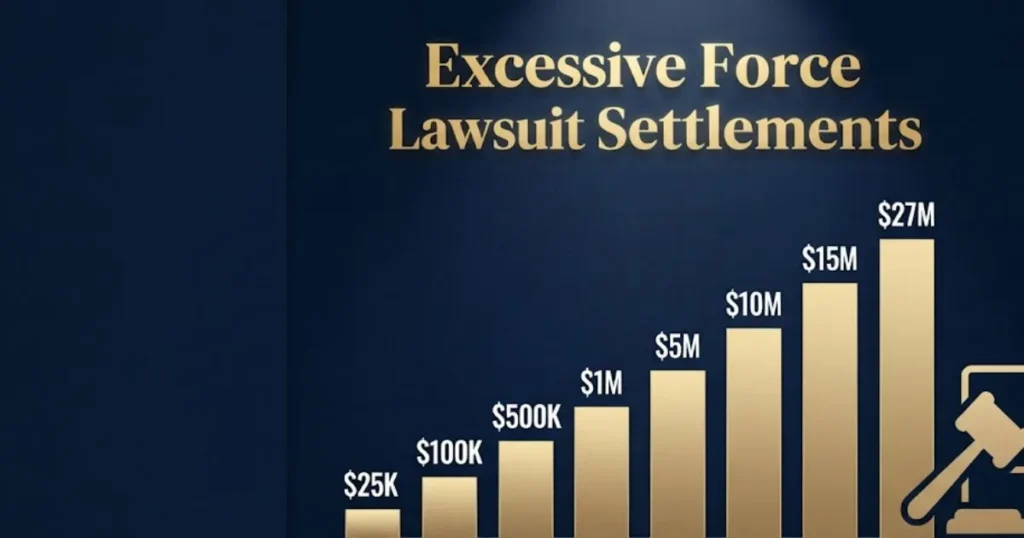
Excessive force lawsuit settlements vary wildly based on the severity of injuries, the strength of evidence, and the jurisdiction. Settlements can range from $25,000 to over $20 million.
Here are real settlement examples from recent years:
| Case | Year | Settlement Amount |
|---|---|---|
| George Floyd (Minneapolis) | 2021 | $27 million |
| Breonna Taylor (Louisville) | 2020 | $12 million |
| Freddie Gray (Baltimore) | 2016 | $6.4 million |
| Elijah McClain (Aurora, CO) | 2023 | $15 million |
| Tyre Nichols (Memphis) | 2024 | $16 million |
| Average minor injury case | 2024-2025 | $25,000 to $150,000 |
| Average serious injury case | 2024-2025 | $250,000 to $2 million |
The biggest factor in settlement size is the severity of physical harm. Fatal cases consistently produce the largest payouts. Cases involving permanent disability or disfigurement also command higher amounts.
Video evidence dramatically increases settlement values. When bodycam or bystander footage clearly shows excessive force, cities are far more likely to settle quickly and for larger amounts.
In 2026, cities are under growing financial pressure from these payouts. Some municipalities now carry specific insurance policies for police misconduct claims because the costs have become so predictable.
Key Takeaway: Excessive force lawsuits are real, winnable cases with documented settlements ranging from $25,000 for minor injuries to tens of millions for fatal encounters, and filing requires quick action on evidence preservation.
How Much Can You Sue for Excessive Force
There is no fixed cap on how much you can sue for in an excessive force case. Your claim amount depends on your actual damages, and courts allow you to seek compensatory and punitive damages.
Compensatory damages cover your real losses:
- Medical bills (past and future)
- Lost wages and lost earning capacity
- Pain and suffering
- Emotional distress
- Rehabilitation costs
- Property damage
Punitive damages are extra money awarded to punish the officer for particularly egregious conduct. These can multiply your total recovery significantly.
| Damage Type | Typical Range |
|---|---|
| Minor injuries (bruises, scrapes) | $10,000 to $75,000 |
| Moderate injuries (fractures, taser burns) | $75,000 to $500,000 |
| Serious injuries (TBI, spinal damage) | $500,000 to $5 million |
| Permanent disability | $1 million to $15 million |
| Wrongful death | $2 million to $30 million+ |
Think of it like car accident damages, but with a civil rights violation stacked on top. The constitutional violation itself carries value beyond just your physical injuries.
Some states cap punitive damages. Others don’t. Federal Section 1983 claims generally have no cap on compensatory damages, which is one reason many attorneys prefer federal court.
Your attorney will calculate a demand amount based on medical costs, income loss, and comparable verdicts in your jurisdiction. The final number depends heavily on where you file.
What Constitutes Excessive Force
Excessive force is any physical force by a law enforcement officer that exceeds what a reasonable officer would use in the same situation. The Supreme Court established this standard in Graham v. Connor (1989).
Courts evaluate excessive force using the “objective reasonableness” test. They don’t ask what the officer was thinking. They ask what a reasonable officer at the scene would have done.
Judges consider several factors:
- How severe was the suspected crime?
- Did the suspect pose an immediate threat to officers or others?
- Was the suspect actively resisting or trying to flee?
- Were there alternative, less forceful options available?
Force exists on a continuum. An officer’s response should match the level of resistance. Using a taser on someone who is calmly standing still is not the same as using one on someone charging with a weapon.
| Force Level | Appropriate When | Excessive When |
|---|---|---|
| Verbal commands | Always the first step | Never excessive on its own |
| Physical control (hands) | Suspect actively resisting | Suspect is compliant and not moving |
| Taser/pepper spray | Suspect is combative | Suspect is handcuffed or restrained |
| Baton strikes | Serious threat present | Suspect is on ground, not resisting |
| Lethal force | Imminent threat of death or serious harm | Suspect is unarmed and fleeing |
Context matters enormously. An officer who shoots a fleeing shoplifter faces a very different legal analysis than one who shoots someone pointing a gun at a bystander.
In 2026, more departments are training officers in de-escalation techniques. When those protocols exist but officers ignore them, it strengthens your excessive force claim.
Police Excessive Force Lawsuit Payouts
Police excessive force lawsuit payouts are funded by taxpayers in most cases. Individual officers rarely pay out of their own pockets because cities indemnify their employees.
This means your settlement check comes from the city or county’s budget, their insurance policy, or both. Here’s how the money typically flows:
- The city’s self-insurance fund covers most payouts
- Larger settlements may come from municipal bonds or general fund reserves
- Some cities carry commercial liability insurance with coverage limits
- Officers almost never pay personally unless the city refuses to indemnify them
Between 2015 and 2024, the ten largest U.S. cities paid out over $3.5 billion in police misconduct settlements. New York City alone averaged over $100 million per year.
| City | Annual Average Payout (Recent Years) |
|---|---|
| New York City | $100 million+ |
| Chicago | $70 million+ |
| Los Angeles | $40 million+ |
| Philadelphia | $15 million+ |
| Houston | $10 million+ |
Payouts in smaller cities and counties tend to be lower, partly because there’s less money available and partly because juries in those areas sometimes side more with police.
But don’t let that discourage you. Even in smaller jurisdictions, six-figure settlements happen regularly when the evidence is strong.
The payout timeline after a settlement agreement is usually 30 to 90 days. Cities need to process the payment through their finance departments, which adds some bureaucratic delay.
Key Takeaway: Taxpayers fund the vast majority of excessive force payouts, with major cities spending tens of millions annually, and your potential recovery depends heavily on injury severity and evidence quality.
Excessive Force by Police Lawsuit
An excessive force by police lawsuit specifically targets officers who used unnecessary physical force during an encounter with a civilian. This is the most common type of civil rights case against law enforcement in America.
These cases cover a wide range of situations:
- Traffic stops that turn violent
- Arrests where officers use chokeholds or knee restraints
- Welfare checks that result in physical confrontation
- Protests where police use tear gas, rubber bullets, or batons on peaceful demonstrators
- Mental health calls where officers use force instead of crisis intervention
The 2020 protests after George Floyd’s death generated thousands of excessive force lawsuits. Many of those cases are still being resolved in 2025 and 2026, with some producing significant settlements.
What makes these cases unique is the power imbalance. Officers carry weapons, wear body armor, and have the authority to detain you. When that power is abused, the legal system provides a way to hold them accountable.
You can file against the individual officer, the police department, the city, or all of them simultaneously. Filing against the city (known as a Monell claim) is often the smartest strategy because cities have deeper pockets than individual officers.
In 2026, body-worn cameras are standard in most departments. That footage is often the single most powerful piece of evidence in your case. Requesting it early is essential because some departments have short retention policies.
Section 1983 Excessive Force Claim
A Section 1983 excessive force claim is the primary federal legal tool for suing police who violate your constitutional rights. It’s based on 42 U.S.C. Section 1983, a law originally passed in 1871 to protect formerly enslaved people from state-sponsored violence.
To win a Section 1983 claim, you must prove two things:
- The person who hurt you was acting “under color of state law” (meaning they were on duty or using their authority as a government employee)
- They violated a right protected by the Constitution (typically the Fourth Amendment’s protection against unreasonable seizures)
This federal law is powerful for several reasons. It allows you to recover compensatory damages, punitive damages, and attorney fees. State law claims sometimes limit one or more of those categories.
| Section 1983 Elements | What You Must Show |
|---|---|
| State action | Officer was on duty or acting in official capacity |
| Constitutional violation | Force was objectively unreasonable |
| Causation | The officer’s actions directly caused your injuries |
| Damages | You suffered real, documented harm |
One major advantage of Section 1983: it lets you sue in federal court. Federal judges handle these cases regularly and tend to be more familiar with the legal standards than some state court judges.
The attorney fee provision is also significant. Under 42 U.S.C. Section 1988, the losing side (the government) pays your attorney’s fees if you win. This makes it financially viable for lawyers to take these cases on contingency.
In 2026, Section 1983 remains the go-to statute for excessive force claims. While some legal scholars push for updates to the law, it continues to serve as the backbone of police accountability litigation.
Qualified Immunity and Excessive Force
Qualified immunity is the biggest legal obstacle in most excessive force lawsuits. It’s a court-created doctrine that protects government officials from civil liability unless they violated “clearly established” law.
Here’s what that means in plain English: even if an officer used excessive force, they can escape liability if no prior court case in their jurisdiction addressed nearly identical facts. The officer has to have been “on notice” that their conduct was illegal.
This doctrine frustrates many plaintiffs. Courts have sometimes granted immunity in shocking cases simply because no prior ruling involved the exact same type of weapon or the exact same circumstances.
- Example: A court might rule that slamming someone’s head into concrete is clearly unconstitutional. But if the officer slammed the person into asphalt instead, a different court might say the law wasn’t “clearly established” for asphalt specifically.
That sounds absurd, and many legal experts agree. Qualified immunity reform has been debated in Congress since 2020, with the George Floyd Justice in Policing Act proposing to eliminate it at the federal level.
| Qualified Immunity Status in 2026 | Details |
|---|---|
| Federal law | Still in effect, no congressional reform passed yet |
| States that have limited it | Colorado, New Mexico, New York City |
| States considering reform | Connecticut, Massachusetts, Oregon |
| Supreme Court stance | Has slightly narrowed it in recent rulings |
As of 2026, qualified immunity remains federal law. But the trend is toward narrowing it. Several states have passed their own laws eliminating or limiting the doctrine for state-level claims.
Your attorney will research whether prior cases in your circuit “clearly established” that the type of force used against you was unconstitutional. Strong factual parallels to existing case law help you overcome this hurdle.
Key Takeaway: Qualified immunity remains the biggest defense barrier in excessive force cases, but state-level reforms and accumulating case law are slowly making it easier for victims to overcome this shield in 2026.
Excessive Force Lawsuit Statute of Limitations
The statute of limitations for an excessive force lawsuit is typically two to three years from the date of the incident, depending on where you live. Miss this deadline, and you lose your right to sue forever.
For federal Section 1983 claims, there’s a twist. Congress never set a specific deadline in the statute. Instead, courts borrow the personal injury statute of limitations from the state where the incident occurred.
| State | Statute of Limitations |
|---|---|
| California | 2 years |
| Texas | 2 years |
| New York | 3 years |
| Florida | 2 years (recently changed from 4) |
| Illinois | 2 years |
| Pennsylvania | 2 years |
| Ohio | 2 years |
| Georgia | 2 years |
| Michigan | 3 years |
| Colorado | 2 years |
Some states require you to file a “notice of claim” or administrative complaint before suing. These notice deadlines are often much shorter, sometimes as little as 90 to 180 days.
That’s the trap many people fall into. They think they have two years, but they needed to file a government tort claim notice within six months. By the time they hire a lawyer, it’s too late for the notice requirement.
In 2026, do not wait. Contact an attorney as soon as possible after any excessive force incident. Even if you’re still receiving medical treatment, get legal counsel moving on the paperwork.
For minors, the statute of limitations is usually tolled (paused) until they turn 18. People with certain disabilities may also qualify for tolling in some jurisdictions.
Excessive Force Lawsuit Evidence Needed
The evidence needed for an excessive force lawsuit includes anything that proves the officer used more force than a reasonable officer would have in the same situation. Physical evidence, video footage, and medical records form the backbone of most successful cases.
Here’s what strengthens your case the most:
- Body camera footage from the officer involved
- Dashcam video from patrol cars
- Bystander cell phone video
- Medical records documenting your injuries
- Photographs of bruises, cuts, swelling, or other injuries taken immediately after
- Witness statements from people who saw what happened
- Police reports (which often contradict video evidence)
- 911 call recordings
- Officer’s disciplinary history and prior complaints
Video evidence is the single most impactful type of proof. Studies show juries are significantly more likely to find excessive force when they can see the incident on camera.
| Evidence Type | Impact on Case | How to Obtain |
|---|---|---|
| Body camera footage | Very high | FOIA request or subpoena |
| Bystander video | Very high | Witnesses or social media |
| Medical records | High | Request from your providers |
| Police report | Moderate | Public records request |
| Officer complaint history | High | FOIA or state transparency laws |
Don’t rely on the police department to preserve evidence for you. File a formal preservation request through your attorney as soon as possible. Departments sometimes “lose” footage or claim cameras malfunctioned.
Your attorney can also subpoena dispatch recordings, GPS data from patrol vehicles, and communication logs between officers. Every piece of documentation helps build the picture of what really happened.
Can You Sue a City for Excessive Force
Yes, you can sue a city for excessive force under a legal theory called a Monell claim. The Supreme Court ruled in Monell v. Department of Social Services (1978) that municipalities can be held liable for constitutional violations caused by their policies or customs.
To win against the city, you must show one of these:
- An official policy that led to the excessive force (like authorizing chokeholds)
- A widespread custom or practice of tolerating excessive force
- A failure to train officers on proper use of force
- A failure to discipline officers with histories of complaints
- A decision by a policymaker that directly caused the violation
Suing the city is strategically important because cities have money. Individual officers often don’t have assets worth pursuing. The city’s insurance and budget make them the practical source of your recovery.
| Monell Claim Element | What You Need to Prove |
|---|---|
| Policy or custom | Pattern of similar incidents or written policy |
| Deliberate indifference | City knew about the problem and did nothing |
| Causation | The policy or custom caused your specific injury |
In 2026, DOJ investigations and consent decrees provide valuable evidence for Monell claims. If the Department of Justice has investigated your city’s police department, those findings can support your argument that the city tolerated a pattern of abuse.
Cities like Ferguson, Baltimore, Minneapolis, and Louisville have all been subject to DOJ investigations. Reports from those investigations documented systemic problems that strengthened individual plaintiffs’ cases.
Think of suing the city as going after the institution that allowed the problem to exist. The individual officer pulled the trigger, but the city loaded the gun through bad policies and poor oversight.
Key Takeaway: You can and should consider suing the city alongside the individual officer because Monell claims target the institutional failures that enabled the abuse, and cities have the financial resources to pay meaningful settlements.
Excessive Force During Arrest Lawsuit
Excessive force during arrest is the most common scenario for these lawsuits. An officer has the right to use reasonable force to make an arrest, but that authority has limits.
The moment someone is handcuffed or clearly subdued, continued use of force almost always crosses the line. Courts consistently find that striking, tasering, or choking a person who is already restrained constitutes excessive force.
Common excessive force during arrest scenarios include:
- Slamming a compliant person to the ground
- Applying a knee to the neck or back for extended periods
- Using a taser on someone already in handcuffs
- Beating a suspect after they’ve stopped resisting
- Using a police dog on a surrendering individual
- Applying overly tight handcuffs that cause nerve damage
Tight handcuff injuries are surprisingly common in excessive force claims. Prolonged application of overly tight cuffs can cause permanent nerve damage, and courts have recognized this as a valid basis for a lawsuit.
| Arrest Scenario | Likely Outcome in Court |
|---|---|
| Force used on actively fighting suspect | Officer likely protected |
| Force used after suspect stops resisting | Strong excessive force claim |
| Force used on handcuffed suspect | Very strong excessive force claim |
| Lethal force on unarmed, fleeing suspect | Extremely strong claim (Tennessee v. Garner) |
The Supreme Court in Tennessee v. Garner (1985) ruled that officers cannot use deadly force to prevent the escape of a nonviolent suspect. If you were shot while running from a misdemeanor, that’s a powerful case.
Your behavior at the time of arrest matters legally. But even if you initially resisted, once you stopped resisting, any continued force becomes potentially excessive. The law recognizes that force must be proportional and must stop when resistance stops.
Police Brutality Lawsuit
A police brutality lawsuit is essentially the same thing as an excessive force lawsuit, but the term carries a broader meaning. Police brutality includes excessive force, verbal abuse, false arrests, racial profiling, and sexual misconduct by officers.
For legal purposes, excessive force is one specific type of police brutality. But when people say “police brutality lawsuit,” they usually mean a case involving physical violence by an officer.
These cases have increased sharply since 2020. Civil rights organizations report that filings of police brutality lawsuits rose by approximately 30% between 2020 and 2024.
- Excessive force (physical violence) claims make up about 60% of police brutality lawsuits
- False arrest and malicious prosecution claims account for roughly 20%
- Wrongful death claims represent about 15%
- Other misconduct (harassment, racial profiling) covers the remaining 5%
The financial impact is staggering. A 2024 analysis found that the 50 largest U.S. cities spent more than $1.5 billion on police misconduct payouts over the prior five years.
| Police Brutality Claim Type | Federal Law Used | Common Damages |
|---|---|---|
| Excessive force | Section 1983 | Medical, pain, punitive |
| False arrest | Section 1983 | Lost wages, emotional distress |
| Wrongful death | Section 1983 + state law | Funeral costs, lost income, consortium |
| Racial profiling | Section 1983, Title VI | Emotional distress, punitive |
One trend in 2026 is the growing use of “pattern and practice” evidence. When an officer has a long history of complaints, attorneys use that track record to show the city tolerated brutality.
Some departments have started publishing use-of-force data publicly. This transparency can actually help your case by showing whether the officer who hurt you had a history of similar conduct.
Excessive Force Lawsuit Against a Police Officer
You can file an excessive force lawsuit directly against the individual police officer who used force against you. This is called suing the officer in their “individual capacity.”
When you sue an officer individually, you’re saying that this specific person violated your constitutional rights through their specific actions. It’s personal accountability.
However, there are practical considerations:
- Qualified immunity may protect the officer (as discussed earlier)
- Most officers don’t have significant personal assets to pay a judgment
- Cities usually indemnify officers, meaning the city pays even when the officer is the named defendant
- Suing both the officer and the city is the standard strategy
| Suing Officer vs. City | Officer (Individual Capacity) | City (Monell Claim) |
|---|---|---|
| Qualified immunity applies? | Yes | No |
| Punitive damages available? | Yes | No (under federal law) |
| Deep pockets? | Usually no | Yes |
| Sends personal message? | Yes | Less so |
| Best strategy? | Include in lawsuit | Include in lawsuit |
The smartest approach is to name both the officer and the city as defendants. You get the benefit of punitive damages against the officer and the financial depth of the city.
In some cases, multiple officers are involved. You can sue each one individually. If several officers stood by and watched one officer use excessive force without intervening, those bystander officers can be held liable too.
The “bystander liability” theory has gained traction in recent years. Courts increasingly hold that officers who witness excessive force and fail to stop it share responsibility for the violation.
In 2026, this theory is well-established in most federal circuits. An officer who watches a colleague beat a handcuffed suspect and does nothing is on the hook.
Key Takeaway: Filing against both the individual officer and the city maximizes your legal options, and bystander officers who fail to intervene can be held equally liable for excessive force.
Excessive Force Lawsuit Attorney Fees
Attorney fees in excessive force lawsuits are typically handled on a contingency basis. That means you pay nothing upfront, and your lawyer collects a percentage of your settlement or verdict.
The standard contingency fee ranges from 33% to 40% of your total recovery. Some attorneys charge 33% if the case settles before trial and 40% if it goes to trial.
Here’s the good news: Section 1988 of federal law allows the court to order the losing government defendant to pay your attorney’s reasonable fees. This is separate from your damages award.
| Attorney Fee Structure | Details |
|---|---|
| Contingency fee (pre-trial) | 33% of settlement |
| Contingency fee (at trial) | 40% of verdict |
| Section 1988 fee shifting | Government pays attorney fees if you win |
| Upfront cost to you | $0 in most cases |
| Costs (filing fees, experts) | Usually advanced by the attorney |
The fee-shifting provision is a huge deal. It means that even in cases where your damages are relatively small, an attorney still has financial incentive to take your case because they’ll collect fees from the government on top of their contingency percentage.
Most civil rights attorneys also advance the costs of litigation. Filing fees, expert witness fees, deposition costs, and copying charges are paid by the firm and reimbursed from your recovery.
When evaluating attorneys, ask these questions:
- What percentage do you charge on contingency?
- Do you advance litigation costs?
- Will you seek Section 1988 attorney fees from the defendant?
- How many excessive force cases have you handled?
- What were the outcomes?
Don’t hire a general practice attorney for this type of case. Excessive force lawsuits involve specialized constitutional law, and you need someone who knows how to handle qualified immunity arguments and Section 1983 procedure.
Signs of Excessive Force by Police
Signs of excessive force by police include any use of physical power that goes beyond what is needed to control the situation. Recognizing these signs is the first step toward understanding whether you have a valid legal claim.
Physical signs that force was excessive:
- Injuries inconsistent with the situation (broken bones from a simple traffic stop)
- Marks from restraints (deep wrist bruises, nerve damage from handcuffs)
- Taser burns or marks when you were not being combative
- Head or facial injuries when you were already on the ground
- Injuries sustained after you were already handcuffed
- Dog bite wounds when you were surrendering
Behavioral signs from the officer:
- Officer escalated instead of de-escalating
- No verbal warnings before using force
- Force continued after you stopped resisting
- Officer used a weapon (baton, taser, firearm) when hands-on control was sufficient
- Officer appeared angry, vengeful, or retaliatory
- Other officers at the scene tried to intervene or expressed concern
| Warning Sign | Why It Matters Legally |
|---|---|
| Force after handcuffing | Strongest indicator of excessive force |
| No verbal commands first | Shows failure to de-escalate |
| Injuries don’t match police report | Suggests cover-up or dishonesty |
| Multiple officers used force on one person | Potential for excessive response |
| Officer had prior complaints | Establishes pattern of behavior |
If you notice any of these signs, document everything immediately. Take photos of your injuries. Write down exactly what happened while your memory is fresh. Get contact information from any witnesses.
Your body is evidence. Seek medical treatment right away, even if you think your injuries are minor. Medical records created close to the incident carry far more weight than those generated weeks later.
In 2026, many people instinctively reach for their phones during police encounters. Bystander video has become one of the most important accountability tools available. If witnesses recorded your encounter, that footage could make your case.
Key Takeaway: Recognizing excessive force signs early and documenting injuries immediately after the incident builds the foundation of a strong case, especially when combined with video evidence and witness statements.
Frequently Asked Questions
How long do I have to file an excessive force lawsuit in 2026?
Most states give you two to three years from the date of the incident.
Some states require a notice of claim within 90 to 180 days, which is a much shorter deadline.
Contact an attorney immediately to avoid missing any filing requirements specific to your state.
What is the average settlement for an excessive force case?
The average settlement for moderate injury cases falls between $75,000 and $500,000.
Minor injury cases settle for $10,000 to $75,000, while severe injury or wrongful death cases can reach millions.
Your specific amount depends on injury severity, evidence strength, and jurisdiction.
Can I sue a police officer personally for excessive force?
Yes, you can sue an officer in their individual capacity under Section 1983.
However, the officer may raise qualified immunity as a defense.
Most attorneys recommend suing both the officer individually and the employing city.
Do I need video evidence to win an excessive force lawsuit?
No, video evidence is not required to win.
Medical records, witness testimony, photos of injuries, and the police report can all support your case.
That said, video evidence significantly increases your chances of a favorable outcome and higher settlement.
What happens if qualified immunity blocks my excessive force case?
If a court grants qualified immunity, the officer is shielded from liability, but you may still have claims against the city under a Monell theory.
Your attorney can appeal a qualified immunity ruling.
Some states have eliminated qualified immunity for state law claims, giving you an alternative path.
The bottom line on excessive force lawsuits in 2026 is straightforward. If police used more force than the situation required, you have legal options.
Act fast. Document your injuries. Preserve every piece of evidence. Get an attorney who specializes in civil rights cases.
Your rights under the Fourth Amendment don’t disappear because you were arrested, stopped, or questioned. Hold the people who violated those rights accountable.







