

The Empire Auto Protect lawsuit centers on allegations that the company sold deceptive vehicle service contracts and used illegal robocalls to reach consumers. If you bought a plan from this company or received unwanted calls, you may be owed money.
This article covers every angle of the legal action as it stands in 2026. You will find details on the class action status, estimated settlement payouts, eligibility requirements, and how to file a claim.
Thousands of consumers have reported problems with Empire Auto Protect. The BBB has logged hundreds of complaints about denied claims and aggressive sales calls. That volume of consumer frustration is exactly what fueled the legal filings now working through the courts.
Whether you are trying to get your money back or just want to understand what is happening, this guide has the answers.
Empire Auto Protect Lawsuit
The Empire Auto Protect lawsuit is a legal action brought by consumers who allege the company engaged in deceptive sales practices, denied legitimate warranty claims, and made illegal telemarketing calls. Multiple lawsuits have been filed in state and federal courts across the country.
At the heart of these cases is a simple claim: Empire Auto Protect sold vehicle service contracts that sounded great on the phone but fell apart when customers actually needed repairs. Consumers say the company used high-pressure sales tactics and buried exclusions deep in the contract language.
The lawsuits generally fall into two categories. The first involves breach of contract and fraud claims from people who bought coverage. The second involves TCPA violations tied to robocalls.
| Lawsuit Category | Core Allegation | Legal Basis |
|---|---|---|
| Contract/Fraud Claims | Denied claims, misleading coverage terms | Breach of contract, state consumer fraud statutes |
| Robocall Claims | Unsolicited automated calls | Telephone Consumer Protection Act (TCPA) |
| Refund Disputes | Failure to refund after cancellation | State consumer protection laws |
These lawsuits have gained traction because the complaint patterns are so consistent. Hundreds of consumers report nearly identical experiences.
Empire Auto Protect Lawsuit Update 2026
As of 2026, the Empire Auto Protect lawsuit continues to move through the courts with new developments expected throughout the year. Several cases are in the discovery phase, and attorneys representing consumers are actively building evidence.
One significant development in early 2026 is the push for class certification in at least two federal cases. If a judge grants class status, it would allow thousands of affected consumers to be represented without each filing an individual suit.
State attorneys general in multiple states have taken notice of the complaint volume. Several have opened consumer protection investigations into Empire Auto Protect’s business practices.
The FTC has also been monitoring extended warranty companies more aggressively since 2024. While no formal FTC enforcement action against Empire Auto Protect has been publicly announced as of early 2026, the regulatory environment has tightened considerably for companies in this space.
- Discovery phase ongoing in federal court cases
- Class certification motions expected to be heard mid-2026
- State attorney general investigations active in at least three states
- FTC increased scrutiny of extended warranty industry
Anyone who purchased a plan or received calls should keep all documentation. That paperwork could become essential evidence as these cases progress.
Empire Auto Protect Class Action
An Empire Auto Protect class action is a lawsuit where one or more named plaintiffs sue on behalf of a large group of consumers who had similar experiences. This approach makes it possible for thousands of people to seek compensation without each hiring their own attorney.
Class actions work well for cases like this. When a company uses the same deceptive script on every sales call and the same denial tactics on every claim, the harm is uniform enough to justify group treatment.
For a case to become a certified class action, a judge must find that:
- The group of affected people is large enough (numerosity)
- The legal and factual issues are shared across the group (commonality)
- The named plaintiffs’ claims are typical of the class (typicality)
- The attorneys can adequately represent the class (adequacy)
| Class Action Requirement | What It Means | Status for Empire Cases |
|---|---|---|
| Numerosity | Enough affected people | Likely met; hundreds of complaints on file |
| Commonality | Shared legal questions | Strong; same contract terms and denial patterns |
| Typicality | Named plaintiffs reflect the group | Being established in current filings |
| Adequacy | Capable legal representation | Experienced consumer rights firms involved |
If certification is granted, all eligible consumers could be included automatically unless they choose to opt out.
Key Takeaway: The Empire Auto Protect lawsuit includes both fraud and robocall claims, with class certification motions expected in mid-2026 that could open the door to compensation for thousands of consumers.
Empire Auto Protect Settlement
No final Empire Auto Protect settlement has been announced as of early 2026, but the legal groundwork is being laid for potential resolution. Settlement talks typically begin once discovery reveals the full scope of a company’s conduct.
In similar extended warranty cases, settlements have ranged from the low millions to over $10 million depending on the number of affected consumers and the severity of the misconduct. Companies in this industry often choose to settle rather than risk a jury trial that could result in even larger verdicts.
What a settlement might look like:
- A settlement fund that compensates consumers who were denied claims
- A separate fund or per-call payout for robocall violations
- Refunds for consumers who paid for coverage but never received the promised benefits
- Possible injunctive relief requiring Empire Auto Protect to change its business practices
The timeline for a settlement depends on whether class certification is granted. If certified, a settlement could come as early as late 2026 or into 2027. If cases proceed individually, resolution will vary.
Keep in mind that any class action settlement must be approved by the court. A judge reviews the terms to make sure the deal is fair to all class members before it becomes final.
Empire Auto Protect Settlement Payout
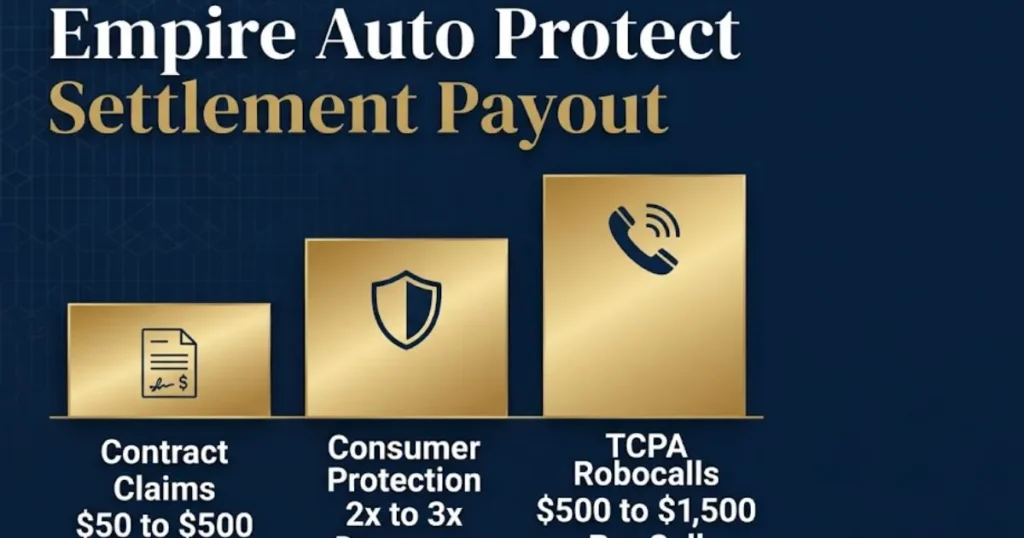
The Empire Auto Protect settlement payout amount will depend on several factors, but affected consumers could receive anywhere from $50 to $500 or more based on comparable extended warranty cases. TCPA robocall claims carry separate statutory damages.
Under the TCPA, each illegal robocall can trigger damages of $500 per call. If the calls were made willfully, that amount triples to $1,500 per call. For consumers who received dozens of calls, the math adds up fast.
| Claim Type | Estimated Payout Range | Basis |
|---|---|---|
| Denied warranty claim | $50 to $500+ | Based on actual repair costs and contract price |
| Contract fraud / misrepresentation | $100 to $1,000+ | Based on amount paid for worthless coverage |
| TCPA robocall violation | $500 to $1,500 per call | Federal statutory damages |
| State consumer protection | Varies by state | Some states allow double or triple damages |
Individual payouts will vary based on how much you paid for the plan, whether you had a claim denied, and how many robocalls you received.
Consumers who kept records of their denied claims, call logs, and contracts are in the strongest position to receive higher payouts. Proof matters in every settlement distribution.
Empire Auto Protect Complaints
Empire Auto Protect complaints have piled up across multiple platforms, with the BBB, state consumer protection offices, and online review sites all showing a consistent pattern of dissatisfaction. The BBB alone has logged hundreds of complaints.
The most common complaints fall into a few categories:
- Claim denials: Customers say the company found reasons to deny nearly every repair claim, citing exclusions that were not clearly explained during the sale.
- Aggressive sales tactics: Consumers report being pressured into buying coverage during long, high-pressure phone calls.
- Cancellation difficulties: Many customers say they had trouble canceling their contracts and getting refunds.
- Robocalls: A significant number of people report receiving repeated unsolicited calls from Empire Auto Protect or its affiliates.
These complaints are not just gripes. They form the evidentiary backbone of the lawsuits. Each complaint filed with the BBB, the FTC, or a state attorney general creates a paper trail that attorneys use to demonstrate a pattern of wrongdoing.
If you have a complaint but have not filed it anywhere officially, doing so now can still help. Attorneys actively search complaint databases when building class action cases.
Key Takeaway: Consistent complaint patterns across hundreds of consumers show a systematic problem at Empire Auto Protect, and these complaints are being used as evidence in ongoing lawsuits.
Empire Auto Protect Scam
Many consumers have called Empire Auto Protect a scam, and the allegations in court filings support the concern that the company’s business model was built on misleading people. Whether it meets the legal definition of fraud is what the courts are deciding.
The word “scam” gets thrown around loosely, but the specific allegations here are serious. Plaintiffs claim the company:
- Sold vehicle service contracts with coverage that sounded broad but was filled with hidden exclusions
- Used deceptive marketing materials that exaggerated what the plans covered
- Made it extremely difficult to actually use the coverage when a breakdown occurred
- Operated using robocalls in violation of federal telemarketing laws
Think of it like buying an umbrella that looks great in the store. Then when it rains, you open it and discover it is full of holes. That is essentially what consumers say happened with their Empire Auto Protect coverage.
The pattern described in complaints and legal filings goes beyond isolated bad experiences. When hundreds of people report the same problems with the same company using the same tactics, it stops looking like customer service failures and starts looking like a business strategy.
Is Empire Auto Protect Legit
The question of whether Empire Auto Protect is legit depends on how you define legitimate. The company was a real, registered business that sold vehicle service contracts, but the lawsuits allege its practices were deceptive and harmful to consumers.
Being a registered company does not automatically make a business trustworthy. Many companies operate legally on paper while engaging in practices that violate consumer protection laws.
Here is what we know:
| Factor | Details |
|---|---|
| Business Registration | Was registered as a business entity |
| BBB Rating | Poor rating with hundreds of complaints |
| State Licensing | Questions raised about proper licensing in some states |
| Lawsuit Status | Facing multiple lawsuits for fraud and TCPA violations |
| Customer Reviews | Overwhelmingly negative across review platforms |
A company can be “real” in the sense that it exists and processes transactions. But when the product it sells consistently fails to deliver what was promised, and when it uses illegal methods to find customers, the legitimacy question becomes much more complicated.
The courts will ultimately decide whether Empire Auto Protect crossed the line from aggressive business practices into outright fraud.
Empire Auto Protect Denied Claim
Empire Auto Protect denied claim situations are among the most common complaints and form the core of the breach of contract lawsuits. Consumers report that the company routinely found reasons to reject repair claims that should have been covered.
The denial tactics described in complaints follow a pattern:
- Pre-existing condition exclusion: The company claimed the mechanical failure existed before the contract started, even without evidence.
- Maintenance requirement: Denials based on alleged failure to maintain the vehicle, sometimes demanding years of service records.
- Excluded component: The specific part that failed was listed in fine-print exclusions that were never discussed during the sales call.
- Inspection delays: The company required inspections that took so long the customer had to pay for repairs out of pocket.
One recurring theme in complaints is that sales representatives described the coverage as “bumper to bumper” or “comprehensive.” Customers later discovered that critical components like transmissions, electrical systems, or air conditioning were excluded.
If your claim was denied by Empire Auto Protect, that denial could be evidence of breach of contract. Save the denial letter, your original contract, and any communication with the company. These documents are valuable to attorneys handling these cases.
Key Takeaway: Denied claims are not just frustrating; they are potential legal evidence, and the pattern of denials at Empire Auto Protect is central to the fraud allegations in the lawsuits.
Empire Auto Protect Warranty Fraud
Empire Auto Protect warranty fraud allegations focus on the gap between what was promised during the sales call and what was actually written in the contract. Plaintiffs argue this gap was intentional and designed to collect premiums without ever paying claims.
Warranty fraud in the extended auto protection industry typically involves:
- Promising broad coverage verbally while the written contract is filled with exclusions
- Using terminology like “full coverage” or “bumper to bumper” that implies complete protection
- Setting up claims processes designed to frustrate customers into giving up
- Failing to maintain adequate reserves to actually pay claims
The extended auto warranty industry has been a target of regulators for years. The FTC has taken action against multiple companies in this space for deceptive practices. State attorneys general have sued warranty companies that operate in ways similar to what is alleged against Empire Auto Protect.
| Fraud Indicator | How It Appears in Empire Complaints |
|---|---|
| Verbal vs. written mismatch | Sales reps promise more than the contract delivers |
| Unreasonable denial rates | Most claims denied regardless of circumstances |
| Cancellation obstacles | Consumers cannot easily cancel or get refunds |
| High complaint volume | Hundreds of near-identical complaints filed |
This pattern is not unique to Empire Auto Protect. But the sheer volume and consistency of complaints make the fraud allegations particularly strong in this case.
Empire Auto Protect Robocall Lawsuit
The Empire Auto Protect robocall lawsuit targets the company’s use of automated or prerecorded calls to reach consumers who never asked to be contacted. These calls violate the Telephone Consumer Protection Act, a federal law with real teeth.
Robocall lawsuits are some of the most straightforward consumer cases to win. The law is clear: you cannot use automated dialing systems or prerecorded messages to call someone’s cell phone without their prior express consent.
Consumers across the country report receiving calls from Empire Auto Protect or companies selling their products. Many of these people say:
- They never requested information about vehicle service contracts
- Their numbers were on the Do Not Call Registry
- They received multiple calls even after asking to be removed
- The calls used prerecorded messages or automated systems
The robocall lawsuits are separate from the contract fraud claims, and they carry their own damages. This means a consumer could potentially recover money from both types of claims if they bought a plan AND received illegal calls.
For the robocall claims, you do not need to have purchased anything. Simply receiving the illegal calls is enough to have standing to sue or join a class action.
Empire Auto Protect TCPA Lawsuit
The Empire Auto Protect TCPA lawsuit specifically invokes the Telephone Consumer Protection Act, which provides statutory damages of $500 per violation and up to $1,500 per willful violation. This federal law is one of the strongest consumer protection tools available.
The TCPA was passed in 1991 to combat the growing problem of telemarketing abuse. It has been updated multiple times and remains one of the most litigated consumer statutes in the country.
| TCPA Provision | What It Prohibits | Penalty |
|---|---|---|
| Autodialer calls to cell phones | Calling cell phones with automated systems without consent | $500 per call |
| Prerecorded voice messages | Using robotic voices without consent | $500 per call |
| Do Not Call violations | Calling numbers on the national registry | $500 per call |
| Willful violations | Knowingly violating any of the above | $1,500 per call (treble damages) |
In the Empire Auto Protect context, plaintiffs allege the company used autodialers to blast out calls to millions of phone numbers. Some consumers report receiving ten, twenty, or even more calls.
The math is straightforward. If you received 20 illegal calls at $500 each, that is $10,000 in statutory damages. If the court finds the calls were willful, that triples to $30,000.
TCPA cases have produced some of the largest consumer settlements in recent history. Companies like Capital One, AT&T, and DISH Network have paid hundreds of millions to settle TCPA class actions.
Key Takeaway: TCPA robocall claims against Empire Auto Protect carry serious financial penalties, with individual damages potentially reaching thousands of dollars based on the number of illegal calls received.
Empire Auto Protect Refund
Getting an Empire Auto Protect refund has been a major source of frustration for consumers who want out of their contracts. Many customers report that canceling the contract and receiving their money back is an unnecessarily difficult process.
Most vehicle service contracts include a cancellation clause. Typically, you can cancel within 30 to 60 days for a full refund. After that period, a prorated refund applies, minus any claims paid and an administrative fee.
The problem consumers describe is not the policy itself. It is the execution. Common refund complaints include:
- Being transferred repeatedly when calling to cancel
- Never receiving the refund after being told it was processed
- Receiving far less than the prorated amount they expected
- Being told they need to send a written cancellation request but receiving no response
If you are trying to get a refund right now, here are practical steps:
- Send a written cancellation request by certified mail with return receipt
- Keep a copy of everything you send
- Note the date and time of every phone call
- If you paid by credit card, contact your card issuer about filing a chargeback
- File a complaint with your state attorney general’s office
Several states have specific laws about vehicle service contract cancellations that may give you stronger rights than the contract itself provides.
How to Sue Empire Auto Protect
You can sue Empire Auto Protect individually in small claims court, join an existing class action, or hire an attorney to file a separate lawsuit. The best option depends on how much money you lost and what type of harm you experienced.
Here is a breakdown of your options:
| Legal Option | Best For | Cost | Potential Recovery |
|---|---|---|---|
| Small claims court | Losses under $5,000 to $10,000 (varies by state) | Filing fee only ($30 to $75) | Actual damages |
| Join class action | Consumers with smaller individual losses | No upfront cost | Share of settlement fund |
| Individual lawsuit with attorney | Larger losses or multiple claims | Attorney works on contingency | Full damages, possibly punitive |
| State AG complaint | Anyone harmed | Free | Indirect; helps build regulatory case |
If you go the small claims route, you do not need an attorney. You file in your local court, pay a small fee, and present your case to a judge. Bring your contract, denial letters, call logs, and any written communication.
For the class action path, most consumer rights attorneys handle these cases on contingency. That means you pay nothing upfront. The attorney collects a percentage of the settlement or verdict, typically 25% to 33%.
Filing a complaint with the FTC at no cost is also worthwhile. While the FTC does not resolve individual complaints, it uses complaint data to identify patterns and launch enforcement actions.
Empire Auto Protect Consumer Protection
Empire Auto Protect consumer protection claims are based on state laws that prohibit unfair or deceptive business practices. Every state has its own consumer protection statute, and many allow consumers to recover double or triple their actual damages.
These state laws are powerful tools because they often have lower burdens of proof than common law fraud. You typically need to show that:
- The company engaged in a deceptive act or practice
- You relied on that deception when making your purchase
- You suffered financial harm as a result
Some of the most consumer-friendly state laws include:
- California: Consumer Legal Remedies Act allows class actions and statutory damages
- New York: General Business Law Section 349 prohibits deceptive practices
- Illinois: Consumer Fraud and Deceptive Business Practices Act allows treble damages
- Texas: Deceptive Trade Practices Act provides for double or triple damages
- Florida: Deceptive and Unfair Trade Practices Act covers warranty disputes
These laws vary significantly from state to state. The statute of limitations, available damages, and procedural requirements all differ. Where you live determines which law applies to your claim.
Key Takeaway: State consumer protection laws can provide powerful remedies against Empire Auto Protect, with some states allowing double or triple damages for deceptive business practices.
Empire Auto Protect Class Action Eligibility
Empire Auto Protect class action eligibility generally includes anyone who purchased a vehicle service contract from the company or received unsolicited robocalls from them. The specific criteria depend on which lawsuit you are looking to join.
For the contract fraud class action, you likely qualify if:
- You purchased a vehicle service contract from Empire Auto Protect
- Your contract was sold with terms or coverage that differed from what was described to you
- You had a claim denied or experienced problems using your coverage
- You purchased the contract within the applicable statute of limitations period
For the TCPA robocall class action, you likely qualify if:
- You received one or more automated or prerecorded calls from Empire Auto Protect
- You did not give prior express consent for those calls
- Your phone number was a cell phone number
| Eligibility Factor | Contract Fraud Class | Robocall TCPA Class |
|---|---|---|
| Must have purchased a plan | Yes | No |
| Must have received calls | No | Yes |
| Must have had claim denied | Strengthens claim but not required | Not relevant |
| Time period | Varies; typically 2 to 6 years | 4 years from date of call |
| Need proof | Contract, receipts, denial letters | Call logs, phone records |
You do not need to take any specific action to be included in a class action once it is certified. Unless you affirmatively opt out, you are automatically part of the class if you meet the criteria.
Empire Auto Protect Attorney
Finding the right Empire Auto Protect attorney means looking for a lawyer or firm with specific experience in consumer class actions, TCPA litigation, or vehicle service contract disputes. Not every attorney is equipped to handle these types of cases.
What to look for in an attorney:
- Contingency fee structure: You should not have to pay anything upfront. The attorney gets paid only if you win or settle.
- TCPA experience: If your claim involves robocalls, you want a firm that has handled TCPA class actions before.
- Consumer protection focus: Look for firms that specialize in consumer fraud, not general practice attorneys.
- Track record: Ask about similar cases they have handled and the results they achieved.
Several national consumer rights firms are currently investigating or litigating Empire Auto Protect claims. These firms typically have the resources to take on a well-funded corporate defendant.
| Attorney Factor | Why It Matters |
|---|---|
| Contingency fee | You pay nothing unless you recover money |
| Specialization | Consumer law expertise is essential |
| Resources | Class actions require significant investment by the firm |
| Communication | You want updates and responsiveness |
When you contact an attorney, be prepared to share your contract, any denial letters, call logs showing robocalls, and a summary of your experience. The more documentation you have, the faster an attorney can evaluate your case.
Do not wait too long to reach out. Statutes of limitations set deadlines for filing claims. Once that deadline passes, you lose your right to sue regardless of how strong your case is.
Frequently Asked Questions
How do I join the Empire Auto Protect class action lawsuit?
You can join by contacting a consumer rights attorney who is handling the case.
Most class actions automatically include all eligible members once certified.
You do not need to do anything until a settlement is reached and a claims process opens.
How much money can I get from the Empire Auto Protect settlement?
Payouts vary, but similar cases have resulted in $50 to $500 for contract claims.
TCPA robocall claims can yield $500 to $1,500 per illegal call received.
The total depends on your specific losses and the number of calls you received.
Is Empire Auto Protect a scam or a legitimate company?
Empire Auto Protect was a registered business, but multiple lawsuits allege it engaged in deceptive practices.
Consumers report denied claims, misleading sales tactics, and illegal robocalls.
The courts are currently deciding whether its conduct constitutes fraud.
Can I get a refund from Empire Auto Protect if I cancel my contract?
Most contracts include a cancellation clause allowing refunds within 30 to 60 days.
After that window, a prorated refund may apply, minus fees and claims paid.
Send your cancellation request by certified mail and file a chargeback with your credit card company if the refund does not arrive.
What is the deadline to file a claim in the Empire Auto Protect lawsuit?
Deadlines vary by state and claim type, but most consumer fraud claims have a 2 to 6 year statute of limitations.
TCPA robocall claims must be filed within 4 years of the last illegal call.
Contact an attorney as soon as possible to make sure you do not miss your window.
The Empire Auto Protect lawsuit is a real legal fight with real consequences for the company and real potential payouts for consumers. Whether you bought a worthless warranty or just got hammered with robocalls, the law provides paths to compensation.
Stay on top of case developments as 2026 progresses. Gather your documents, save your call logs, and connect with an attorney if you have not already.
Your experience as a consumer matters. It is the evidence that drives these cases forward and holds companies accountable.







