

Elmiron lawsuit attorneys are representing thousands of people who suffered serious eye damage after taking the bladder drug pentosan polysulfate sodium. If you used Elmiron and developed vision problems, 2026 is a critical year to act.
The multidistrict litigation (MDL 2973) in New Jersey has been building for years. Settlement talks are progressing. Thousands of claims remain active.
This article covers everything you need to know right now. You’ll learn who qualifies, how much settlements could pay, how attorney fees work, what evidence you need, and whether you still have time to file.
Here’s one fact worth knowing: the FDA itself updated Elmiron’s label in 2020 to warn about retinal damage, years after researchers first raised alarms.
Elmiron Lawsuit Attorneys: How to Choose the Right One
Elmiron lawsuit attorneys are lawyers who specialize in pharmaceutical mass tort cases involving the bladder drug Elmiron and its link to serious eye damage. Not every personal injury lawyer has the right experience for this type of case.
You want an attorney or firm with direct involvement in the Elmiron MDL. That means they’ve handled cases in MDL 2973 before Judge Brian R. Martinotti in the District of New Jersey.
Look for a track record in pharmaceutical litigation, not just general personal injury. A car accident lawyer and a mass tort lawyer are very different animals.
| What to Look For | Why It Matters |
|---|---|
| Mass tort or pharmaceutical experience | These cases involve complex medical and scientific evidence |
| Involvement in Elmiron MDL 2973 | Shows direct familiarity with this specific litigation |
| Contingency fee arrangement | You pay nothing upfront; attorney gets paid from your settlement |
| Staff to handle medical record review | Your case depends on strong medical documentation |
| Clear communication and case updates | You deserve to know what’s happening with your claim |
Ask any prospective attorney how many Elmiron cases they currently handle. Ask about their role in the MDL. Ask how often they’ll update you.
A good firm won’t pressure you into signing immediately. They’ll explain the process, answer your questions, and give you time to decide.
The right elmiron lawsuit attorneys can make the difference between a strong settlement and a dismissed case. Choose carefully.
Elmiron Lawsuit Settlement Amounts: What to Expect
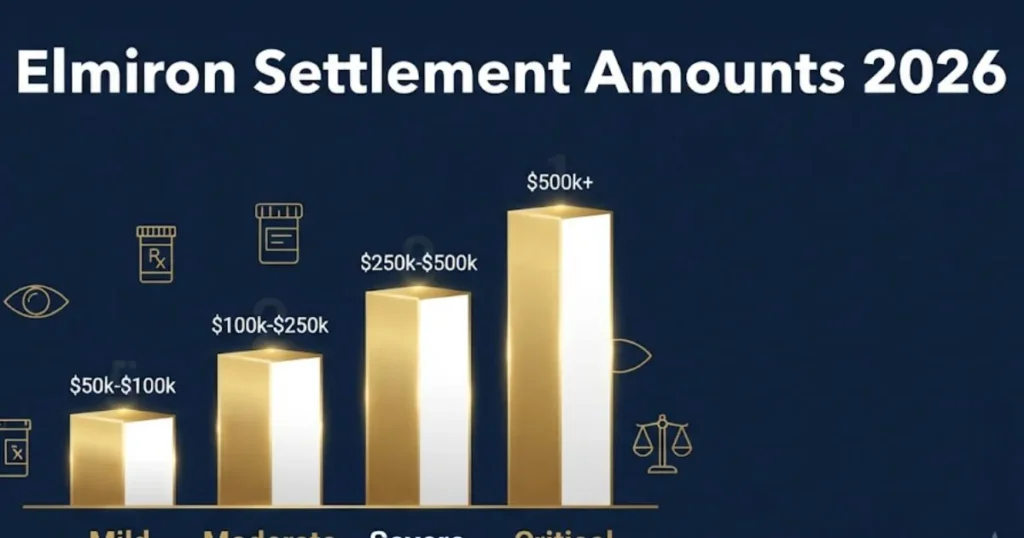
Elmiron lawsuit settlement amounts have not been finalized through a global settlement as of early 2026, but legal analysts estimate individual payouts could range from $50,000 to over $500,000 depending on the severity of eye damage.
Several factors determine where your case falls in that range. The biggest factor is how much vision loss you experienced and whether it’s permanent.
Cases involving documented macular degeneration or pigmentary maculopathy with significant visual impairment tend to sit at the higher end. Cases with early-stage retinal changes and minimal vision loss fall lower.
| Severity Level | Estimated Settlement Range |
|---|---|
| Mild retinal changes, minimal vision impact | $25,000 to $75,000 |
| Moderate pigmentary maculopathy with some vision loss | $75,000 to $200,000 |
| Severe macular degeneration or significant vision loss | $200,000 to $500,000+ |
| Legal blindness or near-total vision loss | $500,000+ |
These estimates come from analysis of similar pharmaceutical mass torts and bellwether trial outcomes. They are projections, not guarantees.
Your length of Elmiron use matters too. Someone who took the drug for ten years has a different case profile than someone who used it for six months.
Keep in mind that individual settlements in mass torts often vary widely. Two people with similar injuries can receive different amounts based on their documentation, medical history, and the strength of their evidence.
Who Qualifies for an Elmiron Lawsuit?
You may qualify for an Elmiron lawsuit if you took the prescription drug Elmiron (pentosan polysulfate sodium) and later developed eye problems, particularly macular degeneration or pigmentary maculopathy.
The core requirement is a connection between your Elmiron use and documented eye damage. That connection needs medical records to back it up.
Here are the basic qualification criteria:
- You were prescribed and took Elmiron for interstitial cystitis or another bladder condition
- You used the drug for a sustained period, typically at least two years
- You developed eye problems such as vision changes, difficulty reading, or trouble adjusting to dim lighting
- An ophthalmologist has documented retinal changes, pigmentary maculopathy, or macular degeneration
- Your eye problems appeared during or after your Elmiron use
You do not need to have stopped taking Elmiron to file. Some claimants are still using the drug.
Age is not a disqualifier. People in their 30s and people in their 80s have filed claims.
If a loved one took Elmiron and has since passed away, family members may be able to file a wrongful death claim in certain states. Rules vary by jurisdiction.
Key Takeaway: Elmiron lawsuit attorneys handle complex pharmaceutical cases, and you may qualify if you took the drug and developed documented eye damage, with potential settlements ranging from $50,000 to over $500,000.
Elmiron Lawsuit Update 2026: Where Things Stand
As of 2026, the Elmiron litigation continues under MDL 2973 in the U.S. District Court for the District of New Jersey. Judge Brian R. Martinotti oversees the consolidated proceedings.
Thousands of individual cases have been filed. Settlement discussions between plaintiff attorneys and Janssen Pharmaceuticals (a Johnson and Johnson subsidiary) have been ongoing.
Bellwether trials, which serve as test cases to gauge jury reactions and establish case values, have been part of the process. Their outcomes influence settlement negotiations.
| 2026 MDL Status | Details |
|---|---|
| Court | U.S. District Court, District of New Jersey |
| MDL Number | 2973 |
| Presiding Judge | Judge Brian R. Martinotti |
| Defendant | Janssen Pharmaceuticals / Johnson and Johnson |
| Number of Pending Cases | Thousands (exact count fluctuates as new cases are filed) |
| Status | Settlement negotiations ongoing; bellwether trials completed |
New cases are still being accepted into the MDL. If you haven’t filed yet, your attorney can submit your case for inclusion.
The litigation has gained momentum because of strong scientific evidence linking pentosan polysulfate sodium to retinal toxicity. The FDA’s 2020 label change added significant weight to the plaintiffs’ arguments.
Johnson and Johnson has faced pressure from multiple bellwether outcomes. Legal observers expect 2026 to be a pivotal year for potential global settlement announcements.
If you’re considering filing, the time to connect with experienced elmiron lawsuit attorneys is now, before any potential settlement deadline is set.
Elmiron Side Effects and Eye Damage Explained
Elmiron’s most serious side effect is a unique form of retinal damage called pigmentary maculopathy, a condition that can lead to permanent vision loss.
The drug’s active ingredient, pentosan polysulfate sodium (PPS), was approved by the FDA in 1996 for treating interstitial cystitis, a painful bladder condition. For over two decades, no one connected it to eye damage.
That changed in 2018 when researchers at Emory Eye Center, led by Dr. Nieraj Jain, published findings identifying a distinctive pattern of retinal toxicity in long-term Elmiron users.
Symptoms of Elmiron-related eye damage include:
- Difficulty reading or seeing fine details
- Problems adjusting to dim or low lighting
- Blurred or distorted central vision
- Dark spots in your field of vision
- Trouble recognizing faces
- Prolonged adjustment when moving between bright and dark environments
The damage occurs in the macula, the central part of the retina responsible for sharp, detailed vision. Think of it like the bullseye of a dartboard slowly deteriorating.
Many patients were initially misdiagnosed with age-related macular degeneration. The retinal pattern caused by Elmiron is actually distinct from typical age-related conditions, but it took specialized research to identify the difference.
In June 2020, the FDA required Janssen to update Elmiron’s label to include warnings about retinal pigmentary changes. By then, millions of prescriptions had already been filled.
Key Takeaway: Elmiron causes a distinctive form of retinal damage called pigmentary maculopathy, first identified by Emory Eye Center researchers in 2018, and the FDA did not require a warning label update until 2020.
Elmiron Average Payout Per Person
The average payout per person in the Elmiron litigation is projected to fall between $100,000 and $300,000 for cases with confirmed, moderate eye damage.
No global settlement has been finalized yet, so these figures are based on bellwether trial results, similar pharmaceutical mass tort resolutions, and legal analyst projections.
Your individual payout depends on several factors:
- Duration of Elmiron use: Longer use generally correlates with stronger claims
- Severity of eye damage: Documented pigmentary maculopathy or vision loss increases value
- Quality of medical records: Clear ophthalmological documentation strengthens your case
- Impact on daily life: Can you still drive, read, work, or live independently?
- Age at diagnosis: Younger patients with decades of vision loss ahead may receive more
In similar pharmaceutical mass torts, payouts have varied widely. The Zantac litigation and the talcum powder cases provide useful comparison points, though every mass tort has its own dynamics.
Some attorneys have suggested that top-tier Elmiron cases with severe, documented vision loss could settle for $500,000 or more. Lower-tier cases with mild retinal changes might settle for $25,000 to $50,000.
Think of settlement tiers like a ladder. Where you land depends on the strength and documentation of your claim, not just the fact that you took the drug.
How to File an Elmiron Lawsuit in 2026
Filing an Elmiron lawsuit in 2026 starts with contacting an experienced mass tort attorney who handles pharmaceutical injury cases. You do not need to file anything yourself.
Here’s the general process, step by step:
Step 1: Free Case Evaluation
Contact an attorney or law firm. Most offer free consultations for Elmiron cases. You’ll discuss your Elmiron use, your eye problems, and your medical history.
Step 2: Medical Record Review
Your attorney’s team will request and review your medical records. They’ll look for pharmacy records confirming Elmiron prescriptions and ophthalmology records documenting retinal damage.
Step 3: Case Filing
If your case qualifies, your attorney files a complaint on your behalf. For cases entering the MDL, the filing goes to the U.S. District Court for the District of New Jersey.
Step 4: Discovery and Case Development
Your legal team builds your case with expert medical opinions, records, and supporting evidence. This phase can take months.
Step 5: Settlement or Trial
Most mass tort cases settle before going to individual trial. If settlement talks succeed, you’ll receive a payout offer based on your case tier.
| Filing Step | What Happens | Your Role |
|---|---|---|
| Case Evaluation | Attorney reviews your situation | Share your medical and drug history |
| Medical Records | Legal team gathers documentation | Sign medical record release forms |
| Filing | Complaint submitted to court | Review and approve the filing |
| Discovery | Evidence gathering and case building | Respond to any requests from your attorney |
| Resolution | Settlement offer or trial | Accept or reject the settlement |
You don’t pay anything out of pocket to start. Reputable elmiron lawsuit attorneys work on contingency.
Elmiron Lawsuit Eligibility Requirements
Elmiron lawsuit eligibility requirements center on three core elements: you took the drug, you developed eye damage, and your claim falls within the statute of limitations.
Let’s break each one down clearly.
Drug Use Requirement:
You must have been prescribed and taken Elmiron (pentosan polysulfate sodium). Over-the-counter bladder medications don’t count. Pharmacy records or prescription records serve as proof.
Eye Damage Requirement:
You need a documented diagnosis of an eye condition linked to Elmiron use. The primary conditions are pigmentary maculopathy and macular degeneration. An ophthalmologist’s diagnosis carries far more weight than a general practitioner’s note.
Timing Requirement:
Your claim must fall within your state’s statute of limitations. This varies by state but typically ranges from two to four years from the date you discovered (or should have discovered) the connection between Elmiron and your eye damage.
| Eligibility Element | What’s Required |
|---|---|
| Elmiron Use | Prescription records showing sustained use (typically 2+ years) |
| Eye Damage | Ophthalmologist diagnosis of pigmentary maculopathy, macular degeneration, or related condition |
| Statute of Limitations | Claim filed within your state’s deadline (varies, usually 2 to 4 years from discovery) |
| Causation Link | Medical evidence connecting your eye condition to Elmiron use |
You don’t need to prove your case alone. That’s your attorney’s job. But gathering your records early speeds up the process.
Key Takeaway: To file in 2026, you need proof you took Elmiron, a documented eye diagnosis, an attorney who works on contingency, and a claim filed within your state’s deadline.
Elmiron Lawyer Contingency Fees and Costs
Elmiron lawyers typically work on a contingency fee basis, meaning you pay zero dollars upfront and the attorney receives a percentage of your settlement or verdict.
Standard contingency fees in mass tort cases range from 25% to 40% of the total recovery. Most Elmiron attorneys charge between 33% and 40%.
Here’s how it works in plain terms: if your settlement is $200,000 and your attorney’s contingency rate is 33%, the firm receives approximately $66,000. You keep the remaining $134,000, minus any case costs.
| Fee Component | Typical Range |
|---|---|
| Contingency fee percentage | 25% to 40% |
| Most common rate | 33% (one-third) |
| Upfront cost to you | $0 |
| Case expenses (medical records, filing fees, experts) | Deducted from settlement or absorbed by the firm |
| Payment if you lose | $0 (you owe nothing) |
Some firms deduct case costs (filing fees, medical record fees, expert witness fees) from your settlement separately. Others absorb those costs into their contingency percentage. Ask about this before signing a retainer agreement.
The “no win, no fee” model is standard in pharmaceutical litigation. If your case doesn’t result in a recovery, you owe your attorney nothing.
Read the retainer agreement carefully. Every fee arrangement should be spelled out in writing before your case begins.
Don’t be afraid to ask your attorney to explain each line item. A trustworthy firm will welcome those questions.
Evidence Needed for an Elmiron Claim
The evidence needed for an Elmiron claim includes pharmacy records, ophthalmology records, and documentation showing how eye damage has affected your daily life.
Think of building an Elmiron case like assembling a puzzle. Each piece of evidence strengthens the picture. Missing pieces weaken it.
Medical Records You Need:
- Pharmacy records or prescription history showing Elmiron was dispensed to you
- Ophthalmologist examination records documenting retinal changes
- Diagnostic test results: optical coherence tomography (OCT), fundus autofluorescence, fluorescein angiography
- Records from any eye surgeon or retinal specialist
- Primary care records showing your interstitial cystitis diagnosis and treatment history
Supporting Documentation:
- A timeline showing when you started and stopped taking Elmiron
- Records of any vision complaints you reported to doctors
- Documentation of vision-related limitations (inability to drive, read, or work)
- Statements from family members about changes in your vision or daily functioning
| Evidence Type | Purpose |
|---|---|
| Pharmacy records | Prove you took Elmiron and for how long |
| Ophthalmology records | Document the type and severity of eye damage |
| OCT and retinal imaging | Provide objective medical proof of macular changes |
| IC treatment records | Show why you were prescribed Elmiron |
| Daily impact documentation | Demonstrate how vision loss has affected your quality of life |
Start gathering these records now, even before you contact an attorney. The sooner your legal team has this information, the faster your case moves forward.
If you’ve lost some records, your attorney can help obtain them from providers and pharmacies. Don’t let missing paperwork stop you from exploring your options.
Elmiron MDL Settlement Negotiations
Elmiron MDL settlement negotiations refer to discussions between plaintiffs’ attorneys and Janssen Pharmaceuticals aimed at resolving thousands of pending cases without individual trials.
Settlement negotiations in mass torts are like a long chess game. Both sides study bellwether trial outcomes, assess the strength of the overall case pool, and try to agree on a resolution framework.
In MDL 2973, these talks have been shaped by several factors:
- Bellwether trial results that demonstrated plaintiff viability
- The FDA’s 2020 label update acknowledging retinal risk
- Strong scientific evidence from peer-reviewed studies
- The sheer volume of pending claims creating pressure on the defendant
A global settlement, if reached, would establish a claims process with tiered payouts. Think of it like a structured grid where your case is scored based on injury severity, drug use duration, and evidence quality.
Johnson and Johnson has significant financial motivation to settle. Prolonged litigation creates ongoing legal costs, negative publicity, and unpredictable jury verdicts.
As of 2026, no final global settlement has been announced. But the trajectory of the litigation strongly suggests one is in development.
Key Takeaway: MDL settlement negotiations are active in 2026, driven by bellwether outcomes and strong scientific evidence, with a global resolution framework expected to emerge.
Elmiron Lawsuit Statute of Limitations
The statute of limitations for an Elmiron lawsuit varies by state but generally ranges from two to four years from the date you discovered (or reasonably should have discovered) that Elmiron caused your eye damage.
This is called the “discovery rule.” The clock doesn’t necessarily start when you first took the drug. It starts when you knew or should have known about the connection between Elmiron and your vision problems.
For many people, that discovery happened around or after the FDA’s June 2020 label update. If that’s when you learned about the risk, your statute of limitations window may have started at that point.
| State Examples | Statute of Limitations for Product Liability |
|---|---|
| California | 2 years from discovery |
| Texas | 2 years from discovery |
| New York | 3 years from discovery |
| Florida | 4 years from discovery (recently changed; verify current law) |
| Pennsylvania | 2 years from discovery |
| Illinois | 2 years from discovery |
These are general guidelines. Every state has its own rules and exceptions. Some states toll (pause) the statute of limitations under certain circumstances.
If you think your window might be closing, contact an attorney immediately. Missing the deadline means you lose your right to file permanently.
Don’t assume you’re too late. Many people have valid claims they don’t realize are still within the filing window. Let a lawyer make that determination.
Elmiron Bellwether Trial Results
Elmiron bellwether trials are test cases selected from the MDL to go to trial first, and their results help both sides gauge the value and strength of the overall litigation.
Bellwether trials serve a specific purpose in mass tort litigation. They’re not binding on other cases, but they signal how juries respond to the evidence, the witnesses, and the legal arguments.
In the Elmiron MDL, bellwether cases were selected to represent different case profiles. Some involved severe vision loss. Others involved more moderate eye damage.
The outcomes of these trials have been mixed but informative:
- Plaintiff victories demonstrated that juries accept the scientific link between Elmiron and retinal damage
- Defense wins highlighted cases where medical evidence was weaker or alternative causes existed
- Trial results gave both sides data points to use in settlement negotiations
Think of bellwether trials like test drives before a big purchase. They help everyone understand what they’re dealing with.
The most significant takeaway from the bellwether process is that the science connecting Elmiron to pigmentary maculopathy has held up under courtroom scrutiny. Expert witnesses, including retinal specialists, have testified convincingly about the drug’s toxicity to the macula.
These results have strengthened the plaintiffs’ position in settlement negotiations and increased pressure on Janssen to resolve the litigation.
Key Takeaway: Bellwether trials have demonstrated that the scientific link between Elmiron and eye damage holds up in court, strengthening the plaintiffs’ negotiating position for a 2026 settlement.
Elmiron Lawsuit Timeline 2026
The Elmiron lawsuit timeline in 2026 reflects a litigation that has been building since 2018, with key milestones marking the path from initial research to potential settlement resolution.
Here’s a condensed timeline of the most important events:
| Year | Event |
|---|---|
| 1996 | FDA approves Elmiron for interstitial cystitis |
| 2018 | Emory Eye Center (Dr. Nieraj Jain) publishes study linking Elmiron to pigmentary maculopathy |
| 2019 | First lawsuits filed against Janssen Pharmaceuticals |
| 2020 | MDL 2973 created in the District of New Jersey |
| 2020 | FDA requires Elmiron label update to include retinal damage warning |
| 2021 to 2023 | Discovery phase; thousands of cases consolidated |
| 2023 to 2025 | Bellwether trials selected and conducted |
| 2025 to 2026 | Settlement negotiations intensify |
| 2026 | Potential global settlement announcement expected |
The litigation has followed a pattern similar to other major pharmaceutical mass torts. Early research, followed by lawsuits, followed by MDL consolidation, followed by bellwether trials, followed by settlement talks.
If you’re filing in 2026, your case joins a well-established litigation. The groundwork has been laid by thousands of claimants and years of legal work.
New filers in 2026 can still benefit from the MDL structure and any eventual global settlement. But acting soon matters, because settlement frameworks sometimes include filing cutoff dates.
What Is the Elmiron Lawsuit About?
The Elmiron lawsuit is about holding Janssen Pharmaceuticals and its parent company Johnson and Johnson accountable for selling a drug that causes serious eye damage without adequate warnings.
Elmiron, the brand name for pentosan polysulfate sodium, is the only FDA-approved oral medication for interstitial cystitis. Millions of people, mostly women, have taken it since 1996.
The core allegation is that Janssen knew or should have known about the risk of retinal toxicity and failed to warn patients and doctors. For over 20 years, the drug’s label contained no mention of eye damage.
Plaintiffs argue that Janssen:
- Failed to conduct adequate safety studies on long-term eye effects
- Ignored or downplayed emerging scientific evidence of retinal damage
- Continued marketing Elmiron aggressively without appropriate warnings
- Did not update the drug’s label until the FDA forced the issue in 2020
The lawsuits are product liability claims. That means plaintiffs don’t need to prove the company was negligent in a traditional sense. They need to prove the product was defective because it lacked adequate warnings about a known risk.
This isn’t about a contaminated batch or a manufacturing error. It’s about a fundamental flaw in how the drug was marketed and labeled for two decades.
For the people affected, many of them women who took Elmiron for years to manage chronic bladder pain, the consequences have been devastating. Some have lost the ability to drive, read, or recognize the faces of their family members.
How Long Does an Elmiron Lawsuit Take?
An Elmiron lawsuit typically takes one to four years from filing to resolution, depending on whether the case settles individually, as part of a global settlement, or goes to trial.
Mass tort cases are not fast. That’s the honest truth. The legal system moves slowly, especially when thousands of cases are consolidated in an MDL.
Here’s a general breakdown of the timeline for a case filed in 2026:
| Phase | Estimated Duration |
|---|---|
| Case evaluation and filing | 1 to 3 months |
| Medical record gathering and review | 2 to 6 months |
| Discovery and case development | 6 to 18 months |
| Settlement negotiation or trial preparation | 6 to 24 months |
| Payout distribution (after settlement) | 3 to 12 months |
If a global settlement is reached in 2026, cases already in the pipeline could see payouts within 12 to 24 months of the settlement announcement.
Cases filed later may take longer, especially if settlement eligibility windows have already opened and closed.
The biggest bottleneck in these cases is usually the medical record review and claims processing. Having your documentation organized and ready before you contact an attorney can shave months off your timeline.
Patience is part of the process. But filing sooner gives you a better position in any settlement queue.
Frequently Asked Questions
Can I Still File an Elmiron Lawsuit in 2026?
Yes, you can still file an Elmiron lawsuit in 2026 in most states.
The statute of limitations varies by state, typically two to four years from discovery of the Elmiron-eye damage connection.
Contact an attorney to confirm your state’s deadline.
How Much Money Will I Get from an Elmiron Settlement?
Most estimates place individual Elmiron settlements between $50,000 and $500,000.
Your specific payout depends on severity of eye damage, length of drug use, and quality of documentation.
Cases with severe vision loss or legal blindness may exceed $500,000.
What Eye Problems Does Elmiron Cause?
Elmiron is linked to pigmentary maculopathy, a condition that damages the macula and can cause permanent vision loss.
Symptoms include blurred vision, difficulty reading, trouble adjusting to low light, and dark spots in vision.
The condition was first identified by researchers at Emory Eye Center in 2018.
Do Elmiron Lawsuit Attorneys Charge Upfront Fees?
No, reputable elmiron lawsuit attorneys work on contingency and charge nothing upfront.
They receive a percentage of your settlement, typically 33% to 40%, only if you win.
If your case doesn’t recover money, you owe the attorney nothing.
How Long Will My Elmiron Lawsuit Take to Settle?
Most Elmiron cases take one to four years from filing to payout.
Cases already in the MDL pipeline may settle faster if a global settlement is reached in 2026.
Having organized medical records and strong documentation can speed up the process.
Time to Take Action
The Elmiron litigation is at a turning point. Settlement talks are active. Bellwether trials have validated the science. 2026 could be the year a global resolution takes shape.
If you took Elmiron and your vision has suffered, don’t wait. Gather your pharmacy records and eye doctor reports. Talk to an experienced mass tort attorney.
Your window to file is open now, but statutes of limitations are real deadlines. Act before yours expires.







