

Depo lawsuit symptoms center on one alarming condition: meningioma, a type of brain tumor linked to long-term Depo-Provera use. Thousands of women across the United States are now connecting persistent headaches, vision changes, and seizures to this popular birth control shot.
A major 2024 French study found that women who used Depo-Provera for more than one year had a 5.6 times higher risk of developing intracranial meningiomas. That single finding triggered a wave of lawsuits that is still growing in 2026.
This article breaks down every symptom tied to Depo-Provera litigation. You will learn what qualifies, what does not, how much money is at stake, and exactly how to file before deadlines pass.
If you have ever received a Depo-Provera injection and are now dealing with unexplained neurological problems, this guide was written for you.
What Are Depo Lawsuit Symptoms
Depo lawsuit symptoms are the physical warning signs that Depo-Provera users experience when a meningioma brain tumor develops after prolonged exposure to the drug’s active ingredient, medroxyprogesterone acetate.
These symptoms go far beyond the normal side effects listed on Depo-Provera packaging. We are talking about neurological problems that can change your daily life. Persistent headaches that do not respond to medication. Vision that blurs or doubles without warning. Ringing in the ears that never stops.
The lawsuits allege that Pfizer and its predecessor companies knew about the meningioma risk for years. They claim the manufacturer failed to warn patients or doctors about this specific danger.
Here is what separates a normal side effect from a lawsuit-qualifying symptom:
| Category | Normal Side Effects | Lawsuit-Qualifying Symptoms |
|---|---|---|
| Head | Mild headaches | Severe, chronic headaches with pressure |
| Vision | Temporary blurriness | Progressive vision loss or double vision |
| Neurological | Mood changes | Seizures, memory loss, speech difficulty |
| Physical | Weight gain, spotting | Weakness on one side of the body |
| Hearing | None typically | Tinnitus or hearing loss |
Not every headache means you have a meningioma. But a cluster of these symptoms after years of Depo-Provera use is exactly what attorneys are looking for in 2026 claims.
Depo Provera Lawsuit Symptoms You Should Know
Depo Provera lawsuit symptoms fall into specific categories based on where the meningioma grows inside the skull. The location of the tumor determines which symptoms appear first and which ones worsen over time.

Women who file lawsuits in 2026 typically report a combination of these issues:
- Chronic headaches that worsen over weeks or months
- Visual disturbances including blurred vision, double vision, or partial vision loss
- Seizures with no prior history of epilepsy
- Cognitive decline such as memory problems and confusion
- Weakness or numbness on one side of the face or body
- Balance problems and unexplained dizziness
- Hearing loss or tinnitus in one or both ears
- Personality or mood changes that feel out of character
- Nausea and vomiting without a gastrointestinal cause
- Difficulty speaking or finding the right words
What makes these symptoms legally significant is the pattern. One isolated headache does not build a case. But when three or four of these symptoms appear together in a woman with a history of Depo-Provera injections, that pattern tells a story.
Medical imaging, specifically an MRI or CT scan, confirms whether a meningioma is present. That confirmed diagnosis is the backbone of any Depo-Provera lawsuit claim.
Depo Provera Meningioma Symptoms Explained
Depo Provera meningioma symptoms are caused by a slow-growing tumor pressing against brain tissue, nerves, and blood vessels inside the skull. Meningiomas develop in the meninges, the protective membranes that surround the brain and spinal cord.
Most meningiomas are benign, meaning they are not cancerous. But “benign” is misleading here. A tumor pressing on your brain can cause devastating symptoms even if it is not technically cancer.
The connection between Depo-Provera and meningiomas comes down to progesterone receptors. Medroxyprogesterone acetate, the synthetic progestin in Depo-Provera, binds to progesterone receptors found on meningioma cells. This binding can stimulate tumor growth.
| Meningioma Grade | Growth Rate | Symptom Severity | Percentage of Cases |
|---|---|---|---|
| Grade I (Benign) | Slow | Mild to moderate | About 80% |
| Grade II (Atypical) | Moderate | Moderate to severe | About 15 to 18% |
| Grade III (Malignant) | Fast | Severe | About 2 to 5% |
The EPI-PHARE study published in 2024, conducted by French health authorities, analyzed data from over 18,000 meningioma patients. Women who used injectable medroxyprogesterone acetate for over 12 months showed that 5.6-fold increase in meningioma risk compared to non-users.
That study changed everything. It gave lawyers the scientific ammunition they needed to take on Pfizer.
Key Takeaway: Depo Provera meningioma symptoms result from tumor pressure on the brain, and a landmark 2024 study confirmed a 5.6 times higher risk for long-term users.
Depo Provera Brain Tumor Symptoms to Watch For
Depo Provera brain tumor symptoms typically start subtle and gradually worsen as the meningioma grows. Many women dismiss early signs as stress, aging, or hormonal fluctuations, which delays diagnosis by months or even years.
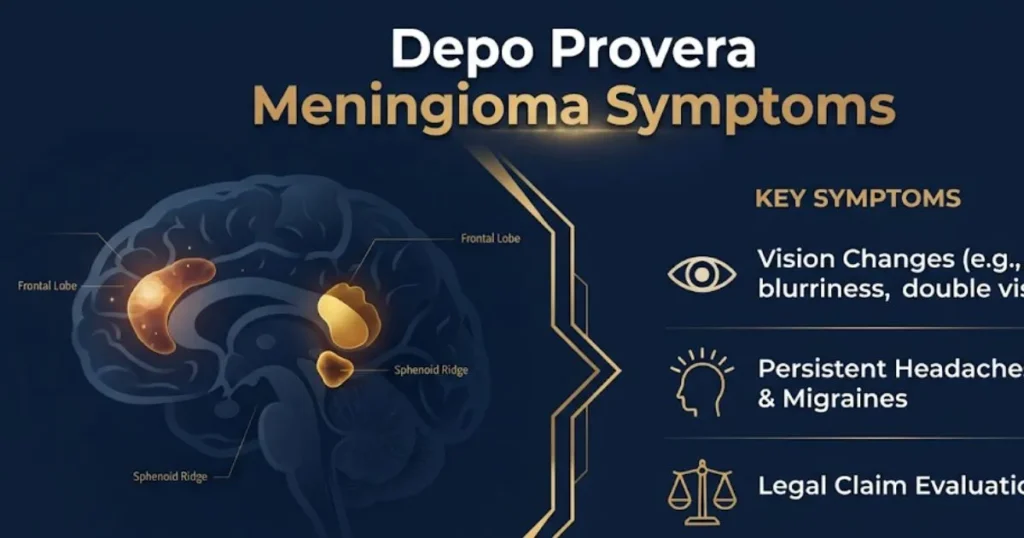
The most common early warning sign is a headache that does not behave like a normal headache. It may be worse in the morning. It may intensify when you bend over or cough. Over-the-counter painkillers barely touch it.
Here are the brain tumor symptoms specifically tied to Depo-Provera litigation, listed from most common to least common:
- Headaches with increasing frequency and severity (reported in roughly 50% of meningioma cases)
- Visual changes including blurred vision and visual field loss (about 25 to 30%)
- Seizures (about 20 to 30%)
- Cognitive or memory issues (about 20%)
- Motor weakness on one side (about 15 to 20%)
- Speech difficulties (about 10 to 15%)
- Personality changes (about 10%)
Think of it like a slow drip from a ceiling. At first you barely notice. Then the stain spreads. By the time you act, the damage is significant.
If you received Depo-Provera shots for a year or longer and recognize three or more symptoms from that list, get an MRI. That scan is the single most important step you can take right now.
The Depo Provera Side Effects Lawsuit Explained
The Depo Provera side effects lawsuit is a mass tort action against Pfizer, alleging the company failed to warn users about the risk of developing meningioma brain tumors from its injectable contraceptive.
This is not a typical drug side effects case. Every medication has side effects. What makes this lawsuit different is the claim that Pfizer had access to research showing the meningioma connection and chose not to update its warning labels for U.S. consumers.
The European Medicines Agency issued warnings about meningioma risk from prolonged progestin use years before any U.S. action. France added a black box warning in 2023. The FDA did not follow suit at the same pace.
The lawsuits rest on two core legal theories:
- Failure to warn: Pfizer allegedly knew about the meningioma risk and did not adequately disclose it to patients or prescribing physicians
- Product liability (design defect): The drug’s formulation creates an unreasonable risk of brain tumor development with prolonged use
The stakes are enormous. Depo-Provera has been on the market since 1992. Millions of women worldwide have received the injection. Some estimates suggest that tens of thousands of current and former users may qualify for compensation.
Plaintiffs claim they would have chosen a different contraceptive method if the meningioma risk had been clearly communicated. That is the heart of the case.
Depo Provera Lawsuit Update 2026
The Depo Provera lawsuit update for 2026 shows rapid acceleration in case filings and legal proceedings. The litigation has moved from the early consolidation phase into active pretrial discovery, with bellwether trial selections expected later in the year.
As of early 2026, key developments include:
| Milestone | Status | Expected Date |
|---|---|---|
| MDL Consolidation | Complete | Established 2024 |
| Number of Filed Cases | Growing | Thousands pending |
| Discovery Phase | Active | Ongoing through 2026 |
| Bellwether Trial Selection | Pending | Late 2026 or early 2027 |
| Settlement Negotiations | Not yet started | After bellwether results |
| Pfizer’s Defense Position | Denying liability | Ongoing |
The Judicial Panel on Multidistrict Litigation consolidated these cases into a single MDL for more efficient pretrial handling. This means all federal Depo-Provera meningioma cases are being managed by one judge.
Pfizer continues to deny that Depo-Provera causes meningiomas. The company’s defense centers on the argument that meningiomas occur naturally in the population and that correlation does not prove causation. Plaintiffs’ attorneys counter with the growing body of epidemiological evidence, particularly the French EPI-PHARE data.
New cases are still being accepted throughout 2026. The litigation window remains open, but it will not stay open forever.
Key Takeaway: The Depo Provera lawsuit is moving through active pretrial discovery in 2026, with bellwether trials on the horizon and new cases still being accepted.
Meningioma Symptoms From Depo Provera
Meningioma symptoms from Depo Provera depend heavily on the tumor’s location within the skull. A meningioma near the optic nerve causes different problems than one pressing on the motor cortex.
Here is how tumor location affects symptoms:
| Tumor Location | Primary Symptoms |
|---|---|
| Convexity (top of brain) | Seizures, headaches, weakness |
| Parasagittal (near midline) | Leg weakness, difficulty walking |
| Sphenoid wing (behind eyes) | Vision loss, facial numbness |
| Posterior fossa (back of skull) | Balance problems, coordination issues |
| Olfactory groove (front) | Loss of smell, personality changes |
| Cerebellopontine angle | Hearing loss, tinnitus, facial weakness |
Women who used Depo-Provera for multiple years often report that symptoms appeared 5 to 15 years after starting the injections. Some developed symptoms while still receiving the shots. Others noticed problems years after stopping.
This long latency period is one reason many women never connected their symptoms to the birth control shot. They moved on to other contraceptive methods and assumed the headaches or vision problems had nothing to do with a shot they received a decade ago.
That assumption is exactly what the lawsuit aims to address. Pfizer allegedly should have warned that the risk persists long after the last injection.
Depo Shot Lawsuit Symptoms and Red Flags
Depo shot lawsuit symptoms include any neurological change that can be medically linked to a meningioma diagnosis in a woman with a documented history of medroxyprogesterone acetate injections.
Not every symptom carries the same weight in a legal claim. Attorneys and medical experts categorize symptoms into red flag tiers based on how directly they point to a meningioma.
High-priority red flags:
- Seizures with no prior seizure history
- Progressive vision loss confirmed by an ophthalmologist
- MRI-confirmed meningioma diagnosis
- Surgical intervention to remove a brain tumor
Medium-priority red flags:
- Chronic headaches lasting more than 6 months
- Documented cognitive decline on neuropsychological testing
- Unilateral weakness or numbness
Lower-priority red flags (still relevant when combined):
- Persistent tinnitus
- Unexplained fatigue
- Personality changes noted by family or physicians
The strongest cases in 2026 involve women who can demonstrate a clear timeline. They started Depo-Provera shots on a specific date. They received injections for a documented period. They developed symptoms. An MRI confirmed a meningioma.
That chain of events, supported by medical records, is what separates a strong claim from a weak one.
Signs of Meningioma From Birth Control
Signs of meningioma from birth control are not limited to Depo-Provera alone, but Depo-Provera carries the highest documented risk among hormonal contraceptives due to its concentrated dose of synthetic progestin delivered by injection.
The key difference between Depo-Provera and other birth control methods is dosage and delivery. A single Depo-Provera injection delivers 150 mg of medroxyprogesterone acetate every three months. That is a massive concentrated dose compared to daily oral progestins.
Signs that specifically suggest a birth control-related meningioma include:
- Symptoms that began or worsened during active contraceptive use
- Tumor growth that accelerated during periods of hormonal exposure
- A meningioma that tested positive for progesterone receptors on biopsy
- Tumor shrinkage or stabilization after discontinuing the hormonal contraceptive
The progesterone receptor connection is critical. When surgeons remove a meningioma and test it, about 60 to 80% of meningiomas express progesterone receptors. This means the tumor has binding sites where synthetic progestins like medroxyprogesterone acetate can attach and stimulate growth.
If your meningioma tested positive for progesterone receptors, that lab finding strengthens your legal claim considerably. It provides biological evidence tying the tumor’s growth to Depo-Provera exposure.
Key Takeaway: A meningioma that tests positive for progesterone receptors provides direct biological evidence linking the tumor to Depo-Provera, which significantly strengthens a 2026 lawsuit claim.
Depo Provera Cancer Symptoms and Tumor Risk
Depo Provera cancer symptoms is a common search term, though it is important to clarify that meningiomas are usually classified as tumors rather than cancers. About 80% of meningiomas are Grade I, which is benign. But benign does not mean harmless.
A benign brain tumor can still cause:
- Permanent neurological damage
- The need for brain surgery
- Lifelong disability
- Ongoing seizure disorders
- Loss of vision, hearing, or motor function
That said, about 2 to 5% of meningiomas are Grade III, which is malignant. These are genuine brain cancers with aggressive growth patterns. Grade II meningiomas, roughly 15 to 18% of cases, sit in between and have a higher chance of recurring after surgery.
| Tumor Grade | Classification | Recurrence Rate After Surgery |
|---|---|---|
| Grade I | Benign | About 10 to 20% over 10 years |
| Grade II | Atypical | About 30 to 40% over 10 years |
| Grade III | Malignant | About 50 to 80% over 10 years |
Beyond meningiomas, some earlier research raised questions about Depo-Provera and breast cancer risk. A 2012 study found a slight increase in breast cancer risk among current and recent users. That research remains part of the broader conversation about Depo-Provera safety, though the current lawsuits focus primarily on meningioma.
Whether your tumor is technically benign or malignant, the impact on your life is real. And that impact is what attorneys evaluate when determining claim value.
Depo Provera Lawsuit Eligibility in 2026
Depo Provera lawsuit eligibility in 2026 requires meeting specific criteria related to your history of Depo-Provera use and your medical diagnosis. Not every former user qualifies. The claim must connect the drug to a documented harm.
The general eligibility requirements include:
- Depo-Provera use: You received at least one Depo-Provera injection (most cases involve 12 or more months of use)
- Meningioma diagnosis: You were diagnosed with an intracranial meningioma via MRI, CT scan, or surgical pathology
- Timing: The meningioma was diagnosed during or after your period of Depo-Provera use
- Medical records: You can obtain records showing both the injection history and the diagnosis
| Eligibility Factor | Minimum Threshold | Strongest Claims |
|---|---|---|
| Duration of use | At least 1 injection | 2 or more years of use |
| Diagnosis | Meningioma confirmed | Surgical pathology confirming progesterone receptor positive |
| Documentation | Some medical records | Complete injection records and imaging |
| Timeline | Diagnosis during or after use | Symptoms within known latency period |
You do not need to have had surgery to qualify. A confirmed diagnosis by imaging is sufficient to file a claim in many cases.
Even if you received Depo-Provera years ago, you may still be eligible. The statute of limitations typically begins when you discover, or should have discovered, the connection between the drug and your condition.
Depo Provera Lawsuit: Who Qualifies
Who qualifies for the Depo Provera lawsuit includes any woman in the United States who received Depo-Provera injections and was subsequently diagnosed with a meningioma brain tumor.
Several groups have particularly strong claims:
- Women who received Depo-Provera for two or more years
- Women diagnosed with multiple meningiomas
- Women who required brain surgery to remove a meningioma
- Women who suffered permanent neurological damage from the tumor
- Women whose meningiomas tested positive for progesterone receptors
There are some situations where eligibility becomes more complex. If you used multiple hormonal contraceptives over the years, attorneys still want to hear from you. They can evaluate whether your Depo-Provera use was a contributing factor.
Women who received the generic version of Depo-Provera (medroxyprogesterone acetate by other manufacturers) may also qualify. The active ingredient is the same regardless of brand name.
Family members of deceased women may file wrongful death claims in some states. If your mother, sister, or daughter died from complications related to a meningioma after Depo-Provera use, you may have legal standing.
The bottom line: if you have a meningioma diagnosis and a history of Depo shots, you likely qualify.
Key Takeaway: Any U.S. woman with a documented history of Depo-Provera injections and a confirmed meningioma diagnosis likely qualifies for the 2026 lawsuit, with the strongest cases involving long-term use and surgical intervention.
Depo Provera Class Action Lawsuit 2026
The Depo Provera class action lawsuit in 2026 is actually structured as a mass tort, not a traditional class action. This distinction matters because it affects how much money individual claimants can receive.
In a class action, everyone gets the same settlement. In a mass tort, each person’s case is evaluated individually. Your compensation depends on the severity of your injuries, the strength of your evidence, and the details of your Depo-Provera use.
Here is how the two structures compare:
| Feature | Class Action | Mass Tort (Current Structure) |
|---|---|---|
| Individual case evaluation | No | Yes |
| Same payout for everyone | Yes | No |
| Personalized compensation | No | Yes |
| Legal representation | One attorney for all | Individual attorney per plaintiff |
| Potential payout | Lower per person | Higher per person |
The federal cases have been consolidated into a multidistrict litigation, which is the standard procedure for mass torts involving a pharmaceutical product. This consolidation speeds up the pretrial process while preserving each plaintiff’s right to individual compensation.
Some state-level lawsuits are also proceeding separately. The MDL handles federal cases, but state courts in certain jurisdictions are accepting claims independently.
If you hear people call this a “class action,” they are using the term loosely. Technically, it is a mass tort MDL, and that is better for you as an individual plaintiff.
Depo Provera Lawsuit Settlement Amounts
Depo Provera lawsuit settlement amounts have not been finalized because no settlements have been reached as of early 2026. The litigation is still in pretrial phases. However, legal analysts and mass tort attorneys have provided estimated ranges based on comparable pharmaceutical cases.
| Claim Tier | Description | Estimated Range |
|---|---|---|
| Tier 1 (Highest) | Brain surgery, permanent disability, multiple meningiomas | $300,000 to $500,000 or more |
| Tier 2 (High) | Meningioma requiring ongoing treatment, significant symptoms | $150,000 to $300,000 |
| Tier 3 (Moderate) | Confirmed meningioma managed with monitoring, moderate symptoms | $75,000 to $150,000 |
| Tier 4 (Lower) | Small meningioma, minimal symptoms, watch-and-wait approach | $25,000 to $75,000 |
These estimates come from attorneys reviewing similar mass tort settlements. Comparable cases like the Paragard IUD litigation and the Bard hernia mesh cases produced individual payouts ranging from $50,000 to over $500,000 depending on injury severity.
Several factors will influence the final settlement amounts:
- Number of plaintiffs: More claimants can sometimes reduce individual payouts
- Pfizer’s willingness to settle: If bellwether trials go badly for Pfizer, settlement offers could increase
- Strength of scientific evidence: The French EPI-PHARE study is powerful ammunition for plaintiffs
- Individual injury documentation: Better records mean higher potential compensation
No one can guarantee specific dollar amounts right now. Anyone promising you a set number before settlement negotiations begin is not being honest.
Depo Provera Lawsuit Payout Per Person
The Depo Provera lawsuit payout per person will vary dramatically from case to case. Mass torts do not pay everyone the same amount. Your payout depends on your specific injuries, medical costs, lost income, and suffering.
Factors that increase your individual payout:
- Surgical removal of the meningioma
- Multiple surgeries or recurrent tumors
- Permanent disability resulting from the tumor or surgery
- Lost wages and inability to work
- Ongoing medical treatment costs
- Documented pain and suffering
- Young age at diagnosis (more years of impact)
Factors that could lower your payout:
- Meningioma managed by observation only (no treatment)
- Limited documentation of Depo-Provera use
- Pre-existing conditions that complicate causation arguments
- Short duration of Depo-Provera use
Think of it like car insurance claims. A fender bender gets a smaller check than a totaled vehicle with injuries. The same principle applies here. The more severe and well-documented your harm, the larger your potential compensation.
Some attorneys work on contingency in mass tort cases. That means they take a percentage (typically 33 to 40%) of your settlement rather than charging upfront fees. You pay nothing unless you win.
Key Takeaway: Your individual Depo Provera lawsuit payout depends on injury severity, medical documentation, and treatment history, with surgical cases potentially reaching $300,000 to $500,000 or more.
Depo Provera Lawsuit Filing Deadline
The Depo Provera lawsuit filing deadline varies by state because each state has its own statute of limitations for personal injury and product liability claims. There is no single national deadline.
Most states allow 2 to 3 years from the date you discovered (or should have discovered) the connection between Depo-Provera and your meningioma. This is called the “discovery rule.”
| State Example | Statute of Limitations | Discovery Rule |
|---|---|---|
| California | 2 years | Yes, from date of discovery |
| Texas | 2 years | Yes, from date of discovery |
| New York | 3 years | Yes, from date of discovery |
| Florida | 2 years (changed in 2023) | Yes, from date of discovery |
| Illinois | 2 years | Yes, from date of discovery |
| Pennsylvania | 2 years | Yes, from date of discovery |
The discovery rule is critical for Depo-Provera cases. You might have received your last injection in 2015 but only learned about the meningioma link in 2024 or 2025. Your filing clock likely started when you learned about the connection, not when you stopped the drug.
However, do not assume you have unlimited time. Courts can disagree about when the discovery clock started. The safest approach is to file as soon as possible. Waiting until the last minute creates unnecessary risk.
Every month that passes, medical records become harder to obtain. Memories fade. Witnesses become unavailable. The earlier you start the process, the stronger your case.
How to File a Depo Provera Lawsuit
Filing a Depo Provera lawsuit involves a series of steps that begin with gathering your medical history and end with either a settlement or a trial verdict. Here is the process broken down.
Step 1: Gather your medical records.
You need documentation of your Depo-Provera injections and your meningioma diagnosis. Contact every healthcare provider who administered the shots and every facility that performed imaging or treatment.
Step 2: Get a case evaluation.
Mass tort attorneys offer free case evaluations. They review your records and determine whether your case meets the eligibility criteria.
Step 3: Sign a retainer agreement.
If your case qualifies, you sign an agreement with an attorney. Most work on contingency, meaning no upfront cost to you.
Step 4: Your attorney files the complaint.
The legal team files your case in the appropriate court. Federal cases join the MDL. Some cases may be filed in state court depending on strategy.
Step 5: Pretrial discovery and litigation.
Your case enters the discovery phase where both sides exchange evidence. You may need to provide additional medical records, undergo an independent medical examination, or give a deposition.
Step 6: Settlement or trial.
Most mass tort cases settle before trial. If bellwether trials produce favorable results for plaintiffs, Pfizer may offer a global settlement to resolve all claims.
| Filing Step | What You Need | Time Involved |
|---|---|---|
| Records gathering | Injection records, imaging, pathology reports | 2 to 8 weeks |
| Case evaluation | Phone or video consultation with attorney | 1 to 2 weeks |
| Filing | Attorney handles paperwork | 1 to 4 weeks |
| Discovery | Medical records, depositions | Months to over a year |
| Resolution | Settlement or trial | 1 to 3 years from filing |
You do not need to go to court yourself in most cases. Your attorney handles the vast majority of legal work. Your main job is providing honest, complete medical records and being available for occasional questions.
Key Takeaway: Filing a Depo Provera lawsuit starts with gathering your medical records and getting a free case evaluation from a mass tort attorney who works on contingency.
Frequently Asked Questions
What symptoms qualify for a Depo-Provera lawsuit in 2026?
The primary qualifying symptom is a confirmed meningioma diagnosis after Depo-Provera use.
Supporting symptoms include chronic headaches, seizures, vision loss, and cognitive decline.
An MRI or CT scan confirming the tumor is required to pursue a claim.
How much is the average Depo-Provera lawsuit payout per person?
No settlements have been finalized yet, but attorneys estimate payouts between $25,000 and $500,000 per person.
The amount depends on injury severity, surgical history, and documentation quality.
Cases involving brain surgery and permanent disability are expected to receive the highest payouts.
Is there a deadline to file a Depo-Provera lawsuit?
Yes, each state has its own statute of limitations, typically 2 to 3 years from the date of discovery.
The discovery rule means your deadline likely started when you learned Depo-Provera caused your meningioma.
Filing sooner rather than later protects your claim and preserves evidence.
Does Depo-Provera cause brain tumors?
A 2024 French study found that long-term Depo-Provera users had a 5.6 times higher risk of meningioma.
The drug’s active ingredient, medroxyprogesterone acetate, binds to progesterone receptors on meningioma cells.
Pfizer denies causation, but the scientific evidence supporting the connection continues to grow.
Who qualifies for the Depo-Provera class action lawsuit in 2026?
Any U.S. woman with a history of Depo-Provera injections and a confirmed meningioma diagnosis may qualify.
The strongest cases involve long-term use of one year or more and documented surgical treatment.
Family members of women who died from meningioma complications may file wrongful death claims.
The Depo-Provera lawsuit is one of the most significant pharmaceutical cases moving through the courts in 2026. If you recognize these symptoms and have a history of Depo shots, your health and your legal rights both deserve attention.
Gather your medical records now. Contact a mass tort attorney for a free case evaluation. Time limits apply in every state, and the strongest claims are the ones filed with complete documentation while evidence is still fresh.
Your experience matters. Act on it before the window closes.







