

The credit cube lawsuit centers on claims that Credit Cube charged borrowers interest rates exceeding 400% APR while hiding behind tribal sovereign immunity to dodge state lending laws. If you borrowed from Credit Cube and felt trapped by impossible repayment terms, you are not alone.
Thousands of borrowers across the country have reported similar experiences. Many paid back far more than they originally borrowed, sometimes double or triple the loan amount, only to find they still owed money.
This article covers everything happening with this case in 2026. You will learn about the latest updates, estimated settlement payouts, who qualifies, how to file a claim, and what your rights are as a borrower.
Here is one number that tells the whole story: some Credit Cube borrowers were charged effective APRs above 700%. That is more than 50 times the average credit card interest rate.
What Is the Credit Cube Lawsuit About
The Credit Cube lawsuit is a legal action alleging that Credit Cube operated as a predatory online lender that charged borrowers illegally high interest rates while claiming protection under tribal sovereign immunity.
Credit Cube offered short-term installment loans online. Borrowers could apply in minutes and receive funds quickly. The catch was buried in the fine print.
Loan agreements included interest rates that would violate usury laws in most states. Borrowers in states like New York, Georgia, and Arkansas reported rates that far exceeded their state’s legal caps.
The lawsuits argue that Credit Cube structured itself as a tribal entity specifically to avoid state regulations. This is sometimes called the “rent-a-tribe” model in legal circles.
Think of it like a company setting up a P.O. box in another country to avoid taxes. The physical operations ran online, targeting borrowers nationwide, but the legal structure pointed to tribal land.
| Detail | Info |
|---|---|
| Defendant | Credit Cube LLC |
| Type of Case | Predatory lending, usury violations |
| Key Allegation | Interest rates exceeding 400% APR |
| Legal Shield Claimed | Tribal sovereign immunity |
| Borrowers Affected | Thousands across multiple states |
Credit Cube Lawsuit Update for 2026
As of 2026, the Credit Cube lawsuit remains an active area of litigation with several legal developments shaping the case’s trajectory.
Courts in multiple jurisdictions have been examining whether Credit Cube’s tribal affiliation genuinely protects it from state lending laws. Several rulings in 2024 and 2025 challenged the validity of the tribal immunity defense for online lenders.
The broader legal environment for tribal lending lawsuits has shifted significantly. The Second Circuit and other federal appellate courts have issued opinions making it harder for online lenders to hide behind tribal entities when the tribe has minimal involvement in actual lending operations.
Settlement discussions have reportedly begun in at least one jurisdiction. No final settlement has been publicly confirmed yet, but legal observers expect movement in mid to late 2026.
Borrowers who previously filed complaints with the CFPB or state attorneys general may be contacted about their eligibility. If you have not filed a complaint yet, 2026 may be your last window to get on record.
| Timeline | Development |
|---|---|
| 2022 to 2023 | Initial lawsuits filed in multiple states |
| 2024 | Key court rulings on tribal immunity defense |
| 2025 | Class certification motions and discovery |
| 2026 | Settlement discussions and potential resolution |
Credit Cube Class Action Lawsuit Explained
A Credit Cube class action lawsuit is a single legal case filed on behalf of a large group of borrowers who all experienced the same type of harm from the same lender.
Instead of thousands of individual borrowers each hiring their own attorney, a class action bundles everyone together. One or a few named plaintiffs represent the entire group. This makes it possible for people who lost a few hundred dollars to still get justice.
For a class action to move forward, a court must grant class certification. That means a judge has to agree that the borrowers share enough in common to be treated as one group.
In the Credit Cube case, the common thread is straightforward. Borrowers took out loans with interest rates that violated state usury laws. They all dealt with the same company. The loan terms were largely identical.
- All class members borrowed from Credit Cube online
- All were charged interest rates exceeding state legal limits
- All signed similar loan agreements with arbitration clauses
- The alleged harm is financial: overpayment of interest and fees
Class actions like this one can take 2 to 4 years from filing to final resolution. That timeline depends on whether the defendant settles or fights through trial.
Key Takeaway: The Credit Cube lawsuit alleges predatory interest rates above 400% APR, class action proceedings are moving forward in 2026, and borrowers across multiple states may qualify as class members.
Is There a Credit Cube Settlement
No finalized, publicly announced Credit Cube settlement has been confirmed as of early 2026. Settlement negotiations are reportedly underway, but nothing has been signed by a judge yet.
This is not unusual for cases of this complexity. Tribal lending lawsuits involve unique jurisdictional questions. Defendants often fight hard before agreeing to any payout because a settlement could set a precedent for the entire tribal lending industry.
When a settlement does happen, it will likely follow a standard process. A court will grant preliminary approval, borrowers will receive notice, there will be a window to file claims or opt out, and then the court will grant final approval.
Settlements in similar tribal lending lawsuits have ranged from $5 million to over $100 million depending on the number of affected borrowers and the severity of the overcharges.
For comparison, the Think Finance settlement in 2020 resulted in approximately $40 million in debt relief for borrowers of tribal-affiliated lenders. The Credit Cube case could follow a similar pattern.
| Settlement Stage | What Happens |
|---|---|
| Preliminary Approval | Judge reviews proposed terms |
| Notice Period | Borrowers receive notification by mail or email |
| Claim Window | Borrowers file claims (typically 60 to 90 days) |
| Opt-Out Period | Borrowers can leave the class if they choose |
| Final Approval | Judge signs off, payments begin |
Credit Cube Lawsuit Payout Estimates
Credit Cube lawsuit payout amounts have not been officially set, but based on comparable tribal lending cases, individual borrowers could receive anywhere from $100 to $1,500 or more.
The exact payout depends on several factors. How much you borrowed matters. How much you paid in interest and fees matters even more. Borrowers who repaid loans in full at inflated rates would likely receive the largest amounts.
Some tribal lending settlements have provided full debt cancellation for borrowers who still owed money at the time of the settlement. Others provided cash refunds of excess interest paid.
The payout structure typically works in tiers. Borrowers who can show more financial harm receive more money. Those with minimal documentation still qualify but receive a smaller flat amount.
- Tier 1: Borrowers with full payment records showing excess interest paid (highest payouts)
- Tier 2: Borrowers who can verify they took out a loan but lack complete payment records (moderate payouts)
- Tier 3: Borrowers identified through Credit Cube’s own records (baseline payouts)
Keep your old bank statements. Save any emails from Credit Cube. These records could directly increase the amount you receive.
Who Is Eligible for the Credit Cube Lawsuit
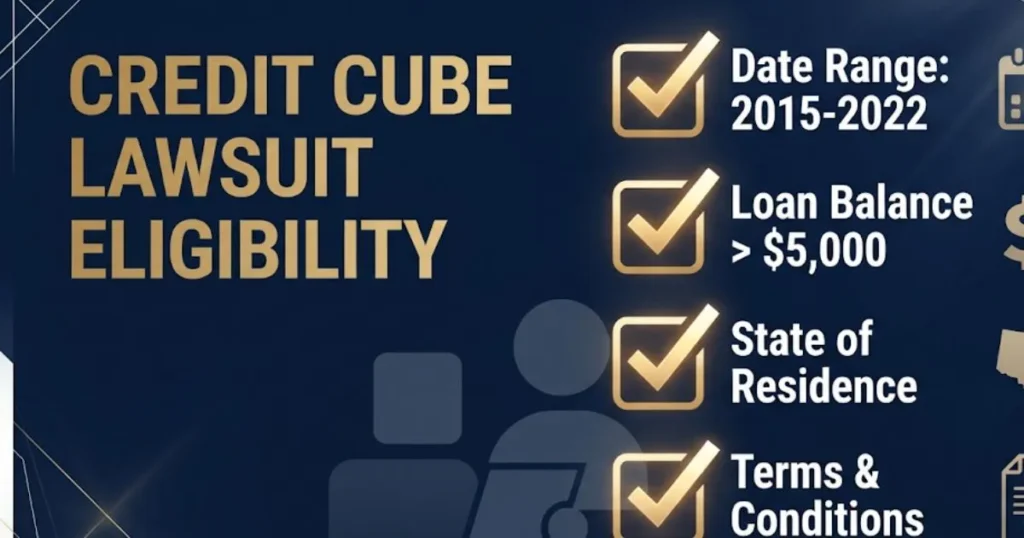
You are likely eligible for the Credit Cube lawsuit if you took out a loan from Credit Cube and were charged an interest rate that exceeded your state’s legal limit.
Most states have usury laws that cap interest rates. Many set the limit between 24% and 36% APR. Credit Cube routinely charged rates above 300% APR, meaning borrowers in nearly every state could have a valid claim.
Eligibility typically requires meeting a few basic conditions.
- You borrowed money directly from Credit Cube (not a different tribal lender)
- Your loan was originated during the relevant time period (usually 2017 to 2023)
- You were a resident of a state with usury laws at the time of borrowing
- You paid interest or fees that exceeded your state’s legal lending rate
You do not need to have fully repaid the loan to be eligible. Borrowers who defaulted, borrowers who are still making payments, and borrowers who paid off their loans early can all qualify.
| Eligibility Factor | Requirement |
|---|---|
| Lender | Must be Credit Cube specifically |
| Loan Period | Typically 2017 to 2023 |
| Residency | State with applicable usury laws |
| Harm | Paid interest exceeding state legal limits |
| Loan Status | Open, closed, or defaulted loans all qualify |
Key Takeaway: While no final settlement has been announced, payouts could range from $100 to $1,500 per borrower, and most people who took out a Credit Cube loan during the relevant period are likely eligible.
How to Join the Credit Cube Lawsuit
Joining the Credit Cube lawsuit typically involves filing a claim through the official settlement website or registering with the law firm handling the class action once the case reaches the claims stage.
If a class action has been certified, you may not need to do anything to be included. In many class actions, all affected borrowers are automatically included unless they choose to opt out. But filing a claim form ensures you actually receive payment.
Here is what you can do right now in 2026 to protect your interests.
- File a complaint with the CFPB at their official website describing your Credit Cube experience
- File a complaint with your state attorney general’s consumer protection division
- Gather your records: loan agreements, payment confirmations, bank statements showing withdrawals by Credit Cube, and any email correspondence
- Contact a consumer protection attorney who handles tribal lending cases to ask about your options
- Monitor the case by checking legal news sites for updates on class certification and settlement announcements
You should not have to pay anything upfront to join the class action. Attorneys in these cases work on contingency, meaning they only get paid if the case wins or settles.
Acting sooner is better than waiting. Once a claim deadline is set, it typically does not get extended.
Credit Cube and Predatory Lending Allegations
The Credit Cube predatory lending lawsuit alleges that the company deliberately targeted financially vulnerable borrowers with loan products designed to trap them in cycles of debt.
Predatory lending is not just about high interest rates. It is about a pattern of behavior that takes advantage of people who have limited options. Credit Cube marketed aggressively to borrowers with poor credit scores who could not qualify for traditional bank loans.
The loans were structured so that early payments went almost entirely toward interest and fees. Very little went toward the actual loan balance. A borrower who took out a $500 loan could end up paying back $1,500 to $2,000 before the balance was paid off.
This repayment structure is sometimes compared to a treadmill. You keep running, but you never get anywhere.
The lawsuit also alleges that Credit Cube used automatic bank withdrawals that were difficult to stop. Borrowers reported that payments were pulled from their accounts even after they requested cancellation.
- Loan marketing targeted borrowers with credit scores below 580
- Repayment schedules front-loaded interest payments
- Automatic ACH debits made it hard to stop payments
- Customer service was reportedly unresponsive to cancellation requests
- Total cost of borrowing often exceeded 3 to 4 times the original loan amount
Credit Cube Interest Rate Lawsuit Details
The Credit Cube interest rate lawsuit focuses specifically on the APRs charged to borrowers, which regularly exceeded 400% and in some cases reached 700% or higher.
To put that in perspective, the average credit card charges between 18% and 25% APR. Even subprime credit cards rarely exceed 36% APR. Credit Cube was charging ten to twenty times more than the most expensive mainstream credit product.
Most states set legal interest rate caps. These usury laws exist specifically to prevent this kind of lending. Here is how Credit Cube’s rates compared to state limits in several key states.
| State | Legal Rate Cap | Credit Cube Reported APR |
|---|---|---|
| New York | 16% civil, 25% criminal | 400% to 700%+ |
| Georgia | 5% (with exceptions up to 60%) | 400% to 600%+ |
| Arkansas | 17% (constitutional limit) | 400% to 700%+ |
| New Jersey | 30% for consumer loans | 400% to 600%+ |
| Pennsylvania | 6% (with exceptions to 24%) | 400% to 700%+ |
The gap between what is legal and what Credit Cube charged is enormous. That gap is the foundation of the interest rate lawsuit.
Borrowers did not always realize the true cost because the APR was sometimes buried in lengthy loan agreements. The lawsuit claims this lack of transparency violated the Truth in Lending Act (TILA), which requires lenders to clearly disclose the cost of borrowing.
Credit Cube and the Tribal Lending Lawsuit Problem
The Credit Cube tribal lending lawsuit sits at the center of a much larger legal battle over whether online lenders can use tribal affiliations to avoid state consumer protection laws.
Credit Cube was structured as a lending entity affiliated with a Native American tribe. This structure was designed to invoke tribal sovereign immunity, a legal doctrine that generally protects tribal nations from being sued in state or federal court without their consent.
The problem is that many of these tribal lending operations have minimal actual tribal involvement. The tribe lends its name and sovereign status, while outside investors and management companies run the day-to-day lending operations, collect the revenue, and keep the majority of profits.
Courts have increasingly looked past the tribal label to examine the economic reality of these arrangements. If the tribe receives only a small percentage of the revenue while a non-tribal company controls operations, courts have ruled that sovereign immunity does not apply.
- The tribe may receive as little as 1% to 4% of lending revenue
- Non-tribal investors often provide all the capital
- Non-tribal companies typically handle technology, marketing, and collections
- The tribe’s involvement may be limited to licensing its name
This is the core tension in every tribal lending lawsuit, including the one against Credit Cube.
Key Takeaway: Credit Cube allegedly charged interest rates 10 to 20 times higher than state legal limits and used a tribal affiliation structure that courts are increasingly rejecting as a shield against consumer protection laws.
Is Credit Cube Legal
Whether Credit Cube is legal depends on which laws apply, and that is exactly what the courts are deciding.
If tribal sovereign immunity protects Credit Cube, then its lending operations may fall outside the reach of state usury laws. Under that theory, state interest rate caps simply would not apply to the company.
But if courts determine that Credit Cube is not genuinely a tribal enterprise, or that its tribal affiliation is a sham arrangement designed to evade regulation, then the company’s loans would be subject to state law. Under most state usury laws, rates above 36% APR are illegal. Rates above 400% APR are wildly illegal.
Several courts have already weighed in on this question for similar tribal lenders. The trend is clear: courts are increasingly skeptical of the tribal lending model when the tribe has minimal actual involvement.
The legality question also extends to federal law. The Truth in Lending Act requires clear disclosure of loan costs. The Electronic Fund Transfer Act gives borrowers the right to stop automatic payments. If Credit Cube violated either of these federal laws, its practices are illegal regardless of tribal immunity.
| Legal Framework | Does It Apply to Credit Cube? |
|---|---|
| State Usury Laws | Yes, if tribal immunity is rejected |
| Truth in Lending Act (TILA) | Yes, federal law applies |
| Electronic Fund Transfer Act | Yes, federal law applies |
| Tribal Sovereign Immunity | Under dispute in courts |
| State Consumer Protection Acts | Yes, if tribal immunity is rejected |
Credit Cube and Sovereign Immunity Defense
Credit Cube’s sovereign immunity defense is its primary legal shield, arguing that as a tribal entity, it cannot be sued in state or federal court without its consent.
Sovereign immunity is a real and important legal protection for Native American tribes. It is rooted in the recognition that tribes are separate sovereign nations. This immunity has been upheld by the Supreme Court in cases involving genuine tribal government activities.
The legal question with Credit Cube is whether an online lending operation that serves non-tribal members nationwide actually qualifies for this protection.
Courts use several factors to evaluate whether a tribal lending entity deserves immunity.
- Ownership: Is the lending entity genuinely owned by the tribe?
- Control: Does the tribe control day-to-day operations?
- Revenue: Does the tribe receive a meaningful share of the profits?
- Purpose: Does the lending operation serve a tribal governmental purpose?
- Management: Are tribal members actually running the business?
When courts find that a non-tribal company is the real operator and the tribe is just a name on paper, immunity is typically denied. The Second Circuit and Fourth Circuit have both issued rulings rejecting sovereign immunity for tribal lending entities with minimal tribal involvement.
For Credit Cube borrowers, this is good news. Each court ruling that pierces the tribal immunity shield makes it harder for Credit Cube to avoid accountability.
Has the CFPB Taken Action Against Credit Cube
The CFPB (Consumer Financial Protection Bureau) has been actively monitoring and taking action against tribal lending entities, though specific public enforcement against Credit Cube by name has been limited.
The CFPB has the authority to enforce federal consumer financial laws regardless of tribal sovereign immunity. Federal laws like TILA and the Consumer Financial Protection Act apply to all lenders, including those claiming tribal status.
In recent years, the CFPB has taken enforcement actions against several tribal-affiliated lenders. These actions have resulted in millions of dollars in borrower relief.
Notable CFPB actions against similar tribal lenders include:
- 2017: CFPB sued four tribal lending entities for deceptive practices
- 2019 to 2020: Multiple consent orders against tribal-affiliated lenders
- 2023 to 2024: Renewed enforcement focus on online lending abuses
- 2025: Expanded complaint database tracking for tribal lending complaints
Borrowers who filed complaints with the CFPB about Credit Cube have contributed to the agency’s enforcement record. These complaints help regulators identify patterns and build cases.
| CFPB Tool | How It Applies |
|---|---|
| Complaint Database | Borrowers can file and track complaints |
| Enforcement Actions | Can sue lenders for federal law violations |
| Supervision Authority | Can examine lending practices |
| Rulemaking | Can issue rules governing lending disclosures |
If you have not filed a CFPB complaint yet, doing so in 2026 still matters. Every complaint strengthens the regulatory record.
Key Takeaway: Credit Cube’s tribal sovereign immunity defense is under serious legal pressure, courts are increasingly rejecting it for online lenders with minimal tribal involvement, and federal regulators have the power to act regardless of tribal status.
Credit Cube Loan Lawsuit Settlement Amounts
Estimated Credit Cube loan lawsuit settlement amounts are projected based on outcomes in comparable tribal lending cases, since no final Credit Cube settlement has been announced as of 2026.
Similar tribal lending settlements have produced a range of outcomes. Some provided direct cash payments to borrowers. Others provided debt cancellation, where remaining loan balances were wiped out. Many provided a combination of both.
Here is a look at settlement amounts from comparable tribal lending lawsuits.
| Case | Settlement Amount | Per-Borrower Estimate | Year |
|---|---|---|---|
| Think Finance (tribal lending) | $40 million (debt relief) | Varied by balance owed | 2020 |
| CashCall (high-interest lending) | $15 million | $200 to $700 | 2016 |
| Western Sky (tribal lending) | $22 million (restitution) | Varied by state | 2017 |
| Tucker/Muir (tribal lending) | $500 million+ (combined state actions) | $100 to $2,000+ | 2019 to 2022 |
Based on these precedents, Credit Cube borrowers could reasonably expect:
- Debt cancellation for those with outstanding balances
- Cash refunds of excess interest paid, potentially ranging from $100 to $1,500
- Credit bureau corrections to remove negative marks related to Credit Cube loans
The total settlement fund will likely depend on how many borrowers are in the class and how much excess interest was collectively paid. Larger classes mean more money in the fund but potentially smaller individual payouts.
How to File a Credit Cube Lawsuit Claim
Filing a Credit Cube lawsuit claim will involve submitting a form through the official claims process once a settlement is approved, but there are steps you can take right now to prepare.
No official claim form is available yet because no final settlement has been announced. When one is approved, affected borrowers will typically be notified by mail, email, or both.
Here is what you should do right now in 2026 to be ready.
Step 1: Confirm your eligibility. Check whether you borrowed from Credit Cube during the relevant loan period (typically 2017 to 2023).
Step 2: Gather your documentation.
- Original loan agreement (check your email for copies)
- Bank statements showing payments to Credit Cube
- Any correspondence from Credit Cube (emails, letters, text messages)
- Records of any complaints you filed with the CFPB or state agencies
Step 3: File regulatory complaints if you have not already.
- Submit a complaint to the CFPB
- Submit a complaint to your state attorney general
Step 4: Contact a consumer protection attorney.
- Many attorneys offer free consultations for tribal lending cases
- You should not have to pay any money upfront
Step 5: Monitor for settlement announcements.
- Check legal news sources regularly
- Watch your mail and email for official notices
| Action | Why It Matters |
|---|---|
| Save loan documents | Proves you were a borrower |
| Save bank statements | Shows how much you paid |
| File CFPB complaint | Creates official record |
| Contact attorney | Protects your legal rights |
Credit Cube Lawsuit Deadline and Key Dates
The Credit Cube lawsuit deadline for filing claims has not been set yet because no final settlement has been approved, but borrowers should act now to avoid missing any future cutoff.
In class action settlements, the claim filing window is typically 60 to 90 days after the court grants preliminary approval and sends out notice to class members. That window is strict. Miss it, and you miss your money.
Here are the key dates and timeline projections for 2026 based on the current pace of litigation.
| Projected Event | Estimated Timing |
|---|---|
| Class Certification Decision | Early to mid 2026 |
| Settlement Negotiations | Mid 2026 |
| Preliminary Settlement Approval | Late 2026 to early 2027 |
| Notice Sent to Borrowers | 30 to 60 days after preliminary approval |
| Claim Filing Window | 60 to 90 days after notice |
| Final Approval Hearing | 90 to 120 days after preliminary approval |
| Payments Distributed | 30 to 90 days after final approval |
These dates are estimates. Litigation can speed up if parties agree to settle, or slow down if the defendant fights every motion.
The most important thing you can do right now is make sure your contact information is current. If you have moved since taking out your Credit Cube loan, update your address with any law firm handling the case and ensure your CFPB complaint has your current details.
Do not wait for a deadline to be announced before you start gathering your records. By then, old bank statements may be harder to access.
Key Takeaway: No claim deadline has been set yet, but borrowers should gather their loan documents, bank statements, and file regulatory complaints now so they are ready the moment a settlement is announced.
Credit Cube Complaints from Borrowers
Credit Cube complaints from borrowers paint a consistent picture of aggressive lending practices, hidden costs, and unresponsive customer service.
The CFPB complaint database and state attorney general records contain numerous complaints about Credit Cube. Borrowers report remarkably similar experiences, which strengthens the class action case.
The most common complaints include:
- Shockingly high total repayment amounts. Borrowers who took out $300 to $800 loans reported paying back $1,500 to $3,000 or more.
- Automatic withdrawals that were hard to stop. Even after requesting cancellation, payments continued to be pulled from bank accounts.
- Unclear loan terms. Many borrowers did not realize the true APR until they had already signed the agreement and received funds.
- Aggressive collection tactics. Borrowers who fell behind received frequent calls and threatening messages about legal action.
- Difficulty reaching customer service. Phone lines were reportedly understaffed, and email responses were slow or nonexistent.
One pattern stands out in particular. Many borrowers say they tried to pay off their loans early but were told they could not, or were charged fees for doing so. This practice, if proven, could violate both state and federal lending laws.
These borrower complaints are not just venting. They form a critical part of the evidence in the lawsuit. Every complaint filed with the CFPB or a state agency becomes part of the public record that regulators and attorneys can use.
What Are Your Rights as a Credit Cube Borrower
As a Credit Cube borrower, you have significant legal rights under both federal and state law, regardless of what your loan agreement says.
Many borrowers believe they gave up their rights when they signed Credit Cube’s loan agreement. That is not entirely true. While the agreement may include an arbitration clause and a choice-of-law provision pointing to tribal law, courts have increasingly refused to enforce these clauses in tribal lending cases.
Here are your key rights as a borrower.
Federal Rights:
- Truth in Lending Act: Credit Cube must clearly disclose the APR, total finance charges, and repayment schedule before you sign
- Electronic Fund Transfer Act: You have the right to stop automatic payments from your bank account at any time by notifying your bank
- Fair Debt Collection Practices Act: If your loan is in collections, the collector cannot harass, threaten, or deceive you
State Rights:
- Usury law protection: If your state caps interest rates, loans that exceed those caps may be void or unenforceable
- Consumer protection act claims: Most states allow you to sue lenders who engage in unfair or deceptive practices
- Right to file complaints: You can report Credit Cube to your state attorney general and the CFPB
Practical Steps to Exercise Your Rights:
- Call your bank and request a stop payment on all ACH debits from Credit Cube
- Send a written revocation of ACH authorization to Credit Cube (keep a copy)
- Do not ignore your loan, but know that you may owe far less than Credit Cube claims
- Talk to a consumer protection attorney about whether your loan is enforceable
| Right | Source | What It Means for You |
|---|---|---|
| Stop automatic payments | EFTA (federal) | Your bank must stop debits when you ask |
| Know your true APR | TILA (federal) | Lender must disclose all costs upfront |
| Protection from harassment | FDCPA (federal) | Collectors cannot threaten or deceive |
| Interest rate limits | State usury laws | Loans above state caps may be void |
| Right to sue | State consumer protection acts | You can seek damages for unfair practices |
You are not powerless here. The law is on your side more than you might think.
Key Takeaway: Credit Cube borrowers have strong legal protections under federal and state law, including the right to stop automatic payments immediately and the possibility that their high-interest loans may be legally unenforceable.
Frequently Asked Questions
How much money can I get from the Credit Cube lawsuit?
Most borrowers can expect between $100 and $1,500 based on comparable tribal lending settlements.
The exact amount depends on how much you borrowed, how much interest you paid, and whether you can provide documentation.
Payments are expected to begin once a settlement is finalized, potentially in late 2026 or 2027.
Is there a deadline to join the Credit Cube class action?
No formal deadline has been announced yet as of 2026.
Once a settlement receives preliminary approval, borrowers will have a 60 to 90 day window to file claims.
You should start gathering your records now so you are ready when the deadline is set.
Can Credit Cube use tribal immunity to avoid the lawsuit?
Credit Cube has raised tribal sovereign immunity as a defense, but courts have increasingly rejected this argument for online lenders with minimal tribal involvement.
Federal laws like TILA and EFTA apply regardless of tribal status.
The trend in recent court rulings strongly favors borrowers on this issue.
What interest rate did Credit Cube charge borrowers?
Credit Cube reportedly charged APRs ranging from 400% to over 700%.
Most state usury laws cap interest rates between 24% and 36% APR.
These rates mean a $500 loan could cost borrowers $1,500 or more in total repayment.
How do I file a claim against Credit Cube in 2026?
No official claim form is available yet, but you can prepare by gathering loan documents and bank statements.
File complaints with the CFPB and your state attorney general to get on record.
Contact a consumer protection attorney for a free consultation about your specific situation.
The Credit Cube lawsuit is heading toward a potential resolution in 2026. Borrowers who were charged sky-high interest rates on loans that should have been illegal in their states now have a real path to getting money back.
Do not wait for a deadline to appear before you act. Start gathering your loan records, bank statements, and any emails from Credit Cube today.
If you qualify, file your complaints with regulators and talk to an attorney. The stronger your documentation, the better your chances of receiving the maximum payout when the time comes.







