

A credit card settlement lawsuit is a legal action where a credit card company or debt buyer sues you for unpaid debt, and a settlement is reached instead of going to trial. In 2026, these cases are surging. American household credit card debt topped $1.14 trillion at the end of 2024, according to the Federal Reserve Bank of New York. That record number means more defaults, more lawsuits, and more people scrambling for answers.
This guide covers everything you need to know. You will learn how credit card lawsuit settlements work this year, what average settlement amounts look like, how to negotiate, and what defenses actually hold up in court.
We also break down what happens after you settle. The tax consequences, the credit score damage, and the steps to make sure your debt is truly gone. If you have been served with papers or you see it coming, this is the resource you need right now.
What Is a Credit Card Settlement Lawsuit
A credit card settlement lawsuit is a civil court case filed against a consumer for unpaid credit card debt that ultimately gets resolved through a negotiated payment rather than a full trial verdict. These lawsuits begin when a creditor or debt buyer files a complaint in court. You receive a summons telling you to respond.
The “settlement” part happens when both sides agree on a reduced amount. Instead of the creditor proving the full debt at trial, they accept less money. You avoid the risk of a judgment for the total balance plus interest and fees.
| Term | Meaning |
|---|---|
| Plaintiff | The credit card company or debt buyer suing you |
| Defendant | You, the person being sued |
| Summons | Court document telling you a lawsuit has been filed |
| Complaint | The plaintiff’s written claim explaining what you owe |
| Settlement | An agreement to pay less than the full amount owed |
These cases are filed in state civil courts. Small claims court handles debts under a certain threshold, which varies by state. Larger debts go to general civil court.
Here is the critical thing most people miss. Getting sued does not automatically mean you lose. Many creditors prefer settlement because trials are expensive. They would rather get 40 cents on the dollar today than spend months chasing the full amount.
How Credit Card Lawsuit Settlements Work in 2026
Credit card lawsuit settlements in 2026 follow a predictable pattern: the creditor files suit, the consumer responds, and both sides negotiate a reduced payment to avoid trial. This year, the process is shaped by record debt levels and aggressive collection activity from major debt buyers.
The sequence typically looks like this:
- Creditor charges off the debt after 180 days of nonpayment
- Original creditor either sues directly or sells the debt to a buyer
- Debt buyer files a lawsuit in your local court
- You receive a summons and complaint
- You file an answer with the court
- Settlement talks begin, often before any hearing
In 2026, debt buyers like Midland Credit Management, Portfolio Recovery Associates, and LVNV Funding are filing cases at a faster pace. Their business model depends on volume. They buy debts for pennies and profit if they collect even a fraction.
The 2026 shift: Courts in several states now require mandatory mediation before credit card debt cases go to trial. This pushes both sides toward settlement earlier in the process.
Settlement can happen at any stage. Before you even file your answer. After discovery. On the courthouse steps the morning of trial. The earlier you engage, the more leverage you tend to have.
How to Settle a Credit Card Lawsuit
To settle a credit card lawsuit, you need to respond to the case on time, then contact the plaintiff or their attorney to propose a payment you can actually afford. Ignoring the lawsuit kills your chance to settle.
Step-by-step process:
- Read the summons carefully and note your deadline to respond
- File your answer with the court before that deadline
- Review the debt: confirm the amount, the creditor, and whether the statute of limitations has passed
- Contact the plaintiff’s attorney in writing
- Make your first offer at 25% to 30% of the claimed amount
- Negotiate back and forth until you reach a number
- Get the settlement agreement in writing before you pay anything
- Make your payment according to the agreed terms
- Confirm the case is dismissed by the court
A common mistake is calling the creditor’s attorney and verbally agreeing to a number. That is dangerous. Verbal agreements are hard to enforce. Always get it on paper.
Your first offer should be lower than what you are willing to pay. Think of it like buying a used car. Start at 25%. They will counter at 70% or 80%. You will likely land somewhere between 35% and 55%.
Timing matters too. Creditors are more willing to settle near the end of a quarter or fiscal year. Their internal targets push them toward closing cases.
Key Takeaway: Always respond to the lawsuit first, then open settlement talks with a written offer well below your actual budget.
Average Credit Card Lawsuit Settlement Amounts
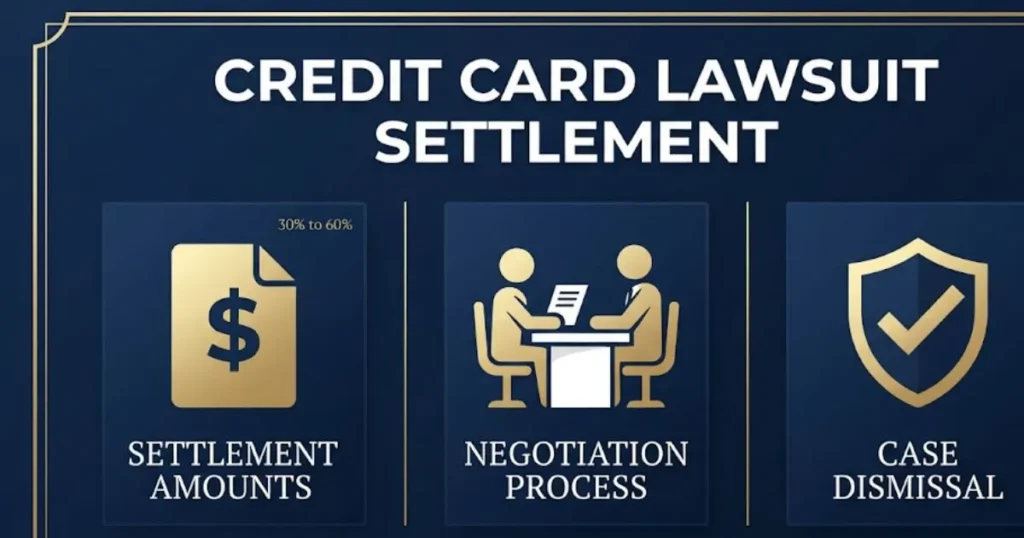
The average credit card lawsuit settlement falls between 30% and 60% of the original debt balance. A $10,000 debt, for example, might settle for $3,000 to $6,000 depending on several factors.
| Original Debt | Low Settlement (30%) | Mid Settlement (45%) | High Settlement (60%) |
|---|---|---|---|
| $3,000 | $900 | $1,350 | $1,800 |
| $5,000 | $1,500 | $2,250 | $3,000 |
| $10,000 | $3,000 | $4,500 | $6,000 |
| $20,000 | $6,000 | $9,000 | $12,000 |
| $50,000 | $15,000 | $22,500 | $30,000 |
Several factors influence where your settlement lands on that spectrum:
- Who is suing you. Original creditors like Chase or Capital One tend to settle higher. Debt buyers settle lower because they paid pennies for the account.
- Your financial situation. If you can show genuine hardship, creditors accept less.
- Stage of the lawsuit. Early settlements tend to cost more because the creditor has not yet spent much on legal fees. Late settlements sometimes cost less because they want to avoid trial expenses.
- Lump sum vs. installments. Offering a lump sum payment gets you a better deal almost every time.
In 2026, with delinquency rates climbing, creditors are dealing with more cases than ever. That volume works in your favor. They simply cannot take every case to trial.
Credit Card Debt Lawsuit Settlement Amount by Tier
Settlement amounts vary sharply depending on the size of the original debt, with smaller debts often settling at higher percentages and larger debts settling at lower ones. The reason is simple: the math favors flexibility when more money is on the table.
Tier Breakdown for 2026:
| Debt Tier | Typical Range | Settlement % | Notes |
|---|---|---|---|
| Under $2,500 | $750 to $1,500 | 40% to 60% | Small claims court; creditors want quick resolution |
| $2,500 to $7,500 | $1,000 to $3,750 | 35% to 50% | Most common tier for debt buyer lawsuits |
| $7,500 to $15,000 | $2,250 to $7,500 | 30% to 50% | Negotiation room increases with stronger defenses |
| $15,000 to $30,000 | $4,500 to $15,000 | 25% to 50% | Creditors weigh legal costs more carefully here |
| Over $30,000 | $7,500+ | 20% to 45% | High-value cases with significant room to negotiate |
Smaller debts settle at higher percentages because the creditor’s legal costs eat into any savings from a lower offer. If they are spending $1,500 on attorney fees to collect $2,000, accepting $1,200 still makes sense.
Larger debts give you more room to push back. A creditor owed $40,000 might accept $12,000 if you can pay in one lump sum. The key is demonstrating that a smaller certain payment beats an uncertain trial outcome.
Your specific number depends on your case details. But these tiers give you a realistic starting point for your negotiations.
What to Include in a Credit Card Lawsuit Settlement Offer
A credit card lawsuit settlement offer should include the specific dollar amount you are proposing, the payment method and timeline, and a requirement that the creditor dismiss the case with prejudice once you pay. Missing any of these elements puts you at risk.
Every settlement offer needs these components:
- Your name and the case number
- The original creditor and current debt holder
- The specific settlement amount in dollars
- Whether you are paying in a lump sum or installments
- The exact payment dates
- A statement that the creditor will file a dismissal with prejudice
- A statement that the creditor will report the account as “settled” or “paid” to credit bureaus
- A clause saying neither side admits fault
What “with prejudice” means: When a case is dismissed with prejudice, the creditor cannot refile the same lawsuit later. Without this language, they could take your money and then sue you again for the remaining balance. This is not theoretical. It happens.
Send your offer in writing. A letter or email to the opposing attorney works. Keep your language professional and direct. State your financial hardship briefly. Present your offer clearly.
Do not explain too much about why you cannot pay the full amount. You do not need a sob story. Just state that you have limited resources and propose a number that works.
Key Takeaway: Never pay a dime until you have a signed settlement agreement that includes dismissal with prejudice and credit bureau reporting terms.
How to Negotiate a Credit Card Debt Lawsuit
Negotiating a credit card debt lawsuit requires knowing your leverage, starting low, and being willing to walk toward trial if the other side will not budge. The creditor’s willingness to negotiate depends on how much it would cost them to beat you in court.
Your strongest negotiation tools:
- Proof of financial hardship. Bank statements showing low balances. Pay stubs showing limited income. A simple financial statement listing your monthly expenses.
- Statute of limitations defense. If the debt is near or past the statute of limitations in your state, the creditor knows they might lose at trial.
- Documentation gaps. Debt buyers often lack the original credit card agreement, account statements, or chain of ownership records. If they cannot prove they own the debt, they lose.
- Time pressure. Creditor attorneys handle hundreds of cases. They want to close files. The closer you get to a trial date, the more motivated they become.
Start your offer at 25% of the claimed amount. Expect a counter at 65% to 80%. Your second offer should be around 35%. Their next counter will usually drop to 50% to 60%.
Most deals close between 35% and 55% for debt buyer cases. Original creditor cases tend to close between 45% and 65%.
Be patient. Negotiations can take two to six weeks. Do not panic if they say no to your first offer. That is expected. The back-and-forth is part of the process.
If you can pay in a lump sum, say so. That single factor can drop your settlement by 10% to 20% compared to installment offers.
Credit Card Company Lawsuit Settlement Patterns
Credit card companies follow predictable settlement patterns that vary based on whether you are dealing with the original creditor or a third-party debt buyer. Knowing these patterns gives you a real advantage at the negotiation table.
Original Creditors (Chase, Capital One, Discover, American Express, Citibank, Synchrony):
| Creditor | Typical Settlement Range | Notes |
|---|---|---|
| Chase | 40% to 60% | Often willing to negotiate before filing suit |
| Capital One | 45% to 65% | Tends to litigate aggressively; settle early |
| Discover | 40% to 55% | Known for reasonable settlement offers |
| American Express | 50% to 70% | Harder to negotiate; strong documentation |
| Citibank | 40% to 60% | Often uses outside law firms for collections |
| Synchrony | 35% to 55% | Store cards; frequently sells to debt buyers |
Debt Buyers (Midland Credit Management, Portfolio Recovery Associates, LVNV Funding, Cavalry SPV):
Debt buyers typically settle for 25% to 50% of the claimed balance. They purchased your debt for 4 to 10 cents on the dollar. Even a 25% settlement is profitable for them.
The biggest difference? Documentation. Original creditors have your application, every statement, and the full transaction history. Debt buyers often have a spreadsheet with your name, an account number, and a balance. That gap in records is your leverage.
In 2026, Portfolio Recovery Associates and Midland Credit Management are the two most active debt buyer litigants in the United States. If either of these names appears on your lawsuit, your settlement prospects are generally strong.
Key Takeaway: Debt buyers settle for less than original creditors because they paid pennies for your account and often lack complete records to win at trial.
How to Respond to a Credit Card Lawsuit
You respond to a credit card lawsuit by filing a written answer with the court before your deadline, which is typically 20 to 30 days after you are served. Missing this deadline almost guarantees a default judgment against you.
Your answer should include:
- A response to each numbered paragraph in the complaint (admit, deny, or state you lack knowledge)
- Any affirmative defenses you want to raise (statute of limitations, improper service, lack of standing)
- Your signature and the date
Filing your answer is not complicated, but it is the single most important step. Once you answer, the creditor knows you will not be a free win. That alone changes the dynamic and opens the door to settlement talks.
| State | Typical Response Deadline | Court Where Filed |
|---|---|---|
| California | 30 days | Superior Court |
| Texas | By 10 AM on the first Monday after 20 days | District or County Court |
| Florida | 20 days | County Court or Circuit Court |
| New York | 20 to 30 days | Civil Court or Supreme Court |
| Illinois | 30 days | Circuit Court |
Check your summons for the exact deadline in your case. Some states count calendar days. Others count business days.
When drafting your answer, deny anything you are unsure about. You are not lying. You are exercising your legal right to make the creditor prove their case. If they claim you owe $8,347.62, and you do not have records confirming that exact number, deny it.
Credit Card Debt Lawsuit Defense Strategies
The strongest defense strategies in a credit card debt lawsuit focus on forcing the creditor to prove every element of their case, including ownership of the debt, the correct amount, and timely filing. Many creditors, especially debt buyers, cannot meet that burden.
Top defenses for 2026:
- Statute of limitations. If the creditor sued after your state’s deadline, the case should be dismissed. This is the most powerful defense available.
- Lack of standing. The plaintiff must prove they own your specific debt. Debt buyers need a complete chain of assignment from the original creditor. Gaps in that chain are fatal to their case.
- Improper service. If you were not properly served with the lawsuit, the court may lack jurisdiction over you.
- Incorrect amount. The creditor must prove the exact balance they claim. Interest calculations, fees, and payment credits all need documentation.
- Identity issues. Is the debt actually yours? Mistaken identity and mixed credit files happen more often than you might think.
- Account stated doctrine failures. In some states, creditors rely on the “account stated” theory, which requires showing you received statements and never objected. If they cannot prove you received the statements, this theory fails.
Raising defenses does not mean you have to go to trial. In fact, strong defenses are your best settlement tool. When the creditor sees you have a real defense, they get realistic about what they can collect.
Think of it this way. A creditor with perfect documentation and a solid case will not settle for 30%. But a debt buyer who cannot produce your original credit card agreement? They will take 25% and call it a win.
Can You Settle Credit Card Debt Before Trial
Yes, you can settle credit card debt at any stage of the lawsuit, and settling before trial is the most common outcome. Roughly 90% or more of credit card debt lawsuits never reach a courtroom verdict.
Best times to settle:
- Before filing an answer. Some creditor attorneys will negotiate even before you officially respond. However, always file your answer on time regardless.
- After filing your answer. This is the sweet spot. You have shown you will fight, which motivates the creditor to deal.
- During discovery. If the creditor’s evidence is weak, discovery exposes that. Settlement offers often improve at this stage.
- At mediation. Many courts now require mediation in debt cases. A neutral mediator helps both sides find middle ground.
- Right before trial. Last-minute settlements happen constantly. Neither side wants the uncertainty of a trial.
The earlier you settle, the less time and money both sides spend on the case. That said, waiting can sometimes work in your favor if the creditor’s evidence weakens over time.
Here is a practical tip. If you have the money for a lump sum payment, approach the creditor’s attorney within 30 days of filing your answer. Offer 30% to 35%. They may counter, but you have signaled that you are serious and ready to close the case quickly.
Key Takeaway: You can settle before trial at almost any point in the case, but the period right after you file your answer typically offers the best combination of leverage and efficiency.
Credit Card Lawsuit Statute of Limitations in 2026
The statute of limitations for credit card debt lawsuits in 2026 varies by state, ranging from 3 years to 10 years depending on where you live. If a creditor sues after the deadline, you can get the case thrown out.
2026 Statute of Limitations by State (Selected):
| State | Statute of Limitations | Debt Type Classification |
|---|---|---|
| California | 4 years | Written contract |
| Texas | 4 years | Written contract |
| Florida | 5 years | Written contract |
| New York | 6 years | Written contract |
| Illinois | 5 years | Written contract |
| Ohio | 6 years (changed from 8 in 2012) | Written contract |
| Georgia | 6 years | Written contract |
| Pennsylvania | 4 years | Written contract |
| North Carolina | 3 years | Open account |
| Mississippi | 3 years | Open account |
When does the clock start? It begins on the date of your last payment or last account activity. Not the date the account was opened. Not the date it was charged off. The last time you made a payment or used the card.
Warning about restarting the clock. In many states, making even a small payment on old debt restarts the statute of limitations. A $10 payment on a 5-year-old debt can give the creditor a fresh window to sue you. Be very careful about making any payment before checking your state’s rules.
If the statute has expired, raise it as an affirmative defense in your answer. Do not assume the court will figure it out on its own. You must assert this defense, or you waive it.
What Happens If You Ignore a Credit Card Lawsuit
If you ignore a credit card lawsuit, the court will enter a default judgment against you, giving the creditor the legal right to garnish your wages, freeze your bank accounts, and place liens on your property. This is the worst possible outcome.
Default judgment consequences:
- The creditor wins automatically without proving their case
- You lose your right to negotiate a settlement
- Wage garnishment can take 10% to 25% of your disposable income in most states
- Bank account levies can freeze your checking and savings accounts
- Property liens can attach to your home and other real estate
- The judgment appears on your credit report and public records
- Interest continues to accrue on the judgment amount
- The creditor can try to collect for 10 to 20 years depending on your state
Here is what makes this especially painful. Many people who ignore credit card lawsuits could have settled the debt for 30% to 50% of the balance. Instead, they owe 100% plus interest, court costs, and attorney fees.
Roughly 70% to 80% of credit card debt lawsuits result in default judgments. That tells you most people are not responding. Do not be one of them.
Even if you have no money today, filing an answer protects your rights and keeps your options open. You can negotiate. You can raise defenses. But once a default judgment is entered, your leverage drops to almost zero.
Key Takeaway: Ignoring a credit card lawsuit is the single most expensive mistake you can make because default judgments give creditors maximum enforcement power with zero negotiation room.
Credit Card Lawsuit Judgment Consequences
A credit card lawsuit judgment means the court has ruled that you owe the debt, and the creditor now has powerful legal tools to collect it from you by force. This is no longer a request for payment. It is a court order.
What the creditor can do with a judgment:
| Collection Tool | How It Works | Typical Impact |
|---|---|---|
| Wage garnishment | Creditor gets a court order directing your employer to withhold a percentage of your paycheck | 10% to 25% of disposable income |
| Bank levy | Creditor freezes your bank account and takes funds to satisfy the debt | Can empty your account |
| Property lien | Judgment attaches to your real estate; must be paid when you sell | Clouds your title |
| Asset seizure | In some states, creditors can seize non-exempt personal property | Rare but legally possible |
Judgments are not permanent, but they last a long time. Most states allow judgments to remain enforceable for 10 to 20 years. Many states allow renewal, meaning the creditor can extend the judgment before it expires.
Interest on judgments typically runs at the state’s statutory rate. In some states, that is 6% per year. In others, it is 10% or higher. Your original $8,000 debt could grow to $15,000 or more over a decade.
One option after a judgment is filing to vacate it. If you were never properly served, or if you had a valid reason for not responding, courts sometimes set aside default judgments. But this requires filing a motion, showing good cause, and demonstrating a viable defense. It is not guaranteed.
Credit Card Lawsuit Settlement Agreement Essentials
A credit card lawsuit settlement agreement is the binding legal document that spells out exactly how much you will pay, when you will pay it, and what the creditor must do in return. Without this document, you have nothing.
Must-have terms in every agreement:
- The exact dollar amount of the settlement
- Payment due date or installment schedule with specific dates
- Method of payment (check, wire transfer, certified funds)
- Statement that the creditor will file a Stipulation of Dismissal with Prejudice within a set number of days after payment
- Confirmation that the creditor will not pursue the remaining balance
- Instruction on how the creditor will report the account to credit bureaus
- A release of all claims related to the debt
- Signatures from both parties or their attorneys
Red flags to watch for:
- Agreement says “dismissed without prejudice” instead of “with prejudice” (this means they can sue you again)
- No mention of credit bureau reporting
- Vague payment terms like “within a reasonable time”
- Confession of judgment clauses that let the creditor get a judgment if you miss one payment by even a day
Keep a copy of the signed agreement forever. Store it digitally and in paper form. Years from now, if the debt resurfaces on your credit report or a collector comes calling, this document is your proof.
After you make your final payment, follow up with the court to confirm the dismissal was filed. Do not assume the creditor handled it. Check the court records yourself.
Key Takeaway: The settlement agreement is your only protection, so make sure it includes dismissal with prejudice, credit reporting terms, and a full release before you pay.
Tax Implications of Credit Card Debt Settlement
Settled credit card debt of $600 or more triggers a tax reporting obligation where the creditor sends you IRS Form 1099-C, and the forgiven amount is treated as taxable income. Many people are blindsided by this.
How it works:
If you owed $10,000 and settled for $4,000, the creditor forgave $6,000. The IRS considers that $6,000 as income. You will receive a 1099-C form, and you must report it on your federal tax return.
| Settlement Scenario | Debt Owed | Amount Paid | Forgiven Amount | Tax Rate (est.) | Tax Owed (est.) |
|---|---|---|---|---|---|
| Example 1 | $5,000 | $2,000 | $3,000 | 22% | $660 |
| Example 2 | $10,000 | $4,000 | $6,000 | 22% | $1,320 |
| Example 3 | $25,000 | $10,000 | $15,000 | 24% | $3,600 |
The insolvency exception: If your total debts exceeded your total assets at the time the debt was forgiven, you may qualify for an exclusion under IRS rules. You would file IRS Form 982 to claim this exclusion. This means you may owe little or no tax on the forgiven amount.
For example, if you had $50,000 in debts and only $30,000 in assets when the debt was canceled, you were insolvent by $20,000. You can exclude up to $20,000 of canceled debt from your income.
Keep records of all your debts and assets as of the settlement date. Bank statements, loan balances, property values, and retirement account balances all matter for this calculation.
Do not ignore the 1099-C. The IRS will match it to your return. If you fail to report it or file Form 982, you could face penalties and interest on top of the tax.
Credit Card Lawsuit Settlement and Your Credit Score
A credit card lawsuit settlement will negatively affect your credit score, but the damage is far less severe than a judgment, wage garnishment, or ongoing delinquency. Settling is the least bad option when you cannot pay the full balance.
Credit score impact timeline:
| Event | Approximate Score Drop | How Long It Stays |
|---|---|---|
| Missed payments (before lawsuit) | 50 to 110 points | 7 years from date of first delinquency |
| Charge-off notation | 75 to 150 points | 7 years from charge-off date |
| Settlement notation (“settled for less”) | Additional 25 to 50 points beyond charge-off | 7 years from date of settlement |
| Default judgment (if you lose or ignore lawsuit) | 100+ additional points | 7 years (varies by state) |
By the time you are settling a lawsuit, your credit has already taken the biggest hits from missed payments and the charge-off. The settlement itself adds a relatively small additional ding.
How it gets reported: The account will show as “settled” or “settled for less than full balance” on your credit report. This is worse than “paid in full” but much better than “judgment” or “unpaid charge-off.”
Recovery timeline: Most people see meaningful credit score improvement within 12 to 24 months after settling, assuming they are making on-time payments on other accounts and keeping balances low. After 2 to 3 years of good credit behavior, the settlement’s impact fades significantly.
One strategy: include a credit reporting clause in your settlement agreement asking the creditor to report the account as “paid in full” rather than “settled.” Not all creditors agree, but some will. It costs nothing to ask.
Key Takeaway: Settling a credit card lawsuit hurts your credit less than a judgment or continued nonpayment, and most people recover within 1 to 2 years of consistent good credit habits.
Sued for Credit Card Debt: Settlement Options in 2026
If you are being sued for credit card debt in 2026, your settlement options include lump sum payment, structured installments, hardship reduction, and in rare cases, debt forgiveness. The best option depends on your financial situation and the strength of the creditor’s case.
Option 1: Lump Sum Settlement
Pay a single amount, typically 25% to 50% of the balance. This gets you the deepest discount. Creditors love certainty, and a lump sum gives them that.
Option 2: Installment Settlement
Pay a higher total amount (40% to 70%) spread over 3 to 12 monthly payments. Creditors accept this when you cannot come up with a lump sum. Expect less of a discount because installments carry the risk that you stop paying.
Option 3: Hardship Settlement
Provide documentation of extreme financial hardship (disability, job loss, medical emergency). Some creditors have internal hardship programs that reduce the balance by 50% to 70%. These require proof and are reviewed case by case.
Option 4: Stipulated Judgment with Payment Plan
You agree to a judgment for a reduced amount with a payment schedule attached. If you complete the payments, the judgment is satisfied. If you miss payments, the creditor can enforce the full judgment. This is riskier than a standard settlement.
| Option | Typical Discount | Payment Structure | Risk Level |
|---|---|---|---|
| Lump sum | 25% to 50% off | Single payment | Low |
| Installments | 20% to 40% off | 3 to 12 months | Medium |
| Hardship | 50% to 70% off | Varies | Low if approved |
| Stipulated judgment | 10% to 30% off | Court-supervised | High |
In 2026, with credit card delinquency rates at their highest point in over a decade, creditors are dealing with a flood of cases. That volume gives consumers more bargaining power than in leaner times.
Your best move is to assess what you can realistically afford, pick the option that matches your situation, and start the conversation with the creditor’s attorney before the court imposes a timeline on you.
Frequently Asked Questions
How much can I settle a credit card lawsuit for in 2026?
Most credit card lawsuits settle for 30% to 60% of the original debt.
Debt buyer cases often settle at the lower end, around 25% to 45%.
Your actual number depends on the creditor, the strength of their evidence, and whether you offer a lump sum.
What happens if I don’t respond to a credit card lawsuit?
The court will enter a default judgment against you, meaning you lose automatically.
The creditor can then garnish your wages, freeze your bank accounts, and place liens on your property.
About 70% to 80% of credit card lawsuits end in default judgment because people fail to respond.
Will settling a credit card lawsuit hurt my credit score?
Yes, a settlement will appear as “settled for less than full balance” on your credit report.
The impact is smaller than a judgment or ongoing delinquency, typically an additional 25 to 50 points beyond the charge-off.
Most people see meaningful score recovery within 12 to 24 months of settling.
Do I have to pay taxes on a credit card debt settlement?
Forgiven debt of $600 or more is reported to the IRS on Form 1099-C and treated as taxable income.
If your debts exceeded your assets at the time of settlement, you may qualify for the insolvency exclusion using IRS Form 982.
Keep records of all debts and assets as of the settlement date to support an insolvency claim.
How long does a credit card lawsuit settlement take?
Most settlements are reached within 30 to 90 days after filing your answer with the court.
Some cases settle in as little as two weeks if both sides are motivated.
Complex cases or those involving disputes over the debt amount can take 3 to 6 months.
Take Action Now
A credit card settlement lawsuit does not have to ruin your finances. Knowing your rights, responding on time, and negotiating strategically can save you thousands of dollars.
If you have been served, file your answer immediately. Then start gathering your financial records and prepare your first settlement offer.
Stay informed. Check your court records regularly. Keep every document related to your case. The people who get the best outcomes are the ones who stay engaged from start to finish.







