

The CPAP machine lawsuit against Philips Respironics is one of the biggest medical device cases heading into 2026. Millions of recalled sleep apnea machines contained foam that broke apart and released toxic particles directly into users’ airways.
If you used a recalled Philips CPAP, BiPAP, or ventilator, you may be entitled to compensation. Some estimates put individual payouts anywhere from a few thousand dollars to over $100,000, depending on the injuries involved.
This article covers every detail you need right now. You will find 2026 settlement updates, payout estimates by claim type, eligibility rules, filing deadlines, and step-by-step instructions.
More than 15 million devices were recalled worldwide. Thousands of lawsuits are consolidated in a single federal court in Pennsylvania. The stakes are enormous, and the clock is ticking.
What Is the CPAP Machine Lawsuit About?
The CPAP machine lawsuit centers on defective polyester-based polyurethane foam, known as PE-PUR foam, inside millions of Philips sleep apnea devices. This foam was designed to reduce noise. Instead, it broke down and sent tiny black particles and chemical gases into the air pathways that users breathed through every night.
Philips Respironics issued a massive recall in June 2021. The FDA classified it as a Class I recall, which is the most serious type. That designation means the devices carried a reasonable chance of causing serious health problems or death.
Users reported breathing in visible black foam fragments. Others developed unexplained respiratory issues, headaches, and nausea. Some were later diagnosed with cancers affecting the lungs, kidneys, liver, and nasal passages.
| Key Fact | Detail |
|---|---|
| Recall Date | June 2021 |
| FDA Classification | Class I (most serious) |
| Devices Affected | Over 15 million worldwide |
| Manufacturer | Philips Respironics |
| Main Defect | PE-PUR foam degradation |
| Legal Venue | Western District of Pennsylvania |
The lawsuits accuse Philips of knowing about the foam degradation problem for years before issuing the recall. Internal documents suggest the company received complaints as early as 2015 but waited six years to act.
Think of it this way: imagine your water filter was quietly shedding plastic into every glass you drank for years, and the company knew but said nothing. That is essentially what happened here, except users were breathing the contaminated air for hours each night while they slept.
CPAP Recall Lawsuit Update for 2026
As of 2026, the CPAP recall lawsuit is in an advanced stage of litigation within the federal multidistrict litigation known as MDL No. 2913. The case is being overseen by Judge Joy Flowers Conti in the U.S. District Court for the Western District of Pennsylvania.

Philips reached a $1.1 billion economic loss settlement in late 2024 to resolve claims from device users who sought compensation for the diminished value of their recalled machines. That settlement covers people who bought or rented affected devices, regardless of whether they got sick.
Personal injury claims, however, are on a separate track. These involve people who developed cancer, respiratory disease, or other serious health conditions. Bellwether trials for personal injury cases have been scheduled and are expected to produce verdicts that will shape future settlement negotiations.
- Economic loss settlement: Approved and distributing payments
- Personal injury claims: Bellwether trials underway or upcoming in 2026
- Medical monitoring claims: Still being litigated separately
- Wrongful death claims: Filed and awaiting trial scheduling
The personal injury track is where the big money sits. If early bellwether verdicts go against Philips, the company faces enormous pressure to settle thousands of remaining cases.
New filings are still being accepted for many claim types. But some deadlines are tightening. If you have not filed yet, 2026 is a critical year to act.
CPAP Lawsuit Settlement Amounts Explained
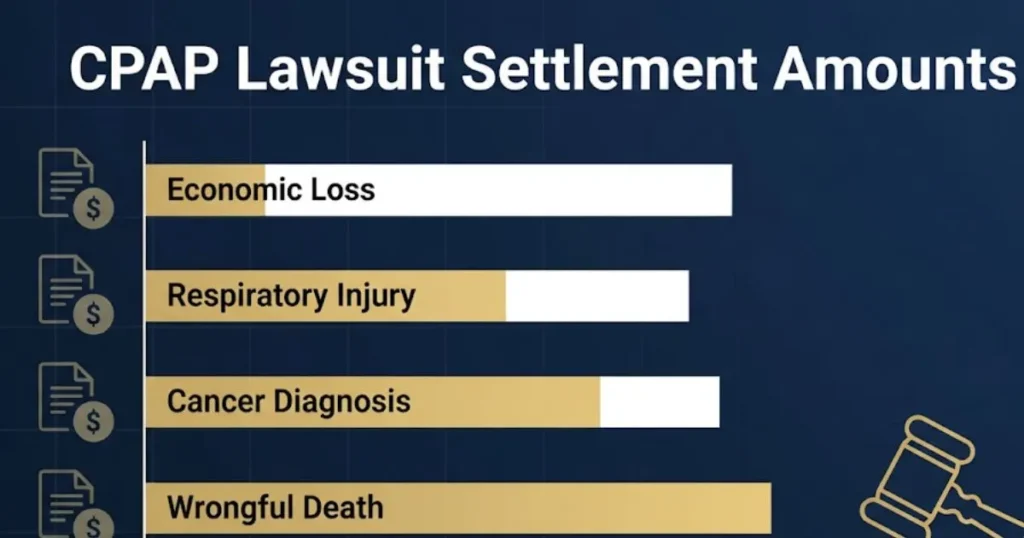
CPAP lawsuit settlement amounts vary dramatically based on the type of claim and the severity of injury. There is no single payout number. The amount you could receive depends on what category your case falls into.
The $1.1 billion economic loss settlement provides payments to device owners even if they did not get sick. These payouts are relatively modest on a per-person basis because millions of claimants share the fund.
Personal injury settlements have not been finalized on a global basis yet. But legal experts and attorneys involved in the MDL have projected ranges based on similar mass tort cases and early case evaluations.
| Claim Type | Estimated Settlement Range |
|---|---|
| Economic Loss (device value) | $50 to $500 per device |
| Respiratory Injury (non-cancer) | $10,000 to $100,000 |
| Cancer Diagnosis | $100,000 to $500,000+ |
| Wrongful Death | $250,000 to $1,000,000+ |
| Medical Monitoring | TBD, pending litigation |
These are projections, not guarantees. Final amounts will depend on bellwether trial outcomes, the strength of medical evidence in each case, and whether Philips agrees to a global personal injury settlement.
Cases with clear medical documentation tying a cancer diagnosis to CPAP use are worth significantly more. Cases with only minor symptoms and limited records will fall on the lower end.
Key Takeaway: Settlement amounts range from under $500 for economic loss claims to potentially over $1 million for wrongful death, with personal injury cancer cases likely falling in the $100,000 to $500,000 range.
How Much Is the CPAP Lawsuit Payout Per Person?
The CPAP lawsuit payout per person depends entirely on the claim type you file. Someone filing for economic loss only will receive far less than someone diagnosed with cancer after years of CPAP use.
For the economic loss settlement, the math is straightforward. A $1.1 billion fund divided among millions of eligible claimants means individual payments are relatively small. Early estimates suggest most economic loss claimants will receive between $50 and $500, depending on the device model, years of use, and whether the device was purchased or rented.
Personal injury payouts are a completely different story. These are individual claims, not a shared fund. Each case is evaluated on its own facts.
Here is what drives the payout amount up:
- Severity of diagnosis: Cancer pays more than respiratory irritation
- Duration of CPAP use: Longer exposure strengthens the claim
- Medical records: Clear documentation linking symptoms to device use
- Age and overall health: Younger victims with long life expectancy disrupted may receive more
- Lost wages and medical costs: Documented financial harm adds to the total
A 55-year-old who used a recalled DreamStation for four years and was later diagnosed with lung cancer has a much stronger case than a 30-year-old who used the device for six months and experienced only mild headaches.
Attorney fees typically take 25% to 40% of the settlement, which reduces the take-home amount. Factor that in when evaluating your potential payout.
Who Qualifies for the CPAP Lawsuit?
You qualify for the CPAP lawsuit if you used, purchased, or rented a recalled Philips Respironics CPAP, BiPAP, or mechanical ventilator. The recall covers devices manufactured before April 26, 2021.
Qualification depends on which type of claim you are filing. Each track has different requirements.
For economic loss claims, you qualify if you:
- Owned or rented a recalled Philips device
- Purchased or received the device before the June 2021 recall
- Reside in the United States
For personal injury claims, you qualify if you:
- Used a recalled device for a sustained period
- Developed health problems such as cancer, respiratory disease, or other conditions
- Can show medical records connecting your health issue to device use
For wrongful death claims, family members qualify if:
- A loved one used a recalled device
- That person died from cancer or another condition potentially linked to foam exposure
- There is medical evidence supporting the connection
You do not need to have been formally diagnosed with cancer to file. People with respiratory injuries, chronic headaches, sinus problems, and other conditions tied to foam inhalation have valid claims.
Even if you are unsure about your eligibility, reviewing your device model against the recall list is a smart first step. Philips published a complete list of affected model numbers when the recall was issued.
CPAP Lawsuit Eligibility Requirements
CPAP lawsuit eligibility requirements boil down to three things: you used a recalled device, you suffered some form of harm or loss, and you can provide documentation.
Here is a clear breakdown of what you need for each claim type:
| Requirement | Economic Loss | Personal Injury | Wrongful Death |
|---|---|---|---|
| Recalled device used | Yes | Yes | Yes |
| Proof of purchase/rental | Yes | Yes | Yes |
| Medical diagnosis | No | Yes | Yes (deceased) |
| Medical records | Not required | Required | Required |
| Proof of device model | Yes | Yes | Yes |
| Deadline compliance | Must meet cutoff | Must meet statute | Must meet statute |
The strongest personal injury claims share a few common traits. Long-term use of the device, ideally two or more years. A diagnosis that matches conditions associated with PE-PUR foam exposure. Medical records that establish a timeline between CPAP use and symptom onset.
One thing that trips people up: you need to identify the specific device model. Not all Philips devices were recalled. The recall applies to specific models manufactured with PE-PUR sound abatement foam.
Recalled device families include:
- DreamStation (various models)
- System One (50 and 60 Series)
- DreamStation Go
- A-Series BiPAP
- Trilogy 100 and 200 ventilators
- Garbin Plus, Aeris, LifeVent
If you threw away or returned your device, you may still qualify. Insurance records, prescription records, and sleep study documentation can help prove you used a recalled model.
Key Takeaway: You qualify for some form of claim if you used any recalled Philips CPAP, BiPAP, or ventilator, and both economic loss and personal injury tracks remain open for new filings in 2026.
How to File a CPAP Lawsuit in 2026
Filing a CPAP lawsuit in 2026 starts with gathering your device information, medical records, and purchase documentation, then working with an attorney experienced in mass tort litigation.
Here are the steps, in order:
Step 1: Confirm your device is on the recall list.
Check your machine’s model and serial number against the Philips recall database. The model number is usually on a sticker on the bottom or back of the device.
Step 2: Collect your documentation.
Pull together everything that supports your claim:
- Device purchase receipts or rental agreements
- Insurance claim records showing the device
- Sleep study prescriptions
- Medical records showing any health issues after CPAP use
- Photos of foam degradation if you noticed it
Step 3: Contact a mass tort attorney.
You want a lawyer or firm that specifically handles CPAP or medical device cases. Most work on contingency, meaning you pay nothing upfront. They take a percentage only if you win.
Step 4: Complete a case evaluation.
Your attorney will review your records and determine which claim type fits your situation: economic loss, personal injury, medical monitoring, or wrongful death.
Step 5: File the claim.
Your attorney files the necessary paperwork, either joining the MDL in Pennsylvania or filing in the appropriate state court, depending on your claim.
The entire process from first contact to filing typically takes two to six weeks. After that, your case enters the litigation queue.
Do not wait for a “perfect” time. Statutes of limitations vary by state, and some deadlines are approaching fast.
CPAP Lawsuit Deadline You Need to Know in 2026
The most important CPAP lawsuit deadline in 2026 depends on your state and your claim type. There is no single national deadline, but several critical cutoffs are approaching.
For economic loss claims, the registration deadline for the $1.1 billion settlement has specific cutoff dates. If you have not registered yet, check whether the claims administrator is still accepting late registrations. Some settlement programs allow late claims with reduced payouts.
For personal injury claims, the statute of limitations varies by state. Most states allow two to three years from the date you discovered your injury, or reasonably should have discovered it. Since the recall happened in June 2021, many state deadlines fall in 2023 to 2026.
| State Examples | Statute of Limitations | Potential Deadline |
|---|---|---|
| California | 2 years from discovery | Varies by individual |
| New York | 3 years from discovery | Varies by individual |
| Texas | 2 years from discovery | Varies by individual |
| Florida | 4 years (products) | May extend to 2025-2026 |
| Pennsylvania | 2 years from discovery | Varies by individual |
Some states use a “discovery rule,” meaning the clock starts when you learn your injury was caused by the device, not when the injury occurred. This can extend the deadline for people diagnosed recently.
If you wait too long, you lose your right to sue. No exceptions. Courts enforce these deadlines strictly.
The safest move is to start the filing process immediately. Even if you are unsure about your case, an attorney can assess your timeline for free.
The Philips CPAP Lawsuit Breakdown
The Philips CPAP lawsuit is the largest medical device litigation tied to sleep apnea equipment in U.S. history. Philips Respironics, a subsidiary of the Dutch conglomerate Koninklijke Philips N.V., is the sole defendant.
The core accusation is simple: Philips sold millions of CPAP machines with a known defect and did not warn users until the damage was already done. The PE-PUR foam inside these devices degraded over time, especially in warm and humid environments, which is exactly the environment created by a breathing machine.
Plaintiffs allege that Philips received internal complaints about black foam particles appearing in devices as early as 2015. Despite this, the company continued selling the devices for six more years.
The legal case rests on several theories:
- Product liability: The device was defectively designed
- Failure to warn: Philips did not disclose known risks
- Negligence: The company failed to act on safety complaints
- Fraud: Philips allegedly concealed evidence of foam breakdown
As of 2026, the MDL contains thousands of individual cases. The consolidated litigation allows for shared discovery, expert witnesses, and coordinated trial scheduling, which saves time for everyone involved.
Philips has denied that the foam caused serious injuries. The company points to its own testing, which it claims shows cancer risk is below harmful levels. Plaintiffs and independent researchers have challenged those findings.
Key Takeaway: Philips faces allegations of knowing about the foam defect years before the recall and continuing to sell devices, which forms the backbone of fraud and failure-to-warn claims.
Philips Respironics Lawsuit Details
Philips Respironics is the specific Philips division responsible for designing, manufacturing, and selling the recalled CPAP machines. The company is headquartered in Murrysville, Pennsylvania, which is why the MDL was assigned to the Western District of Pennsylvania.
The division produces a wide range of respiratory care products. But the recall focused on devices using PE-PUR foam as a sound abatement component.
Devices covered by the Philips Respironics recall:
- DreamStation ASV
- DreamStation ST, AVAPS
- DreamStation CPAP, Auto CPAP
- DreamStation Go CPAP, Auto CPAP
- System One (50 and 60 Series ASV, BiPAP, CPAP)
- C-Series ASV, S/T, AVAPS
- OmniLab Advanced Plus
- Trilogy 100, 200 ventilators
- Garbin Plus, Aeris, LifeVent
Philips initially offered a “repair and replace” program, providing new devices or replacement foam. But the program was slow. Many users waited months to over a year to receive a replacement, during which time they faced an impossible choice: keep using a recalled device or stop treating their sleep apnea.
The company reported $5.3 billion in total charges related to the recall through its financial filings. That includes the $1.1 billion economic loss settlement, recall logistics, legal fees, and device replacements.
Despite the massive costs, Philips has fought aggressively against personal injury claims. The company argues that its post-recall testing shows the foam does not release chemicals at levels that cause cancer. Independent experts hired by plaintiffs’ attorneys have disputed those conclusions.
CPAP Cancer Lawsuit Claims
CPAP cancer lawsuits are the most serious and potentially highest-value claims in the entire litigation. These cases allege that long-term inhalation of degraded PE-PUR foam particles and off-gassed chemicals caused users to develop various forms of cancer.
The types of cancer most commonly cited in CPAP lawsuits include:
- Lung cancer
- Kidney cancer
- Liver cancer
- Bladder cancer
- Nasal and sinus cancer
- Throat cancer
- Lymphoma
- Leukemia
The connection between PE-PUR foam chemicals and cancer is based on the presence of known or suspected carcinogens. Testing has identified chemicals including formaldehyde, toluene diisocyanate, and diethylene glycol in the off-gassing from degraded foam.
Formaldehyde is classified as a known human carcinogen by the International Agency for Research on Cancer (IARC). The presence of this chemical in the air pathway of a device used for hours every night is central to plaintiffs’ arguments.
| Cancer Type | Reported Cases | Claim Strength |
|---|---|---|
| Lung cancer | High volume | Strong (direct airway exposure) |
| Kidney cancer | Moderate volume | Strong (chemical filtration organ) |
| Liver cancer | Moderate volume | Strong (chemical processing organ) |
| Nasal/sinus cancer | Lower volume | Very strong (first point of contact) |
| Lymphoma | Lower volume | Moderate (systemic exposure argument) |
Proving causation is the hardest part of a cancer claim. Plaintiffs need to show that CPAP foam exposure was a substantial factor in causing their cancer, not just that they used the device and later got sick.
Expert testimony from toxicologists and oncologists will play a massive role in bellwether trials. The outcomes of those trials will set the tone for all remaining cancer claims.
Health Risks Linked to CPAP Machines
The health risks linked to recalled CPAP machines fall into two categories: injuries from inhaling physical foam particles and injuries from breathing chemical off-gasses released by the degrading foam.
Physical particle risks:
Users reported finding black specks and foam fragments inside their masks, tubing, and humidifier chambers. Inhaling these particles can irritate the airways, trigger inflammatory responses, and potentially cause tissue damage in the lungs and sinuses.
Chemical off-gassing risks:
As PE-PUR foam breaks down, it releases volatile organic compounds (VOCs) and other chemicals into the air stream. Testing has identified:
- Formaldehyde (known carcinogen)
- Toluene diisocyanate
- Diethylene glycol
- Phenol
- Various other VOCs
Reported symptoms and conditions include:
- Chronic headaches
- Upper airway irritation
- Coughing and wheezing
- Sinus infections
- Chest pressure
- Asthma onset or worsening
- Nausea
- Skin irritation from mask contact
- Cancer (multiple types)
The FDA received over 100,000 medical device reports related to the recalled Philips devices. These reports included complaints about respiratory problems, cancers, and other serious health effects.
It is worth understanding that not every CPAP user will develop cancer. But even minor respiratory symptoms can form the basis of a valid legal claim. The risk was real, it was avoidable, and Philips had a duty to prevent it.
Key Takeaway: Recalled CPAP machines exposed users to both physical foam particles and toxic chemical vapors, causing a wide range of health problems from chronic headaches to cancer.
CPAP Foam Degradation Risks Explained
CPAP foam degradation refers to the breakdown of PE-PUR sound abatement foam inside Philips devices, which creates both particle contamination and toxic off-gassing. This degradation is the root cause of every claim in the entire litigation.
PE-PUR foam was used to dampen the motor noise in CPAP, BiPAP, and ventilator devices. In a normal environment, the foam was expected to last the life of the device. But CPAP machines create a perfect storm for foam breakdown.
Why the foam degraded faster in CPAP machines:
- Heat: The device motor generates warmth
- Humidity: Users breathe moist air through the device, and many use heated humidifiers
- Ozone exposure: Some users cleaned devices with ozone-based cleaners, which accelerated foam breakdown
- Continuous use: Devices run 6 to 10 hours per night, every night
Think of it like leaving a sponge in a hot, steamy shower for years. Eventually, it falls apart. Except this “sponge” was sitting in the air pathway of a medical device, and its crumbling pieces went straight into people’s lungs.
Philips acknowledged that ozone cleaning products specifically accelerated degradation. But plaintiffs argue the foam broke down even without ozone exposure, just from normal heat and humidity during regular use.
| Degradation Factor | Impact Level |
|---|---|
| Normal heat and humidity | Moderate degradation over time |
| Ozone cleaner use | Severe, rapid degradation |
| Extended device age (3+ years) | Increased particle release |
| High ambient temperature | Accelerated breakdown |
The foam degradation issue was not limited to a single batch or production run. It affected the fundamental design of the foam material used across the entire recalled product line.
CPAP Lawsuit Medical Monitoring Claims
CPAP lawsuit medical monitoring claims are filed by device users who have not been diagnosed with a serious illness yet but need ongoing screening because of their exposure to toxic foam. These claims seek compensation for future medical testing costs.
This is a distinct category from personal injury. You do not need to be sick right now. You just need to have used a recalled device and face an elevated risk of developing health problems in the future.
What medical monitoring covers:
- Regular lung function tests
- CT scans or imaging of the chest
- Blood work to check organ function
- Cancer screenings tailored to your risk profile
- Ongoing pulmonary evaluations
The legal argument is straightforward. You were exposed to known carcinogens through no fault of your own. Because of that exposure, you need medical surveillance that you would not otherwise need. Philips should pay for it.
Not every state recognizes medical monitoring claims. Some jurisdictions require a physical injury before allowing this type of case. Others have adopted more progressive standards that accept exposure-based claims.
States with strong medical monitoring precedent include:
- Pennsylvania
- California
- New Jersey
- West Virginia
- Massachusetts
If you used a recalled CPAP for several years and your doctor recommends ongoing screenings, a medical monitoring claim lets you recover those costs even if you never develop cancer.
This track is still being actively litigated in the MDL. No global settlement has been reached for medical monitoring claims as of early 2026.
CPAP Wrongful Death Lawsuit Claims
CPAP wrongful death lawsuits are filed by surviving family members of people who died from conditions allegedly caused by exposure to degraded PE-PUR foam in recalled Philips devices. These carry the highest potential settlement values.
To file a wrongful death claim, the family must show that the deceased used a recalled CPAP device for a meaningful period and died from a condition consistent with foam or chemical exposure. Most wrongful death cases in the CPAP litigation involve cancer.
Who can file a wrongful death claim:
- Spouse of the deceased
- Children of the deceased
- Parents of the deceased (if no spouse or children)
- Estate representative or executor
What wrongful death claims seek compensation for:
- Medical bills incurred before death
- Funeral and burial expenses
- Lost income and future earnings
- Loss of companionship and consortium
- Pain and suffering endured by the deceased before death
| Wrongful Death Claim Element | Details |
|---|---|
| Average estimated value | $250,000 to $1,000,000+ |
| Most common cause of death | Lung cancer, kidney cancer |
| Proof required | Medical records, death certificate, device use history |
| Filing party | Surviving spouse, children, or estate |
These cases are emotionally and legally complex. Proving that a recalled CPAP machine caused the death, rather than some other factor, requires expert medical testimony and a detailed timeline.
Wrongful death statutes of limitations tend to be shorter than personal injury deadlines. In many states, the deadline is one to two years from the date of death. Families should act quickly.
Key Takeaway: Wrongful death CPAP claims carry the highest potential payouts but require strong medical evidence and must be filed within tight state deadlines.
Is There a CPAP Class Action Lawsuit?
The CPAP litigation is not a traditional class action lawsuit. It is a multidistrict litigation (MDL), which works differently. Each plaintiff files an individual case, but all cases are grouped together for pretrial proceedings to save time and court resources.
Here is the difference:
| Feature | Class Action | MDL (CPAP Lawsuit) |
|---|---|---|
| One lawsuit for everyone | Yes | No |
| Individual cases | No | Yes |
| Shared pretrial discovery | Yes | Yes |
| Individual settlement amounts | Same for all members | Varies per case |
| You must opt in | Sometimes opt-out | Must file individually |
| Trial outcomes | Binding on class | Advisory for other cases |
In a class action, everyone gets roughly the same payout. In an MDL, your payout depends on your individual injuries, evidence, and circumstances. This structure generally benefits people with serious injuries because their cases are evaluated on their own merits.
The economic loss settlement does function similarly to a class action. All eligible device owners share a pool of money. But personal injury claims are handled individually.
Some people confuse the two because the lawsuit is often called a “CPAP class action” in everyday conversation. Technically, that label is inaccurate. MDL No. 2913 is a consolidated individual litigation, not a certified class.
This distinction matters when you hear settlement numbers. The per-person payout from the economic loss fund is modest. But individual personal injury settlements could be six or seven figures for the most serious cases.
CPAP Lawsuit Timeline for 2026 and Beyond
The CPAP lawsuit timeline for 2026 is focused on bellwether trial outcomes, personal injury settlement negotiations, and final distribution of economic loss payments. Here is a projected roadmap of key events.
| Timeline Phase | Expected Timeframe | What Happens |
|---|---|---|
| Economic loss payments distributed | Early to mid-2026 | Claimants receive checks from $1.1B fund |
| Bellwether personal injury trials | Throughout 2026 | First individual cases go to jury verdict |
| Post-trial settlement talks | Mid to late 2026 | Results of trials drive global settlement discussions |
| Medical monitoring rulings | 2026 | Court decides legal standards for monitoring claims |
| Potential global PI settlement | Late 2026 to 2027 | If trials favor plaintiffs, Philips may settle broadly |
| Wrongful death trials | 2026 to 2027 | Separate trial track for death claims |
Bellwether trials are the pivot point. These are the first individual cases tried before a jury. Their outcomes signal to both sides what a jury is likely to do. If Philips loses big, the company has strong motivation to settle the remaining cases. If Philips wins, plaintiffs face tougher negotiations.
The MDL has been in litigation since 2021. Five years of discovery, expert reports, and motion practice have led to this moment. 2026 is when the rubber meets the road.
For people who have already filed, patience is required. The legal process moves slowly, especially in a case this large. But movement is happening.
For people who have not filed yet, time is running out. Each passing month brings you closer to a potential statute of limitations expiration. The best time to act was yesterday. The second best time is today.
Key Takeaway: 2026 is the most critical year in the CPAP lawsuit, with bellwether trials expected to drive settlement negotiations for thousands of personal injury cases.
Frequently Asked Questions
How much money will I get from the CPAP machine lawsuit?
Most economic loss claimants will receive between $50 and $500 per device.
Personal injury claimants with cancer diagnoses could receive $100,000 to $500,000 or more.
The exact amount depends on your injuries, medical records, and duration of device use.
What is the deadline to file a CPAP lawsuit in 2026?
There is no single national deadline; it depends on your state’s statute of limitations.
Most states allow two to three years from the date you discovered your injury was linked to the device.
Contact an attorney immediately to confirm your specific deadline before it passes.
Do I qualify for the CPAP lawsuit if I never got sick?
Yes, you can still qualify for the economic loss settlement if you owned or rented a recalled device.
You may qualify for medical monitoring claims if your exposure puts you at elevated health risk.
You do not need a cancer diagnosis to participate in the litigation.
Is the Philips CPAP lawsuit a class action or individual case?
It is a multidistrict litigation (MDL), not a class action.
Each person files an individual case, but all cases share pretrial proceedings in one federal court.
This means your payout is based on your personal injuries and evidence, not a flat rate for everyone.
What health problems are linked to recalled CPAP machines?
Reported health problems include lung cancer, kidney cancer, liver cancer, chronic respiratory issues, headaches, and sinus infections.
The degraded PE-PUR foam released toxic particles and chemical vapors including formaldehyde.
Over 100,000 medical device reports were filed with the FDA about these issues.
The CPAP machine lawsuit is reaching a turning point in 2026. If you used a recalled Philips device, your window to file is narrowing.
Check your device model against the recall list. Gather your medical records and proof of purchase. Reach out to a mass tort attorney for a free case evaluation.
This is your money and your health. Do not leave either on the table.







