

A Connecticut mesothelioma lawsuit gives asbestos victims and their families a real path to financial recovery in 2026. The state’s industrial history left thousands of workers exposed at shipyards, power plants, and factories across the state.
If you or someone you love got a mesothelioma diagnosis tied to asbestos exposure in Connecticut, you may be entitled to significant compensation. Settlements in mesothelioma cases nationally average between $1 million and $1.4 million, and some Connecticut verdicts have exceeded $10 million.
This guide breaks down everything you need to know for 2026. You will learn who qualifies, how much money is available, what the filing deadlines are, which trust funds pay Connecticut residents, and exactly how the lawsuit process works from start to finish.
One fact that surprises most people: Connecticut has a three-year statute of limitations, which means the clock starts ticking the moment you receive your diagnosis. Waiting too long can permanently block your claim.
Connecticut Mesothelioma Lawsuit Overview for 2026
A Connecticut mesothelioma lawsuit is a legal claim filed by someone diagnosed with mesothelioma after being exposed to asbestos in the state. These cases fall under personal injury or wrongful death law and are typically filed in Connecticut Superior Court.
Connecticut’s long manufacturing and defense industry history created widespread asbestos exposure. Factories, shipyards, and power plants across the state used asbestos-containing materials for decades. Workers in these facilities breathed in microscopic asbestos fibers, often without any protective equipment or warning.
In 2026, these lawsuits remain active and viable. The disease has a latency period of 20 to 50 years, which means people exposed in the 1960s through 1990s are still being diagnosed today.
Connecticut courts handle mesothelioma cases as individual toxic tort claims. They are not treated as class actions. Each case is evaluated based on the specific exposure history, diagnosis, and damages of the individual plaintiff.
| Key Fact | Detail |
|---|---|
| Case Type | Personal injury or wrongful death |
| Court | Connecticut Superior Court |
| Typical Defendants | Asbestos manufacturers, employers, property owners |
| Latency Period | 20 to 50 years |
| Active in 2026 | Yes |
The number of new filings remains steady because of that long latency window. Even people who left Connecticut decades ago can file if their exposure happened in the state.
Mesothelioma is almost always caused by asbestos. That direct link between exposure and disease makes these cases strong from a liability standpoint.
Mesothelioma Compensation in Connecticut for 2026
Mesothelioma compensation in Connecticut for 2026 can come from multiple sources, including lawsuit settlements, jury verdicts, asbestos trust fund payouts, and VA benefits. Most victims pursue more than one of these at the same time.
The total compensation a Connecticut mesothelioma patient receives depends on several factors. These include the severity of the illness, the number of asbestos products involved, the length and intensity of exposure, and whether the case goes to trial or settles.
Here is what the compensation picture looks like for 2026:
| Compensation Source | Estimated Range |
|---|---|
| Lawsuit Settlement | $1 million to $1.4 million (average) |
| Jury Verdict | $2.4 million to $10 million or more |
| Asbestos Trust Fund | $25,000 to $400,000 per trust |
| VA Benefits (if veteran) | $3,900+ per month (disability) |
Most cases settle before trial. That is not a sign of weakness. It means the defendant’s liability was clear enough that they chose to pay rather than risk a larger verdict.
Filing against multiple defendants and trust funds at once is standard practice. A single plaintiff may file claims with five to ten trust funds while also pursuing a lawsuit against a solvent company.
The real question is not whether compensation exists. It does. The question is how fast you can get the process started, because delays cost money and can jeopardize your claim entirely.
Mesothelioma Settlement Amounts in Connecticut
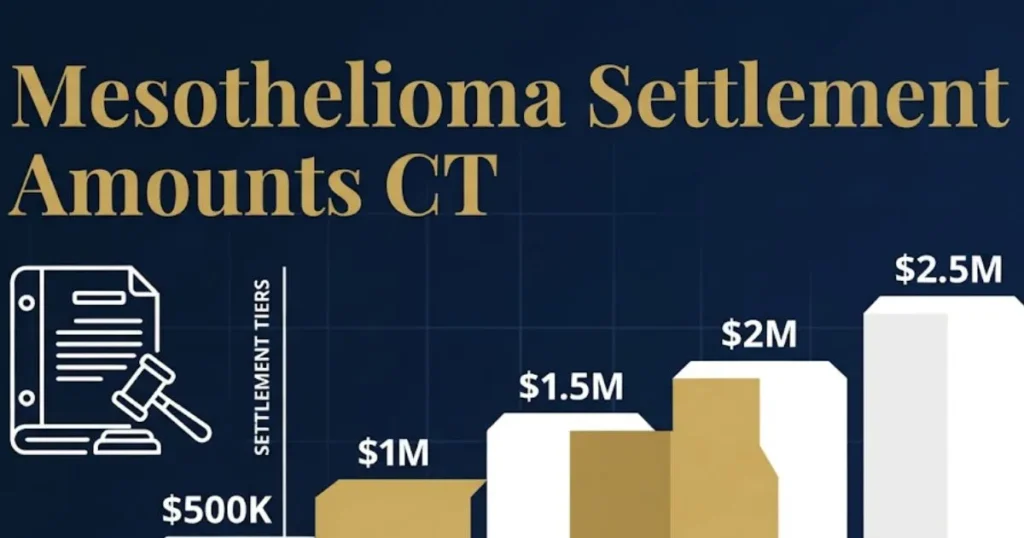
Mesothelioma settlement amounts in Connecticut typically range from $1 million to $2.5 million, though some cases settle for significantly more depending on the facts.
Settlement amounts are not random. They reflect the strength of the evidence, the plaintiff’s age and health, lost wages, medical costs, and pain and suffering. A 55-year-old breadwinner with clear occupational exposure history will generally receive a larger settlement than an elderly retiree with secondary exposure, simply because the economic damages are higher.
Here is a breakdown of the factors that push settlement values up or down:
Factors that increase settlement value:
- Clear documentation of asbestos exposure at a specific worksite
- Multiple responsible defendants still in business
- Diagnosis of pleural mesothelioma (most common type, well-documented link to asbestos)
- Young age at diagnosis with dependents
- High lifetime earnings that were cut short
Factors that decrease settlement value:
- Weak or incomplete work history records
- Exposure at sites where the responsible company is bankrupt with no trust fund
- Smoking history (defendants argue contributory negligence)
- Delayed filing close to the statute of limitations deadline
Connecticut does not cap compensatory damages in personal injury cases. That means there is no state-imposed ceiling on what a jury or settlement can award for medical bills, lost income, or pain and suffering.
Punitive damages are harder to get in Connecticut. Courts require proof of reckless or intentional misconduct. But in cases where a company knowingly hid asbestos dangers, punitive damages have been awarded.
Key Takeaway: Connecticut mesothelioma victims in 2026 can access compensation from lawsuits, trust funds, and VA benefits simultaneously, with average settlements exceeding $1 million.
Who Qualifies for a Mesothelioma Lawsuit in Connecticut
Anyone diagnosed with mesothelioma who was exposed to asbestos in Connecticut may qualify to file a lawsuit. Family members of deceased victims can also qualify through wrongful death or survival actions.
Qualification is not limited to people who currently live in Connecticut. If you worked at a Connecticut factory, shipyard, or military base decades ago and later moved to another state, you can still file in Connecticut courts based on where the exposure occurred.
Here are the basic eligibility requirements:
| Requirement | Details |
|---|---|
| Medical Diagnosis | Confirmed mesothelioma (any type) |
| Asbestos Exposure | Documented exposure at a CT worksite, home, or military facility |
| Statute of Limitations | Filed within 3 years of diagnosis (personal injury) |
| Filing Party | The patient, their spouse, or surviving family members |
You do not need to know the exact brand of asbestos product that harmed you. Experienced attorneys can identify the products and manufacturers based on your work history and the materials commonly used at your job sites.
Common groups that qualify include:
- Factory workers at manufacturing plants
- Shipyard workers at Electric Boat in Groton
- Power plant employees
- Construction tradespeople (pipefitters, electricians, insulators)
- Military veterans stationed at Connecticut bases
- Family members exposed through contaminated work clothing (take-home exposure)
Even people with secondary exposure qualify. Spouses who washed asbestos-contaminated work clothes have filed successful claims in Connecticut.
How to File a Mesothelioma Lawsuit in Connecticut
Filing a mesothelioma lawsuit in Connecticut starts with choosing an experienced asbestos attorney, gathering medical and employment records, and then filing a complaint in Connecticut Superior Court. The process has clear steps.
Think of it like building a house. You need a solid foundation of evidence before you can construct the legal arguments on top. Rushing to file without proper documentation weakens the entire case.
Here is the step-by-step filing process:
Step 1: Free Case Evaluation
Contact an attorney who specializes in asbestos litigation. Most offer free consultations and work on contingency, meaning you pay nothing upfront.
Step 2: Evidence Gathering
Your legal team collects medical records, pathology reports, employment history, union records, and military service records. They identify which companies manufactured the asbestos products at your worksites.
Step 3: Filing the Complaint
The attorney files a formal complaint in Connecticut Superior Court naming specific defendants. This officially starts the lawsuit.
Step 4: Discovery Phase
Both sides exchange evidence. Depositions are taken. Your attorney may depose you at home or in a hospital if travel is difficult.
Step 5: Settlement Negotiations or Trial
Most cases settle during or after discovery. If no settlement is reached, the case proceeds to trial.
| Filing Step | Estimated Duration |
|---|---|
| Case Evaluation | 1 to 2 weeks |
| Evidence Gathering | 1 to 3 months |
| Filing the Complaint | 1 to 2 weeks |
| Discovery Phase | 6 to 12 months |
| Settlement or Trial | 3 to 12 months |
Connecticut courts sometimes expedite mesothelioma cases due to the terminal nature of the disease. Ask your attorney about requesting accelerated scheduling.
Connecticut Mesothelioma Statute of Limitations
The statute of limitations for a mesothelioma lawsuit in Connecticut is three years from the date of diagnosis for personal injury claims and two years from the date of death for wrongful death claims.
This is one of the most critical deadlines in the entire process. Miss it, and the court will almost certainly dismiss your case, no matter how strong your evidence is.
| Claim Type | Deadline |
|---|---|
| Personal Injury | 3 years from date of diagnosis |
| Wrongful Death | 2 years from date of death |
Connecticut follows the discovery rule for mesothelioma cases. This means the clock does not start when you were first exposed to asbestos. It starts when you were diagnosed or when you reasonably should have known about the disease. For a cancer with a 20 to 50 year latency period, this distinction matters enormously.
A common mistake: Some families assume the statute of limitations expired because the asbestos exposure happened in the 1970s. That is not how it works. The deadline is tied to the diagnosis date, not the exposure date.
If the patient passes away before filing, the family has two years from the date of death to file a wrongful death action. If a lawsuit was already filed and the patient dies during the case, the claim converts to a survival action, and the estate continues the case.
Do not wait until the deadline is close. Evidence becomes harder to gather over time, and witnesses move or pass away.
Key Takeaway: Connecticut gives mesothelioma patients three years from diagnosis to file, but starting early protects your evidence and strengthens your case.
Connecticut Asbestos Trust Fund Claims
Connecticut residents can file claims against more than 60 active asbestos trust funds established by bankrupt asbestos companies. These trust funds hold an estimated $30 billion in combined remaining assets as of 2025.
Trust fund claims are separate from lawsuits. You can pursue both at the same time. The trust fund process is administrative, not judicial. That means no courtroom, no judge, and usually faster payouts than a trial.
Each trust fund has its own payment percentage and criteria. Here are some of the major trusts Connecticut residents commonly file against:
| Trust Fund | Estimated Individual Payout | Payment Percentage (2025) |
|---|---|---|
| Johns Manville Trust | $50,000 to $350,000 | Varies by disease level |
| Owens Corning/Fibreboard Trust | $25,000 to $200,000 | 6.1% of scheduled value |
| W.R. Grace Trust | $20,000 to $150,000 | 35.4% |
| USG Corporation Trust | $15,000 to $100,000 | 25% |
| Combustion Engineering Trust | $10,000 to $75,000 | 17.9% |
Payment percentages change periodically based on the number of remaining claims and the trust’s assets. A trust paying 35% today might adjust down to 30% in a year if claim volume increases.
You can file with multiple trusts. A Connecticut worker who handled products from Johns Manville, Owens Corning, and W.R. Grace can file three separate trust claims. Each one pays independently.
Your attorney handles the trust fund paperwork. The process involves submitting medical records, work history, and exposure documentation to each trust. Most trusts process claims within 6 to 12 months.
Average Mesothelioma Verdict in Connecticut
The average mesothelioma trial verdict in Connecticut and comparable jurisdictions ranges from $2.4 million to $14 million, depending on the case facts and the defendants involved.
Going to trial is riskier than settling because a jury could award less than the settlement offer, or in rare cases, nothing at all. But juries often award significantly more than what defendants offered in settlement talks, especially when corporate negligence is blatant.
Notable mesothelioma verdict trends nationally:
- $250 million verdict against Johnson and Johnson in a talc-asbestos case (2019, later reduced)
- $75 million verdict against Honeywell/Bendix in a brake mechanic case
- $32 million verdict against a major insulation manufacturer
Connecticut does not have a publicly maintained database of asbestos verdicts at the state level. However, cases filed in Connecticut Superior Court have resulted in multimillion-dollar outcomes when defendants refused to settle.
Factors that lead to higher verdicts:
- Evidence that the defendant knew about asbestos dangers and concealed them
- Internal company memos showing knowledge of health risks
- Young plaintiffs with families
- Significant medical expenses and lost future earnings
| Outcome Type | Typical Range |
|---|---|
| Low Verdict | $1 million to $2 million |
| Average Verdict | $2.4 million to $5 million |
| High Verdict | $5 million to $14 million+ |
| Exceptional Verdict | $14 million and above |
Most attorneys recommend starting with settlement negotiations. If the offer is too low, trial becomes the backup plan. About 95% of mesothelioma cases settle before reaching a jury.
Connecticut Asbestos Exposure Sites
Connecticut has hundreds of documented asbestos exposure sites, including shipyards, power plants, military bases, schools, and manufacturing facilities. The state’s industrial economy relied heavily on asbestos-containing materials from the 1930s through the 1980s.
The single largest concentration of asbestos exposure in Connecticut occurred at Electric Boat in Groton. Thousands of workers built submarines there using asbestos insulation, gaskets, and fireproofing materials. The U.S. Navy’s submarine fleet was assembled with asbestos in nearly every compartment.
Major Connecticut asbestos exposure sites include:
- Electric Boat (General Dynamics), Groton
- Pratt and Whitney Aircraft, East Hartford
- Sikorsky Aircraft, Stratford and Bridgeport
- United Illuminating power plants, Bridgeport
- Connecticut Light and Power facilities, statewide
- Yale University buildings (maintenance and renovation workers)
- Remington Arms, Bridgeport
- Anaconda American Brass, Waterbury
- Norden Systems, Norwalk
- U.S. Naval Submarine Base, New London
| Site | Location | Primary Exposure Type |
|---|---|---|
| Electric Boat | Groton | Insulation, pipe covering, gaskets |
| Pratt and Whitney | East Hartford | Thermal insulation, brake linings |
| Sikorsky Aircraft | Stratford | Fireproofing, insulation |
| Connecticut Light and Power | Statewide | Boiler insulation, pipe lagging |
| U.S. Naval Sub Base | New London | Ship insulation, engine rooms |
Workers were not the only ones affected. Families of these workers were exposed to asbestos fibers carried home on clothing, shoes, and hair. This is called take-home or secondary exposure, and it has been the basis for successful Connecticut lawsuits.
Key Takeaway: Electric Boat in Groton, Pratt and Whitney, and Connecticut’s power plants are among the most significant asbestos exposure sites still generating mesothelioma cases in 2026.
Connecticut Asbestos Companies Sued for Mesothelioma
Dozens of companies have been named as defendants in Connecticut mesothelioma lawsuits for manufacturing, selling, or using asbestos-containing products. Some of these companies are still operating; others went bankrupt and created trust funds.
The defendants in a Connecticut mesothelioma case are identified through a detailed review of the plaintiff’s work history. Your attorney traces which products were present at your job sites and matches them to the companies responsible.
Commonly sued companies in Connecticut mesothelioma cases:
- General Dynamics (Electric Boat division)
- Pratt and Whitney (United Technologies)
- Johns Manville (insulation)
- Owens Corning (insulation and roofing)
- W.R. Grace (fireproofing)
- Honeywell/Bendix (brake products)
- General Electric
- Metropolitan Life Insurance (knew about asbestos risks, suppressed findings)
- Union Carbide
- Dana Companies (gaskets and seals)
| Company | Product/Role | Status |
|---|---|---|
| Johns Manville | Insulation | Bankrupt, trust fund active |
| Owens Corning | Insulation | Bankrupt, trust fund active |
| W.R. Grace | Fireproofing | Bankrupt, trust fund active |
| General Dynamics | Employer (Electric Boat) | Still operating |
| Honeywell/Bendix | Brake products | Still operating |
When a company is still in business, you sue them directly. When a company is bankrupt, you file a trust fund claim. In most Connecticut cases, plaintiffs do both.
Connecticut courts have consistently held that companies which knew about asbestos dangers and failed to warn workers can be liable for negligence and product liability.
Connecticut Mesothelioma Wrongful Death Lawsuit
A Connecticut mesothelioma wrongful death lawsuit allows surviving family members to seek compensation after a loved one dies from mesothelioma caused by asbestos exposure. The executor or administrator of the deceased person’s estate files this claim.
Connecticut law permits two types of claims when a mesothelioma patient dies:
Wrongful Death Action: This compensates the family for their losses, including lost financial support, loss of companionship, and funeral expenses. The statute of limitations is two years from the date of death.
Survival Action: This continues any personal injury claim the deceased had during their lifetime. It covers medical bills, pain and suffering endured before death, and lost wages. The survival action belongs to the estate.
| Claim Type | Who Files | Deadline | What It Covers |
|---|---|---|---|
| Wrongful Death | Estate executor | 2 years from death | Family’s losses, lost support, funeral costs |
| Survival Action | Estate executor | Continues existing claim | Medical bills, pain, lost wages during life |
Both claims can be filed at the same time. In fact, most attorneys pursue both to maximize compensation for the family.
Connecticut does not cap damages in wrongful death cases. Juries have awarded millions in wrongful death mesothelioma cases when the evidence showed corporate negligence or concealment.
If the patient was already pursuing a lawsuit before they died, that case does not end. It converts to a survival action, and the estate takes over as plaintiff.
Connecticut Mesothelioma Class Action vs Individual Lawsuit
Connecticut mesothelioma cases are filed as individual lawsuits, not class actions. This is an important distinction because individual cases typically result in much higher compensation than class action settlements.
Think of it this way: in a class action, the settlement pot gets split among thousands. In an individual lawsuit, the entire award goes to you and your family.
| Feature | Individual Lawsuit | Class Action |
|---|---|---|
| Compensation | Higher (personalized) | Lower (shared among group) |
| Control | Plaintiff controls case | Lead plaintiff controls for group |
| Timeline | 12 to 24 months typical | 2 to 5 years or more |
| Payout Customization | Based on your damages | One-size-fits-all |
| Common in Mesothelioma | Yes | No |
Mesothelioma lawsuits are not class actions because each case involves unique exposure history, different worksites, different products, and different medical outcomes. A shipyard worker at Electric Boat has a completely different case than a construction worker in Hartford, even though both have mesothelioma.
Why individual lawsuits pay more:
- Your medical costs are calculated individually
- Your lost wages are specific to your career
- Pain and suffering is assessed based on your personal experience
- Punitive damages (if awarded) go directly to you
Some people confuse multidistrict litigation (MDL) with class actions. MDL consolidates similar cases for pretrial proceedings but keeps each case individual for trial and settlement purposes. Some mesothelioma cases do end up in federal MDL proceedings.
Key Takeaway: Mesothelioma cases in Connecticut are always individual lawsuits, giving each plaintiff personal control over their case and access to higher compensation than any class action would provide.
Asbestos Lawsuit Timeline in Connecticut
An asbestos lawsuit in Connecticut typically takes 12 to 24 months from filing to resolution, though some cases settle faster and a few take longer if they go to trial.
Connecticut courts often grant priority scheduling for mesothelioma cases. Judges understand that plaintiffs are fighting a terminal illness with a median survival time of 12 to 21 months after diagnosis. Speed matters.
Here is the standard timeline:
| Phase | Duration | What Happens |
|---|---|---|
| Initial Consultation | 1 to 2 weeks | Attorney reviews case, accepts engagement |
| Investigation and Filing | 1 to 3 months | Evidence gathered, complaint filed |
| Discovery | 6 to 12 months | Document exchange, depositions |
| Settlement Talks | 1 to 6 months | Negotiations with defendants |
| Trial (if needed) | 1 to 4 weeks | Jury hears case, delivers verdict |
| Payout After Settlement | 30 to 90 days | Check issued after agreement finalized |
Factors that speed up the timeline:
- Strong medical documentation already in hand
- Well-documented work history with union records
- Multiple defendants eager to settle before trial
- Court granting expedited scheduling
Factors that slow it down:
- Difficulty identifying all exposure sources
- Defendants filing motions to dismiss
- Complex multi-defendant cases crossing state lines
Trust fund claims run on a separate, often faster timeline. Many trusts process claims in 6 to 12 months and can pay while the lawsuit is still pending.
Your attorney will likely pursue trust fund claims in parallel with the lawsuit. This gives you access to some money sooner while the larger case works through the courts.
How to Choose a Connecticut Mesothelioma Lawyer
The best Connecticut mesothelioma lawyer has specific experience with asbestos litigation, a track record of settlements and verdicts in mesothelioma cases, and the resources to investigate exposure history thoroughly.
Picking a lawyer for a mesothelioma case is nothing like hiring someone for a traffic ticket. This is a complex area of law that requires deep knowledge of industrial products, military records, corporate history, and medical evidence.
What to look for in a mesothelioma attorney:
- At least 10 years of asbestos litigation experience
- Past settlements or verdicts in the millions
- A team that includes investigators, medical experts, and industrial hygienists
- Contingency fee arrangement (no payment unless you win)
- Willingness to travel to your home or hospital for meetings and depositions
- National firm with Connecticut filing experience
| Criteria | Why It Matters |
|---|---|
| Asbestos-specific experience | General personal injury firms lack product knowledge |
| Contingency fees | You pay nothing upfront; attorney gets a percentage of the award |
| National reach | Many defendants are based outside CT |
| Client communication | You need regular updates given the urgency |
| Track record | Past results indicate capability |
Most top mesothelioma firms handle cases nationwide. Even if the firm is headquartered in another state, they can file in Connecticut courts and manage the entire case remotely.
Red flags to watch for:
- Firms that promise specific dollar amounts before reviewing your case
- Attorneys who have never handled a mesothelioma case
- High-pressure sales tactics or cold calls right after diagnosis
Ask for references from past mesothelioma clients. A good firm will gladly provide them.
Connecticut VA Asbestos Exposure and Mesothelioma Claims
Connecticut veterans exposed to asbestos during military service, especially at the Naval Submarine Base in New London or Electric Boat in Groton, can file both VA disability claims and civil lawsuits for mesothelioma compensation.
Veterans make up roughly 30% of all mesothelioma patients in the United States. The military used asbestos extensively in ships, submarines, aircraft, barracks, and vehicle components throughout the 20th century.
Connecticut is home to two major military asbestos hotspots:
- U.S. Naval Submarine Base New London in Groton
- Electric Boat (General Dynamics), which built submarines for the Navy
VA benefits available to veterans with mesothelioma:
- VA Disability Compensation: Up to $3,900+ per month for 100% disability rating (2025 rate, expected to increase in 2026)
- Dependency and Indemnity Compensation (DIC): Monthly payments to surviving spouses
- Special Monthly Compensation: Additional payments for severe disabilities
- VA health care: Treatment at VA medical centers at no cost
| Benefit | Amount | Eligibility |
|---|---|---|
| 100% Disability | $3,900+/month | Mesothelioma diagnosis linked to service |
| DIC (Surviving Spouse) | $1,612+/month | Veteran died from service-connected disease |
| Special Monthly Comp | Varies | Severe disability requiring aid |
VA claims do not affect your right to file a civil lawsuit. You can receive VA benefits and also sue the asbestos manufacturers whose products were used on the base or in the shipyard.
Filing a VA claim requires a service connection. Your attorney and a VA-accredited claims agent can help establish that your asbestos exposure occurred during military service.
Key Takeaway: Connecticut veterans exposed at the Naval Submarine Base or Electric Boat can collect VA disability benefits and file civil lawsuits simultaneously, with no offset or reduction in either.
Connecticut Mesothelioma Diagnosis and Legal Options
A mesothelioma diagnosis in Connecticut triggers several legal options, including personal injury lawsuits, wrongful death claims, asbestos trust fund filings, and VA benefit applications. The type and number of claims you pursue depends on your exposure history and personal circumstances.
Mesothelioma is diagnosed through imaging scans, biopsies, and pathology reviews. The three main types are pleural (lungs), peritoneal (abdomen), and pericardial (heart). Pleural mesothelioma accounts for about 75% of all cases and is the most directly linked to asbestos inhalation.
Once you receive a diagnosis, your first step should be documenting your asbestos exposure history. Think back through every job you held, every worksite, and every product you handled.
Your legal options after diagnosis:
- Personal Injury Lawsuit: File against companies responsible for your exposure. You must file within 3 years of diagnosis.
- Asbestos Trust Fund Claims: File against bankrupt companies’ trust funds. No lawsuit required.
- VA Disability Claim: Available if your exposure occurred during military service.
- Workers’ Compensation: May apply if exposure happened on the job. Does not prevent filing a lawsuit against the product manufacturer.
| Legal Option | Deadline | Average Compensation |
|---|---|---|
| Personal Injury Lawsuit | 3 years from diagnosis | $1M to $2.5M (settlement) |
| Trust Fund Claim | Varies by trust | $25K to $400K per trust |
| VA Disability | None, but sooner is better | $3,900+/month |
| Workers’ Comp | 1 year from diagnosis (CT) | Varies |
Connecticut is a “comparative fault” state. This means even if your employer was partly responsible for your exposure, you can still recover from the manufacturers whose products caused the harm. Your compensation is reduced only by your own percentage of fault, if any.
Getting started early is the single most important step. Medical records are freshest, witnesses are available, and filing deadlines are not a concern when you begin right after diagnosis.
Frequently Asked Questions
How much is a Connecticut mesothelioma lawsuit worth in 2026?
Most Connecticut mesothelioma lawsuits settle for $1 million to $2.5 million.
Trust fund claims can add $25,000 to $400,000 per fund.
Total compensation depends on your exposure history, medical costs, and the number of defendants.
What is the deadline to file a mesothelioma lawsuit in Connecticut?
The deadline is three years from the date of diagnosis for personal injury claims.
For wrongful death claims, the deadline is two years from the date of death.
The clock starts at diagnosis, not at the time of exposure.
Can family members file a mesothelioma wrongful death lawsuit in Connecticut?
Yes, the executor or administrator of the deceased person’s estate can file a wrongful death lawsuit.
Surviving spouses, children, and dependents may receive compensation.
The claim must be filed within two years of the death.
How long does a Connecticut mesothelioma lawsuit take from filing to payout?
Most cases resolve within 12 to 24 months.
Settlements typically arrive 30 to 90 days after the agreement is finalized.
Trust fund claims can pay out within 6 to 12 months and run in parallel with the lawsuit.
Do I need a Connecticut lawyer to file a mesothelioma claim?
You do not need a lawyer based in Connecticut specifically.
National mesothelioma firms regularly file cases in Connecticut Superior Court.
The most important factor is choosing an attorney with specific asbestos litigation experience, regardless of their office location.
The bottom line for 2026 is straightforward: Connecticut mesothelioma lawsuits remain a powerful way to hold asbestos companies accountable and secure compensation for victims and families.
If you have a mesothelioma diagnosis linked to asbestos exposure in Connecticut, start by reviewing your work history and contacting an experienced mesothelioma attorney. Time is your most valuable resource right now.
Every day you delay is a day closer to a filing deadline and a day further from the strongest version of your case.







