

Commercial lawsuit loans give business plaintiffs cash now while their case is still pending. If your company is stuck in litigation and running low on operating capital, this type of funding could be the financial lifeline you need in 2026.
These advances are not technically loans. They are non-recourse funding agreements, meaning you only repay if you win or settle your case. That single detail changes everything about how they work and who should consider them.
This guide breaks down how commercial lawsuit loans function in 2026, what they cost, who qualifies, which companies offer them, and the real risks nobody else is talking about. The commercial litigation funding industry now exceeds $15 billion in annual deployments, and the rules governing it are shifting fast.
You will walk away knowing exactly whether this option makes sense for your situation, and what to watch out for before you sign anything.
What Are Commercial Lawsuit Loans
Commercial lawsuit loans are cash advances provided to business plaintiffs who have pending commercial litigation. They are technically not loans at all. The industry calls them “pre-settlement funding” or “litigation financing.”
Here is how the basic concept works. A funding company reviews your case, evaluates its strength, and offers you a lump sum. You receive the money upfront. If you win or settle, you repay the advance plus fees. If you lose, you owe nothing.
That “owe nothing if you lose” structure is what separates this from a bank loan or line of credit. Traditional lenders require repayment regardless of outcome. Lawsuit funders tie their return entirely to your case result.
| Feature | Commercial Lawsuit Loan | Traditional Business Loan |
|---|---|---|
| Repayment Required if You Lose | No | Yes |
| Credit Check Required | Rarely | Always |
| Collateral Needed | Your pending case | Business assets |
| Based On | Case merit | Creditworthiness |
| Typical Timeline to Receive Funds | 3 to 14 days | 30 to 90 days |
The types of commercial cases funded include breach of contract disputes, partnership dissolution, intellectual property infringement, fraud claims, antitrust actions, and construction litigation. Most funders want cases worth at least $100,000 in expected recovery.
Think of it like selling a slice of your future settlement at a discount. The funder takes on the risk that you might lose. In exchange, they charge premium rates that reflect that gamble.
Commercial Lawsuit Loans in 2026: What Has Changed
The commercial lawsuit loan market in 2026 looks very different from just three years ago. Several states have introduced new regulations, and the industry itself has responded to growing consumer protection pressure.
New York updated its litigation funding disclosure requirements in late 2025, requiring funders to provide borrowers with a clear, itemized breakdown of all fees, interest, and total repayment amounts before any agreement is signed. California followed with similar transparency mandates taking effect in early 2026.
The Consumer Financial Protection Bureau (CFPB) has signaled increased oversight of the litigation finance sector. While the CFPB has not yet classified lawsuit funding as a consumer financial product subject to full federal regulation, its 2025 market report flagged concerns about compounding interest structures and lack of standardized disclosures.
- Several states now cap effective annual interest rates on litigation advances
- Mandatory cooling-off periods exist in at least 5 states as of 2026
- Some jurisdictions require attorney acknowledgment before a client can accept funding
- Disclosure rules now mandate total cost projections at 12, 24, and 36 months
The biggest shift? Competition. More companies entered the market between 2023 and 2026, which has driven rates down slightly for strong commercial cases. Plaintiffs with cases valued above $500,000 are now seeing more competitive offers than at any point in the past decade.
Key Takeaway: The 2026 commercial lawsuit loan market is more regulated, more competitive, and more transparent than ever, but you still need to read every line of the agreement.
How Do Commercial Lawsuit Loans Work
Commercial lawsuit loans work by advancing you money based on the projected value of your pending case, not your credit score or business revenue. The funding company bets on your case outcome.
Here is the step-by-step process in plain terms:
- You apply. You or your attorney submits basic case information to a funding company.
- They review. The funder’s underwriting team evaluates your case strength, expected recovery, and timeline.
- They make an offer. If approved, you receive a funding agreement with the advance amount, fee structure, and repayment terms.
- You get cash. After signing, funds hit your account, typically within 3 to 14 business days.
- Your case resolves. When you win or settle, the funder gets repaid from the proceeds. If you lose, you keep the money.
The funder does not control your case. Your attorney makes all litigation decisions. The funder simply has a financial interest in the outcome.
Most commercial lawsuit funders advance between 5% and 15% of the expected case value. On a case projected to settle for $1 million, you might receive $50,000 to $150,000 upfront.
| Step | What Happens | Typical Timeline |
|---|---|---|
| Application | Submit case details | Day 1 |
| Underwriting Review | Funder evaluates case merit | Days 2 to 7 |
| Offer Issued | Funding terms presented | Days 5 to 10 |
| Funds Disbursed | Cash sent to your account | Days 7 to 14 |
| Repayment | Paid from settlement or verdict | When case resolves |
Your attorney usually needs to cooperate with the funding company by providing case documents and signing an acknowledgment letter. Some attorneys resist this, so have that conversation early.
Who Qualifies for Commercial Lawsuit Loans
You qualify for a commercial lawsuit loan if you are the plaintiff in a pending commercial case with a reasonable chance of winning. The funding company cares almost entirely about case merit, not your personal finances.
Here are the typical qualification requirements:
- You must be the plaintiff (defendants rarely qualify)
- Your case must involve a commercial or business dispute
- You need an attorney on contingency or willing to cooperate with the funder
- Your case must have a projected recovery of at least $75,000 to $100,000 (varies by company)
- The case should be past the initial filing stage, with some discovery completed
Credit scores do not matter. Funders are not lending based on your ability to repay. They are investing in the case outcome. You could have a 500 credit score and still qualify if your case is strong.
Employment status and personal income are also irrelevant. The only real question is: does this case have strong enough facts and legal theory to likely result in a favorable outcome?
| Qualification Factor | Required? | Notes |
|---|---|---|
| Plaintiff Status | Yes | Must be suing, not defending |
| Attorney Representation | Yes | Attorney must cooperate with funder |
| Minimum Case Value | Usually | Typically $75K to $100K minimum |
| Credit Check | No | Not a factor |
| Collateral | No | The case itself is the collateral |
| Discovery Completed | Preferred | Strengthens approval odds |
Cases that commonly qualify: breach of contract, fraud, business tort, intellectual property theft, antitrust violations, partnership disputes, and commercial real estate litigation.
Cases that almost never qualify: speculative claims with no documentary evidence, cases in very early stages with no attorney, and disputes where liability is unclear.
How Much Can You Get from a Commercial Lawsuit Loan
Most commercial lawsuit loan companies advance between 5% and 15% of the estimated settlement or verdict value. On a case worth $500,000, that means you could receive $25,000 to $75,000 upfront.
The exact amount depends on several factors:
- Case strength. Stronger evidence and clearer liability mean a larger advance.
- Expected recovery amount. Higher projected damages lead to bigger funding offers.
- Case timeline. If your case will take 3 or more years to resolve, funders may offer less due to increased risk.
- Attorney reputation. Experienced commercial litigators with strong track records help your application.
Some funders specialize in large commercial cases and will advance $250,000 to $5 million or more for complex business litigation. Companies like Burford Capital and Bentham IMF focus on this higher end of the market.
| Estimated Case Value | Typical Advance Range | Advance as Percentage |
|---|---|---|
| $100,000 | $5,000 to $15,000 | 5% to 15% |
| $500,000 | $25,000 to $75,000 | 5% to 15% |
| $1,000,000 | $50,000 to $150,000 | 5% to 15% |
| $5,000,000 | $250,000 to $750,000 | 5% to 15% |
| $10,000,000+ | $500,000 to $2,000,000+ | 5% to 20% |
Keep in mind that the advance plus all accumulated fees and interest comes out of your settlement first. If you borrow too much, a win might still leave you with less than expected. Think of it like taking a smaller slice of a pie you have not baked yet.
Key Takeaway: The amount you can borrow is tied directly to your case value and strength, and borrowing the maximum available is almost never the smartest move.
Commercial Lawsuit Loan Interest Rates in 2026
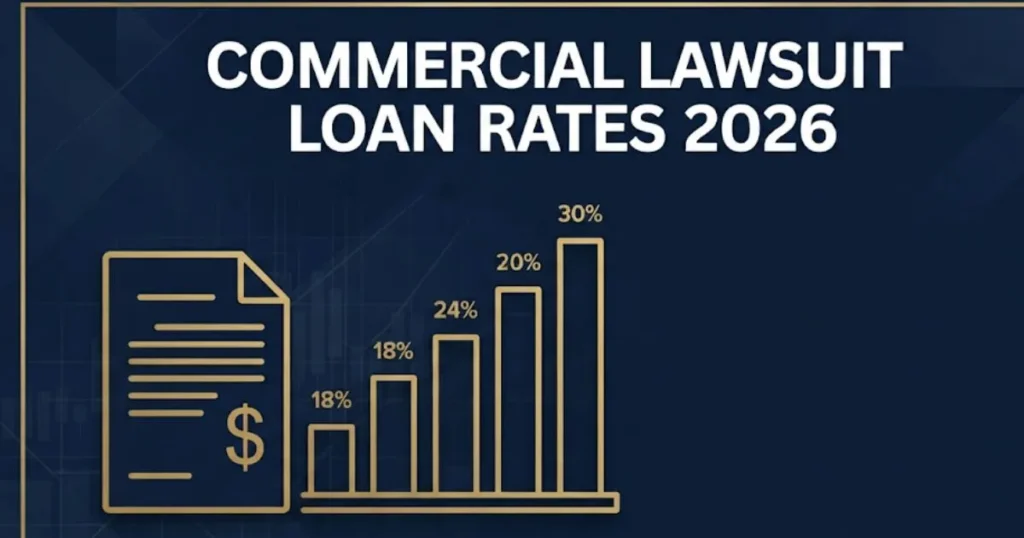
Commercial lawsuit loan interest rates in 2026 typically range from 2% to 4% per month, which translates to roughly 24% to 48% annualized. These rates are significantly higher than traditional bank lending, and for good reason: the funder may never get repaid.
Here is why rates are so high. If you lose your case, the funding company eats the entire loss. That risk premium is baked into every dollar they advance. No bank would accept that deal, which is why lawsuit funding fills a gap that traditional finance will not touch.
Some companies use simple interest, meaning the rate applies only to the original advance amount. Others use compounding interest, where interest accrues on top of previously accumulated interest. The difference is enormous over time.
| Interest Type | $50,000 Advance at 3% Monthly | After 12 Months | After 24 Months | After 36 Months |
|---|---|---|---|---|
| Simple Interest | $50,000 | $68,000 | $86,000 | $104,000 |
| Compound Interest | $50,000 | $71,288 | $101,640 | $144,858 |
That table should stop you cold. With compounding interest, a $50,000 advance can balloon to nearly $145,000 if your case takes three years. That is almost triple what you received.
In 2026, several states have stepped in. Arkansas caps annualized rates at certain thresholds for litigation funding. Ohio and Tennessee have enacted disclosure requirements so borrowers see projected totals at multiple time intervals before signing. Nebraska limits certain funding fees.
Always ask the funding company one direct question: “What will I owe if my case takes 12, 24, and 36 months to resolve?” If they will not answer clearly, walk away.
Commercial Lawsuit Loan Fees and Costs
Commercial lawsuit loan fees go beyond just the interest rate. Several additional costs can increase your total repayment amount, sometimes substantially.
Common fees include:
- Origination fee: A one-time charge for processing your application, typically 1% to 5% of the advance
- Underwriting fee: Covers the cost of evaluating your case, sometimes $500 to $2,000
- Administrative fees: Monthly or quarterly charges for maintaining the funding agreement
- Attorney coordination fee: Some companies charge for communicating with your legal team
- Wire transfer fee: A small charge for sending funds to your bank account
Not every company charges all of these fees. The best funders bundle everything into one clear rate. The worst ones layer fees that are buried in fine print.
| Fee Type | Typical Range | When Charged |
|---|---|---|
| Origination | 1% to 5% of advance | At funding |
| Underwriting | $500 to $2,000 | At funding |
| Administrative | $25 to $100/month | Monthly |
| Attorney Coordination | $0 to $500 | At funding |
| Wire Transfer | $25 to $50 | At funding |
Here is what matters most. Ask every funder for the total cost of capital, not just the monthly rate. Request a written projection showing your total repayment obligation at 6, 12, 18, 24, and 36 months. Compare those numbers across multiple companies.
The cheapest monthly rate is meaningless if the origination fee is 5% and there are hidden administrative charges stacking up. Look at the total picture, always.
Best Commercial Lawsuit Loan Companies in 2026
The best commercial lawsuit loan companies in 2026 combine competitive rates, transparent fee structures, fast funding, and strong reputations for fair dealing.
Here are several of the most recognized names in the space:
| Company | Typical Case Size | Rate Range (Monthly) | Funding Speed | Notable Strength |
|---|---|---|---|---|
| Burford Capital | $1M+ | Negotiable | 2 to 4 weeks | Largest funder globally |
| Baker Street Funding | $50K+ | 2% to 3.5% | 5 to 10 days | Transparent pricing |
| Oasis Financial | $25K+ | 2.5% to 4% | 3 to 7 days | Fast consumer cases |
| USClaims | $25K+ | 2% to 3.5% | 5 to 14 days | Wide case coverage |
| Pravati Capital | $500K+ | Negotiable | 2 to 6 weeks | Complex commercial |
| Express Legal Funding | $10K+ | 2% to 3.5% | 24 to 48 hours | Speed |
| Legalist | $500K+ | Negotiable | 2 to 4 weeks | Data-driven underwriting |
When choosing a funder, prioritize these factors:
- Rate transparency. Do they clearly state whether interest is simple or compound?
- Total cost disclosure. Will they show you projected repayment at multiple timelines?
- No upfront fees. Reputable funders never charge you anything before you receive funding.
- Attorney references. Can they provide references from attorneys who have worked with them?
- State licensing. Are they registered and compliant in your state?
Get quotes from at least three companies. Rates and terms vary significantly, and a little comparison shopping can save you thousands.
Key Takeaway: The “best” funder is the one offering the lowest total cost with the clearest terms for your specific case type and size.
The Commercial Lawsuit Loan Application Process
The commercial lawsuit loan application process starts with a simple form and typically ends with cash in your account within one to two weeks. It is much faster than applying for traditional business financing.
Here is what you will need to provide:
- Your name and contact information
- Your attorney’s name and contact information
- A brief description of the case
- The type of commercial dispute (breach of contract, fraud, IP, etc.)
- The approximate value of the case
- How long the case has been pending
After you submit, the funder contacts your attorney to gather supporting documents. They will want to review the complaint, any discovery materials, and your attorney’s assessment of the case strength and expected timeline.
| Application Stage | What You Do | What the Funder Does | Timeline |
|---|---|---|---|
| Initial Application | Fill out form | Confirm receipt | Day 1 |
| Attorney Outreach | Nothing | Contacts your lawyer | Days 1 to 3 |
| Document Review | Nothing | Reviews case files | Days 3 to 7 |
| Offer Presentation | Review terms | Presents funding offer | Days 5 to 10 |
| Signing | Sign agreement | Processes funding | Day of signing |
| Funding | Receive cash | Wires money | 1 to 3 days after signing |
Your attorney plays a key role. If they respond quickly and provide requested documents without delay, the process moves faster. Some attorneys have strong opinions about litigation funding, so discuss the idea with your lawyer before applying.
There is no obligation to accept an offer. If the terms are not right, decline and try another company.
How Long Does Commercial Lawsuit Funding Take
Commercial lawsuit funding typically takes 7 to 21 business days from application to cash in hand. Smaller, straightforward cases move faster. Large, complex commercial disputes take longer.
The biggest factor affecting speed is your attorney’s responsiveness. Funders cannot evaluate your case without documentation from your legal team. If your lawyer takes a week to return calls, the process stalls.
Here is a realistic breakdown:
| Case Complexity | Application to Approval | Approval to Funding | Total Timeline |
|---|---|---|---|
| Simple breach of contract | 3 to 5 days | 1 to 3 days | 4 to 8 days |
| Mid-level commercial dispute | 5 to 10 days | 2 to 5 days | 7 to 15 days |
| Complex IP or antitrust | 10 to 20 days | 3 to 7 days | 13 to 27 days |
| Multi-million dollar case | 14 to 30 days | 5 to 14 days | 19 to 44 days |
Some companies advertise “24-hour funding.” That is realistic for personal injury cases with clear liability. For commercial cases, it is nearly impossible. Do not let marketing promises set unrealistic expectations.
If timing is critical, tell the funder upfront. Some will expedite their review for an additional fee. Others will prioritize your case if the amount is large enough to justify the effort.
The fastest path to funding: have your attorney prepared with case documents before you apply, choose a funder experienced in your case type, and respond to every request the same day.
Non-Recourse Commercial Lawsuit Funding Explained
Non-recourse commercial lawsuit funding means you only repay the advance if your case results in a financial recovery. If you lose at trial or your case is dismissed, you owe absolutely nothing. The funder absorbs the entire loss.
This is the defining feature that separates lawsuit funding from every other type of business financing. A bank loan must be repaid no matter what. A credit card balance does not disappear if your business deal falls through. But a non-recourse lawsuit advance? If you lose, it is gone. The funder writes it off.
That sounds like free money, and in the event of a loss, it basically is. But the trade-off is cost. Funders charge premium rates precisely because they are taking on this risk. Every advance they make is a bet. Some bets pay off. Some do not. The high interest rates on winning cases subsidize the losses on losing ones.
- Non-recourse: You repay only if you win or settle
- Recourse: You repay regardless of outcome (very rare in lawsuit funding, but some agreements contain hidden recourse provisions)
Read your funding agreement carefully. Some contracts include partial recourse clauses that kick in under certain conditions, like if you drop your case voluntarily or fire your attorney without cause. These conditions effectively turn a “non-recourse” advance into a recourse obligation.
Ask this direct question before signing: “Under what circumstances would I owe you money even if I do not recover anything from my case?” The answer should be “none.” If it is anything else, negotiate or find a different funder.
Key Takeaway: Non-recourse funding shifts the risk of losing to the funder, but you pay for that protection through higher rates, so borrow only what you truly need.
Commercial Lawsuit Loans for Small Business
Commercial lawsuit loans for small businesses work the same way as larger commercial funding, but the stakes often feel more personal. When a small business owner is tied up in litigation, the financial pressure can threaten not just the company but the owner’s personal savings and livelihood.
Small businesses commonly seek lawsuit funding for:
- Breach of contract disputes with vendors, partners, or clients
- Fraud claims against business associates
- Construction disputes involving unpaid work or defective projects
- Employment litigation where the business is the plaintiff
- Landlord-tenant commercial disputes
The challenge for small businesses is meeting minimum case value thresholds. Many funders require cases worth at least $75,000 to $100,000 in expected recovery. Cases below that amount may not be profitable enough for the funder to take on.
| Small Business Consideration | Reality |
|---|---|
| Minimum Case Value | $75,000 to $100,000 at most funders |
| Average Advance | $10,000 to $50,000 |
| Most Common Case Type | Breach of contract |
| Personal Guarantee Required | No (non-recourse) |
| Impact on Business Credit | None |
If your case falls below the minimum, consider smaller, specialized funders that cater to lower-value commercial claims. Some companies have reduced their minimums to $25,000 in expected recovery.
One thing that catches small business owners off guard: the funding comes to you, not your business entity, in many cases. Discuss with your attorney and accountant how to properly categorize the advance for tax and accounting purposes.
Commercial Lawsuit Loan vs Traditional Loan
A commercial lawsuit loan is fundamentally different from a traditional business loan in nearly every way that matters. The most important difference is what happens if things go wrong.
With a traditional loan, you repay the bank no matter what. Your case could fall apart, your business could close, and the bank still wants its money. With a lawsuit loan, the repayment is tied solely to your case outcome. Lose the case, owe nothing.
| Feature | Commercial Lawsuit Loan | Traditional Business Loan |
|---|---|---|
| Repayment Obligation | Only if you win/settle | Always |
| Credit Score Impact | None | Yes, affects credit |
| Interest Rate | 24% to 48% annually | 6% to 15% annually |
| Collateral | Pending lawsuit | Business or personal assets |
| Approval Speed | 1 to 3 weeks | 4 to 12 weeks |
| Personal Guarantee | Not required | Often required |
| Tax Treatment | Varies by jurisdiction | Interest may be deductible |
| Risk to Borrower | Low (non-recourse) | High (full liability) |
The interest rate gap is real. Traditional loans cost far less per year. But they also carry far more risk to you personally. If your business is already under financial stress from ongoing litigation, adding a traditional loan with mandatory repayment could be reckless.
Think of it this way. A lawsuit loan is like buying insurance against a cash flow crisis during litigation. You are paying a premium for the protection of not having to repay if you lose. Whether that premium is worth it depends entirely on your financial situation and the strength of your case.
If you have strong credit, available collateral, and steady revenue, a traditional loan or line of credit will almost always cost less. If your finances are strained because of the litigation itself, a non-recourse lawsuit loan may be the only viable option.
Commercial Lawsuit Loan Risks You Should Know
Commercial lawsuit loans carry real risks that every borrower should understand before signing anything. The biggest risk is not losing your case. It is winning and still ending up with less money than you expected.
Here are the primary risks:
- Compounding interest can consume your settlement. A 3% monthly compound rate turns a $50,000 advance into nearly $145,000 over three years. If your case settles for $200,000, the funder takes $145,000, your attorney takes a third, and you are left with very little.
- Hidden fees add up. Origination fees, administrative charges, and processing costs can add thousands to your repayment total.
- You lose negotiating leverage. Once you take funding, you may feel pressure to settle quickly rather than hold out for a better offer, because the interest clock is ticking.
- Your attorney may object. Some attorneys refuse to work with funders, which can create friction in your legal representation.
- Partial recourse clauses. Some contracts include conditions under which you owe money even if you lose, such as voluntarily dismissing your case.
| Risk | Impact Level | How to Mitigate |
|---|---|---|
| Compounding interest | High | Insist on simple interest |
| Hidden fees | Medium | Request total cost projection |
| Settlement pressure | Medium | Set a minimum acceptable amount before signing |
| Attorney conflict | Low to Medium | Discuss funding with your lawyer first |
| Partial recourse | High | Read every clause, ask direct questions |
The single best protection you have is information. Know exactly what you will owe at 12, 24, and 36 months. Know whether the interest compounds. Know what triggers partial recourse. And never, ever borrow the maximum amount offered.
Borrow the minimum you need to stay afloat. Every additional dollar you take today costs you significantly more tomorrow.
Key Takeaway: The biggest risk of a commercial lawsuit loan is not losing, it is winning and watching compounding interest eat your recovery.
What Happens If You Lose Your Case with a Lawsuit Loan
If you lose your case with a non-recourse commercial lawsuit loan, you owe nothing. You keep whatever money you received, and the funding company absorbs the loss. That is the entire point of non-recourse funding.
This sounds almost too good to be true, so let’s look at how it actually plays out.
Say you received a $75,000 advance on a breach of contract case. After two years of litigation, the jury rules against you. Your total accumulated obligation, including interest and fees, would have been $130,000. But because the agreement is non-recourse, that number disappears. You walk away with the $75,000 you already spent, and the funder writes off the loss.
The funder planned for this possibility. Their business model assumes that a certain percentage of funded cases will lose. The profits from winning cases cover those losses. That is why rates are high across the board.
| Scenario | What You Owe |
|---|---|
| You win or settle | Full advance plus interest and fees |
| Case dismissed involuntarily | Nothing |
| Jury verdict against you | Nothing |
| Case settled for less than owed to funder | Typically only the settlement amount (varies by contract) |
| You voluntarily dismiss your case | May owe full amount (check contract) |
That last row is critical. If you choose to abandon your case without the funder’s knowledge or consent, some agreements convert to recourse obligations. The same applies if you are found to have committed fraud in your application or misrepresented your case facts.
Read the default and termination clauses in your agreement. Know exactly which actions on your part could trigger repayment obligations even without a case recovery.
Commercial Lawsuit Loan State Regulations in 2026
Commercial lawsuit loan state regulations in 2026 vary widely, with some states offering strong consumer protections and others providing almost none. There is no single federal law governing litigation financing.
This patchwork creates real confusion. A funding agreement that is perfectly legal in one state might violate usury laws or disclosure requirements in another.
Here is the current regulatory snapshot for key states:
| State | Interest Rate Cap | Disclosure Requirements | Cooling-Off Period | Attorney Consent Required |
|---|---|---|---|---|
| New York | No specific cap for commercial | Yes, itemized breakdown | No | Yes |
| California | Under review in 2026 | Yes, total cost projections | Proposed | Yes |
| Illinois | Some consumer protections apply | Yes | No | No |
| Ohio | No specific cap | Yes, multi-timeline projections | No | No |
| Arkansas | Usury cap may apply | Limited | No | No |
| Tennessee | Limited regulation | Yes, basic disclosure | No | No |
| Nebraska | Some fee restrictions | Limited | No | No |
| Indiana | Specific litigation funding statute | Yes | 5 business days | Yes |
States with the strongest protections in 2026 tend to require three things: clear disclosure of total costs at multiple time intervals, attorney acknowledgment before the client signs, and cooling-off periods that let borrowers cancel without penalty.
States with weak regulation leave borrowers largely on their own. In those jurisdictions, your best protection is comparison shopping, careful contract reading, and having your attorney review the funding agreement before you sign.
The legal classification of lawsuit funding is still debated. Some states treat it as a consumer transaction subject to lending laws. Others classify it as an investment or purchase of a legal claim, which exempts it from traditional usury caps.
Watch for legislative activity in your state. Several bills are pending in 2026 that could dramatically change the rules. The trend is clearly toward more regulation, not less.
Key Takeaway: State regulations in 2026 are a patchwork, so know your state’s rules before signing any commercial lawsuit funding agreement.
Frequently Asked Questions
Are commercial lawsuit loans considered real loans?
No, commercial lawsuit loans are not technically loans in the traditional sense.
They are classified as non-recourse advances or purchases of a portion of your future case proceeds.
This classification means they often fall outside standard lending regulations and usury caps.
Can I get a commercial lawsuit loan with bad credit?
Yes, credit scores are not a factor in commercial lawsuit loan approvals.
Funders evaluate your case merit, expected recovery, and the strength of evidence.
Your financial history, employment status, and existing debts are irrelevant to their decision.
How fast can I receive commercial lawsuit funding?
Most applicants receive funding within 7 to 21 business days.
Simple cases with responsive attorneys can fund in as few as 4 to 8 days.
Complex, high-value commercial disputes may take 3 to 6 weeks for full underwriting and approval.
Do I have to repay a commercial lawsuit loan if I lose?
No, you do not repay a non-recourse commercial lawsuit loan if you lose your case.
The funding company absorbs the full loss.
The only exceptions involve voluntary case dismissal, fraud in the application, or specific contract provisions, so read the agreement carefully.
What types of business cases qualify for lawsuit funding?
Breach of contract, fraud, partnership disputes, intellectual property infringement, antitrust claims, and construction litigation commonly qualify.
The case generally needs a projected recovery of at least $75,000 to $100,000.
You must be the plaintiff with an attorney actively handling the case.
Your Next Move
Commercial lawsuit loans in 2026 offer a real option for businesses stuck in litigation with shrinking cash reserves. The funding is faster, more competitive, and better regulated than in years past.
Do your homework before you commit. Compare at least three funders. Demand total cost projections. Have your attorney review the agreement. And only borrow what you absolutely need.
The right funding can keep your business alive long enough to win. The wrong deal can swallow your settlement whole. Know the difference.







