

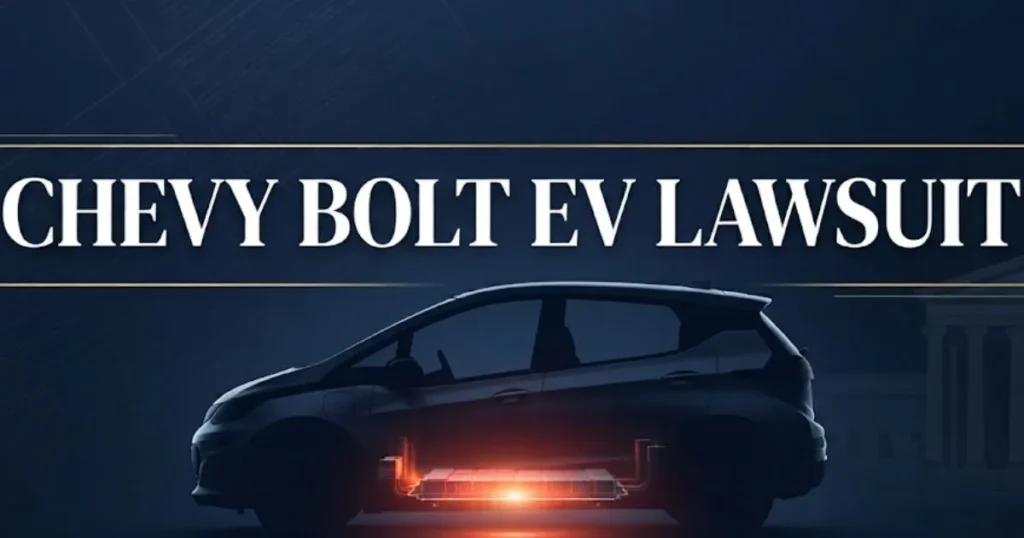
The Chevy Bolt EV lawsuit is still active in 2026 and covers battery fire defects in both the Bolt EV and Bolt EUV. General Motors recalled every single Bolt ever made because of defective LG Energy Solution battery cells that could overheat and catch fire.
If you own or owned a Chevy Bolt, you may be owed money. This article breaks down who qualifies, how much you could get, and what deadlines you need to know about.
More than 140,000 vehicles were recalled. At least 19 confirmed fires were reported before GM pulled the plug on production.
You will learn about the class action case, payout estimates, eligibility rules, filing steps, and the 2026 timeline. Everything here is specific, current, and written for real people who need real answers.
What Is the Chevy Bolt EV Lawsuit About
The Chevy Bolt EV lawsuit is a series of legal actions against General Motors and LG Energy Solution for selling vehicles with defective lithium-ion battery cells that could cause fires. These lawsuits include class action claims, individual product liability cases, and lemon law filings across multiple states.
The core problem traces back to manufacturing flaws in the battery cells produced by LG Chem at its facilities in South Korea and Michigan. Two specific defects were identified: a torn anode tab and a folded separator inside the battery cell. When both defects existed in the same cell, the battery could experience thermal runaway during charging.
GM first issued a partial recall in November 2020 for certain 2017 to 2019 model year Bolt EVs. By August 2021, the recall expanded to include every Bolt EV ever produced, covering model years 2017 to 2022. The 2022 Bolt EUV was later added.
| Detail | Info |
|---|---|
| Defendants | General Motors, LG Energy Solution |
| Vehicles Affected | Chevy Bolt EV (2017 to 2022), Bolt EUV (2022 to 2023) |
| Total Vehicles Recalled | Approximately 142,000 |
| Root Cause | Defective LG battery cells (torn anode tab + folded separator) |
| Confirmed Vehicle Fires | At least 19 reported |
| Primary Legal Claims | Product liability, breach of warranty, negligence |
These lawsuits claim GM knew about the fire risk but delayed the full recall for over a year. Owners were told to park outside, avoid charging above 90%, and limit their battery to 80% state of charge. For many people, that meant their car became essentially unusable.
Chevy Bolt Class Action Lawsuit Explained
The Chevy Bolt class action lawsuit is a consolidated legal case where a large group of Bolt owners collectively sue GM for damages related to the battery defect and recall. Instead of each owner filing separately, one case represents thousands of affected consumers.
Several class action complaints were filed in federal courts across the country starting in 2020. Many of these cases were consolidated for pretrial proceedings. The lawsuits allege that GM violated state consumer protection laws, breached express and implied warranties under the Magnuson-Moss Warranty Act, and committed fraud by concealment.
A class action works like this: lead plaintiffs represent the entire group. If the case settles or wins at trial, every qualifying class member receives compensation. You don’t have to do much. In most class actions, you just need to submit a claim form when the time comes.
Key claims in the class action include:
- GM knew about the battery defect before selling the vehicles
- GM’s initial software fix was inadequate and did not address the root cause
- Owners suffered financial losses from diminished resale value
- Owners faced safety risks and inconvenience during the extended recall period
- The recall process took too long, leaving owners without reliable transportation
One important distinction: the class action is separate from individual lawsuits. If your Bolt actually caught fire and caused property damage or injuries, you may have a stronger case filing individually rather than joining the class.
Chevy Bolt EV and EUV Battery Lawsuit Details
The Chevy Bolt EV and EUV battery lawsuit covers both the standard Bolt EV and the slightly larger Bolt EUV, since both models used the same defective LG Energy Solution battery modules. There is no difference in legal coverage between the two models.
GM launched the Bolt EUV in 2022 as a roomier version of the original Bolt EV. Both vehicles shared the same battery platform. When the defective cells were discovered, the recall expanded to include EUV models produced through 2023.
The battery packs in both models contained multiple modules, each housing several pouch-type lithium-ion cells. The manufacturing flaw at LG’s plants meant that a percentage of these cells had structural defects that could lead to internal short circuits. During charging, especially to full capacity, the damaged cells could overheat rapidly.
| Model | Years Covered | Battery Supplier | Recall Status |
|---|---|---|---|
| Chevy Bolt EV | 2017 to 2022 | LG Energy Solution | Full recall, battery replacement |
| Chevy Bolt EUV | 2022 to 2023 | LG Energy Solution | Full recall, battery replacement |
GM’s fix involved replacing every battery module in every recalled vehicle. This was one of the most expensive recalls in automotive history, costing GM an estimated $1.8 billion in total charges. GM later reached a reimbursement deal with LG Energy Solution for approximately $1.9 billion to cover recall costs.
If you own either model, you are covered by the same legal actions. There is no need to worry about whether your specific version qualifies. Both do.
Key Takeaway: The Chevy Bolt EV lawsuit covers both the EV and EUV models across all production years because both used the same defective LG battery cells.
Chevy Bolt EV Lawsuit Payout Estimates
Chevy Bolt EV lawsuit payouts will vary significantly based on the type of damage you experienced. Someone whose car caught fire will receive far more than someone who just dealt with the inconvenience of the recall.
No final settlement amounts have been officially confirmed for the class action as of early 2026. But based on similar automotive defect cases and the claims being made, legal analysts have outlined several payout tiers that owners might expect.
| Damage Type | Estimated Payout Range |
|---|---|
| Vehicle fire with total loss | $20,000 to $50,000 or more |
| Property damage from fire (garage, home) | $50,000 to $150,000 or more |
| Physical injury from fire | $100,000 to $500,000 or more |
| Diminished vehicle value (no fire) | $3,000 to $8,000 |
| Inconvenience and loss of use | $500 to $3,000 |
| Out-of-pocket costs (rental cars, etc.) | Actual documented costs |
These numbers are estimates based on court filings and comparable EV battery defect settlements. Your actual payout depends on your documentation, the severity of your situation, and whether the case settles or goes to trial.
Owners who kept records of rental car expenses, repair costs, insurance claims, and communications with GM dealers are in the strongest position. Think of it like building a receipt folder for a tax audit. The more paper you have, the better your outcome.
Individual lawsuits for fire-related damages tend to pay out much higher than class action claims. If your Bolt actually caught fire, filing your own lawsuit may be worth more than waiting for the class settlement.
Chevy Bolt Class Action Settlement Amount
The Chevy Bolt class action settlement amount has not been finalized as of 2026, but legal experts expect a total settlement fund in the range of $150 million to $500 million or more based on the size of the affected class and the severity of the defects.
To put this in context, GM already spent $1.8 billion on the recall itself. LG Energy Solution reimbursed GM roughly $1.9 billion. The class action settlement would be a separate payment on top of those recall costs, meant to compensate owners for losses that the recall alone did not cover.
What the settlement would cover:
- Loss of vehicle value (your Bolt is worth less because of its recall history)
- Time without your vehicle during the recall
- Costs you paid out of pocket (rental cars, alternate transportation)
- Emotional distress and safety concerns
- Reduced battery capacity if you received a software-limited replacement
Settlement math in class actions can be tricky. If 100,000 owners file claims against a $300 million fund, the average payout per person would be around $3,000. But payouts are rarely equal. People with documented fire damage get more. People with minimal losses get less.
The final amount depends heavily on negotiations between the plaintiffs’ attorneys and GM’s legal team. If the case goes to trial instead of settling, the potential payout could be higher, but the timeline would stretch even longer.
Who Is Eligible for the Chevy Bolt EV Lawsuit
You are eligible for the Chevy Bolt EV lawsuit if you currently own, previously owned, or leased a Chevy Bolt EV (2017 to 2022) or Chevy Bolt EUV (2022 to 2023) that was subject to GM’s battery recall.
Eligibility is broad. You do not need to have experienced a fire. You do not need to have been injured. The class action covers all owners and lessees of affected vehicles, regardless of whether the worst-case scenario happened to them.
You likely qualify if:
- You bought or leased a new Chevy Bolt EV or EUV during the affected model years
- You purchased a used Bolt that was still subject to the recall
- Your vehicle received the battery replacement under the recall
- Your vehicle had its software updated to limit charging capacity
- You sold your Bolt at a loss because of the recall
You may not qualify if:
- You bought a Bolt after the battery replacement was completed and the recall was fully resolved on that specific vehicle
- Your vehicle was a salvage title purchased after a fire (this varies by state)
- You are outside the statute of limitations in your state
| Eligibility Factor | Covered? |
|---|---|
| Current owner of recalled Bolt EV/EUV | Yes |
| Former owner who sold during recall period | Yes |
| Lessee of recalled Bolt | Yes |
| Buyer of used Bolt under recall | Yes |
| Owner whose Bolt caught fire | Yes, with higher compensation |
| Owner who experienced no fire or damage | Yes, for diminished value and inconvenience |
The key is timing. If you owned the vehicle at any point during the recall period, you have standing to participate. Keep your purchase or lease documents handy.
Key Takeaway: Almost every person who owned or leased a recalled Chevy Bolt EV or EUV qualifies for the lawsuit, even if their car never caught fire.
Chevy Bolt Battery Fire Lawsuit Claims
Chevy Bolt battery fire lawsuits are individual legal claims filed by owners whose vehicles actually caught fire or posed an imminent fire risk due to the defective LG battery cells. These cases seek much higher compensation than the class action because the damages are more severe and specific.
NHTSA recorded at least 19 confirmed battery fires in Chevy Bolt EVs before the full recall was issued. Some of these fires happened while the vehicles were parked and not even charging. Others occurred during or shortly after charging sessions.
Several owners reported their Bolts catching fire inside garages, causing significant damage to their homes. In at least two cases, the fires spread to adjacent structures. These owners filed individual product liability lawsuits seeking compensation for property destruction, temporary housing costs, and personal belongings lost in the fire.
Types of damages claimed in fire lawsuits:
- Total loss of the vehicle
- Home or garage fire damage
- Personal injury (burns, smoke inhalation)
- Emotional distress and trauma
- Lost wages during recovery
- Temporary housing expenses
- Replacement of personal property destroyed in the fire
Fire-related lawsuits are treated differently from the class action. They are individual cases, often handled on a contingency fee basis by specialized product liability attorneys. The payouts in these cases can reach into the six figures or higher, depending on the extent of the damage.
If your Bolt caught fire, do not wait. Individual fire claims have specific statute of limitations deadlines that vary by state. Some states give you as little as two years from the date of the fire to file.
Chevy Bolt EV Settlement Status in 2026
The Chevy Bolt EV settlement is still in the negotiation phase as of early 2026. No final class action settlement has been approved by the court, but pretrial proceedings and discovery have been underway for several years.
Both GM and the plaintiffs’ legal teams have been engaged in mediation efforts. Court filings suggest that a proposed settlement framework could emerge sometime in mid to late 2026. If a settlement is reached, it would then need preliminary court approval, a notice period for class members, a fairness hearing, and final approval before any money is distributed.
Current settlement timeline (estimated):
| Phase | Expected Timing |
|---|---|
| Mediation and negotiation | Ongoing through mid-2026 |
| Proposed settlement announcement | Mid to late 2026 |
| Preliminary court approval | Late 2026 |
| Class member notification | Late 2026 to early 2027 |
| Objection and opt-out period | 60 to 90 days after notification |
| Fairness hearing | Early to mid 2027 |
| Final approval | Mid 2027 |
| Claims submission period | Mid to late 2027 |
| First payouts | Late 2027 to early 2028 |
This timeline is an estimate. Settlements in large automotive class actions often take 3 to 5 years from the first filing to the first check. The Takata airbag and GM ignition switch cases both followed similar timelines.
Patience is required. But the wheels are turning. If you qualify, make sure you are registered to receive notifications about the settlement when it is announced.
GM Chevy Bolt Lawsuit Update for 2026
The most important GM Chevy Bolt lawsuit update for 2026 is that multiple legal tracks remain active, including the consolidated class action, individual fire damage cases, and state-level lemon law claims.
GM completed its battery replacement program in late 2023 and early 2024, replacing battery modules in the vast majority of recalled vehicles. But the lawsuits are not about the recall fix itself. They are about the losses owners suffered before, during, and after the recall process.
Key 2026 developments:
- Mediation between GM and plaintiffs’ counsel is ongoing
- Discovery phase has produced internal GM communications about the defect timeline
- Several individual fire cases have been resolved through private settlements (amounts undisclosed)
- State attorney general investigations in multiple states remain open
- LG Energy Solution’s reimbursement to GM does not affect individual owner claims
Court documents filed in early 2026 indicate that both sides are preparing for possible trial if settlement talks stall. GM has maintained that the recall adequately addressed the safety issue, while plaintiffs argue that the recall was too slow and the interim safety measures (parking outside, limiting charging) were burdensome and insufficient.
Think of the current situation like a chess match in its middle game. Both sides have made their moves. The endgame, whether that is settlement or trial, is approaching.
Key Takeaway: The GM Chevy Bolt lawsuit is active in 2026 with mediation ongoing, and a proposed settlement could emerge by the second half of the year.
Chevy Bolt Recall Lawsuit 2026 Timeline
The Chevy Bolt recall lawsuit in 2026 sits at a critical stage where settlement discussions could produce a resolution or the case could advance toward trial. Here is the full timeline from the beginning to where things stand now.
| Date | Event |
|---|---|
| November 2020 | GM issues first partial recall for 2017 to 2019 Bolt EVs |
| February 2021 | Software update offered as interim fix |
| July 2021 | GM warns owners to park outside and limit charging |
| August 2021 | Recall expands to all Bolt EVs (2017 to 2022) |
| September 2021 | Bolt EUV added to recall |
| October 2021 | First class action lawsuits filed |
| April 2022 | Battery module replacements begin |
| Late 2023 | Majority of battery replacements completed |
| 2024 | Pretrial discovery and depositions continue |
| 2025 | Mediation sessions begin |
| Early 2026 | Settlement framework under negotiation |
| Mid to Late 2026 | Proposed settlement expected |
The recall itself lasted roughly three years from the first notice to the completion of most battery replacements. During that time, owners dealt with reduced vehicle capability, safety anxiety, and significant inconvenience.
From a legal standpoint, 2026 is likely the year when we will see the clearest picture of what the settlement looks like. Owners who have not yet registered with the class action administrators should do so as soon as possible.
Chevy Bolt Battery Replacement Lawsuit
The Chevy Bolt battery replacement lawsuit focuses specifically on problems owners experienced with the recall repair itself, not just the original defect. Many owners reported long wait times, inadequate loaner vehicles, and battery replacements that came with reduced warranty terms.
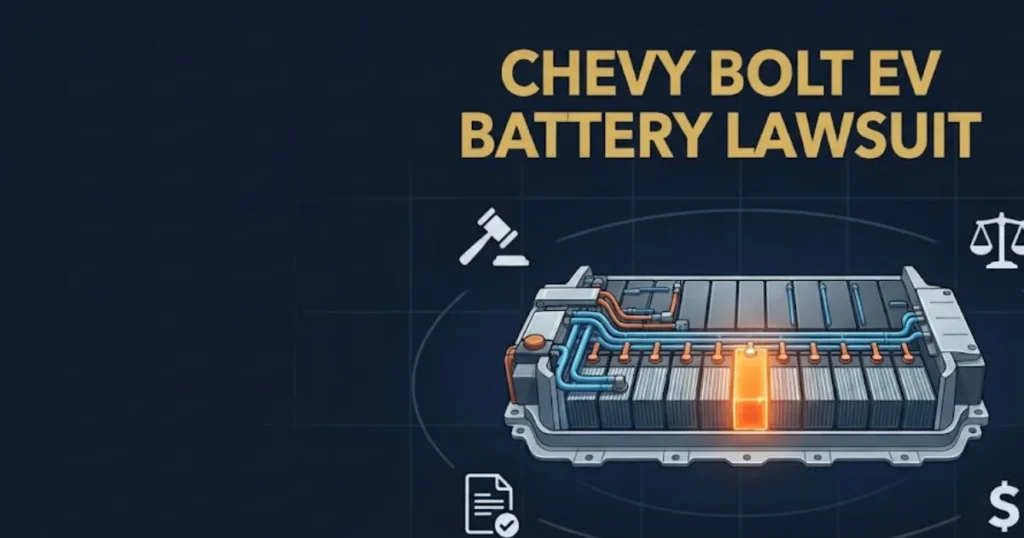
GM’s recall fix involved replacing every battery module in every affected Bolt. That sounds straightforward, but in practice, it created a second wave of frustration. Dealerships were overwhelmed. Parts were backordered for months. Some owners waited six months to a year for their replacement battery.
Common complaints about the replacement process:
- Months-long wait times for battery modules
- Loaner vehicles that were not equivalent (gas cars instead of EVs)
- Reduced driving range after replacement in some cases
- New battery modules with shorter warranty coverage than original
- Dealers refusing to perform the recall in a timely manner
- Loss of vehicle use during the wait
The lawsuit claims that GM’s handling of the replacement process caused additional damages beyond the original defect. Owners who relied on their Bolts for daily commuting had to find alternative transportation, often at their own expense.
Some owners also reported that the replacement batteries had slightly different performance characteristics than the originals. While GM stated the new modules met all specifications, owner reports of reduced range persisted.
If you experienced significant delays or out-of-pocket costs during the battery replacement process, those losses are part of your potential claim.
Chevy Bolt EV Recall Compensation Options
Chevy Bolt EV recall compensation is available through several legal pathways, and the best option depends on your specific situation. Not everyone should take the same route.
Compensation options available to Bolt owners:
| Option | Best For | Potential Value |
|---|---|---|
| Class action participation | Owners with no fire, moderate losses | $500 to $8,000 |
| Individual product liability lawsuit | Owners whose Bolt caught fire | $20,000 to $500,000+ |
| State lemon law claim | Owners in states with strong lemon laws | Vehicle buyback or replacement |
| Insurance claim plus subrogation | Owners with fire-damaged property | Varies by policy |
| Direct negotiation with GM | Owners seeking a quick buyback | Trade-in value plus recall adjustment |
The class action is the easiest path for most people. You fill out a claim form, provide documentation, and wait for the settlement to be distributed. But the payout per person is lower.
Individual lawsuits are worth pursuing if you experienced a fire, significant property damage, or personal injury. These cases take longer but pay much more.
Lemon law claims are state-specific. In California, for example, the Song-Beverly Consumer Warranty Act allows owners of defective vehicles to demand a full refund or replacement. Other states have similar protections, though the rules and timelines vary.
Some owners have already negotiated directly with GM for vehicle buybacks at above-market prices. GM’s customer assistance program offered some owners enhanced trade-in values, though the details of these deals are not publicly disclosed.
Key Takeaway: You have multiple compensation paths available, from class action claims to individual lawsuits to lemon law filings, and the right choice depends on the type of damage you experienced.
Chevy Bolt Diminished Value Claim
A Chevy Bolt diminished value claim seeks compensation for the loss in your vehicle’s resale value caused by its recall history. Even after the battery replacement, a Bolt with a fire recall on its record is worth less than one without.
Think of it like a house that had termite damage. Even after the termites are gone and the wood is replaced, buyers will pay less for that house because of its history. The same principle applies to recalled vehicles.
How diminished value is calculated:
- Pre-recall market value of your specific Bolt model and year
- Post-recall market value based on comparable sales data
- The difference between those two numbers is your diminished value
Studies of used Bolt resale prices show a 15% to 25% drop in value compared to similar EVs that were not subject to fire-related recalls. On a vehicle originally worth $30,000, that represents a loss of $4,500 to $7,500.
| Model Year | Pre-Recall Avg Value | Post-Recall Avg Value | Estimated Loss |
|---|---|---|---|
| 2017 Bolt EV | $15,000 | $11,500 | $3,500 |
| 2019 Bolt EV | $20,000 | $15,500 | $4,500 |
| 2020 Bolt EV | $23,000 | $18,000 | $5,000 |
| 2022 Bolt EV | $27,000 | $21,000 | $6,000 |
| 2022 Bolt EUV | $29,000 | $22,500 | $6,500 |
Diminished value claims are typically part of the class action settlement. But you can also file a diminished value claim independently through your insurance company or as a separate legal action against GM.
The key evidence you need is proof of what your Bolt was worth before the recall news broke and what comparable models sell for now. Online valuation tools and dealer trade-in records can help establish these numbers.
Chevy Bolt Fire Risk Legal Action
Chevy Bolt fire risk legal action refers to lawsuits filed on the basis that GM sold vehicles with a known risk of spontaneous battery fires and failed to warn consumers or act quickly enough to fix the problem.
The legal theory here is straightforward: GM had a duty to sell safe vehicles. The Bolts were not safe. GM knew about the problem. GM delayed. People got hurt, lost property, or suffered financial harm as a result.
Legal theories used in Chevy Bolt fire risk cases:
- Product liability (strict liability): The vehicle was defective and unreasonably dangerous
- Negligence: GM failed to exercise reasonable care in design, manufacturing, or recall
- Fraud by concealment: GM knew about the defect and withheld information from buyers
- Breach of express warranty: GM guaranteed the vehicle was safe and fit for use
- Breach of implied warranty: The vehicle was not merchantable due to the fire risk
- Violation of state consumer protection statutes: Unfair and deceptive business practices
Court filings reveal that GM engineers identified potential battery cell issues as early as 2017, shortly after the first Bolt EVs hit dealerships. Internal emails and technical reports obtained during discovery have become central evidence in the case.
NHTSA opened its investigation after receiving fire complaints and issued a formal recall under NHTSA Recall Numbers 21V-560 and 21V-786. These recall numbers are referenced in nearly every lawsuit filed against GM related to the Bolt.
The strength of these legal claims is significant. When a manufacturer knows about a life-threatening defect and delays action, courts tend to take that very seriously.
How to File a Chevy Bolt Lawsuit
Filing a Chevy Bolt lawsuit in 2026 is a straightforward process, but the exact steps depend on whether you are joining the class action or pursuing an individual claim.
For the class action:
- Check whether you owned or leased a recalled Bolt EV or EUV
- Gather your vehicle purchase or lease documents
- Collect records of any recall-related expenses (rental cars, lost time, repairs)
- Register with the class action administrator when the settlement is announced
- Submit a claim form with supporting documentation
- Wait for the settlement to be approved and payments distributed
For an individual lawsuit:
- Document all damages (photos of fire damage, repair bills, medical records)
- Obtain your vehicle’s recall history from the dealer or GM
- Contact a product liability attorney who handles automotive defect cases
- Your attorney will file the complaint in the appropriate court
- The case proceeds through discovery, negotiation, and potentially trial
Documents you should gather now:
- Purchase or lease agreement
- Vehicle registration and VIN
- Recall notification letters from GM
- Service records showing battery replacement or software updates
- Receipts for rental cars, rideshare costs, or alternate transportation
- Insurance claim records (if applicable)
- Photos of any fire or heat damage
- Written communications with GM or your dealer about the recall
Most attorneys who handle these cases work on a contingency fee basis. That means you pay nothing upfront. The attorney takes a percentage (typically 25% to 40%) of your settlement or verdict if you win. If you don’t win, you owe nothing.
Do not wait until the last minute. Gathering documents now puts you in the best position when the settlement is announced or your individual case moves forward.
Key Takeaway: Whether you join the class action or file individually, start collecting your documentation now because your records directly affect how much compensation you can receive.
Chevy Bolt EV Lawsuit Deadline and Statute of Limitations
The Chevy Bolt EV lawsuit deadline depends on your state’s statute of limitations for product liability and breach of warranty claims. In most states, you have two to four years from the date of injury or discovery of the defect to file a lawsuit.
This is where things get a little complicated. The “discovery rule” in many states means the clock starts ticking not when you bought the car, but when you knew or should have known about the defect. For most Bolt owners, that date is when GM issued the recall notice for their specific vehicle.
Statute of limitations by state (selected examples):
| State | Product Liability SOL | Breach of Warranty SOL |
|---|---|---|
| California | 2 years | 4 years |
| Texas | 2 years | 4 years |
| New York | 3 years | 4 years |
| Florida | 4 years | 4 years |
| Michigan | 3 years | 4 years |
| Illinois | 2 years | 4 years |
| Pennsylvania | 2 years | 4 years |
| Ohio | 2 years | 4 years |
If the recall notice for your vehicle was issued in 2021 and your state has a two-year statute of limitations for product liability, your filing deadline may have already passed. But warranty claims often have a longer window, and the class action itself may preserve your rights through the tolling doctrine.
Tolling means the statute of limitations can be paused while a class action is pending. If you are a member of the class, your individual deadline may be extended while the case is active. But this protection only applies if you are part of the certified class.
Here is the bottom line: if you have not taken any action yet, 2026 is likely your last clear window. Do not assume you have unlimited time. Check your state’s rules and act accordingly.
Important deadlines to watch in 2026:
- Settlement announcement (expected mid to late 2026)
- Claim submission period (opens after settlement approval)
- Opt-out deadline (if you want to file individually instead of joining the class)
- State-specific statute of limitations for individual lawsuits
Frequently Asked Questions
How much money can I get from the Chevy Bolt EV lawsuit?
Most class action participants can expect between $500 and $8,000 depending on their documented losses.
Owners whose vehicles caught fire may receive $20,000 to $500,000 or more through individual lawsuits.
Final amounts depend on the settlement terms and your specific evidence.
Is there a deadline to file a Chevy Bolt class action lawsuit in 2026?
Yes, the statute of limitations varies by state, typically two to four years from discovery of the defect.
For many owners, 2026 may be the final year to preserve their claims.
Watch for the official claim submission window once a settlement is announced.
Does the Chevy Bolt battery lawsuit cover both the EV and EUV models?
Yes, the lawsuit covers both the Chevy Bolt EV (2017 to 2022) and Bolt EUV (2022 to 2023).
Both models used the same defective LG Energy Solution battery cells.
There is no distinction between the two in terms of legal eligibility.
Can I file a Chevy Bolt lawsuit if my car never caught fire?
Yes, you can still file even if your Bolt never caught fire.
The class action covers diminished vehicle value, loss of use, and recall-related inconvenience.
You do not need to have experienced a fire or injury to qualify.
What is the current status of the Chevy Bolt EV settlement?
The class action settlement is in the negotiation and mediation phase as of early 2026.
A proposed settlement framework is expected to be announced by mid to late 2026.
No final settlement amount has been approved by the court yet.
What You Should Do Right Now
The Chevy Bolt EV lawsuit in 2026 represents one of the biggest EV-related legal actions in American history. If you own or owned a recalled Bolt, your window to act is narrowing.
Gather your purchase documents, recall letters, and expense receipts. Keep everything in one place. When the settlement claim form opens, you will want to be ready to submit quickly.
Stay informed. Register for class action updates. And if your Bolt caught fire or caused significant damage, talk to a product liability attorney about filing an individual claim before your state’s deadline passes.







