

Yes, a lawsuit can be reopened after settlement, but only under very specific legal circumstances. Courts treat settlement agreements as binding contracts, and overturning one requires proof of fraud, duress, mutual mistake, or another recognized legal ground.
Most people assume that once you sign a settlement, the door is shut forever. That’s not always true. In rare situations, courts do allow cases to come back to life.
This article breaks down every legal ground for reopening a settlement in 2026. You’ll learn the exact process, time limits, and real consequences of challenging an agreement you already signed.
Here’s a fact that surprises most people: under Federal Rule of Civil Procedure 60(b), you can ask a court to set aside a settlement-related judgment for up to one full year after entry, and in some cases, even longer.
Can a Lawsuit Be Reopened After Settlement?
A lawsuit can be reopened after settlement, but the bar is set high. Courts don’t undo settlements casually because the whole point of settling is to end the dispute permanently.
When you settle a case, both sides typically sign a release of claims. That release is a binding contract. You give up your right to sue in exchange for money or some other benefit.
But contracts can be voided. If the settlement was obtained through lies, threats, or a serious misunderstanding, the law provides a path to undo it.
Think of it like buying a house. If you close the deal and later discover the seller hid a cracked foundation, you might have grounds to rescind the sale. Settlements work similarly.
| Factor | Details |
|---|---|
| General Rule | Settlements are final and binding |
| Exceptions Exist | Yes, under specific legal grounds |
| Relevant Federal Rule | Rule 60(b) of the Federal Rules of Civil Procedure |
| Typical Success Rate | Low; most challenges fail |
| Common Reason for Success | Fraud by the opposing party |
The key question is always whether you can prove something went seriously wrong with the agreement itself. Simply regretting the amount you accepted isn’t enough. Courts require evidence of a legal defect in how the settlement was formed or executed.
Grounds for Reopening a Settled Case
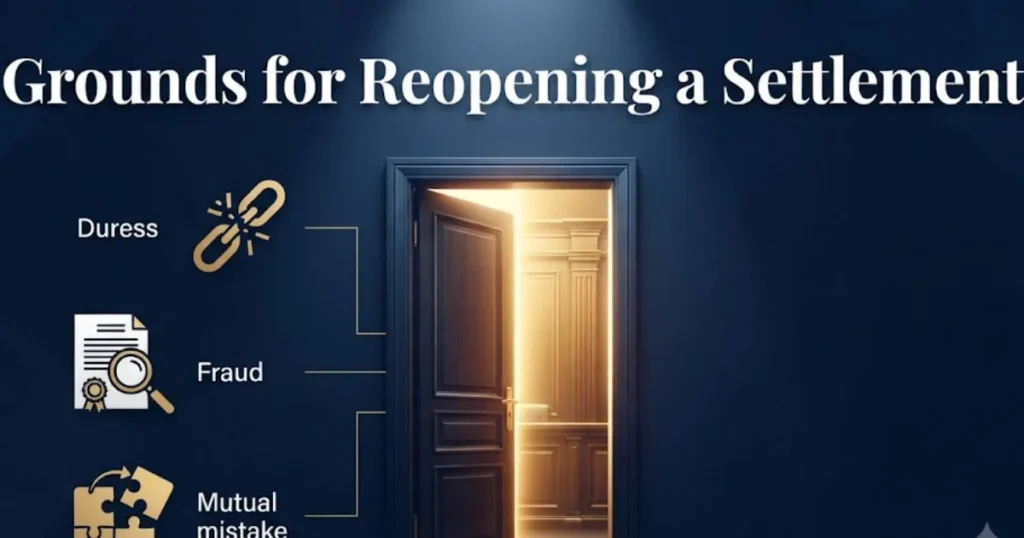
The most common grounds for reopening a settled case include fraud, duress, mutual mistake, newly discovered evidence, and unconscionability. Each one requires specific proof.
Fraud means the other side lied about something important. Maybe they hid assets, concealed evidence, or misrepresented the severity of damages.
Duress means you were threatened or coerced into signing. This goes beyond feeling pressured by a tight deadline.
Mutual mistake means both parties were wrong about a basic fact when they agreed to settle. A simple math error in the settlement amount could qualify.
Here are the recognized grounds in most jurisdictions:
- Fraud or misrepresentation by the opposing party
- Duress, coercion, or undue influence
- Mutual mistake of material fact
- Newly discovered evidence that could not have been found earlier
- Unconscionable or grossly unfair terms
- Lack of mental capacity at the time of signing
- Breach of the settlement agreement by the other party
Not every ground carries equal weight. Fraud is the strongest basis for reopening because courts take dishonesty seriously. Claiming you simply didn’t understand the terms is much harder to prove.
Can You Sue Again After Settling?
In most cases, you cannot sue again after settling because the settlement agreement includes a release of all claims. That release specifically bars you from filing a new lawsuit on the same issue.
This is one of the most misunderstood parts of settlement law. People think settling just pauses the case. It doesn’t. Settling kills it.
When your case is dismissed “with prejudice” as part of a settlement, that phrase means permanently. You can’t refile. Period.
But here’s the twist. If the case was dismissed “without prejudice,” the door may still be open. Some settlements are structured this way intentionally.
| Dismissal Type | Can You Sue Again? | Common In |
|---|---|---|
| With Prejudice | No, unless settlement is voided | Most settlements |
| Without Prejudice | Yes, potentially | Partial settlements, interim agreements |
The only way to sue again after a “with prejudice” dismissal is to first get the settlement thrown out. That means filing a motion to vacate and proving one of the legal grounds discussed above.
Some people try to get creative by suing on a slightly different legal theory. Courts usually see through this. If the underlying facts are the same, the claim will be blocked by a legal doctrine called “res judicata,” which prevents re-litigating the same dispute.
Key Takeaway: A settlement is a binding contract, and you generally cannot sue again after signing one unless you can prove fraud, duress, or another recognized legal defect in the agreement.
Motion to Vacate Settlement Agreement
A motion to vacate is the formal legal tool you use to ask a court to throw out a settlement agreement. It’s your petition to the judge explaining why the settlement should not stand.
In federal court, this motion is filed under Rule 60(b) of the Federal Rules of Civil Procedure. State courts have their own versions, but the concept is the same everywhere.
Your motion must include specific factual allegations. Vague claims like “the settlement was unfair” won’t work. You need evidence.
Here’s what a typical motion to vacate must contain:
- The case number and court where the settlement was entered
- The specific legal ground you’re relying on (fraud, mistake, etc.)
- A detailed factual statement explaining what went wrong
- Supporting evidence such as documents, communications, or affidavits
- A request for the specific relief you want (vacate the judgment, reopen discovery, etc.)
| Step | Action Required |
|---|---|
| 1 | Identify the legal ground for vacating |
| 2 | Gather supporting evidence |
| 3 | Draft the motion with factual allegations |
| 4 | File the motion in the same court that approved the settlement |
| 5 | Serve the motion on the opposing party |
| 6 | Attend the hearing and present your argument |
Filing fees for a motion to vacate are typically modest, ranging from $50 to $400 depending on the court. But the real cost is attorney time. Expect to spend $2,000 to $10,000 or more in legal fees for this type of challenge.
Courts will hold a hearing on your motion. The opposing side gets to respond. A judge then decides whether the settlement stays or goes.
Settlement Agreement Fraud Grounds
Fraud is the strongest ground for reopening a settlement. If the other party lied about something material during negotiations, the agreement can be voided.
“Material” is the key word here. The lie has to be about something that would have changed your decision. A minor exaggeration about an irrelevant detail won’t qualify.
Common fraud scenarios include:
- An insurance company hiding the true policy limits
- A defendant concealing assets during negotiations
- A company withholding evidence of additional harm (such as unreported product defects)
- A party fabricating documents to justify a lowball offer
- An employer misrepresenting the strength of your legal claims
In 2024, a notable case in the Southern District of New York saw a settlement vacated after it was revealed that the defendant corporation had hidden internal safety reports during mediation. The plaintiff had accepted $150,000 but the concealed documents showed liability exposure exceeding $2 million.
To prove fraud, you generally need to show five things:
| Element | What You Must Prove |
|---|---|
| False Statement | The other party made a statement that was untrue |
| Knowledge | They knew it was false when they said it |
| Intent | They intended for you to rely on the false statement |
| Reliance | You actually relied on that false information |
| Damages | You were harmed as a result |
This is a high bar. But when you can clear it, courts act decisively to undo the tainted settlement.
How to Challenge a Settlement Agreement
Challenging a settlement agreement starts with identifying your legal ground, then follows a specific procedural path through the court system. You don’t just call up the other side and say you want out.
The first step is reviewing your settlement agreement word by word. Look for any terms you believe were based on false information, any signatures obtained under pressure, or any provisions that seem grossly one-sided.
Next, consult with an attorney who has experience with contract disputes or post-judgment motions. This is specialized work. Not every lawyer handles it.
The general process looks like this:
- Review the settlement agreement and all related documents
- Identify the specific legal ground for your challenge
- Collect evidence to support your claim (emails, texts, financial records, witness statements)
- File a motion to vacate or a separate lawsuit to rescind the contract
- Attend a court hearing where both sides present arguments
- Wait for the judge’s ruling
Timing matters enormously. If you wait too long, you may lose your right to challenge the agreement entirely. Most courts expect you to act promptly once you discover the problem.
One thing people often overlook: you may need to choose between two different legal paths. You can file a motion to vacate the court judgment (if one was entered), or you can file a brand new lawsuit alleging breach of contract or fraud. The right path depends on your specific situation and the type of settlement.
Key Takeaway: Challenging a settlement is a formal legal process with strict requirements for evidence, timing, and procedure, and fraud remains the most successful ground for overturning an agreement.
New Evidence After Settlement
Newly discovered evidence can justify reopening a settlement, but only if that evidence could not have been found through reasonable diligence before you signed the agreement.
This is where a lot of people get tripped up. Courts will ask: “Could you have found this information earlier if you had looked harder?” If the answer is yes, your motion will likely fail.
The new evidence must also be significant enough to change the outcome. Finding a minor detail that doesn’t affect the settlement value won’t move the needle.
Situations where new evidence has successfully reopened settlements include:
- A plaintiff discovering that their injuries were far more severe than initially diagnosed
- Internal company documents surfacing through whistleblowers after the settlement closed
- New scientific studies proving a product caused harm that wasn’t known at settlement time
- Financial records revealed through a separate legal proceeding showing the defendant had hidden assets
| Requirement | Details |
|---|---|
| Must Be Truly New | Evidence must not have been available during settlement talks |
| Due Diligence Test | You must show you could not have found it earlier with reasonable effort |
| Material Impact | The evidence must be significant enough to change the settlement terms |
| Timeliness | You must act quickly once the evidence is discovered |
Under Rule 60(b)(2), a federal court can reopen a judgment based on newly discovered evidence within one year of the judgment’s entry. Some states allow longer windows.
The discovery of new evidence often comes up in pharmaceutical and medical device cases. A person might settle a product liability claim, only to learn years later that the manufacturer knew about additional risks and never disclosed them.
Settlement Agreement Duress or Coercion
A settlement signed under duress or coercion is voidable because it was not entered into voluntarily. You must prove that threats, intimidation, or extreme pressure forced your hand.
Duress in settlement negotiations doesn’t mean you felt nervous or worried about losing your case. Everyone feels that. Legal duress means something far more extreme.
It typically involves threats of physical harm, threats to destroy someone’s reputation with false information, or abuse of a power dynamic where one party holds extreme control over the other.
Examples of duress that courts have recognized:
- An employer threatening to fire someone unless they sign a settlement waiver
- A party threatening to file false criminal charges unless the other side settles
- Withholding essential resources (like insurance payments for medical care) to force a settlement
- An attorney pressuring their own client to accept a deal that serves the attorney’s interests rather than the client’s
Coercion is a close cousin of duress. It involves persistent, aggressive pressure that goes beyond tough negotiation tactics.
| Type | Description | Court’s View |
|---|---|---|
| Physical Threats | Threats of bodily harm | Always qualifies as duress |
| Economic Duress | Exploiting financial desperation | Sometimes qualifies, depends on severity |
| Emotional Pressure | Guilt-tripping, crying, begging | Rarely qualifies |
| Legal Threats | Threatening legitimate legal action | Usually does NOT qualify |
| Undue Influence | Exploiting a trust relationship | Qualifies in many jurisdictions |
Here’s the part that catches people off guard. Threatening to file a legitimate lawsuit is generally NOT duress. That’s just normal litigation strategy. But threatening to file a baseless lawsuit to extract a settlement can cross the line.
Settlement Agreement Mutual Mistake
A settlement can be voided if both parties shared a false belief about a fundamental fact at the time they agreed to the terms. This is called mutual mistake.
The critical word is “mutual.” If only one side was wrong, that’s typically a unilateral mistake, and courts rarely undo settlements for those. Both parties must have been operating under the same incorrect assumption.
Think of it this way. Suppose two parties settle a car accident case believing the injured person has a sprained wrist. After settlement, medical testing reveals the wrist was actually fractured with nerve damage requiring surgery. If neither party knew about the fracture, that’s a mutual mistake about a material fact.
Common mutual mistake scenarios in settlements:
- Both sides believed the plaintiff’s injuries were minor when they were actually severe
- Both sides used incorrect financial data to calculate damages
- Both sides were unaware of a separate insurance policy that would have changed the negotiation
- A mathematical error in the settlement calculations that neither party caught
| Element | Requirement |
|---|---|
| Shared Belief | Both parties must have been wrong |
| Material Fact | The mistake must relate to something important |
| Impact on Agreement | The mistake must have affected the settlement terms |
| Not Negligence | The mistake can’t be due to one party’s carelessness |
Mutual mistake claims are hard to win because the other side will almost always argue that they knew the truth or that you should have investigated more carefully. But when the evidence clearly shows both sides operated under false assumptions, courts will intervene.
Key Takeaway: Duress, coercion, and mutual mistake can each void a settlement, but the proof requirements are strict, and courts expect you to show the defect was serious enough to undermine the entire agreement.
Can a Judge Reopen a Dismissed Case After Settlement?
Yes, a judge has the authority to reopen a case that was dismissed after settlement, but only when presented with a valid legal basis through a proper motion. Judges don’t reopen cases on their own initiative.
The most common vehicle for this is Rule 60(b) in federal court. This rule lists six specific grounds for relief from a final judgment:
- Mistake, inadvertence, surprise, or excusable neglect
- Newly discovered evidence
- Fraud, misrepresentation, or misconduct by the opposing party
- The judgment is void
- The judgment has been satisfied or is no longer equitable
- Any other reason that justifies relief
A judge’s decision to reopen is discretionary. That means even if you have a valid ground, the judge can still say no. Courts weigh factors like how long you waited, whether reopening would unfairly harm the other party, and whether you have a strong underlying case.
In practice, judges are reluctant to reopen settled cases. The legal system depends on finality. If settlements could be easily undone, nobody would agree to them.
| Factor Judges Consider | Why It Matters |
|---|---|
| Strength of your legal ground | Weak grounds get rejected quickly |
| Time since settlement | Long delays hurt your credibility |
| Prejudice to the other party | Would reopening cause them unfair harm? |
| Your diligence | Did you act promptly once you discovered the problem? |
| Public interest | Does reopening serve justice? |
When a judge does reopen a case, the settlement is essentially erased. The parties go back to where they were before settling, which means the litigation restarts.
Statute of Limitations to Reopen a Settlement
The statute of limitations for reopening a settlement varies by jurisdiction and by the legal ground you’re using. In federal court, the deadline ranges from one year to a “reasonable time” depending on the specific Rule 60(b) subsection.
This is one of the trickiest parts of the process. Miss the deadline and your challenge dies, no matter how strong your evidence.
Federal court deadlines under Rule 60(b):
| Rule 60(b) Subsection | Ground | Time Limit |
|---|---|---|
| 60(b)(1) | Mistake, inadvertence, excusable neglect | 1 year from judgment |
| 60(b)(2) | Newly discovered evidence | 1 year from judgment |
| 60(b)(3) | Fraud, misrepresentation, misconduct | 1 year from judgment |
| 60(b)(4) | Judgment is void | “Reasonable time” (no fixed limit) |
| 60(b)(5) | Judgment satisfied or inequitable | “Reasonable time” |
| 60(b)(6) | Any other justifying reason | “Reasonable time” |
State courts have their own rules. California, for example, allows a motion to vacate based on fraud within the later of 2 years from judgment entry or 180 days from discovery of the fraud under Code of Civil Procedure Section 473(d). Texas allows challenges within 4 years for fraud under its bill of review process.
Even when a statute says “reasonable time,” courts expect you to act fast. Waiting six months after discovering fraud might already be too long in some courts. The clock starts ticking the moment you learn about the problem, not when you decide to do something about it.
How Long After Settlement Can You Reopen a Case?
The practical answer is that you typically have one year or less from the date the court entered judgment on the settlement, with some exceptions stretching to two or four years for fraud-based claims in certain states.
Let’s put this in everyday terms. If your case settled and the court entered a final order in January 2025, you would generally need to file a motion to vacate by January 2026 at the latest under federal rules.
But timing gets complicated because the clock runs differently depending on what you’re claiming.
Quick reference for common timelines:
| Situation | Typical Deadline |
|---|---|
| You discover fraud | 1 year from judgment (federal); varies by state |
| New evidence surfaces | 1 year from judgment (federal) |
| Simple mistake in agreement | 1 year from judgment |
| Judgment is void (e.g., court lacked jurisdiction) | No fixed deadline; “reasonable time” |
| Separate lawsuit to rescind contract | State contract statute of limitations (often 4 to 6 years) |
Here’s something important: filing a separate breach of contract or fraud lawsuit to rescind the settlement agreement is a different path than filing a motion to vacate. The statute of limitations for a new lawsuit is often much longer than the deadline for a motion to vacate.
So if the one-year window for a motion to vacate has closed, you might still be able to challenge the settlement through an independent lawsuit. This is a strategy that many people and even some attorneys overlook.
Key Takeaway: Time limits for reopening a settlement range from one year to several years depending on your legal ground and jurisdiction, and acting quickly after discovering the problem dramatically increases your chances of success.
Can You Reopen a Personal Injury Settlement?
A personal injury settlement can be reopened, but it is one of the hardest types of settlements to undo. Courts and insurance companies structure these agreements specifically to prevent reopening.
Personal injury settlements almost always include a “full and final release” of all claims. That release typically covers not just known injuries but also injuries you might discover in the future. You’re signing away your right to come back later.
This is why personal injury attorneys emphasize waiting until you’ve reached “maximum medical improvement” before settling. Once you sign, it’s extremely difficult to get more money, even if your condition worsens.
Exceptions that might allow reopening:
- The insurance company committed fraud during negotiations (hiding policy limits, misrepresenting coverage)
- You signed the release while mentally incapacitated (under heavy medication, suffering from a brain injury)
- A minor’s settlement was approved without proper court oversight
- The settlement involved workers’ compensation, which has different reopening rules in many states
| Factor | Personal Injury Specifics |
|---|---|
| Release Language | Usually covers all past, present, and future claims |
| Worsening Injuries | Generally NOT grounds to reopen |
| Fraud by Insurer | Valid ground for reopening |
| Minor Claimants | Additional protections apply |
| Workers’ Comp | Many states allow reopening for changed conditions |
Workers’ compensation is a special category. In states like California, New York, and Florida, workers’ comp settlements can sometimes be reopened if your work-related condition significantly worsens. The rules and timeframes vary by state.
For standard personal injury cases, your best protection is refusing to settle too early. Once you sign that release, the deal is almost always permanent.
Reopening a Class Action Settlement
Reopening a class action settlement is exceptionally rare because these settlements go through a rigorous court approval process before they become final. A federal judge must certify that the deal is fair, adequate, and reasonable.
Because of this judicial oversight, courts are even more reluctant to reopen class action settlements than individual ones. The judge already examined the terms. Thousands or millions of class members relied on that approval.
However, it can happen. The grounds are essentially the same as for individual settlements, but the stakes and complications are much bigger.
Scenarios where class action settlements have been challenged:
- Objectors appealed the settlement approval, arguing the deal was unfair to class members
- Evidence emerged that class counsel had a conflict of interest
- The defendant failed to comply with the settlement terms (breach)
- Fraud in the claims administration process
- New information revealed that the class was much larger or the harm much greater than represented
| Class Action Challenge | How It Works |
|---|---|
| Objection During Approval | File objections before the fairness hearing |
| Appeal After Approval | Appeal to the circuit court within 30 days of final approval |
| Motion to Vacate | File under Rule 60(b) after final judgment |
| Breach of Terms | File a motion to enforce or reopen based on noncompliance |
One important distinction: as an individual class member, your ability to challenge the settlement is limited. If you didn’t opt out of the class during the opt-out period, you’re generally bound by the terms the court approved.
The opt-out deadline in class action cases is your critical moment. Missing it means you’ve accepted the deal, even if you never filed a claim. By 2026, courts are increasingly using electronic notice systems to ensure class members receive timely information about their opt-out rights.
What Happens If You Break a Settlement Agreement?
Breaking a settlement agreement exposes you to a breach of contract lawsuit, potential contempt of court charges, and the obligation to pay the other side’s legal fees. It’s not something to take lightly.
A settlement agreement is a contract. If you violate its terms, the other party can sue you for breach. They can seek damages, specific performance (forcing you to comply), or both.
If the settlement was incorporated into a court order, violating it could also constitute contempt of court. That can result in fines or even jail time in extreme cases.
Common ways people “break” settlement agreements:
- Refusing to make agreed-upon payments
- Violating a non-disclosure or confidentiality clause
- Filing a new lawsuit on the same claims despite the release
- Failing to dismiss pending claims as required by the agreement
- Publicly disparaging the other party in violation of a non-disparagement clause
| Consequence | Severity |
|---|---|
| Breach of Contract Lawsuit | The other side sues you for damages |
| Contempt of Court | Fines or jail if the settlement was a court order |
| Attorney’s Fees | You may owe the other side’s legal costs |
| Specific Performance | Court forces you to comply with the terms |
| Loss of Settlement Benefits | You forfeit payments or benefits you were receiving |
Here’s the thing that trips people up. “Breaking” a settlement is different from “challenging” one. If you believe the settlement is invalid due to fraud or duress, you should challenge it through proper legal channels. Simply ignoring the agreement and acting as if it doesn’t exist will only create more legal problems.
Key Takeaway: Personal injury and class action settlements are among the hardest to reopen, and breaking a settlement agreement without going through proper legal channels can result in serious financial and legal consequences.
Financial Consequences of Reopening a Settlement
Reopening a settlement carries significant financial risks, including legal fees, potential repayment of settlement funds, and the cost of re-litigating your case from scratch. The total cost can exceed what you originally received.
Most people don’t think about this part. They focus on whether they can reopen a settlement. They should also ask whether they should, given the financial math.
Costs you may face when challenging a settlement:
- Attorney’s fees for the motion to vacate (typically $2,000 to $15,000)
- Court filing fees ($50 to $400)
- Expert witness fees if needed ($1,000 to $5,000 or more)
- The cost of re-litigating the entire case if the settlement is vacated
- Potential obligation to return settlement money already received
That last point deserves special attention. If a court voids your settlement, you may have to give back the money you were paid. The legal principle is called “restitution.” You can’t keep the benefits of a contract while asking the court to erase it.
| Financial Factor | Estimated Range |
|---|---|
| Attorney Fees for Motion | $2,000 to $15,000 |
| Court Filing Fees | $50 to $400 |
| Expert Witnesses | $1,000 to $5,000+ |
| Returning Settlement Funds | Full amount previously received |
| Re-Litigation Costs | $10,000 to $100,000+ |
| Risk of Losing | You could end up with nothing |
Think of it like returning a car to the dealer. You can’t keep driving it while demanding your money back. If the settlement is undone, both sides go back to zero. You return the money; they lose their release from liability. Then you fight the whole case again.
For smaller settlements, the cost of challenging often exceeds the potential benefit. If you settled for $5,000 and it costs $10,000 in legal fees to reopen, the math doesn’t work unless you’re confident you can recover significantly more the second time around.
State Court vs. Federal Court Settlement Reopening
The process for reopening a settlement differs between state and federal courts, with each system applying its own procedural rules, time limits, and standards of review. Knowing which system governs your case is essential.
In federal court, Rule 60(b) provides the framework. The rule is uniform across all federal districts, so the process is relatively consistent whether you’re in New York, Texas, or California.
State courts are a different story. Each state has its own civil procedure rules, and they vary widely.
| Feature | Federal Court | State Court |
|---|---|---|
| Governing Rule | Rule 60(b) | Varies by state (e.g., CCP 473 in CA, CPLR 5015 in NY) |
| Time Limit for Fraud | 1 year from judgment | Varies: 6 months to 4 years |
| Standard of Review | Abuse of discretion | Varies by state |
| “Reasonable Time” Deadline | Interpreted strictly | Varies; some states more lenient |
| Independent Action for Fraud | Allowed under Rule 60(d) | Most states allow separate fraud lawsuits |
Key differences in major states:
- California: Allows motions to vacate within 6 months for mistake or excusable neglect. Fraud-based challenges can go longer under equitable principles.
- New York: CPLR 5015 allows vacatur for excusable default, newly discovered evidence, fraud, and lack of jurisdiction. Time limits vary by ground.
- Texas: Uses a “bill of review” process for challenging final judgments. The standard requires showing a meritorious defense, which the party was prevented from presenting due to fraud or official mistake.
- Florida: Rule 1.540 mirrors federal Rule 60(b) closely, with a one-year limit for most grounds.
If your settlement was reached in state court, you need to research that specific state’s rules. The grounds may be similar to federal court, but the deadlines and procedures can be very different.
One practical tip: if your case involved a federal question (like a civil rights claim or a federal statute), it may have been in federal court even if you didn’t realize it. Check the case caption and court name on your settlement documents.
Key Takeaway: Federal and state courts follow different rules for reopening settlements, with time limits ranging from 6 months to 4 years depending on your jurisdiction and legal ground, so identifying the correct court system is your first critical step.
Frequently Asked Questions
Can you reopen a lawsuit after signing a settlement agreement?
Yes, but only under limited circumstances like fraud, duress, or mutual mistake.
The settlement must have a legal defect; simply regretting the amount is not enough.
You’ll need to file a motion to vacate in the same court that approved the settlement.
What are the most common reasons a settlement gets reopened?
Fraud by the opposing party is the most common successful ground.
Other reasons include duress, newly discovered evidence, and mutual mistake.
Courts rarely reopen settlements for buyer’s remorse or changed circumstances alone.
How long do you have to challenge a settlement agreement?
In federal court, the deadline is typically one year from the date the judgment was entered.
Some state courts allow longer periods, especially for fraud-based claims.
Acting quickly after discovering the problem significantly improves your chances.
Can a personal injury settlement be reopened if injuries get worse?
In most cases, worsening injuries alone are not enough to reopen a personal injury settlement.
Standard release language covers future injuries, even those you didn’t know about.
Workers’ compensation settlements are an exception in many states, where changed conditions may allow reopening.
Do you have to return settlement money if a case is reopened?
Yes, in most situations you must return the settlement funds if the agreement is voided.
Courts apply restitution principles, meaning both sides go back to their pre-settlement positions.
You return the money, and the defendant loses their release from liability.
What to Do Right Now
If you believe your settlement was tainted by fraud, signed under pressure, or based on a serious mistake, time is not on your side. Every day you wait makes your challenge harder.
Pull out your settlement agreement and review every line. Gather any evidence that supports your claim. Find an attorney who handles post-judgment motions in your jurisdiction.
The window for reopening a settlement is narrow and unforgiving. If you’re going to act, 2026 is the year to do it before your deadlines close for good.







