

Business lawsuit insurance is the single biggest safety net standing between your company and financial ruin from a legal claim. One lawsuit can cost a small business between $3,000 and $150,000 in legal fees alone, even if the claim has no merit.
In 2026, the risk is higher than ever. Data breach suits, employment claims, and AI-related liability are surging. Businesses that skip proper coverage are gambling with their entire operation.
This guide breaks down every type of policy that protects you. You’ll learn what’s covered, what’s excluded, how much it costs, and exactly what to do when you get served.
Whether you run a one-person consulting shop or a 50-employee company, this is the information you need before the next lawsuit lands on your desk.
Business Lawsuit Insurance Explained
Business lawsuit insurance refers to any insurance policy that covers the costs your company faces when someone files a legal claim against it. There isn’t one single product called “lawsuit insurance.” Instead, several different policy types work together to shield your business from legal expenses.
These policies generally cover two things: the cost of defending yourself and the cost of paying a judgment or settlement. Think of it like car insurance for your business operations. You pay premiums now so you don’t pay catastrophic amounts later.
The most common policies that provide lawsuit protection include:
- Commercial General Liability (CGL) for bodily injury and property damage claims
- Professional Liability (E&O) for service-related mistakes
- Employment Practices Liability (EPLI) for employee claims
- Directors and Officers (D&O) for leadership decisions
- Cyber Liability for data breach lawsuits
- Commercial Umbrella for claims exceeding other policy limits
Each policy covers different lawsuit types. No single policy covers everything. That’s where most business owners get burned. They buy one policy and assume they’re fully protected.
| Coverage Type | What It Covers | Common Lawsuit Example |
|---|---|---|
| General Liability (CGL) | Bodily injury, property damage, advertising injury | Customer slips and falls in your store |
| Professional Liability (E&O) | Service errors, negligence, missed deadlines | Client sues over bad advice |
| EPLI | Discrimination, harassment, wrongful termination | Employee files a retaliation claim |
| D&O | Management decisions, fiduciary duty breaches | Investor sues over financial losses |
| Cyber Liability | Data breaches, privacy violations | Customer data gets hacked |
The right combination depends on your industry, size, and risk profile.
Why Every Company Needs Lawsuit Insurance for Business
Lawsuit insurance for business is not optional in 2026. It is a survival tool. The American Bar Association reports that about 36% to 53% of small businesses face at least one lawsuit in any given year. Some industries see even higher rates.
The consequences of getting sued without coverage are brutal. A single employment discrimination suit averages $75,000 in defense costs. A professional negligence claim can run well past six figures. Without insurance, every dollar comes straight from your business accounts.
Here’s what makes lawsuit insurance essential:
- Defense costs alone can bankrupt a small business. Even frivolous lawsuits cost thousands to fight.
- Courts don’t care about your revenue. A judge won’t reduce a judgment because your company is small.
- Contracts often require it. Many clients, landlords, and vendors require proof of insurance before doing business with you.
Some owners think lawsuits won’t happen to them. That mindset is like driving without a seatbelt because you’ve never been in an accident. The first crash changes everything.
Your business doesn’t need to be negligent to get sued. Anyone can file a claim for any reason. The question is whether you can afford to respond. Insurance makes that answer “yes.”
Does Business Insurance Cover Civil Lawsuit Claims
Yes, most business insurance policies cover civil lawsuit claims, but the type of civil lawsuit determines which policy responds. Civil lawsuits include everything from breach of contract to personal injury to discrimination. Not all of these fall under one umbrella.
A standard Commercial General Liability (CGL) policy covers civil suits involving bodily injury, property damage, and personal or advertising injury. If a delivery driver damages a client’s property, your CGL policy steps in.
But CGL won’t touch a contract dispute. It won’t cover a lawsuit alleging your professional advice caused financial harm. And it won’t pay for employment-related claims like wrongful termination.
Here’s a quick breakdown of what gets covered and what doesn’t:
| Civil Lawsuit Type | Covered by CGL? | What You Need Instead |
|---|---|---|
| Slip and fall injury | Yes | N/A |
| Property damage by your employee | Yes | N/A |
| Breach of contract | No | Commercial property or standalone policy |
| Professional negligence | No | Professional Liability (E&O) |
| Employment discrimination | No | EPLI |
| Defamation/libel | Sometimes | CGL personal injury or media liability |
| Data breach | No | Cyber Liability |
The phrase “business insurance” is dangerously vague. When someone asks “does business insurance cover civil lawsuit claims,” the real answer is: it depends entirely on what kind of civil lawsuit and what kind of business insurance.
Read your policy’s declarations page. Look at the exclusions section. That’s where the real answers live.
Key Takeaway: Business lawsuit insurance is not one product but a combination of policies, and civil lawsuit coverage depends entirely on matching the right policy to the right claim type.
What Type of Insurance Covers Lawsuits for Business
Several types of insurance cover lawsuits for business, and each one handles a different category of legal risk. Picking the wrong type leaves gaps that can cost you everything.
Commercial General Liability (CGL) is the foundation. It handles third-party bodily injury, property damage, and some advertising claims. Every business should have this at minimum.
Professional Liability, also called Errors and Omissions (E&O), covers claims arising from your professional services. If a client says your work product caused them financial harm, E&O responds.
Employment Practices Liability Insurance (EPLI) covers lawsuits from employees or job applicants. Discrimination, sexual harassment, wrongful termination, and retaliation claims fall here. EEOC charge filings hit over 73,000 in fiscal year 2024, and the trend continues upward into 2026.
Other important types include:
- Directors and Officers (D&O): Protects company leaders from personal liability for business decisions
- Cyber Liability: Covers lawsuits related to data breaches and privacy violations
- Product Liability: Covers injury or damage caused by a product you manufacture or sell
- Commercial Umbrella: Sits on top of your other policies and kicks in when primary limits are exhausted
Don’t treat this like a menu where you pick one item. Treat it like building a wall. Each policy is a brick. Miss one, and the whole structure has a hole.
Does General Liability Cover Lawsuits
General liability covers many common lawsuits, but it does not cover all of them. A standard CGL policy responds to claims involving bodily injury, property damage, personal injury (like defamation), and advertising injury.
If a customer trips on a loose floor tile in your office and breaks their wrist, general liability pays for their medical bills and your legal defense. If your advertising accidentally copies another company’s slogan, general liability covers the resulting claim.
What general liability does not cover:
- Professional mistakes or bad advice (you need E&O for that)
- Employee lawsuits (you need EPLI)
- Your own injuries (you need workers’ compensation)
- Auto accidents (you need commercial auto)
- Intentional acts (no policy covers deliberate wrongdoing)
- Contract disputes (typically excluded from CGL)
- Pollution or environmental claims (requires specialized environmental liability)
Think of general liability as the floor, not the ceiling. It catches the most common types of claims against a business. But it was never designed to catch everything.
A frequent mistake in 2026: business owners assume their CGL policy covers cyber-related lawsuits. It almost never does. If a customer sues because their data was stolen from your systems, your general liability insurer will likely deny the claim. You need a separate cyber liability policy.
| What CGL Covers | What CGL Does Not Cover |
|---|---|
| Customer injuries on your premises | Employee injury claims |
| Damage your work causes to others’ property | Damage to your own property |
| Slander, libel, false advertising claims | Professional negligence |
| Medical payments for minor third-party injuries | Auto-related injuries |
Business Insurance for Legal Defense Costs
Business insurance for legal defense means your insurer pays for attorneys, court filings, expert witnesses, and related expenses when your company faces a lawsuit. This is separate from paying a settlement or judgment. Defense costs can be enormous on their own.
Most CGL and professional liability policies include what’s called a “duty to defend.” This means the insurer must provide and pay for your legal defense as long as the claim falls within your coverage. The duty to defend is broader than the duty to pay a judgment. Your insurer might have to defend you even if the lawsuit ultimately isn’t covered.
Here’s the critical distinction many business owners miss: some policies treat defense costs inside the policy limit, while others treat them outside the limit.
| Policy Structure | How It Works | Impact on Your Coverage |
|---|---|---|
| Defense costs inside limits | Attorney fees reduce your available coverage | A $1M policy might only have $600K left for a settlement after $400K in legal bills |
| Defense costs outside limits | Attorney fees are paid separately | Your full $1M remains available for the settlement or judgment |
Policies with defense costs outside limits are more expensive. But they provide dramatically better protection. If your policy burns through its limit on lawyers before the case even settles, you’re paying the rest yourself.
When shopping for coverage, always ask: “Are defense costs inside or outside the limits?” That single question can save your business.
Key Takeaway: The duty to defend is often your most valuable coverage feature, but you must know whether defense costs eat into your policy limits or sit outside them.
Business Insurance That Covers Attorney Fees
Business insurance that covers attorney fees typically includes any liability policy with a duty to defend. Your insurer assigns and pays for an attorney when a covered claim hits. You don’t choose the lawyer or negotiate their rate. The insurer handles that.
Attorney fees in business lawsuits are staggering. A straightforward slip-and-fall case might cost $10,000 to $50,000 in legal fees. A complex employment discrimination suit can exceed $200,000 in defense costs alone, before any settlement.
The types of insurance that cover attorney fees include:
- CGL policies for bodily injury and property damage claims
- E&O policies for professional negligence allegations
- EPLI for employee-related lawsuits
- D&O for shareholder and governance disputes
- Cyber liability for data breach litigation
One wrinkle: if you disagree with the insurer’s chosen attorney, you may have the right to select your own lawyer in certain states. This is called “independent counsel” or “Cumis counsel” (named after a California court case). When a conflict of interest exists between you and your insurer, the insurer may be required to pay for the attorney you choose.
Keep in mind that most policies have a deductible or self-insured retention (SIR) that you pay before coverage kicks in. SIR amounts for professional liability policies often range from $1,000 to $25,000. You’ll cover attorney fees up to that threshold yourself.
Always check your policy for fee caps or hourly rate limits. Some insurers cap what they’ll pay per hour for legal counsel. If the attorney bills above that rate, you might owe the difference.
Small Business Lawsuit Insurance Cost in 2026
Small business lawsuit insurance cost in 2026 ranges from about $300 to $3,500 per year for a basic general liability policy, depending on your industry, location, revenue, and claims history. Higher-risk industries pay more.
Here’s what typical annual premiums look like:
| Policy Type | Average Annual Cost (Small Business) | Common Limit |
|---|---|---|
| General Liability (CGL) | $400 to $1,500 | $1M per occurrence / $2M aggregate |
| Professional Liability (E&O) | $500 to $3,000 | $1M per claim / $1M aggregate |
| EPLI | $800 to $3,500 | $500K to $1M |
| Cyber Liability | $500 to $2,500 | $1M |
| Commercial Umbrella | $400 to $1,500 | $1M to $5M (excess) |
| BOP (Bundled) | $500 to $2,000 | Varies |
A Business Owner’s Policy (BOP) bundles general liability with commercial property insurance and often costs less than buying each separately. For many small businesses, a BOP is the most cost-effective starting point.
Factors that increase your premium in 2026:
- Prior claims history. Past lawsuits make you more expensive to insure.
- Industry risk. Construction, healthcare, and food service pay more than consulting or IT.
- Employee count. More employees means more exposure to EPLI claims.
- Revenue. Higher revenue generally increases premiums.
- Location. States with higher litigation rates (California, New York, Florida) cost more.
A helpful way to think about it: the average cost of defending one lawsuit without insurance could pay for 5 to 15 years of premium payments. The math is overwhelmingly in favor of buying coverage.
Business Lawsuit Insurance Policy Limits You Should Know
Business lawsuit insurance policy limits define the maximum amount your insurer will pay for covered claims. Once you hit that limit, every additional dollar comes from your own pocket.
Two numbers matter on every policy:
- Per-occurrence limit: The max your insurer pays for a single claim
- Aggregate limit: The max your insurer pays for all claims during the policy period (usually one year)
A standard CGL policy often has a $1 million per-occurrence limit and a $2 million aggregate limit. That sounds like a lot until you consider that a single catastrophic injury claim can exceed $1 million in medical costs and damages.
| Limit Type | Typical Amount | What It Means |
|---|---|---|
| Per-occurrence | $1M | Max payout for one single claim |
| Aggregate | $2M | Max payout for all claims in one policy year |
| Personal/advertising injury | $1M | Subset of aggregate for defamation-type claims |
| Medical payments | $5K to $10K | Small injuries, no lawsuit needed |
Here’s a scenario that illustrates the risk. Your CGL policy has $1M per-occurrence. You face a lawsuit with $400K in defense costs (inside limits) and a $900K settlement. Your insurer pays $1M total. You owe the remaining $300K out of pocket.
Businesses with higher exposure should consider:
- Increasing per-occurrence limits to $2M or $5M
- Adding a commercial umbrella policy for excess coverage
- Splitting defense costs outside limits to preserve the full limit for judgments
Don’t set your limits based on what you think a lawsuit will cost. Set them based on what the worst possible lawsuit could cost.
Key Takeaway: Policy limits are not suggestions. They are hard ceilings, and once your insurer hits them, you’re responsible for every dollar beyond that line.
Commercial Lawsuit Protection Insurance Options
Commercial lawsuit protection insurance is a broad term covering any policy designed to shield a business from the financial impact of legal claims. In 2026, companies have more options than ever, but the choices can feel overwhelming.
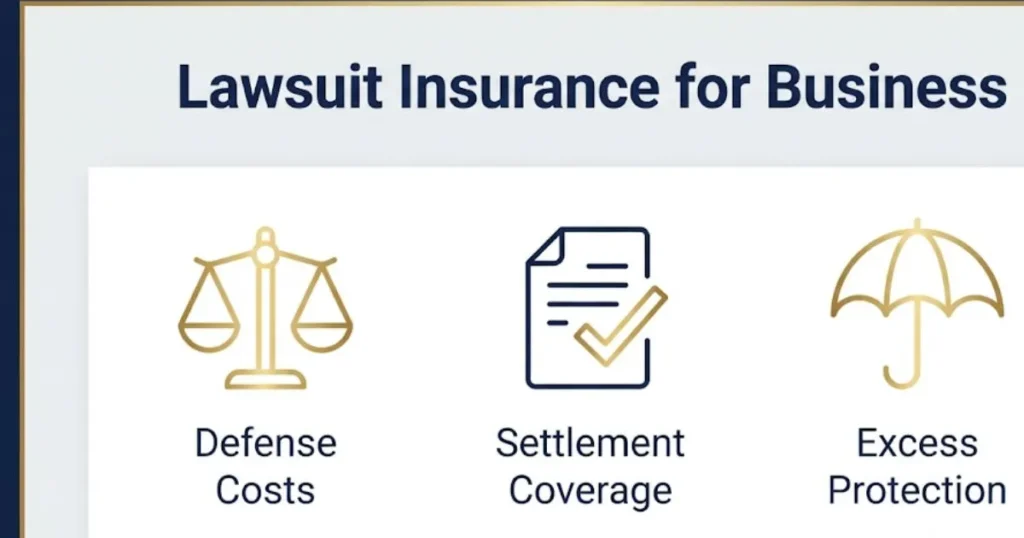
The most effective approach is layering coverage. Start with foundational policies and build upward based on your risk.
Layer 1: Foundation
- Commercial General Liability (CGL)
- Commercial Property (or a combined BOP)
Layer 2: Specialized Coverage
- Professional Liability (E&O) if you provide advice or services
- EPLI if you have employees
- Product Liability if you manufacture or sell goods
- Cyber Liability if you store customer data
Layer 3: Excess Protection
- Commercial Umbrella Policy sits above your primary policies
- Excess Liability extends specific policy limits further
An umbrella policy is one of the most underused tools for small businesses. For an extra $400 to $1,500 per year, you can add $1M to $5M in coverage that kicks in after your underlying policies are exhausted. That’s incredibly cheap protection for catastrophic claims.
Some industries also use specialty insurance products:
- Media liability for publishing, advertising, and content companies
- Environmental liability for businesses handling chemicals or waste
- Fiduciary liability for businesses managing retirement plans or benefits
Talk to a commercial insurance broker, not just an online quoting tool. Brokers can identify gaps in your coverage that automated platforms miss.
Employment Lawsuit Insurance for Small Business
Employment lawsuit insurance for small business is called EPLI, and it covers claims made by current employees, former employees, or even job applicants. These lawsuits are among the most common and expensive legal threats facing businesses in 2026.
EPLI covers claims including:
- Discrimination (age, race, gender, disability, religion)
- Sexual harassment
- Wrongful termination
- Retaliation for whistleblowing or filing complaints
- Wage and hour violations (in some policies)
- Failure to promote
- Breach of employment contract
The EEOC reported over 73,000 workplace discrimination charges in fiscal year 2024. That number continues climbing. Small businesses with 10 to 50 employees face the highest per-employee risk because they often lack formal HR departments and documented policies.
| EPLI Fast Facts for 2026 | Details |
|---|---|
| Average annual premium | $800 to $3,500 for small businesses |
| Common policy limit | $500K to $1M |
| Average defense cost per claim | $75,000 to $125,000 |
| Most common claim type | Retaliation and discrimination |
| Typical deductible | $2,500 to $10,000 |
Here’s something most small business owners don’t realize: CGL policies exclude employment-related claims entirely. If an employee sues you for harassment and you only have general liability, you get zero help from your insurer.
Even a single wrongful termination claim can cost more than most small businesses earn in profit for an entire year. EPLI isn’t a luxury. It’s a lifeline.
Does Business Insurance Cover Defamation Lawsuits
Business insurance sometimes covers defamation lawsuits, but it depends on the circumstances and the policy type. Standard CGL policies include coverage for “personal and advertising injury,” which encompasses defamation, libel, slander, and disparagement.
If your business is accused of making false statements that damage another company’s reputation in an advertisement, your CGL policy should respond. If your employee publicly makes defamatory statements about a competitor during a business presentation, that may also trigger coverage.
However, there are major exceptions:
- Intentional defamation is excluded. If you knowingly made false statements, no insurer will cover you.
- Social media posts may or may not be covered, depending on whether they’re classified as “advertising.”
- Online reviews written by your business about a competitor could be covered under advertising injury.
- Employee defamation claims (an employee sues because a manager defamed them) fall under EPLI, not CGL.
In 2026, social media defamation lawsuits are exploding. Business owners posting about competitors, responding to negative reviews, or allowing employees to make public statements face real litigation risk.
| Defamation Scenario | Likely Covered By |
|---|---|
| False claims about a competitor in your ad | CGL (advertising injury) |
| Employee defamed by a supervisor publicly | EPLI |
| Defamatory social media post by your business | CGL (possibly, depends on policy language) |
| Intentional, knowing false statements | Not covered by any policy |
If your business has a public-facing brand or active social media presence, review your CGL policy’s personal and advertising injury section carefully. The language matters enormously.
Key Takeaway: Defamation coverage exists within most CGL policies, but intentional acts, social media gray areas, and employee-related defamation claims often fall outside standard coverage.
Business Insurance vs Lawsuit Out of Pocket Cost
Paying for a lawsuit out of pocket is almost always more expensive than carrying insurance. The comparison isn’t even close for most businesses.
Let’s look at real numbers. A business with no insurance faces these costs directly:
- Attorney fees: $150 to $500 per hour, adding up to $10,000 to $200,000+ per case
- Expert witnesses: $2,000 to $15,000 per expert
- Court filing fees: $200 to $1,500
- Depositions and discovery: $5,000 to $50,000
- Settlement or judgment: Varies wildly, from $10,000 to millions
Now compare that to insurance premiums:
| Scenario | Without Insurance | With Insurance |
|---|---|---|
| Slip-and-fall lawsuit | $25,000 to $100,000 out of pocket | $500 to $1,500 annual premium + deductible |
| Employment discrimination claim | $75,000 to $300,000 out of pocket | $800 to $3,500 annual premium + deductible |
| Professional negligence suit | $50,000 to $250,000 out of pocket | $500 to $3,000 annual premium + deductible |
| Data breach lawsuit | $100,000 to $500,000+ out of pocket | $500 to $2,500 annual premium + deductible |
A single midsize lawsuit can cost more than a decade of premiums. That’s not an exaggeration. Run the numbers for your own industry.
There’s another cost most owners forget: opportunity cost. Fighting a lawsuit without insurance consumes your time, energy, and focus. You stop running your business and start managing a legal crisis. Insurance doesn’t just pay the bills. It handles the logistics so you can keep working.
Some business owners gamble that they’ll never be sued. Statistically, that bet loses roughly half the time.
Does LLC Protect From Lawsuits Without Insurance
An LLC provides limited liability protection, but it does not protect you from lawsuits. It only limits what’s at risk. There’s a massive difference between those two things.
When you form an LLC, your personal assets (home, savings, personal bank accounts) are generally shielded from business debts and judgments. If someone sues your LLC and wins, they can take business assets but typically cannot go after your personal property.
But here’s what an LLC does not do:
- It doesn’t prevent lawsuits. Anyone can still sue your LLC.
- It doesn’t pay for defense costs. You still need money for lawyers.
- It doesn’t cover settlements or judgments. If your LLC can’t pay, the business may be forced to close.
- It doesn’t protect against personal guarantees. Many landlords and lenders require owners to personally guarantee debts, piercing the LLC shield.
- It doesn’t protect against personal negligence. If you personally cause harm, your personal assets may still be at risk.
Courts can also “pierce the corporate veil” of an LLC if:
- You mix personal and business finances
- You don’t follow LLC formalities
- The LLC is undercapitalized (not enough assets to cover foreseeable risks)
- You commit fraud
That third point matters here. Courts have found LLC owners personally liable partly because the business carried no insurance and was therefore undercapitalized. Not having insurance can actually weaken your LLC protection.
Think of an LLC as a fence and insurance as a security system. The fence marks boundaries, but it doesn’t stop intruders. You need both.
How to File a Business Insurance Claim for a Lawsuit
Filing a business insurance claim for a lawsuit starts the moment you learn about a potential claim, not after you’ve been formally served. Early notification is everything.
Step 1: Notify your insurer immediately.
Most policies require you to report claims “as soon as practicable.” Waiting too long can give your insurer grounds to deny the claim. Call the claims number on your policy card the same day you receive a demand letter, legal notice, or lawsuit papers.
Step 2: Gather your documentation.
Prepare these items before your initial call:
- The lawsuit complaint or demand letter (full copy)
- Your insurance policy declarations page
- Any correspondence related to the claim
- Photos, contracts, or records relevant to the incident
- Names and contact information of witnesses
Step 3: Cooperate fully with your insurer’s investigation.
Your insurer will assign a claims adjuster and, if necessary, an attorney. You are required to cooperate under the policy terms. That means providing documents, attending meetings, and not admitting fault without your insurer’s approval.
Step 4: Understand your role during litigation.
| Your Responsibility | Your Insurer’s Responsibility |
|---|---|
| Report the claim promptly | Assign and pay for legal defense |
| Provide all requested documents | Investigate the claim |
| Attend depositions and hearings | Negotiate settlement within policy limits |
| Don’t admit liability or make deals without insurer consent | Pay covered judgments or settlements |
Step 5: Track everything.
Keep copies of every communication with your insurer. Note dates, names, and what was discussed. If a dispute arises about coverage later, your records will matter.
One common mistake: settling a claim on your own before telling your insurer. If you pay money to the plaintiff without your insurer’s knowledge, they may refuse to reimburse you. Always loop in your insurer first.
Key Takeaway: Notify your insurer the same day you learn about any claim or potential claim, and never admit fault or settle anything without your insurer’s involvement.
Best Business Lawsuit Insurance in 2026
The best business lawsuit insurance in 2026 depends on your industry, size, and specific risks, but several insurers consistently stand out for small and mid-size business coverage.
Top-Rated Insurers for Business Lawsuit Protection in 2026:
| Insurer | Best For | Standout Feature | Typical CGL Premium |
|---|---|---|---|
| The Hartford | Small businesses with employees | Strong EPLI and workers’ comp bundling | $400 to $1,500/year |
| Hiscox | Professional service firms | Excellent E&O coverage with low minimums | $350 to $1,200/year |
| Next Insurance | Sole proprietors and freelancers | Fast online quotes, digital-first experience | $300 to $900/year |
| biBERK (Berkshire Hathaway) | Cost-conscious small businesses | Direct-to-consumer pricing, no broker fees | $300 to $1,000/year |
| Progressive Commercial | Businesses needing bundled coverage | Easy BOP packages with multiple add-ons | $400 to $1,300/year |
| Nationwide | Mid-size businesses | High coverage limits and umbrella options | $500 to $2,000/year |
When choosing a provider, don’t just compare premiums. Look at these factors:
- Claims satisfaction ratings from AM Best and J.D. Power
- Policy flexibility. Can you add EPLI, cyber, or umbrella coverage easily?
- Defense cost structure. Inside limits or outside limits?
- Deductible options. Lower deductibles cost more in premiums but less at claim time.
- Financial strength rating. You want an insurer rated A or higher by AM Best so they can actually pay claims.
In 2026, three emerging risks are reshaping what “best” means:
AI liability. If your business uses AI tools that cause harm or errors, you need E&O coverage that doesn’t exclude AI-assisted work. Check your policy for technology exclusions.
Remote work claims. Employees working from home are filing injury claims and discrimination suits at higher rates. Your EPLI and workers’ comp need to account for remote setups.
Data privacy lawsuits. State privacy laws are expanding rapidly. California, Colorado, Connecticut, Virginia, and several other states now have consumer privacy statutes that create direct lawsuit risk. Cyber liability insurance is no longer optional for businesses handling personal data.
The “best” policy isn’t the cheapest one. It’s the one that actually covers the lawsuits most likely to hit your specific business.
Frequently Asked Questions
What is business lawsuit insurance and what does it cover?
Business lawsuit insurance is a collection of policies that pay for legal defense, settlements, and judgments when your company faces a lawsuit.
Common policies include general liability, professional liability, EPLI, and cyber liability.
Each policy covers a different type of claim, so most businesses need more than one.
How much does lawsuit insurance cost for a small business in 2026?
Most small businesses pay between $300 and $3,500 per year depending on the policy type and industry.
A basic general liability policy averages around $500 to $1,500 annually.
EPLI and professional liability policies cost more but cover high-risk claim categories.
Does general liability insurance cover all types of lawsuits?
No, general liability only covers bodily injury, property damage, and certain advertising injury claims.
It does not cover professional errors, employment disputes, cyber incidents, or contract breaches.
You need separate policies for those risks.
Can my business be sued even if I have an LLC?
Yes, an LLC can absolutely be sued.
The LLC only limits personal asset exposure; it does not prevent lawsuits or pay for legal defense.
Courts can also pierce the LLC veil if you mix finances or undercapitalize the business.
What should I do first when my business gets sued?
Contact your insurance company immediately, ideally the same day you receive the complaint or demand letter.
Do not admit fault, negotiate with the plaintiff, or make any payments without your insurer’s knowledge.
Gather all relevant documents and cooperate fully with the claims investigation.
Business lawsuit insurance is not something you figure out after you get sued. It’s something you put in place now, while you have the luxury of choosing coverage instead of scrambling for it.
Review your current policies for gaps. Compare your limits to realistic lawsuit costs in your industry. Add EPLI, cyber, or umbrella coverage where needed.
The businesses that survive lawsuits in 2026 are the ones that prepared before the complaint was filed.







