

Bus accident lawsuit loans let you borrow against your pending bus crash case so you get cash now instead of waiting months or years for a settlement. If you were hurt in a bus accident and filed a lawsuit, you might qualify for anywhere from $500 to $500,000 depending on your case value.
These aren’t traditional loans. They’re advances on your future settlement. You only repay if you win. That single fact changes everything about how this type of funding works.
This guide covers how bus accident lawsuit loans work in 2026, who qualifies, what they cost, and which companies offer the best terms. You’ll also learn the real risks nobody else talks about.
The lawsuit lending industry has grown to over $3.2 billion annually in the U.S. Bus accident cases are among the most commonly funded personal injury claims because they tend to involve clear liability and large settlements.
Bus Accident Lawsuit Loans
Bus accident lawsuit loans are cash advances given to plaintiffs with pending bus crash injury cases. A funding company reviews your lawsuit, evaluates its strength, and provides money upfront based on your expected settlement.
This type of funding is technically not a “loan” in most states. It’s a purchase of a portion of your future settlement proceeds. That distinction matters because it affects how states regulate the product and what consumer protections apply to you.
The funding company takes on the risk. If your case loses, you owe nothing back. If you win, the company gets its advance back plus fees and interest from your settlement proceeds.
| Feature | Detail |
|---|---|
| Type of Funding | Non-recourse cash advance |
| Repayment Required | Only if you win your case |
| Credit Check | Not required in most cases |
| Typical Range | $500 to $500,000 |
| Approval Based On | Case strength, not personal finances |
Bus accident claims often involve government entities, commercial carriers, or large insurance policies. That usually means bigger potential settlements, which makes funding companies more willing to approve these cases.
The funding company doesn’t give you money based on your credit score or income. They care about one thing: how strong your case is and how much it’s likely to settle for.
How Bus Accident Lawsuit Loans Work
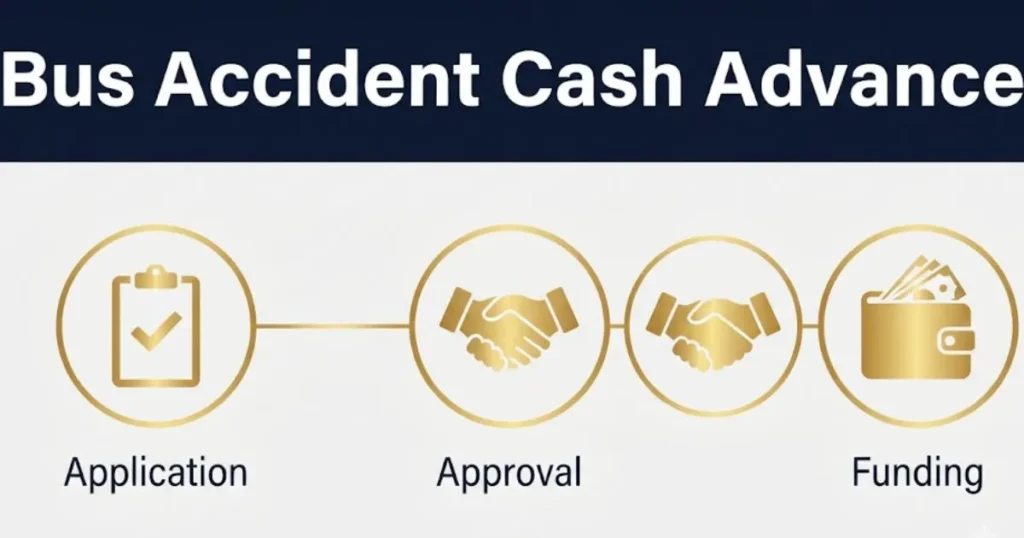
Bus accident lawsuit loans work by advancing you a percentage of your expected settlement in exchange for a portion of the final payout. The process typically takes 24 to 48 hours from application to funding.
Here’s the step-by-step breakdown of how it actually works:
- You apply with a funding company and provide your attorney’s contact information
- The funding company contacts your lawyer to review your case details
- An underwriter evaluates the strength of your claim and estimates its value
- If approved, you receive a funding offer with the advance amount, fees, and repayment terms
- You and your attorney sign the agreement
- Money hits your bank account, usually within 1 to 2 business days
Your attorney plays a central role. The funding company won’t approve anything without your lawyer’s cooperation. They need case documents, medical records, and liability assessments from your legal team.
Think of it like selling a small slice of a pie that hasn’t been baked yet. You get paid now for a piece of whatever comes out of the oven later. If the oven breaks and there’s no pie, you keep the money you already received.
Most companies fund between 10% and 20% of your estimated case value. So if your bus accident case is projected to settle for $200,000, you might receive $20,000 to $40,000 upfront.
Bus Accident Lawsuit Loan Requirements
The requirements for a bus accident lawsuit loan focus on your case, not your personal financial situation. You need an active lawsuit or filed claim, a retained attorney, and injuries serious enough to support a meaningful settlement.
Here are the standard requirements most funding companies look for:
- An active personal injury claim or filed lawsuit
- An attorney working your case on contingency
- Documented injuries from the bus accident
- Clear or likely liability against the bus company, driver, or other party
- A case value that exceeds the requested funding amount by a wide margin
Credit scores don’t matter. Employment status doesn’t matter. Whether you’re behind on bills doesn’t matter. The underwriting process is entirely based on the merits of your bus accident case.
| Requirement | Why It Matters |
|---|---|
| Active Lawsuit | Proves you have a real claim pending |
| Retained Attorney | Company needs a lawyer to verify case details |
| Documented Injuries | Higher injury severity means higher case value |
| Clear Liability | Stronger liability means lower risk for the funder |
| Sufficient Case Value | Ensures settlement can cover repayment plus your share |
One thing that can kill your application: if your attorney refuses to cooperate. Some lawyers discourage pre-settlement funding because the interest rates eat into the client’s final payout. If your attorney won’t return calls or provide case documents, funding companies can’t move forward.
Key Takeaway: Bus accident lawsuit loans are cash advances based on case strength, not credit. You need an attorney, an active claim, and documented injuries to qualify.
How Much Can I Get for a Bus Accident Lawsuit Loan
Most bus accident lawsuit loan amounts range from $2,000 to $200,000, depending on the severity of your injuries and the total expected settlement value. The average funding amount for bus accident cases falls between $10,000 and $50,000.
Funding companies typically advance 10% to 20% of what they believe your case is worth. Several factors directly influence how much money you’ll receive.
Factors that increase your funding amount:
- Severe injuries like spinal cord damage, traumatic brain injury, or multiple fractures
- Surgery or ongoing medical treatment
- Clear liability (the bus driver was at fault)
- A commercial bus company or government entity as the defendant
- Large insurance policy limits on the defendant’s side
Factors that decrease your funding amount:
- Minor soft tissue injuries
- Disputed liability or shared fault
- Pre-existing conditions that complicate the injury claim
- Small insurance policy limits
- Your case is still in early stages without strong evidence gathered
| Injury Severity | Typical Case Value | Estimated Funding Amount |
|---|---|---|
| Minor (sprains, bruises) | $10,000 to $50,000 | $1,000 to $5,000 |
| Moderate (fractures, herniated discs) | $50,000 to $250,000 | $5,000 to $50,000 |
| Severe (TBI, spinal injury, amputation) | $250,000 to $2,000,000+ | $25,000 to $200,000+ |
Bus accident cases involving government-operated transit buses often involve larger settlements because common carrier liability standards hold these operators to a higher duty of care. That typically means funding companies are willing to advance more money.
Your attorney’s track record matters too. If your lawyer has a strong reputation and history of winning bus accident cases, funding companies view your claim as lower risk.
Bus Accident Cash Advance
A bus accident cash advance is the same product as a lawsuit loan, just described differently. The term “cash advance” more accurately reflects what’s happening because you’re receiving an advance against future settlement proceeds.
Many funding companies prefer the term “cash advance” because it avoids regulatory issues. In several states, calling the product a “loan” triggers lending regulations, interest rate caps, and licensing requirements that wouldn’t otherwise apply.
For you as the consumer, the practical difference is zero. You apply, get approved based on your case, receive money, and repay from your settlement if you win.
The speed of a cash advance is one of its biggest selling points. Most applicants get money within 24 to 72 hours of approval. Some companies even offer same-day funding for straightforward cases.
| Cash Advance Feature | Details |
|---|---|
| Speed | 24 to 72 hours typical |
| Same-Day Option | Available from some companies |
| Minimum Amount | Usually $500 to $1,000 |
| Maximum Amount | Up to $500,000 for large cases |
| Application Fee | Most companies charge none |
Bus accident victims often need cash advances for immediate expenses: medical bills that insurance won’t cover, rent payments, car repairs, groceries, and utility bills. The financial pressure of being unable to work after a serious bus crash is real, and it’s the primary reason people seek this type of funding.
One important thing to remember: taking a cash advance reduces your final settlement payout. The money you receive plus interest and fees all come off the top of your settlement before you see your share.
Pre-Settlement Funding for Bus Accidents
Pre-settlement funding for bus accidents is financial assistance you receive while your lawsuit is still ongoing. It bridges the gap between your accident and the day your case finally resolves.
The term “pre-settlement” means exactly what it sounds like. You get money before the settlement happens. This is different from post-settlement funding, where companies advance money after a settlement is reached but before the check arrives.
Bus accident cases are particularly well-suited for pre-settlement funding because they tend to take a long time to resolve. Cases involving municipal bus systems can take 18 to 36 months or longer because claims against government entities involve notice requirements, sovereign immunity issues, and bureaucratic delays.
During that waiting period, bills don’t stop coming. Pre-settlement funding keeps you financially afloat so you don’t accept a lowball settlement offer out of desperation.
Common uses of pre-settlement funding:
- Medical bills and co-pays
- Rent or mortgage payments
- Vehicle repair or replacement costs
- Childcare expenses
- Physical therapy and rehabilitation costs
- Daily living expenses when you can’t work
The biggest strategic advantage of pre-settlement funding is patience. When you’re not financially desperate, your attorney can negotiate harder and longer for a better settlement. Insurance companies know when plaintiffs are broke. They use that pressure to push low offers.
Pre-settlement funding removes that pressure. It’s like giving your lawyer more ammunition at the negotiating table.
Key Takeaway: Pre-settlement funding for bus accidents covers your bills while your case drags on, and it gives your attorney more leverage to negotiate a better settlement.
Non-Recourse Bus Accident Lawsuit Loans
Non-recourse bus accident lawsuit loans mean you owe nothing if you lose your case. The funding company absorbs the entire loss. This is the single most important feature that separates lawsuit funding from traditional loans.
With a regular bank loan, you owe the money back no matter what happens. Your house, your wages, your credit score are all at risk. Non-recourse funding flips that model completely.
Here’s how non-recourse works in practice:
| Scenario | What You Owe |
|---|---|
| You win your case | Repay the advance plus interest and fees |
| You settle your case | Repay from settlement proceeds |
| You lose your case | Nothing. Zero. You keep the money. |
| Your case gets dismissed | Nothing. The funding company takes the loss. |
This structure is why funding companies are so careful about which cases they approve. They’re essentially betting on your lawsuit. If they pick wrong, they lose their money.
Because of this risk, non-recourse funding costs more than traditional borrowing. Interest rates are higher because the lender has no guarantee of repayment. Think of it like this: a bank lends you money knowing they can garnish your wages if you don’t pay. A lawsuit funding company lends you money knowing they might never see a penny back.
Not all states treat non-recourse funding the same way. Some states like New York, Ohio, and Oklahoma have passed specific laws regulating lawsuit lending. Others have minimal oversight. In 2026, the regulatory environment continues to evolve as more states consider consumer protection measures.
Make sure any agreement you sign clearly states the funding is non-recourse. Read every word of the contract. If the repayment terms include any language about personal liability, that’s a red flag.
Bus Accident Lawsuit Loan Interest Rates
Bus accident lawsuit loan interest rates typically range from 27% to 60% annually on a compounding basis. Some companies charge even higher rates, making this one of the most expensive forms of borrowing available.
Interest on lawsuit loans works differently than interest on a credit card or mortgage. Most funding companies use compounding interest, which means you pay interest on top of interest over time.
Here’s a real-world example of how compounding interest affects your repayment:
| Funding Amount | Annual Rate | After 12 Months | After 24 Months | After 36 Months |
|---|---|---|---|---|
| $10,000 | 30% | $13,000 | $16,900 | $21,970 |
| $10,000 | 40% | $14,000 | $19,600 | $27,440 |
| $10,000 | 60% | $16,000 | $25,600 | $40,960 |
That table should grab your attention. A $10,000 advance at 40% compounding interest becomes nearly $27,500 after just three years. Bus accident cases that drag on for years can result in enormous repayment obligations.
Some companies offer simple interest instead of compounding interest. Simple interest is calculated only on the original amount, not on accumulated interest. That’s a much better deal.
How to get the lowest rate possible:
- Compare offers from at least 3 to 5 funding companies
- Ask specifically whether interest is simple or compounding
- Negotiate. Rates are not set in stone.
- Have your attorney review the terms before signing
- Look for companies that cap total repayment amounts
A few states have stepped in to regulate rates. Oklahoma caps rates at 18% simple interest per year. Indiana requires specific disclosures. Other states are considering similar protections in 2026.
Always ask for a full repayment schedule before signing anything. Know exactly what you’ll owe at 12 months, 24 months, and 36 months.
Bus Accident Settlement Advance Repayment
Repayment on a bus accident settlement advance comes directly from your settlement proceeds. You don’t write a check or make monthly payments. The funding company gets paid when your case resolves.
Here’s how the repayment process typically works:
- Your case settles or you receive a verdict
- The defendant’s insurance company sends the settlement check to your attorney
- Your attorney deposits the check into a trust account
- From that trust account, your attorney pays the funding company the agreed repayment amount
- Your attorney takes their contingency fee
- You receive whatever is left
The order of payment matters. Medical liens, funding repayment, and attorney fees all get deducted before you see your share. That’s why it’s critical to understand how much of your settlement will actually end up in your pocket.
| Settlement Distribution | Example ($150,000 Settlement) |
|---|---|
| Gross Settlement | $150,000 |
| Attorney Fee (33%) | $49,500 |
| Lawsuit Loan Repayment | $26,000 |
| Medical Liens | $18,000 |
| Case Costs | $5,000 |
| Your Take-Home | $51,500 |
In that example, you’d keep about 34% of the total settlement. Without the lawsuit loan repayment, you’d take home $77,500 instead. That’s a $26,000 difference.
Some funding agreements include a “buyback” provision. This lets you repay the advance early at a reduced rate if your case settles faster than expected. Ask about this before signing. It can save you thousands.
If your settlement is smaller than anticipated, some agreements cap the repayment amount so you’re guaranteed to receive at least a minimum portion. Read your contract carefully to see if this protection exists.
Key Takeaway: Repayment comes from your settlement, but interest and fees can eat a significant chunk of your final payout, so understand the full cost before you sign.
Bus Accident Lawsuit Loan vs Personal Loan
A bus accident lawsuit loan differs from a personal loan in almost every way that matters. The biggest difference: a lawsuit loan requires no credit check and no repayment if you lose, while a personal loan demands both.
| Feature | Bus Accident Lawsuit Loan | Personal Loan |
|---|---|---|
| Credit Check | No | Yes |
| Income Verification | No | Yes |
| Monthly Payments | None | Required |
| Repayment If You Lose | None | Still owed in full |
| Interest Rate | 27% to 60%+ | 6% to 36% |
| Collateral | Your lawsuit | Unsecured or secured |
| Approval Speed | 24 to 72 hours | 1 to 7 days |
| Regulatory Oversight | Limited in most states | Heavy federal and state regulation |
Personal loans are cheaper. That’s the plain truth. If you have good credit and can qualify for a personal loan at 10% to 15% interest, that will cost you far less than a lawsuit loan at 40%.
But most people seeking bus accident lawsuit loans can’t get personal loans. They’re not working because of their injuries. Their credit might be damaged from missed payments during recovery. Banks see them as high risk.
The non-recourse feature of lawsuit loans is what justifies the higher cost for many people. If your bus accident case falls apart, a personal loan still follows you. A lawsuit loan disappears.
It’s like comparing renting a safety net versus buying one. The rental costs more over time, but you can return it if you never need it. The purchase is cheaper but you’re stuck with it regardless.
Before choosing either option, run the numbers with your attorney. Calculate what each option costs over the expected timeline of your case.
Bus Accident Injury Claim Funding Eligibility
Eligibility for bus accident injury claim funding depends on three core factors: an active legal claim, a cooperating attorney, and injuries with documented medical treatment. Your personal finances play almost no role.
Who qualifies for bus accident claim funding:
- Passengers injured on a city bus, school bus, charter bus, or intercity bus
- Pedestrians hit by a bus
- Drivers or passengers in vehicles struck by a bus
- Cyclists injured in a bus collision
- Workers injured in bus-related workplace accidents
Who typically does not qualify:
- People with no attorney representing them
- Cases where liability is highly disputed with little evidence
- Minor injuries with low case values (under $5,000 estimated)
- Cases in very early stages before a demand letter or lawsuit is filed
- Individuals who have already settled their case
Your medical records are the single most important piece of evidence. Funding companies want to see that you received treatment, that your injuries are real, and that ongoing treatment supports a significant claim value.
| Eligibility Factor | Strong Candidate | Weak Candidate |
|---|---|---|
| Attorney Status | Retained, experienced PI lawyer | No attorney or recently hired |
| Liability | Clear fault on bus company/driver | Disputed or shared fault |
| Injury Severity | Surgery, hospitalization, ongoing care | Minor sprains, single ER visit |
| Case Stage | Discovery phase or beyond | Claim just filed, minimal evidence |
| Medical Documentation | Complete records, consistent treatment | Gaps in treatment, minimal records |
If you were partially at fault for the accident, you can still qualify in states that follow comparative negligence rules. Your funding amount might be reduced to reflect your share of fault, but you’re not automatically disqualified.
School Bus Accident Lawsuit Loans
School bus accident lawsuit loans are available for parents of injured children or for other parties hurt in school bus collisions. These cases carry unique legal complexities that affect both the lawsuit and the funding process.
School bus accidents often involve government entities like school districts. Suing a government body requires following specific procedural rules, including shorter filing deadlines called notice of claim requirements. In many states, you must file a notice of claim within 90 days of the accident.
Because government defendants and their insurers know that plaintiffs face strict procedural requirements, these cases can take longer to resolve. That extended timeline makes pre-settlement funding more attractive and sometimes more necessary.
Special factors in school bus accident funding:
- Claims against school districts may be subject to damage caps under sovereign immunity laws
- Some states cap government liability at $100,000 to $500,000 per incident
- Insurance policies for school districts vary widely by state and district size
- Cases involving children often generate higher jury sympathy and larger verdicts
- Medical damages for children can be extensive when long-term care is needed
| School Bus Accident Factor | Impact on Funding |
|---|---|
| Government Defendant | May limit total settlement due to caps |
| Child Plaintiff | Often increases case value |
| Notice of Claim Deadline | Must be met or case is dismissed |
| Clear Driver Negligence | Increases approval likelihood |
| Multiple Injured Students | May complicate individual case value |
Funding companies are generally cautious with school bus cases because of damage caps and sovereign immunity protections. But when the facts are strong, especially cases involving serious child injuries, these claims can still receive significant funding.
Key Takeaway: School bus accident lawsuit loans involve extra legal hurdles like government immunity caps and notice deadlines, but strong cases with serious injuries can still qualify for substantial funding.
Public Transit Accident Lawsuit Funding
Public transit accident lawsuit funding covers cases involving city buses, subway systems, light rail, trolleys, and other government-operated transportation. These cases are among the strongest candidates for pre-settlement funding because transit agencies carry large insurance policies and are held to high safety standards.
Public transit operators are considered “common carriers” under the law. That legal designation means they owe passengers the highest duty of care. When they fail to meet that standard, liability is often clear.
Cities like New York, Chicago, Los Angeles, Houston, and Philadelphia process thousands of transit injury claims every year. The sheer volume of cases means the claims process often moves slowly, creating a need for funding.
Common public transit accident scenarios that qualify for funding:
- Sudden braking injuries when a bus stops without warning
- Slip and fall injuries while boarding or exiting
- Collisions with other vehicles while riding a city bus
- Door-closing injuries where passengers get caught
- Pedestrian injuries caused by transit vehicles
| Transit System | Typical Liability Coverage | Average Case Timeline |
|---|---|---|
| NYC MTA | High coverage, city self-insured | 24 to 48 months |
| Chicago CTA | Municipal insurance pool | 18 to 36 months |
| LA Metro | Self-insured retention + excess | 18 to 30 months |
| SEPTA (Philadelphia) | State authority coverage | 12 to 24 months |
One wrinkle with public transit cases: many cities require administrative claims before you can file a lawsuit. Missing these deadlines can kill your case entirely, which means no case to fund.
Funding companies like transit accident cases because the defendants are solvent. A city bus system won’t go bankrupt or dodge a judgment. That financial stability reduces risk for the funder and typically results in faster approval.
Charter Bus Accident Legal Funding
Charter bus accident legal funding applies to cases involving private bus companies hired for group travel, corporate events, church trips, sporting events, and tours. These cases often produce large settlements because charter companies carry significant commercial insurance.
Charter bus companies are regulated by the Federal Motor Carrier Safety Administration (FMCSA) and must maintain minimum insurance coverage. For passenger carriers, the federal minimum is $5 million in liability coverage. Many companies carry even more.
That insurance floor is good news for injured passengers and for funding companies. A $5 million policy means there’s likely enough money to cover a substantial settlement plus the funding repayment.
What makes charter bus cases strong for funding:
- Federal insurance minimums ensure policy availability
- FMCSA safety records can be used to prove negligence
- Driver fatigue and hours-of-service violations are common factors
- Vehicle maintenance failures are well-documented in many cases
- Multiple injured passengers can strengthen individual claims
Charter bus accidents often involve catastrophic injuries because these buses travel at highway speeds, frequently at night, and sometimes on unfamiliar routes. Rollover accidents and head-on collisions involving charter buses have produced some of the largest personal injury verdicts in recent years.
| Charter Bus Accident Factor | Funding Impact |
|---|---|
| FMCSA Violations | Strengthens liability, increases approval odds |
| Federal Insurance Minimum ($5M) | Ensures policy coverage for large claims |
| Highway Speed Crashes | Higher injury severity, larger case values |
| Multiple Passengers Injured | May reduce individual funding amount if policy limits are spread thin |
If your charter bus accident involves a company with prior safety violations on file with the FMCSA, your case value goes up. Funding companies know this and may offer you a larger advance.
Greyhound Bus Accident Lawsuit Loans
Greyhound bus accident lawsuit loans are available for passengers, pedestrians, and other drivers injured in collisions involving Greyhound buses or its subsidiary brands. Greyhound, owned by FlixBus since 2021, is one of the largest intercity bus operators in North America.
Greyhound has faced numerous lawsuits over the years for accidents involving driver fatigue, speeding, poor vehicle maintenance, and inadequate driver training. The company’s safety record has been scrutinized by the FMCSA and the National Transportation Safety Board (NTSB) following several high-profile crashes.
Because Greyhound is a major corporation with significant insurance coverage, funding companies view these cases favorably. There’s a clear defendant with deep pockets, which reduces the funder’s risk.
Greyhound accident case strengths for funding:
- Large commercial insurance policies
- Corporate defendant with established litigation history
- FMCSA inspection and safety data available as evidence
- Multiple witnesses often available (other passengers)
- Prior incidents can demonstrate a pattern of negligence
| Greyhound Case Detail | Information |
|---|---|
| Parent Company | FlixBus (acquired 2021) |
| Federal Insurance Requirement | $5 million minimum |
| Regulating Agency | FMCSA |
| Common Accident Causes | Driver fatigue, speeding, poor maintenance |
| Average Case Duration | 12 to 36 months |
One strategic advantage in Greyhound cases: because the company faces lawsuits regularly, their legal team often pushes for settlements to avoid bad publicity. That settlement tendency means your case might resolve faster than average, which reduces your total interest costs on the lawsuit loan.
If you were a Greyhound passenger who was injured during a crash, a rollover, or even a sudden braking incident, you likely have a viable claim. Funding companies are familiar with these cases and can often process applications quickly.
Key Takeaway: Cases involving Greyhound, charter buses, and public transit systems tend to qualify more easily for lawsuit loans because these defendants carry large insurance policies and face clear liability standards.
Best Bus Accident Lawsuit Loan Companies 2026
The best bus accident lawsuit loan companies in 2026 offer competitive interest rates, transparent contracts, fast approval, and no hidden fees. Choosing the wrong company can cost you thousands in unnecessary charges.
When comparing funding companies, focus on these specific factors:
What to look for in a funding company:
- Transparent interest rates (ask if it’s simple or compounding)
- No application fees or processing fees
- A clear repayment cap so your balance doesn’t spiral
- Positive reviews on independent platforms
- Willingness to let your attorney review the contract before signing
- Responsive customer service that answers your questions directly
Red flags to avoid:
- Companies that pressure you to sign immediately
- Agreements with hidden fees buried in fine print
- Rates that seem low but switch to compounding after a set period
- Companies that won’t provide a full repayment schedule
- Brokers who shop your case to multiple funders without your knowledge
| Evaluation Criteria | What Good Looks Like | What Bad Looks Like |
|---|---|---|
| Interest Rate | Clearly stated, simple interest preferred | Vague, compounding, changes after 12 months |
| Fees | None upfront, minimal at closing | Application fees, origination fees, broker fees |
| Repayment Cap | Total repayment capped at 2x to 3x the advance | No cap, unlimited compounding |
| Contract Clarity | Plain language, attorney review encouraged | Dense legalese, rush to sign |
| Funding Speed | 24 to 48 hours | More than 7 days |
Get quotes from at least three companies before committing. Treat this like shopping for a car loan. The first offer is rarely the best one.
Your attorney should review every funding agreement before you sign. An experienced personal injury lawyer has likely seen these contracts before and can spot unfavorable terms that you might miss.
Bus Crash Lawsuit Funding Approval Time
Bus crash lawsuit funding approval typically takes 24 to 72 hours from the time you submit a complete application. Some companies advertise same-day approval, but the actual timeline depends on how quickly your attorney responds to the funding company’s requests.
Here’s the typical approval timeline broken down:
| Stage | Time Required |
|---|---|
| Application Submission | 15 to 30 minutes |
| Attorney Contact and Case Review | 12 to 48 hours |
| Underwriting Decision | 4 to 24 hours |
| Contract Review and Signing | 1 to 4 hours |
| Funds Deposited | Same day to 2 business days |
| Total Process | 24 to 72 hours typical |
The bottleneck is almost always your attorney. If your lawyer is in trial, on vacation, or simply busy, the review process stalls. Before applying, let your attorney know a funding company will be calling. That heads-up can speed things up significantly.
What slows down approval:
- Attorney delays in providing case documents
- Complex liability disputes requiring deeper analysis
- Government defendants that complicate case valuation
- Incomplete medical records
- Prior funding on the same case (secondary funding requests take longer)
What speeds up approval:
- Attorney responds to the funding company the same day
- Clear liability with police report confirming fault
- Strong medical documentation already compiled
- Single defendant with adequate insurance coverage
- A simple, straightforward case narrative
Some companies offer an expedited track for urgent situations. If you’re facing eviction, medical treatment cancellation, or utility shutoff, tell the funding company. Many will prioritize your application.
Risks of Bus Accident Lawsuit Loans
The risks of bus accident lawsuit loans center on high costs, reduced settlement payouts, and the potential for financial harm if you don’t fully understand the terms. This type of funding is not free money, and treating it that way can leave you worse off.
Risk 1: High interest erodes your settlement. At 40% compounding interest, a $15,000 advance can balloon to over $41,000 after three years. If your case takes longer than expected, the repayment amount can consume most of your settlement.
Risk 2: Multiple advances compound the problem. Some plaintiffs take a second or third advance as their case drags on. Each new advance carries its own interest. The combined repayment obligation can exceed what you’d receive from your settlement.
Risk 3: Lack of regulation in many states. Unlike bank loans, lawsuit funding isn’t subject to federal lending laws like the Truth in Lending Act in most states. That means fewer disclosure requirements and weaker consumer protections. In 2026, only a handful of states have comprehensive lawsuit lending regulations.
Risk 4: Strained attorney relationships. Some attorneys refuse to work with funding companies because they’ve seen clients lose most of their settlement to repayment. If your lawyer opposes funding, that tension can affect your case.
Risk 5: You might not need it. Sometimes people take lawsuit loans when they could access other resources: family help, community assistance, medical payment plans, or state crime victim funds. Exploring every alternative first can save you thousands.
| Risk | How to Mitigate |
|---|---|
| High interest costs | Compare rates from 3+ companies, choose simple interest |
| Multiple advances | Take only what you absolutely need, avoid second draws |
| Weak regulation | Have your attorney review the contract thoroughly |
| Attorney conflict | Discuss funding with your lawyer before applying |
| Unnecessary borrowing | Exhaust all other financial options first |
The bottom line: bus accident lawsuit loans serve a real purpose for people in genuine financial distress. But they should be a last resort, not a first choice. Borrow only what you need, understand every term in the contract, and make sure your attorney approves.
Key Takeaway: Bus accident lawsuit loans carry real risks including high compounding interest and reduced settlement payouts, so borrow only what you absolutely need and always have your attorney review the agreement.
Frequently Asked Questions
Do I need good credit to get a bus accident lawsuit loan?
No, credit scores are not a factor in bus accident lawsuit loan approvals.
Funding companies evaluate your case strength, not your personal finances.
Even people with bankruptcies or collections can qualify if their case is strong.
What happens if I lose my bus accident case after getting a lawsuit loan?
You owe nothing if your case loses because bus accident lawsuit loans are non-recourse.
The funding company absorbs the loss entirely.
You keep whatever money you received with no obligation to repay.
How fast can I receive money from a bus accident lawsuit loan?
Most applicants receive funds within 24 to 72 hours after approval.
The speed depends largely on how quickly your attorney provides case information.
Some companies offer same-day funding for urgent situations.
Can I get a bus accident lawsuit loan if I already have an attorney?
Yes, having an attorney is actually a requirement for bus accident lawsuit loan approval.
The funding company needs your lawyer to verify case details and sign the funding agreement.
Your attorney’s cooperation is essential to the process.
Are bus accident lawsuit loans available in every state?
Bus accident lawsuit loans are available in most states, but not all.
A few states, including Arkansas and Kentucky, have restrictions or outright bans on pre-settlement funding.
Regulations vary widely, so check your state’s rules before applying.
If you were hurt in a bus accident and your bills are piling up while your case drags on, a lawsuit loan might give you the breathing room you need. Just do your homework first.
Compare rates from several companies. Have your attorney review every contract. Borrow only the minimum amount necessary to cover your essential expenses.
The right funding can keep you afloat. The wrong terms can drain your settlement. Know the difference before you sign.







