

A bullying lawsuit in 2026 can help victims recover real money for the harm they suffered. Whether your child was targeted at school or you faced harassment at work, the law gives you options to fight back.
Families have won settlements ranging from $50,000 to over $1 million in bullying cases. The exact amount depends on the severity of harm, who was responsible, and which state you live in.
This article breaks down everything you need to know. You will learn who can sue, what kind of damages are available, how to gather evidence, and which new laws took effect heading into 2026.
One fact that surprises most people: nearly 160,000 students skip school every day in the United States because of bullying. That number alone tells you why courts are taking these cases more seriously than ever.
What Is a Bullying Lawsuit in 2026
A bullying lawsuit is a civil legal action filed by a victim or their family to recover damages caused by repeated harassment, intimidation, or abuse. In 2026, these cases cover physical violence, verbal attacks, social exclusion, and online harassment.
There is no single federal “bullying law.” Instead, these cases are built on existing legal theories like negligence, intentional infliction of emotional distress, civil rights violations, and sometimes criminal statutes.
What changed heading into 2026 is the willingness of courts to treat bullying as serious actionable harm. Judges and juries are awarding larger verdicts. More states passed specific anti-bullying statutes that give victims stronger footing in court.
| Aspect | Details |
|---|---|
| Type of Case | Civil lawsuit (sometimes criminal charges apply too) |
| Who Can File | Victims, parents of minor victims, guardians |
| Defendants | Schools, employers, individual bullies, parents of minor bullies |
| Common Legal Theories | Negligence, IIED, civil rights (Section 1983, Title IX) |
| Where Filed | State court or federal court depending on the claim |
Think of a bullying lawsuit like holding someone accountable for ignoring a leaky roof. The school or employer knew the problem existed, did nothing, and now someone got hurt. That failure to act is often the strongest part of the case.
The definition of bullying in court goes beyond name-calling. To win, you generally need to show a pattern of repeated behavior that caused measurable harm, whether physical injury, emotional trauma, or financial losses like therapy bills.
Can You Sue for Bullying
Yes, you can sue for bullying in most situations, though the legal path depends on where the bullying happened and who failed to stop it. Courts treat bullying cases under several legal theories rather than one specific “bullying” cause of action.
You do not need a criminal conviction to file a civil lawsuit. Civil cases use a lower standard of proof called “preponderance of the evidence,” which basically means you need to show it is more likely than not that the bullying happened.
The strongest cases involve a school, employer, or organization that knew about the bullying and failed to take reasonable action to stop it. This is called “deliberate indifference” in the legal world.
Here are the most common situations where you can sue:
- School bullying: Parents sue the school district for negligent supervision or deliberate indifference
- Workplace bullying: Employees sue employers for hostile work environment, especially if tied to a protected class
- Cyberbullying: Victims sue individual harassers and sometimes the platforms that enabled the abuse
- Physical assault: Victims sue both the attacker and any institution that failed to protect them
You cannot sue simply because someone was rude once. Courts require evidence of a pattern of behavior that caused real, documented harm. A single insult probably will not make it to trial.
The key question courts ask is whether someone in authority had a duty to protect the victim and breached that duty. If the answer is yes, you have a case.
Bullying Lawsuit Settlement Amounts
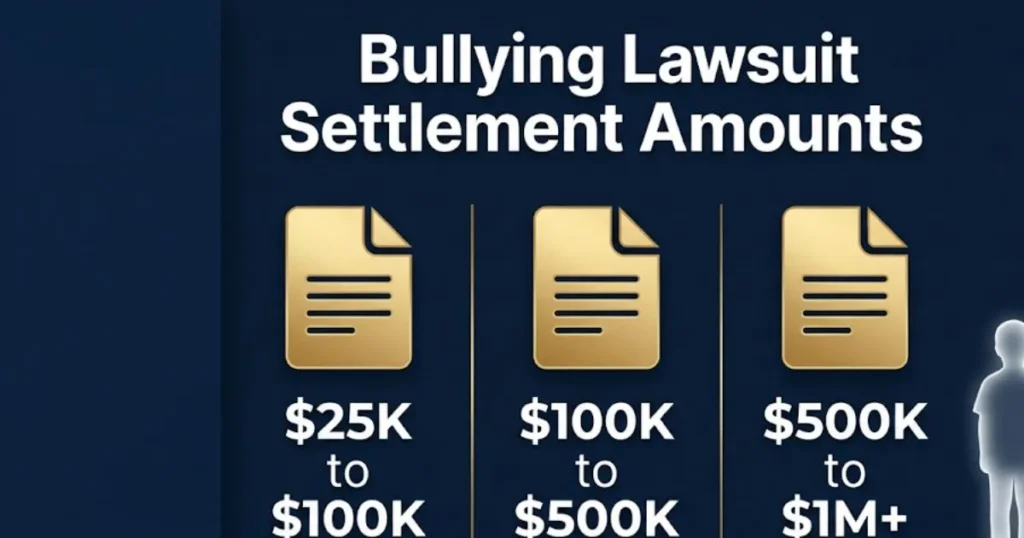
Bullying lawsuit settlements in 2026 typically range from $25,000 to over $1 million, with the exact amount driven by the severity of harm and the strength of evidence. Most cases settle between $50,000 and $300,000.
Settlement amounts swing wildly depending on several factors. A case involving physical injury and documented PTSD will bring far more than a case where the harm was primarily emotional with limited documentation.
Schools and employers often prefer to settle rather than go to trial. A public verdict attracts media attention, damages reputations, and can cost even more in punitive damages.
| Settlement Range | Typical Case Characteristics |
|---|---|
| $10,000 to $50,000 | Minor emotional harm, short duration, limited evidence |
| $50,000 to $150,000 | Documented emotional distress, therapy costs, some physical harm |
| $150,000 to $500,000 | Severe bullying, school transfer required, diagnosed PTSD or anxiety |
| $500,000 to $1 million+ | Physical injury, suicide attempt, wrongful death, egregious institutional failure |
A few real-world examples paint the picture. In one 2024 case in New Jersey, a school district settled for $500,000 after a student with disabilities was repeatedly assaulted by classmates. The school had records showing staff were told about the abuse and did nothing.
In another case out of Texas, a family received a $200,000 settlement after their child was cyberbullied so severely they required hospitalization for depression.
Keep in mind that settlement amounts are often confidential. The numbers that become public tend to be the larger, more dramatic cases, which can skew expectations.
Key Takeaway: You can absolutely sue for bullying in 2026, and settlements routinely reach six figures when the victim can show severe harm and institutional failure.
How Much Can You Sue for Bullying
The amount you can sue for in a bullying case depends on the type of damages you claim. There is no fixed cap in most states, though some states limit damages against government entities like public schools.
Compensatory damages cover your actual losses. These include medical bills, therapy costs, lost wages (or a parent’s lost income), and the cost of changing schools or relocating.
Non-economic damages cover pain and suffering, emotional distress, loss of enjoyment of life, and similar harms that do not come with a receipt. These are often the largest part of a bullying settlement.
Punitive damages are awarded to punish the defendant for especially reckless or malicious behavior. Courts reserve these for the worst cases, like a school that actively covered up known abuse.
Here is a breakdown of common damage categories:
- Medical and therapy costs: $5,000 to $100,000+
- Pain and suffering: $10,000 to $500,000+
- Lost income or educational opportunity: $5,000 to $200,000+
- Punitive damages: varies, sometimes exceeds compensatory damages by 2x to 3x
- Attorney fees: sometimes recoverable, especially in civil rights cases under Section 1983
One factor many people overlook is future damages. If a child develops chronic anxiety or PTSD that will require years of treatment, the lawsuit can demand payment for those future costs.
Some states cap damages against government entities at $250,000 to $500,000. Texas, for example, limits tort claims against school districts under the Texas Tort Claims Act. California tends to allow higher recovery amounts.
School Bullying Lawsuit
A school bullying lawsuit targets the educational institution, its administrators, or the school district for failing to protect a student from known harassment. These are the most common type of bullying case in the United States.
Public schools have a legal duty to provide a safe learning environment. When they ignore reports of bullying, fail to enforce their own anti-bullying policies, or allow a pattern of abuse to continue, they can be held financially responsible.
The landmark case Davis v. Monroe County Board of Education (1999) established that schools receiving federal funding can be sued for student-on-student harassment under Title IX. The standard requires showing the school had actual knowledge and responded with deliberate indifference.
| Legal Requirement | What It Means |
|---|---|
| Actual Knowledge | The school was told about the bullying (reports, emails, complaints) |
| Deliberate Indifference | The school’s response was clearly unreasonable given the circumstances |
| Severe and Pervasive | The bullying was bad enough to deny the victim access to education |
| Under School’s Control | The bullying happened on school grounds or at school-sponsored events |
Private schools are handled differently. They do not receive the same government immunity protections, which sometimes makes them easier to sue. But private school cases often rely on contract law, since families signed enrollment agreements.
One growing trend in 2026 is schools being held liable for bullying that starts online but spills into the school environment. Courts are increasingly recognizing that schools cannot ignore cyberbullying just because it happens off campus if it affects the student at school.
Bullying Lawsuit Against School District
A bullying lawsuit against a school district is filed when the district itself, not just one school or teacher, bears responsibility for systemic failures that allowed bullying to persist. These cases often produce the largest settlements.
School districts are government entities, so suing them comes with extra procedural hurdles. Most states require filing a tort claim notice before you can sue. This notice has strict deadlines, sometimes as short as 60 to 180 days after the incident.
The notice requirement trips up a lot of families. Miss that window and your case may be permanently barred, no matter how strong the facts are.
Strong cases against school districts usually involve:
- Multiple complaints that went unanswered
- Pattern evidence showing the district ignored bullying across several schools
- Policy failures where the district had no anti-bullying policy or refused to enforce the one on paper
- Retaliation against families who reported bullying
- Violations of IEP or 504 plans for students with disabilities who were targeted
A 2023 case in California resulted in a $1.25 million settlement against a school district after a student with autism was bullied for three consecutive years. The district had received over a dozen formal complaints and took no meaningful action.
When suing a school district, government immunity caps may limit your recovery. But in cases involving civil rights violations (Section 1983 claims), those caps often do not apply, and attorney fees can be recovered on top of damages.
Cyberbullying Lawsuit
A cyberbullying lawsuit targets individuals or entities responsible for online harassment, including threats, spreading false information, doxxing, impersonation, or distributing intimate images without consent. These cases have exploded in 2026 as digital harassment becomes more severe.
Cyberbullying cases can be filed against the bully directly, their parents if the bully is a minor, and in some situations the school or platform that allowed the behavior to continue.
Federal law (Section 230 of the Communications Decency Act) generally protects social media platforms from liability for user-generated content. But this protection has limits. Platforms can be sued if they actively participated in creating the harmful content or failed to remove illegal material.
| Type of Cyberbullying | Potential Legal Claim |
|---|---|
| Threats of violence | Criminal charges + civil IIED claim |
| Spreading false statements | Defamation (libel/slander) |
| Sharing intimate images | Revenge porn statutes (criminal + civil) |
| Impersonation | Identity theft, fraud |
| Sustained harassment campaigns | Stalking/cyberstalking statutes |
| Doxxing | Privacy violation, IIED |
One major challenge in cyberbullying cases is identifying the bully. Anonymous accounts make it harder, but attorneys can subpoena social media companies for IP addresses and account information.
The financial harm from cyberbullying can be enormous. Victims often need extensive therapy, may need to change schools, and in workplace contexts may lose their job. All of these costs are recoverable in a lawsuit.
Several states enacted or strengthened cyberbullying laws in 2025, giving victims better tools heading into 2026. States like Florida, New York, and Illinois now have specific civil causes of action for cyberbullying, separate from traditional harassment statutes.
Key Takeaway: Schools and school districts are the most common targets in bullying lawsuits, but cyberbullying cases are growing fast and now carry serious legal weight in most states.
Workplace Bullying Lawsuit
A workplace bullying lawsuit is a legal action filed by an employee who was subjected to repeated harassment, intimidation, or abuse at work. Unlike school bullying, workplace bullying has fewer explicit legal protections in 2026, but there are still viable paths to sue.
Here is the uncomfortable truth: the United States has no federal law that specifically bans workplace bullying. Unless the bullying is tied to a protected characteristic like race, sex, religion, disability, or national origin, there is no standalone federal claim.
That does not mean you have no options. It just means workplace bullying cases require creative legal strategy.
Viable legal theories for workplace bullying include:
- Hostile work environment (Title VII): if the bullying targets a protected class
- Disability harassment (ADA): if the victim has a disability
- Intentional infliction of emotional distress (IIED): state-level tort claim
- Workers’ compensation: if the bullying caused a diagnosed mental health condition
- Constructive discharge: if the bullying was so bad you were forced to quit
- Whistleblower retaliation: if the bullying started after you reported misconduct
The Healthy Workplace Bill has been introduced in over 30 states but as of early 2026 has only passed in a handful. This legislation would make severe workplace bullying independently actionable regardless of protected class status.
| State | Healthy Workplace Bill Status (2026) |
|---|---|
| California | Introduced, not yet passed |
| New York | Pending committee review |
| Tennessee | Partial protections enacted |
| Utah | Protections for public employees only |
| Massachusetts | Introduced in 2025, pending |
If your workplace bully targeted you because of who you are, whether your race, gender, age, or disability, your case is much stronger. Federal anti-discrimination laws already prohibit that conduct.
Emotional Distress from Bullying Lawsuit
Emotional distress damages are available in most bullying lawsuits and often make up the largest portion of the total recovery. Courts recognize that bullying causes psychological harm that is just as real as a broken bone.
There are two legal theories for emotional distress claims:
Intentional infliction of emotional distress (IIED) requires showing the defendant’s behavior was outrageous, intentional or reckless, and caused severe emotional harm. This applies when the bully or institution acted deliberately.
Negligent infliction of emotional distress (NIED) applies when someone’s carelessness caused your emotional harm. A school that negligently failed to supervise students could face NIED claims.
To win emotional distress damages, you typically need:
- Professional diagnosis: anxiety, depression, PTSD, or similar conditions documented by a therapist or psychiatrist
- Treatment records: proof you sought and received mental health care
- Impact testimony: descriptions of how the bullying changed your daily life, sleep, relationships, and academic or work performance
- Expert witness: a mental health professional who can testify about the severity and cause of your condition
Courts in 2026 are increasingly comfortable awarding significant emotional distress damages. In a 2024 Georgia case, a jury awarded $750,000 in emotional distress damages alone to a student who developed severe PTSD after years of school bullying.
One common defense tactic is arguing the victim had pre-existing mental health issues. Your attorney can counter this by showing the bullying made the condition substantially worse, known as the “eggshell plaintiff” doctrine.
Who Is Liable for Bullying
Liability for bullying falls on whoever had a duty to protect the victim and failed to do so. This includes the bully themselves, their parents, schools, employers, coaches, and sometimes other organizations.
Here is how liability breaks down by defendant:
| Defendant | Basis of Liability | When It Applies |
|---|---|---|
| The bully (individual) | Assault, battery, IIED, defamation | Direct harm caused by the bully’s actions |
| Parents of a minor bully | Negligent supervision, parental liability statutes | Parent knew about behavior and failed to stop it |
| School / school district | Negligence, deliberate indifference, Title IX | School knew about bullying and did not act |
| Employer | Title VII, ADA, IIED, negligent retention | Employer knew about harassment and did nothing |
| Coaches / activity leaders | Negligent supervision | Bullying occurred during supervised activities |
| Social media platforms | Limited liability; Section 230 protections apply | Only if platform actively contributed to harm |
Schools are the most frequently sued defendants because they have the clearest duty of care. Courts have consistently ruled that schools must take reasonable steps to protect students from foreseeable harm.
For workplace cases, the employer’s liability often depends on whether management knew about the bullying. An HR complaint that went ignored is gold for plaintiffs. A bully who operated completely under the radar is harder to pin on the company.
Parents of minor bullies can be held liable under state parental responsibility laws. Most states cap parental liability at $5,000 to $25,000 for property damage and personal injury caused by their children. But if the parents knew about the bullying pattern and did nothing, the cap may not apply.
Key Takeaway: Multiple parties can be held liable for bullying, and the strongest cases target institutions that had a duty to act, were told about the problem, and chose to ignore it.
How to File a Bullying Lawsuit
Filing a bullying lawsuit involves documenting the harm, identifying the liable parties, meeting procedural deadlines, and working with an attorney who handles harassment or personal injury cases. The process typically takes 6 to 18 months before any resolution.
Here are the steps in order:
Step 1: Document everything. Save texts, emails, screenshots, social media posts, school reports, medical records, and any written complaints you filed. This is your foundation.
Step 2: Get medical and psychological treatment. See a doctor or therapist. You need a professional record of your injuries. Without treatment records, defendants will argue the harm was not that bad.
Step 3: File formal complaints. Report the bullying to the school, employer, or relevant authority. Put it in writing. Keep copies. This creates the paper trail showing they had notice.
Step 4: Check your deadlines. If suing a government entity like a public school, you may need to file a tort claim notice within 60 to 180 days. Missing this kills your case.
Step 5: Hire an attorney. Look for a lawyer who handles personal injury, education law, or civil rights cases. Most bullying attorneys work on contingency, meaning you pay nothing upfront. They take 25% to 40% of the recovery.
Step 6: File the complaint. Your attorney drafts a legal complaint naming the defendants and the causes of action. This is filed with the court and served on the other side.
Step 7: Discovery and negotiation. Both sides exchange evidence. Most cases settle during this phase. If no settlement is reached, the case goes to trial.
| Phase | Typical Timeline |
|---|---|
| Document and report | Ongoing, start immediately |
| Tort claim notice (if required) | 60 to 180 days from incident |
| File lawsuit | Within statute of limitations (1 to 3 years) |
| Discovery | 3 to 12 months after filing |
| Settlement negotiations | During or after discovery |
| Trial (if needed) | 12 to 24 months after filing |
Bullying Lawsuit Evidence
Strong evidence wins bullying lawsuits. The most important types of evidence are written records, medical documentation, witness statements, and any proof that the responsible institution was notified and failed to act.
Courts need to see a clear pattern. One incident is rarely enough. You need to show repeated behavior over time that caused measurable harm.
Here is what the strongest bullying cases include:
- Written complaints: Emails, letters, or forms you submitted to the school or employer
- Responses (or lack thereof): Evidence that the institution did nothing or took inadequate action after being notified
- Medical records: Doctor or therapist notes documenting physical or psychological harm
- Screenshots: Social media posts, text messages, chat logs showing the bullying
- Witness statements: Teachers, coworkers, classmates, or parents who saw the bullying or its effects
- School records: Incident reports, suspension records, grade changes, attendance drops
- Expert testimony: Mental health professionals who can link the bullying to the victim’s condition
- Video or audio: Surveillance footage, recorded phone calls (check your state’s recording laws)
One underrated piece of evidence is the victim’s journal or diary. Courts accept contemporaneous written accounts of events, especially from children. If your child wrote about being bullied on specific dates, that counts.
Another powerful evidence type is the institution’s own anti-bullying policy. If they had a policy and ignored it, that document becomes evidence against them.
Think of evidence like building a brick wall. Each piece is one brick. A single brick is not a wall. But stack enough of them together and you have something a jury cannot ignore.
Parents Suing for Bullying
Parents can sue for bullying on behalf of their minor children, and they may have their own separate claims for damages like lost income, medical expenses, and emotional distress. In every state, a parent or legal guardian files the lawsuit as the child’s representative.
When a minor is the victim, the parent acts as the “next friend” or “guardian ad litem” in court. The child is the actual plaintiff, but the parent handles the legal process.
Parents often have their own damages in these cases:
- Lost wages from taking time off work to deal with the situation
- Out-of-pocket medical costs for therapy, medication, or hospitalization
- Costs of transferring schools including tuition at a new school or moving expenses
- Their own emotional distress from watching their child suffer
One key legal point: the statute of limitations for a minor’s claim is often tolled (paused) until the child reaches adulthood. This means you might have longer to file than you think. But waiting too long weakens the evidence, so filing sooner is almost always better.
Parents can also sue the parents of the bully. Most states have parental responsibility statutes that hold parents liable for their minor child’s intentional harmful acts.
| State | Parental Liability Cap |
|---|---|
| California | $25,000 per incident |
| Texas | $25,000 per incident |
| Florida | No specific cap; varies by case |
| New York | $5,000 per incident |
| Illinois | Actual damages; no fixed cap |
Key Takeaway: Parents have both the right and the standing to sue for their child’s bullying, and they can recover their own financial losses on top of the child’s damages.
Bullying Lawsuit Statute of Limitations
The statute of limitations for a bullying lawsuit varies by state and by the type of legal claim you are bringing. In most states, you have 1 to 3 years from the date of the last incident to file a civil lawsuit.
This deadline is strict. Miss it by even one day and the court will throw your case out, no matter how terrible the bullying was.
| Claim Type | Typical Deadline |
|---|---|
| Personal injury / negligence | 2 to 3 years from injury |
| Intentional infliction of emotional distress | 1 to 3 years from last incident |
| Civil rights (Section 1983) | Follows state personal injury deadline |
| Title IX (school) | 180 days to file with OCR; civil suit deadline varies |
| Tort claim against government entity | 60 to 180 days for notice; 1 to 2 years for lawsuit |
There are a few exceptions that can extend your deadline:
Minor victims: In most states, the statute of limitations does not begin running until the child turns 18. So a child bullied at age 10 might have until age 20 or 21 to file.
Discovery rule: In some jurisdictions, the clock does not start until the victim discovers (or should have discovered) the harm. This comes up when psychological damage surfaces years later.
Government notice requirements: If you are suing a public school district, the tort claim notice deadline is separate from and shorter than the lawsuit filing deadline. Check your state’s requirements immediately.
Do not wait to see if things get better. The strongest cases are filed while evidence is fresh and witnesses still remember what happened. Every month that passes makes your case harder to prove.
School Bullying Lawsuit Settlements
School bullying lawsuit settlements have been increasing in size and frequency heading into 2026. Families are recovering larger amounts as courts recognize the serious long-term impact bullying has on children.
Here are notable settlement examples from recent years:
| Year | State | Settlement Amount | Key Facts |
|---|---|---|---|
| 2024 | New Jersey | $500,000 | Student with disabilities assaulted repeatedly |
| 2024 | Texas | $200,000 | Cyberbullying led to hospitalization for depression |
| 2023 | California | $1.25 million | 3 years of bullying, 12+ complaints ignored |
| 2023 | Ohio | $150,000 | Student transferred schools due to physical bullying |
| 2022 | New York | $675,000 | School failed to enforce its own anti-bullying policy |
Several factors push settlements higher:
- Duration of bullying: Longer patterns of abuse mean larger settlements
- Severity of harm: Hospitalization, suicide attempts, or permanent psychological damage increase value significantly
- Strength of notice evidence: Proof that the school was told multiple times and did nothing
- Quality of medical documentation: Well-documented treatment records with professional diagnoses
- Media attention: High-profile cases put pressure on school districts to settle quickly and generously
Most school bullying settlements include a confidentiality clause. The school pays the money but demands the family never disclose the amount publicly. This is why the true average is hard to pin down.
Some settlements also include injunctive relief, meaning the school agrees to change its policies, train staff, or implement new anti-bullying programs as part of the deal. For many families, these changes matter as much as the money.
Bullying Wrongful Death Lawsuit
A bullying wrongful death lawsuit is filed when a victim dies as a result of bullying, most commonly by suicide. These are the most devastating and often the highest-value bullying cases in the legal system.
Bullying-related suicides among children and teens remain a serious problem. According to CDC data, suicide is the second leading cause of death for people aged 10 to 24. Research consistently links bullying victimization with increased suicide risk.
To succeed in a wrongful death bullying case, the family must prove:
- The bullying was severe and prolonged
- The school or institution knew about the bullying
- The institution failed to take reasonable steps to stop it
- The failure to act was a substantial factor in causing the victim’s death
| Element | What Families Must Show |
|---|---|
| Duty of Care | The school had a responsibility to protect the student |
| Breach | The school failed to take reasonable protective action |
| Causation | The school’s failure contributed to the student’s death |
| Damages | Funeral costs, loss of companionship, emotional suffering of surviving family |
These cases are emotionally charged and legally complex. Defense attorneys will argue that the school cannot be blamed for a suicide, that other factors like home life or mental illness were the real cause, and that the connection between bullying and death is too attenuated.
But juries in recent years have rejected those arguments. A 2023 verdict in Florida awarded $3 million to the family of a 14-year-old who took his life after months of bullying that the school documented but never addressed.
Wrongful death cases also carry longer statutes of limitations in some states. The clock may start on the date of death rather than the date of the last bullying incident, giving families more time to file.
Key Takeaway: Bullying wrongful death cases carry enormous potential damages and are increasingly successful when families can show the institution knew about the bullying and chose to do nothing.
Cyberbullying Laws by State 2026
Cyberbullying laws vary significantly by state in 2026, with all 50 states now having some form of anti-bullying legislation that addresses electronic or online harassment. The strength and scope of these laws differ greatly.
Some states treat cyberbullying as a criminal offense. Others only address it through school policy requirements. A few states have created specific civil causes of action allowing victims to sue their cyberbullies directly.
| State | Criminal Cyberbullying Law | Civil Cause of Action | School Policy Required |
|---|---|---|---|
| California | Yes | Yes | Yes |
| Florida | Yes (felony for repeat offenders) | Yes | Yes |
| New York | Yes | Limited | Yes |
| Texas | Yes (David’s Law) | Yes | Yes |
| Illinois | Yes | Yes | Yes |
| Georgia | Yes | Limited | Yes |
| Ohio | Limited | No | Yes |
| Michigan | Limited | No | Yes |
| New Jersey | Yes | Yes | Yes (strongest school mandate) |
| Missouri | Yes (Megan’s Law provisions) | Limited | Yes |
States leading the way in 2026 include:
- Florida: Made repeated cyberbullying a felony in 2024, expanded to cover adults targeting minors
- Texas: David’s Law gives schools authority to investigate off-campus cyberbullying and allows civil lawsuits
- New Jersey: Has the most stringent school anti-bullying mandate in the country, requiring investigation within one school day
A significant gap remains for adult victims. Most cyberbullying statutes focus on minors in school settings. Adults facing online harassment often must rely on general stalking, harassment, or defamation laws, which have higher thresholds for proving a case.
Several states introduced bills in their 2025 legislative sessions to address AI-generated harassment, including deepfake bullying. These laws are expected to take full effect by mid-2026.
Anti-Bullying Laws 2026
Anti-bullying laws in 2026 reflect a national shift toward stronger protections and actual enforcement. Every state now has an anti-bullying statute on the books, but the quality and enforceability of those laws range from excellent to nearly toothless.
The best anti-bullying laws share these features:
- Clear definition of bullying that includes physical, verbal, social, and electronic forms
- Enumerated protected classes (race, gender, sexual orientation, disability, religion)
- Mandatory reporting requirements for school staff
- Investigation timelines (some states require response within 24 to 48 hours)
- Consequences for both the bully and the institution that fails to respond
- Civil remedy provisions allowing victims to sue
The weakest laws simply say schools should have an anti-bullying policy. They do not specify what the policy must include, set no deadlines for investigation, and create no penalties for inaction.
| Law Quality Tier | States (Examples) | Key Characteristics |
|---|---|---|
| Strong | NJ, CA, FL, IL, TX | Criminal penalties, civil remedies, mandatory investigation |
| Moderate | NY, OH, GA, PA, MA | Policy requirements with some enforcement teeth |
| Weak | MT, SD, WY, AL, MS | Policy requirements only, minimal enforcement, no civil remedy |
Two major legislative trends heading into 2026:
AI and deepfake bullying: At least 8 states introduced bills in 2025 to specifically criminalize the use of AI to create fake images, videos, or audio of another person for harassment purposes.
Workplace bullying legislation: The Healthy Workplace Bill gained momentum. While no state has fully passed it as a standalone law, elements of it have been incorporated into existing employment statutes in Tennessee and Utah.
The federal government has not passed a national anti-bullying law. The Megan Meier Cyberbullying Prevention Act was introduced years ago but has never made it through Congress. Federal protections still rely on Title IX, Section 1983, and existing civil rights statutes.
Frequently Asked Questions
How much money can you get from a bullying lawsuit in 2026?
Most bullying lawsuit settlements range from $50,000 to $300,000 in 2026.
Cases involving severe harm like hospitalization or suicide attempts can exceed $1 million.
The exact amount depends on the severity of harm, quality of evidence, and whether the institution ignored reports.
Can parents sue a school for not stopping bullying?
Yes. Parents can sue a school or school district that knew about bullying and failed to take reasonable steps to stop it.
The legal standard is “deliberate indifference,” meaning the school’s response was clearly inadequate.
You must file a tort claim notice within 60 to 180 days if suing a public school district.
What evidence do you need for a bullying lawsuit?
You need documented complaints to the school or employer, medical or therapy records, and evidence of the bullying itself like screenshots or witness statements.
A pattern of repeated behavior is essential; one isolated incident is usually not enough.
The strongest cases include proof that the institution was notified and took no meaningful action.
Is workplace bullying illegal in 2026?
Workplace bullying is not specifically illegal under federal law unless it targets a protected class like race, sex, or disability.
Some states have enacted limited protections, and the Healthy Workplace Bill is gaining traction.
Victims may file claims for intentional infliction of emotional distress, hostile work environment, or constructive discharge.
How long do you have to file a bullying lawsuit?
The statute of limitations is typically 1 to 3 years from the date of the last bullying incident.
For minor victims, the clock is usually paused until they turn 18.
If suing a public school district, you must file a tort claim notice within 60 to 180 days, which is a much shorter deadline.
Take Action Now
Bullying causes real harm, and the legal system in 2026 offers real remedies. Settlements are growing. Courts are holding schools and employers accountable.
If you or your child experienced bullying, start by documenting everything and filing formal complaints. Check your state’s deadlines, especially the tort claim notice window for public schools.
The families who win these cases are the ones who act quickly and build strong evidence. Do not let a filing deadline pass you by.







