

Breast implant lawsuit payouts in 2026 range from a few thousand dollars to well over $500,000, depending on the type of injury and the manufacturer involved. Thousands of women are filing claims right now against companies like Allergan and Mentor.
These lawsuits center on defective breast implants linked to cancer, autoimmune disorders, and chronic illness. If you received textured or silicone gel implants and got sick, there may be money waiting for you.
This article breaks down every detail you need. Settlement amounts, eligibility rules, filing steps, deadlines, and how payouts are actually calculated.
Here’s one number that puts it all in perspective: Allergan’s parent company AbbVie has already set aside billions to resolve implant-related claims.
Breast Implant Lawsuit Payouts
Breast implant lawsuit payouts are compensation payments made to women harmed by defective breast implants. These payouts come from settlements, jury verdicts, or negotiated agreements between plaintiffs and implant manufacturers.
The money covers things like medical bills, lost wages, pain and suffering, and the cost of implant removal surgery. Some women also receive compensation for emotional distress.
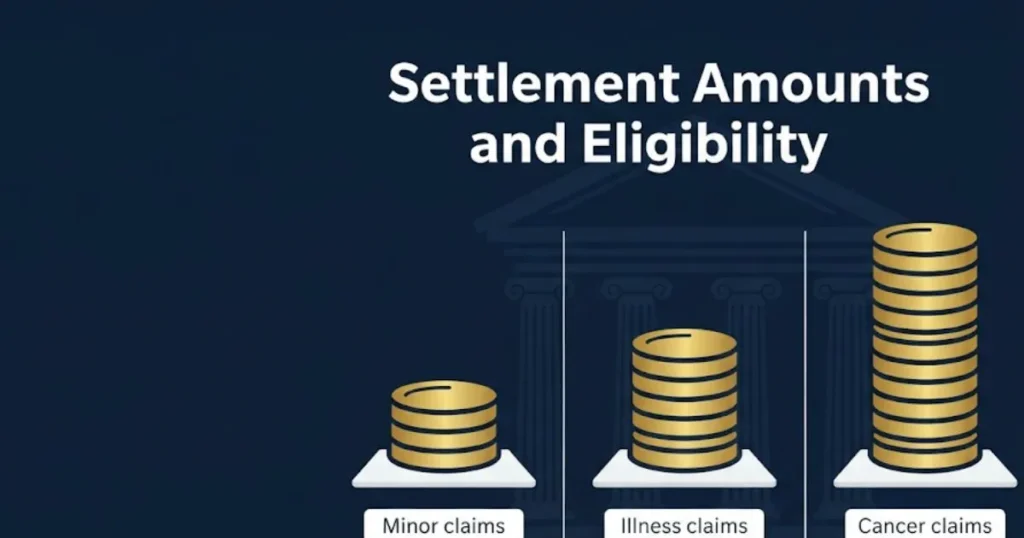
Payout amounts vary wildly. A straightforward rupture claim might bring $5,000 to $25,000. A BIA-ALCL cancer diagnosis can push the number past $500,000.
| Injury Type | Estimated Payout Range |
|---|---|
| Implant Rupture | $5,000 to $50,000 |
| Capsular Contracture | $10,000 to $75,000 |
| Breast Implant Illness (BII) | $25,000 to $150,000 |
| BIA-ALCL (Lymphoma) | $100,000 to $500,000+ |
| Wrongful Death | $500,000 to $2,000,000+ |
Most of these payouts come through mass tort litigation, not individual trials. That means your case gets grouped with others, which speeds things up and puts pressure on the manufacturer.
The manufacturer’s level of negligence matters too. If a company hid known risks from the FDA, punitive damages can pile on top of the base settlement.
Breast Implant Lawsuit Settlement Amounts
Settlement amounts in breast implant cases depend on three main factors: the severity of your injury, which manufacturer made your implant, and whether your case involves a cancer diagnosis.
Women with documented BIA-ALCL have received some of the highest settlements. Several cases against Allergan have settled individually for amounts between $200,000 and $500,000 or more.
Cases involving breast implant illness without a cancer diagnosis tend to settle lower. Most fall in the $25,000 to $150,000 range.
Here’s what drives the settlement number up:
- Cancer diagnosis (BIA-ALCL confirmed by pathology)
- Multiple revision surgeries required
- Lost income due to illness or recovery
- Documented autoimmune conditions triggered by implants
- Manufacturer knew about the risk and failed to warn
Cases that settle for less usually involve minor complications like localized pain or a single implant rupture without systemic illness.
The biggest factor is proof. Medical records linking your implant to your health problems carry enormous weight. Without that paper trail, even strong cases can settle below their potential.
Average Breast Implant Settlement
The average breast implant settlement in 2026 falls somewhere between $50,000 and $150,000 for most claims that don’t involve cancer.
That number comes from aggregating reported settlements across mass tort filings and individual lawsuits over the past several years. It’s not a guarantee. It’s a realistic middle ground.
Cancer-related cases pull the average much higher. When you factor in BIA-ALCL claims, the overall average across all breast implant lawsuits climbs closer to $175,000 to $250,000.
| Case Category | Average Settlement |
|---|---|
| Non-Cancer Claims | $50,000 to $150,000 |
| BIA-ALCL Claims | $200,000 to $500,000 |
| All Claims Combined | $175,000 to $250,000 |
Keep in mind that “average” doesn’t mean “typical.” A few massive verdicts can skew the average upward. The median settlement, which better represents what most people actually receive, is likely lower.
Attorney fees also reduce your take-home amount. Most breast implant lawyers work on contingency, taking 33% to 40% of the settlement. Court costs and medical record retrieval fees come out of the total too.
Key Takeaway: Breast implant lawsuit payouts range from $5,000 for minor issues to over $500,000 for cancer cases, with the average non-cancer settlement sitting between $50,000 and $150,000.
How Much Can I Get from a Breast Implant Lawsuit
How much you can get from a breast implant lawsuit depends on your specific injuries, your medical documentation, and which implant manufacturer you’re suing. There’s no single number that applies to everyone.
Think of it like car insurance claims. A fender bender gets a small check. A totaled car with injuries gets a big one. Breast implant lawsuits work the same way.
Your payout is shaped by these specific factors:
- Type of implant (textured vs. smooth, silicone vs. saline)
- Manufacturer (Allergan pays more due to stronger evidence against them)
- Severity of health problems (cancer vs. chronic symptoms)
- Number of surgeries required to fix the damage
- Length of suffering (years of symptoms before diagnosis)
- Lost wages and earning capacity
- Quality of your medical records
Women who kept detailed medical records tend to receive higher payouts. That includes imaging reports showing rupture, pathology reports confirming BIA-ALCL, and doctor notes documenting symptom progression.
If your surgeon used Allergan Biocell textured implants and you developed BIA-ALCL, you’re looking at the strongest possible claim. Those cases have the clearest liability trail and the highest documented payouts.
Breast Implant Lawsuit 2026 Update
The breast implant lawsuit landscape in 2026 is active, with ongoing litigation against multiple manufacturers and new filings still being accepted in several jurisdictions.
Allergan’s parent company AbbVie continues to face the largest volume of claims. The MDL (multidistrict litigation) centralized in the U.S. District Court for the District of New Jersey, MDL No. 2921, remains the primary federal case hub for BIA-ALCL related claims.
Several bellwether trials are expected to move forward in 2026. These test cases will set the tone for settlement negotiations across thousands of pending claims.
| 2026 Milestone | Status |
|---|---|
| Allergan MDL No. 2921 | Active, bellwether trials expected |
| New BII Filings | Still being accepted |
| Mentor Implant Claims | Growing, earlier stage |
| FDA Safety Reviews | Ongoing monitoring |
| Statute of Limitations | Varies by state, some closing soon |
New scientific research published in late 2024 and 2025 strengthened the link between textured implants and BIA-ALCL. That research is giving plaintiffs’ attorneys stronger ammunition in court.
For women who haven’t filed yet, 2026 is a critical year. Some states have statutes of limitations that are approaching their deadlines based on when the FDA issued its 2019 recall of Allergan Biocell implants.
Breast Implant Class Action Lawsuit
Most breast implant cases in 2026 are not traditional class actions. They are mass tort cases, which work differently and usually result in better individual payouts.
In a class action, everyone gets the same settlement amount. In a mass tort, each person’s case is evaluated individually. That means your specific injuries determine your specific payout.
The distinction matters a lot for your wallet.
| Feature | Class Action | Mass Tort |
|---|---|---|
| Individual Evaluation | No | Yes |
| Same Payout for All | Yes | No |
| Attorney Representation | One firm for the class | Your own attorney |
| Settlement Speed | Faster | Varies |
| Average Payout | Lower | Higher |
Some earlier breast implant cases in the 1990s were handled as class actions. The Dow Corning silicone implant class action resulted in a $3.2 billion settlement fund, but individual payouts were relatively small because so many claimants were involved.
Today’s litigation structure favors mass torts. The Allergan BIA-ALCL MDL is structured this way. Each plaintiff files an individual lawsuit, but the cases are coordinated together for efficiency.
If someone tells you to “join the class action,” they likely mean filing your own individual claim within the mass tort. The end result is the same: your case gets grouped with others for pretrial proceedings.
Key Takeaway: Current breast implant lawsuits are mass torts, not class actions, meaning each claimant’s payout is based on their individual injuries rather than a flat amount for everyone.
Allergan Breast Implant Lawsuit
The Allergan breast implant lawsuit is the largest and most well-known breast implant litigation in 2026. It primarily targets Allergan’s Biocell textured breast implants, which the FDA recalled in July 2019.
Allergan, now owned by AbbVie, faces thousands of lawsuits claiming its textured implants caused BIA-ALCL, a rare form of non-Hodgkin’s lymphoma. The World Health Organization formally recognized BIA-ALCL as a disease in 2016.
The FDA’s recall was a turning point. It was the first time the agency requested a mandatory recall of a breast implant product. The recall covered all Allergan Biocell textured implants and tissue expanders.
Key facts about the Allergan lawsuit:
- MDL No. 2921 is centralized in New Jersey federal court
- Judge Brian Martinotti oversees the proceedings
- AbbVie acquired Allergan in 2020 for $63 billion
- Thousands of individual claims are consolidated in the MDL
- Bellwether trials are expected to begin in 2026
Internal documents revealed during discovery suggest Allergan had knowledge of the BIA-ALCL risk before the recall. Plaintiffs’ attorneys argue the company failed to adequately warn patients and doctors.
AbbVie has set aside significant financial reserves for implant-related liabilities. The company’s quarterly filings acknowledge the ongoing litigation as a material financial risk.
Mentor Breast Implant Lawsuit
Mentor breast implant lawsuits are growing in 2026, though they trail behind Allergan cases in both volume and settlement size. Mentor, a subsidiary of Johnson & Johnson, manufactures both smooth and textured silicone implants.
Claims against Mentor focus on two main issues. First, that their textured implants carry a risk of BIA-ALCL similar to Allergan’s products. Second, that their MemoryGel silicone implants can rupture silently, causing chronic inflammation.
Unlike Allergan, Mentor’s textured implants were not recalled by the FDA. However, the FDA issued a black box warning for all breast implants in 2020, which covers Mentor products.
| Comparison | Allergan | Mentor |
|---|---|---|
| FDA Recall | Yes (2019) | No |
| Black Box Warning | Yes | Yes |
| Primary Claim | BIA-ALCL | Rupture/BII/BIA-ALCL |
| Parent Company | AbbVie | Johnson & Johnson |
| Litigation Stage | Advanced (MDL active) | Earlier stage |
| Estimated Case Volume | Thousands | Hundreds growing |
Mentor lawsuits are earlier in the litigation process. That means settlements may take longer to materialize compared to Allergan cases. But the legal groundwork being laid in the Allergan MDL is creating a roadmap for Mentor claims.
Johnson & Johnson has experience defending mass tort litigation. The company’s track record with talc powder lawsuits gives some indication of how aggressively it may fight or settle breast implant claims.
Textured Breast Implant Lawsuit
Textured breast implant lawsuits focus specifically on the rough surface design of certain implants, which has been directly linked to BIA-ALCL. The textured surface was designed to reduce capsular contracture but ended up creating a cancer risk.
The science behind this is becoming clearer every year. The textured surface creates more surface area where bacteria can accumulate. That chronic bacterial biofilm triggers an immune response that, in some patients, leads to lymphoma.
Not all textured implants carry the same risk level. Allergan’s Biocell “macro-textured” implants have the highest reported rates of BIA-ALCL. Other manufacturers’ “micro-textured” implants show lower but still elevated risk.
Quick facts about textured implant cases:
- Allergan Biocell implants are at the center of most lawsuits
- FDA data shows textured implants account for the vast majority of BIA-ALCL cases
- Smooth implants have not been linked to BIA-ALCL
- The WHO classified BIA-ALCL as a distinct lymphoma in 2016
- Over 1,000 cases of BIA-ALCL have been reported worldwide
If you had textured implants and developed swelling, fluid buildup, or a mass near the implant, you should get tested for BIA-ALCL. An ultrasound-guided aspiration of the fluid around the implant is the standard diagnostic test.
Women with textured implants who haven’t developed symptoms can still take legal action if they’ve had to undergo removal surgery as a preventive measure. Explant surgery costs, lost wages, and emotional distress are all compensable.
Key Takeaway: Textured breast implants, especially Allergan’s Biocell design, are the primary target of breast implant lawsuits because of their direct link to BIA-ALCL lymphoma.
Breast Implant Illness Lawsuit
Breast implant illness (BII) lawsuits are filed by women who experience systemic health problems they believe are caused by their implants, even without a cancer diagnosis. BII is not a formal medical diagnosis but a widely recognized pattern of symptoms.
Symptoms commonly reported in BII cases include:
- Chronic fatigue and brain fog
- Joint and muscle pain
- Hair loss
- Skin rashes
- Autoimmune-like symptoms
- Anxiety and depression
- Difficulty concentrating
- Chest tightness and shortness of breath
The legal challenge with BII cases is proving causation. Unlike BIA-ALCL, where pathology confirms the link, BII relies on a pattern of symptoms that improved after implant removal.
Many women report dramatic improvement after explant surgery. That before-and-after evidence is becoming more persuasive in court. Attorneys are building cases around medical records that document symptom onset after implantation and resolution after removal.
BII lawsuits typically settle for less than BIA-ALCL cases. Expected payouts range from $25,000 to $150,000. The stronger your medical documentation, the higher that number goes.
The FDA acknowledged BII concerns in its 2020 guidance requiring new patient decision checklists. That regulatory action gives plaintiffs additional support for their claims that manufacturers should have warned about these risks earlier.
BIA-ALCL Breast Implant Lawsuit
BIA-ALCL breast implant lawsuits involve women diagnosed with breast implant-associated anaplastic large cell lymphoma, a cancer of the immune system directly linked to textured breast implants. These are the highest-value cases in breast implant litigation.
BIA-ALCL is not breast cancer. It’s a type of non-Hodgkin’s lymphoma that develops in the scar tissue surrounding the implant. When caught early, it’s usually curable with surgery to remove the implant and surrounding capsule.
When caught late, it can spread and require chemotherapy, radiation, or more aggressive treatment. Some cases have been fatal.
| BIA-ALCL Fact | Detail |
|---|---|
| Type of Cancer | Non-Hodgkin’s Lymphoma |
| Cause | Textured breast implants |
| Total Reported Cases | Over 1,000 worldwide |
| Reported Deaths | Approximately 40 to 50 globally |
| Time to Develop | Average 8 to 10 years after implantation |
| Treatment | Implant removal, capsulectomy, sometimes chemo |
| Lawsuit Payout Range | $100,000 to $500,000+ |
The FDA first identified BIA-ALCL as a potential risk in 2011. It took until 2019 for the agency to order Allergan’s recall. Plaintiffs argue that gap represents years of preventable harm.
If you’ve been diagnosed with BIA-ALCL, your case is among the strongest in this litigation. Pathology reports, surgical records, and implant identification records form the core of the evidence package.
Breast Implant Complications Lawsuit
Breast implant complications lawsuits cover a broad range of injuries beyond cancer and systemic illness. These include implant rupture, capsular contracture, implant displacement, chronic pain, and infections.
Capsular contracture is one of the most common complications. It happens when scar tissue around the implant tightens, squeezes the implant, and causes pain or distortion. Severe cases require surgical correction.
Implant rupture is another frequent claim. Silicone gel implants can rupture “silently,” meaning you may not know it happened without an MRI. The leaking silicone can migrate to lymph nodes and surrounding tissue.
Common complications that support lawsuits:
- Capsular contracture (Baker Grade III or IV)
- Silent rupture of silicone gel implants
- Implant displacement or malposition
- Chronic pain at the implant site
- Infection requiring implant removal
- Seroma (fluid collection around the implant)
- Nerve damage causing numbness or sensitivity changes
These cases tend to settle in the $10,000 to $75,000 range. The payout depends on how many surgeries were needed, how long the complications lasted, and whether the manufacturer failed to warn about the specific risk.
If your complications required multiple revision surgeries, your case value increases significantly. Each additional surgery adds documented medical expenses and extends the period of pain and suffering.
Key Takeaway: BIA-ALCL cases represent the strongest and highest-paying breast implant claims, while complications like rupture and capsular contracture can still result in meaningful payouts between $10,000 and $75,000.
Breast Implant Recall Lawsuit
Breast implant recall lawsuits are filed by women who had implants that were later recalled or subjected to safety warnings by the FDA. The most significant recall in this space is the July 2019 recall of Allergan Biocell textured breast implants.
That recall was historic. It marked the first time the FDA issued a mandatory Class I recall for a breast implant device. Class I is the FDA’s most serious recall category, reserved for products that could cause serious injury or death.
The recall covered all Allergan Biocell textured surface breast implants and tissue expanders. It did not require women to have their implants removed, but it stopped new sales and implantations.
| Recall Detail | Info |
|---|---|
| Date | July 24, 2019 |
| Manufacturer | Allergan (now AbbVie) |
| Product | Biocell textured implants and tissue expanders |
| Recall Class | Class I (most serious) |
| Reason | Risk of BIA-ALCL |
| Required Removal? | No, but monitoring recommended |
Women who chose to have their recalled implants removed can claim the cost of explant surgery, replacement implants (if desired), lost wages during recovery, and emotional distress.
Even women who kept their recalled implants in place may have claims. The anxiety and ongoing medical monitoring required because of the recall can be compensable in some jurisdictions.
The recall triggered a wave of lawsuits that continues into 2026. If you received Allergan Biocell implants at any point, you may have a viable claim regardless of whether you’ve experienced symptoms.
Who Qualifies for a Breast Implant Lawsuit
You may qualify for a breast implant lawsuit if you received breast implants that caused you physical harm, required unexpected medical treatment, or were later recalled or found to be defective.
The qualification criteria vary depending on which type of lawsuit you’re joining. Here’s a breakdown:
For Allergan BIA-ALCL lawsuits, you typically need:
- Allergan Biocell textured implants (confirmed by surgical records)
- Diagnosis of BIA-ALCL or related symptoms
- Medical records documenting your implant type and health problems
For breast implant illness lawsuits, you generally need:
- Any brand of breast implant
- Documented systemic symptoms (fatigue, joint pain, cognitive issues)
- Improvement after explant surgery (helpful but not always required)
- Medical records showing symptom timeline
For complications lawsuits, you typically need:
- Evidence of implant failure (rupture, contracture, displacement)
- Medical treatment for the complication
- Records showing the complication was not disclosed as a known risk
You don’t need a cancer diagnosis to qualify. Women with BII symptoms, implant ruptures, or even just the cost of removing recalled implants may have valid claims.
One thing that disqualifies many potential claimants is timing. If your state’s statute of limitations has expired, your case may be barred. That clock usually starts when you discovered (or should have discovered) the injury, not when the implant was placed.
Breast Implant Lawsuit Eligibility
Breast implant lawsuit eligibility in 2026 depends on your implant type, your health problems, your state’s statute of limitations, and whether you have supporting medical records.
The strongest eligible cases share these characteristics:
- Confirmed implant type through surgical records or device ID cards
- Documented health problems that began after implantation
- Medical treatment for implant-related conditions
- Filed within the statute of limitations for your state
| Eligibility Factor | Strong Claim | Weak Claim |
|---|---|---|
| Implant Type Documented | Yes, with records | No documentation |
| Health Problem Timing | Started after implant | Pre-existing condition |
| Medical Records | Complete and detailed | Sparse or missing |
| Statute of Limitations | Within time limit | Expired |
| Manufacturer Identified | Known brand (Allergan, Mentor) | Unknown brand |
Many women don’t realize they still have their device identification cards or that their surgeon’s office kept records of the implant manufacturer and model number. Check with your plastic surgeon’s office, the hospital where your surgery was performed, and your insurance company.
If you can’t identify your implant manufacturer, an MRI or ultrasound may help determine the implant type. Some manufacturers used distinct designs that radiologists can recognize on imaging.
Statutes of limitations are the biggest eligibility hurdle. Most states give you 2 to 6 years from the date you discovered (or reasonably should have discovered) your injury. The FDA’s 2019 recall can sometimes reset or extend that clock.
Key Takeaway: Eligibility for breast implant lawsuits requires documented implant records, medical evidence of harm, and filing within your state’s statute of limitations, which varies from 2 to 6 years after injury discovery.
How to File a Breast Implant Lawsuit
Filing a breast implant lawsuit in 2026 starts with contacting a law firm that handles mass tort medical device cases. Most breast implant attorneys offer free case evaluations and work on a contingency fee basis, meaning you pay nothing upfront.
Here’s the step-by-step process:
Step 1: Gather your records. Collect surgical records, implant device cards, medical records showing complications, imaging reports, and any documentation of symptoms.
Step 2: Contact a mass tort attorney. Look for firms with specific experience in breast implant or medical device litigation. They’ll review your case for free.
Step 3: Case evaluation. The attorney determines whether you have a viable claim based on your implant type, injuries, and timeline.
Step 4: File the complaint. Your attorney drafts and files a legal complaint in the appropriate court. For Allergan cases, this is typically the MDL in New Jersey.
Step 5: Discovery and litigation. Your case enters the discovery phase where evidence is exchanged. This can take months to years.
Step 6: Settlement or trial. Most cases settle before trial. If they don’t, bellwether trial results will influence your case value.
| Filing Step | What Happens | Your Time Investment |
|---|---|---|
| Record Gathering | You collect medical documents | 1 to 4 weeks |
| Attorney Consultation | Free case review | 30 to 60 minutes |
| Complaint Filing | Attorney handles everything | Minimal |
| Discovery | Evidence exchange | Months (attorney handles) |
| Resolution | Settlement or trial | Varies |
You won’t need to appear in court for most of the process. Your attorney handles the legal work while you provide medical records and answer questions about your health history.
Breast Implant Lawsuit Timeline
The breast implant lawsuit timeline from filing to payout typically spans 1 to 4 years, depending on the complexity of your case and whether it’s part of an active MDL.
Here’s a realistic timeline for cases filed in 2026:
| Phase | Expected Timeframe |
|---|---|
| Case Evaluation and Filing | 1 to 3 months |
| Discovery Phase | 6 to 18 months |
| Bellwether Trials (if applicable) | 2026 to 2027 |
| Settlement Negotiations | 3 to 12 months after bellwether results |
| Payout Distribution | 3 to 6 months after settlement approval |
Cases in the Allergan MDL are further along. Bellwether trials expected in 2026 will provide critical data points for settlement negotiations. Once those trials produce verdicts, settlement discussions often accelerate.
Mentor cases are earlier in the process. Women filing Mentor implant claims in 2026 should expect a longer timeline, potentially 3 to 5 years before seeing a payout.
Think of the bellwether trials as test runs. Both sides learn how juries react to the evidence. If plaintiffs win big verdicts, the manufacturer usually moves quickly to settle remaining cases. If the defense wins, negotiations can stall.
Individual settlements outside the MDL can sometimes move faster. If you have a particularly strong case with clear liability and severe injuries, your attorney may negotiate a direct settlement without waiting for the MDL process.
Patience is part of the equation here. The cases with the biggest payouts often take the longest to resolve. Quick settlements usually mean smaller checks.
Breast Implant Lawsuit Payout Calculator
A breast implant lawsuit payout calculator estimates your potential compensation based on factors like injury severity, medical costs, lost income, and manufacturer liability. No calculator can give you an exact number, but it can provide a reasonable range.
Here’s a simplified framework that attorneys use to estimate payouts:
Base factors in the calculation:
- Medical expenses (past and future): surgery costs, imaging, doctor visits, medications
- Lost wages: income missed during treatment and recovery
- Pain and suffering: physical pain and emotional distress
- Loss of quality of life: activities you can no longer do
- Punitive damages: additional penalties if the manufacturer acted recklessly
| Factor | Low Estimate | High Estimate |
|---|---|---|
| Medical Expenses | $5,000 | $200,000+ |
| Lost Wages | $2,000 | $100,000+ |
| Pain and Suffering | $10,000 | $300,000+ |
| Punitive Damages | $0 | $500,000+ |
| Attorney Fees (deducted) | 33% of total | 40% of total |
The math gets personal fast. A woman who had one explant surgery and returned to work in two weeks has a very different case value than a woman who battled BIA-ALCL through chemotherapy and lost her job.
Your attorney’s contingency fee is the biggest deduction from your payout. On a $150,000 settlement with a 33% fee, you’d take home roughly $100,500 before additional costs like medical record retrieval and court filing fees.
The best way to get an accurate estimate is through a free case evaluation with a breast implant attorney. They can look at your specific records and give you a realistic range based on cases similar to yours.
Key Takeaway: Your potential payout depends on injury severity, medical documentation, and manufacturer liability, with attorney fees typically reducing your take-home amount by 33% to 40%.
Frequently Asked Questions
How much money can I get from a breast implant lawsuit in 2026?
Most breast implant lawsuit payouts range from $5,000 to $500,000 or more.
Non-cancer claims typically settle between $25,000 and $150,000.
BIA-ALCL cancer claims can exceed $500,000 depending on the severity of your diagnosis and treatment.
Do I qualify for the Allergan breast implant lawsuit?
You may qualify if you received Allergan Biocell textured breast implants and experienced health problems.
You’ll need surgical records confirming your implant type and medical documentation of your injuries.
Even women who had recalled implants removed as a precaution may have eligible claims.
What is the deadline to file a breast implant lawsuit?
Filing deadlines vary by state, with most statutes of limitations ranging from 2 to 6 years after injury discovery.
The FDA’s 2019 recall may have reset the clock in some states.
Check with a breast implant attorney in your state to confirm your specific deadline before it expires.
Is there a class action lawsuit for breast implant illness?
There is no traditional class action for breast implant illness in 2026.
Most BII cases are filed as individual claims within mass tort litigation.
This structure actually benefits you because your payout is based on your individual injuries rather than a flat amount shared among all claimants.
How long does it take to get a breast implant lawsuit payout?
Most breast implant lawsuit payouts take 1 to 4 years from the date you file.
Cases in the Allergan MDL may see faster resolution as bellwether trials progress through 2026 and 2027.
Individual settlements can sometimes be reached sooner if your case has strong evidence and clear liability.
The bottom line on breast implant lawsuit payouts in 2026 is straightforward. If you were harmed by defective breast implants, real money is on the table.
Your first move should be gathering your surgical records and identifying your implant manufacturer. From there, a free case evaluation with a mass tort attorney will tell you where you stand.
Don’t let the statute of limitations run out on your claim. Every month you wait is a month closer to losing your right to compensation.







