

A brachial plexus injury lawsuit allows families to seek compensation when medical negligence during delivery damages the nerves in a baby’s shoulder, arm, or hand. These cases are filed against doctors, hospitals, or medical staff who failed to meet the standard of care during childbirth.
If your child suffered this type of birth injury, 2026 could be a critical year to take action. Filing deadlines vary by state, and some are running out.
Settlements in these cases range from $100,000 to over $10 million, depending on injury severity and long-term impact. About 1 to 3 out of every 1,000 live births involve some form of brachial plexus injury, according to published medical literature.
This article covers everything you need to know: settlement amounts, eligibility rules, the filing process, evidence requirements, state deadlines, and recent verdict results.
What Is a Brachial Plexus Injury Lawsuit
A brachial plexus injury lawsuit is a medical malpractice claim filed when a baby’s brachial plexus nerves are damaged during birth due to a healthcare provider’s negligence. These nerves run from the spinal cord through the neck and into the arm, controlling movement and sensation.
When a doctor uses excessive force during delivery, the brachial plexus can stretch, tear, or completely rupture. The result is partial or full loss of arm function. In the worst cases, the damage is permanent.
These lawsuits target the specific medical professionals involved. That includes the delivering physician, nurses, anesthesiologists, and the hospital itself.
The legal claim centers on one core question: did the medical team act below the accepted standard of care? If they did, and the injury resulted from that failure, the family has grounds to sue.
| Key Detail | Information |
|---|---|
| Type of Case | Medical malpractice / birth injury |
| Who Gets Sued | Doctors, nurses, hospitals, medical staff |
| Legal Basis | Failure to meet standard of care |
| Common Injuries | Erb’s palsy, Klumpke’s palsy, total plexus palsy |
| Typical Filing | State civil court |
Most families file these claims within the first few years of the child’s life. However, some states allow filing well into the child’s teenage years under special minor provisions.
Brachial Plexus Birth Injury Settlement Amounts in 2026
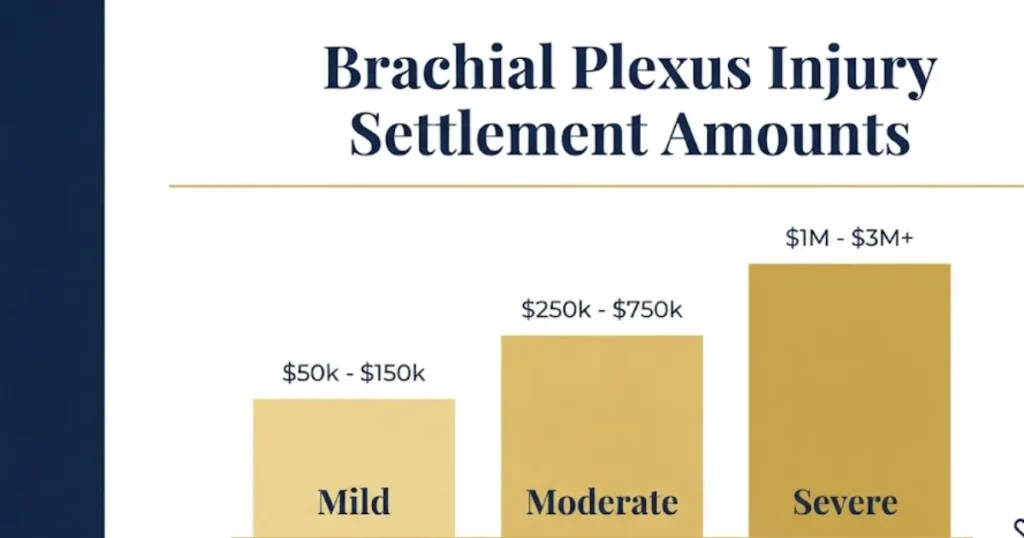
Settlement amounts for brachial plexus birth injuries in 2026 typically range from $100,000 to $10 million or more, with the exact figure depending on injury severity, permanence, and required medical care.

Mild cases involving temporary nerve stretch (neuropraxia) that resolve within a few months tend to settle on the lower end. These often fall between $100,000 and $500,000.
Moderate cases requiring surgery or long-term therapy land in the $500,000 to $3 million range. These involve nerve ruptures that need grafting or transfer procedures.
Severe and permanent cases, especially total brachial plexus palsy with avulsion injuries, push settlements well above $5 million. When a child faces lifelong disability, lost future earnings, and ongoing medical costs, the numbers climb quickly.
| Injury Severity | Typical Settlement Range | Common Condition |
|---|---|---|
| Mild (resolves in months) | $100,000 to $500,000 | Neuropraxia |
| Moderate (requires surgery) | $500,000 to $3,000,000 | Nerve rupture |
| Severe (permanent damage) | $3,000,000 to $10,000,000+ | Avulsion / total palsy |
Several factors affect the final number. These include the state where you file, the strength of your medical evidence, and whether the case goes to trial or settles before.
Jury verdicts tend to award higher amounts than settlements. But trials carry risk, and not every case makes it that far.
Who Qualifies for a Brachial Plexus Lawsuit
You may qualify for a brachial plexus lawsuit if your child suffered nerve damage to the shoulder, arm, or hand during birth, and medical negligence played a role in causing that injury.
Qualification isn’t automatic. The injury alone doesn’t create a valid lawsuit. You need to show that the doctor or medical team did something wrong, or failed to do something they should have done, during the delivery process.
Here are the main eligibility factors:
- Your child was diagnosed with a brachial plexus injury at or shortly after birth
- The delivery involved a known risk factor like shoulder dystocia, large birth weight, or breech presentation
- The medical team used excessive traction, improper forceps technique, or failed to order a timely C-section
- A medical expert can testify that the standard of care was not met
- Your claim falls within your state’s statute of limitations
Parents, legal guardians, or the injured child (once they reach adulthood in some states) can bring the claim. Both the mother and child may have separate legal claims if the mother was also harmed.
If your child’s injury healed completely within a few weeks and required no treatment, the case may not hold enough value to pursue. Attorneys evaluate these cases based on the long-term medical and financial impact.
Key Takeaway: Brachial plexus injury lawsuits are medical malpractice claims that can result in settlements from $100,000 to over $10 million, but you must prove that negligence during delivery caused the injury.
How to File a Brachial Plexus Injury Lawsuit
Filing a brachial plexus injury lawsuit starts with obtaining your child’s complete medical records from the delivery and all follow-up care. This is the foundation of your entire case.
The process follows a predictable path, though each state has its own procedural rules. Here’s the general sequence:
- Gather medical records. Get every document from the prenatal period, labor and delivery notes, and postnatal treatment records.
- Consult a birth injury attorney. Most work on contingency, meaning no upfront fees.
- Medical expert review. Your attorney will have an independent medical expert evaluate whether negligence occurred.
- File a complaint. The lawsuit is formally filed in your state’s civil court system.
- Discovery phase. Both sides exchange evidence, take depositions, and build their arguments.
- Settlement negotiations or trial. Most cases settle before trial, but some go the distance.
| Step | What Happens | Estimated Time |
|---|---|---|
| Records collection | Gather all birth and treatment records | 1 to 3 months |
| Attorney consultation | Case evaluation and agreement | 1 to 4 weeks |
| Expert medical review | Independent doctor reviews the case | 1 to 3 months |
| Filing the complaint | Formal lawsuit filed in court | 1 to 2 months |
| Discovery | Evidence exchange and depositions | 6 to 18 months |
| Settlement or trial | Resolution of the case | 3 to 12 months |
Some states require a “certificate of merit” before you can file. This means a qualified medical expert must confirm in writing that your case has valid grounds before the court will accept it.
Don’t wait too long to start this process. Statutes of limitations are strict, and missing the deadline means losing your right to sue entirely.
Brachial Plexus Injury Compensation Breakdown
Compensation in a brachial plexus injury case covers both economic and non-economic damages, and in some cases, punitive damages when the negligence was especially reckless.
Economic damages are the measurable financial costs. These include:
- Past and future medical bills (surgeries, therapy, medications)
- Rehabilitation and occupational therapy costs
- Adaptive equipment or home modifications
- Lost future earning capacity for the child
- Cost of ongoing attendant care if needed
Non-economic damages are harder to quantify but equally important:
- Physical pain and suffering
- Emotional distress for the child and parents
- Loss of quality of life
- Disfigurement or scarring from surgeries
Punitive damages are rare but possible. They come into play when a doctor’s behavior was so far below acceptable standards that the court wants to send a message. Think of a doctor who ignored repeated warning signs during labor and refused to perform a C-section despite obvious distress.
| Damage Type | Examples | Typical Range |
|---|---|---|
| Economic | Medical bills, lost earnings, therapy | $50,000 to $5,000,000+ |
| Non-economic | Pain, suffering, quality of life | $50,000 to $5,000,000+ |
| Punitive | Punishment for extreme negligence | Varies widely; sometimes capped by state |
The total compensation package depends on the child’s prognosis. A child who recovers full arm function within a year will receive far less than a child facing permanent paralysis and multiple reconstructive surgeries.
Future medical costs are often the largest component. Life care planners and economists are brought in to calculate what decades of treatment will cost.
Erb’s Palsy Lawsuit Updates for 2026
Erb’s palsy remains the most common type of brachial plexus birth injury, and lawsuits related to this condition are actively being filed and settled in 2026.
Erb’s palsy specifically affects the upper nerves of the brachial plexus (C5 and C6). It typically results in weakness or paralysis of the shoulder and upper arm. The baby may hold the affected arm close to the body with the forearm rotated inward, a posture sometimes called the “waiter’s tip” position.
In 2026, courts across the country continue to see a steady flow of Erb’s palsy malpractice claims. Several trends are shaping these cases:
- Higher settlement values. As medical costs rise, so do settlement amounts. Inflation and increased therapy costs are pushing numbers upward.
- Better diagnostic imaging. Advanced MRI and nerve conduction studies make it easier to document injury severity and link it to delivery events.
- Stronger expert testimony standards. Courts are requiring more specific expert opinions, which means well-prepared cases are succeeding while weaker ones are getting dismissed earlier.
Some states have seen notable Erb’s palsy verdicts recently. Jury awards exceeding $5 million have been reported in states like New York, Pennsylvania, and Texas for cases involving permanent impairment.
If your child was diagnosed with Erb’s palsy and you haven’t explored your legal options, 2026 is a year to act. Many state filing deadlines could be approaching, especially for children born between 2018 and 2024.
Key Takeaway: Erb’s palsy lawsuits are actively being filed in 2026, with rising settlement values driven by increasing medical costs and stronger diagnostic evidence.
Brachial Plexus Injury and Medical Malpractice
A brachial plexus injury becomes a medical malpractice case when a healthcare provider’s negligence during delivery directly caused or worsened the nerve damage.
Medical malpractice has four required legal elements. Every single one must be proven for the case to succeed:
- Duty of care. The doctor or hospital had a professional obligation to the mother and baby.
- Breach of duty. The medical team failed to meet the accepted standard of care during delivery.
- Causation. That failure directly caused the brachial plexus injury.
- Damages. The child suffered actual harm requiring medical treatment or causing lasting impairment.
The “standard of care” is essentially what a reasonably competent doctor in the same specialty would have done under the same circumstances. It’s not about perfection. It’s about whether the doctor’s actions fell below what’s considered acceptable.
Common acts of malpractice in these cases include applying excessive lateral traction to the baby’s head during a shoulder dystocia event, failing to recognize risk factors for a difficult delivery, or delaying a cesarean section when vaginal delivery was clearly unsafe.
| Malpractice Element | What It Means | Example |
|---|---|---|
| Duty of care | Doctor-patient relationship existed | OB-GYN delivered the baby |
| Breach | Standard of care was violated | Excessive pulling force used |
| Causation | Breach caused the specific injury | Pulling caused nerve tear |
| Damages | Real harm occurred | Child has permanent arm weakness |
Not every brachial plexus injury is malpractice. Some occur despite proper medical care. That’s why expert medical testimony is the backbone of every case.
Brachial Plexus Injury Lawsuit Eligibility Requirements
To be eligible for a brachial plexus injury lawsuit, you must demonstrate that a medical provider’s negligent actions during childbirth caused your child’s nerve injury, and your claim must be filed within the legal time limit.
Eligibility involves both medical and legal requirements. Let’s break them down.
Medical requirements:
- A documented brachial plexus injury diagnosed at birth or shortly after
- Medical records showing delivery complications such as shoulder dystocia, prolonged labor, or instrument-assisted delivery
- An independent medical expert’s opinion that negligence occurred
Legal requirements:
- The claim must be filed within your state’s statute of limitations
- In most states, a certificate of merit from a medical expert is required before filing
- The claimant must be a parent, legal guardian, or the injured individual (if filing as an adult)
One important detail that many people miss: the child may have their own right to file a lawsuit once they turn 18, even if the parents didn’t file earlier. Many states “toll” the statute of limitations for minors, giving the child additional years to bring a claim.
| Eligibility Factor | Requirement |
|---|---|
| Injury documentation | Medical records confirming brachial plexus damage |
| Negligence evidence | Expert opinion supporting malpractice |
| Filing deadline | Within state statute of limitations |
| Who can file | Parent, guardian, or adult child |
| Certificate of merit | Required in most states before filing |
If you’re unsure whether you meet these requirements, the fastest way to find out is through a case evaluation with a birth injury attorney. These evaluations are typically free.
What Causes Brachial Plexus Birth Injuries
Brachial plexus birth injuries are most commonly caused by excessive pulling force applied to the baby’s head, neck, or shoulders during a difficult vaginal delivery.
The nerves of the brachial plexus are delicate. They run from the spinal cord in the neck through a narrow space near the collarbone and into the arm. During birth, if the baby’s shoulder gets stuck behind the mother’s pelvic bone (a condition called shoulder dystocia), the delivering physician may pull too hard to free the baby.
That excessive traction stretches or tears the nerves. The harder the pull, the worse the damage.
Here are the most common causes and risk factors:
- Shoulder dystocia during delivery
- Large birth weight (macrosomia, typically over 8 lbs 13 oz)
- Prolonged labor with the baby in the birth canal too long
- Forceps or vacuum extractor used improperly
- Breech delivery where the arms get trapped
- Maternal diabetes, which increases the chance of a large baby
- Previous delivery with shoulder dystocia
Think of it like pulling a plant out of the ground by its stem. If you pull straight and gently, the roots come out intact. If you yank sideways with force, the roots tear. The brachial plexus nerves are those roots.
Not every cause is preventable. But when a doctor knows the risk factors and ignores them, or uses excessive force when alternatives exist, that’s when a lawsuit becomes appropriate.
Key Takeaway: Shoulder dystocia and excessive pulling force during delivery are the leading causes of brachial plexus birth injuries, and both are often preventable with proper medical decision-making.
Brachial Plexus Injury During Delivery: Proving Negligence
Proving negligence in a brachial plexus delivery injury requires showing that the medical team knew or should have known about risk factors and failed to take appropriate action.
This is where most cases are won or lost. It’s not enough to show that the injury happened. You have to prove that it happened because someone made a mistake they shouldn’t have made.
Here’s what “proving negligence” actually looks like in practice:
What the medical records should show:
- Prenatal ultrasounds indicating a large baby
- Documented maternal risk factors (diabetes, previous large baby, prior shoulder dystocia)
- Labor and delivery notes describing the delivery technique
- Nursing notes showing fetal heart rate patterns during labor
- Any notation of shoulder dystocia and the maneuvers attempted
What an expert witness will testify about:
- Whether the doctor should have recommended a C-section given the known risk factors
- Whether the amount of force used during delivery was excessive
- Whether proper shoulder dystocia maneuvers (like the McRoberts maneuver or suprapubic pressure) were attempted before resorting to traction
- Whether the hospital’s protocols were followed
The strongest cases involve situations where the medical records clearly document risk factors that were ignored. For example, a baby estimated at over 10 pounds being delivered vaginally to a diabetic mother with a history of difficult deliveries.
Weaker cases involve situations where the injury occurred despite reasonable medical decisions. These are harder to win because the defense will argue that not all birth injuries are preventable.
Types and Severity of Brachial Plexus Injuries
Brachial plexus injuries are classified into four types based on the degree of nerve damage: neuropraxia, neuroma, rupture, and avulsion. Each type carries different implications for recovery and lawsuit value.
Neuropraxia is the mildest form. The nerve is stretched but not torn. Most babies with neuropraxia recover fully within 3 to 6 months without surgery. These cases produce the lowest settlement values.
Neuroma involves a more serious stretch that causes scar tissue to form on the nerve. The scar tissue puts pressure on the healthy nerve and can limit recovery. Some neuroma cases require surgery; others improve with therapy alone.
Rupture means the nerve is actually torn. It won’t heal on its own. Surgical repair through nerve grafting is usually necessary. Recovery varies, and some children regain most function while others have lasting limitations.
Avulsion is the most severe type. The nerve root is torn completely away from the spinal cord. This type of injury cannot be surgically repaired through traditional grafting. Nerve transfers may restore some function, but permanent disability is common.
| Injury Type | What Happens | Recovery Outlook | Typical Settlement Impact |
|---|---|---|---|
| Neuropraxia | Nerve stretched, not torn | Full recovery in 3 to 6 months | Lower end ($100K to $500K) |
| Neuroma | Scar tissue forms on nerve | Partial recovery, may need surgery | Moderate ($300K to $1.5M) |
| Rupture | Nerve torn apart | Requires surgery; variable recovery | Higher ($500K to $5M) |
| Avulsion | Nerve ripped from spinal cord | Permanent disability likely | Highest ($2M to $10M+) |
These categories also correspond to common diagnostic terms. Erb’s palsy affects the upper plexus (C5-C6), while Klumpke’s palsy affects the lower plexus (C8-T1). Total brachial plexus palsy involves all five nerve roots and causes complete arm paralysis.
Brachial Plexus Injury Lawsuit Verdicts and Case Results
Jury verdicts in brachial plexus injury lawsuits have ranged from $1 million to over $50 million in recent years, with the largest awards going to cases involving permanent total arm paralysis and clear evidence of negligence.
Here are examples of notable verdicts and settlements that reflect the range of outcomes families have received:
| Year | State | Verdict/Settlement | Injury Details |
|---|---|---|---|
| 2023 | New York | $33,000,000 verdict | Total plexus palsy, permanent paralysis |
| 2022 | Pennsylvania | $18,500,000 verdict | Erb’s palsy with failed surgical repair |
| 2023 | Texas | $12,000,000 settlement | Severe Erb’s palsy, multiple surgeries |
| 2024 | Illinois | $7,200,000 settlement | Rupture injury requiring nerve graft |
| 2022 | California | $5,500,000 settlement | Moderate Erb’s palsy, ongoing therapy |
| 2023 | Florida | $3,800,000 settlement | Neuropraxia with partial recovery |
These numbers tell a clear story. When the negligence is obvious and the injury is severe, juries and insurance companies pay substantial amounts.
Verdicts tend to run higher than settlements because juries sometimes include large non-economic damage awards for pain and suffering. But verdicts can also be appealed, reduced by the judge, or overturned entirely. That’s the risk of going to trial.
Settlements offer certainty. You know exactly what you’re getting, and you get it faster. Most birth injury attorneys recommend settling when the offer is fair, and going to trial only when the other side won’t make a reasonable offer.
Key Takeaway: Brachial plexus injury verdicts have reached tens of millions of dollars, but most cases settle for amounts between $500,000 and $10 million depending on injury severity and negligence evidence.
Brachial Plexus Lawsuit Statute of Limitations by State
The statute of limitations for a brachial plexus lawsuit varies by state, ranging from 1 to 10 years from the date of injury, with most states providing extended deadlines when the injured person is a minor.
This is one of the most misunderstood parts of birth injury law. Many parents assume they have decades to file. Others assume the deadline has already passed. Both assumptions can be wrong.
Most states have a general medical malpractice statute of limitations of 2 to 3 years. But nearly every state also has a “tolling” provision for minors. This means the clock doesn’t start running until the child turns 18, or it extends the deadline by a certain number of years.
| State | General Med Mal Limit | Minor Exception |
|---|---|---|
| California | 3 years | Must file by child’s 8th birthday |
| New York | 2.5 years | Must file by child’s 10th birthday |
| Texas | 2 years | Must file by child’s 14th birthday |
| Florida | 2 years | Must file by child’s 8th birthday |
| Pennsylvania | 2 years | Must file by child’s 20th birthday |
| Illinois | 2 years | Must file by child’s 8th birthday |
| Ohio | 1 year | Must file by child’s 19th birthday |
| Michigan | 2 years | Must file by child’s 10th birthday |
These deadlines are hard. Miss them, and the court will dismiss your case regardless of how strong the evidence is. No exceptions.
Some states also have a “discovery rule” that extends the deadline if the injury wasn’t discovered right away. But with brachial plexus injuries, the damage is usually visible at birth, so this rule rarely applies.
Check your specific state’s rules. If your child’s deadline is approaching in 2026, act now.
Brachial Plexus Injury Lawsuit Timeline: Filing to Payout
A brachial plexus injury lawsuit typically takes 2 to 5 years from the initial filing to final resolution, whether through settlement or trial verdict.
That’s a wide range, and here’s why it varies so much. Simple cases with clear negligence and cooperating defendants can settle in under 2 years. Complex cases with disputed facts, multiple defendants, or appeals can stretch to 5 years or beyond.
Here’s a realistic timeline breakdown:
| Phase | Duration | What Happens |
|---|---|---|
| Case evaluation | 1 to 3 months | Attorney reviews records, consults medical expert |
| Pre-filing investigation | 2 to 6 months | Gathering evidence, obtaining expert certificate of merit |
| Filing the complaint | 1 month | Lawsuit formally filed in court |
| Discovery | 12 to 24 months | Depositions, document exchanges, expert reports |
| Mediation/settlement talks | 2 to 6 months | Negotiation attempts before trial |
| Trial (if needed) | 1 to 4 weeks | Jury hears evidence and delivers verdict |
| Post-trial motions/appeals | 6 to 18 months | Possible if either side challenges the result |
| Payout | 1 to 3 months after resolution | Settlement check or structured payments |
The discovery phase is usually the longest part. Both sides take sworn depositions from the doctors, nurses, and medical experts. They exchange thousands of pages of medical records and hire experts to write detailed reports.
Many cases settle during or right after discovery, once both sides see the strength of the evidence. If the hospital’s insurance company realizes they’ll lose at trial, they often offer a settlement to avoid the risk of a bigger jury verdict.
Evidence Needed for a Brachial Plexus Injury Lawsuit
The most important evidence in a brachial plexus injury lawsuit is the complete set of medical records from the mother’s prenatal care, labor and delivery, and the child’s postnatal treatment.
Without strong medical records, the case falls apart. These records tell the story of what happened in the delivery room, what decisions were made, and whether those decisions were appropriate.
Here’s a checklist of the evidence your attorney will need:
- Prenatal records: ultrasound reports showing estimated fetal weight, maternal health records, gestational diabetes test results
- Labor and delivery records: nursing notes, fetal monitoring strips, physician delivery notes, time logs
- Operative reports: if forceps, vacuum, or C-section was involved
- Neonatal records: Apgar scores, initial physical exam findings, NICU records if applicable
- Diagnostic imaging: MRI, nerve conduction studies, EMG results
- Treatment records: surgical reports, physical therapy notes, occupational therapy records
- Expert opinions: written reports from independent medical experts confirming negligence
- Life care plan: a detailed projection of future medical costs prepared by a specialist
- Economic analysis: expert calculation of lost future earning capacity
| Evidence Category | Why It Matters |
|---|---|
| Fetal monitoring strips | Shows if baby was in distress before delivery |
| Delivery notes | Documents techniques and force used |
| Ultrasound reports | Shows if large baby size was known |
| Expert medical opinion | Establishes that negligence occurred |
| Life care plan | Quantifies future damages in dollars |
One often overlooked piece of evidence is the hospital’s own policies and protocols. If the hospital had a written protocol for managing shoulder dystocia and the doctor didn’t follow it, that’s powerful evidence of negligence.
Key Takeaway: Medical records from every stage of pregnancy and delivery form the backbone of a brachial plexus injury lawsuit, and expert medical opinions are required to prove that negligence caused the harm.
How to Choose a Brachial Plexus Injury Lawyer
The right brachial plexus injury lawyer is one who specializes in birth injury medical malpractice, works on a contingency fee basis, and has a track record of settlements or verdicts in similar cases.
Not every personal injury attorney is equipped to handle these cases. Birth injury malpractice is one of the most complex areas of law. It requires deep medical knowledge, access to top expert witnesses, and the financial resources to fund a case that may take years to resolve.
Here’s what to look for:
- Specialization in birth injury or medical malpractice. General personal injury firms often lack the specific expertise needed.
- Contingency fee arrangement. You should pay nothing upfront. The attorney takes a percentage (typically 33% to 40%) only if you win.
- Proven results. Ask about previous brachial plexus or Erb’s palsy verdicts and settlements.
- In-house medical consultants. The best firms have nurses or doctors on staff who review records before the case is even filed.
- Trial experience. Some firms only settle. You want one that’s willing and able to go to trial if the settlement offer is too low.
- Resources to fund litigation. Expert witnesses, medical reviews, and depositions are expensive. The firm should cover these costs upfront.
| Factor | Why It Matters |
|---|---|
| Birth injury specialization | Ensures medical and legal expertise |
| Contingency fees | No financial risk to you |
| Trial experience | Stronger negotiating position |
| Prior case results | Evidence of competence |
| In-house medical staff | Faster, more accurate case evaluation |
During your initial consultation, ask how many brachial plexus cases the firm has handled. Ask what the outcomes were. Ask who the medical experts are that they work with. If the answers are vague, keep looking.
Can You Sue for Erb’s Palsy in 2026
Yes, you can sue for Erb’s palsy in 2026 if your child’s injury was caused by medical negligence during delivery and your claim falls within the applicable statute of limitations.
Erb’s palsy is a specific type of brachial plexus injury affecting the C5 and C6 nerve roots. It’s the most frequently litigated form of brachial plexus birth injury because it’s the most common type, and because the connection between excessive delivery force and the resulting nerve damage is well-established in medical literature.
Here’s who can still file in 2026:
- Children born in recent years. If your child was born within the last 2 to 8 years (depending on your state’s statute of limitations for minors), you likely still have time.
- Young adults. In some states, the injured person can file their own lawsuit up to age 20 or even later.
- Cases where the injury was recently discovered. Rare, but some mild cases aren’t identified until the child starts school and has difficulty with arm function.
The process for suing for Erb’s palsy is the same as any brachial plexus injury lawsuit. You need medical records, an expert opinion confirming negligence, and a complaint filed in the appropriate court.
One thing to keep in mind: the fact that your child recovered from Erb’s palsy doesn’t necessarily prevent you from filing suit. Even temporary injuries can warrant compensation for medical costs, pain and suffering, and emotional distress. The case value will be lower than a permanent injury case, but it may still be worth pursuing.
If you’re on the fence about filing, 2026 is the year to at least get a free case evaluation. Waiting another year could put you past the deadline.
Key Takeaway: You can absolutely sue for Erb’s palsy in 2026, and even children who recovered may still have valid claims for the medical costs and suffering they endured.
Frequently Asked Questions
How much is the average brachial plexus injury settlement in 2026?
The average settlement falls between $500,000 and $3 million for moderate cases.
Mild injuries that resolve quickly may settle for $100,000 to $500,000.
Severe permanent injuries have produced settlements and verdicts exceeding $10 million.
What is the statute of limitations for a brachial plexus birth injury lawsuit?
Most states set the deadline at 2 to 3 years from the date of injury for adults.
For minors, most states extend the deadline until the child reaches a certain age, often 8 to 20 years old.
Check your specific state’s rules, as deadlines vary significantly.
Can I sue the hospital for my child’s brachial plexus injury?
Yes, you can sue the hospital in addition to the individual doctors and nurses involved.
Hospitals can be held liable under theories of vicarious liability or direct negligence.
The hospital may also be liable if its protocols for managing delivery complications were inadequate.
What evidence do I need for a brachial plexus injury lawsuit?
You need complete medical records from prenatal care through delivery and postnatal treatment.
An independent medical expert must review the records and confirm that negligence occurred.
Diagnostic imaging, fetal monitoring strips, and a life care plan for future costs are also critical.
How long does a brachial plexus injury lawsuit take from start to finish?
Most cases take 2 to 5 years from filing to resolution.
Cases that settle during discovery tend to resolve in 2 to 3 years.
Cases that go to trial and face appeals can take 5 years or longer.
The bottom line on brachial plexus injury lawsuits in 2026 is simple: if your child was harmed by medical negligence during birth, the law provides a path to compensation. The amounts can be significant, especially for permanent injuries.
Don’t let a filing deadline slip past you. Get your child’s medical records together and have them reviewed by a birth injury attorney as soon as possible.
The sooner you start, the stronger your case will be.







