

The Bang Energy drink lawsuit is one of the biggest false advertising cases in the energy drink industry. Multiple class action claims accused the company of lying about key ingredients, including something called “super creatine” that turned out not to be creatine at all.
If you bought Bang Energy drinks between 2015 and 2023, you may be entitled to a payout. Some claimants could receive anywhere from a few dollars to over $100, depending on how many cans they purchased and whether they have proof.
This article breaks down every detail of the lawsuit in 2026. You will learn who qualifies, how much you might get, how to file, and what the bankruptcy of Vital Pharmaceuticals means for your claim. The company behind Bang sold billions of cans based on marketing that federal courts found to be misleading.
That fact alone makes this case worth paying attention to.
What Is the Bang Energy Drink Lawsuit About?
The Bang Energy drink lawsuit is a series of legal actions accusing Vital Pharmaceuticals (VPX Sports) of making false and misleading marketing claims about its popular energy drink line. The core allegation is that Bang’s labeling and advertising deceived consumers about what was actually in the can.
Bang Energy marketed itself as a performance drink packed with “super creatine,” BCAAs, and CoQ10. Consumers believed they were getting proven sports nutrition ingredients. In reality, lab testing and expert testimony showed some of those claims were either exaggerated or outright false.
The lawsuits were filed by individual consumers and also took the form of class actions. They targeted Bang’s parent company, VPX Sports, and its CEO Jack Owoc personally in some filings.
| Detail | Info |
|---|---|
| Defendant | Vital Pharmaceuticals / VPX Sports |
| Product | Bang Energy Drinks |
| Main Allegation | False advertising of ingredients |
| Key Ingredient at Issue | “Super Creatine” (creatyl-L-leucine) |
| Courts Involved | S.D. Florida, S.D. California |
The case matters because millions of Americans bought Bang based on health and fitness claims. Those claims shaped purchasing decisions for years.
Bang Energy Lawsuit 2026: What Has Changed This Year?
The Bang Energy lawsuit in 2026 has moved into its final resolution stages. After years of litigation, bankruptcy proceedings, and corporate acquisition, the legal picture is becoming clearer for claimants who have been waiting for answers.
Vital Pharmaceuticals, the company behind Bang, filed for Chapter 11 bankruptcy in October 2022. That filing paused many of the pending lawsuits. Monster Beverage Corporation then acquired Bang’s assets out of bankruptcy in a deal worth roughly $362 million in mid-2023.
By 2025, bankruptcy court distributions and class action settlement processes had been running simultaneously. In 2026, the focus has shifted to finalizing claim reviews and beginning payouts where settlements have been approved.
- Bankruptcy claims bar dates have passed
- Monster Beverage now owns the Bang brand
- Some class settlements have received preliminary or final approval
- Individual claim reviews are underway
The biggest change this year is the movement from “waiting” to “processing.” If you filed a claim, your paperwork is likely being reviewed right now.
Bang Energy Class Action Lawsuit Explained
A class action lawsuit allows one person or a small group to sue on behalf of thousands of others who were harmed the same way. In the Bang Energy case, several class actions were filed across different states on behalf of consumers who purchased the drinks.
The class representatives argued that every Bang customer was deceived by the same marketing. The “super creatine” label appeared on every can. The advertising reached everyone through the same channels. That uniformity is what makes a class action possible.
Think of it like a neighborhood where every house has the same faulty wiring from the same builder. Instead of 500 separate lawsuits, one case covers everyone.
| Class Action Element | Bang Energy Case |
|---|---|
| Lead Plaintiffs | Individual consumers in CA and FL |
| Class Members | All U.S. purchasers of Bang Energy |
| Common Claim | Deceptive labeling and advertising |
| Legal Basis | State consumer protection laws, Lanham Act |
| Certification Status | Certified in multiple jurisdictions |
Being part of a class action means you do not need your own lawyer. The class attorneys handle everything. Your job is to file a claim when the window opens.
Key Takeaway: The Bang Energy lawsuit stems from false ingredient claims, has been shaped by bankruptcy and acquisition, and operates as a class action covering millions of U.S. purchasers.
Bang Energy Lawsuit Settlement Details
The Bang Energy lawsuit settlement involves multiple legal tracks. There is no single, unified “Bang settlement” because the company faced lawsuits from competitors, the FTC, and consumers all at once.
The largest related settlement came from litigation between Monster Beverage (formerly a competitor, now the owner of Bang) and Bang’s parent company. Monster won a $293 million jury verdict against Vital Pharmaceuticals in 2023 for false advertising under the Lanham Act. That verdict related to the same “super creatine” claims that hurt consumers.
On the consumer class action side, settlement funds have been established as part of the bankruptcy process. Vital Pharmaceuticals’ Chapter 11 plan included provisions for consumer creditors, though those claims rank behind secured creditors in the distribution order.
- Monster Beverage won a $293 million Lanham Act verdict
- Consumer class settlements are processed through bankruptcy court
- Settlement amounts for individuals depend on the total fund and number of claims filed
- Attorney fees and administrative costs reduce the pool before distribution
The settlement is real, but it is complicated by the bankruptcy. Consumers should not expect the same kind of straightforward payout you see in a typical class action.
Bang Energy Lawsuit Payout: How Much Is the Settlement Worth?
The total value of Bang Energy lawsuit payouts depends on which legal action you are looking at. The consumer-facing settlement fund is smaller than the headline jury verdicts suggest.
In bankruptcy cases, consumer claims are usually classified as unsecured. That means they get paid after banks, suppliers, and other secured creditors. The total consumer claims pool in the Vital Pharmaceuticals bankruptcy has been estimated in the low tens of millions, though the exact amount depends on how many valid claims are filed.
The $293 million Monster Beverage verdict was a business-to-business judgment. That money does not go directly to consumers.
| Settlement Component | Estimated Value |
|---|---|
| Monster vs. VPX Jury Verdict | $293 million |
| Consumer Class Action Fund | Estimated $10 to $30 million range |
| Bankruptcy Consumer Claims Pool | Dependent on final court approval |
| Total Claims Filed | Hundreds of thousands |
Here is the honest truth: when you divide even $30 million among hundreds of thousands of claimants, the per-person amount shrinks fast. That is just how class actions work.
Bang Energy Lawsuit Payout Per Person
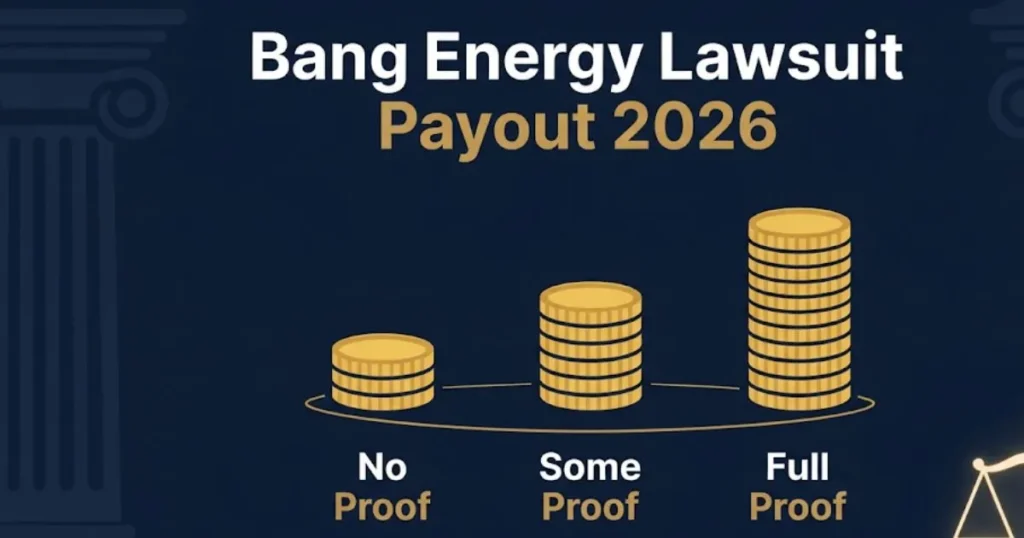
Most individual claimants in the Bang Energy lawsuit can expect to receive between $5 and $100 per person, depending on their purchase volume and whether they submitted proof of purchase.
Class action payouts per person are almost always modest. The settlement is designed to compensate a huge group, not to make any one person wealthy. Your payout depends on a few things.
- With proof of purchase: Receipts, bank statements, or loyalty program records increase your payout
- Without proof of purchase: You can still file, but your claim tier is lower
- Purchase volume: Someone who bought 500 cans will receive more than someone who bought 10
| Claim Tier | Estimated Payout Range |
|---|---|
| No proof, minimal purchases | $5 to $15 |
| No proof, regular consumer | $15 to $30 |
| With proof, moderate purchases | $30 to $60 |
| With proof, heavy consumer | $60 to $100+ |
These ranges are estimates based on similar class action settlements in the food and beverage industry. Final numbers depend on total claims filed and court-approved distribution formulas.
Key Takeaway: Individual payouts from the Bang Energy lawsuit are modest, likely ranging from $5 to $100, with proof of purchase being the biggest factor in how much you receive.
Who Qualifies for the Bang Energy Lawsuit?
You qualify for the Bang Energy lawsuit if you purchased Bang Energy drinks in the United States during the relevant class period, which generally covers purchases made between 2015 and 2023.
There is no requirement that you got sick or suffered a health problem. The claim is based on false advertising, not personal injury. If you bought the product and were exposed to the misleading marketing, you are a class member.
Eligibility requirements include:
- You purchased Bang Energy drinks in the U.S.
- Your purchases fell within the class period (typically 2015 to 2023)
- You have not previously opted out of the class action
- You can describe your purchase history (receipts help but are not mandatory)
| Eligibility Factor | Requirement |
|---|---|
| Location | United States |
| Time Period | 2015 to 2023 |
| Product | Any Bang Energy drink variant |
| Proof Needed | Helpful but not required |
| Injury Required | No |
If you bought even one can of Bang during that window, you likely qualify. The barrier to entry is intentionally low in false advertising class actions.
Bang Energy Super Creatine Lawsuit
The super creatine claim is the heart of the entire Bang Energy lawsuit. Bang marketed its drinks as containing “super creatine,” which it described as a superior, brain-boosting form of creatine that no other energy drink had.
The problem? Independent testing revealed that Bang’s “super creatine” was actually creatyl-L-leucine, a bonded amino acid compound. Scientists testified that creatyl-L-leucine is not creatine. It does not behave like creatine in the body. It does not provide the athletic or cognitive benefits associated with creatine supplementation.
This is like a company selling “super gold” jewelry that turns out to be brass with a fancy name. The labeling made consumers believe they were getting something they were not.
- Creatine monohydrate is a well-studied sports supplement with proven benefits
- Creatyl-L-leucine (Bang’s “super creatine”) has no published peer-reviewed studies supporting performance benefits
- Bang’s own patents described the compound differently than its marketing did
- The FDA has not approved “super creatine” as a recognized dietary ingredient
The super creatine deception is what gave plaintiffs their strongest legal ammunition. Courts found the marketing materially misleading.
Bang Energy False Advertising Lawsuit
The false advertising claims against Bang Energy go beyond just super creatine. Plaintiffs alleged a pattern of deceptive marketing that touched almost every major selling point of the drink.
Bang’s advertising claimed the drink could reverse mental decline, cure Alzheimer’s disease, and treat other medical conditions. These claims appeared on social media, in press releases, and in statements made by CEO Jack Owoc. No clinical evidence supported any of these claims.
Key false advertising allegations include:
- Claims that Bang could reverse mental retardation
- Claims about curing or preventing Alzheimer’s and Parkinson’s disease
- Marketing Bang as containing BCAAs when testing showed negligible amounts
- Claiming CoQ10 was present in meaningful quantities
- Stating that Bang was a healthier alternative to all competitors
| Advertising Claim | Reality |
|---|---|
| “Contains Super Creatine” | Contained creatyl-L-leucine, not creatine |
| “Reverses mental decline” | No clinical evidence |
| “Contains BCAAs” | Trace or negligible amounts found |
| “CoQ10 enriched” | Amounts too small to be beneficial |
A federal jury agreed that these claims were false and awarded Monster Beverage $293 million in the Lanham Act case. That verdict validated what consumer plaintiffs had argued all along.
Key Takeaway: Bang Energy’s false advertising went far beyond one ingredient, encompassing disease cure claims, BCAA content, and CoQ10 levels, all of which courts found to be deceptive.
Bang Energy Drink Ingredients at the Center of the Lawsuit
Several specific ingredients and label claims sit at the center of the Bang Energy drink lawsuit. Understanding what was promised versus what was delivered helps explain why courts sided with the plaintiffs.
Super Creatine: The marquee ingredient. Marketed as a patented creatine compound. Actually creatyl-L-leucine, which has no proven creatine-like benefits. This was the single biggest deception in the case.
BCAAs (Branched-Chain Amino Acids): Bang’s label prominently featured BCAAs, which athletes use for muscle recovery. Independent lab tests found the BCAA content was either zero or so low it had no functional benefit.
CoQ10 (Coenzyme Q10): Marketed as an ingredient that supports heart health and cellular energy. Testing showed amounts far below what would provide any measurable benefit. A therapeutic dose of CoQ10 is typically 100 to 300 mg. Bang’s cans contained a fraction of that.
| Ingredient | Label Claim | Testing Results |
|---|---|---|
| Super Creatine | Performance-enhancing creatine | Not creatine at all |
| BCAAs | Muscle recovery amino acids | Zero or trace amounts |
| CoQ10 | Heart and cell health | Sub-therapeutic dose |
| Caffeine (300mg) | Accurate | This claim was accurate |
The caffeine content was one of the few claims Bang got right. Each can does contain roughly 300mg of caffeine, which is accurate.
How to File a Bang Energy Lawsuit Claim
Filing a Bang Energy lawsuit claim requires submitting a proof of claim form through the appropriate settlement administrator or bankruptcy court portal. The process is straightforward and does not require a lawyer.
Here is the step-by-step process:
- Locate the official claim form. This is available through the bankruptcy court’s claims portal for the Vital Pharmaceuticals case or through the class action settlement website (if a consumer class settlement has been separately approved).
- Complete the form. You will need to provide your name, address, and a description of your Bang Energy purchases. Include dates, approximate quantities, and where you bought the product.
- Attach proof if you have it. Receipts, credit card statements, or store loyalty program records strengthen your claim. You can file without proof, but your payout will be lower.
- Submit before the deadline. Claims bar dates for the bankruptcy case have specific cutoffs. Missing the deadline usually means you get nothing.
- Filing is free
- No lawyer required
- Online submission is the fastest method
- Keep a copy of your confirmation number
| Filing Step | What You Need |
|---|---|
| Step 1 | Official claim form |
| Step 2 | Personal information and purchase details |
| Step 3 | Proof of purchase (optional but recommended) |
| Step 4 | Submission before the deadline |
Bang Energy Lawsuit Proof of Purchase Requirements
Proof of purchase is not strictly required to file a Bang Energy lawsuit claim, but it significantly increases how much you will receive. The settlement structure uses a tiered system where documented purchases get higher payouts.
Acceptable forms of proof include:
- Store receipts showing Bang Energy purchases
- Credit or debit card statements with charges at convenience stores, gas stations, or grocery stores where Bang was bought
- Online order confirmations from Amazon, Walmart.com, or other retailers
- Store loyalty program records (Walgreens, CVS, grocery chains)
- Subscription delivery records if you ordered through a subscription service
If you do not have any proof, you can still file a claim. You will need to estimate how many Bang Energy drinks you purchased and during what time period. Courts understand that most people do not save receipts for energy drinks.
| Proof Type | Strength of Claim |
|---|---|
| Store receipts | Strongest |
| Bank/card statements | Strong |
| Online order history | Strong |
| Loyalty program data | Moderate |
| Self-reported estimate | Accepted but lowest tier |
The honest reality is that most claimants will file without receipts. That is normal and expected. Your claim will still be processed.
Key Takeaway: You do not need receipts to file a Bang Energy claim, but any proof of purchase will move your claim into a higher payout tier, so check your old bank statements and online order history.
Bang Energy Lawsuit Update for 2026
The Bang Energy lawsuit in 2026 is in its distribution and final claims processing phase. The major litigation battles are over. What remains is the administrative work of reviewing claims, calculating payouts, and mailing checks.
Here is what has happened in the last 12 months:
- The Vital Pharmaceuticals bankruptcy plan has been substantially consummated
- Monster Beverage completed its integration of the Bang brand
- Consumer claims from the bankruptcy proceeding are being reviewed by the claims administrator
- Several state-level class action claims have been resolved or consolidated
What to expect for the rest of 2026:
- Q1 to Q2 2026: Final claim reviews and objection resolution
- Q3 2026: Distribution calculations finalized
- Q4 2026: First consumer payout checks expected to mail
| Timeline Phase | Expected Period |
|---|---|
| Claims Review | Q1 to Q2 2026 |
| Distribution Calculations | Q3 2026 |
| First Payouts | Q4 2026 |
| Final Distributions | Early 2027 |
If you filed a claim and have not heard anything yet, that is normal. Bankruptcy distributions are notoriously slow. Patience is required, but the process is moving forward.
Bang Energy Bankruptcy and Its Effect on the Settlement
Vital Pharmaceuticals filed for Chapter 11 bankruptcy on October 10, 2022, in the U.S. Bankruptcy Court for the Southern District of Florida. That filing had a massive impact on every pending lawsuit and consumer claim against the company.
When a company files for bankruptcy, an automatic stay goes into effect. That means all lawsuits pause. Creditors, including consumers with class action claims, must file their claims through the bankruptcy court instead of pursuing them in regular civil court.
This changed the game for Bang Energy claimants in several ways:
- Consumer claims became unsecured debts. In bankruptcy, unsecured creditors (like consumers) get paid after secured creditors (like banks and major suppliers).
- The total pool of money shrank. Vital Pharmaceuticals’ assets were sold to Monster Beverage for approximately $362 million. After paying secured creditors, legal fees, and administrative costs, the money left for consumer claims is a fraction of that total.
- Claims bar date passed. If you did not file a proof of claim by the bankruptcy court’s deadline, you may be barred from recovery.
| Bankruptcy Detail | Info |
|---|---|
| Filing Date | October 10, 2022 |
| Court | S.D. Florida Bankruptcy Court |
| Acquirer | Monster Beverage Corporation |
| Sale Price | Approximately $362 million |
| Consumer Claim Priority | Unsecured (lower priority) |
The bankruptcy did not eliminate consumer claims. It just changed the process and likely reduced the total payout.
When Will the Bang Energy Lawsuit Pay Out?
Consumer payouts from the Bang Energy lawsuit are expected to begin in late 2026, with most checks arriving between Q4 2026 and early 2027. The exact timing depends on how quickly the claims administrator processes remaining claims.
Several factors are controlling the payout timeline:
- Claims volume. Hundreds of thousands of claims were filed. Each one must be reviewed and categorized.
- Objections. Some claims may be disputed or flagged for verification, which slows the process.
- Court approval. The final distribution plan must be approved by the bankruptcy judge before any checks go out.
- Administrative processing. Printing, mailing, and managing returned checks takes time.
If you want a rough comparison, the Red Bull false advertising settlement from 2015 took about 6 to 9 months from final approval to checks arriving. The Bang case is more complex because of the bankruptcy layer, so expect it to be on the longer side of that range.
- Filed your claim before the deadline? You are in line.
- Have not received confirmation? Contact the claims administrator.
- Lost your claim number? The administrator can look it up with your name and address.
Key Takeaway: Bang Energy lawsuit payouts are expected to start arriving in late 2026, but the bankruptcy process adds complexity and delay, so plan for checks to arrive between Q4 2026 and Q1 2027.
Bang Energy BCAA Claims Lawsuit
The BCAA-related claims are a separate but connected thread in the Bang Energy lawsuit. Bang prominently marketed its drinks as containing BCAAs, which are branched-chain amino acids valued by athletes for muscle recovery and growth.
Independent laboratory analysis revealed that Bang Energy drinks contained zero or negligible amounts of BCAAs. The amounts detected were so small they provided no functional benefit whatsoever.
BCAAs are leucine, isoleucine, and valine. A typical effective dose for muscle recovery is 5 to 10 grams. If Bang contained any BCAAs at all, the amounts were measured in milligrams, not grams. That is like advertising a pool as “Olympic-sized” when it is actually a puddle.
- Bang’s labeling highlighted BCAAs as a key selling point
- Lab tests from plaintiff experts found essentially zero BCAA content
- Consumers who chose Bang specifically for BCAA content were misled
- The BCAA claims were part of the broader false advertising pattern
| BCAA Claim Detail | Info |
|---|---|
| Advertised | BCAAs for muscle recovery |
| Effective Dose | 5 to 10 grams |
| Amount in Bang | Negligible (milligrams at most) |
| Consumer Impact | Purchasing decisions based on false claims |
This claim reinforced the plaintiffs’ argument that Bang’s entire marketing strategy was built on deception, not just one ingredient.
Frequently Asked Questions
How much money will I get from the Bang Energy lawsuit?
Most claimants will receive between $5 and $100, depending on purchase volume and proof.
Claims with receipts or bank statements receive higher payouts.
Final amounts depend on how many total claims are filed against the settlement fund.
Do I need a receipt to file a Bang Energy claim?
No, you do not need a receipt to file a claim.
You can estimate your purchase history and still be eligible.
Having proof of purchase simply qualifies you for a higher payout tier.
Is the Bang Energy lawsuit still open in 2026?
The litigation phase is mostly complete, but claims processing continues in 2026.
Some claims are still being reviewed through the bankruptcy court.
New claims may not be accepted if the claims bar date has already passed.
What did Bang Energy lie about?
Bang falsely claimed its drinks contained “super creatine,” BCAAs, and beneficial CoQ10 levels.
Testing proved “super creatine” was not creatine, BCAAs were absent, and CoQ10 was negligible.
The company also made unproven medical claims about curing diseases.
How do I check the status of my Bang Energy claim?
Contact the claims administrator assigned to the Vital Pharmaceuticals bankruptcy case.
You can look up your claim using your name, address, or confirmation number.
Status updates are also posted on the bankruptcy court’s electronic docket.
The Bang Energy drink lawsuit exposed years of false advertising that misled millions of consumers. If you bought Bang and have not filed a claim yet, check whether the window is still open.
Your best move is to gather any purchase records you can find. Bank statements from 2015 to 2023 are a good place to start.
Stay informed about payout timelines. Checks should begin arriving in late 2026.







