

If you or someone you love was hurt because of hospital negligence, an attorney for hospital lawsuit cases can help you fight back and recover compensation. Hospitals make mistakes more often than most people realize. A Johns Hopkins study found that medical errors cause over 250,000 deaths in the United States every year, making it the third leading cause of death.
This guide covers everything you need to know in 2026. You will learn how to find the right lawyer, what qualifies as a valid case, how the filing process works, and what kind of settlement you might receive.
We break down state deadlines, damage caps, and the exact steps involved. Whether your case involves a surgical error, a misdiagnosis, or a hospital infection, you will find the answers here.
Attorney for Hospital Lawsuit
An attorney for hospital lawsuit cases is a lawyer who focuses on medical malpractice and patient injury claims against hospitals. These attorneys know how to take on large hospital systems and their aggressive legal teams.
Hospital lawsuits are some of the most complex cases in civil law. You are not just suing one doctor. You might be going up against a billion-dollar healthcare corporation with an army of defense lawyers. That is why having the right attorney matters more here than in almost any other type of case.
Most attorneys who handle these cases work on a contingency fee basis. That means you pay nothing upfront. They only get paid if you win.
| Attorney Detail | What to Know |
|---|---|
| Fee Structure | Contingency (25% to 40% of recovery) |
| Upfront Costs | Usually $0 |
| Free Consultation | Standard at most firms |
| Specialization Needed | Medical malpractice or hospital negligence |
Look for a lawyer who has tried hospital cases before. Ask how many they have won. Ask about their experience with your specific type of injury. A personal injury generalist is not the same as a seasoned medical malpractice trial attorney.
Your attorney should also have access to medical expert witnesses. These experts are essential for proving that the hospital violated the standard of care. Without them, your case will not survive.
What Is a Hospital Lawsuit
A hospital lawsuit is a legal claim filed by a patient or their family against a hospital for injuries caused by negligence, errors, or unsafe conditions. It falls under the broader category of medical malpractice law.
Think of it like this. When you check into a hospital, you trust them with your life. A hospital lawsuit happens when that trust is broken because someone on their staff did something wrong, or failed to do something they should have done.

These cases can involve doctors, nurses, anesthesiologists, technicians, and even administrative staff. The hospital itself can be held liable under a legal theory called vicarious liability, also known as respondeat superior.
Common reasons patients file hospital lawsuits include:
- Surgical errors (wrong site surgery, leaving instruments inside patients)
- Misdiagnosis or delayed diagnosis
- Medication errors (wrong drug, wrong dosage)
- Hospital-acquired infections
- Birth injuries (cerebral palsy, Erb’s palsy, oxygen deprivation)
- Emergency room negligence
- Falls due to inadequate supervision
A hospital lawsuit is different from suing an individual doctor in private practice. Hospitals have deeper pockets, more insurance, and more lawyers. But that also means potential settlements tend to be larger.
How Do I File a Lawsuit Against a Hospital
Filing a lawsuit against a hospital starts with getting your medical records and consulting a qualified attorney. You cannot just walk into a courthouse and file papers. Hospital lawsuits have strict procedural requirements.
Here is how it works in most states in 2026:
Step 1: Gather your medical records. Request your complete records from the hospital. Federal law under HIPAA gives you the right to obtain them. The hospital must provide copies within 30 days of your request.
Step 2: Get a case evaluation from an attorney. Most medical malpractice lawyers offer free initial consultations. They will review your records and tell you if you have a viable case.
Step 3: Obtain a certificate of merit. Many states require this before you can file. A medical expert must review your case and sign a statement confirming that malpractice likely occurred.
Step 4: File a complaint with the court. Your attorney drafts and files the formal legal complaint. This document lays out what the hospital did wrong and what damages you are seeking.
Step 5: Serve the hospital. The hospital must be officially notified of the lawsuit through a legal process called service of process.
| Filing Step | Timeframe |
|---|---|
| Gather Medical Records | 2 to 4 weeks |
| Attorney Consultation | 1 to 2 weeks |
| Certificate of Merit | 2 to 6 weeks |
| File Complaint | 1 to 2 weeks after cert |
| Serve the Hospital | Within 30 to 120 days |
Some states also require you to submit a pre-suit notice to the hospital before filing. This notice gives the hospital a window to respond or attempt settlement before litigation begins.
Key Takeaway: Hiring the right attorney for a hospital lawsuit is the single most important decision you will make, because these cases require specialized knowledge, medical experts, and serious litigation experience.
Filing a Lawsuit Against a Hospital
Filing a lawsuit against a hospital is a formal legal action that requires you to prove the hospital’s negligence directly caused your injury. It is not as simple as proving the hospital made a mistake. You must prove that mistake caused actual harm.
Every state has its own rules for filing. Some require mandatory mediation or arbitration before you can go to trial. Others demand that you file within a very tight window after your injury.
Here are a few state-specific examples:
| State | Pre-Filing Requirement | Statute of Limitations |
|---|---|---|
| California | Certificate of merit required | 1 year from discovery, 3 years max |
| Texas | Expert report within 120 days of filing | 2 years |
| Florida | Pre-suit investigation required | 2 years |
| New York | Certificate of merit required | 2.5 years |
| Illinois | Affidavit of merit required | 2 years, 4 years max |
Filing against a hospital is harder than filing against an individual. Hospitals will argue that the doctor who treated you was an independent contractor, not an employee. If they succeed, the hospital may escape liability entirely.
Your attorney needs to investigate the employment relationship carefully. This is a common defense strategy that catches many patients off guard.
Can You Sue a Hospital for Negligence
Yes, you can sue a hospital for negligence in 2026 if the hospital or its staff failed to provide care that meets accepted medical standards, and that failure caused you harm. This is the foundation of every hospital negligence claim.
You need to prove four things to win:
- Duty of care: The hospital had a responsibility to treat you properly.
- Breach of duty: The hospital or its staff fell below the standard of care.
- Causation: That breach directly caused your injury.
- Damages: You suffered real, measurable harm as a result.
It sounds straightforward, but proving breach and causation is where most cases get complicated. Hospitals will bring in their own medical experts to argue that the care provided was reasonable.
One common scenario involves emergency rooms. If an ER sends you home without proper testing and you later suffer a stroke or heart attack, the hospital could be liable. Under EMTALA (the Emergency Medical Treatment and Labor Act), hospitals that accept Medicare must screen and stabilize all ER patients regardless of their ability to pay.
Not every bad outcome means negligence happened. Medicine involves risk. The question is whether the hospital’s actions fell below what a competent provider would have done in the same situation.
What Qualifies as Hospital Malpractice
Hospital malpractice occurs when a hospital or its employees provide care that falls below the accepted standard, resulting in patient injury or death. The key word is “standard.” Every medical situation has an expected level of care that competent providers follow.
Here are the most common types of hospital malpractice in 2026:
- Anesthesia errors that cause brain damage or death
- Failure to monitor patients after surgery or during labor
- Infections from unsanitary conditions or improper sterilization
- Wrong-patient or wrong-site surgery
- Failure to diagnose conditions like cancer, heart disease, or sepsis
- Medication mix-ups that cause organ damage or allergic reactions
- Premature discharge before a patient is stable
A case qualifies as malpractice only if an expert in the same medical field would agree the care was substandard. That is why medical expert testimony is required in nearly every state.
| Malpractice Type | Common Injuries | Average Severity |
|---|---|---|
| Surgical Error | Organ damage, infection | High |
| Misdiagnosis | Disease progression, death | High |
| Medication Error | Organ failure, allergic reaction | Moderate to High |
| Hospital Infection | Sepsis, prolonged hospital stay | Moderate |
| Birth Injury | Cerebral palsy, brain damage | Very High |
If a hospital hires unqualified staff or fails to maintain equipment, that can also qualify as direct negligence by the hospital itself, separate from any individual doctor’s actions.
Key Takeaway: Hospital malpractice requires proof that care fell below the accepted medical standard, and you will need a qualified medical expert to confirm that in writing before most courts will let your case proceed.
Types of Hospital Lawsuits
Hospital lawsuits fall into several categories depending on what went wrong and who is responsible. The type of lawsuit you file determines what you need to prove and how your case is structured.
Here are the main types in 2026:
Medical malpractice lawsuits are the most common. These cover surgical errors, diagnostic failures, medication mistakes, and other clinical negligence.
Premises liability lawsuits involve injuries from unsafe conditions. If you slip on a wet floor, get hurt by faulty equipment, or are injured because of inadequate security, the hospital may be liable as a property owner.
Employment-related lawsuits happen when hospital workers sue for wrongful termination, discrimination, or retaliation. While these do not involve patients directly, they affect hospital operations and culture.
Wrongful death lawsuits are filed by families when hospital negligence causes a patient’s death. These claims seek compensation for funeral costs, lost income, and the emotional toll on surviving family members.
Class action or mass tort lawsuits arise when multiple patients are harmed by the same systemic failure. Examples include contaminated surgical instruments, defective medical devices used across many patients, or widespread billing fraud.
| Lawsuit Type | Who Files | Key Element |
|---|---|---|
| Medical Malpractice | Patient or family | Breach of standard of care |
| Premises Liability | Patient or visitor | Unsafe property conditions |
| Wrongful Death | Family members | Death caused by negligence |
| Class Action | Multiple patients | Systemic hospital failure |
| Employment Claims | Hospital staff | Workplace violations |
Your attorney will determine which category your case fits into. Sometimes a single incident involves more than one type of claim.
How to Prove Hospital Negligence
Proving hospital negligence requires medical records, expert testimony, and evidence that the hospital’s actions directly caused your injury. You cannot win on feelings alone. You need documented proof.
Start with your medical records. These records tell the story of your treatment. They show what tests were ordered, what medications were given, what was communicated between staff, and what decisions were made. Any gaps, alterations, or missing entries in those records can actually help your case.
Your attorney will hire a medical expert witness. This expert reviews everything and provides a written opinion on whether the hospital met the standard of care. In most states, you cannot even file your lawsuit without this expert opinion.
Evidence that strengthens a hospital negligence claim:
- Medical records showing deviations from protocols
- Witness statements from nurses, techs, or other staff
- Hospital policies and procedures that were violated
- Incident reports filed by hospital staff
- Photographs of injuries or conditions
- Billing records that contradict treatment records
Discovery is the phase where your attorney can force the hospital to hand over internal documents. This is where cases often turn. Hospitals may try to hide unfavorable evidence, but a good attorney knows how to fight for full disclosure.
One powerful tool is depositions. Your attorney questions hospital staff under oath. Their testimony is recorded and can be used at trial. Nurses and technicians are often more honest about what happened than the doctors or administrators.
Hospital Lawsuit Process Step by Step
The hospital lawsuit process follows a predictable path from initial consultation through trial or settlement. Most cases resolve before trial, but you need to be prepared for every stage.
Stage 1: Consultation and Case Review (Week 1 to 4)
You meet with an attorney. They review your records and determine if you have a valid case. This is free at most firms.
Stage 2: Pre-Suit Requirements (Month 1 to 3)
Your attorney obtains the certificate of merit and sends any required pre-suit notices to the hospital.
Stage 3: Filing the Complaint (Month 3 to 4)
The formal lawsuit is filed with the court. The hospital is served and given time to respond.
Stage 4: Discovery (Month 4 to 18)
Both sides exchange documents, take depositions, and gather evidence. This is the longest phase.
Stage 5: Mediation or Settlement Talks (Month 12 to 20)
Many courts require mediation before trial. This is a structured negotiation with a neutral third party.
Stage 6: Trial (Month 18 to 36)
If settlement fails, the case goes to trial. A jury or judge decides the outcome.
| Stage | Typical Duration | What Happens |
|---|---|---|
| Case Review | 1 to 4 weeks | Attorney evaluates your claim |
| Pre-Suit | 1 to 3 months | Expert review, notices sent |
| Filing | 1 month | Complaint filed and served |
| Discovery | 6 to 14 months | Evidence exchange, depositions |
| Mediation | 1 to 3 months | Settlement negotiation |
| Trial | 1 to 4 weeks | Case presented to jury or judge |
About 90% to 95% of hospital lawsuits settle before reaching a jury. Settlement is often faster and more predictable than trial.
Key Takeaway: The hospital lawsuit process typically takes 18 to 36 months from start to finish, with discovery being the longest and most important phase for building your case.
Signs You Need an Attorney for a Hospital Lawsuit
You need an attorney for a hospital lawsuit if your injury resulted from treatment that felt wrong, was unexplained, or left you worse off than before you were admitted. Not every bad medical outcome means malpractice, but certain warning signs point strongly toward negligence.
Watch for these red flags:
- Your condition worsened significantly after a routine procedure
- You developed a serious infection during or after your hospital stay
- You were discharged too early and ended up back in the ER
- A different doctor told you the original treatment was wrong
- The hospital was evasive when you asked questions about your care
- Your medical records have gaps or do not match your memory of events
- You were not informed about risks before a procedure (lack of informed consent)
- A loved one died unexpectedly during a hospital stay
If any of these apply to you, contact an attorney for a free case evaluation. Do not wait. Evidence can disappear. Memories fade. Hospital staff leave and become harder to locate.
Here is something most people do not realize: hospitals start building their legal defense the moment something goes wrong. They have risk management teams that begin documenting everything in their favor immediately. You need someone fighting for your side just as quickly.
Time is not on your side in these cases. Every state has a statute of limitations, and once it expires, you lose your right to sue forever.
Hospital Lawsuit Settlement Amounts
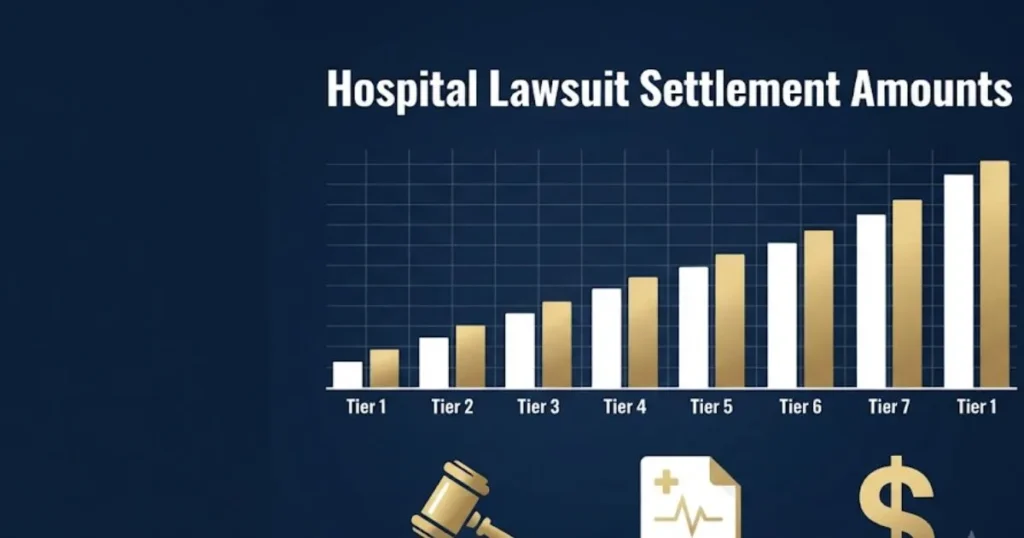
Hospital lawsuit settlement amounts in 2026 range from $100,000 to over $10 million, depending on the severity of the injury, the strength of the evidence, and the state where the case is filed. The median medical malpractice payout in the United States has hovered around $300,000 to $425,000 in recent years.
Here is a breakdown by injury type based on national data:
| Injury Type | Typical Settlement Range | Notable Verdicts |
|---|---|---|
| Surgical Error | $200,000 to $3 million | $7.5 million (2024, New York) |
| Misdiagnosis (Cancer) | $500,000 to $5 million | $12 million (2023, Illinois) |
| Birth Injury | $1 million to $10 million+ | $53 million (2023, Florida) |
| Hospital Infection | $100,000 to $1.5 million | $2.8 million (2024, Texas) |
| Medication Error | $150,000 to $2 million | $4.1 million (2023, California) |
| Wrongful Death | $500,000 to $8 million+ | $18 million (2024, New Jersey) |
| ER Negligence | $200,000 to $4 million | $6.2 million (2024, Pennsylvania) |
Several factors determine where your case falls within these ranges:
- Severity of injury (temporary vs. permanent disability)
- Age of the patient (younger patients often receive more)
- Economic damages (lost wages, future medical costs)
- State damage caps (some states limit non-economic damages)
- Quality of evidence (stronger proof means higher offers)
Settlements are not guaranteed. Hospitals and their insurance companies negotiate aggressively. Your attorney’s track record with similar cases directly affects the offer you receive.
How Much Can You Sue a Hospital For
You can sue a hospital for the full amount of your economic and non-economic damages, but some states impose caps that limit what you can actually recover. There is no universal maximum.
Economic damages cover measurable financial losses:
- Past and future medical bills
- Lost wages and lost earning capacity
- Rehabilitation and therapy costs
- Home modification costs (for permanent disabilities)
- In-home nursing care
Non-economic damages cover pain, suffering, emotional distress, loss of enjoyment of life, and loss of companionship. These are harder to quantify but often make up the largest portion of a payout.
| State | Non-Economic Damage Cap (2026) | Notes |
|---|---|---|
| California | $350,000 to $750,000 | Adjusted annually under MICRA reform |
| Texas | $250,000 per defendant | Cap applies per institution |
| Florida | No cap | Caps struck down in 2017 |
| New York | No cap | No statutory limit |
| Ohio | $250,000 to $500,000 | Varies by case severity |
| Illinois | No cap | Caps ruled unconstitutional |
| Virginia | $2.55 million total | Increases slightly each year |
Some states also allow punitive damages if the hospital’s conduct was reckless or intentional. Punitive damages punish the hospital and serve as a warning to others. These can add millions to a verdict.
Your attorney will calculate the total value of your claim based on your specific injuries, losses, and the laws in your state.
Key Takeaway: Hospital lawsuit settlements vary wildly based on injury severity and state law, so understanding damage caps and your specific losses is essential before accepting any offer.
Hospital Lawsuit Damages and Compensation
Hospital lawsuit damages fall into three categories: economic, non-economic, and punitive. Each category compensates you for a different type of loss.
Economic damages are the easiest to prove. They include every dollar you spent or will spend because of the hospital’s negligence. Medical bills, lost income, future care costs, and any out-of-pocket expenses all count.
Non-economic damages compensate for things that do not have a price tag. Pain and suffering. Emotional distress. Loss of the ability to enjoy activities you once loved. The death of a relationship because of permanent disability.
Punitive damages are rare but powerful. Courts award them when a hospital acted with extreme recklessness or disregard for patient safety. For example, if a hospital knowingly allowed an impaired surgeon to operate, punitive damages could apply.
| Damage Type | What It Covers | How It Is Calculated |
|---|---|---|
| Economic | Medical bills, lost wages, future care | Actual documented costs |
| Non-Economic | Pain, suffering, emotional distress | Multiplier method or per diem |
| Punitive | Punishment for egregious conduct | Court discretion |
The “multiplier method” is one common approach. Your attorney takes your economic damages and multiplies them by a factor of 1.5 to 5, depending on severity. A patient with $200,000 in economic damages and severe permanent injuries might receive a 4x multiplier, bringing non-economic damages to $800,000.
In wrongful death cases, surviving family members can recover damages for funeral costs, loss of financial support, loss of companionship, and the deceased’s pain and suffering before death.
Statute of Limitations for a Hospital Lawsuit
The statute of limitations for a hospital lawsuit is the legal deadline by which you must file your case, and missing it means losing your right to sue forever. Every state sets its own deadline, and they vary significantly.
Most states give you between 1 and 3 years from the date of injury. But the “discovery rule” can extend that deadline in some states. Under the discovery rule, the clock starts when you knew or should have known about the injury, not when the injury actually occurred.
This matters because some injuries are not immediately obvious. If a surgeon leaves a sponge inside you, you might not discover it for months or years.
| State | Standard Deadline | Discovery Rule | Special Rules |
|---|---|---|---|
| California | 1 year from discovery | Yes | 3-year maximum from injury date |
| Texas | 2 years | Yes | 10-year maximum for minors |
| New York | 2.5 years | Limited | Foreign object rule extends time |
| Florida | 2 years | Yes | 4-year max from incident |
| Pennsylvania | 2 years | Yes | 7 years max |
| Ohio | 1 year | Yes | 4-year max from incident |
Special rules for minors: Many states toll (pause) the statute of limitations for children. In some states, a child injured at birth has until age 8, 10, or even 20 to file a claim. These rules vary dramatically.
Wrongful death cases often have shorter deadlines. Some states give surviving family members only 1 to 2 years from the date of death to file.
Do not rely on guesswork. An attorney can tell you exactly how long you have based on your state and the specifics of your case.
Suing a Government Hospital
Suing a government hospital is significantly harder than suing a private hospital because government entities have special legal protections under sovereign immunity laws. You can still do it, but the rules are different and the deadlines are tighter.
If the hospital is operated by a city, county, or state government, you typically must file a formal notice of claim before you can sue. This notice gives the government a chance to investigate and respond.
| Government Level | Notice Deadline | Key Law |
|---|---|---|
| Federal (VA hospitals, military) | Must file with agency first | Federal Tort Claims Act (FTCA) |
| State | 30 to 365 days depending on state | State tort claims act |
| County or City | 30 to 180 days in most states | Local government tort claims |
For federal hospitals like VA medical centers, you must file an administrative claim with the agency before you can go to court. The agency has 6 months to respond. Only after they deny your claim (or fail to respond) can you file a lawsuit in federal court.
Damage caps for government hospital lawsuits are often lower than for private hospitals. Some states cap government liability at $300,000 to $500,000 regardless of how severe the injury is.
Here is what catches people off guard: the notice deadlines. In some states, you have as little as 30 days to file your notice of claim against a government hospital. Miss that deadline and your case is gone.
Veterans who received substandard care at a VA hospital have specific rights under the FTCA. These cases involve a completely separate process from state court litigation.
Key Takeaway: Suing a government hospital requires strict compliance with notice deadlines that can be as short as 30 days, making immediate legal consultation absolutely essential.
Hospital Negligence Claims in 2026
Hospital negligence claims in 2026 are increasing due to post-pandemic staffing shortages, higher patient volumes, and growing awareness of patient rights. The legal environment is more active than it has been in years.
Several trends are shaping hospital negligence cases this year:
Staffing shortages remain a major factor. Hospitals across the country are still struggling to retain nurses and support staff. Overworked staff make more errors. Studies from the American Nurses Association show a direct link between nurse-to-patient ratios and adverse patient outcomes.
Telehealth misdiagnosis claims are growing. As hospitals expanded virtual care options, a new category of negligence claims has emerged. Patients who were misdiagnosed during telehealth visits and suffered harm are filing lawsuits in increasing numbers.
Artificial intelligence in diagnostics is creating new legal questions. Some hospitals use AI tools to assist with reading scans and lab results. When those tools fail and patients are harmed, the question of who is liable becomes complicated.
| 2026 Trend | Impact on Claims |
|---|---|
| Staffing Shortages | More errors due to overworked staff |
| Telehealth Misdiagnosis | New category of negligence claims |
| AI Diagnostic Tools | Unclear liability between hospital and tech company |
| Infection Outbreaks | Ongoing risk from drug-resistant bacteria |
| Ambulance Diversion | Delayed treatment from ER overcrowding |
Hospitals are also facing increased scrutiny from the Joint Commission and CMS over patient safety metrics. Facilities that receive poor safety grades from organizations like Leapfrog may face stronger negligence arguments in court.
If you were injured at a hospital in 2025 or 2026, the legal climate is favorable for patients who take action promptly.
How Long Does a Hospital Lawsuit Take
A hospital lawsuit typically takes 18 to 36 months from the initial filing to resolution. Some cases settle in under a year. Complex cases involving catastrophic injuries or wrongful death can take 4 to 5 years.
Here is why it takes so long. Discovery alone can last 6 to 14 months. Both sides need time to gather records, hire experts, and take depositions. Hospitals often use delay tactics to wear down plaintiffs. They know that time is a weapon.
| Case Complexity | Average Duration | Settlement Likelihood |
|---|---|---|
| Straightforward (clear error) | 12 to 18 months | High (70%+) |
| Moderate (disputed liability) | 18 to 30 months | Moderate (50% to 70%) |
| Complex (catastrophic injury) | 30 to 48 months | Lower pre-trial (40%) |
| Wrongful Death | 24 to 48 months | Varies widely |
Factors that speed things up:
- Strong evidence makes hospitals more willing to settle early
- Pre-suit negotiation can resolve cases before a lawsuit is even filed
- Mediation resolves many cases in a single day of structured talks
Factors that slow things down:
- Multiple defendants (hospital, doctor, anesthesiologist, etc.)
- Disputed medical facts requiring competing expert opinions
- Government hospital cases with mandatory administrative processes
- Appeals after trial can add 1 to 3 years
Your attorney should give you a realistic timeline during your initial consultation. Be wary of anyone who promises a quick resolution. Hospital lawsuits require patience and persistence.
What to Expect in a Hospital Lawsuit
Expect a hospital lawsuit to be a stressful but structured legal process that tests your patience, requires your active participation, and ultimately aims to hold the hospital accountable for the harm it caused. Knowing what is coming helps you stay prepared.
During the early stages, you will spend time gathering records and meeting with your attorney. You may need to undergo an independent medical examination requested by the hospital’s lawyers. This exam is performed by a doctor chosen by the defense, and it is designed to minimize your injuries.
During discovery, you will likely give a deposition. This is a recorded interview under oath where the hospital’s attorneys ask you about your medical history, the events leading up to your injury, and how the injury has affected your life. Your attorney will prepare you for this thoroughly.
During settlement negotiations, expect lowball offers. The hospital’s first offer is almost always far below what your case is worth. Do not panic. This is normal. Your attorney will counter with evidence-backed demands.
What you should prepare for:
- Emotional difficulty revisiting the trauma of your experience
- Time commitment for depositions, meetings, and court appearances
- Financial patience since settlement payments take time
- Privacy concerns as your medical history becomes part of the case
- The possibility of trial if settlement talks fail
| Lawsuit Phase | Your Role |
|---|---|
| Pre-Filing | Gather records, describe your experience |
| Discovery | Attend deposition, answer questions under oath |
| Mediation | Participate in settlement discussions |
| Trial | Testify, attend court proceedings |
Most patients find the process worth it. Holding a hospital accountable protects future patients from the same kind of negligence. Your case can force systemic changes.
Key Takeaway: A hospital lawsuit demands patience and participation from you, but with the right attorney guiding the process, it is one of the most powerful ways to get justice and prevent future harm.
Frequently Asked Questions
Do I need a lawyer to sue a hospital?
Yes, you almost certainly need a lawyer to sue a hospital.
Hospital lawsuits require expert medical testimony, complex procedural filings, and the ability to take on well-funded defense teams.
Attempting to handle a medical malpractice case alone puts you at a severe disadvantage.
How much does an attorney for a hospital lawsuit cost?
Most medical malpractice attorneys work on contingency, meaning you pay nothing upfront.
The attorney takes 25% to 40% of your settlement or verdict if you win.
If you lose, you typically owe nothing for attorney fees.
What is the average settlement for a hospital lawsuit in 2026?
The average hospital lawsuit settlement in 2026 falls between $300,000 and $425,000 based on national data.
However, birth injury and wrongful death cases regularly settle for $1 million to $10 million or more.
Your payout depends on injury severity, evidence quality, and state law.
Can I sue a hospital if I signed a consent form?
Signing a consent form does not protect the hospital from all liability.
Consent forms cover known risks of a procedure, not negligence or errors.
If the hospital deviated from the standard of care or failed to explain material risks, you can still sue.
How long do I have to file a lawsuit against a hospital?
Most states give you 1 to 3 years from the date of injury or discovery.
Some states have shorter deadlines for government hospitals, sometimes as little as 30 to 90 days for the initial notice of claim.
Contact an attorney immediately to confirm your deadline.
Take Action Before Your Deadline Passes
If you were injured by hospital negligence, 2026 is the year to act. Every day that passes brings you closer to a statute of limitations deadline that could erase your rights entirely.
Get your medical records. Contact a qualified attorney for a free case evaluation. Find out what your claim is worth.
Your case could be worth far more than you think. The only way to know for sure is to have it reviewed by someone who handles these cases every day.







