

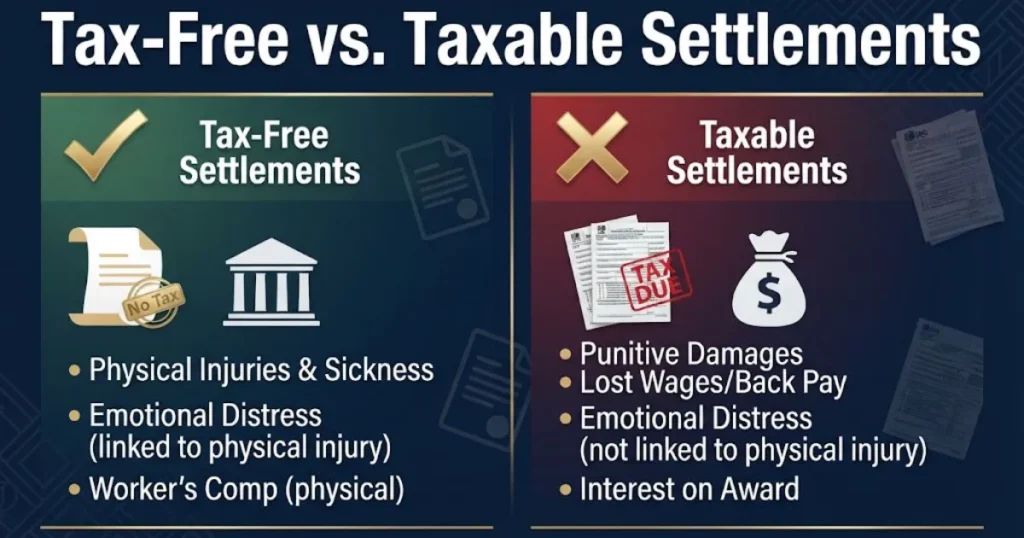
Yes, most lawsuit winnings are taxable in 2026. The IRS treats settlement money and court awards as income unless a specific exception applies. The biggest exception? Settlements for physical injuries or physical sickness. Those are generally tax-free under federal law.
But here’s what catches people off guard. Punitive damages, lost wages, emotional distress awards, and interest on settlements are almost always taxable. The IRS doesn’t care whether you won at trial or settled quietly. Money is money to them.
This article breaks down every type of lawsuit payout and its tax treatment for 2026. You’ll learn which settlements are tax-free, what the current rates look like, how to file correctly, and what new tax law changes could affect your bottom line.
One stat worth knowing: according to IRS data, nearly 60% of lawsuit recipients underreport or misreport their settlement income. That’s a mistake that can trigger audits, penalties, and back taxes.
Are Lawsuit Winnings Taxable?
Lawsuit winnings are taxable in most cases under federal law. The IRS considers settlement payments and court awards as gross income unless they fall under a specific exclusion in the tax code.
The main exception comes from IRC Section 104(a)(2). This provision excludes damages received “on account of personal physical injuries or physical sickness” from taxable income. Everything else, including breach of contract awards, employment discrimination payouts, and punitive damages, goes on your tax return.
Think of it like a paycheck. When you receive money, the IRS wants its share. Lawsuit winnings work the same way unless Congress carved out a specific exception.
| Type of Lawsuit Winning | Taxable in 2026? |
|---|---|
| Physical injury compensation | No |
| Punitive damages | Yes |
| Emotional distress (no physical injury) | Yes |
| Lost wages | Yes |
| Property damage (up to basis) | No |
| Breach of contract | Yes |
| Interest on settlement | Yes |
The key word in the tax code is “physical.” If your lawsuit involved a physical injury or physical sickness, you’re likely in the clear. If it didn’t, you probably owe taxes on the entire amount.
Many people assume all lawsuit money is a windfall that escapes taxation. That assumption costs thousands of dollars every year when the IRS comes knocking.
Are Lawsuit Settlements Taxable Income?
Most lawsuit settlements count as taxable income under IRS rules. The agency makes no distinction between money won at trial and money accepted through a settlement agreement.
When a defendant writes you a check to resolve a lawsuit, the IRS views that payment through the lens of what the money is replacing. If it replaces lost income, it’s taxed as income. If it compensates for physical harm, it’s excluded.

This concept is called the “origin of the claim” doctrine. Courts established this principle in multiple rulings, including the landmark Supreme Court case Banks v. Commissioner (2005). The tax treatment depends on the nature of the underlying claim, not what the settlement documents call the payment.
Here’s where it gets tricky. A single settlement can include multiple types of damages:
- Compensatory damages for physical injuries (tax-free)
- Back pay for lost wages (taxable)
- Emotional distress awards (taxable unless tied to physical injury)
- Punitive damages (always taxable)
How the settlement agreement allocates these amounts matters enormously. A poorly drafted settlement can turn tax-free money into taxable income. That allocation language in your settlement paperwork isn’t just legal boilerplate. It directly affects how much you keep.
Do You Pay Taxes on Lawsuit Settlements?
You pay taxes on lawsuit settlements unless your specific type of award qualifies for an exclusion. The default position under the tax code is that all income from any source is taxable.
The IRS doesn’t automatically know the details of your case. They receive a Form 1099 from the paying party, and that form reports the gross amount paid to you. It’s your responsibility to determine and document which portions are excludable.
Many settlement recipients get blindsided by their tax bill. They spend the money, then realize they owe the IRS 25% to 37% of the total depending on their income bracket. Setting aside money for taxes immediately after receiving a settlement is one of the smartest moves you can make.
Quick Facts:
- The IRS requires payers to report settlements over $600 on Form 1099
- You must report all settlement income even if you don’t receive a 1099
- Failure to report can result in penalties of 20% to 75% of the underpayment
- The statute of limitations for unreported income is 6 years, not the usual 3
Don’t assume your attorney handled the tax side. Most lawyers focus on winning your case, not on structuring the payout for tax efficiency. The tax burden falls entirely on you.
Key Takeaway: The IRS taxes most lawsuit settlements as ordinary income, and the only major exception is compensation for physical injuries or physical sickness under IRC Section 104(a)(2).
How Are Lawsuit Settlements Taxed?
Lawsuit settlements are taxed as ordinary income at your regular federal income tax rate. There is no special “settlement tax rate” or reduced rate for legal payouts.
The IRS treats your settlement money just like wages or business income. It gets added to your total income for the year, and you pay taxes based on your overall tax bracket. For 2026, federal income tax rates range from 10% to 37% depending on your filing status and total taxable income.
Here’s an important wrinkle. You pay taxes on the full settlement amount, including the portion that goes to your attorney. The Supreme Court confirmed this in Banks v. Commissioner (2005). Even if your lawyer takes a 33% contingency fee, you report 100% of the settlement as income.
| 2026 Federal Tax Bracket | Single Filer Income Range |
|---|---|
| 10% | Up to $11,925 |
| 12% | $11,926 to $48,475 |
| 22% | $48,476 to $103,350 |
| 24% | $103,351 to $197,300 |
| 32% | $197,301 to $250,525 |
| 35% | $250,526 to $626,350 |
| 37% | Over $626,350 |
Note: 2026 brackets may shift due to TCJA sunset provisions. These reflect projected ranges based on current IRS guidance.
A large settlement can push you into a higher bracket for that year. If you normally earn $60,000 and receive a $200,000 settlement, you’re suddenly in the 32% bracket territory. That’s a massive jump from the 22% rate you’re used to.
Tax-Free Lawsuit Settlements Explained
Tax-free lawsuit settlements are payments received specifically for physical injuries or physical sickness. Under IRC Section 104(a)(2), these amounts are completely excluded from gross income.
This exclusion covers several types of payments as long as the underlying claim involves actual physical harm:
- Compensation for medical bills related to physical injuries
- Pain and suffering damages tied to a physical injury
- Emotional distress damages that originate from a physical injury
- Loss of consortium awards connected to a physical injury
The physical component is the magic ingredient. A broken arm from a car accident? Tax-free settlement. Anxiety from a contract dispute? Taxable. Anxiety caused by injuries from a car accident? Tax-free, because the emotional harm flows from the physical injury.
One exception to know: even in a physical injury case, if you previously deducted medical expenses related to the injury and then receive a settlement reimbursing those costs, the reimbursed portion becomes taxable. The IRS calls this the “tax benefit rule.” You got a tax break once on those medical bills. You can’t double-dip.
Property damage settlements can be tax-free too, but only up to your adjusted basis in the property. If your car was worth $15,000 and the settlement gives you $15,000, no tax. If they give you $20,000, the extra $5,000 is taxable gain.
Is a Personal Injury Settlement Taxable?
Personal injury settlements for physical injuries are not taxable under federal law. This is the clearest and most generous tax exclusion available for lawsuit winnings.
The IRS requires two conditions for this exclusion to apply. First, the settlement must be received “on account of” personal physical injuries. Second, the injuries must be physical in nature, not purely emotional or psychological.
The connection between the payment and the physical injury must be direct. Courts have been strict about this requirement. In Commissioner v. Schleier (1995), the Supreme Court ruled that settlement money must be received because of the physical injury, not just connected to a lawsuit that happened to involve physical harm.
| Personal Injury Settlement Component | Taxable? |
|---|---|
| Medical expenses (physical) | No |
| Pain and suffering (physical) | No |
| Emotional distress from physical injury | No |
| Lost wages included in physical injury claim | No |
| Punitive damages in physical injury case | Yes |
| Interest earned on the settlement | Yes |
Notice the last two rows. Even in a completely legitimate physical injury case, punitive damages and interest are always taxable. The IRS does not budge on this. The tax-free treatment covers compensatory damages only.
If you suffered a workplace injury, a car accident, a slip-and-fall, or harm from a defective product, your compensatory settlement is almost certainly tax-free. Just make sure the settlement agreement clearly identifies the payment as compensation for physical injuries.
Key Takeaway: Personal injury settlements for physical injuries are tax-free, but punitive damages and interest on those same settlements are always taxable regardless of the underlying claim.
Are Punitive Damages Taxable?
Punitive damages are always taxable. No exceptions exist under current federal law, regardless of the type of case that produced them.
This catches a lot of people by surprise. You could win a physical injury case where the compensatory damages are entirely tax-free, but if the jury also awards punitive damages, that portion hits your tax return as ordinary income.
The reason is straightforward. Punitive damages don’t compensate you for anything. They exist to punish the defendant for particularly bad behavior. Since they aren’t replacing a loss or compensating for harm, the IRS sees no reason to exclude them from income.
Some states have tried to challenge this treatment. In O’Gilvie v. United States (1996), a widow argued that punitive damages from a personal injury wrongful death case should be tax-free. The Supreme Court disagreed. Punitive damages are taxable, period.
What this means in real numbers:
- You win a $500,000 verdict: $300,000 compensatory, $200,000 punitive
- The $300,000 is tax-free (physical injury)
- The $200,000 is taxed as ordinary income
- At the 32% bracket, you owe roughly $64,000 in federal taxes on the punitive portion alone
If your case involves punitive damages, factor taxes into your financial planning before you spend a dime. Many plaintiffs have been caught short because they treated the entire award as tax-free.
Is Emotional Distress Settlement Taxable?
Emotional distress settlements are taxable unless the emotional distress originated from a physical injury or physical sickness. This is one of the most misunderstood areas of lawsuit taxation.
If you sued your employer for harassment and received a settlement for emotional distress, that money is fully taxable. The IRS treats it as ordinary income because no physical injury caused the emotional harm.
But if a drunk driver hit your car, broke your leg, and you developed PTSD from the accident, the emotional distress damages are tax-free. The PTSD stems from the physical injury. That connection makes all the difference.
Here’s a helpful way to think about it. Ask yourself: “Did something physically happen to my body first?” If yes, the emotional distress damages tied to that physical event are excluded. If no, the money is taxable.
| Emotional Distress Scenario | Taxable? |
|---|---|
| PTSD from a physical assault | No |
| Anxiety from workplace discrimination | Yes |
| Depression caused by a car accident injury | No |
| Stress from a breach of contract | Yes |
| Sleep disorders from toxic exposure | No (physical sickness) |
There’s one small relief for taxable emotional distress settlements. You can reduce the taxable amount by any medical expenses you paid for treatment of that emotional distress, as long as you didn’t previously deduct those expenses on a prior tax return.
So if your emotional distress settlement was $100,000 and you paid $15,000 in therapy bills that you never deducted, you only report $85,000 as income.
Are Wrongful Death Settlements Taxable?
Wrongful death settlements are generally not taxable at the federal level. The IRS treats them similarly to personal injury settlements because the underlying claim involves physical harm that led to death.
Most wrongful death settlements fall under the IRC Section 104(a)(2) exclusion. The death resulted from physical injuries, which means the compensation paid to surviving family members qualifies for the same tax-free treatment.
However, there are a few wrinkles. The tax treatment can depend on state law because wrongful death claims are creatures of state statute. Some states structure wrongful death recoveries differently than others.
Components of a wrongful death settlement and their tax status:
- Compensation for the deceased person’s pain and suffering before death: tax-free
- Loss of financial support for surviving family: tax-free in most states
- Funeral and burial expense reimbursement: tax-free
- Punitive damages in a wrongful death case: taxable
- Interest accrued on the settlement amount: taxable
The biggest pitfall is punitive damages. Just like in a personal injury case, punitive damages awarded in a wrongful death suit are fully taxable. And some wrongful death cases involve substantial punitive awards, especially in cases involving corporate negligence or reckless behavior.
If you received a wrongful death settlement in 2025 or expect one in 2026, check whether the settlement agreement separates compensatory damages from punitive damages. That separation directly controls your tax bill.
Key Takeaway: Wrongful death and emotional distress settlements have tricky tax rules that depend entirely on whether the claim traces back to a physical injury or physical sickness.
Are Medical Malpractice Settlements Taxable?
Medical malpractice settlements are usually not taxable because they compensate for physical injuries caused by a healthcare provider’s negligence. The physical injury connection makes them eligible for the IRC Section 104(a)(2) exclusion.
Think about what medical malpractice actually involves. A surgeon made an error. A misdiagnosis led to worsening physical harm. A medication mistake caused organ damage. These are all physical injuries at their core.
That means the compensatory portion of a medical malpractice settlement, covering medical bills, pain and suffering, and reduced quality of life, is tax-free.
But as with every other settlement type, the details matter:
- Compensatory damages for physical harm: Tax-free
- Lost income or earning capacity: Tax-free when part of a physical injury claim
- Punitive damages: Taxable, always
- Interest on the award: Taxable, always
- Damages for emotional harm only (no physical component): Taxable
Medical malpractice cases sometimes produce very large settlements. A $2 million payout with $400,000 in punitive damages means you could owe over $100,000 in federal taxes depending on your bracket.
One often-missed detail: if you received a structured settlement that pays out over time instead of a lump sum, each payment is still tax-free as long as the original settlement qualified under Section 104. Structured settlements can actually be a smart tax move because they keep you in a lower bracket year over year.
Is Lost Wages Settlement Taxable?
Lost wages settlements are taxable in most situations. The IRS treats them as a replacement for income you would have earned, so they get taxed the same way your regular paycheck would.
This surprises many people. They think all settlement money is the same. It’s not. Lost wages are fundamentally different from pain and suffering or medical expense reimbursement.
There’s one important exception. When lost wages are included as part of a physical injury settlement and the settlement agreement doesn’t separately allocate the lost wages, the entire amount can be excluded under Section 104(a)(2). The key is how the settlement documents are written.
| Lost Wages Scenario | Taxable? | Tax Type |
|---|---|---|
| Lost wages in a physical injury case (not separately allocated) | No | N/A |
| Lost wages in an employment discrimination case | Yes | Ordinary income |
| Lost wages in a wrongful termination case | Yes | Ordinary income + FICA |
| Back pay from an employment lawsuit | Yes | Ordinary income + FICA |
| Front pay (future lost earnings) | Yes | Ordinary income |
Something most articles don’t mention: lost wages settlements from employment cases are subject to FICA taxes (Social Security and Medicare), not just income tax. That adds an extra 7.65% on top of your income tax rate. The employer portion is also due, and in a settlement situation, the defendant typically handles that.
This is why settlement allocation matters so much. If your attorney can legitimately classify more of the payment as physical injury compensation rather than lost wages, your tax bill drops significantly. The allocation has to reflect reality, though. You can’t just label everything “physical injury” if the case didn’t involve one.
Are Class Action Settlement Payments Taxable?
Class action settlement payments follow the same tax rules as individual lawsuit settlements. The taxability depends on the nature of the underlying claim, not the structure of the lawsuit.
Most class action settlements you hear about in consumer cases involve things like price-fixing, data breaches, defective products, or false advertising. These typically produce taxable income because they rarely involve physical injuries.
That $15 check you got from a class action against a tech company for data privacy violations? Technically taxable. Most people don’t report small amounts, and the IRS rarely pursues them, but legally, that money counts as income.
Common class action scenarios and their tax treatment:
- Product defect causing physical harm: Tax-free (physical injury)
- Data breach settlement: Taxable
- Consumer fraud/overcharging: Taxable (but may offset by cost basis)
- Securities fraud: Taxable (though capital loss offsets may apply)
- Employment class action for wage theft: Taxable as wages
- Environmental contamination causing illness: Tax-free (physical sickness)
The IRS generally requires class action administrators to issue 1099 forms for settlement payments above $600. If you receive a 1099, the IRS already knows about the payment. Not reporting it is a red flag.
For larger class action payouts, especially those involving employment claims or securities fraud, the tax bite can be substantial. Don’t assume that because it came from a class action, it’s somehow treated differently. The rules are identical.
Key Takeaway: Lost wages and class action payments are taxable more often than people expect, and the way your settlement agreement allocates the money can make or break your tax outcome.
Lawsuit Settlement Tax Rate 2026
The lawsuit settlement tax rate in 2026 is your regular federal income tax rate, which ranges from 10% to 37% based on your total taxable income. There is no special tax rate for settlement money.
Your settlement gets stacked on top of whatever other income you earned during the year. That total determines your bracket. A big settlement can easily push you two or three brackets higher than normal.
| Filing Status | 37% Bracket Starts At (2026 Projected) |
|---|---|
| Single | Over $626,350 |
| Married Filing Jointly | Over $751,600 |
| Head of Household | Over $688,950 |
Potential TCJA changes for 2026: the Tax Cuts and Jobs Act’s individual rate reductions are scheduled to sunset after December 31, 2025. If Congress does not extend them, tax brackets for 2026 could revert to pre-2018 levels. That means the top rate could jump from 37% to 39.6%, and every bracket below it shifts upward.
As of early 2025, Congress has not passed legislation to make the TCJA rates permanent. This creates genuine uncertainty for anyone expecting a large settlement in 2026.
Self-employment tax is another factor. If your settlement is for lost business income or involves a business-related claim, you may owe an additional 15.3% in self-employment tax on top of income tax. That can push your effective rate above 50% when combined with state taxes.
Capital gains rates could also apply in rare situations, such as settlements involving the sale or destruction of capital assets. Long-term capital gains rates of 0%, 15%, or 20% would apply instead of ordinary income rates. But this scenario is uncommon for typical lawsuit settlements.
2026 Tax Law Changes Affecting Settlements
Several 2026 tax law changes could significantly affect how lawsuit settlements are taxed. The biggest is the potential expiration of the Tax Cuts and Jobs Act’s individual provisions.
Here’s what’s at stake if the TCJA sunsets as scheduled:
- Tax brackets widen and rates increase across the board
- The standard deduction drops by roughly half (from about $15,000 to around $8,000 for single filers)
- Personal exemptions return (approximately $5,300 per person)
- The miscellaneous itemized deduction for unreimbursed expenses comes back with a 2% AGI floor
- The above-the-line deduction for attorney fees in certain cases could be affected
That last point deserves attention. Under current TCJA rules, the above-the-line deduction for attorney fees in employment discrimination and whistleblower cases survives. But the broader landscape of itemized deductions changes if the TCJA expires.
What you should know for 2026 planning:
| Tax Feature | Current (TCJA Active) | If TCJA Expires in 2026 |
|---|---|---|
| Top individual rate | 37% | 39.6% |
| Standard deduction (single) | ~$15,000 | ~$8,000 |
| Personal exemption | $0 | ~$5,300 |
| Misc. itemized deductions | Suspended | Restored (2% AGI floor) |
| AMT exemption | Higher | Lower |
The alternative minimum tax (AMT) is another concern. If exemption amounts drop back to pre-TCJA levels, more settlement recipients could find themselves subject to the AMT. This parallel tax system can eliminate deductions you thought you had.
Nobody can predict exactly what Congress will do. But if you’re expecting a large settlement in 2026, planning for the worst-case tax scenario is the prudent move.
How to Report Lawsuit Settlement on Tax Return
You report a lawsuit settlement on your tax return using several different forms depending on the type of payment received. The most common form is Schedule 1 (Form 1040), where you list the settlement as “Other Income” on Line 8z.
Step-by-step for reporting in 2026:
- Determine which portions of your settlement are taxable
- Gather all 1099 forms received from the defendant or settlement administrator
- Report taxable settlement income on Schedule 1, Line 8z
- If the settlement includes wages, it should appear on a W-2 and goes on Line 1 of Form 1040
- Deduct attorney fees if eligible (more on this below)
- Pay estimated taxes if you haven’t had withholding applied
Common reporting forms:
| Form | When It’s Used |
|---|---|
| 1099-MISC, Box 10 | Gross proceeds paid to an attorney |
| 1099-NEC | Attorney fees reported as non-employee compensation |
| W-2 | Wage-related settlement payments |
| Schedule 1, Line 8z | Other taxable settlement income |
| Form 8275 | Disclosure statement for aggressive tax positions |
The IRS specifically watches for mismatches. If you receive a 1099 showing $300,000 but only report $100,000 because the rest was for physical injuries, attach a statement explaining the exclusion. Without that explanation, the IRS computer will flag the discrepancy automatically.
Tax-free settlements don’t need to be reported as income. But keeping documentation of the physical injury basis is critical. If you’re ever audited, you’ll need medical records, the settlement agreement, and any court filings that establish the physical injury claim.
Key Takeaway: Report taxable settlement income on Schedule 1 of your 1040, attach an explanation for any 1099 amounts you’re excluding, and keep your settlement documents for at least six years in case of an audit.
Are Attorney Fees From a Lawsuit Tax Deductible?
Attorney fees from a lawsuit are tax deductible in certain cases, but the rules changed significantly under the Tax Cuts and Jobs Act and may shift again in 2026.
Before 2018, attorney fees in most lawsuits could be deducted as miscellaneous itemized deductions subject to a 2% AGI floor. The TCJA eliminated that deduction for tax years 2018 through 2025. If the TCJA sunsets, this deduction could return for 2026.
However, there’s an important exception that survived the TCJA. Attorney fees in employment discrimination cases, whistleblower claims, and certain other federal civil rights cases can be deducted “above the line” under IRC Section 62(a)(20) and (21). This means you subtract attorney fees before calculating your adjusted gross income.
Types of cases eligible for above-the-line attorney fee deductions:
- Employment discrimination under Title VII, ADA, ADEA
- Whistleblower claims under the False Claims Act
- Claims under the National Labor Relations Act
- IRS whistleblower awards under IRC Section 7623
- Claims under certain state anti-discrimination laws
For cases that don’t qualify for the above-the-line deduction, the tax treatment of attorney fees is painful. You report 100% of the settlement as income, and you may not be able to deduct the attorney fees at all. This means you pay taxes on money your lawyer kept.
Example:
- $400,000 breach of contract settlement
- $133,000 goes to your attorney (33% contingency)
- You receive $267,000
- You pay taxes on $400,000 (not $267,000)
- At the 32% bracket, your tax is $128,000
- Your net after taxes and fees: $139,000
That’s less than 35% of the original settlement. It’s harsh, but that’s the current law. Planning for this reality before you settle can save you from a financial shock.
State Taxes on Lawsuit Settlements
State taxes on lawsuit settlements vary dramatically depending on where you live. Some states follow federal rules exactly, while others have their own treatment of settlement income.
If your state has an income tax, your lawsuit settlement is likely subject to state taxation on top of federal taxes. The combined rate can push your total tax burden above 45% in high-tax states.
State-by-state overview of key differences:
| State Category | States | Treatment |
|---|---|---|
| No state income tax | TX, FL, NV, WA, WY, SD, AK, TN, NH | No state tax on settlements |
| Follows federal rules | CA, NY, IL, PA, OH (and most others) | Taxable if federally taxable |
| Has unique exclusions | AL, MT, NJ (partial) | May exclude certain settlement types beyond federal rules |
| High state tax rate | CA (13.3%), HI (11%), NJ (10.75%) | Significant additional burden |
States with no income tax give settlement recipients a meaningful advantage. A $500,000 taxable settlement in Texas versus California could mean a difference of over $60,000 in state taxes alone.
Some states also have their own rules about deducting attorney fees. Even if federal law allows an above-the-line deduction, your state might not conform to that provision.
If you’re considering relocating before receiving a large settlement, the state tax implications are worth analyzing. Some states tax based on where you lived when the settlement was received. Others look at where the injury occurred or where the lawsuit was filed.
One more consideration: city and local taxes. New York City, for example, imposes its own income tax of up to 3.876% on top of the state tax. Residents of some Ohio cities face local income taxes too. These add up fast on a large settlement.
Key Takeaway: State and local taxes can add 5% to 13% on top of your federal tax bill, making your total tax burden on a lawsuit settlement significantly higher than most people anticipate.
Frequently Asked Questions
Do I have to pay federal taxes on my lawsuit settlement in 2026?
Yes, unless your settlement compensates you for physical injuries or physical sickness.
Physical injury settlements are excluded under IRC Section 104(a)(2).
All other settlement types, including punitive damages and lost wages, are taxable as ordinary income.
What types of lawsuit settlements are completely tax-free?
Settlements for physical injuries, physical sickness, and wrongful death (compensatory portion) are tax-free.
Property damage recoveries up to your cost basis are excluded too.
Punitive damages and interest are always taxable, even in physical injury cases.
How do I report a lawsuit settlement on my 2026 tax return?
Report taxable settlement income on Schedule 1, Line 8z of Form 1040.
Wage-related settlements should appear on a W-2 and go on Line 1.
Attach a statement explaining any 1099 amounts excluded as tax-free physical injury compensation.
Are attorney fees deductible from my lawsuit winnings in 2026?
Attorney fees are deductible above the line for employment discrimination and whistleblower cases.
For most other case types, attorney fees are not deductible under current TCJA rules.
If the TCJA expires in 2026, the miscellaneous itemized deduction for attorney fees may return.
Do states charge separate taxes on lawsuit settlement money?
Yes, most states with an income tax also tax lawsuit settlements.
Seven states charge no income tax at all, giving settlement recipients a significant advantage.
Some states have unique exclusions or different rules for specific settlement types.
What to Do Next
Lawsuit winnings are taxable more often than not. The physical injury exclusion is valuable, but it doesn’t cover punitive damages, lost wages, or emotional distress without a physical cause.
If you received or expect a settlement in 2026, review your settlement agreement’s allocation language now. Set aside at least 30% to 40% of any taxable portion for federal and state taxes.
Stay informed about TCJA expiration developments. The tax rates and deduction rules for 2026 could change significantly before year-end.







