

The advance financial 24 7 lawsuit centers on claims that the Tennessee-based lender trapped borrowers in cycles of debt through sky-high interest rates and deceptive lending practices. If you took out a FLEX loan or any short-term product from Advance Financial, you could be owed money.
This company has charged APRs that reportedly exceed 279% on certain loan products. That kind of rate can turn a $500 loan into thousands of dollars in repayment costs.
In this guide, you’ll get every detail that matters for 2026. We cover case updates, settlement estimates, eligibility rules, how to file a claim, and what the actual timeline looks like.
Whether you borrowed $200 or $4,000, here’s what you need to know right now.
What Is the Advance Financial 24 7 Lawsuit About?
The Advance Financial 24 7 lawsuit is a legal action accusing the company of predatory lending through its FLEX loan products and other short-term financial offerings. Borrowers claim the company used excessive interest rates, hidden fees, and aggressive collection tactics to profit from financially vulnerable people.
Advance Financial operates out of Nashville, Tennessee. It markets itself as a convenient, around-the-clock lending option. The “24/7” branding suggests easy access, but plaintiffs argue that easy access became easy exploitation.
The core legal argument is straightforward. Borrowers say they were charged interest rates so extreme that repaying the loan became nearly impossible without taking on additional debt.
| Detail | Info |
|---|---|
| Company | Advance Financial (dba Advance Financial 24/7) |
| Headquarters | Nashville, Tennessee |
| Primary Product | FLEX Loans (open-end line of credit) |
| Key Allegation | Predatory lending with excessive APRs |
| Reported APR Range | 179% to 350%+ |
| States Affected | Tennessee, plus online borrowers in multiple states |
The lawsuits do not involve just one borrower. Thousands of people across several states have raised similar concerns about the company’s lending practices.
Think of it like this: you walk into a store thinking you’re buying a $10 item, but the receipt shows $35 after hidden charges. Now multiply that math across a loan with monthly payments.
Advance Financial 24/7 Lawsuit Update for 2026
As of early 2026, the Advance Financial 24/7 lawsuit remains active with ongoing legal proceedings in multiple jurisdictions. Court filings show that discovery phases have produced significant internal documents from the company regarding its fee structures and lending criteria.
Several state attorneys general have expressed interest in the case. Tennessee regulators have been reviewing whether Advance Financial’s FLEX loan product complies with the state’s Flexible Credit Act, which was designed to allow high-cost lending under certain conditions.
The CFPB has also flagged Advance Financial in enforcement-related communications. Federal scrutiny of high-cost lenders has intensified under current regulatory priorities.
- January 2026: Updated class certification motions filed
- Spring 2026: Discovery documents expected to become partially public
- Mid-2026: Potential settlement negotiations or trial date confirmation
- Late 2026: Earliest possible settlement distribution window
New plaintiffs continue to join the case. The legal team representing borrowers has expanded its outreach to states where Advance Financial operated online lending.
Key point for 2026: The case has not been dismissed or settled yet. That means the window to get involved is still open.
Advance Financial 24/7 Class Action Lawsuit Explained
A class action lawsuit against Advance Financial 24/7 allows a large group of borrowers to sue the company together instead of filing individual cases. This structure gives everyday borrowers the legal firepower to challenge a corporation with deep pockets.
In a class action, one or more “lead plaintiffs” represent the entire group. Everyone who meets the class definition can potentially receive compensation if the case succeeds.
The class in this lawsuit generally includes people who:
- Took out a FLEX loan or similar product from Advance Financial
- Were charged APRs above what state law allows
- Paid fees that were not clearly disclosed before signing
- Experienced aggressive or misleading collection practices
Class actions work well in cases like this because individual loan amounts might be relatively small. Nobody is going to hire a lawyer over a $500 loan. But when 50,000 borrowers each lost $500 to $3,000 in excessive fees, the combined damages become substantial.
| Class Action Element | How It Applies Here |
|---|---|
| Lead Plaintiffs | Named borrowers representing the class |
| Class Size | Estimated thousands of borrowers |
| Common Issue | Excessive APRs and undisclosed fees |
| Legal Basis | State consumer protection and lending laws |
| Potential Outcome | Settlement fund or court-ordered damages |
If the class gets certified, you typically don’t need to do anything to be included. But filing a claim when the time comes ensures you actually get paid.
Key Takeaway: The Advance Financial 24/7 lawsuit accuses the company of trapping borrowers with extreme interest rates, the case remains active in 2026 with growing regulatory attention, and the class action structure lets everyday borrowers participate without hiring their own attorney.
Advance Financial Predatory Lending Lawsuit Details
The predatory lending lawsuit against Advance Financial centers on allegations that the company deliberately designed its loan products to keep borrowers in a continuous cycle of debt. Predatory lending means using unfair, deceptive, or abusive practices to push loans on people who cannot realistically repay them.
Plaintiffs in this case argue three main things. First, that the interest rates charged were unconscionably high. Second, that fee disclosures were confusing or misleading. Third, that the company targeted borrowers with limited financial options.
Predatory lending is not just about high rates. It’s about the whole package: targeting vulnerable communities, making repayment nearly impossible, and profiting from borrower distress.
The legal claims in this lawsuit typically fall under:
- State usury laws (caps on interest rates)
- State consumer protection statutes (unfair or deceptive practices)
- Truth in Lending Act (TILA) (federal disclosure requirements)
- State Flexible Credit Acts (specific rules for high-cost credit products)
Some borrowers report that they paid back double or triple what they originally borrowed but still owed a remaining balance. That pattern is a textbook sign of predatory lending design.
When a lender builds a product where the minimum payment barely covers interest, the principal hardly shrinks. The borrower stays stuck.
Advance Financial Flex Loan Lawsuit Breakdown
The Advance Financial flex loan is the specific product at the heart of most claims in this lawsuit. A FLEX loan is an open-end line of credit, meaning borrowers can draw funds up to a set limit and make minimum payments over time.
Here’s where it gets ugly. The minimum payments on FLEX loans are structured so that most of the payment goes toward fees and interest, not the principal balance. Borrowers can technically pay the minimum for years without making real progress on the debt.
Let’s look at the actual numbers to understand why borrowers are angry.
| Loan Example | Details |
|---|---|
| Amount Borrowed | $500 |
| APR Charged | 279% |
| Monthly Minimum Payment | Approx. $62 |
| Amount Going to Principal | Approx. $8 to $15 per month |
| Total Repaid Over 12 Months | Approx. $744 |
| Remaining Balance After 12 Months | Approx. $380 to $420 |
After a full year of payments on a $500 loan, borrowers could still owe most of the original balance. That’s the math that drives this lawsuit.
The FLEX loan product is legal in Tennessee under the Flexible Credit Act. But plaintiffs argue the way Advance Financial structures and markets these loans crosses the line from legal lending into predatory territory.
It’s like a gym membership that charges you monthly but locks the doors half the time. Technically you signed up, but you’re not getting what you expected.
Advance Financial Interest Rate Lawsuit Claims
The interest rate lawsuit claims against Advance Financial focus on APRs that reportedly range from 179% to over 350% depending on the loan amount, state, and product type. These rates dwarf what traditional lenders charge and even exceed rates common among other high-cost lenders.
For comparison, here’s how Advance Financial’s rates stack up:
| Lender Type | Typical APR Range |
|---|---|
| Credit Cards | 15% to 30% |
| Personal Loans (Banks) | 6% to 36% |
| Payday Loans | 300% to 600% |
| Advance Financial FLEX Loans | 179% to 350%+ |
| State Usury Cap (Many States) | 24% to 36% |
Advance Financial’s rates fall in the same territory as payday loans, which are banned or heavily restricted in many states for good reason. The company operates under Tennessee’s Flexible Credit Act, which allows higher rates than most states permit.
Plaintiffs argue these rates are so extreme that they violate the spirit of consumer protection, even where they may technically comply with the letter of Tennessee law. The legal question becomes whether lending across state lines to borrowers in states with stricter caps is permissible.
Several states cap consumer lending APRs at 36% or lower. When Advance Financial lends online to residents of those states at 279%, the legality gets murky fast.
Key Takeaway: Advance Financial’s FLEX loan minimum payments are designed so borrowers barely reduce their principal, interest rates reach 350% or higher, and the math shows a $500 loan can cost over $700 in a single year while the balance barely drops.
Is Advance Financial 24/7 Illegal?
Whether Advance Financial 24/7 is illegal depends on which state you’re in and which specific lending practices are examined. The company itself is a licensed lender in Tennessee, where the Flexible Credit Act permits higher-cost lending products that would be prohibited in many other states.
The lawsuit does not claim the company’s entire existence is illegal. Instead, it targets specific practices: the rates charged, how fees were disclosed, and whether the company complied with lending laws in every state where it served borrowers.
Here’s the breakdown:
- In Tennessee: Advance Financial holds a state license and operates under the Flexible Credit Act. Its products are technically permitted by state law.
- Online lending to other states: This is where legality gets complicated. Many states have interest rate caps far below what Advance Financial charges. Lending to residents of those states at Tennessee rates may violate those states’ laws.
- Federal law: The Truth in Lending Act requires clear disclosure of all loan terms. Plaintiffs allege these disclosures were inadequate or misleading.
The word “illegal” is strong, but certain lending practices can be unlawful even when the company holds a state license. A licensed restaurant can still violate health codes.
State attorneys general in several jurisdictions have the authority to pursue Advance Financial for lending to their residents at rates that exceed state caps. Whether they will take action in 2026 remains an open question.
Advance Financial Predatory Lending Evidence
Evidence of predatory lending by Advance Financial comes from borrower testimony, internal company documents obtained during discovery, regulatory filings, and analysis of loan repayment data. The strongest evidence involves the mathematical structure of the loans themselves.
Key pieces of evidence in the case include:
- Loan repayment schedules showing that minimum payments result in years-long debt cycles
- Internal marketing materials that allegedly targeted low-income communities and borrowers with poor credit
- Customer complaint records filed with state regulators and the CFPB
- Comparison data showing Advance Financial’s rates far exceeding peer averages even among high-cost lenders
- Borrower affidavits describing experiences where they repaid multiples of the original loan yet still carried a balance
Discovery in the class action has produced internal communications. These documents reportedly show that company executives were aware of the debt cycle pattern and considered it a feature of the business model, not a bug.
The CFPB complaint database contains multiple entries from Advance Financial borrowers. Common themes include unexpected fees, difficulty getting clear payoff amounts, and frustration with customer service responses.
| Evidence Type | What It Shows |
|---|---|
| Loan Math Analysis | Minimum payments barely reduce principal |
| Internal Emails | Awareness of borrower debt cycles |
| CFPB Complaints | Patterns of borrower confusion and distress |
| Marketing Materials | Targeting of financially vulnerable populations |
| State Regulatory Filings | Gaps in compliance documentation |
Strong evidence usually wins these cases. The math alone tells a compelling story.
Who Qualifies for the Advance Financial Lawsuit?
You may qualify for the Advance Financial lawsuit if you took out a FLEX loan, line of credit, or other lending product from Advance Financial 24/7 and were charged interest rates or fees that you believe were excessive, hidden, or not properly disclosed.
Qualification is not limited to borrowers in Tennessee. If you borrowed from Advance Financial online from any state, you may be part of the class.
General qualification criteria include:
- You took out a loan from Advance Financial 24/7 at any point during the relevant class period (typically covering multiple years of operations)
- You were charged an APR that exceeded your state’s legal cap for consumer lending
- You made payments that primarily went toward interest and fees rather than principal
- You experienced aggressive collection tactics or misleading communications about your balance
| Qualification Factor | Details |
|---|---|
| Loan Type | FLEX loans, lines of credit, installment loans |
| Time Period | Varies by state, generally 2018 to present |
| Location | Any state where Advance Financial lent money |
| Key Issue | Excessive APR, hidden fees, or deceptive practices |
| Proof Needed | Loan agreement, payment records, bank statements |
You do not need to have defaulted on the loan. Even if you paid it off completely, you may still qualify if you were overcharged.
Keep your original loan documents. They are the single most important piece of evidence you can hold onto.
Key Takeaway: Evidence in the case includes internal company documents showing awareness of debt cycles, you may qualify if you borrowed from Advance Financial in any state and were charged excessive rates, and keeping your original loan paperwork is critical.
Advance Financial Lawsuit Eligibility Requirements
Eligibility for the Advance Financial lawsuit depends on specific criteria set by the court and the legal team handling the class action. Meeting these requirements determines whether you can participate in any settlement or judgment.
The eligibility requirements generally break down into these categories:
Mandatory Requirements:
- You must have been a borrower of Advance Financial 24/7
- Your loan must fall within the class period defined by the court
- You must have been charged fees or rates that are part of the lawsuit’s claims
Supporting Factors That Strengthen Your Claim:
- You have copies of your loan agreement showing the APR and fee schedule
- You have bank statements showing payments made to Advance Financial
- You experienced a demonstrable financial harm from the lending terms
- You can show that the fees were not clearly explained before you signed
The difference between qualifying and having a strong claim matters. Almost anyone who borrowed from Advance Financial during the class period qualifies. But those with documentation will likely receive higher payouts.
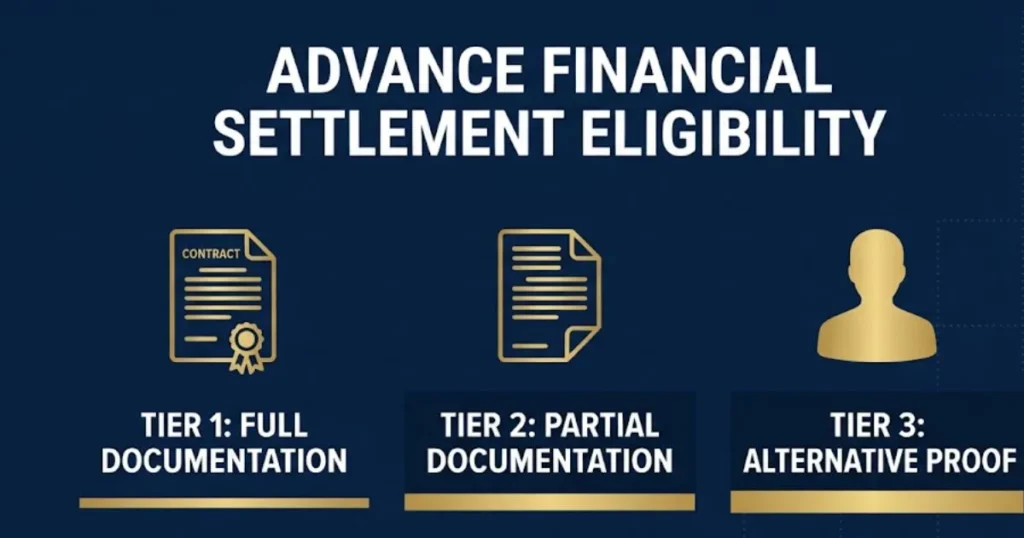
| Eligibility Tier | Description | Expected Strength |
|---|---|---|
| Tier 1 | Has loan documents, bank records, and proof of excessive fees | Strongest claim |
| Tier 2 | Has some records but missing original loan agreement | Moderate claim |
| Tier 3 | No records but can be verified through company databases | Baseline claim |
Even if you have zero paperwork, the company’s own records can verify your account. Don’t assume you’re out of the running just because you tossed the loan agreement.
Advance Financial 24/7 Settlement Overview
The Advance Financial 24/7 settlement has not been finalized as of early 2026, but settlement negotiations are expected to be a major development this year. Settlements in predatory lending class actions typically result in a fund that gets distributed among all eligible borrowers.
In cases like this, the settlement structure usually includes:
- A cash fund paid by the company and distributed to class members
- Loan forgiveness for borrowers who still carry outstanding balances
- Fee refunds for specific charges found to be unlawful
- Business practice changes requiring the company to modify its lending terms going forward
The settlement amount depends on several factors. How many borrowers are in the class, how much total harm occurred, and how strong the evidence is all play into the final number.
Based on similar predatory lending settlements in recent years, here’s what comparable cases have produced:
| Comparable Case | Settlement Amount | Class Size | Per-Person Average |
|---|---|---|---|
| Payday Lender A (2023) | $39 million | 80,000 borrowers | $487 |
| Online Lender B (2024) | $25 million | 150,000 borrowers | $167 |
| FLEX Lender C (2024) | $18 million | 45,000 borrowers | $400 |
These comparisons are not guarantees. They show the range of what courts have approved in similar situations.
A settlement benefits everyone because it avoids the risk and uncertainty of a trial. Both sides have reasons to negotiate.
Advance Financial 24/7 Settlement Amount Estimates
The estimated settlement amount for the Advance Financial 24/7 case could range from $15 million to $50 million based on the size of the class, the severity of the allegations, and precedent from similar cases. Individual payouts would depend on how much you borrowed and how much you overpaid.
Settlement math in class actions works by dividing the total fund among claimants after legal fees and administrative costs. Attorney fees in class actions typically take 25% to 33% of the fund.
Here’s a rough estimate of what borrowers might see:
| Scenario | Total Fund | After Legal Fees | Est. Class Size | Per-Person Payout |
|---|---|---|---|---|
| Conservative | $15 million | $10 million | 60,000 | $167 |
| Moderate | $30 million | $20 million | 60,000 | $333 |
| Optimistic | $50 million | $33 million | 60,000 | $550 |
Your individual amount could be higher or lower than these averages. Borrowers who took out larger loans and paid more in excessive fees would likely receive more.
Some settlements use a tiered payout system. Someone who paid $3,000 in excess interest would receive more than someone who paid $200. The formula usually ties back to the documented harm each borrower experienced.
Bold stat: In the 2023 Lending Club settlement, some individual claimants received over $1,200 based on their specific loan histories. High-value borrowers in the Advance Financial case could see similar or higher individual amounts.
Advance Financial 24/7 Lawsuit Payout Expectations
Payout expectations for the Advance Financial 24/7 lawsuit depend on whether the case settles or goes to trial, plus your individual loan history and the documentation you provide. Most class action participants receive their payments 6 to 18 months after a settlement is finalized.
Here’s what the payout process typically looks like:
- Settlement agreement reached between both parties
- Court approval of the settlement terms (preliminary, then final)
- Claims period opens for borrowers to submit their information
- Claims review by the settlement administrator
- Payout distribution via check or direct deposit
The timeline from settlement to check in your hand usually stretches longer than people expect. Courts require a fairness hearing, an objection period, and administrative processing before any money moves.
- Best case: Payments begin late 2026 if settlement finalizes in early to mid-2026
- Likely case: Payments arrive in mid to late 2027
- Worst case: If the case goes to trial, payouts could be delayed to 2028 or beyond
You have options for receiving payment. Most settlements offer:
- Paper check mailed to your address on file
- Direct deposit if you provide banking details during the claim
- Prepaid debit card in some settlement structures
Don’t forget: If you’ve moved since taking out the loan, update your address with the settlement administrator. Uncashed checks are the number one reason people miss their payouts.
Key Takeaway: Settlement estimates range from $15 million to $50 million total, individual payouts could fall between $167 and $550 or higher depending on your loan history, and most payments arrive 6 to 18 months after final settlement approval.
How to File an Advance Financial Lawsuit Claim
To file a claim in the Advance Financial lawsuit, you will need to submit a claim form through the official settlement website once the claims period opens. The form asks for basic personal information, loan details, and any supporting documentation you can provide.
Filing a claim is free. You should never pay anyone to file a class action claim on your behalf.
Here’s the step-by-step process:
Step 1: Gather Your Documents
- Original loan agreement (if available)
- Bank statements showing payments to Advance Financial
- Any correspondence from the company about your account
- Records of fees or charges you believe were excessive
Step 2: Watch for Official Notice
- Class members will receive notice by mail, email, or both
- The settlement website will publish the claim form and instructions
- Legal news outlets will report when the claims period opens
Step 3: Complete the Claim Form
- Fill in your name, address, and contact information
- Provide your Advance Financial account number if you have it
- Describe your loan and the harm you experienced
- Attach any supporting documents
Step 4: Submit Before the Deadline
- Claims deadlines are strict in class actions
- Late submissions are almost always rejected
- Submit early to avoid technical issues
| Filing Detail | Info |
|---|---|
| Cost to File | Free |
| How to Submit | Online form (settlement website) or mail |
| Documents Needed | Loan agreement, bank statements, account number |
| Deadline | To be announced (expected mid to late 2026) |
If you don’t have your account number, don’t panic. The settlement administrator can often verify your participation through the company’s own records.
Advance Financial CFPB Complaint Process
Filing a CFPB complaint against Advance Financial is a separate action from the class action lawsuit, and it creates an official record of your experience that can support both regulatory enforcement and your individual claim. The Consumer Financial Protection Bureau accepts complaints about all types of financial products and services.
The CFPB complaint process is simple and free. You can complete it online in about 15 minutes.
How to File a CFPB Complaint:
- Visit the CFPB complaint portal (search “CFPB submit a complaint”)
- Select “Payday loan, title loan, or personal loan” as the product category
- Describe the issue: excessive interest, hidden fees, collection harassment, or other concerns
- Include dates, amounts, and the company name (Advance Financial)
- Submit and save your complaint number
After you file, the CFPB forwards your complaint to Advance Financial. The company has 15 days to respond. The CFPB publishes complaints in its public database after the company responds or after 60 days, whichever comes first.
| CFPB Complaint Detail | Info |
|---|---|
| Cost | Free |
| Time to Complete | 10 to 15 minutes |
| Company Response Time | 15 days |
| Public Database | Yes, after response or 60 days |
| Impact | Creates official regulatory record |
Filing a CFPB complaint does two things. It puts your experience on the official record, and it adds pressure on the company through regulatory channels. The more complaints filed, the more likely federal regulators are to take direct action.
Advance Financial 24/7 Complaints From Borrowers
Borrower complaints against Advance Financial 24/7 paint a consistent picture of confusion, frustration, and financial harm. The most common complaints involve unexpected fee amounts, difficulty understanding payoff balances, and feeling trapped in a cycle of debt.
Real borrower complaints gathered from regulatory databases and public records include themes like:
- “I borrowed $400 and paid back over $1,100 but still owed $300.”
- “The fees were explained so fast I didn’t understand what I was signing.”
- “Every time I tried to pay off the loan, they told me I owed more than I expected.”
- “They called me multiple times a day when I was late on a payment.”
- “I made minimum payments for 8 months and my balance barely moved.”
These complaints are not isolated incidents. The CFPB database shows a pattern of similar experiences across dozens of borrowers in multiple states.
| Complaint Category | Frequency |
|---|---|
| Unexpected or excessive fees | Very Common |
| Difficulty getting payoff amount | Common |
| Aggressive collection calls | Common |
| Confusing loan terms at signing | Very Common |
| Balance not decreasing with payments | Very Common |
When hundreds of people independently describe the same problem, it stops being a misunderstanding and starts being a pattern. That pattern is the foundation of the legal case.
Borrowers who felt embarrassed or alone in their experience should know this: thousands of others went through the exact same thing.
Key Takeaway: Filing a claim is free and requires basic loan documents, a CFPB complaint creates an official regulatory record that strengthens the case, and borrower complaints consistently describe the same patterns of excessive fees and stagnant balances.
Advance Financial 24/7 Borrower Rights in 2026
Borrowers who took loans from Advance Financial 24/7 have specific legal rights in 2026, including the right to transparent lending terms, protection from excessive interest rates under state law, and the right to participate in class action litigation without retaliation.
Your rights as a borrower include:
- Right to clear disclosure: Federal law requires lenders to clearly state the APR, total cost of the loan, and all fees before you sign anything.
- Right to fair collection practices: The Fair Debt Collection Practices Act prohibits harassment, threats, and deceptive tactics during collection.
- Right to dispute charges: You can challenge any charge you believe is incorrect or was not properly disclosed.
- Right to file complaints: You can report concerns to the CFPB, your state attorney general, and state banking regulators without fear of retaliation.
- Right to join the class action: Participating in the lawsuit does not affect your credit score or create any legal obligation.
One right that many borrowers overlook: you can request a complete accounting of every payment you’ve made and how it was applied. The lender must provide this.
| Borrower Right | Legal Basis |
|---|---|
| APR Disclosure | Truth in Lending Act (TILA) |
| Fee Transparency | State consumer protection laws |
| Fair Collection | Fair Debt Collection Practices Act (FDCPA) |
| Complaint Filing | CFPB regulatory authority |
| Class Action Participation | Federal Rules of Civil Procedure |
If Advance Financial contacts you about an outstanding balance in 2026, you have the right to request written verification of the debt. You do not have to accept a phone caller’s word about what you owe.
Knowing your rights changes the power dynamic. You’re not a victim begging for mercy. You’re a consumer with legal protections.
Advance Financial Lawsuit Timeline for 2026
The Advance Financial lawsuit timeline for 2026 includes several critical milestones that borrowers should track. Court proceedings are expected to move through discovery completion, potential settlement talks, and either a settlement approval process or trial preparation.
Here’s the projected timeline based on current case status and typical class action progression:
| Timeline Phase | Expected Date | What Happens |
|---|---|---|
| Discovery Completion | Q1 2026 | Both sides finish exchanging documents and depositions |
| Class Certification Decision | Q1 to Q2 2026 | Court decides if the case can proceed as a class action |
| Settlement Negotiations | Q2 to Q3 2026 | Both parties attempt to reach an agreement |
| Preliminary Settlement Approval | Q3 2026 (if settlement reached) | Court gives initial approval to settlement terms |
| Notice to Class Members | Q3 to Q4 2026 | Borrowers receive notification of settlement and claim instructions |
| Claims Period | Q4 2026 to Q1 2027 | Window to submit your claim form |
| Final Approval Hearing | Q1 2027 | Court gives final approval after reviewing objections |
| Payout Distribution | Mid to Late 2027 | Checks or deposits sent to approved claimants |
If settlement talks fail, the case goes to trial. A trial would likely push any payout to 2028 at the earliest.
What you should do right now:
- Gather every document related to your Advance Financial account
- Save all emails, letters, and text messages from the company
- Monitor legal news for official settlement announcements
- Consider filing a CFPB complaint to strengthen the regulatory record
Class actions move slowly. Patience is part of the process. But staying informed and prepared puts you in the best position when the claims window opens.
The 2026 calendar is packed with potential turning points. This year could be the one where borrowers finally see accountability.
Frequently Asked Questions
How much money can I get from the Advance Financial 24/7 lawsuit?
Individual payouts are estimated between $150 and $550 for most claimants based on comparable settlements.
Your exact amount depends on your loan size, fees paid, and documentation provided.
Borrowers with larger loans and stronger proof of harm could receive significantly more.
Do I qualify for the Advance Financial 24/7 class action?
You likely qualify if you took out any loan product from Advance Financial 24/7 during the class period.
Both in-store and online borrowers from any state may be eligible.
You do not need to have defaulted on the loan to be part of the class.
What is the deadline to file a claim against Advance Financial?
The claims deadline has not been set yet because the settlement has not been finalized.
Based on the current timeline, the claims period is expected to open in late 2026 or early 2027.
Watch for official court notices sent by mail or email.
Is Advance Financial 24/7 still operating in 2026?
Advance Financial continues to operate as a licensed lender in Tennessee and online.
The lawsuit has not forced the company to shut down.
Borrowers can still take out loans, but the pending litigation may lead to changes in the company’s lending practices.
How do I file a CFPB complaint against Advance Financial?
Go to the CFPB’s complaint portal and select the loan product category.
Describe your specific issues with dates, amounts, and details.
The process takes about 15 minutes and is completely free.
The Advance Financial 24/7 lawsuit is heading toward critical decisions in 2026. If you borrowed from this company and felt the terms were unfair, now is the time to act.
Gather your loan documents and payment records. File a CFPB complaint to get your experience on the official record.
Stay alert for settlement announcements. When the claims window opens, be ready to submit your information quickly and completely. Your financial experience matters, and this case could deliver real accountability.







