

The acorn cop lawsuit update for 2026 centers on the ongoing federal civil case filed by Marquis Jackson against former Okaloosa County Deputy Jesse Hernandez. This case became one of the most talked-about police misconduct incidents in recent American history.
Why? Because an officer emptied his gun at a handcuffed man sitting inside a patrol car. The “threat” that triggered the shooting was nothing more than an acorn falling on the car’s roof.
Jackson survived the shooting physically. But the legal battle over his civil rights is still playing out in federal court. In this article, you will find every key detail about the case status, the criminal charges, settlement expectations, and what it all means heading into 2026.
One fact that still shocks people: body cam footage shows the deputy fired multiple rounds in under four seconds based on a sound alone.
Acorn Cop Lawsuit Update
The acorn cop lawsuit update as of early 2026 shows the federal civil rights case remains active in the U.S. District Court for the Northern District of Florida. The case has moved through discovery and into the phase where both sides are building their arguments for trial or settlement.
Jackson’s legal team has continued to press claims under 42 U.S.C. Section 1983 for violations of his constitutional rights. The defense has explored qualified immunity arguments, though the strength of those arguments has been questioned given the body cam evidence.
Settlement discussions have reportedly taken place, but no final agreement has been publicly confirmed as of this writing. Cases like this often settle before trial because the video evidence makes a jury verdict unpredictable for the defense.
| Case Detail | Current Status |
|---|---|
| Case Type | Federal civil rights lawsuit |
| Court | U.S. District Court, Northern District of Florida |
| Primary Claim | 42 U.S.C. Section 1983 |
| Case Phase | Post-discovery, pre-trial |
| Settlement Status | Negotiations reported, no public confirmation |
The judge overseeing the case has kept a standard federal timeline. That means motion practice, depositions, and expert witness disclosures have all been part of the process through 2025 and into 2026.
Acorn Cop Lawsuit
The acorn cop lawsuit is a federal civil rights case filed by Marquis Jackson against Jesse Hernandez, Sergeant Beth Roberts, and the Okaloosa County Sheriff’s Office. It stems from a November 2022 incident in Crestview, Florida.
Jackson was handcuffed in the back of a patrol car when Hernandez opened fire on the vehicle. The deputy believed he was under attack. In reality, an acorn had fallen from a tree and struck the roof of the car.

The lawsuit alleges that Hernandez used deadly force without any reasonable justification. It also claims that Roberts fired her weapon at the vehicle as well, following Hernandez’s lead without independently assessing whether a real threat existed.
This is not a minor complaint about procedure. The lawsuit accuses the officers of violating Jackson’s Fourth Amendment right to be free from unreasonable force. A man in handcuffs inside a locked patrol car posed zero threat to anyone.
- Jackson was fully restrained during the entire incident
- No weapon was found on Jackson or in the vehicle
- The only “sound” was an acorn hitting the patrol car roof
- Multiple rounds were fired at or near a defenseless person
Think of it this way: imagine being strapped into a seat with your hands behind your back while someone starts shooting at you. That is what Jackson experienced.
Acorn Cop Case 2026
The acorn cop case in 2026 is expected to reach a resolution, either through a negotiated settlement or a trial date being set. Federal civil rights cases of this profile typically take two to three years to resolve, and this one is squarely within that window.
Several factors will shape what happens next. The strength of the body cam evidence favors Jackson’s claims significantly. Qualified immunity, which often shields officers from personal liability, is harder to argue when video shows the force was objectively unreasonable.
The Okaloosa County Sheriff’s Office also faces potential municipal liability. If Jackson’s attorneys can show that inadequate training or a pattern of excessive force contributed to the incident, the county could be on the hook for damages too.
| 2026 Case Milestones | Expected Timeline |
|---|---|
| Final discovery deadline | Early 2026 |
| Summary judgment motions | Mid 2026 |
| Settlement conference | Mid to late 2026 |
| Trial date (if no settlement) | Late 2026 or early 2027 |
Courts in the Northern District of Florida have been managing heavy dockets. That said, high-profile cases with clear video evidence tend to move faster because both sides have strong incentives to resolve them.
Key Takeaway: The acorn cop case is on track for a resolution in 2026, with settlement talks likely intensifying as a potential trial date approaches.
Acorn Cop Settlement Amount
The acorn cop settlement amount has not been publicly confirmed as of 2026, but legal experts estimate the case could settle in the range of $500,000 to $2 million or more based on comparable police excessive force cases.
Several factors drive that estimate. Jackson was handcuffed and completely defenseless. Multiple rounds were fired at or near him. Body cam footage captured the entire incident in undeniable detail. And the “threat” was literally an acorn.
Comparable cases offer some useful reference points. Police shooting settlements involving unarmed or restrained individuals have ranged widely depending on jurisdiction and injury severity.
| Comparable Case Type | Typical Settlement Range |
|---|---|
| Excessive force, minor physical injuries | $100,000 to $500,000 |
| Excessive force, significant trauma | $500,000 to $2 million |
| Wrongful death by police | $1 million to $10 million+ |
| Civil rights violation with video evidence | Higher end of range |
Jackson did not suffer gunshot wounds, which affects the damages calculation. But physical injury is only one category of harm. Emotional distress, psychological trauma, and the violation of constitutional rights all carry their own value in federal court.
The fact that video evidence went viral and became international news could also increase the settlement. Municipalities often pay more to resolve cases that generate ongoing negative publicity.
Acorn Cop What Happened
Here is what happened in the acorn cop case. On November 12, 2022, Deputy Jesse Hernandez responded to a call involving Marquis Jackson in Crestview, Florida. Jackson was suspected of a minor offense and was detained without significant resistance.
Officers placed Jackson in handcuffs and put him in the back seat of Hernandez’s patrol car. While Hernandez stood outside the vehicle, an acorn fell from an overhead oak tree and struck the roof of the car.
Hernandez immediately reacted as if he was being shot at. He yelled “shots fired” and dove away from the vehicle. Then he drew his weapon and fired multiple rounds into or toward his own patrol car with Jackson still handcuffed inside.
Sergeant Beth Roberts, who was nearby, also drew her weapon and fired in the direction of the vehicle. Neither officer took the time to assess the situation before pulling the trigger.
- The entire shooting lasted approximately four seconds
- Hernandez fired multiple rounds from his service weapon
- Roberts also discharged her firearm
- Jackson was restrained in handcuffs the entire time
- No actual threat existed at any point
After the shooting stopped, officers approached the vehicle and found Jackson unharmed by bullets but visibly terrified. He had done nothing wrong during the encounter. The “attack” was the sound of a single acorn.
Body cam footage from both officers was later released, and it showed the entire sequence of events. The video went viral worldwide.
Marquis Jackson Acorn Lawsuit
Marquis Jackson filed his acorn lawsuit in federal court, naming Jesse Hernandez, Beth Roberts, and the Okaloosa County Sheriff’s Office as defendants. His claims rest on violations of the Fourth Amendment and 42 U.S.C. Section 1983.
Jackson’s legal team argues that no reasonable officer would have believed deadly force was justified in this situation. A man in handcuffs inside a locked vehicle is not a threat. A sound from above is not gunfire.
The lawsuit seeks compensatory damages for emotional distress, psychological harm, and the violation of Jackson’s civil rights. It also seeks punitive damages to punish the officers for their reckless conduct.
Jackson has spoken publicly about the lasting impact of the incident. Being shot at while completely helpless left deep psychological scars. He has described ongoing anxiety, fear of law enforcement, and difficulty trusting authority figures.
| Lawsuit Details | Information |
|---|---|
| Plaintiff | Marquis Jackson |
| Defendants | Jesse Hernandez, Beth Roberts, Okaloosa County Sheriff’s Office |
| Court | U.S. District Court, Northern District of Florida |
| Legal Basis | 42 U.S.C. Section 1983, Fourth Amendment |
| Damages Sought | Compensatory and punitive |
His case has become one of the most cited examples of why police use-of-force standards need reform. The video evidence leaves almost no room for the defense to argue the shooting was reasonable.
Key Takeaway: Marquis Jackson’s federal lawsuit targets the officers and the sheriff’s office, seeking both compensation for his trauma and accountability for the reckless use of force.
Jesse Hernandez Acorn Deputy
Jesse Hernandez is the former Okaloosa County deputy at the center of the acorn cop case. He was a relatively new officer at the time of the November 2022 incident, which raised immediate questions about his training and readiness.
Hernandez’s reaction to the falling acorn was captured in full on his body camera. The footage shows him responding to a harmless sound as though he were in a combat zone. He yelled “shots fired,” took cover, and then opened fire on his own patrol car.
What made the footage even more remarkable was what Hernandez said during and after the shooting. He repeatedly stated that he was being fired upon, even though no evidence of gunfire existed. No bullet casings were found. No weapon was recovered. No witness heard gunshots besides the ones Hernandez and Roberts fired.
After the incident, the Okaloosa County Sheriff’s Office launched an internal investigation. Hernandez was placed on administrative leave and then terminated from the department.
- Hernandez was a newer officer at the time
- His body cam captured every second of the incident
- He claimed to be under fire despite zero evidence
- He was terminated from the sheriff’s office
- He faces both criminal charges and the civil lawsuit
Some have speculated about whether Hernandez suffered from heightened anxiety or stress that day. Regardless of the cause, his reaction to a falling acorn put an innocent, handcuffed man’s life at risk.
Okaloosa County Deputy Acorn Shooting
The Okaloosa County deputy acorn shooting became a national story because of its sheer absurdity and the terrifying implications for the handcuffed man inside the car. The incident took place on a residential street in Crestview, Florida.
Okaloosa County is in the Florida Panhandle. The sheriff’s office serves a mid-sized community and is led by Sheriff Eric Aden. After body cam footage went public, Aden held a press conference where he addressed the incident and announced disciplinary action.
The department’s response was relatively swift compared to many police misconduct cases. Hernandez was fired. Roberts was also investigated. The Florida Department of Law Enforcement (FDLE) conducted a separate probe into the shooting.
| Agency Response | Action Taken |
|---|---|
| Okaloosa County Sheriff’s Office | Terminated Hernandez, investigated Roberts |
| Sheriff Eric Aden | Public statement, acknowledged the incident |
| FDLE | Conducted independent investigation |
| State Attorney’s Office | Filed criminal charges against Hernandez |
The department has faced criticism about its hiring and training practices. If a new officer reacts to a falling acorn as though it is a gunfight, something went wrong long before that day. Training should prepare officers to assess threats before using deadly force.
This case is now studied in police academies as an example of catastrophic threat assessment failure.
Acorn Cop Body Cam Footage Details
The acorn cop body cam footage is the single most important piece of evidence in both the criminal and civil cases. It captured every critical moment of the incident from multiple angles, since both Hernandez and Roberts wore cameras.
The footage begins with a routine encounter. Jackson is detained and placed in the back of the patrol car. Everything seems calm. Then there is a faint popping or tapping sound as the acorn strikes the car.
Within a split second, Hernandez’s entire demeanor changes. He shouts “shots fired” and scrambles away from the vehicle. He draws his weapon and begins shooting toward or into the patrol car where Jackson sits handcuffed and unable to move.
The footage also captures Roberts reacting to Hernandez’s shouts. She draws her weapon and fires without independently verifying the supposed threat. This is a phenomenon known in law enforcement as “contagious shooting,” where one officer’s actions trigger others to fire.
- The sound of the acorn is barely audible on the recording
- Hernandez’s “shots fired” shout is clearly captured
- Multiple gunshots from both officers are visible and audible
- Jackson can be seen ducking and cowering in the back seat
- After the shooting, officers approach the car cautiously
- Jackson is found alive and uninjured by gunfire
The footage was viewed millions of times online. It became one of the most shared police body cam videos in history. News outlets worldwide ran the clip, and it sparked intense debate about police training, threat assessment, and use-of-force standards.
Key Takeaway: Body cam footage from both officers provides undeniable evidence that no real threat existed, making this one of the most clear-cut excessive force cases in recent memory.
Acorn Cop Criminal Charges
Criminal charges were filed against Jesse Hernandez by the State Attorney’s Office following the FDLE investigation. Hernandez was charged with aggravated assault with a deadly weapon, a serious felony under Florida law.
Aggravated assault with a deadly weapon in Florida carries a potential sentence of up to five years in prison. The charge reflects the fact that Hernandez pointed and fired a loaded weapon at a person who posed no threat.
The criminal case is separate from the civil lawsuit. In the criminal case, the State must prove beyond a reasonable doubt that Hernandez committed the assault. In the civil case, Jackson only needs to prove his claims by a preponderance of the evidence, which is a much lower bar.
| Criminal Case Facts | Details |
|---|---|
| Defendant | Jesse Hernandez |
| Charge | Aggravated assault with a deadly weapon |
| Maximum Penalty | Up to 5 years in prison |
| Investigating Agency | FDLE |
| Prosecuting Authority | State Attorney’s Office, 1st Judicial Circuit |
The criminal case has moved slowly, as is common in officer-involved shooting prosecutions. Officers charged with crimes committed on duty receive significant procedural protections. Defense attorneys in these cases often argue the officer acted in good faith or under a genuine belief of danger.
With body cam footage this clear, however, arguing good faith becomes extremely difficult. The jury will see what everyone else has seen: a man shooting at an acorn.
Did Acorn Cop Go to Jail
Jesse Hernandez, the acorn cop, did not go to jail immediately after the incident. He was placed on administrative leave following standard department protocol. Criminal charges came later, after the FDLE completed its investigation.
When charges were filed, Hernandez was arrested and processed through the court system. However, like most defendants charged with non-capital felonies, he was released on bond while awaiting trial. He has not been incarcerated on a long-term basis as of early 2026.
The criminal trial is the event that could change that. If convicted of aggravated assault with a deadly weapon, Hernandez faces potential prison time. Florida’s sentencing guidelines for this charge allow for up to five years behind bars.
- Hernandez was not jailed at the scene
- He was placed on administrative leave first
- Charges were filed after the FDLE investigation
- He was arrested but released on bond
- The criminal trial will determine if he serves time
Many people who watched the body cam footage were frustrated that Hernandez was not immediately arrested. But the legal process for charging law enforcement officers is typically slower and more deliberate than for civilians. Grand jury proceedings and special investigations add time.
Whether Hernandez actually goes to prison will depend on the jury’s verdict. The body cam evidence is powerful, but juries in officer-involved cases can be unpredictable.
Acorn Cop Fired
Jesse Hernandez was fired from the Okaloosa County Sheriff’s Office after the internal investigation concluded that his actions were unjustified. The termination happened relatively quickly compared to many police misconduct cases.
Sheriff Eric Aden announced the firing in a public statement. He made clear that the department reviewed the body cam footage and found no justification for the use of deadly force. The acorn striking the patrol car did not constitute a reasonable basis for believing that shots were being fired.
Sergeant Beth Roberts was also investigated. Her status and any disciplinary action received less public attention than Hernandez’s termination. Reports indicate she was also subjected to internal review for discharging her weapon without independently verifying the threat.
| Disciplinary Actions | Outcome |
|---|---|
| Jesse Hernandez | Terminated |
| Sergeant Beth Roberts | Under internal review |
| Okaloosa County Sheriff’s Office | Revised training protocols (reported) |
Being fired from one department does not always prevent an officer from working in law enforcement elsewhere. This phenomenon, known as “gypsy cops” or “wandering officers,” is a well-documented problem in American policing. Whether Hernandez has sought employment at another agency is not publicly known.
The firing was necessary, but it was only one piece of accountability. The criminal charges and civil lawsuit carry far greater consequences.
Key Takeaway: Hernandez was fired and criminally charged, but the civil lawsuit and criminal trial are the proceedings that will determine the full scope of accountability for this incident.
Acorn Cop Federal Lawsuit Claims
The acorn cop federal lawsuit includes several distinct legal claims, all rooted in the U.S. Constitution and federal civil rights law. The primary claim falls under 42 U.S.C. Section 1983, which allows individuals to sue government officials who violate their constitutional rights.
Here are the main claims in the lawsuit:
- Fourth Amendment excessive force: Hernandez used deadly force against a restrained, unarmed person without any reasonable basis. The Fourth Amendment prohibits unreasonable seizures, and shooting at a handcuffed person qualifies.
- Failure to intervene: Roberts had a duty to stop Hernandez from using excessive force if she recognized it was unjustified. Instead, she joined in and fired her own weapon.
- Municipal liability (Monell claim): Jackson’s attorneys argue the Okaloosa County Sheriff’s Office is liable because its training, supervision, or policies were inadequate and led to the incident.
- State law claims: The lawsuit likely includes Florida state tort claims for assault, battery, and intentional infliction of emotional distress.
The Section 1983 claim is the backbone of the case. To win, Jackson must show that Hernandez acted under color of state law (he was on duty as a deputy) and that he violated Jackson’s clearly established constitutional rights.
Given the body cam evidence, the “clearly established” element is strong. No reasonable officer could believe that shooting at a handcuffed man because of an acorn sound was constitutionally permissible.
Acorn Shooting Lawsuit Damages
The acorn shooting lawsuit damages could be substantial based on the facts of this case. Damages in federal civil rights cases fall into several categories, and Jackson’s legal team is pursuing multiple types.
Compensatory damages cover actual losses. These include:
- Medical expenses (including mental health treatment)
- Lost wages and future earning capacity
- Pain and suffering
- Emotional distress and psychological trauma
- Loss of enjoyment of life
Punitive damages are designed to punish especially reckless or malicious conduct. Given that Hernandez shot at a handcuffed man over an acorn, punitive damages are very much in play.
| Damage Category | Description |
|---|---|
| Medical costs | Therapy, counseling, any physical treatment |
| Emotional distress | Ongoing anxiety, PTSD symptoms, fear |
| Pain and suffering | Physical and emotional harm during incident |
| Punitive damages | Punishment for reckless conduct |
| Attorney fees | Recoverable under Section 1983 if plaintiff wins |
One important detail: under Section 1983, if Jackson wins, the defendants may also be required to pay his attorney fees. This provision exists to encourage lawyers to take civil rights cases.
Even though Jackson was not physically struck by a bullet, the emotional and psychological harm of being shot at while completely helpless can carry enormous value. Courts have awarded six and seven-figure verdicts in cases where the physical injury was minimal but the rights violation and emotional harm were severe.
Police Excessive Force Acorn Case
The police excessive force acorn case has become a landmark example in discussions about use-of-force standards in American law enforcement. It illustrates how a total failure in threat assessment can lead to deadly consequences.
The legal standard for excessive force comes from the Supreme Court case Graham v. Connor (1989). Under Graham, courts evaluate whether the force used was “objectively reasonable” based on the totality of the circumstances. The analysis considers:
- The severity of the crime at issue
- Whether the suspect posed an immediate threat
- Whether the suspect was actively resisting or fleeing
In the acorn case, every single Graham factor weighs heavily in Jackson’s favor. He was suspected of a minor offense. He was handcuffed and unable to move. He was not resisting in any way. And the “threat” was a natural object falling from a tree.
This case is now referenced in police training materials and academic papers about reactive shooting. The concept of “contagious shooting,” where one officer’s panic spreads to others, is perfectly demonstrated by Roberts firing her weapon after Hernandez without checking for an actual threat.
Civil liberties organizations have cited this case in advocacy for stronger use-of-force policies. The argument is simple: if current training allows an officer to shoot at an acorn, the training needs to change.
Key Takeaway: The acorn excessive force case has become a reference point for police reform discussions because it demonstrates how failed threat assessment and contagious shooting can endanger innocent people.
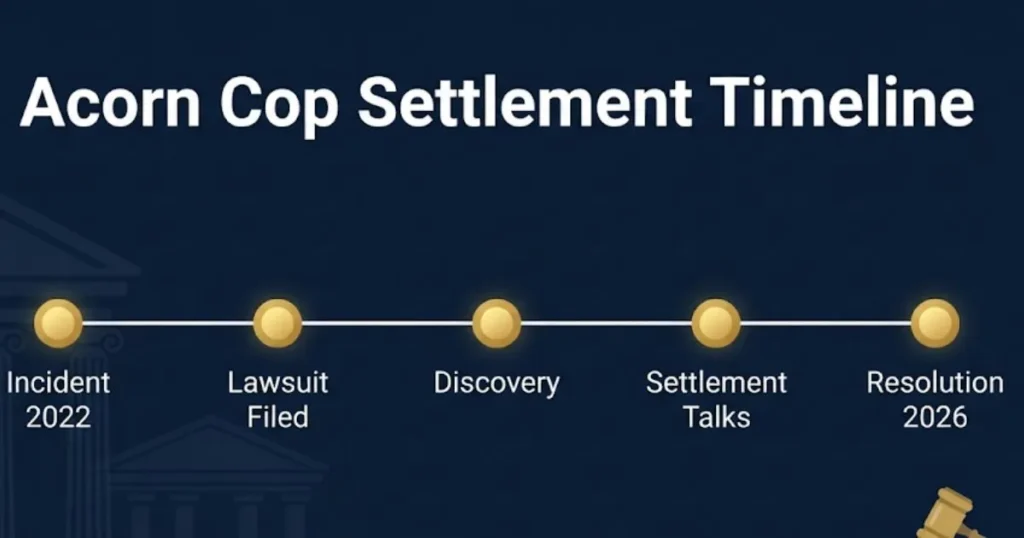
Acorn Cop Settlement Timeline
The acorn cop settlement timeline depends on whether the parties reach a negotiated agreement or the case goes to trial. Based on the typical pace of federal civil rights litigation, here is a projected timeline.
| Phase | Estimated Date |
|---|---|
| Lawsuit filed | 2023 |
| Discovery period | 2023 to 2025 |
| Expert witness disclosures | 2025 |
| Settlement negotiations | Late 2025 to mid 2026 |
| Summary judgment motions | Mid 2026 |
| Trial (if no settlement) | Late 2026 to early 2027 |
| Settlement payout (if agreed) | 3 to 6 months after agreement |
Most federal civil rights cases settle before trial. The percentage is somewhere around 90 to 95 percent according to federal court data. Municipalities prefer to settle rather than risk a larger jury verdict and the bad publicity of a trial.
If a settlement is reached in mid 2026, Jackson could receive payment by late 2026 or early 2027. Settlement agreements in these cases typically include confidentiality clauses, so the exact dollar amount may never become public.
If the case goes to trial, the timeline extends significantly. Trials involve jury selection, witness testimony, and deliberation. A verdict could come in late 2026 or early 2027, but post-trial motions and potential appeals could push final resolution into 2027 or even 2028.
The strongest factor pushing toward settlement is the body cam footage. When the evidence is this clear, defendants rarely want to put it in front of a jury.
Marquis Jackson Settlement
Marquis Jackson’s settlement, if finalized, would represent one of the most closely watched police misconduct payouts in recent years. The case has all the elements that drive high-value settlements: clear video evidence, a completely defenseless victim, and nationwide public attention.
Jackson’s attorneys are likely pushing for a seven-figure settlement. The combination of emotional distress, violation of constitutional rights, and the sheer recklessness of the officers’ conduct supports that range.
Here is how Jackson’s potential settlement compares to similar cases:
| Case Type | Settlement Range |
|---|---|
| Excessive force, restrained victim, no physical injury | $250,000 to $1 million |
| Excessive force with video evidence and public attention | $500,000 to $3 million |
| Wrongful death by police | $1 million to $20 million+ |
| Acorn cop case (estimated) | $500,000 to $2 million+ |
Part of the settlement discussion may include non-monetary terms. Jackson’s legal team could push for policy changes at the Okaloosa County Sheriff’s Office, mandatory retraining programs, or public acknowledgment of wrongdoing.
Jackson’s story has resonated with people across the country because it captures a nightmare scenario. A person cooperating with law enforcement, fully restrained, nearly killed because of a sound from a tree. His settlement will send a message about accountability, regardless of the exact dollar amount.
The case also raises questions about what happens next for Jackson personally. Receiving a settlement check does not erase the trauma. Many plaintiffs in police misconduct cases report that the psychological effects last far longer than any legal proceeding.
Key Takeaway: Marquis Jackson’s settlement is projected to be significant, potentially reaching seven figures, and may include policy reform demands alongside financial compensation.
Frequently Asked Questions
What is the latest acorn cop lawsuit update in 2026?
The federal civil rights lawsuit is in the pre-trial phase as of early 2026.
Settlement negotiations are reportedly underway, but no final agreement has been confirmed.
A trial date could be set for late 2026 if the parties do not reach a deal.
How much is the acorn cop settlement amount?
No official settlement amount has been announced yet.
Legal experts estimate the case could settle between $500,000 and $2 million based on similar excessive force cases.
The body cam evidence and nationwide attention could push the value higher.
Did the acorn cop go to jail for shooting at Marquis Jackson?
Jesse Hernandez was arrested and charged with aggravated assault with a deadly weapon.
He was released on bond and has not been incarcerated long-term as of early 2026.
A conviction at trial could result in up to five years in prison.
What federal claims were filed in the acorn cop lawsuit?
The primary claim is a Section 1983 civil rights violation under the Fourth Amendment.
The lawsuit also includes failure-to-intervene claims against Sergeant Beth Roberts.
Municipal liability claims target the Okaloosa County Sheriff’s Office for inadequate training.
When will the acorn cop settlement be finalized?
If settlement talks succeed, a deal could be reached by mid to late 2026.
Payment would follow approximately three to six months after an agreement.
If the case goes to trial, resolution could extend into 2027 or later.
The acorn cop case stands as one of the most striking examples of police excessive force in modern history. A falling acorn. A handcuffed man. Bullets flying. And now, a legal reckoning that could bring both financial accountability and policy change.
If you have been following this case, keep watching for settlement announcements and trial date updates through 2026. The outcome will set a precedent for how similar cases are handled across the country.
Stay informed. Know your rights. And pay attention to cases like this one, because they shape the standards that protect everyone.







