Latest update (November 18, 2026): The GM L87 engine lawsuit is a consolidated class action in the U.S. District Court for the Eastern District of Michigan before Judge Shalina D. Kumar, including Powell et al. v. General Motors, LLC (No. 4:25-cv-10479). GM has asked the court to dismiss it, arguing its April 2025 recall and 10-year, 150,000-mile engine warranty already address the problem. No ruling or settlement has been reported.
What’s next: Watch for Judge Kumar’s ruling on GM’s motion to dismiss and for NHTSA’s review of whether the recall covers all affected vehicles. There is no claim form to file yet. We’ll update this page if new details emerge.
Last updated: November 2026
Background as of August 17, 2026: the consolidated GM L87 engine class action — Powell et al. v. General Motors, LLC, pending in the U.S. District Court for the Eastern District of Michigan — remains in a holding pattern while the court weighs GM’s motion to dismiss. GM filed that motion on June 8, 2026, arguing its 2025 recall and extended warranty program already remedy the alleged engine problems, and that the defects were caused by limited supplier manufacturing issues rather than a uniform design flaw affecting all L87 engines. As of this writing, Judge Shalina D. Kumar has not yet ruled on the motion. No settlement has been reached, and there is still no formal claims process for owners to join.
Related: WP Engine Lawsuit 2026: Full Case Update and Status
In short: the GM L87 engine lawsuit is a consolidated federal class action over failures of the 6.2L V8 in 2019 to 2024 GM trucks and SUVs. GM recalled about 600,000 vehicles in April 2025 and extended the engine warranty, but there is no settlement and no claim form yet.
The GM L87 engine lawsuit is a consolidated class action over engine failures, and no settlement or payout has been announced. If you own a Chevrolet Silverado, GMC Sierra, Tahoe, Yukon, or Cadillac Escalade with the 6.2L V8 engine, this case matters to you.
GM faces accusations that it sold vehicles with a defective L87 engine design. The complaint says insufficient lubrication between the bearings and crankshaft can cause sudden engine failure. GM says the failures trace to supplier manufacturing problems and affected about 3% of engines.
This guide breaks down everything happening with this lawsuit in 2026. You will learn who is covered, what GM’s recall and warranty offer, and what to do while the case is pending.
GM L87 Engine Lawsuit
The GM L87 engine lawsuit is a class action case alleging General Motors sold vehicles with defective 6.2L V8 engines while hiding known problems from buyers. Multiple lawsuits filed across the country have been consolidated into coordinated litigation against the automaker.
Plaintiffs say the L87’s design lets the engine run short of lubrication between the bearings and crankshaft, and that GM kept selling these engines as premium powerplants. Owners paid extra for the 6.2L upgrade, only to face the risk of engine failure.
The core legal argument is straightforward. GM allegedly violated consumer protection laws in multiple states by concealing material defects. Buyers say they never would have purchased these vehicles, or paid premium prices, if GM disclosed the problems upfront.
| Case Detail | Information |
|---|---|
| Case Type | Class Action Lawsuit |
| Defendant | General Motors LLC |
| Engine at Issue | 6.2L V8 L87 |
| Primary Defect | Alleged bearing and crankshaft lubrication failure |
| Affected Years | 2019 to 2024 |
| Current Status | Consolidated; GM motion to dismiss pending |
GM recalled about 600,000 trucks and SUVs in April 2025 and extended the engine warranty on recalled vehicles. Plaintiffs say that fix does not go far enough, and NHTSA has been reviewing whether the recall covers every affected vehicle.
The plaintiffs seek refunds for repair costs, diminished vehicle value, and other damages, plus changes to how GM handles affected engines. No court has awarded or approved any payment.
GM 6.2L L87 Engine Lawsuit
The GM 6.2L L87 engine lawsuit specifically targets the L87 variant used in GM’s full-size trucks and SUVs from model years 2019 through 2024. This engine replaced the older L86 and introduced Dynamic Fuel Management technology, which is part of the engine’s design, though the complaint centers on lubrication of the bearings and crankshaft.
Dynamic Fuel Management allows the engine to run on anywhere from one to eight cylinders. The system constantly activates and deactivates cylinders to improve fuel economy. Plaintiffs argue this constant cycling causes premature wear on lifters and related components.
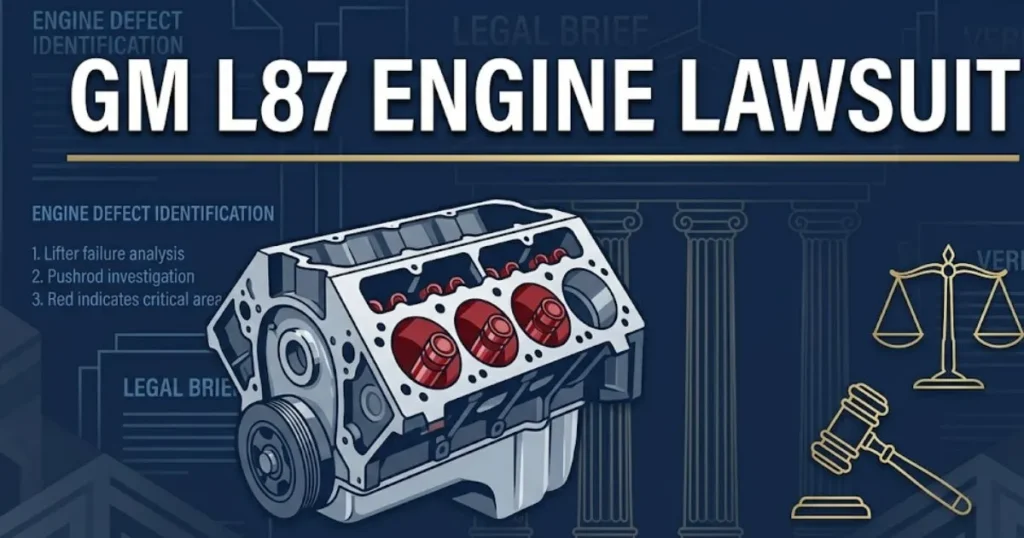
The 6.2L engine was marketed as GM’s top-tier powertrain option. Customers paid premium prices expecting premium reliability. Instead, many experienced catastrophic failures before reaching 50,000 miles.
| Engine Comparison | L86 (Previous) | L87 (Lawsuit Target) |
|---|---|---|
| Displacement | 6.2L V8 | 6.2L V8 |
| Fuel Management | AFM (4 or 8 cylinders) | DFM (1 to 8 cylinders) |
| Model Years | 2014 to 2019 | 2019 to 2024 |
| Lawsuit Status | Limited claims | Primary target |
Court documents reveal hundreds of complaints filed with NHTSA about the L87 engine. These federal safety reports describe stalling, loss of power, and engine failure while driving. Some owners reported near-miss accidents when engines quit on highways.
The lawsuit consolidates claims from owners across all 50 states. Legal teams are pursuing certification as a nationwide class, which would allow all affected owners to participate in any settlement.
GM Class Action Lawsuit Engine
The GM class action lawsuit engine litigation represents one of several powertrain-related cases GM currently faces. This particular case focuses on the 6.2L L87 but connects to broader allegations about GM’s fuel management technologies across multiple engine families.
Class action status means individual owners do not need to sue GM separately. Instead, lead plaintiffs represent all similarly affected owners. Any settlement or verdict applies to the entire class automatically.
GM has faced engine-related class actions before. The company settled previous cases involving the 5.3L V8 with Active Fuel Management for hundreds of millions of dollars. Legal experts expect similar outcomes with the L87 litigation.
Quick Facts:
- Multiple lawsuits have been filed in federal courts
- Cases are being coordinated for efficiency
- Lead plaintiffs represent thousands of owners
- GM has not yet agreed to settlement terms
The class action approach benefits owners who cannot afford individual litigation. Attorney fees come from any recovery, not from owners’ pockets. This levels the playing field against a corporation with unlimited legal resources.
Certification hearings will determine the exact scope of the class. Judges must confirm that all class members share common legal questions and that a class action is the best way to resolve them.
Key Takeaway: The GM L87 engine lawsuit is a consolidated class action targeting the 6.2L V8’s Dynamic Fuel Management system, which allegedly causes premature lifter failure in vehicles from 2019 to 2024.
GM L87 Engine Problems
GM L87 engine problems center on premature lifter failure, but owners report a range of related issues affecting drivability and safety. Understanding these problems helps owners recognize whether their vehicle might qualify for the lawsuit.
The most common complaint involves collapsed lifters. When lifters fail, they cannot properly open and close engine valves. This causes misfires, rough running, and eventually complete engine failure if not addressed.
Oil consumption is another widespread issue. Many L87 owners report using a quart of oil every 1,000 miles or less. GM considers this “normal,” but excessive oil consumption often precedes lifter failure.
| Problem | Symptoms | Typical Mileage |
|---|---|---|
| Lifter Collapse | Ticking noise, misfires | 30,000 to 70,000 |
| Oil Consumption | Low oil warnings | 20,000 to 50,000 |
| Camshaft Damage | Rough idle, reduced power | 40,000 to 80,000 |
| Pushrod Failure | Engine knocking | 35,000 to 75,000 |
Engine tick or knock is often the first warning sign. Owners describe a distinct tapping sound from the engine bay that gets louder over time. This noise indicates lifters are not functioning correctly.
Check engine lights with misfire codes are common. Codes P0300 through P0308 indicate misfires in specific cylinders. Dealers often replace spark plugs or ignition coils first, delaying proper diagnosis.
The repair cost shocks most owners. Replacing lifters requires significant engine disassembly. Labor alone can exceed $3,000, with parts adding another $2,000 or more depending on damage extent.
GM 6.2 Lifter Failure Lawsuit
The GM 6.2 lifter failure lawsuit specifically alleges that Active Fuel Management and Dynamic Fuel Management technologies cause premature lifter wear. Plaintiffs claim GM prioritized fuel economy numbers over engine longevity.
Lifters in the L87 engine activate and deactivate constantly during normal driving. Think of it like repeatedly clicking a pen thousands of times per minute. Eventually, the mechanism wears out. Plaintiffs say GM’s design accelerated this wear dramatically.
Evidence shows GM received thousands of warranty claims for lifter failures. Internal documents allegedly reveal engineers raised concerns about DFM reliability before the L87 launched. GM proceeded anyway, according to court filings.
The lawsuit points to a pattern of behavior. GM faced similar allegations with the previous AFM system in 5.3L engines. Rather than fixing the underlying design flaw, plaintiffs say GM simply rebranded the technology and continued selling problematic engines.
Typical Lifter Failure Timeline:
- 20,000 to 30,000 miles: Early warning signs begin
- 30,000 to 50,000 miles: Most failures occur
- 50,000 to 80,000 miles: Late failures, often beyond warranty
Repair costs for lifter replacement range from $4,000 to $8,000 at dealerships. Some owners report paying over $10,000 when camshaft damage accompanies lifter failure. These costs often exceed the value of older vehicles.
GM L87 Engine Defect Symptoms
GM L87 engine defect symptoms typically start subtly and worsen over time. Recognizing these warning signs early can help owners document problems before complete failure occurs. Documentation strengthens any eventual claim.
The engine tick is usually the first symptom. It sounds like a sewing machine running under the hood. This ticking often appears after the engine warms up and becomes more pronounced with mileage.
Rough idle comes next for many owners. The engine may shake at stoplights or feel like it wants to stall. This happens because damaged lifters cannot maintain proper valve timing.
| Symptom | Description | Severity |
|---|---|---|
| Engine Tick | Tapping noise at idle | Early Warning |
| Rough Idle | Vibration at stops | Moderate |
| Misfire Codes | Check engine light | Serious |
| Power Loss | Reduced acceleration | Severe |
| Stalling | Engine shuts off | Critical |
Reduced power warnings appear on dashboards when the problem advances. GM’s computer system detects misfires and limits engine output to prevent damage. This can leave drivers stranded or unable to merge safely on highways.
Excessive oil consumption often accompanies other symptoms. Owners should track oil levels between changes. Using more than one quart per 2,000 miles suggests internal problems that may connect to the lawsuit allegations.
Some owners report a burnt oil smell from the exhaust. This indicates oil is entering the combustion chamber, often through worn valve seals or piston rings affected by the overall engine problems.
Key Takeaway: Lifter failure symptoms include engine ticking, rough idle, misfire codes, and excessive oil consumption, with most failures occurring between 30,000 and 50,000 miles.
GM Engine Class Action Eligibility
GM engine class action eligibility depends on several factors including vehicle model, engine type, model year, and whether you experienced qualifying problems. Not everyone with a GM vehicle automatically qualifies for compensation.
The primary requirement is owning or leasing a GM vehicle equipped with the 6.2L L87 engine from model years 2019 through 2024. You must have either paid for repairs related to the alleged defect or still own a vehicle with the defect present.
Purchase or lease timing matters for certain claims. Some legal theories require you to have bought or leased the vehicle new. Others include used car buyers who inherited the defect from previous owners.
| Eligibility Factor | Requirement |
|---|---|
| Engine Type | 6.2L L87 V8 |
| Model Years | 2019 to 2024 |
| Repair Costs | Any out of pocket expenses |
| Current Ownership | Not required but helpful |
| Documentation | Repair receipts preferred |
Repair documentation strengthens your claim significantly. Invoices showing lifter replacement, engine repair, or related diagnostics prove you suffered financial harm. Warranty repair records also count as evidence of the defect.
Owners who still have the vehicle but have not experienced problems yet may still qualify. The lawsuit seeks diminished value damages, arguing that all affected vehicles are worth less due to the known defect risk.
State residency can affect certain claims. Consumer protection laws vary by state, and some states offer stronger remedies than others. The class action attorneys will sort these details during the claims process.
GM Silverado L87 Engine Lawsuit
The GM Silverado L87 engine lawsuit involves the best-selling vehicle affected by this litigation. Chevrolet Silverado 1500 trucks equipped with the 6.2L L87 engine make up a significant portion of all claims filed.
Silverado owners specifically chose the 6.2L upgrade for towing capacity and performance. They paid $2,000 to $4,000 extra compared to the base 5.3L engine option. These owners argue they deserve compensation for paying premium prices for a defective product.
The Silverado uses the L87 in High Country, LTZ, and other upper trim levels. These are expensive trucks, often priced between $55,000 and $75,000 new. Owners expected corresponding quality and reliability.
Affected Silverado Trims:
- Silverado 1500 High Country
- Silverado 1500 LTZ
- Silverado 1500 RST (6.2L option)
- Silverado 1500 LT Trail Boss
Truck owners often rely on their vehicles for work. When engines fail, it means lost income for contractors, tradespeople, and others who depend on their trucks daily. The lawsuit seeks compensation for these economic harms beyond just repair costs.
Silverado complaints dominate NHTSA records for the L87 engine. The high sales volume means more vehicles on the road experiencing problems. This large affected population strengthens the case for class certification.
GM Tahoe L87 Engine Problems
GM Tahoe L87 engine problems mirror those found in Silverado trucks but often carry higher stakes for family transportation. Tahoe and Suburban owners frequently use these vehicles as primary family haulers with safety as a top priority.
The Tahoe received the L87 engine starting with the 2021 redesign. This newer generation Tahoe also introduced an independent rear suspension and new interior. Buyers expected modern engineering throughout, including the powertrain.
Tahoe owners report the same lifter failures, engine ticks, and misfires found in trucks. However, stalling and power loss present greater dangers in a vehicle often carrying multiple passengers including children.
| Tahoe Model Year | Engine Status | Common Issues |
|---|---|---|
| 2021 | L87 6.2L | Lifter failure, oil consumption |
| 2022 | L87 6.2L | Lifter failure, misfire codes |
| 2023 | L87 6.2L | Lifter failure, engine tick |
| 2024 | L87 6.2L | Early reports emerging |
Repair costs hit Tahoe owners hard. These vehicles often remain in families for years, accumulating high mileage. Engine replacement at 60,000 miles was never part of the ownership plan or budget.
The Suburban shares the Tahoe’s platform and engine. Escalade uses a similar L87 variant. All these full-size SUVs fall under the same lawsuit umbrella, though specific models may have different claim outcomes.
Key Takeaway: Silverado 1500, Tahoe, Suburban, Sierra 1500, Yukon, and Escalade models with the 6.2L L87 engine from 2019 to 2024 are included in the class action.
How to Join GM Engine Lawsuit
Joining the GM engine lawsuit requires minimal effort for most owners right now. Class actions automatically include all qualifying owners unless they actively opt out. However, taking proactive steps strengthens your eventual claim.
The first step is documenting everything related to your vehicle’s problems. Keep all repair invoices, diagnostic reports, and correspondence with dealers. Take photos of your dashboard when warning lights appear. Save text messages or emails about appointments.
Contact one of the law firms handling the case to register your interest. This ensures you receive direct updates about settlement offers and filing deadlines. Registration does not cost anything and does not commit you to anything.
Steps to Join:
- Gather all repair records and receipts
- Document current symptoms with photos and videos
- Note your vehicle’s VIN, mileage, and purchase date
- Register with a participating law firm
- Wait for official claim forms when settlement is reached
You do not need to hire your own attorney. The class action lawyers represent all class members collectively. Their fees come from any settlement percentage, not from individual owners.
If you already sold your vehicle, you may still have a claim. Keep any paperwork from the sale and document what problems existed when you owned it. Repair records from your ownership period remain valid evidence.
Watch for official court notices. When a settlement is finalized, all class members receive notification with instructions for filing claims. Missing these notices can affect your ability to participate.
GM L87 Settlement 2026
There is no GM L87 settlement in 2026. GM has instead asked the court to dismiss the case, and no settlement talks have been publicly reported.
GM is currently fighting the case. It argues the recall and warranty extension already give owners what they want and that only about 3% of engines had problems. Plaintiffs disagree.
The first L87 lawsuits were filed in 2025 after NHTSA opened its engine failure investigation. Automotive class actions often take years, so owners should not expect quick payments.
| Case Timeline | Status |
|---|---|
| April 2025 | GM recalls about 600,000 vehicles and extends the engine warranty |
| November 13, 2025 | Court appoints interim co-lead class counsel |
| January 2026 | NHTSA announces a recall query on post-recall engine failures |
| June 2026 | GM’s motion to dismiss reported |
| Next | Ruling on the motion; no date announced |
| Settlement and claims | None exist yet |
No settlement terms exist. Any future deal could include cash for owners who paid for repairs, but nothing has been proposed. GM’s existing remedy is the April 2025 recall, with free engine replacement for vehicles that fail inspection and a 10-year, 150,000-mile engine warranty.
Any settlement requires court approval. A judge must determine the terms are fair to all class members. This process adds months between settlement announcement and actual payment distribution.
GM L87 Lawsuit Payout
There is no GM L87 lawsuit payout today, because no settlement has been reached and no court has awarded damages. What owners can get now comes from GM’s recall and extended warranty.
Owners who paid out of pocket for an L87 engine repair should keep every invoice. If a settlement is ever reached, documented expenses are the kind of evidence that usually matters most, but no amounts have been set.
Plaintiffs also seek diminished value, meaning lost resale value, even for engines that still run. Whether a court will award it is undecided.
| Situation | What Applies Today |
|---|---|
| Recalled vehicle that fails the engine inspection | Free engine replacement at a GM dealer |
| Recalled vehicle that passes inspection | Higher-viscosity oil change, new oil fill cap and filter |
| All recalled vehicles | 10-year, 150,000-mile extended engine warranty |
| Past out-of-pocket repair | Keep invoices; no settlement or reimbursement program exists in the lawsuit |
| Diminished value | Sought in the lawsuit; not awarded |
Earlier GM engine cases, such as those over the 5.3L Active Fuel Management system, are separate matters and do not set any amount for the L87 case.
No settlement administrator or claim form exists for this case. If one is ever approved, the official notice will explain how to file.
GM Engine Lawsuit Compensation
GM engine lawsuit compensation encompasses more than just repair cost reimbursement. Plaintiffs seek multiple categories of damages reflecting the full impact of owning a defective vehicle.
Economic damages cover direct financial losses. This includes repair costs, rental car expenses, towing fees, and lost wages if your vehicle’s breakdown affected work. Every dollar you spent because of the defect could be compensable.
Diminished value addresses the reduction in your vehicle’s market worth. A Silverado with known engine defect history sells for less than an identical truck without problems. This loss exists whether you sell or keep the vehicle.
Compensation Categories:
- Out-of-pocket repair costs
- Rental car and transportation expenses
- Towing and diagnostic fees
- Lost wages from missed work
- Diminished resale value
- Extended warranty value
Some states allow additional damages for consumer protection violations. These statutory damages can double or triple actual losses in certain circumstances. Your state’s laws will determine available remedies.
Injunctive relief benefits all owners even without individual payments. Courts may require GM to extend warranties, improve repair procedures, or enhance disclosure. These changes provide ongoing value beyond cash compensation.
Key Takeaway: No payout amounts exist because there is no settlement. Owners can use GM’s recall remedy and extended warranty now and should keep repair records.
GM L87 Lawsuit Filing Deadline
There is no GM L87 lawsuit filing deadline for owners today, because no settlement exists. If a settlement is ever approved, the court would set deadlines for opting out and filing claims.
Statute of limitations rules still apply to individual claims. Most states allow between two and six years from when you discovered the defect to file claims. Joining the class action before limitations expire protects your rights.
The class action tolls, or pauses, limitation periods for class members while litigation continues. This legal protection means you will not lose your claim while waiting for the case to resolve. However, acting promptly is still wise.
| Deadline Type | Current Status |
|---|---|
| Class Action Registration | No class settlement; no deadline |
| Settlement Claim Filing | Not yet established |
| Opt Out Deadline | Not yet established |
| Statute of Limitations | Varies by state (2 to 6 years) |
When settlement is announced, expect a claims deadline of 90 to 180 days. This window requires owners to submit claim forms and documentation. Missing this deadline typically means forfeiting compensation.
Opt out deadlines run shorter, usually 60 to 90 days. Opting out allows you to pursue individual litigation instead of accepting the class settlement. Most owners stay in the class because individual lawsuits are expensive and time-consuming.
GM 6.2 Engine Recall
GM did issue a recall for 6.2L L87 engines in April 2025, covering about 600,000 trucks and SUVs. Dealers replace engines that fail an inspection at no cost, and all recalled vehicles get a 10-year, 150,000-mile extended engine warranty.
Technical service bulletins, called TSBs, guide dealers on diagnosing and repairing known problems. They are different from recalls and do not require GM to pay for repairs outside warranty. The L87 recall, by contrast, is a safety recall and the repair is free.
NHTSA opened an engine failure investigation in January 2025, closed it in October 2025 after the recall, then opened a new review into whether the recall covers all affected vehicles. In January 2026 it announced a recall query on engine problems in vehicles already recalled.
TSB vs. Recall Comparison:
| Aspect | Technical Service Bulletin | Safety Recall |
|---|---|---|
| Repair Cost | Owner pays outside warranty | GM pays regardless |
| Notification | Dealers only | All owners notified |
| Mandatory | No | Yes |
| NHTSA Involvement | Minimal | Direct oversight |
GM relies on the recall in court. Its motion to dismiss argues the recall and warranty extension already remedy the problem, while plaintiffs say failures continue in recalled vehicles.
Owners can report problems to NHTSA directly at safercar.gov. High complaint volumes may trigger investigation. Every complaint adds to the record of problems GM allegedly ignored.
Key Takeaway: GM recalled about 600,000 L87 vehicles in April 2025 and extended the engine warranty. The lawsuit argues that is not enough.
Frequently Asked Questions
What is the GM L87 engine lawsuit about?
The GM L87 engine lawsuit alleges that General Motors sold vehicles with a defective 6.2L V8 engine design that can fail suddenly.
Plaintiffs say poor lubrication between the bearings and crankshaft causes engine failure and expensive repairs.
The lawsuit seeks compensation for repair costs, diminished vehicle value, and other damages.
Which vehicles are included in the GM engine class action?
Chevrolet Silverado 1500, GMC Sierra 1500, Tahoe, Suburban, Yukon, and Cadillac Escalade models from 2019 to 2024 with the 6.2L L87 engine qualify.
Only vehicles with the L87 engine are included, not the 5.3L variants.
Both original purchasers and some used car buyers may be eligible.
How much money can I get from the GM L87 lawsuit?
Nothing yet. No settlement or payout amount has been announced.
Recalled vehicles that fail GM’s inspection get a free engine replacement, and all recalled vehicles have a 10-year, 150,000-mile extended engine warranty.
Keep your repair records in case a settlement is ever reached.
What is the deadline to join the GM engine lawsuit?
No specific deadline exists currently because the lawsuit has not reached settlement.
Once settlement is announced, expect a 90 to 180 day window to file claims.
Register with a participating law firm now to receive deadline notifications.
Does GM have a recall for the 6.2L L87 engine?
Yes. GM issued a safety recall in April 2025 covering about 600,000 vehicles with the 6.2L L87 engine.
Engines that fail the inspection are replaced for free, and all recalled vehicles get a 10-year, 150,000-mile extended engine warranty.
NHTSA is reviewing whether the recall covers all affected vehicles.
What to Do Now
The GM L87 engine lawsuit is still at the pleading stage, with GM’s motion to dismiss awaiting a ruling. If you own an affected vehicle, check your recall status now.
Gather every repair record, invoice, and piece of documentation related to engine problems. Register with a law firm handling the case to ensure you receive settlement updates directly. Keep tracking any new symptoms that develop.
No settlement has been announced. Owners with good documentation will be best positioned if one is ever reached, so keep your records and watch for official court notices.