

The Connor Group lawsuit isn’t just one case. It’s a growing web of legal actions from tenants, employees, and housing advocates that stretches across multiple states heading into 2026.
This Dayton, Ohio based real estate giant manages over 40,000 apartments in more than a dozen states. Yet behind the luxury branding, former tenants and workers have raised serious allegations. We’re talking discrimination, withheld security deposits, hostile workplaces, and Fair Housing Act violations.
In this guide, you’ll find every major legal claim against The Connor Group broken down clearly. You’ll learn who qualifies to take action, what settlements could look like, and exactly how to file your own complaint.
One detail that might surprise you: some former employees have alleged that discriminatory policies came from the very top of the company’s leadership.
What Is The Connor Group Lawsuit About?
The Connor Group lawsuit refers to multiple legal actions filed against the Dayton, Ohio based real estate investment firm by tenants, employees, and fair housing organizations. These cases span employment discrimination, tenant rights violations, security deposit disputes, and alleged Fair Housing Act breaches.
The Connor Group was founded by Larry Connor in 1992. It has grown into one of the largest privately held apartment firms in the country. The company operates luxury apartment communities across states including Ohio, Florida, Texas, North Carolina, Georgia, and Colorado.
Despite its growth, the company has faced repeated legal challenges. Former employees have filed lawsuits claiming racial discrimination, gender bias, and wrongful termination. Tenants have raised complaints about unfair lease practices and withheld security deposits.
| Detail | Info |
|---|---|
| Company | The Connor Group |
| Headquarters | Dayton, Ohio |
| Founded | 1992 by Larry Connor |
| Properties Managed | 40,000+ apartments |
| States of Operation | 13+ states |
| Types of Lawsuits | Employment, discrimination, tenant, Fair Housing |
Housing advocacy groups have also gotten involved. Organizations working with HUD and state civil rights commissions have flagged the company’s rental practices in certain markets. The legal pressure is building from multiple directions at once.
What makes this situation different from a typical landlord dispute is the scale. When a company manages tens of thousands of units, patterns of behavior become harder to dismiss as isolated incidents.
Connor Group Lawsuit 2026: What’s New This Year?
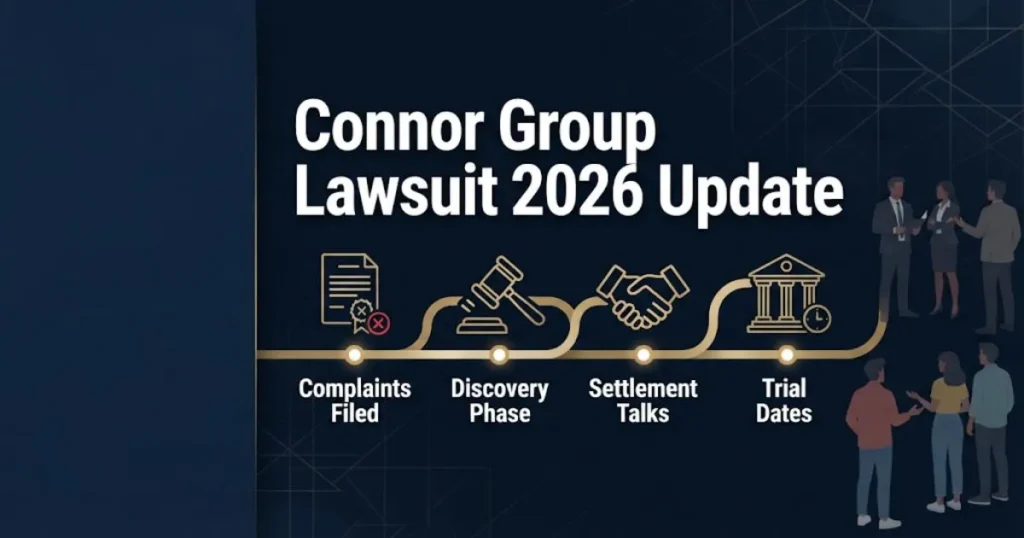
Heading into 2026, several pending cases against The Connor Group are moving toward critical phases, including discovery deadlines, mediation sessions, and potential trial dates in federal and state courts.

The most watched developments involve employment discrimination claims filed in U.S. District Court. Several of these cases entered 2026 with active discovery, meaning both sides are exchanging evidence and taking depositions.
On the tenant side, complaints about security deposit practices have continued to pile up across multiple states. State attorneys general offices in at least two states have received formal complaints about The Connor Group’s deposit return policies.
Fair housing organizations are also ramping up pressure. Complaints filed with HUD in 2024 and 2025 are now being investigated, and some could result in formal charges or consent agreements in 2026.
- Employment discrimination cases are in active discovery
- Tenant security deposit complaints are being reviewed by state AGs
- HUD investigations from prior years may produce formal outcomes
- Mediation is being scheduled in several pending cases
- New complaints continue to be filed in multiple states
The company itself has denied wrongdoing in public statements. But the volume of cases tells its own story. 2026 could be the year that scattered complaints turn into coordinated legal outcomes.
Connor Group Lawsuit Update: Latest Developments
The latest Connor Group lawsuit update shows that courts in Ohio, Florida, and North Carolina are actively processing claims against the company, with several cases expected to reach resolution milestones in mid to late 2026.
In Ohio, the Southern District federal court has multiple active cases involving former employees. Judges have been scheduling case management conferences and setting deadlines for expert witness disclosures.
Florida courts are handling tenant-related claims, particularly around lease termination fees and security deposit disputes. Some of these cases involve putative class allegations, meaning the plaintiffs want to represent a larger group of affected tenants.
North Carolina has seen complaints related to both employment and tenant issues at Connor Group properties in the Charlotte and Raleigh markets.
| Court/Agency | Location | Case Type | Status (2026) |
|---|---|---|---|
| U.S. District Court, S.D. Ohio | Dayton, OH | Employment discrimination | Active discovery |
| Florida State Courts | Multiple counties | Tenant deposit disputes | Pre-trial motions |
| North Carolina Superior Court | Charlotte/Raleigh | Employment and tenant | Pending proceedings |
| HUD | Nationwide | Fair Housing complaints | Under investigation |
| EEOC | Regional offices | Workplace discrimination | Charge processing |
There’s no single massive verdict yet. But the fact that legal activity is happening simultaneously in multiple states is significant. It suggests systemic issues rather than one-off disputes.
Key Takeaway: The Connor Group faces active legal proceedings in multiple states across employment, tenant, and fair housing categories, with 2026 expected to bring significant case milestones.
Connor Group Discrimination Lawsuit Allegations
Connor Group discrimination lawsuits allege that the company engaged in racial, gender, and age-based discrimination in both its hiring practices and its treatment of tenants seeking housing.
On the employment side, former workers have claimed that The Connor Group maintained a culture where promotions and favorable assignments were given based on race and gender rather than performance. Some lawsuits reference specific statements allegedly made by managers during meetings and evaluations.
Tenant-side discrimination allegations are equally concerning. Fair housing testers in certain markets reported that prospective renters received different treatment based on race, national origin, or familial status. These testing results have been cited in complaints filed with HUD.
- Racial discrimination: Allegations of biased hiring, promotion, and tenant screening
- Gender discrimination: Claims of unequal pay and hostile treatment of female employees
- Age discrimination: Reports of older workers being pushed out or passed over
- Familial status: Complaints from families with children being steered away from certain properties
- National origin: Reports of differential treatment toward non-English speaking applicants
The Connor Group has publicly stated that it does not tolerate discrimination. However, the pattern of allegations across different states and different types of discrimination suggests a deeper issue than individual bad actors.
What’s telling is the consistency of the claims. When people in Ohio, Florida, and Texas describe similar experiences, it points to possible company-wide practices rather than local management failures.
Connor Group Fair Housing Violations
The Connor Group has faced allegations of Fair Housing Act violations related to discriminatory rental practices, advertising, and tenant screening at properties across multiple states.
The Fair Housing Act, passed in 1968 and amended over the decades, prohibits discrimination in housing based on race, color, religion, national origin, sex, familial status, and disability. When a property management company violates these protections, tenants and advocacy groups can file complaints with HUD.
Several complaints filed with HUD allege that Connor Group properties treated prospective tenants differently based on protected characteristics. In some cases, fair housing organizations conducted paired testing, where testers of different racial backgrounds applied for the same apartments and received different responses.
| Fair Housing Category | Alleged Violation |
|---|---|
| Race/Color | Different treatment in tours, pricing, and application processing |
| Familial Status | Steering families with children away from certain units or buildings |
| National Origin | Language barriers used to discourage applications |
| Disability | Failure to provide reasonable accommodations or modifications |
When HUD investigates a Fair Housing complaint, the process can take months or even years. If HUD finds reasonable cause, the case can go to an administrative law judge or be referred to the Department of Justice.
For tenants, the takeaway is straightforward: if you believe a Connor Group property treated you differently because of who you are, federal law protects your right to file a complaint.
Is There a Connor Group Class Action?
As of early 2026, no certified class action lawsuit against The Connor Group has been publicly confirmed, but several pending cases include class or collective action allegations that could lead to certification later this year.
A class action requires a judge to certify that enough people share common legal claims. The plaintiffs must show that their individual cases raise the same questions of law or fact and that a class action is the most efficient way to resolve them.
Some tenant lawsuits in Florida courts have been filed with class allegations, particularly around security deposit practices. If a court finds that The Connor Group applied the same deposit withholding policy across hundreds or thousands of tenants, class certification becomes more likely.
On the employment side, collective action allegations under the Fair Labor Standards Act or Title VII could also evolve into larger cases. Former employees in multiple states have described similar experiences, which strengthens the argument for a collective approach.
- No class has been formally certified yet
- Several cases include class or collective allegations
- Security deposit disputes are the strongest candidates for class treatment
- Employment claims could become collective actions
- Certification decisions are expected in 2026
Think of it like a puzzle. Right now, the pieces are scattered across courts in different states. If a judge sees that those pieces form the same picture, a class action could bring everything together.
Key Takeaway: While no class action has been certified against The Connor Group yet, multiple pending cases include class allegations, and 2026 could see certification rulings that change the scope of these lawsuits dramatically.
Connor Group Employment Lawsuit Overview
Connor Group employment lawsuits involve claims from former workers alleging wrongful termination, wage violations, discrimination, and breach of employment agreements at the company’s corporate offices and property locations.
The Connor Group employs thousands of people across its apartment communities. Property managers, leasing agents, maintenance staff, and corporate employees have all been involved in legal disputes with the company.
Some of the most common employment claims include:
- Wrongful termination: Workers fired for reporting problems or for discriminatory reasons
- Wage and hour violations: Disputes over overtime pay, meal breaks, and off-the-clock work
- Breach of contract: Claims that employment agreements were not honored
- Failure to pay commissions: Leasing agents alleging earned bonuses were withheld
- Misclassification: Workers classified as exempt from overtime when they shouldn’t have been
Ohio employment law provides protections beyond federal minimums. Workers in other states where The Connor Group operates may have additional state-level claims available to them.
What’s notable about these cases is that many former employees describe a high-pressure work culture. Online reviews from workers consistently mention long hours, unrealistic quotas, and fear of retaliation for speaking up. While online reviews aren’t legal evidence, they paint a picture that aligns with the allegations in court filings.
Employment lawsuits against property management companies are notoriously hard to track because many settle quietly with confidentiality agreements. The true number of claims against The Connor Group is likely higher than what’s publicly visible.
Connor Group Employee Lawsuits and Workplace Claims
Specific Connor Group employee lawsuits have included claims of racial discrimination in promotions, sexual harassment, pregnancy discrimination, and retaliation against whistleblowers at properties across the company’s portfolio.
Former leasing consultants and property managers have filed complaints with the EEOC and in federal court describing a workplace where certain employees were favored based on personal characteristics rather than job performance.
In one notable set of allegations, former employees described being disciplined or terminated shortly after raising concerns about discriminatory practices. This pattern, if proven, constitutes illegal retaliation under federal and state employment law.
| Claim Type | Description | Legal Basis |
|---|---|---|
| Racial discrimination in promotions | Qualified workers of color passed over for less experienced white colleagues | Title VII, State civil rights laws |
| Sexual harassment | Unwelcome comments and conduct from supervisors | Title VII |
| Pregnancy discrimination | Adverse actions after pregnancy announcement | Pregnancy Discrimination Act |
| Whistleblower retaliation | Termination after reporting violations | State whistleblower statutes |
| Hostile work environment | Pervasive discriminatory atmosphere | Title VII, State laws |
These aren’t just legal theories on paper. Court filings include specific allegations about conversations, emails, and management decisions. Some plaintiffs have named individual managers and corporate leaders as personally responsible.
For current Connor Group employees who are experiencing similar issues, documenting everything is essential. Save emails, take notes on conversations with dates and witnesses, and file internal complaints through proper channels before going external.
Connor Group Hostile Work Environment Claims
Connor Group hostile work environment claims allege that some properties and offices fostered a work culture where discriminatory remarks, excessive pressure, and intimidation were regular occurrences rather than isolated incidents.
A hostile work environment claim under federal law requires more than just a bad boss or a tough workplace. The employee must show that the harassment was based on a protected characteristic (race, sex, religion, etc.) and was severe or pervasive enough to alter their working conditions.
Former Connor Group employees have described scenarios where:
- Racial slurs or racially charged comments were used in meetings
- Female employees received comments about their appearance
- Workers who complained were given undesirable assignments or shifts
- Management set impossible performance targets to create grounds for termination
- New hires from certain backgrounds were closely scrutinized while others were not
The key legal question in these cases is whether the behavior was bad enough to cross the legal threshold. A single rude comment usually isn’t enough. But a pattern of discriminatory conduct over weeks or months can absolutely qualify.
What makes property management companies particularly susceptible to these claims is the decentralized structure. Each property has its own management team, and corporate oversight can be inconsistent. Bad behavior at one site might go unchecked because corporate headquarters isn’t monitoring day-to-day interactions.
For The Connor Group, the volume of similar complaints from properties in different states suggests the issue isn’t limited to rogue managers at a single location.
Key Takeaway: Hostile work environment claims against The Connor Group describe patterns of discriminatory conduct across multiple properties, suggesting potential systemic issues in the company’s workplace culture and management oversight.
Connor Group Retaliation Claims
Connor Group retaliation claims allege that employees were punished, demoted, or fired after reporting discrimination, safety concerns, or other workplace violations to management or government agencies.
Retaliation is one of the most commonly filed charges with the EEOC nationwide. It’s also one of the easiest to prove when the timeline is clear. If an employee files a complaint on Monday and gets fired on Friday, that timing alone can support a retaliation claim.
Former Connor Group workers have described a chilling pattern. They reported a problem, and then their work life got worse. Sometimes it was an immediate termination. Other times it was a slow squeeze: reduced hours, exclusion from meetings, negative performance reviews that seemed to come out of nowhere.
| Retaliation Indicator | Example |
|---|---|
| Timing | Adverse action shortly after complaint |
| Shifting explanations | Different reasons given for termination at different times |
| Comparator treatment | Others who didn’t complain treated more favorably |
| Documentation changes | Sudden negative reviews after years of positive ones |
| Isolation | Exclusion from meetings, emails, or team activities |
Federal law protects employees who report discrimination, even if the underlying discrimination claim doesn’t succeed. You don’t have to be right about the discrimination to be protected from retaliation for reporting it in good faith.
This is a critical point for current employees. If you’ve reported something to HR or a government agency and then experienced negative consequences, you may have a standalone retaliation claim regardless of the original issue.
Connor Group EEOC Complaints
Connor Group EEOC complaints are charges filed by current and former employees with the Equal Employment Opportunity Commission alleging workplace discrimination based on race, sex, age, disability, or retaliation.
The EEOC is the federal agency responsible for enforcing workplace anti-discrimination laws. Before most employees can file a discrimination lawsuit in federal court, they must first file a charge with the EEOC and receive a “right to sue” letter.
Multiple EEOC charges have been filed against The Connor Group over the years. These charges involve properties and offices in different states. The EEOC investigates each charge and either finds reasonable cause, offers mediation, or issues a right to sue letter allowing the employee to proceed in court.
- EEOC charges must typically be filed within 180 or 300 days of the discriminatory act, depending on the state
- The EEOC can investigate, mediate, or litigate on behalf of the employee
- If the EEOC finds a pattern of discrimination, it can file its own lawsuit against the employer
- Employees can request a right to sue letter after 180 days even if the EEOC hasn’t finished investigating
The EEOC filing process is free. Employees don’t need a lawyer to file a charge, although having one can help. Charges can be filed online, by mail, or in person at a local EEOC office.
For a company the size of The Connor Group, EEOC complaints from multiple states and multiple years create a paper trail. That trail can be used by future plaintiffs to show that the company was on notice about discriminatory practices and failed to correct them.
Connor Group Tenant Complaints
Connor Group tenant complaints cover a wide range of issues including improper security deposit deductions, poor maintenance response times, aggressive lease enforcement, hidden fees, and alleged discrimination in the leasing process.
Tenants across The Connor Group’s portfolio have raised these complaints through state consumer protection agencies, the Better Business Bureau, online review platforms, and in some cases, formal legal filings.
The most common tenant grievances include:
- Security deposit disputes: Tenants claim excessive or fabricated charges at move-out
- Maintenance delays: Slow response to repair requests, especially for non-emergency items
- Lease fee surprises: Charges for services or penalties not clearly disclosed at signing
- Early termination penalties: Steep fees for breaking a lease, even for legitimate reasons
- Pest infestations: Reports of roaches, bed bugs, or rodents not addressed promptly
What separates a complaint from a lawsuit is documentation. Tenants who photograph their unit at move-in and move-out, save all communication with management, and send requests in writing are in the strongest position to pursue legal action.
Some states require landlords to provide an itemized list of security deposit deductions within a specific timeframe, often 14 to 30 days. When companies fail to meet this deadline, they may lose the right to withhold any portion of the deposit.
Key Takeaway: Connor Group tenant complaints span security deposits, maintenance, fees, and discrimination, and tenants with thorough documentation are best positioned to take legal action or recover withheld funds.
Connor Group Apartment Complaints and Reviews
Connor Group apartment complaints found on consumer review sites and government databases reveal recurring themes of poor management communication, aggressive collections practices, and disputes over move-out charges that align with formal legal claims.
Online reviews from former tenants on platforms like Google, Yelp, and apartment-specific sites tell a consistent story. While luxury amenities and modern finishes receive praise, the management experience draws frequent criticism.
| Complaint Category | Frequency | Typical Description |
|---|---|---|
| Move-out charges | Very common | Excessive cleaning, painting, or repair fees |
| Communication issues | Common | Unreturned calls, delayed email responses |
| Collections threats | Common | Sent to collections for disputed charges |
| Lease terms | Moderate | Confusing or one-sided lease language |
| Amenity access | Moderate | Amenities closed or unavailable as advertised |
| Noise and neighbor issues | Moderate | Slow response to noise complaints |
It’s worth paying attention to when the same complaint appears across properties in different states. One angry tenant at one complex is a personal experience. Dozens of tenants at dozens of complexes describing the same problem? That looks like a policy.
Consumer protection agencies track these complaints. When a pattern emerges, it can trigger state-level investigations or enforcement actions. Some of the formal legal claims against The Connor Group originated from exactly this kind of complaint accumulation.
For tenants considering whether to take action, reading reviews from people at your specific property can help you understand whether your experience is isolated or part of a wider pattern.
Connor Group Security Deposit Lawsuit Issues
Connor Group security deposit lawsuits involve claims that the company improperly withheld all or part of tenants’ security deposits by charging for normal wear and tear, fabricating damages, or failing to provide timely itemized statements.
Security deposit law varies by state, but the core principles are similar everywhere. Landlords can deduct for actual damage beyond normal wear and tear. They cannot charge for routine cleaning, minor scuffs, or carpet wear that comes from ordinary use.
Former Connor Group tenants have reported being charged hundreds or even thousands of dollars at move-out for items they dispute. Common charges include full apartment repainting, carpet replacement, and cleaning fees that seem inflated compared to market rates.
| State | Deposit Return Deadline | Penalty for Late Return |
|---|---|---|
| Ohio | 30 days | Tenant may recover full deposit plus damages |
| Florida | 15 to 60 days (varies) | Landlord forfeits right to claim deductions |
| Texas | 30 days | Tenant can sue for up to 3x deposit plus $100 |
| North Carolina | 30 days | Tenant can recover full deposit |
| Georgia | 30 days | Possible liability for double damages |
The pattern described in complaints follows a familiar playbook. Tenant moves out. Deposit is withheld. Tenant receives an itemized statement with inflated charges. Tenant disputes but gets no response. Tenant is sent to collections.
If you’re a former Connor Group tenant who lost your deposit unfairly, small claims court is often the fastest and cheapest route to recovery. Filing fees are typically $30 to $75, and you don’t need a lawyer.
Who Can File a Lawsuit Against The Connor Group?
Anyone who has suffered a legally recognized harm from The Connor Group’s actions can potentially file a lawsuit, including current and former tenants, employees, job applicants, and housing discrimination victims.
Eligibility depends on the type of claim:
Tenant Claims:
- You rented an apartment at a Connor Group property
- Your security deposit was improperly withheld
- You experienced discrimination during the application or leasing process
- You were charged fees that violated your lease or state law
- Your apartment had habitability issues that went unaddressed
Employment Claims:
- You worked at a Connor Group property or corporate office
- You were discriminated against based on a protected characteristic
- You were fired or demoted after reporting workplace violations
- You were denied overtime pay or proper compensation
- You experienced a hostile work environment
Fair Housing Claims:
- You applied for housing and were treated differently based on race, familial status, disability, or another protected class
- You were steered toward or away from certain units or properties
- You were denied a reasonable accommodation for a disability
Statute of limitations deadlines vary by claim type and state. Employment discrimination charges typically must be filed with the EEOC within 180 to 300 days. Tenant claims may have deadlines of 1 to 6 years depending on the state and legal theory.
Key Takeaway: Tenants, employees, job applicants, and housing discrimination victims may all have grounds to file claims against The Connor Group, but strict deadlines apply, and documenting your experience is essential.
Connor Group Settlement Information
No large-scale public settlement with The Connor Group has been announced as of early 2026, but individual cases have settled confidentially, and any future class action certification could open the door to a broader settlement.
Settlement in lawsuits like these typically happens one of three ways. First, individual plaintiffs settle their cases quietly with confidentiality agreements. Second, a class action settles with a fund available to all class members. Third, government agencies reach consent agreements with the company requiring policy changes and monetary relief.
Given that The Connor Group has faced claims in multiple categories (employment, tenant, Fair Housing), a future settlement could take different forms for different groups of affected people.
| Settlement Scenario | Likelihood | Potential Outcome |
|---|---|---|
| Individual case settlements | High (already occurring) | Confidential payouts to individual plaintiffs |
| Tenant class action settlement | Moderate | Fund for affected tenants, deposit refunds |
| EEOC consent decree | Moderate | Policy changes plus monetary relief for employees |
| HUD conciliation agreement | Moderate | Fair housing policy reforms, monitoring, penalties |
| Large public settlement | Lower (for now) | Multi-million dollar fund if class certified |
Companies like The Connor Group often prefer to settle quietly rather than risk a public trial. A trial creates a public record. A confidential settlement keeps the details out of the news.
If a class action is certified and a settlement is reached, class members will typically receive notice by mail or email. They’ll have the option to submit a claim, opt out, or object to the terms.
Connor Group Lawsuit Payout: What to Expect
Connor Group lawsuit payouts will vary significantly depending on the type of claim, but individual plaintiffs in employment cases could recover thousands to tens of thousands of dollars, while tenant claims may yield security deposit refunds plus statutory penalties.
Here’s a realistic breakdown of potential payouts by claim type:
| Claim Type | Estimated Payout Range | Basis |
|---|---|---|
| Security deposit dispute (individual) | $500 to $5,000 | Deposit refund plus statutory penalties |
| Employment discrimination (individual) | $10,000 to $100,000+ | Back pay, emotional distress, punitive damages |
| Wrongful termination (individual) | $15,000 to $150,000+ | Lost wages, benefits, emotional harm |
| Wage and hour violations | $1,000 to $20,000 | Unpaid overtime plus liquidated damages |
| Fair Housing violation (HUD) | $5,000 to $50,000+ | Compensatory damages, civil penalties |
| Class action (per class member) | $50 to $2,000 | Pro-rata share of settlement fund |
These are estimates based on comparable cases in the property management industry. Actual amounts depend on the strength of evidence, the specific state’s laws, and whether the case goes to trial or settles.
Employment cases tend to produce the largest individual payouts because they involve lost income and emotional distress. Security deposit cases are smaller per person but can add up to significant sums when hundreds or thousands of tenants are involved.
If you’re part of a potential class action, keep in mind that class settlements divide a fixed fund among all claimants. The more people who file claims, the smaller each individual share becomes. That’s just the math of class actions.
How to Sue The Connor Group
To sue The Connor Group, you need to identify your specific legal claim, gather supporting documentation, determine the right court or agency, and either file on your own or hire an attorney who handles your type of case.
Here’s a step-by-step process:
Step 1: Identify Your Claim
Determine whether your issue is a tenant dispute, employment matter, or housing discrimination claim. The type of claim dictates where and how you file.
Step 2: Gather Documentation
Collect everything relevant: lease agreements, move-in and move-out photos, emails, text messages, pay stubs, performance reviews, and any written complaints you made.
Step 3: File with the Right Agency (if required)
- Employment discrimination: File an EEOC charge first
- Fair Housing violations: File with HUD or your state fair housing agency
- Tenant disputes: Check if your state requires a demand letter before filing suit
Step 4: Choose Your Court
- Small claims court for deposit disputes under your state’s limit (typically $5,000 to $15,000)
- State court for larger tenant or employment claims
- Federal court for federal discrimination or Fair Housing Act claims
Step 5: Consider Legal Representation
Many employment and discrimination attorneys work on contingency, meaning they only get paid if you win. Tenant deposit cases can often be handled without a lawyer in small claims court.
| Filing Option | Best For | Cost |
|---|---|---|
| EEOC charge | Employment discrimination | Free |
| HUD complaint | Housing discrimination | Free |
| Small claims court | Security deposit disputes | $30 to $75 filing fee |
| State court with attorney | Larger employment or tenant claims | Contingency or hourly |
| Federal court with attorney | Federal civil rights claims | Contingency typical |
The most important thing you can do right now is preserve your evidence. Don’t delete emails. Don’t throw away documents. Screenshot everything. Once a case gets going, the strength of your evidence matters more than almost anything else.
Key Takeaway: Filing against The Connor Group requires matching your claim to the right agency or court, gathering solid documentation, and acting within your state’s statute of limitations before deadlines expire.
Frequently Asked Questions
What is The Connor Group lawsuit about?
The Connor Group lawsuit encompasses multiple legal actions alleging employment discrimination, tenant rights violations, security deposit disputes, and Fair Housing Act violations.
Cases have been filed by former tenants and employees in states including Ohio, Florida, Texas, and North Carolina.
Legal activity is ongoing in 2026 with several cases in active discovery and investigation phases.
Can tenants sue The Connor Group for keeping security deposits?
Yes, tenants can sue The Connor Group in small claims or state court for improperly withheld security deposits.
Most states require landlords to return deposits within 14 to 30 days with an itemized statement of deductions.
Tenants who document their unit’s condition at move-in and move-out have the strongest cases.
How much money could I get from a Connor Group settlement?
Payout amounts depend on the claim type, ranging from $500 to $5,000 for deposit disputes and $10,000 to $150,000 or more for employment discrimination cases.
Class action members typically receive $50 to $2,000 per person if a class is certified and a settlement is reached.
No large-scale public settlement fund has been established as of early 2026.
Has The Connor Group been found guilty of discrimination?
As of early 2026, no public court verdict has found The Connor Group guilty of discrimination, though multiple cases with discrimination allegations remain pending.
EEOC and HUD investigations are active, and prior complaints have been filed in several states.
The company has denied wrongdoing in its public statements.
What is the deadline to file a claim against The Connor Group in 2026?
Deadlines vary by claim type and state, but EEOC charges must generally be filed within 180 to 300 days of the discriminatory act.
Tenant security deposit claims typically have statutes of limitations ranging from 1 to 6 years.
Acting quickly is important because evidence gets harder to gather as time passes.
The Connor Group lawsuit story is still being written in 2026. Whether you’re a former tenant missing a security deposit or a former employee who experienced discrimination, the legal system offers real pathways to hold this company accountable.
Start by documenting your experience. Gather your records. Check your state’s deadlines.
If your rights were violated, now is the time to take action before the clock runs out.







