

The Similac NeoSure lawsuit targets Abbott Laboratories for allegedly selling a premature infant formula that increases the risk of necrotizing enterocolitis, a devastating intestinal disease. Thousands of families have filed claims. The litigation is heating up in 2026.
If your premature baby was fed Similac NeoSure and later diagnosed with NEC, you may be entitled to significant compensation. Settlement estimates range from $50,000 to over $500,000 depending on the severity of injury.
This article covers everything happening with this case right now. You will learn who qualifies, expected payout amounts, filing deadlines, bellwether trial dates, and the latest MDL developments. Over 1,000 cases are currently pending in federal court.
One critical fact many parents don’t know: Abbott had access to research linking cow’s milk-based formula to NEC in preemies for decades before lawsuits forced the issue into public view.
What Is the Similac NeoSure Lawsuit About?
The Similac NeoSure lawsuit is a mass tort action against Abbott Laboratories alleging that its cow’s milk-based premature infant formula causes necrotizing enterocolitis in vulnerable newborns. Parents claim Abbott knew about the NEC risk and failed to warn hospitals or families.
NEC is a life-threatening condition where intestinal tissue dies. It primarily strikes premature infants in the NICU. Babies fed cow’s milk-based formula like NeoSure face significantly higher NEC rates compared to those fed exclusively with human breast milk.
The lawsuits center on one core argument: Abbott prioritized profits over infant safety. Plaintiffs say the company marketed NeoSure aggressively to hospitals and pediatricians without adequate warnings about NEC risk.
| Detail | Info |
|---|---|
| Defendant | Abbott Laboratories |
| Product | Similac NeoSure |
| Condition Alleged | Necrotizing Enterocolitis (NEC) |
| Court | Northern District of Illinois |
| MDL Number | 3026 |
| Cases Pending | 1,000+ as of early 2026 |
These cases are not limited to NeoSure alone. Other Abbott products like Similac Special Care and liquid human milk fortifiers are named in complaints. But NeoSure remains the most frequently cited product across the litigation.
The stakes are enormous. NEC kills roughly 25% of premature infants who develop it. Survivors often face lifelong complications including short bowel syndrome, feeding difficulties, and developmental delays.
Similac NeoSure NEC Lawsuit Update for 2026
The Similac NeoSure NEC lawsuit enters 2026 at a pivotal stage, with bellwether trials expected to begin and settlement negotiations gaining momentum. This is the most active period the litigation has seen since the MDL was created.
Judge Rebecca R. Pallmeyer continues to oversee all federally consolidated cases in the Northern District of Illinois. Through late 2025, the court worked through discovery disputes and Daubert motions challenging expert testimony.
Abbott has fought aggressively to exclude certain scientific experts. The company argues that the link between cow’s milk formula and NEC remains unproven. Plaintiffs counter with decades of peer-reviewed research.
Several key milestones are expected in 2026:
- Bellwether trial selections finalized in early to mid-2026
- First trial dates potentially set for the second half of 2026
- Expert testimony rulings that will shape the entire litigation
- Possible global settlement discussions if early trial outcomes favor plaintiffs
The outcome of bellwether cases will set the tone for everything. Think of them as test runs. If juries side with families, Abbott faces massive pressure to settle. If Abbott wins, the value of pending claims drops.
State-level cases are also moving forward. Several lawsuits filed in state courts across Illinois, California, and Texas are proceeding on independent timelines outside the federal MDL.
Similac NeoSure Lawsuit Settlement Amounts
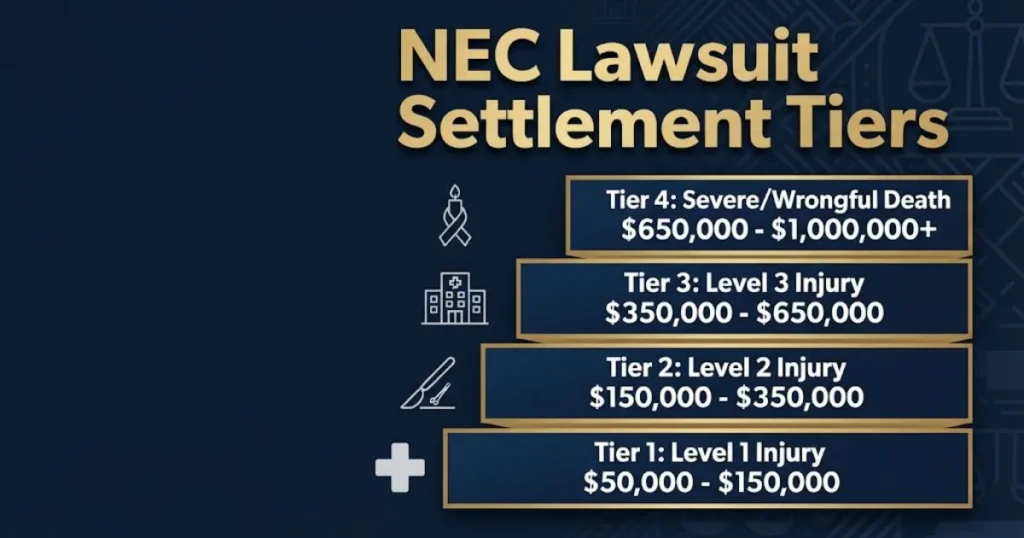
No official Similac NeoSure lawsuit settlement has been announced as of early 2026. However, legal analysts project settlement values between $50,000 and $500,000 or more per case depending on injury severity.
These projections are based on comparable mass tort settlements, the strength of plaintiffs’ evidence, and the severity of NEC injuries. NEC death cases will command the highest values. Cases involving surgery and long-term disability fall in the mid to upper range.
| Injury Level | Estimated Settlement Range |
|---|---|
| NEC Diagnosis with Full Recovery | $50,000 to $125,000 |
| NEC Requiring Surgery | $125,000 to $300,000 |
| NEC with Short Bowel Syndrome | $250,000 to $500,000 |
| NEC Resulting in Death | $500,000 to $1,000,000+ |
These are estimates, not guarantees. Actual settlement amounts will depend on bellwether trial outcomes, the strength of each individual case, and the quality of documentation.
Abbott has not publicly signaled willingness to settle. The company maintains that its products are safe and properly labeled. But the financial exposure from over 1,000 pending cases creates strong incentive for resolution.
If a global settlement fund is established, payouts will likely use a tiered system. Each claim gets scored based on the child’s gestational age, feeding history, NEC diagnosis, treatment received, and long-term outcomes.
Key Takeaway: The Similac NeoSure lawsuit is actively progressing in 2026 with bellwether trials on the horizon, and estimated settlement payouts range from $50,000 to over $1 million based on injury severity.
Who Qualifies for the Similac NeoSure Lawsuit?
You may qualify for the Similac NeoSure lawsuit if your premature infant was fed Similac NeoSure or a similar Abbott cow’s milk-based formula and later developed necrotizing enterocolitis. Qualification requires documented NEC diagnosis and evidence of formula use.
The basic eligibility criteria include:
- Premature birth (generally before 37 weeks gestation)
- Formula feeding with Similac NeoSure, Similac Special Care, or Abbott liquid human milk fortifier
- NEC diagnosis confirmed by medical records
- Injury or death resulting from NEC
Gestational age matters. Infants born before 32 weeks are at the highest risk for NEC and tend to have the strongest claims. But babies born between 32 and 37 weeks who developed NEC after formula feeding may also qualify.
Medical records are the backbone of any claim. You will need NICU records, feeding logs, and documentation of NEC diagnosis. Hospital charts that show when NeoSure was introduced to the baby’s diet are particularly valuable.
Parents, legal guardians, and surviving family members can file claims. In wrongful death cases, the estate of the deceased infant may be the named plaintiff.
One common question: does it matter if the baby also received breast milk? Not necessarily. Many NICU babies receive a mix of breast milk and formula. If NeoSure was part of the feeding regimen, you may still qualify.
Similac NeoSure Lawsuit Payout Per Person
Individual payouts from the Similac NeoSure lawsuit are expected to range from $50,000 to over $500,000, with wrongful death cases potentially exceeding $1 million. No payouts have been distributed yet as of early 2026.
The per-person amount depends on several factors that attorneys use to evaluate claim strength:
- Severity of NEC (Stage I, II, or III)
- Whether surgical intervention was required
- Long-term complications like short bowel syndrome
- Whether the infant survived
- Quality and completeness of medical documentation
- How clearly the records link NeoSure to the NEC diagnosis
| Factor | Impact on Payout |
|---|---|
| NEC Stage III (most severe) | Highest tier |
| Emergency bowel surgery | Increases value significantly |
| Short bowel syndrome | Adds long-term damages |
| Wrongful death | Highest potential payout |
| Mixed feeding (breast milk + formula) | May reduce but not eliminate value |
| Incomplete records | Can lower settlement tier |
Compare this to other baby product mass torts. The Zantac MDL saw projected individual values between $10,000 and $300,000. NEC cases tend to be higher because the injuries are catastrophic and the victims are newborns.
Attorney fees in mass tort cases typically run between 33% and 40% of the recovery. That percentage is negotiated upfront. It comes out of your settlement, not as an additional cost.
Nobody should expect a quick payout. Even after a settlement is reached, the claims process and fund distribution often take 12 to 24 months.
How to File a Similac NeoSure Claim
Filing a Similac NeoSure claim starts with contacting an attorney experienced in NEC baby formula litigation. Most law firms handling these cases offer free case evaluations and work on contingency, meaning you pay nothing upfront.
Here is the typical process:
- Contact a law firm specializing in NEC formula lawsuits
- Provide basic information about your child’s birth, feeding history, and NEC diagnosis
- Sign a retainer agreement authorizing the attorney to represent you
- Gather medical records from the hospital and NICU
- Attorney files your complaint in the appropriate court
- Your case enters the MDL or proceeds in state court
The most important documents you will need:
- NICU admission and discharge records
- Feeding logs showing formula type and duration
- NEC diagnosis records including imaging and lab results
- Surgical reports if applicable
- Death certificate if the infant did not survive
You do not need to have all records in hand before calling an attorney. Most firms have medical record retrieval teams that handle this for you. The process typically takes a few weeks.
There is no class action claim form to fill out online. Each case is filed individually. That is because this is a mass tort, not a class action. Your claim stands on its own facts.
Filing sooner is better than waiting. Statutes of limitations vary by state, and critical medical records become harder to obtain over time.
Key Takeaway: Filing a claim requires proof that your premature infant was fed Similac NeoSure and developed NEC, and most attorneys handle these cases at no upfront cost through contingency fee arrangements.
What Is Necrotizing Enterocolitis from Similac NeoSure?
Necrotizing enterocolitis is a severe intestinal disease in which portions of a newborn’s bowel tissue become inflamed and die. NEC from Similac NeoSure refers to cases where this condition developed after a premature infant was fed Abbott’s cow’s milk-based formula.
NEC strikes primarily in preterm infants during their first weeks of life. The condition progresses rapidly. What begins as feeding intolerance can escalate to intestinal perforation and sepsis within hours.
The disease is classified in three stages:
| NEC Stage | Description | Severity |
|---|---|---|
| Stage I (Suspected) | Mild symptoms, feeding intolerance, slight belly distension | Least severe |
| Stage II (Definite) | Confirmed on X-ray, pneumatosis intestinalis present | Moderate |
| Stage III (Advanced) | Bowel perforation, peritonitis, systemic shock | Most severe, often fatal |
The connection between cow’s milk formula and NEC is not a new discovery. Research dating back to the 1990s showed that premature infants fed human breast milk had significantly lower NEC rates than those fed formula.
Abbott’s NeoSure is specifically designed for premature and low-birth-weight infants. That is precisely the population most vulnerable to NEC. Plaintiffs argue this makes Abbott’s failure to warn especially reckless.
Surviving NEC often means multiple surgeries. Many infants lose portions of their intestine. Short bowel syndrome, a lifelong condition requiring specialized nutrition and medical care, is a common aftermath.
The mortality rate for NEC ranges from 20% to 30% in affected preemies. Among the most premature infants, it can be even higher.
Abbott Similac NeoSure Lawsuit: Why Abbott Is Being Sued
Abbott Laboratories is being sued because plaintiffs allege the company knew that cow’s milk-based formulas like NeoSure posed NEC risks to premature infants yet continued marketing the product without adequate warnings.
The core legal theory is failure to warn. This is a product liability claim. It does not require proving the product was “defective” in a manufacturing sense. It means Abbott allegedly had a duty to inform hospitals, doctors, and parents about NEC risk and chose not to.
Plaintiffs point to several key facts:
- Abbott funded internal research on formula and NEC risk
- Published studies available to Abbott linked cow’s milk formula to higher NEC rates
- The World Health Organization and American Academy of Pediatrics have long recommended breast milk for preemies
- Abbott’s marketing to NICUs emphasized growth benefits without mentioning NEC risk
- NeoSure labels did not carry NEC warnings during the relevant period
Abbott denies these allegations. The company argues its products meet FDA safety standards and that NEC has multiple causes, including prematurity itself, bacterial infection, and reduced blood flow to the intestines.
This is not the first time Abbott has faced scrutiny over infant formula. In 2022, the company recalled certain Similac products from its Sturgis, Michigan plant due to bacterial contamination. While that recall involved different safety issues, it heightened public concern about Abbott’s formula practices.
The lawsuits name Abbott Laboratories and certain subsidiaries. Some cases also name Mead Johnson, maker of Enfamil products, as a co-defendant. But NeoSure-specific claims focus squarely on Abbott.
Similac NeoSure Lawsuit Deadline to File
The deadline to file a Similac NeoSure lawsuit depends on your state’s statute of limitations for product liability and personal injury claims. Most states set this deadline at two to four years from the date of injury or discovery of injury.
| State | Statute of Limitations | Notes |
|---|---|---|
| California | 2 years | From date of injury or discovery |
| Texas | 2 years | Strict deadline enforcement |
| Illinois | 2 years | MDL is based here |
| New York | 3 years | From date of injury |
| Florida | 4 years | Recently changed from 2 years |
| Pennsylvania | 2 years | Discovery rule may extend |
For minors, many states have special rules. The statute of limitations clock often does not start running until the child turns 18. This gives families more time, but relying on this extension is risky because evidence and records can deteriorate.
There is a concept called the “discovery rule” that applies in many jurisdictions. If you did not know that NeoSure caused your child’s NEC until recently, the filing window may start from the date you learned about the connection rather than the date of the injury itself.
Do not wait until the last minute. Medical records from years ago can be lost or destroyed. Witnesses’ memories fade. Hospital record retention policies vary, and some facilities purge files after a set number of years.
If you think your child might have a case, getting a free evaluation now protects your rights. An attorney can determine your specific filing deadline based on your state and circumstances.
Key Takeaway: Filing deadlines vary by state from two to four years, but special rules for minors and the discovery rule can extend the window, so getting a legal evaluation early is the safest approach.
Similac NeoSure MDL Update
The Similac NeoSure cases are consolidated under MDL No. 3026 in the Northern District of Illinois, overseen by Judge Rebecca R. Pallmeyer. As of early 2026, over 1,000 cases are pending in this multidistrict litigation.
MDL stands for multidistrict litigation. It is a federal procedure that groups similar lawsuits together for pretrial efficiency. All discovery, motions, and expert challenges happen once rather than in each individual case. This saves time and resources for everyone involved.
Key MDL developments heading into 2026:
- Discovery phase largely completed for bellwether candidates
- Daubert hearings held to determine which expert witnesses can testify
- Bellwether case pool narrowed to a handful of representative cases
- Trial scheduling expected to firm up in the first half of 2026
- Settlement discussions remain preliminary but ongoing
The MDL does not prevent you from filing a new case. New claims are still being added to the docket. Each new filing gets transferred to Judge Pallmeyer’s court if it meets the MDL criteria.
One important distinction: the MDL handles pretrial matters only. If a case does not settle and does not go through a bellwether trial, it gets sent back to the court where it was originally filed for individual trial.
State court cases are not part of the MDL. Some plaintiffs have chosen to file in state courts with favorable procedural rules or jury pools. These cases move on their own timelines.
The pace of the MDL has been slower than many families hoped. Mass tort litigation involving medical causation questions is inherently complex. But 2026 is shaping up to be the year that truly moves the needle.
Similac NeoSure Bellwether Trials in 2026
Bellwether trials are expected to be the defining event for the Similac NeoSure lawsuit in 2026. These are the first cases selected from the MDL to go before a jury and test the strength of both sides’ arguments.
A bellwether trial works like a preview. The court picks a small number of representative cases, typically three to six, that reflect the range of claims in the MDL. The outcomes guide settlement negotiations for the remaining cases.
Here is what to expect:
| Bellwether Phase | Expected Timeline |
|---|---|
| Final case selection | Early to mid-2026 |
| Pretrial motions | Mid-2026 |
| First trial begins | Late 2026 (projected) |
| Verdict | Weeks after trial starts |
If plaintiffs win a bellwether verdict, the settlement value for all pending cases rises substantially. A strong plaintiff verdict could push Abbott toward a global settlement offer. On the other hand, if Abbott wins early bellwether trials, the company gains leverage and may fight harder.
The cases chosen for bellwether trials are not random. Both sides negotiate over which cases best represent the broader litigation. Plaintiffs want cases with strong medical evidence and sympathetic facts. Abbott wants cases with weaker causation links.
Previous mass tort bellwether results have been transformative. In the 3M earplug litigation, early plaintiff verdicts worth hundreds of millions pushed 3M toward a $6 billion settlement. The baby formula cases could follow a similar pattern if juries side with families.
The bellwether process does not directly determine your payout. But it sets the market value for claims. Think of it as setting the price in a negotiation.
Similac NeoSure: Class Action vs Mass Tort
The Similac NeoSure lawsuit is a mass tort, not a class action. This is an important distinction because it affects how much money you can receive and how your case is handled.
| Feature | Class Action | Mass Tort |
|---|---|---|
| Individual evaluation | No, one-size-fits-all | Yes, each case valued separately |
| Settlement per person | Usually small, often under $100 | Can be $50,000 to $1,000,000+ |
| Plaintiff involvement | Minimal, lead plaintiff represents all | Active, you work with your own attorney |
| Proof required | General harm to the class | Individual medical evidence |
| Typical payout timeline | 6 to 18 months after settlement | 12 to 36 months after settlement |
In a class action, one lawsuit represents everyone. Payouts tend to be small because the settlement is split among thousands or millions of class members. You might get $10 or $50.
Mass torts are different. Each plaintiff files their own case. Your settlement reflects your child’s specific injuries. A baby who had emergency bowel surgery and developed short bowel syndrome will receive far more than a case involving mild NEC that resolved without surgery.
This is why the Similac NeoSure litigation uses the mass tort structure. NEC injuries vary enormously. Some babies recover fully. Others die. A class action cannot account for those differences.
The MDL consolidation might look like a class action from the outside. But it is not. The MDL simply groups cases for pretrial efficiency. Each family retains its own attorney and its own claim.
Key Takeaway: The Similac NeoSure litigation is a mass tort where each case is valued individually, meaning your child’s specific injuries directly determine your potential payout rather than a flat amount split among all claimants.
Similac NeoSure Side Effects in Premature Babies
The most serious side effect linked to Similac NeoSure in premature babies is necrotizing enterocolitis, a condition that can destroy intestinal tissue and lead to life-threatening complications. Research shows preemies fed cow’s milk formula face 6 to 10 times higher NEC risk than those fed exclusively with human milk.
Reported side effects and complications include:
- Necrotizing enterocolitis (the primary allegation)
- Bowel perforation requiring emergency surgery
- Short bowel syndrome from intestinal tissue removal
- Sepsis from bacteria entering the bloodstream through damaged intestines
- Feeding intolerance and chronic digestive problems
- Developmental delays linked to prolonged NICU stays and malnutrition
- Death in the most severe cases
Not every premature baby who receives NeoSure develops NEC. The overall NEC rate among preemies is approximately 5% to 10%. But among very low-birth-weight infants fed formula, the rates climb higher.
The warning signs of NEC in a newborn include abdominal swelling, bloody stools, lethargy, temperature instability, and feeding refusal. These symptoms can appear suddenly and escalate rapidly.
Parents often did not choose NeoSure themselves. In many cases, hospital staff and NICU teams selected the formula as part of standard feeding protocols. This is part of why the lawsuits focus on Abbott’s marketing to healthcare institutions.
The long-term impact on surviving infants can be profound. Children who lose significant portions of their intestine to NEC may require IV nutrition, repeated surgeries, and specialized medical care throughout childhood and beyond.
Similac NeoSure Lawsuit Evidence and Studies
The scientific evidence supporting the Similac NeoSure lawsuit includes multiple peer-reviewed studies spanning three decades that link cow’s milk-based formula to increased NEC risk in premature infants.
Key studies cited in the litigation:
- Lucas and Cole (1990), The Lancet: This landmark study found that NEC was 6 to 10 times more common in formula-fed preemies than in those fed breast milk exclusively. It remains one of the most cited pieces of evidence in the lawsuit.
- Sullivan et al. (2010), Journal of Pediatrics: Found that an exclusively human milk-based diet reduced NEC rates by approximately 77% compared to cow’s milk-based supplementation.
- Cristofalo et al. (2013), Journal of Pediatrics: Confirmed that extremely premature infants fed human milk-based fortifier had significantly fewer NEC cases than those receiving cow’s milk-based fortifier.
| Study | Year | Key Finding |
|---|---|---|
| Lucas and Cole | 1990 | NEC 6 to 10x higher with formula |
| Sullivan et al. | 2010 | 77% NEC reduction with human milk diet |
| Cristofalo et al. | 2013 | Lower NEC with human milk fortifier |
| Abrams et al. | 2014 | Confirmed dose-response relationship |
Plaintiffs argue that Abbott had access to this research and could have acted on it. At minimum, they say Abbott should have added NEC risk warnings to NeoSure packaging and marketing materials.
Abbott’s defense relies on questioning the causation link. The company’s experts argue that NEC has multiple causes and that no study definitively proves NeoSure itself triggers the condition. They point to prematurity, bacterial colonization, and circulatory problems as primary NEC drivers.
Internal documents obtained through discovery could prove critical. If plaintiffs can show that Abbott’s own scientists recognized the NEC risk and the company suppressed or ignored those findings, it dramatically strengthens the case.
Similac NeoSure Recall and Lawsuit Connection
Similac NeoSure has not been subject to a recall specifically related to NEC risk. However, a major 2022 recall of other Similac products from Abbott’s Sturgis, Michigan facility raised broader concerns about the company’s infant formula safety practices.
The 2022 recall involved Similac, Alimentum, and EleCare powdered formulas. It was triggered by reports of bacterial infections, including Cronobacter sakazakii, in infants who consumed products made at the Sturgis plant. Four infants were hospitalized and two died.
| Event | Details |
|---|---|
| 2022 Recall Products | Similac, Alimentum, EleCare (powder) |
| Reason | Cronobacter sakazakii contamination risk |
| NeoSure Included in Recall? | No |
| NeoSure Subject to NEC-Related Recall? | No |
| Connection to NEC Lawsuit | Indirect: raised safety scrutiny |
The recall and the NEC lawsuits involve different safety issues. The recall was about bacterial contamination in a specific manufacturing facility. The NEC lawsuits are about the inherent risk of cow’s milk-based formula in premature infant digestive systems.
But the 2022 recall matters to the lawsuit in an indirect way. It brought intense public and congressional scrutiny to Abbott’s formula business. Congressional hearings revealed that Abbott had been aware of sanitation problems at the Sturgis plant months before the recall.
This pattern of awareness without action is central to the NEC litigation too. Plaintiffs argue that Abbott repeatedly knew about safety risks and delayed or avoided taking protective steps.
The absence of a NEC-specific recall does not weaken the lawsuit. Product liability claims do not require a recall. They require proof that the manufacturer knew or should have known about a danger and failed to warn consumers.
Key Takeaway: While Similac NeoSure itself has not been recalled for NEC risk, Abbott’s 2022 formula recall and pattern of delayed action on safety concerns strengthens the plaintiffs’ argument that the company prioritizes sales over infant safety.
NEC Baby Formula Lawsuit in 2026
The broader NEC baby formula lawsuit encompasses claims against both Abbott Laboratories (Similac products) and Mead Johnson Nutrition (Enfamil products) and is expected to reach critical milestones in 2026.
This is one of the largest infant health litigations in United States history. The combined caseload across federal and state courts exceeds thousands of individual claims. The federal cases are consolidated under MDL No. 3026.
Here is where things stand heading into 2026:
- Abbott and Mead Johnson face separate but related claims
- Bellwether trials for both product lines are being prepared
- Scientific evidence has survived initial challenges in most cases
- Public awareness continues to grow, bringing new filings
- Legislative interest in infant formula safety regulation is increasing
The 2026 landscape for NEC formula litigation is shaped by several factors. Courts have largely ruled that the scientific evidence linking formula to NEC is admissible. This was a major hurdle that plaintiffs needed to clear.
New cases are still being filed every month. Parents learning about the connection between cow’s milk formula and NEC for the first time are reaching out to attorneys in growing numbers. There is no cutoff for new filings as long as the statute of limitations has not expired.
The parallel structure of claims against both Abbott and Mead Johnson creates interesting dynamics. A settlement by one company could pressure the other to follow. Alternatively, if one company wins at trial, it could embolden the other to fight.
2026 is the year this litigation moves from preparation to action. The trials, verdicts, and settlement talks expected over the next 12 months will shape outcomes for every family with a pending claim.
| 2026 Milestone | Expected Impact |
|---|---|
| Bellwether trials | Set settlement value benchmarks |
| Expert testimony rulings | Determine strength of causation evidence |
| Settlement talks | Could begin if trial results favor plaintiffs |
| New case filings | Continue to increase MDL size |
| State court verdicts | May move faster than federal timeline |
Frequently Asked Questions
How much money can I get from the Similac NeoSure lawsuit?
Most estimates place individual payouts between $50,000 and $500,000 depending on injury severity.
Wrongful death cases may exceed $1 million.
No settlements have been paid yet as of early 2026; payouts depend on bellwether trial outcomes.
Is there a deadline to file a Similac NeoSure claim?
Yes, deadlines are set by each state’s statute of limitations, typically two to four years from the injury or its discovery.
Special rules for minors may extend the deadline in many states.
Filing early preserves evidence and protects your rights.
Does my child qualify for the Similac NeoSure lawsuit?
Your child may qualify if they were born prematurely, fed Similac NeoSure, and diagnosed with necrotizing enterocolitis.
Medical records documenting formula use and NEC diagnosis are required.
Both surviving children and families of infants who died from NEC can file claims.
Has there been a Similac NeoSure recall?
No, Similac NeoSure has not been recalled for NEC-related reasons.
Abbott did recall other Similac products in 2022 due to bacterial contamination at a manufacturing plant.
A recall is not required for a product liability lawsuit to proceed.
When will the Similac NeoSure lawsuit settle?
Settlement timing depends on bellwether trial outcomes expected in late 2026 or early 2027.
If early verdicts favor plaintiffs, global settlement negotiations could begin shortly after.
Actual payouts to families would likely follow 12 to 24 months after any settlement agreement.
The Similac NeoSure lawsuit stands as one of the most consequential infant safety cases moving through the courts right now. Families who lost babies to NEC or watched their children endure emergency surgeries and lifelong complications deserve answers.
If your premature infant was fed NeoSure and developed NEC, now is the time to get a case evaluation. Deadlines are real. Evidence fades over time. The 2026 bellwether trials will shape settlement values for every family in this litigation.
Do not wait for a headline to tell you the case settled. Get your claim filed and your records secured. The window to act is open right now.







