

The Pacific Fertility Center lawsuit stems from a catastrophic liquid nitrogen tank failure in March 2018 that may have destroyed thousands of frozen embryos and eggs. For hundreds of families, that single equipment malfunction wiped out years of fertility treatments and their hopes of having biological children.
This case has become one of the most significant fertility clinic lawsuits in U.S. history. Multiple lawsuits were filed against the clinic and the tank manufacturer, Chart Industries.
Here you will find the latest 2026 updates on the case status. You will also learn about settlement progress, estimated payouts, who qualifies, and how to file a claim.
One fact that sets this case apart: the tank reportedly had a faulty auto-fill system that went undetected for days, while the clinic had no backup alarm system in place.
Pacific Fertility Center Lawsuit
The Pacific Fertility Center lawsuit is a group of legal claims filed by patients whose frozen embryos and eggs were destroyed due to a storage tank malfunction at the San Francisco clinic. The incident occurred on or around March 4, 2018, when a cryogenic storage tank known as the MVE XC 47/11-6 lost its liquid nitrogen supply.
When the liquid nitrogen levels dropped, temperatures inside the tank rose to dangerous levels. Embryos and eggs that had been frozen for years began to thaw and degrade. The clinic later confirmed that the tank failure likely damaged or destroyed the reproductive material of hundreds of patients.
Lawsuits began piling up within weeks of the announcement. Patients filed claims in both San Francisco Superior Court and U.S. District Court for the Northern District of California. The legal actions targeted Pacific Fertility Center, its parent company Prelude Fertility, and the tank manufacturer Chart Industries.
| Detail | Info |
|---|---|
| Incident Date | March 4, 2018 |
| Location | San Francisco, California |
| Defendants | Pacific Fertility Center, Chart Industries, Prelude Fertility |
| Affected Patients | Estimated 500 or more families |
| Court Jurisdictions | San Francisco Superior Court, U.S. District Court (N.D. Cal.) |
| Primary Claims | Negligence, product liability, breach of bailment |
The core allegation is simple. The clinic and the equipment maker both failed to protect irreplaceable biological material that patients had entrusted to them.
Pacific Fertility Center Lawsuit Update 2026
As of 2026, the Pacific Fertility Center lawsuit remains active with significant legal developments shaping the path forward. Several individual cases have proceeded through discovery and motion practice, while others have been grouped for more efficient handling.
Court proceedings have progressed past early procedural stages. Depositions of clinic staff and Chart Industries engineers have been completed. Expert witnesses on cryogenic storage standards have submitted reports in multiple related cases.
A key development in recent years involved rulings on whether emotional distress claims could proceed. Courts have generally allowed these claims to move forward, recognizing the unique nature of losing frozen reproductive material.
Key updates for 2026:
- Discovery phase is largely complete in the lead cases
- Settlement discussions have intensified between parties
- No single global settlement has been reached yet
- Individual cases may proceed to trial if settlement talks stall
- Chart Industries has faced separate motions related to product defect evidence
The pace of the case has been affected by the complexity of damages calculations. Putting a dollar value on a destroyed embryo is something courts have rarely tackled before. That legal question alone has generated extensive briefing and expert testimony.
Patients who have not yet engaged with the litigation should be aware that deadlines may tighten as cases move toward resolution.
Pacific Fertility Center Lawsuit Settlement
No finalized, court-approved settlement has been announced in the Pacific Fertility Center lawsuit as of early 2026. Settlement negotiations, however, have been ongoing between the plaintiffs’ legal teams and the defendants.
Several factors complicate settlement discussions. First, the number of affected patients is large. Second, each patient’s situation is different. Some lost embryos that represented their only chance at biological children. Others had additional eggs or embryos stored elsewhere.
Think of it like an insurance claim after a house fire. Two neighbors can lose their homes to the same fire, but one had everything they owned inside while the other had a storage unit across town. The loss is different even though the cause is the same.
Settlement Status Overview:
| Factor | Status |
|---|---|
| Global Settlement Offer | Not yet finalized |
| Individual Settlements | Some cases reportedly resolved privately |
| Mediation | Multiple mediation sessions held |
| Court Approval Required | Yes, for any class-wide settlement |
| Settlement Fund Estimate | Not publicly disclosed |
Some individual plaintiffs have reportedly reached private settlements with confidentiality agreements. The terms of those deals have not been made public.
If a class-wide settlement is reached, it would need court approval. That process typically takes several months after an agreement is announced.
Key Takeaway: The Pacific Fertility Center lawsuit is active in 2026 with settlement talks progressing, but no final class-wide deal has been publicly announced yet.
Pacific Fertility Center Lawsuit Payout
Potential payouts in the Pacific Fertility Center lawsuit will vary significantly based on each patient’s individual circumstances. There is no fixed amount that applies to every affected person.
Several variables determine how much a claimant might receive:
- Number of embryos or eggs destroyed: More lost material generally means higher compensation
- Age of the patient at the time: Older patients who cannot produce more eggs face greater losses
- Whether the embryos were their last chance at biological children: This increases the emotional and practical damages
- Cost of IVF treatments invested: Out-of-pocket expenses for cycles that produced the lost embryos
- Emotional and psychological harm suffered: Documented mental health treatment adds to the claim value
In similar fertility clinic cases across the country, settlements have ranged from $20,000 to over $1 million per family, depending on the severity of the loss.
| Payout Factor | Estimated Range |
|---|---|
| Minimal loss (backup embryos existed) | $20,000 to $100,000 |
| Moderate loss (significant fertility impact) | $100,000 to $500,000 |
| Severe loss (only remaining embryos destroyed) | $500,000 to $1,000,000+ |
| IVF cost reimbursement component | $15,000 to $75,000 per cycle |
| Emotional distress component | Varies widely |
These figures are estimates based on comparable cases and publicly reported fertility lawsuit outcomes. Actual payouts in this specific case will depend on settlement terms or jury verdicts.
The cost of a single IVF cycle in San Francisco runs between $15,000 and $30,000. Many patients went through multiple cycles before successfully freezing embryos.
Who Qualifies for Pacific Fertility Center Lawsuit
You may qualify for the Pacific Fertility Center lawsuit if you had frozen embryos, eggs, or other reproductive material stored in the tank that failed at the San Francisco clinic in March 2018. The affected tank was the MVE XC 47/11-6 model located at the clinic’s main storage facility.
Basic eligibility requirements include:
- You were a patient of Pacific Fertility Center
- You had cryopreserved eggs, embryos, or reproductive tissue at the clinic
- Your material was stored in the specific tank that malfunctioned
- You received notification from the clinic about potential damage to your stored material
Not every Pacific Fertility Center patient is affected. Only those whose material was in the specific failed tank have standing in the lawsuit. The clinic operated multiple storage containers, and only one experienced the malfunction.
| Eligibility Factor | Qualifies | Does Not Qualify |
|---|---|---|
| Material in failed tank | Yes | No |
| Material in other clinic tanks | No | N/A |
| Received notification letter | Strong indicator | Not definitive |
| Patient during March 2018 | Likely | Need to verify |
| Material already used before failure | No | N/A |
Partners and spouses of patients may also have standing to file claims. If the destroyed embryos were created using both partners’ genetic material, both individuals can potentially seek damages.
Patients who are unsure whether their stored material was affected should review any correspondence they received from the clinic in March or April 2018.
Pacific Fertility Center Tank Failure
The tank failure at Pacific Fertility Center occurred when a cryogenic storage vessel lost its liquid nitrogen supply, causing internal temperatures to rise and destroy the frozen biological material inside. The incident was traced to a malfunction in the tank’s auto-fill system.
The tank in question was the MVE XC 47/11-6, manufactured by a subsidiary of Chart Industries. These tanks are designed to maintain temperatures around negative 196 degrees Celsius to keep embryos and eggs viable indefinitely.
Here is what went wrong:
- The tank’s automatic liquid nitrogen refill mechanism failed
- Liquid nitrogen levels dropped over a period of hours or days
- Temperatures inside the tank rose above safe storage levels
- The clinic did not have a functioning remote alarm system to detect the temperature change
- Staff did not discover the problem until significant damage had occurred
The failure was not a sudden explosion or dramatic event. It was a slow, silent disaster. The tank quietly warmed up while no one was watching.
Tank Failure Technical Summary:
| Detail | Info |
|---|---|
| Tank Model | MVE XC 47/11-6 |
| Manufacturer | Chart Industries (MVE Biological Solutions) |
| Failure Type | Auto-fill system malfunction |
| Temperature Required | Negative 196 degrees Celsius |
| Detection Delay | Multiple hours to days |
| Backup Alarm System | Not in place at the clinic |
This failure raised serious questions about industry standards. Many fertility clinics at the time did not have 24/7 remote monitoring or backup alarm systems for their cryogenic tanks. The Pacific Fertility Center incident helped change that.
Key Takeaway: The tank failure was caused by a malfunctioning auto-fill system on a Chart Industries storage vessel, and the clinic had no backup alarm to catch the problem before embryos were destroyed.
Pacific Fertility Center Class Action
The Pacific Fertility Center class action refers to consolidated legal claims filed on behalf of a group of affected patients rather than individual lawsuits. Multiple patients joined together to pursue their claims more efficiently through the court system.
Class action status gives the case certain advantages. It allows plaintiffs to share legal costs, prevents inconsistent rulings across dozens of separate cases, and puts more collective pressure on the defendants to settle.
Key class action details:
- Lead plaintiffs represent the broader group of affected patients
- The class includes all patients whose material was stored in the failed tank
- Claims were filed in both state and federal courts
- Class certification motions have been filed and argued
- The defendants have challenged class certification on grounds that individual damages vary too much
The defendants argue that each patient’s loss is so different that a class action is not the right vehicle. A 25-year-old who lost a few eggs faces a very different situation than a 42-year-old who lost her only remaining embryos.
This tension between collective action and individual circumstances has shaped much of the legal strategy. Some plaintiffs have opted to pursue individual lawsuits instead of remaining in the class.
Both approaches have pros and cons. Class actions can achieve faster resolution. Individual suits can pursue higher, personalized damages.
Pacific Fertility Center Embryo Lawsuit
The embryo-specific claims in the Pacific Fertility Center lawsuit focus on the legal status and value of destroyed frozen embryos. This is one of the most complex parts of the case because American law does not treat embryos the same way across all states.
In California, courts have generally treated frozen embryos as something between property and human life. They are not simply “property” like a car or a bank account. But they are not legally considered persons with independent rights either.
This in-between status matters enormously for damages calculations. If embryos are just property, damages might be limited to replacement cost. If they hold a higher status, damages can include:
- Emotional distress related to the loss
- Loss of chance to have a biological child
- Future fertility treatment costs to attempt replacement
- Loss of unique genetic material that cannot be recreated
Several plaintiffs described their embryos as their future children. One couple had spent over $100,000 on IVF before successfully creating embryos they planned to use within the year.
| Legal Treatment of Embryos | Impact on Damages |
|---|---|
| Treated as property | Limited to replacement/monetary value |
| Treated as special property | Allows emotional distress claims |
| Treated as potential life | Highest potential damages |
| California’s approach | Special property with emotional damage rights |
The California courts’ willingness to allow emotional distress claims alongside property-based claims has been a significant win for the plaintiffs in this case.
How to File Pacific Fertility Center Lawsuit
Filing a claim in the Pacific Fertility Center lawsuit requires connecting with a plaintiffs’ attorney who is already involved in the litigation or who handles fertility clinic negligence cases. You cannot simply fill out a form online and join the class.
Steps to file a claim:
- Gather your records: Collect any documentation from Pacific Fertility Center, including consent forms, storage agreements, billing records, and the notification letter about the tank failure
- Document your losses: Write down what was stored, how many embryos or eggs were affected, and how the loss has impacted your life
- Contact a qualified attorney: Reach out to a law firm handling Pacific Fertility Center cases. Several firms have been leading the litigation since 2018
- Review your options: Your attorney will advise whether joining the class action or filing an individual suit makes more sense for your situation
- File within applicable deadlines: Statute of limitations rules may apply, so acting sooner rather than later is important
Keep in mind that most attorneys handling these cases work on a contingency fee basis. That means you pay nothing upfront. The attorney collects a percentage of any settlement or verdict you receive.
| Filing Step | What You Need |
|---|---|
| Initial consultation | Basic facts about your stored material |
| Document collection | Clinic records, storage agreements, notification letters |
| Case evaluation | Attorney reviews strength of your claim |
| Filing decision | Choose class action or individual suit |
| Engagement agreement | Sign retainer with your attorney |
Time matters. While the statute of limitations in California for negligence claims is generally two years, various tolling rules and the ongoing nature of the class action may affect your specific deadline.
Key Takeaway: You can still potentially file a claim in the Pacific Fertility Center lawsuit, but you should contact a qualified attorney immediately to assess your options before any deadlines close.
Pacific Fertility Center San Francisco Lawsuit
Pacific Fertility Center is located in San Francisco, California, and the geographic context of this case matters for several legal reasons. California law provides certain protections and damage categories that may not be available in other states.
The clinic operated at 55 Francisco Street, Suite 500 in San Francisco. It was one of the most well-known fertility clinics in the Bay Area, serving patients from across Northern California and beyond.
San Francisco Superior Court has been one of the primary venues for these lawsuits. The Northern District of California federal court has handled related federal claims.
Why the San Francisco location matters:
- California allows emotional distress damages in negligence cases involving reproductive material
- California’s consumer protection laws provide additional legal theories
- San Francisco juries tend to be sympathetic to plaintiffs in medical negligence cases
- The cost of living and medical care in San Francisco supports higher damage calculations
- California’s statute of limitations rules have specific provisions for delayed discovery of harm
The Bay Area setting also means that the jury pool, if any case goes to trial, draws from one of the most progressive and plaintiff-friendly jurisdictions in the country.
Many patients traveled significant distances to use Pacific Fertility Center. Some came from other states, which has raised questions about jurisdiction and which state’s laws apply to their claims.
Chart Industries Fertility Tank Lawsuit
Chart Industries, the manufacturer of the cryogenic storage tank that failed, faces separate product liability claims as part of the Pacific Fertility Center litigation. The company made the MVE XC 47/11-6 tank through its subsidiary MVE Biological Solutions.
The claims against Chart Industries are distinct from the claims against the fertility clinic. While the clinic is accused of negligence in monitoring and maintenance, Chart Industries faces allegations that the tank itself was defectively designed or manufactured.
Specific allegations against Chart Industries include:
- The auto-fill system was prone to failure
- The tank lacked adequate built-in alarm systems
- The company knew or should have known about reliability issues
- Marketing materials overstated the tank’s safety features
- The company failed to warn clinics about the need for external monitoring
A similar tank failure occurred at University Hospitals in Cleveland, Ohio around the same time in March 2018. That incident also destroyed thousands of embryos and eggs. The same Chart Industries equipment was involved.
| Comparison | Pacific Fertility Center | University Hospitals Cleveland |
|---|---|---|
| Date of Failure | March 2018 | March 2018 |
| Tank Manufacturer | Chart Industries | Chart Industries |
| Material Destroyed | Eggs and embryos | Eggs and embryos |
| Estimated Patients Affected | 500+ families | 950+ families |
| Location | San Francisco, CA | Cleveland, OH |
The fact that two separate tank failures occurred at different facilities around the same time significantly strengthened the product liability claims against Chart Industries. It suggested a systemic problem, not an isolated incident.
Pacific Fertility Center Negligence Claims
The negligence claims against Pacific Fertility Center allege that the clinic failed to meet its duty of care in storing and protecting patients’ frozen reproductive material. Negligence is the foundation of most claims in this case.
To prove negligence, plaintiffs must show four things:
- Duty: The clinic had a duty to safely store embryos and eggs
- Breach: The clinic failed to meet that duty
- Causation: The breach caused the destruction of the stored material
- Damages: Patients suffered real harm as a result
The duty element is straightforward. When a fertility clinic accepts your embryos or eggs for storage, it takes on a bailment responsibility. That means it must care for your property with reasonable diligence. The same way a parking garage must not let your car get stolen.
The breach element focuses on several failures:
- No functioning remote alarm system on the tank
- No regular manual temperature checks
- No backup liquid nitrogen supply system
- Inadequate staff training on emergency protocols
- Failure to follow industry best practices for cryogenic storage
| Negligence Element | Plaintiff’s Argument |
|---|---|
| Duty | Clinic accepted material for paid storage |
| Breach | No alarm system, no backup, no monitoring |
| Causation | Tank failure destroyed material |
| Damages | Lost embryos, emotional harm, financial loss |
The clinic’s lack of a 24/7 monitoring system is perhaps the most damning allegation. Industry guidelines from the American Society for Reproductive Medicine had recommended such systems, yet Pacific Fertility Center did not have one in place.
Key Takeaway: The negligence case against Pacific Fertility Center rests heavily on the clinic’s failure to install basic monitoring and alarm systems that could have prevented the disaster.
Pacific Fertility Center Emotional Distress Damages
Emotional distress damages in the Pacific Fertility Center case compensate patients for the psychological and emotional suffering caused by the destruction of their frozen embryos and eggs. These damages often represent the largest component of individual claims.
The loss of frozen embryos is not like losing a piece of furniture. For many patients, those embryos represented years of painful, expensive fertility treatments. They were the physical manifestation of a dream to become parents.
Courts have recognized that this type of loss causes genuine, severe emotional harm. California law allows claims for negligent infliction of emotional distress when a defendant’s carelessness causes serious psychological injury.
Types of emotional distress documented in this case:
- Severe grief and mourning for lost potential children
- Clinical depression diagnosed after the incident
- Anxiety about future fertility prospects
- Relationship strain and divorce connected to the loss
- Post-traumatic stress symptoms
- Loss of sleep, appetite, and daily functioning
Plaintiffs who received professional mental health treatment have stronger emotional distress claims. Therapy records, psychiatric evaluations, and medication histories all serve as evidence of genuine suffering.
| Emotional Distress Factor | Strengthens Claim |
|---|---|
| Professional therapy records | Yes, significantly |
| Psychiatric diagnosis | Yes |
| Impact on relationships | Yes |
| Pre-existing mental health conditions | Can complicate claim |
| Duration of symptoms | Longer duration supports higher damages |
Some plaintiffs have described the loss as similar to a miscarriage or the death of a child. While courts do not equate embryo loss with child death, the emotional impact testimony has been powerful.
The average emotional distress component in comparable fertility cases has ranged from $50,000 to several hundred thousand dollars per plaintiff.
Destroyed Embryos Compensation Amount
Compensation for destroyed embryos in fertility lawsuits typically ranges from $50,000 to over $1 million per family, depending on the specific facts of each case. There is no standard formula, and each situation is evaluated individually.
Several real-world cases provide benchmarks:
- In the University Hospitals Cleveland case, some families reportedly settled for amounts in the six-figure range
- A 2021 California case involving a single family’s destroyed embryos resulted in a jury award exceeding $15 million, though that amount was later reduced
- Some private settlements in fertility cases have been reported in the $200,000 to $750,000 range
The value of a destroyed embryo case depends on measurable and subjective factors:
Measurable factors:
- Cost of IVF cycles that produced the embryos (often $15,000 to $30,000 per cycle)
- Cost of medications for each cycle (often $3,000 to $7,000)
- Travel and related expenses
- Future fertility treatment costs if the patient wants to try again
Subjective factors:
- Emotional and psychological suffering
- Loss of the chance to have a biological child
- Age of the patient and remaining fertility window
- Whether the embryos were the patient’s last viable option
| Case Comparison | Reported Outcome |
|---|---|
| Pacific Fertility Center (ongoing) | No public final amounts yet |
| University Hospitals Cleveland | Six-figure individual settlements reported |
| California single-family jury verdict | $15 million (later reduced on appeal) |
| Private fertility settlements (various) | $200,000 to $750,000 range |
Juries tend to award higher amounts than settlements provide. But trials carry risk for both sides. Most fertility clinic cases settle before reaching a jury.
Frozen Embryo Destruction Lawsuit
A frozen embryo destruction lawsuit arises when a fertility clinic, storage facility, or equipment manufacturer causes the loss of cryopreserved embryos through negligence, defective products, or breach of contract. The Pacific Fertility Center case is part of a growing category of these claims nationwide.
These lawsuits are relatively new in the legal system. Twenty years ago, very few cases like this existed. The rapid expansion of IVF and egg freezing has created a much larger population of people with stored reproductive material.
Common causes of embryo destruction lawsuits:
- Cryogenic tank failures (the most common cause)
- Power outages without backup systems
- Human error in handling or labeling
- Shipping accidents during embryo transfers
- Deliberate destruction without patient consent
- Facility closures without proper material transfer
The legal framework for these cases draws from several areas of law:
- Bailment law: The clinic accepted your property for safekeeping
- Medical malpractice: The clinic provided substandard medical care
- Product liability: The equipment was defective
- Contract law: The clinic breached its storage agreement
- Consumer protection: The clinic’s practices were unfair or deceptive
Each legal theory opens different avenues for damages. Smart plaintiffs’ attorneys typically pursue multiple theories simultaneously to maximize the chances of recovery.
The Pacific Fertility Center case and the University Hospitals case together have pushed the fertility industry to adopt better safety standards. Many clinics now use 24/7 remote monitoring, backup tanks, and redundant alarm systems as standard practice.
Key Takeaway: Frozen embryo destruction lawsuits are a growing area of law, and the Pacific Fertility Center case has become a landmark example that is reshaping safety standards across the fertility industry.
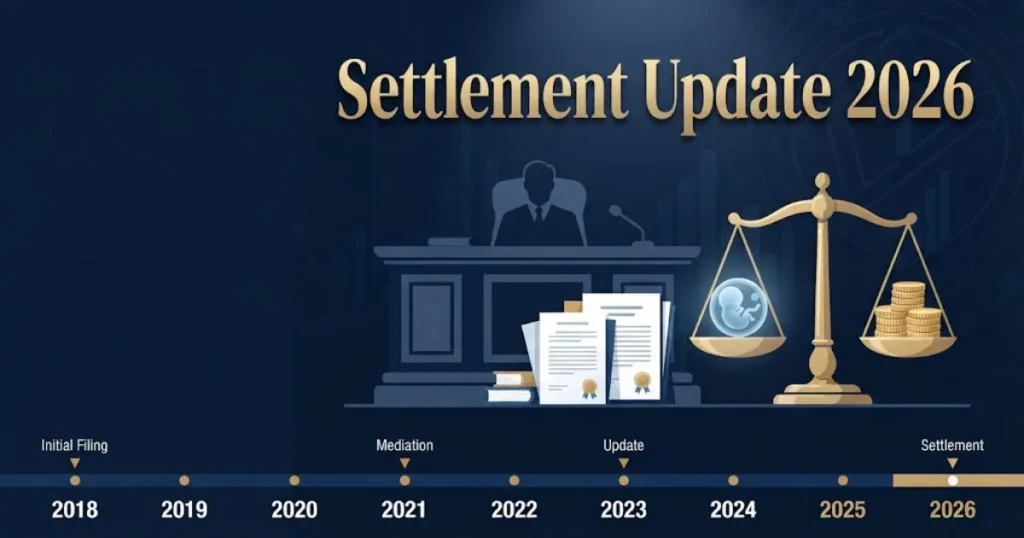
Pacific Fertility Center Lawsuit Timeline
The Pacific Fertility Center lawsuit has followed a long legal path since the tank failure was first discovered in 2018. Here is a chronological breakdown of the major events and milestones.
Timeline of Key Events:
| Date | Event |
|---|---|
| March 4, 2018 | Cryogenic storage tank failure occurs at Pacific Fertility Center |
| March 2018 | Clinic notifies affected patients by letter |
| April 2018 | First lawsuits filed in San Francisco Superior Court |
| Mid-2018 | Additional lawsuits filed in federal court (N.D. California) |
| Late 2018 | Chart Industries named as co-defendant in product liability claims |
| 2019 | Discovery phase begins; depositions of clinic staff and engineers |
| 2019 to 2020 | Related University Hospitals Cleveland case progresses in parallel |
| 2020 to 2021 | COVID-19 pandemic causes court delays |
| 2021 to 2022 | Expert witness reports filed on cryogenic standards and damages |
| 2023 | Motions for class certification argued |
| 2023 to 2024 | Settlement discussions begin in earnest |
| 2024 to 2025 | Mediation sessions held between parties |
| 2026 | Case remains active; settlement talks ongoing; trial dates possible |
The timeline shows a case that has moved slowly by any standard. Eight years from incident to potential resolution is a long wait for families whose lives were turned upside down.
Court delays during the pandemic added approximately 12 to 18 months to the overall timeline. The complexity of damages calculations and the novelty of the legal issues have added more time.
If settlement talks fail in 2026, the first trials could begin in late 2026 or 2027. Bellwether trials, where a few representative cases go to trial first, are one possible approach.
Fertility Clinic Cryo Tank Failure Lawsuits
The Pacific Fertility Center case is not an isolated incident. Cryogenic tank failures at fertility clinics have generated lawsuits across the United States, and the problem may be more widespread than most patients realize.
Notable cryo tank failure lawsuits:
- University Hospitals (Cleveland, OH, 2018): A tank failure at the same time as the Pacific Fertility Center incident destroyed embryos and eggs belonging to approximately 950 families. Lawsuits resulted in settlements, though amounts remain largely confidential.
- Pacific Fertility Center (San Francisco, CA, 2018): The case covered extensively in this article, affecting 500+ families.
- Various smaller incidents: Individual clinics across the country have faced lawsuits for storage failures that affected smaller numbers of patients.
| Facility | Year | Patients Affected | Tank Manufacturer |
|---|---|---|---|
| University Hospitals, Cleveland | 2018 | ~950 families | Chart Industries |
| Pacific Fertility Center, SF | 2018 | ~500+ families | Chart Industries |
| Other reported incidents | Various | Smaller numbers | Various |
The common thread in many of these cases is the same manufacturer: Chart Industries. The company’s dominant market position in cryogenic storage equipment means its products are in clinics across the country.
After these high-profile failures, the fertility industry began adopting stricter standards. The American Society for Reproductive Medicine updated its guidelines to recommend:
- 24/7 remote temperature monitoring
- Redundant alarm systems with multiple notification methods
- Backup liquid nitrogen supplies
- Regular maintenance protocols with documented records
- Staff training on emergency response procedures
These changes came too late for the families affected by the 2018 failures. But they represent a direct legacy of the lawsuits filed against Pacific Fertility Center and University Hospitals.
The growth of egg freezing, particularly among younger women choosing to preserve fertility for future use, means that more Americans than ever have biological material in cryogenic storage. The stakes for getting safety standards right continue to grow.
Key Takeaway: Cryo tank failures have affected fertility clinics beyond Pacific Fertility Center, with Chart Industries equipment involved in multiple incidents, driving industry-wide safety improvements that came too late for affected families.
Frequently Asked Questions
What happened at Pacific Fertility Center that caused the lawsuit?
A cryogenic storage tank at Pacific Fertility Center in San Francisco malfunctioned in March 2018.
The tank’s auto-fill system failed, causing liquid nitrogen levels to drop and temperatures to rise.
This destroyed or damaged the frozen embryos and eggs of an estimated 500 or more families.
How much money can I get from the Pacific Fertility Center lawsuit?
Payouts vary based on individual circumstances, ranging from an estimated $20,000 to over $1 million per family.
The amount depends on the number of embryos lost, the patient’s age, remaining fertility options, and documented emotional harm.
No final class-wide payout schedule has been publicly announced as of 2026.
Is the Pacific Fertility Center lawsuit still open in 2026?
Yes, the lawsuit remains active in 2026.
Settlement negotiations are ongoing, and discovery has been largely completed in the lead cases.
If no settlement is reached, trials could begin in late 2026 or 2027.
Can I still file a claim against Pacific Fertility Center?
It may still be possible, but time is running out.
Statute of limitations rules and the advancing stage of the litigation mean that new claimants should contact an attorney as soon as possible.
An attorney can evaluate whether your claim is still timely based on the specific facts of your situation.
Who is being sued in the Pacific Fertility Center case?
Three main defendants are named in the lawsuits: Pacific Fertility Center (the clinic), Chart Industries (the tank manufacturer), and Prelude Fertility (the clinic’s parent company).
The clinic faces negligence and bailment claims.
Chart Industries faces product liability claims for the defective cryogenic tank.
This case is far from over. Affected families should stay informed about settlement developments and court deadlines throughout 2026.
If you had embryos or eggs stored at Pacific Fertility Center in March 2018, now is the time to review your records and speak with an attorney. The window for action may narrow as the case moves toward resolution.
Your stored embryos represented something irreplaceable. The legal system is working to put a value on that loss, and you deserve to be part of that process.







