

The Truist lawsuit story in 2026 involves multiple class actions targeting the bank for overdraft fees, data breaches, Zelle fraud, and mortgage servicing failures. If you’re a Truist customer who got hit with surprise charges or lost money through fraud the bank failed to stop, you may be owed compensation.
This article breaks down every active and pending Truist lawsuit. You’ll learn what each case alleges, who qualifies, how much money is at stake, and the exact steps to file a claim.
Here’s one number worth knowing: Truist has already faced regulatory penalties exceeding $20 million in recent years. And the lawsuits keep piling up.
What follows is everything you need in one place.
What Is the Truist Lawsuit About
The Truist lawsuit refers to a collection of legal actions filed against Truist Financial Corporation by customers, regulators, and consumer advocacy groups. These cases accuse the bank of unfair fee practices, inadequate fraud protections, data security failures, and mortgage servicing errors.
Truist was formed in 2019 when BB&T and SunTrust merged. That merger created the sixth-largest bank in the United States. But it brought chaos for millions of account holders.
Customers reported duplicate charges, lost payments, and frozen accounts during the transition. Many say the bank’s systems simply weren’t ready to handle the integration.
The lawsuits span multiple federal courts. Most are filed in North Carolina, where Truist is headquartered in Charlotte. Several cases have been consolidated for efficiency.
| Detail | Info |
|---|---|
| Defendant | Truist Financial Corporation |
| Headquarters | Charlotte, North Carolina |
| Formed | December 2019 (BB&T + SunTrust merger) |
| Primary Courts | M.D. North Carolina, W.D. North Carolina |
| Lawsuit Categories | Overdraft fees, data breach, Zelle fraud, mortgage, wire fraud |
| Regulatory Body Involved | Consumer Financial Protection Bureau (CFPB) |
These aren’t frivolous complaints. They represent systemic problems that affected ordinary checking and savings account holders across the Southeast and beyond.
Truist Class Action Lawsuit 2026: What You Need to Know
The Truist class action lawsuit in 2026 includes at least four active putative class actions covering different categories of consumer harm. Each case represents a different group of affected customers.
Class actions allow one or a few plaintiffs to sue on behalf of thousands or even millions of people. This matters because most individual Truist customers lost between $30 and $500. That’s not enough to hire a lawyer alone, but it adds up fast across millions of accounts.
The biggest class action relates to overdraft fees. Plaintiffs allege Truist reordered transactions to maximize the number of overdraft charges per day. A second major case involves the 2023 to 2024 data breach that exposed personal information.
By early 2026, courts have certified or are considering certification for several of these classes. Certification is the green light that lets a case proceed on behalf of everyone similarly harmed.
- Overdraft fee class action: Alleges transaction reordering and improper fee assessment
- Data breach class action: Covers customers whose personal data was exposed
- Zelle fraud class action: Targets the bank’s failure to reimburse unauthorized Zelle transfers
- Mortgage servicing class action: Focuses on escrow miscalculations and payment misapplication after the merger
If any of these situations sound familiar, you’re likely part of the proposed class.
Truist Bank Lawsuit: A History of Legal Trouble
Truist Bank’s lawsuit history stretches back to the earliest days of the BB&T and SunTrust merger. Legal trouble started almost immediately after the two banks combined operations.
In 2020 and 2021, customers flooded the CFPB with complaints about missing direct deposits, incorrect account balances, and surprise fees. Many of these complaints directly cited the merger as the root cause.
By 2022, the first formal class action filings hit federal court. Plaintiffs in North Carolina and Georgia alleged that Truist’s systems were so poorly integrated that customers suffered real financial harm.
The bank’s legal problems only accelerated from there.
| Year | Key Legal Event |
|---|---|
| 2019 | BB&T and SunTrust merger completed |
| 2020 to 2021 | Surge in CFPB complaints from former SunTrust customers |
| 2022 | First class action lawsuits filed in federal court |
| 2023 | Data breach exposed; overdraft fee lawsuit gains traction |
| 2024 | CFPB opens formal investigation; Zelle fraud claims mount |
| 2025 | Multiple cases advance toward trial or settlement talks |
| 2026 | Settlement negotiations active; deadlines approaching |
Think of it like buying two houses and trying to wire them into one electrical system overnight. Something was bound to short circuit. For Truist customers, that short circuit hit their wallets.
Key Takeaway: Truist faces multiple active class action lawsuits in 2026 stemming from its messy merger, covering everything from overdraft fees to data breaches to Zelle fraud.
Truist Lawsuit Update 2026: Latest Developments
The latest Truist lawsuit update for 2026 shows several cases moving toward resolution while new claims continue to emerge. Settlement discussions are underway in at least two major cases.
In early 2026, the overdraft fee class action entered mediation. Both sides agreed to work with a neutral mediator, which is often a sign that settlement is within reach. The data breach case is slightly behind, with discovery still ongoing.
The Zelle fraud lawsuit picked up steam after a federal judge denied Truist’s motion to dismiss in late 2025. That ruling means the case will proceed to discovery and potentially trial.
On the regulatory front, the CFPB’s enforcement action against Truist remains active. The bureau has been investigating Truist’s fee practices and fraud response procedures since 2024.
- Overdraft case: In mediation as of Q1 2026
- Data breach case: Discovery phase, depositions scheduled for mid-2026
- Zelle fraud case: Motion to dismiss denied; moving forward
- Mortgage case: Amended complaint filed in early 2026
- CFPB action: Investigation ongoing; consent order possible by late 2026
New complaints are still being filed. Some involve Truist’s handling of wire transfer fraud and its alleged failures to flag suspicious activity on customer accounts.
Truist Overdraft Fee Lawsuit
The Truist overdraft fee lawsuit alleges that the bank systematically reordered customer transactions from highest to lowest dollar amount to trigger more overdraft charges per day. This practice, plaintiffs say, generated millions in unfair revenue.
Here’s how it works in practice. Say you have $100 in your account and make five small purchases of $10 each, followed by one $80 purchase. If the bank processes the $80 purchase first, your balance drops to $20, and the next three $10 purchases each trigger a $36 overdraft fee.
That’s $108 in fees on a day when you only overdrew your account by $30.
The lawsuit covers Truist checking account holders who were charged overdraft fees between 2020 and 2025. Former SunTrust customers are especially affected because SunTrust’s overdraft policies were particularly aggressive before the merger.
| Detail | Info |
|---|---|
| Allegation | Transaction reordering to maximize overdraft fees |
| Fee Amount | $36 per overdraft |
| Period Covered | 2020 to 2025 |
| Most Affected | Former SunTrust checking account holders |
| Court | U.S. District Court, W.D. North Carolina |
| Status | In mediation as of early 2026 |
Truist has denied wrongdoing. The bank says its transaction processing order is disclosed in account agreements. But plaintiffs argue that disclosure buried in fine print doesn’t make the practice fair or legal.
Truist Data Breach Lawsuit
The Truist data breach lawsuit stems from a security incident that exposed the personal and financial information of thousands of customers. The breach occurred between late 2023 and early 2024 and was linked to a former employee who allegedly stole customer data.
Exposed information reportedly included names, Social Security numbers, account numbers, and other sensitive financial details. Truist confirmed the breach in mid-2024 and began notifying affected customers.
Plaintiffs argue that Truist failed to implement adequate security measures. They say the bank should have detected the insider threat earlier and that its notification to customers came too late.
The class action seeks compensation for:
- Credit monitoring costs incurred by affected customers
- Time and effort spent dealing with identity theft or fraud attempts
- Emotional distress caused by the exposure of private financial data
- Actual financial losses from any unauthorized transactions linked to the breach
| Detail | Info |
|---|---|
| Breach Period | Late 2023 to early 2024 |
| Cause | Former employee data theft |
| Data Exposed | Names, SSNs, account numbers |
| Notification | Mid-2024 |
| Court | U.S. District Court, M.D. North Carolina |
| Status | Discovery phase in 2026 |
If you received a data breach notification letter from Truist, you are almost certainly part of the affected class.
Truist Zelle Fraud Lawsuit
The Truist Zelle fraud lawsuit accuses the bank of refusing to reimburse customers who lost money through unauthorized or fraudulent Zelle transactions. Zelle, the instant payment platform built into the Truist mobile app, has become a favorite tool for scammers.
Federal law under Regulation E requires banks to reimburse customers for unauthorized electronic fund transfers. Plaintiffs in this case say Truist routinely denied fraud claims by arguing that customers “authorized” the transactions, even when they were clearly tricked by scammers.
The distinction matters enormously. If a scammer impersonates your bank and convinces you to send money, Truist has argued that you authorized the payment. Consumer advocates and federal regulators disagree.
Reported losses range from a few hundred dollars to over $10,000 per victim. Many plaintiffs are elderly customers who were targeted by sophisticated impersonation scams.
- Scammers posed as Truist fraud department employees
- Victims were told to “verify” their accounts by sending Zelle payments
- Truist denied reimbursement claims, calling the transfers “authorized”
- The CFPB has taken the position that banks bear responsibility in these cases
| Detail | Info |
|---|---|
| Platform | Zelle (via Truist mobile app) |
| Allegation | Refusal to reimburse unauthorized/fraudulent transfers |
| Typical Loss | $200 to $10,000 per customer |
| Legal Basis | Regulation E, Electronic Fund Transfer Act |
| Status | Motion to dismiss denied; case proceeding |
This case could set a major precedent for how all banks handle Zelle fraud claims going forward.
Key Takeaway: The overdraft fee, data breach, and Zelle fraud lawsuits represent the three largest active Truist cases, and each one is progressing through federal court in 2026.
Truist Mortgage Lawsuit
The Truist mortgage lawsuit focuses on servicing errors that affected homeowners after the BB&T and SunTrust merger. Plaintiffs allege that Truist misapplied mortgage payments, miscalculated escrow accounts, and wrongly reported borrowers as delinquent to credit bureaus.
When the two banks merged their loan servicing systems, thousands of mortgage accounts experienced disruptions. Payments made on time were posted late or to the wrong accounts. Escrow balances were calculated incorrectly, causing insurance and tax payment shortfalls.
Some borrowers received foreclosure notices despite being current on their payments. Others saw their credit scores drop by 100 points or more because of false delinquency reports.
The lawsuit covers borrowers whose mortgages were serviced by Truist between 2020 and 2025. Both former BB&T and former SunTrust mortgage holders are included.
| Detail | Info |
|---|---|
| Allegation | Payment misapplication, escrow errors, false credit reporting |
| Period | 2020 to 2025 |
| Affected Borrowers | Former BB&T and SunTrust mortgage customers |
| Credit Impact | Drops of 100+ points reported |
| Court | Federal court, North Carolina |
| Status | Amended complaint filed early 2026 |
Imagine paying your mortgage on time every month for years, then getting a letter saying you’re in default. That’s what happened to thousands of Truist customers. And many of them are now part of this lawsuit.
Truist Wire Transfer Fraud Lawsuit
The Truist wire transfer fraud lawsuit alleges that the bank failed to detect and prevent fraudulent wire transfers from customer accounts. Plaintiffs say Truist’s fraud detection systems were inadequate and that the bank ignored red flags on suspicious transactions.
Wire fraud typically involves hackers gaining access to email accounts and impersonating real estate agents, attorneys, or business partners. They send fake wire instructions, and the victim’s bank sends the money to the scammer’s account.
Several plaintiffs lost six-figure sums. One case involved a homebuyer who wired over $250,000 to a fraudulent account after receiving spoofed closing instructions. Truist processed the wire without any additional verification.
The lawsuits argue that Truist should have:
- Flagged wires going to newly opened accounts
- Required callback verification for large transfers
- Warned customers about common wire fraud schemes
- Delayed suspicious transactions for manual review
| Detail | Info |
|---|---|
| Allegation | Failure to detect/prevent fraudulent wire transfers |
| Typical Loss | $10,000 to $250,000+ |
| Common Scenario | Real estate closing fraud, business email compromise |
| Legal Theory | Negligence, breach of duty of care |
| Status | Multiple individual and class claims filed |
Banks have a duty to protect their customers’ money. When they process a clearly suspicious wire without blinking, that duty has been broken.
Truist CFPB Enforcement Action
The Truist CFPB enforcement action is a separate regulatory proceeding initiated by the Consumer Financial Protection Bureau. This is not a private lawsuit filed by customers but a government investigation into Truist’s business practices.
The CFPB began investigating Truist in 2024 after receiving a high volume of consumer complaints. The bureau is examining the bank’s overdraft fee structure, its handling of Zelle fraud claims, and potential violations of federal consumer protection laws.
If the CFPB determines that Truist violated the law, the bureau can issue a consent order. Consent orders typically include:
- Monetary penalties paid by the bank to the government
- Consumer restitution paid directly to affected customers
- Mandatory changes to the bank’s policies and procedures
- Ongoing monitoring and compliance requirements
| Detail | Info |
|---|---|
| Agency | Consumer Financial Protection Bureau |
| Investigation Started | 2024 |
| Focus Areas | Overdraft fees, Zelle fraud response, fee disclosures |
| Potential Outcome | Consent order with penalties and restitution |
| Expected Timeline | Possible resolution by late 2026 |
A CFPB consent order could result in automatic restitution. That means affected customers might receive money without even filing a claim. The CFPB has done this before with other banks, ordering payments of $100 to $500 per affected account.
Key Takeaway: Beyond private lawsuits, Truist faces a CFPB enforcement investigation that could result in mandatory restitution payments directly to affected customers without requiring them to file individual claims.
Truist Settlement: What Has Been Resolved
Truist settlement activity in 2026 includes both completed agreements and ongoing negotiations across multiple cases. Some smaller matters have already been resolved, while the larger class actions are still being worked out.
Truist has settled several individual lawsuits quietly. These are cases where a single plaintiff or small group reached a confidential agreement with the bank. The terms of these settlements are not public.
For the major class actions, no final settlements have been approved by a court as of early 2026. The overdraft fee case is closest to settling, with mediation sessions reportedly making progress.
Here’s what we know about the status of each major case:
| Case | Settlement Status |
|---|---|
| Overdraft Fee Class Action | In mediation; settlement expected mid to late 2026 |
| Data Breach Class Action | No settlement talks yet; still in discovery |
| Zelle Fraud Class Action | Pre-settlement; case advancing through discovery |
| Mortgage Servicing Class Action | Early stages; amended complaint just filed |
| Wire Transfer Fraud Cases | Individual settlements reached in some cases |
| CFPB Enforcement | Consent order possible by late 2026 |
Settlement doesn’t happen overnight. Think of it like negotiating the price of a car, except both sides have teams of lawyers and the sticker price involves millions of dollars. It takes time.
Truist Settlement Payout: How Much Money Can You Get
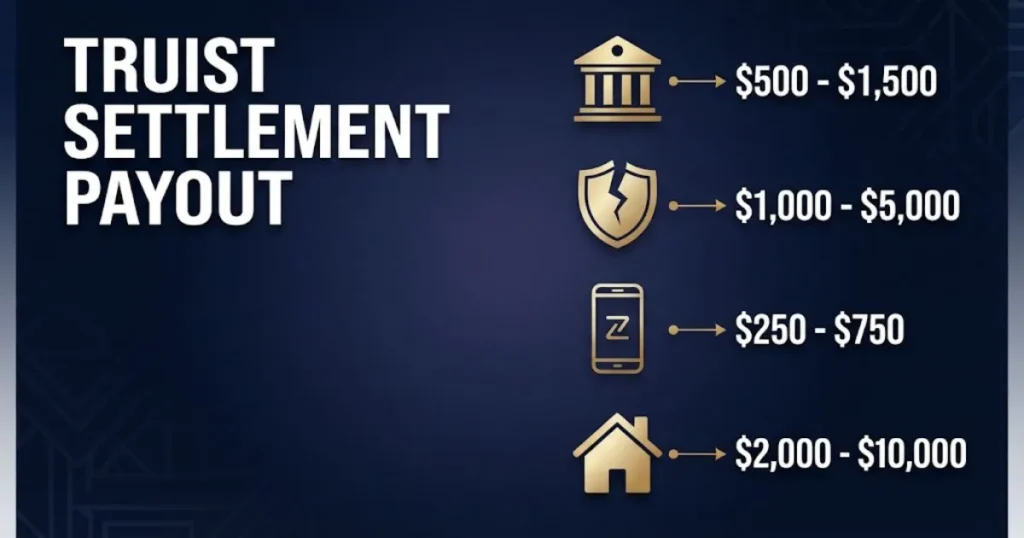
Truist settlement payout amounts will vary significantly depending on the type of case, your specific losses, and how many claimants participate. Based on comparable banking class action settlements, here are realistic estimates.
For overdraft fee cases, payouts in similar lawsuits against other major banks have ranged from $30 to $500 per claimant. The amount depends on how many overdraft fees you were charged and how many people file claims.
Data breach settlements typically offer $100 to $1,000 per affected person. The higher end goes to people who can document actual identity theft or financial losses. Those who only experienced the exposure of their data usually receive the base payment.
Zelle fraud claimants could receive their full stolen amount back if the settlement or CFPB order requires full restitution. Individual losses in these cases range from $200 to $10,000 or more.
| Case Type | Estimated Payout Range | Basis |
|---|---|---|
| Overdraft Fees | $30 to $500 | Number of fees charged |
| Data Breach | $100 to $1,000 | Documented losses vs. base payment |
| Zelle Fraud | $200 to $10,000+ | Full restitution of stolen funds |
| Mortgage Servicing | $500 to $5,000 | Credit damage, financial harm |
| Wire Transfer Fraud | $10,000 to $250,000+ | Amount of fraudulent transfer |
Keep in mind that settlement amounts are split among all qualifying claimants. Fewer people filing means bigger individual checks. In most banking class actions, only 5% to 15% of eligible people actually file a claim.
Truist Bank Class Action Settlement Amount
The total Truist bank class action settlement amount across all cases could reach $50 million to $200 million or more, based on the scope of the alleged harm and precedent from similar banking lawsuits.
For context, Wells Fargo paid $3.7 billion in a 2022 CFPB consent order for widespread consumer abuses. Bank of America paid $727 million in 2023 over junk fees and fake accounts. Truist’s cases are smaller in scale but still significant.
The overdraft fee class action alone could settle for $20 million to $60 million, based on the estimated number of affected accounts and the average fees charged.
| Comparable Bank Settlement | Amount | Year |
|---|---|---|
| Wells Fargo (CFPB order) | $3.7 billion | 2022 |
| Bank of America (junk fees) | $727 million | 2023 |
| TD Bank (overdraft fees) | $97 million | 2023 |
| Regions Bank (overdraft) | $65 million | 2022 |
| Truist (estimated total) | $50M to $200M+ | 2026 |
These numbers might sound large, but remember that they get divided among hundreds of thousands or millions of claimants. The total settlement amount matters less than what each individual person receives. And that depends entirely on your specific situation and whether you file your claim on time.
Key Takeaway: Truist settlement payouts could range from $30 for a simple overdraft refund to over $250,000 for wire transfer fraud victims, with total settlement funds potentially exceeding $100 million across all cases.
Truist Lawsuit Eligibility: Do You Qualify
Truist lawsuit eligibility depends on the specific case and whether you experienced the type of harm alleged in that lawsuit. Each class action has its own eligibility criteria based on the time period, account type, and nature of the injury.
You don’t need to have filed a complaint with the bank or the CFPB to be eligible. You don’t need to have contacted a lawyer. If you were a Truist customer during the relevant time period and experienced the specific harm, you likely qualify.
The simplest way to check is to match your situation against the criteria for each case.
| Case | Who Qualifies |
|---|---|
| Overdraft Fee | Checking account holders charged overdraft fees, 2020 to 2025 |
| Data Breach | Customers notified of the 2023 to 2024 data breach |
| Zelle Fraud | Customers who filed Zelle fraud claims that were denied |
| Mortgage | Borrowers with payment or escrow errors, 2020 to 2025 |
| Wire Transfer | Customers who lost money to wire fraud via Truist |
| CFPB Action | May cover all affected customers automatically |
If you’re not sure whether you received a data breach notice or were charged overdraft fees, check your old mail, email, and bank statements. Truist is required to maintain records and can confirm your account history upon request.
Who Qualifies for the Truist Lawsuit
Who qualifies for the Truist lawsuit depends entirely on which case applies to your situation. There is no single “Truist lawsuit” that covers everyone. Each legal action has distinct requirements.
For the overdraft fee lawsuit, you qualify if you held a Truist checking account (or a former BB&T or SunTrust account that converted to Truist) and were charged at least one overdraft fee between 2020 and 2025.
For the data breach lawsuit, you qualify if Truist sent you a notification letter about the breach. Even if you threw the letter away, Truist has a record of who was notified.
For the Zelle fraud lawsuit, you qualify if:
- You reported an unauthorized Zelle transaction to Truist
- Truist denied your claim or refused to refund the money
- The transaction occurred through the Truist banking app
For the mortgage lawsuit, you qualify if:
- Your mortgage was serviced by Truist
- You experienced payment misapplication, escrow errors, or false credit reporting
- The problems occurred after the BB&T and SunTrust merger
There is no minimum dollar amount required to participate. Even if you were charged a single overdraft fee, you’re part of the class.
How to File a Claim Against Truist
To file a claim against Truist, you need to identify which lawsuit applies to your situation and then submit a proof of claim form by the stated deadline. The process differs slightly for each case, but the basic steps are the same.
Step 1: Determine your case. Match your experience to one of the active lawsuits (overdraft, data breach, Zelle fraud, mortgage, or wire transfer).
Step 2: Gather your documents. Pull together bank statements, fee records, data breach notification letters, Zelle transaction records, or mortgage statements. The more documentation you have, the stronger your claim.
Step 3: Complete the claim form. Once a settlement is approved, a claims administrator will set up a process for filing. Claim forms are typically available online and by mail.
Step 4: Submit before the deadline. Every settlement has a claims deadline. Missing it means you get nothing, even if you qualify.
Step 5: Wait for processing. Claims administrators review each submission. If approved, your payment will arrive by check or direct deposit.
| Step | Action | Notes |
|---|---|---|
| 1 | Identify your case | Match your situation to an active lawsuit |
| 2 | Gather documents | Bank statements, letters, transaction records |
| 3 | Complete claim form | Available after settlement approval |
| 4 | Submit on time | Deadlines are strict; no extensions |
| 5 | Await payment | Checks or direct deposit after review |
Filing is free. You do not need to hire a lawyer. You do not need to appear in court. The entire process can be completed online in most cases.
Key Takeaway: Filing a claim is free, requires no lawyer, and can be done online, but you must submit your claim before the deadline or you will receive nothing regardless of your eligibility.
Truist Lawsuit Deadline 2026
The Truist lawsuit deadline in 2026 has not been finalized for all cases because not every lawsuit has reached the settlement stage. However, several key dates are expected throughout the year.
For the overdraft fee case, if mediation results in a settlement during the first half of 2026, the claims deadline would likely fall in late 2026 or early 2027. Courts typically allow 60 to 120 days after final settlement approval for claimants to submit their forms.
The data breach case is further behind, so its deadline probably won’t arrive until 2027 at the earliest.
For the CFPB enforcement action, there may not be a traditional deadline at all. If the bureau orders automatic restitution, Truist would be required to identify affected customers and send payments directly.
| Case | Expected Deadline |
|---|---|
| Overdraft Fee | Late 2026 to early 2027 |
| Data Breach | 2027 (estimated) |
| Zelle Fraud | 2027 (estimated) |
| Mortgage | 2027 or later |
| Wire Transfer | Varies by individual case |
| CFPB Action | Automatic; no claim required if consent order issued |
Here’s the thing about deadlines in class action lawsuits: they are final. Courts do not grant extensions for individual claimants who miss the cutoff. If the deadline is October 15, 2026, and you file on October 16, you’re out.
Stay aware of announcements. Check the settlement administrator’s website (once announced) or sign up for case updates through the court’s public records system. Procrastination is the single biggest reason eligible people lose their payouts.
Frequently Asked Questions
How much money will I get from the Truist lawsuit?
Most claimants in the overdraft fee case can expect between $30 and $500.
Data breach victims may receive $100 to $1,000, and Zelle fraud claimants could get full restitution of their stolen funds.
The exact amount depends on your documented losses and how many people file claims.
Is there a class action lawsuit against Truist Bank in 2026?
Yes, there are multiple active class action lawsuits against Truist Bank in 2026.
These cover overdraft fees, data breach damages, Zelle fraud refusals, and mortgage servicing errors.
Several cases are advancing toward settlement or trial.
How do I file a claim against Truist Bank?
You file a claim by completing a proof of claim form once the settlement is approved by the court.
Claim forms are typically available online through the settlement administrator’s website.
Filing is free and does not require a lawyer.
What is the deadline to join the Truist lawsuit?
No final claims deadline has been set for most Truist cases as of early 2026.
The overdraft fee case is expected to have a deadline in late 2026 or early 2027.
Watch for court announcements, as deadlines are strict and not extendable.
Does the Truist lawsuit cover Zelle fraud?
Yes, there is a specific class action lawsuit targeting Truist’s refusal to reimburse customers for unauthorized Zelle transactions.
The case is active in federal court after a judge denied Truist’s motion to dismiss in late 2025.
Customers who reported Zelle fraud and were denied reimbursement may qualify.
The Truist lawsuit situation in 2026 is active and evolving. Multiple cases are moving toward settlements that could put real money back in customers’ pockets.
If you were a Truist customer who experienced overdraft fees, a data breach, Zelle fraud, mortgage errors, or wire transfer losses, check your eligibility now. Gather your records and be ready to file when claim forms become available.
Don’t wait until deadlines pass. The people who act early are the ones who get paid.







