

A wrongful firing lawsuit is your legal weapon when an employer breaks the law to get rid of you. If you were fired for discriminatory reasons, for reporting illegal activity, or in violation of a contract, you may have a valid claim worth tens of thousands of dollars or more.
That number isn’t just talk. The EEOC secured over $665 million in monetary benefits for victims of workplace discrimination in fiscal year 2024 alone. Wrongful termination cases made up a significant chunk of those recoveries.
In this article, you’ll learn exactly what counts as wrongful termination in 2026, how to spot the signs, what evidence you need, how to file your case, and what kind of money you can realistically expect. We’ll cover every type of claim, every deadline, and what a lawyer will actually cost you.
Whether you got fired last week or you’re still wondering if what happened to you was legal, this is everything you need to know before making your next move.
What Is a Wrongful Firing Lawsuit?
A wrongful firing lawsuit is a legal action filed by an employee who was terminated in violation of federal, state, or local law. It’s not about being fired unfairly in a general sense. It’s about being fired illegally.
The distinction matters. You can be let go because your boss doesn’t like your shoes. That’s legal. But you can’t be fired because of your race, gender, religion, disability, or because you reported safety violations. That’s illegal.
These lawsuits fall into several categories. Each one has different rules, deadlines, and potential payouts.
| Claim Type | Legal Basis | Common Examples |
|---|---|---|
| Discrimination | Title VII, ADA, ADEA | Fired for race, age, disability |
| Retaliation | Various federal/state laws | Fired for filing a complaint |
| Whistleblower | Sarbanes-Oxley, OSHA laws | Fired for reporting fraud |
| Breach of Contract | State contract law | Fired despite valid employment contract |
| Public Policy Violation | State common law | Fired for jury duty, voting, military service |
A wrongful firing lawsuit can be filed in federal or state court depending on the claim. Many cases start with an administrative complaint through the EEOC or a state agency before a lawsuit can proceed.
The stakes are real. Successful plaintiffs can recover lost wages, emotional distress damages, and sometimes punitive damages that punish the employer.
What Qualifies as Wrongful Termination?
Wrongful termination happens when an employer fires someone for a reason that violates a specific law or contractual obligation. Not every unfair firing is wrongful in the legal sense.
To qualify, your termination generally has to fall into one of these buckets:
- Discrimination: You were fired because of a protected characteristic like race, sex, age, religion, national origin, pregnancy, or disability.
- Retaliation: You were fired for exercising a legal right, such as filing a harassment complaint, requesting FMLA leave, or reporting a safety hazard.
- Contract violation: Your employer broke the terms of a written or implied employment agreement.
- Public policy violation: You were fired for doing something the law protects, like serving on a jury, voting, or refusing to commit an illegal act.
- Whistleblowing: You reported illegal company conduct to a government agency and got terminated as punishment.
The key word is “illegal.” Being fired because your company is downsizing isn’t wrongful. Being fired two days after filing a sexual harassment complaint very well could be.
Think of it like traffic law. Getting a flat tire is bad luck. Getting rear-ended by a drunk driver is illegal. The law only steps in when someone breaks a rule.
Quick Fact: According to the EEOC, retaliation was the most frequently cited basis for charges filed with the agency in recent years, accounting for over 55% of all complaints.
Signs You Were Wrongfully Fired
The biggest sign you were wrongfully fired is suspicious timing between a protected activity and your termination. If you complained about harassment on Monday and got a pink slip on Friday, that pattern tells a story.
Here are the most common red flags:
- You were fired shortly after filing a discrimination or safety complaint
- Your employer gave no reason or an obviously fake reason for your termination
- You were replaced by someone outside your protected class (younger, different race, etc.)
- Other employees who did the same thing you did weren’t fired
- Your performance reviews were positive right up until you were let go
- You were fired after requesting medical leave, disability accommodations, or pregnancy leave
- Your boss made discriminatory comments before or during the termination
- You were fired after refusing to do something illegal
None of these signs alone proves wrongful termination. But a combination of them builds a pattern that attorneys and juries take seriously.
Pay attention to documentation. If your employer suddenly started writing you up for minor infractions right after you engaged in protected activity, that’s often a sign of “papering the file.” It’s a tactic some companies use to create a false paper trail.
Key Takeaway: Wrongful termination isn’t about fairness in a general sense; it’s about whether your firing violated a specific law, and timing plus context are the two biggest clues.
At-Will Employment and Wrongful Termination
At-will employment means your employer can fire you for any reason or no reason at all, as long as the reason isn’t illegal. Every state except Montana follows the at-will doctrine by default.
This trips people up constantly. They think “at-will” means their employer can do literally anything. That’s not true.
At-will employment has three major exceptions recognized by courts across the country:
| Exception | What It Means | Example |
|---|---|---|
| Public Policy | Can’t fire you for exercising a legal right | Fired for filing a workers’ comp claim |
| Implied Contract | Promises made in handbooks or verbally can create binding agreements | Handbook says “employees will only be terminated for cause” |
| Implied Covenant of Good Faith | Employer can’t fire you in bad faith to avoid obligations | Fired the day before your pension vests |
Not every state recognizes all three exceptions. Some states only recognize one or two. Montana is the outlier; it requires “good cause” for termination after a probationary period.
So yes, you can absolutely sue for wrongful termination even as an at-will employee. The at-will doctrine protects employers from lawsuits over arbitrary firings, but it does not protect them from illegal ones. That line is where your case lives.
Wrongful Termination Based on Discrimination
Discrimination-based wrongful termination is the most common type of claim, and it occurs when an employer fires someone because of who they are rather than how they perform. Federal law prohibits termination based on specific protected characteristics.
Under Title VII of the Civil Rights Act, employers with 15 or more employees cannot fire someone because of:
- Race or color
- Religion
- Sex (including sexual orientation and gender identity, per the 2020 Bostock v. Clayton County ruling)
- National origin
- Pregnancy
Other federal laws expand protections:
- ADA: Prohibits firing based on disability
- ADEA: Prohibits firing workers 40 and older because of age
- GINA: Prohibits firing based on genetic information
State laws often go further. California, New York, and Illinois, for example, protect against termination based on marital status, political activity, and other categories not covered federally.
Here’s the tricky part. Employers rarely say “we’re firing you because you’re [protected class].” Instead, they give a neutral reason. Your job is to show that reason is a pretext, a cover story for discrimination.
Quick Fact: In fiscal year 2024, race discrimination charges made up approximately 31% of all EEOC filings, followed closely by sex and disability claims.
Wrongful Firing Retaliation Claims
A wrongful firing retaliation claim arises when your employer terminates you as punishment for engaging in a legally protected activity. Retaliation is the single most common charge filed with the EEOC.
Protected activities that trigger retaliation claims include:
- Filing a discrimination or harassment complaint (internally or with the EEOC)
- Participating as a witness in a workplace investigation
- Requesting accommodations under the ADA
- Taking FMLA leave
- Reporting wage theft or labor law violations
- Filing a workers’ compensation claim
- Cooperating with a government investigation of your employer
To win a retaliation claim, you generally need to prove three things. First, you engaged in a protected activity. Second, your employer took an adverse action against you (firing, demotion, pay cut). Third, there’s a causal connection between the two.
The causal connection is where timing becomes critical. Courts have ruled that very close timing between the protected activity and the firing can be enough to establish a prima facie case of retaliation.
Think of it like this: if you never had a single write-up in five years, then suddenly received three in the month after filing an EEOC complaint, that pattern speaks louder than any excuse your employer gives.
Key Takeaway: Retaliation claims are the most frequently filed type of EEOC charge, and close timing between your protected activity and your firing is often the strongest piece of evidence you have.
Wrongful Firing and Whistleblower Protection
Whistleblower protection laws make it illegal for employers to fire workers who report fraud, safety violations, or other illegal conduct. These protections exist at both the federal and state level.
Major federal whistleblower laws include:
| Law | What It Protects | Who’s Covered |
|---|---|---|
| Sarbanes-Oxley Act | Reporting corporate fraud/securities violations | Employees of publicly traded companies |
| Dodd-Frank Act | Reporting SEC violations | Anyone who reports to the SEC |
| False Claims Act (qui tam) | Reporting fraud against the federal government | Private citizens filing on behalf of the government |
| OSHA Whistleblower Statutes | Reporting workplace safety violations | Most private sector workers |
| Whistleblower Protection Act | Reporting waste/fraud in government | Federal employees |
The False Claims Act is especially powerful. It allows whistleblowers to receive 15% to 30% of any government recovery. Some qui tam whistleblowers have received payouts in the millions.
Every state has its own whistleblower laws on top of federal protections. Many of these state laws cover a broader range of employer misconduct than federal statutes.
If you reported your employer for illegal activity and got fired for it, your claim may be stronger than you think. Whistleblower cases often result in higher payouts because courts and juries take a dim view of employers who punish honesty.
Wrongful Termination Evidence You Need
The evidence you need for a wrongful termination case includes documentation of the firing itself, proof of your protected activity or status, and anything showing the employer’s stated reason is false. Strong evidence wins cases; weak evidence loses them.
Start collecting these items immediately after being fired:
- Termination letter or email (if one was provided)
- Your personnel file (request a copy; many states require employers to provide it)
- Performance reviews from your entire tenure
- Emails, texts, or voicemails showing discriminatory or retaliatory intent
- Witness names of coworkers who saw or heard relevant events
- Company policies and employee handbook sections relevant to termination procedures
- Your complaint or report (if you filed one before being fired)
- Pay stubs and benefits information (to calculate damages)
- Notes and a personal timeline of events leading up to the termination
Digital evidence matters more than ever in 2026. Screenshots of Slack messages, Microsoft Teams chats, and internal memos can be devastating for employers who put discriminatory thoughts in writing.
One mistake people make is waiting too long. Memories fade. Coworkers leave. Emails get deleted. Write down everything you remember the same week you’re fired. Include dates, names, locations, and exact words used when possible.
Quick Fact: Employment attorneys report that cases with strong documentary evidence settle for 30% to 50% more than cases relying mainly on verbal testimony.
How to File a Wrongful Termination Lawsuit
Filing a wrongful termination lawsuit typically starts with an administrative complaint, not a direct trip to the courthouse. For most federal claims, you must file with the EEOC or your state’s fair employment agency first.
Here’s the step-by-step process:
Step 1: File an Administrative Charge
For discrimination and retaliation claims, file a charge with the EEOC or your state’s equivalent agency. This is mandatory before you can sue under Title VII, the ADA, or the ADEA.
Step 2: Cooperate with the Investigation
The agency will investigate your claim. They may attempt mediation between you and your former employer.
Step 3: Receive a Right-to-Sue Letter
If the agency doesn’t resolve your claim, they’ll issue a “right-to-sue” letter. This gives you permission to take your case to court. You generally have 90 days from receiving this letter to file your lawsuit.
Step 4: File the Lawsuit
Your attorney files the complaint in federal or state court. The lawsuit formally begins, and the discovery process (exchanging evidence) starts.
Step 5: Settlement Negotiation or Trial
Most wrongful termination cases settle before trial. If they don’t, a judge or jury decides the outcome.
| Process Stage | Typical Timeline |
|---|---|
| File EEOC Charge | Within 180 to 300 days of firing |
| EEOC Investigation | 3 to 10 months |
| Right-to-Sue Letter Issued | After investigation or upon request |
| File Lawsuit in Court | Within 90 days of right-to-sue letter |
| Settlement or Trial | 6 months to 3 years after filing |
Not all claims require the EEOC step. Breach of contract claims, public policy claims, and some whistleblower claims can go directly to state court.
Key Takeaway: Most wrongful termination claims require you to file with the EEOC first and get a right-to-sue letter before you can take your employer to court, and that 90-day window after receiving the letter is a hard deadline.
The Wrongful Termination Complaint Process
The wrongful termination complaint process begins the moment you contact the EEOC or your state’s labor agency to report your illegal firing. You don’t need a lawyer to file the initial complaint, but having one helps.
You can file an EEOC charge in several ways:
- Online through the EEOC Public Portal
- In person at your nearest EEOC field office
- By mail with a signed, detailed letter
Your charge must include your name and contact information, your employer’s name and contact information, a description of the events you believe were discriminatory or retaliatory, the dates of those events, and the number of employees at the company.
After you file, the EEOC assigns an investigator. They’ll contact your employer for a response. The employer then submits their version of events. The EEOC may request additional documentation from both sides.
At this stage, the EEOC often offers mediation. This is a free, voluntary process where a neutral mediator tries to help both parties reach a resolution without litigation. Mediation is confidential, and anything said during it can’t be used in court if it fails.
If mediation doesn’t work and the investigation wraps up, the EEOC issues one of three outcomes:
- Cause finding: The EEOC believes discrimination occurred and attempts conciliation
- No cause finding: The EEOC doesn’t find sufficient evidence (you can still sue)
- Right-to-sue letter: Issued upon request or after investigation, allowing you to file in court
The complaint process is free. The EEOC doesn’t charge fees. Your only cost is time and whatever you spend on an attorney if you choose to hire one.
Wrongful Firing Lawsuit Statute of Limitations
The statute of limitations for a wrongful firing lawsuit depends on the type of claim and your state. Missing your deadline means losing your right to sue entirely, so this is one of the most time-sensitive details in the entire process.
Here are the key federal deadlines:
| Claim Type | Filing Deadline |
|---|---|
| Title VII (discrimination/retaliation) | 180 days to file EEOC charge (300 days if state has a fair employment agency) |
| ADA (disability discrimination) | 180 to 300 days for EEOC charge |
| ADEA (age discrimination) | 180 to 300 days for EEOC charge |
| Section 1981 (race discrimination) | 4 years to file directly in court |
| FMLA retaliation | 2 years (3 years for willful violations) |
| Sarbanes-Oxley whistleblower | 180 days to file with OSHA |
| State law claims | Varies: 1 to 6 years depending on state and claim type |
The 180-day deadline is the one that catches most people off guard. It starts running from the date of your termination, not the date you decided to do something about it.
States with their own fair employment agencies often extend that federal deadline to 300 days. California, New York, Texas, Illinois, and most other populous states have these agencies.
For breach of contract claims filed under state law, the statute of limitations is typically 2 to 6 years depending on whether the contract was written or oral. Public policy claims vary widely by state.
Don’t sit on your rights. If you think you were wrongfully fired, start the process within the first few weeks. Waiting until month five of a six-month deadline is risky.
Can You Sue for Wrongful Termination in 2026?
Yes, you can sue for wrongful termination in 2026 as long as you fall within the applicable statute of limitations and your firing violated a specific law. No new federal legislation has eliminated or changed these rights heading into 2026.
Several legal developments in 2025 and early 2026 are worth watching:
- The EEOC continues to enforce expanded protections for LGBTQ workers under the Bostock decision.
- Several states have passed new laws increasing protections against retaliation for reporting wage theft.
- Remote work termination disputes are rising as courts begin addressing whether out-of-state remote employees are covered by the laws of their home state or the employer’s state.
The remote work question is becoming a big deal in 2026. Imagine you live in California but work remotely for a company headquartered in Texas. Which state’s employment laws apply when you’re fired? Courts are split, and this issue will generate significant case law in 2026.
If you were fired in 2024 or 2025, check your deadlines carefully. Some federal claims may have already expired if your termination happened more than 300 days ago. State law claims, however, may still be viable depending on the type of claim and your state’s deadline.
Quick Fact: The EEOC received over 81,000 charges of workplace discrimination in fiscal year 2024. That number is expected to remain steady or increase in 2026.
Key Takeaway: You can absolutely file a wrongful termination lawsuit in 2026, but deadlines vary dramatically depending on your claim type and state, so check your specific time limits before anything else.
How Long Does a Wrongful Termination Lawsuit Take?
A wrongful termination lawsuit typically takes 6 months to 3 years from filing to resolution. Cases that settle finish faster. Cases that go to trial take longer.
Here’s a realistic breakdown of the timeline:
| Phase | Duration |
|---|---|
| EEOC complaint and investigation | 3 to 10 months |
| Right-to-sue letter to filing lawsuit | 1 to 90 days |
| Discovery (exchanging evidence) | 3 to 12 months |
| Mediation or settlement talks | 1 to 3 months |
| Trial (if needed) | 1 to 2 weeks for the actual trial |
| Total from firing to resolution | 6 months to 3+ years |
Several factors speed things up or slow things down. Simple cases with strong evidence and a willing employer often settle within 6 to 12 months. Complex cases involving multiple plaintiffs, disputed facts, or large damage claims can stretch past 3 years.
Federal courts tend to move slower than state courts in many jurisdictions. Large metropolitan court systems often have heavy backlogs that add months to your timeline.
One thing that often shortens the process is a strong demand letter. If your attorney sends a well-documented demand letter before filing suit, some employers choose to settle immediately rather than face the cost and publicity of litigation.
Patience matters, but urgency matters more at the start. File on time, gather evidence quickly, and then be prepared for a process that moves at the speed of the legal system, which is rarely fast.
Wrongful Termination Settlement Amounts
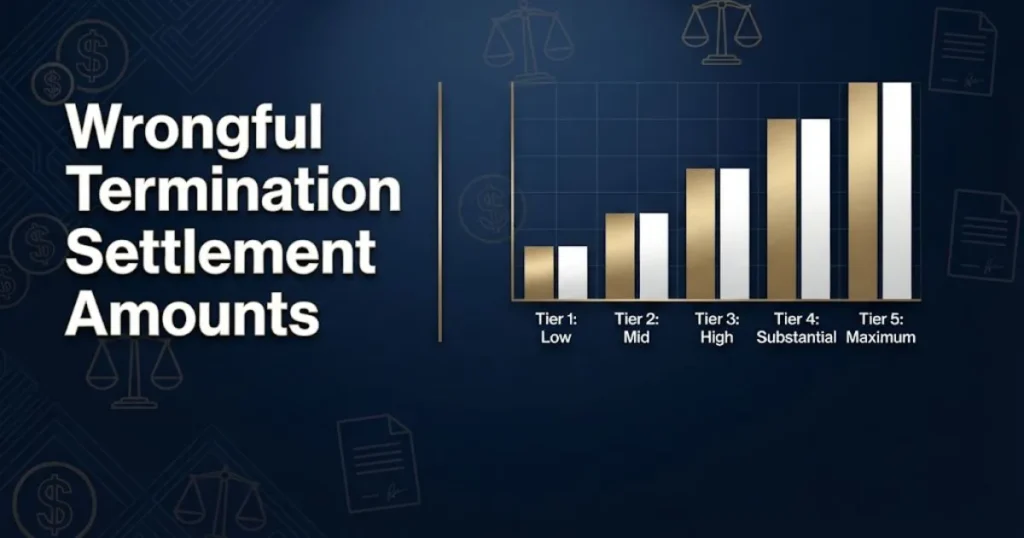
Wrongful termination settlement amounts range from $5,000 to over $1 million, with the typical case settling between $20,000 and $100,000. The amount depends on your salary, the strength of your evidence, the type of claim, and the size of the employer.
Here’s a general breakdown of settlement ranges:
| Case Strength | Typical Settlement Range |
|---|---|
| Weak case (little evidence, small employer) | $5,000 to $20,000 |
| Moderate case (decent evidence, mid-size employer) | $20,000 to $100,000 |
| Strong case (strong evidence, large employer) | $100,000 to $500,000 |
| Exceptional case (egregious conduct, public company) | $500,000 to $1 million+ |
Several factors push settlements higher:
- High salary (more lost wages to recover)
- Clear discriminatory or retaliatory statements in writing
- Employer with a history of similar complaints
- Emotional distress with medical documentation
- Public employers or large corporations trying to avoid bad press
Most wrongful termination cases settle out of court. Estimates suggest that roughly 90% to 95% of employment lawsuits resolve before trial. Employers prefer settlements because they avoid unpredictable jury verdicts and negative publicity.
Small employers (under 50 employees) tend to settle for less simply because they have fewer resources. Large corporations, on the other hand, sometimes settle for more because the cost of litigation and reputational damage outweighs the settlement amount.
Average Wrongful Termination Settlement in 2026
The average wrongful termination settlement in 2026 is estimated at $40,000 to $80,000 for cases with moderate evidence and standard wage claims. High-value cases involving discrimination or whistleblower retaliation often settle for six figures.
These figures come from analysis of EEOC conciliation outcomes, state agency resolution data, and reported settlements from employment law practitioners. Exact averages are difficult to pin down because most settlements include confidentiality agreements.
| Claim Type | Estimated Average Settlement (2026) |
|---|---|
| Discrimination (race, sex, age) | $50,000 to $100,000 |
| Retaliation | $40,000 to $90,000 |
| Whistleblower | $75,000 to $250,000+ |
| Breach of contract | $30,000 to $80,000 |
| Public policy violation | $25,000 to $75,000 |
Whistleblower cases command the highest averages because federal laws like the False Claims Act and Dodd-Frank allow for enhanced damages and financial incentives. Qui tam whistleblowers can receive a percentage of the government’s recovery, which can mean millions in certain fraud cases.
Jury verdicts at trial tend to be significantly higher than settlements. The median jury award in wrongful termination cases at trial has historically hovered around $200,000 to $300,000. But going to trial carries risk; you could also walk away with nothing.
Your individual payout depends on your lost wages, the severity of the employer’s conduct, your emotional distress, and how aggressively your employer fights the claim. Two people fired from the same company for the same illegal reason can settle for very different amounts.
Key Takeaway: The average wrongful termination settlement in 2026 falls between $40,000 and $80,000, but whistleblower and discrimination cases regularly push into six-figure territory, especially when the evidence is strong.
Wrongful Termination Damages You Can Recover
Wrongful termination damages include economic losses like back pay and benefits, non-economic losses like emotional distress, and sometimes punitive damages designed to punish the employer. The total depends on your specific situation and the laws that apply.
Economic Damages:
- Back pay: Wages and benefits you lost from the date of firing to the date of settlement or verdict
- Front pay: Future wages you’ll lose if you can’t find comparable employment
- Lost benefits: Health insurance, retirement contributions, stock options, bonuses
- Job search costs: Expenses incurred while looking for new work
Non-Economic Damages:
- Emotional distress: Anxiety, depression, humiliation, loss of sleep
- Pain and suffering: Ongoing psychological impact of the termination
- Loss of professional reputation: Damage to your career and standing in your industry
Punitive Damages:
These are awarded to punish employers for especially egregious or malicious conduct. They’re not available in every case or under every statute.
Federal law caps combined compensatory and punitive damages based on employer size:
| Employer Size | Maximum Combined Cap |
|---|---|
| 15 to 100 employees | $50,000 |
| 101 to 200 employees | $100,000 |
| 201 to 500 employees | $200,000 |
| 501+ employees | $300,000 |
These caps apply to Title VII and ADA claims. They do not apply to Section 1981 race discrimination claims, state law claims, or certain whistleblower statutes, which may have no caps at all.
Back pay has no cap under any federal statute. If you earned $80,000 a year and your case takes two years, your back pay claim alone could be $160,000 before you add anything else.
What Does a Wrongful Termination Lawyer Cost?
Most wrongful termination lawyers work on a contingency fee basis, meaning they charge nothing upfront and take a percentage of your recovery if you win. The standard contingency rate is 33% to 40% of the settlement or verdict.
Here’s how the fee structure typically works:
| Fee Type | Typical Amount | When You Pay |
|---|---|---|
| Contingency fee (pre-litigation settlement) | 25% to 33% | Only if you win |
| Contingency fee (after filing suit) | 33% to 40% | Only if you win |
| Contingency fee (at or after trial) | 40% | Only if you win |
| Hourly rate (less common in employment cases) | $200 to $500/hour | Monthly or as billed |
| Consultation fee | Free to $300 | At initial meeting |
If your case settles for $100,000 on a 33% contingency, your lawyer gets $33,000 and you take home $67,000 (before case expenses). Some firms deduct case costs (filing fees, deposition costs, expert witness fees) from your share on top of the contingency percentage.
Always ask these questions before signing a fee agreement:
- Is the contingency percentage calculated before or after deducting case expenses?
- What costs will I be responsible for if we lose?
- Does the percentage increase if the case goes to trial?
- Are there any flat fees or retainer requirements?
The good news is that several federal statutes, including Title VII and the ADA, allow courts to order the losing employer to pay the winning employee’s attorney fees. This means your lawyer may recover their fees from the employer on top of your damages, which can increase your net recovery.
Don’t let the cost of a lawyer stop you from pursuing a valid claim. The contingency model exists specifically so that workers who were just fired and have no income can still access the legal system.
Key Takeaway: Most wrongful termination lawyers work on contingency and take 33% to 40% of your recovery, but federal law may require your employer to pay your attorney fees if you win, so the real out-of-pocket cost to you could be zero.
Frequently Asked Questions
What is the average payout for a wrongful firing lawsuit in 2026?
Most wrongful firing lawsuits settle between $40,000 and $80,000 in 2026.
High-value cases involving discrimination or whistleblowing can reach six figures.
Jury verdicts at trial tend to be higher, with a median around $200,000 to $300,000.
How do I prove I was wrongfully terminated?
You prove wrongful termination with documentation showing the real reason for your firing.
Key evidence includes emails, performance reviews, witness testimony, and the timeline of events.
Showing that the employer’s stated reason is a pretext for illegal conduct is the heart of most cases.
How long do I have to file a wrongful termination lawsuit?
For federal discrimination claims, you must file an EEOC charge within 180 to 300 days of your termination.
State law claims may give you 1 to 6 years depending on the type of claim.
Missing the deadline means losing your right to sue permanently.
Can I sue my employer if I was an at-will employee?
Yes, at-will employees can sue for wrongful termination when the firing violates a law.
At-will employment does not protect employers from firing based on discrimination, retaliation, or whistleblowing.
Court-recognized exceptions to the at-will doctrine exist in nearly every state.
Do I need a lawyer to file a wrongful firing lawsuit?
You don’t legally need a lawyer, but having one dramatically increases your chances of success.
Most employment attorneys work on contingency, so you pay nothing unless you win.
An experienced lawyer can often negotiate a higher settlement than you would get on your own.
Your Next Move
A wrongful firing lawsuit can recover real money and hold your former employer accountable. The claims are valid, the law is on your side, and the process is more accessible than most people realize.
If you believe you were illegally terminated, start by documenting everything. Write down what happened, save any evidence, and check your filing deadlines based on your claim type and state.
Time is your biggest enemy in these cases. The sooner you act, the stronger your position. Check your eligibility, gather your records, and connect with an employment attorney who works on contingency. Your case starts now.







