

A lawsuit is a specific legal case filed in court. Litigation is the entire process of fighting that case. Understanding litigation vs lawsuit matters because it changes how much you spend, how long you wait, and what strategy your attorney uses.
Most people use these words like they mean the same thing. They don’t. About 97% of civil cases settle before trial, according to data from federal court records. That means most lawsuits involve litigation but never see a courtroom verdict.
This article breaks down every meaningful difference. You will learn what each term actually means, what the process looks like, how much it costs in 2026, and when you need professional help.
Whether you are dealing with a personal injury claim, a consumer fraud dispute, or a product liability case, knowing these terms puts you in control.
Litigation vs Lawsuit: What Is the Real Difference?
A lawsuit is the legal action itself. Litigation is everything that happens to resolve it. Think of a lawsuit as the game and litigation as the entire season of play.
When someone files a complaint in court against another party, that is a lawsuit. The moment attorneys start exchanging documents, filing motions, negotiating settlements, and preparing for trial, that is litigation. One is the thing. The other is the doing.
Here is the simplest way to see it:
| Term | What It Means | Analogy |
|---|---|---|
| Lawsuit | A specific legal dispute filed in court | The recipe |
| Litigation | The process of resolving that dispute | The cooking |
A lawsuit can exist without full litigation. Some cases settle within weeks of filing. The defendant agrees to pay, both sides sign off, and it is done. No discovery, no depositions, no trial.
But litigation without a lawsuit? That is rare. Litigation almost always starts because someone filed a formal complaint. The lawsuit opens the door. Litigation walks through it.
This distinction is not just academic. It affects your costs, your timeline, and your legal strategy. If your attorney says “we are in litigation,” that means the fight is active and ongoing. If they say “we filed a lawsuit,” that is just the starting gun.
Difference Between Litigation and Lawsuit Explained
The difference between litigation and a lawsuit comes down to scope. A lawsuit is a single event. Litigation is a series of events that follow.
Filing a lawsuit is like buying a plane ticket. Litigation is the entire trip, from packing your bags to landing at your destination. You can buy the ticket and cancel the trip. That happens all the time in legal disputes.
Three core differences separate the two concepts:
- Scope: A lawsuit is narrow (one complaint, one court). Litigation is broad (all legal activity tied to the dispute).
- Duration: A lawsuit begins when you file. Litigation can stretch months or years.
- Cost: Filing a lawsuit has fixed court fees. Litigation costs include attorney time, expert witnesses, document review, and more.
| Factor | Lawsuit | Litigation |
|---|---|---|
| Starting Point | Filing a complaint | Begins after complaint is filed |
| End Point | Can end with a quick settlement | Ends when the case is fully resolved |
| Who Is Involved | Plaintiff and defendant | Attorneys, judges, witnesses, experts |
| Cost Range (2026) | $200 to $500 filing fee | $10,000 to $300,000 or more |
Many people use these terms interchangeably in casual conversation. In a legal setting, precision matters. Telling your attorney you want to “file a lawsuit” sends one message. Saying you are “prepared for litigation” sends a very different one.
What Is Litigation?
Litigation is the formal process of resolving a legal dispute through the court system. It includes everything from the initial investigation to the final judgment or settlement.
Most people picture a courtroom drama when they hear “litigation.” The reality is far less dramatic. About 95% of litigation activity happens in offices, conference rooms, and email threads. Depositions, document requests, and motion filings eat up most of the time.
The litigation process generally includes:
- Pre-filing investigation: Gathering evidence before any complaint is filed
- Pleadings: Filing and responding to the initial complaint
- Discovery: Exchanging documents, taking depositions, requesting information
- Pre-trial motions: Asking the court to rule on specific issues before trial
- Settlement negotiations: Trying to resolve the case without a trial
- Trial: Presenting the case before a judge or jury
- Post-trial motions and appeals: Challenging or enforcing the outcome
Not every case goes through every stage. Settlement can happen at any point. Many corporate defendants prefer settling during discovery because going to trial is expensive and risky.
Litigation is a process, not a moment. It moves in phases, and each phase has its own costs, deadlines, and strategic considerations.
Key Takeaway: A lawsuit is a single legal action; litigation is the full process of resolving it, and understanding the difference directly affects your costs and strategy.
What Is a Lawsuit?
A lawsuit is a formal legal claim filed by one party against another in a court of law. It starts when the plaintiff submits a complaint and serves it on the defendant.
You can think of a lawsuit as the opening move. It is the official document that says: “I have been harmed, and I want the court to fix it.” Without a lawsuit, there is no case. Without a case, there is no litigation.
Lawsuits fall into two broad categories:
- Civil lawsuits: Disputes between individuals, businesses, or organizations over money, property, contracts, or rights
- Criminal cases: Brought by the government against individuals accused of breaking the law
For the purposes of this article, we are focused on civil lawsuits. These are the cases that affect everyday people, such as personal injury claims, consumer fraud complaints, product liability disputes, and employment discrimination cases.
| Lawsuit Element | Description |
|---|---|
| Complaint | The document that starts the case |
| Plaintiff | The person or entity filing the lawsuit |
| Defendant | The person or entity being sued |
| Summons | Official notice to the defendant |
| Filing Fee | Typically $200 to $500 in 2026 |
Filing a lawsuit does not mean you are going to trial. It means you are putting your claim on the record. What happens next depends on the defendant’s response, the strength of your case, and whether both sides can reach an agreement.
Litigation Meaning in Law
In law, litigation means the entire body of work involved in bringing, defending, or resolving a civil dispute through the judicial system. It is the legal profession’s term for “the fight.”
Attorneys who specialize in this work are called litigators or trial lawyers. Their job is not just to argue in court. They spend far more time researching, writing motions, reviewing documents, and negotiating than they ever do standing before a judge.
The word litigation comes from the Latin “litigare,” meaning to dispute or carry on a suit. In modern American law, it covers every action taken from the moment a legal dispute arises until the matter is fully resolved.
Here is what litigation looks like in practice:
- Drafting and filing legal documents
- Conducting depositions of witnesses
- Reviewing thousands of pages of evidence
- Filing motions to dismiss, compel discovery, or exclude evidence
- Negotiating settlement terms with opposing counsel
- Presenting arguments at trial
The American Bar Association reported that federal courts handled over 400,000 new civil cases in 2024. Each of those cases involved some degree of litigation, even if most never reached a trial.
Litigation is not a single action. It is a discipline. When someone says they practice litigation, they are describing an entire field of legal work.
Civil Litigation vs Lawsuit
Civil litigation is the process used to resolve non-criminal disputes, while a lawsuit is the specific case being resolved. Every civil lawsuit involves civil litigation, but the terms describe different things.
Civil litigation handles disputes between private parties. It does not involve criminal charges or jail time. The goal is usually money (damages) or a court order requiring someone to do something or stop doing something.
Common types of civil litigation in 2026 include:
- Personal injury: Car accidents, slip-and-fall, medical malpractice
- Contract disputes: Breach of business agreements, lease violations
- Employment claims: Wrongful termination, wage theft, discrimination
- Consumer protection: Defective products, false advertising, data breaches
- Real estate disputes: Property boundary conflicts, landlord-tenant issues
| Civil Litigation vs Lawsuit | Key Point |
|---|---|
| Civil Litigation | The process and practice area |
| Lawsuit | The individual case within that process |
| Who Uses “Civil Litigation” | Attorneys, courts, legal professionals |
| Who Uses “Lawsuit” | Everyday people, media, plaintiffs |
If you are a consumer affected by a defective product, you would file a lawsuit. Your attorney would then conduct civil litigation on your behalf. Same case, different terms for different parts.
Key Takeaway: Civil litigation is the professional practice of resolving disputes; a lawsuit is one specific dispute within that practice, and both terms show up in your case, just at different stages.
Types of Litigation
Litigation comes in many forms, and the type determines the rules, timeline, and costs of your case. The most common types in 2026 are civil, commercial, criminal defense, and administrative.
Each type has its own court system, its own set of procedures, and its own typical outcomes. Knowing which type applies to your situation helps you find the right attorney and set realistic expectations.
Here are the primary types:
- Civil litigation: Disputes between individuals or entities (personal injury, product liability)
- Commercial litigation: Business-to-business conflicts (contract breaches, partnership disputes)
- Criminal litigation: Defense against criminal charges brought by the government
- Administrative litigation: Disputes involving government agencies (Social Security appeals, regulatory challenges)
- Class action litigation: One lawsuit filed on behalf of a large group of similarly harmed people
- Mass tort litigation: Multiple individual lawsuits grouped together over the same product or harm
| Type | Who Is Involved | Typical Outcome |
|---|---|---|
| Civil | Individuals, small businesses | Money damages or injunction |
| Commercial | Corporations, partnerships | Contract enforcement or damages |
| Class Action | Large consumer groups | Settlement fund with individual payouts |
| Mass Tort | Hundreds or thousands of plaintiffs | Individual settlements or bellwether trials |
| Administrative | Individuals vs. government agencies | Agency decision upheld or reversed |
Class actions and mass torts are especially relevant for consumers in 2026. Ongoing cases involving pharmaceutical companies, tech platforms, and consumer product manufacturers are moving through courts right now. The type of litigation dictates how long you wait and how much you might receive.
Stages of Litigation
Litigation moves through six main stages: investigation, pleadings, discovery, pre-trial, trial, and post-trial. Most cases resolve during discovery or pre-trial, long before a jury ever hears the facts.
Think of these stages like chapters in a book. Some books are short; the case settles in chapter two. Others are epics that drag through every stage and into appeals.
Stage 1: Investigation and Pre-Filing
Attorneys gather evidence, interview witnesses, and assess whether the case has merit. This can take weeks or months.
Stage 2: Pleadings
The plaintiff files a complaint. The defendant responds with an answer or a motion to dismiss. These documents frame the entire case.
Stage 3: Discovery
Both sides exchange evidence. This is usually the longest and most expensive stage. Depositions, document requests, and interrogatories happen here.
Stage 4: Pre-Trial Motions and Conferences
Attorneys file motions to shape the case. The judge may hold conferences to encourage settlement.
Stage 5: Trial
If settlement fails, the case goes before a judge or jury. Trials can last days, weeks, or even months in complex cases.
Stage 6: Post-Trial
The losing side can file appeals. Judgments must be enforced. This stage can add months or years.
| Stage | Average Duration | Cost Impact |
|---|---|---|
| Investigation | 1 to 6 months | Low |
| Pleadings | 1 to 3 months | Low to moderate |
| Discovery | 6 to 18 months | High (50% to 80% of total cost) |
| Pre-Trial | 1 to 6 months | Moderate |
| Trial | Days to months | Very high |
| Post-Trial/Appeal | 6 to 24 months | Variable |
Discovery alone accounts for the majority of litigation costs. In federal cases, discovery expenses can reach tens of thousands of dollars just for document review.
Litigation Process Explained
The litigation process is a step-by-step legal procedure that begins with a dispute and ends with a resolution, whether through settlement, trial verdict, or dismissal. Every step follows rules set by the court.
For someone going through this for the first time, it can feel overwhelming. Here is a plain-language walkthrough of what actually happens and when.
Step 1: Something goes wrong. You get hurt by a product. A company breaches your contract. Your employer fires you illegally. This is the triggering event.
Step 2: You consult an attorney. They review your facts and determine whether you have a valid legal claim. Many attorneys offer free consultations for personal injury and consumer cases.
Step 3: Your attorney files the complaint. This is the formal lawsuit. It gets filed with the court and served on the defendant.
Step 4: The defendant responds. They have a set number of days (usually 20 to 30) to file an answer or a motion to dismiss.
Step 5: Discovery begins. Both sides request documents, take depositions, and build their case. This is where most of the work happens.
Step 6: Settlement talks. The majority of cases settle here. Both sides weigh the costs of trial against the benefits of a deal.
Step 7: Trial (if needed). Only about 3% of civil cases reach trial in federal court, based on Federal Judicial Center data.
Step 8: Judgment and enforcement. The court issues a ruling. The winning side collects.
This process can take anywhere from a few months to several years. The complexity of your case, the court’s backlog, and the willingness of both sides to negotiate all affect the timeline.
Key Takeaway: Most litigation cases settle during discovery or pre-trial; fewer than 5% of civil cases ever reach a trial, so understanding the early stages saves you time and money.
When Does a Lawsuit Become Litigation?
A lawsuit becomes litigation the moment legal activity extends beyond the initial filing. Once attorneys begin exchanging information, filing motions, or negotiating, the case has entered the litigation phase.
Filing a complaint is just the first step. It is like putting a car in gear. Litigation is when you actually start driving. Some cases shift into litigation immediately. Others sit idle for weeks while the defendant prepares a response.
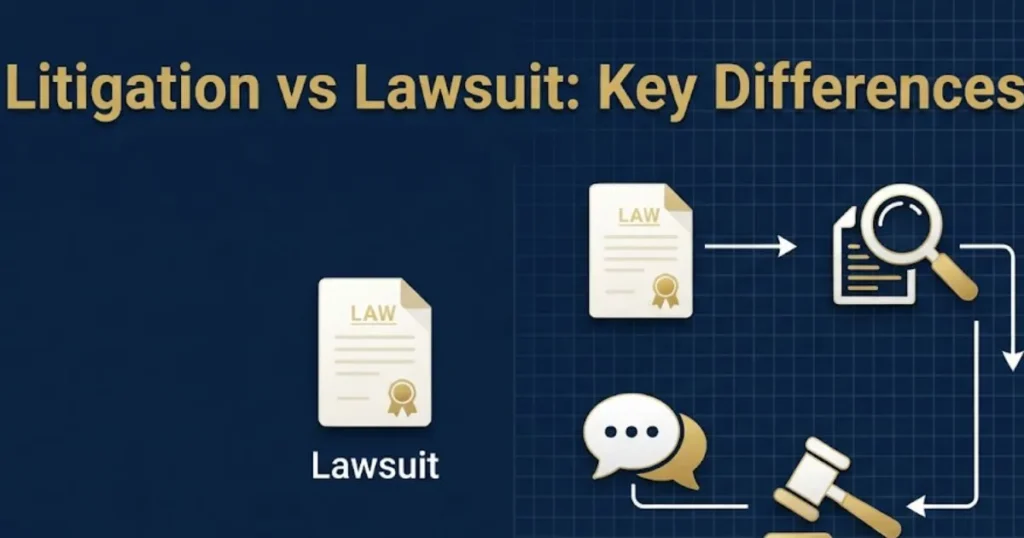
Here is a simple timeline:
| Event | Is It a Lawsuit? | Is It Litigation? |
|---|---|---|
| You hire an attorney | No | No (pre-lawsuit) |
| Complaint is filed | Yes | Not yet (just filed) |
| Defendant is served | Yes | Beginning |
| Defendant files an answer | Yes | Active litigation |
| Discovery begins | Yes | Full litigation |
| Settlement is reached | Yes (resolved) | Litigation ends |
| Case goes to trial | Yes | Peak litigation |
The transition is not always clear-cut. In practice, attorneys consider a case “in litigation” once both sides are actively engaged. That usually means the defendant has responded and discovery is underway.
For consumers involved in class actions or mass torts, litigation often begins long before they even know about the case. Attorneys file on behalf of a class, litigation proceeds for months or years, and individual claimants join later when a settlement is announced.
Your lawsuit becomes litigation when the legal process starts moving. From that point forward, costs increase, timelines extend, and the stakes get real.
How to File a Lawsuit
Filing a lawsuit requires drafting a legal complaint, paying a court filing fee, and serving the document on the defendant. In 2026, most courts accept electronic filings, making the process faster than ever.
You do not always need an attorney to file a lawsuit. Small claims courts are designed for self-represented plaintiffs. But for anything involving significant money, injuries, or complex legal issues, professional help is strongly recommended.
Here are the basic steps:
- Determine the right court: Small claims, state court, or federal court, depending on the amount in dispute and the type of claim
- Draft the complaint: This document must identify the parties, state the facts, and explain what relief you are seeking
- Pay the filing fee: Ranges from $30 in small claims to $400 or more in federal court
- File with the court clerk: Submit your complaint electronically or in person
- Serve the defendant: The defendant must receive official notice of the lawsuit, usually through a process server or certified mail
| Filing Detail | Small Claims | State Court | Federal Court |
|---|---|---|---|
| Filing Fee (2026) | $30 to $100 | $150 to $400 | $350 to $405 |
| Attorney Required? | Usually no | Recommended | Strongly recommended |
| Typical Claim Amount | Up to $5,000 to $10,000 | No limit | Over $75,000 (diversity) |
| Electronic Filing | Varies by state | Most states | Required (PACER/ECF) |
After filing, the clock starts. The defendant typically has 20 to 30 days to respond. What happens after that determines whether your case resolves quickly or enters full litigation.
Lawsuit vs Litigation Cost
Lawsuit costs are the fees you pay to start a case. Litigation costs are the total expenses of fighting it from start to finish. The gap between the two can be enormous.
Filing a lawsuit might cost a few hundred dollars. But litigation? That can run from $10,000 for a simple dispute to over $500,000 for complex commercial cases. The National Center for State Courts has found that discovery costs alone often exceed the total amount in dispute for smaller claims.
Here is what the numbers look like in 2026:
| Cost Category | Low End | High End |
|---|---|---|
| Court filing fee | $30 | $405 |
| Attorney retainer | $2,500 | $25,000 |
| Discovery costs | $5,000 | $100,000+ |
| Expert witnesses | $2,000 | $50,000+ |
| Trial preparation | $5,000 | $75,000+ |
| Total litigation cost | $10,000 | $500,000+ |
Most personal injury attorneys work on contingency fees. That means you pay nothing upfront. They take a percentage of your settlement, usually 33% to 40%. This arrangement makes lawsuits accessible to people who cannot afford hourly attorney rates.
For consumer class actions, you typically pay nothing at all. The attorneys fund the litigation and recover their fees from the settlement. Your share comes from the settlement fund after attorney costs are deducted.
The bottom line: filing a lawsuit is cheap. Fighting one is not. Know the difference before you commit.
Key Takeaway: Filing a lawsuit costs a few hundred dollars, but full litigation can cost tens of thousands; contingency fees and class action structures help everyday consumers avoid upfront expenses.
Litigation Timeline
The average litigation timeline in 2026 runs 12 to 24 months for a standard civil case. Complex cases, class actions, and mass torts can take three to five years or longer.
Time is one of the biggest frustrations for plaintiffs. Courts are backlogged. Discovery takes forever. Defendants use delay tactics. Here is a realistic breakdown of what to expect.
| Phase | Typical Duration |
|---|---|
| Pre-filing investigation | 1 to 3 months |
| Filing and service | 1 to 2 months |
| Defendant’s response | 20 to 60 days |
| Discovery | 6 to 18 months |
| Pre-trial motions | 2 to 6 months |
| Settlement negotiations | Ongoing (can happen any time) |
| Trial | 3 days to 3 months |
| Appeals | 6 to 24 months |
Personal injury cases tend to resolve faster than commercial disputes. A straightforward car accident claim might settle in 6 to 12 months. A pharmaceutical mass tort could take 5 to 7 years.
Federal courts generally move faster than state courts for complex litigation. Multi-district litigation (MDL) cases get assigned to a single judge, which helps streamline discovery and settlement talks.
If your case is in active litigation right now, ask your attorney for a realistic timeline estimate. Press for specifics, not vague answers. A good attorney should be able to tell you which phase you are in and what comes next.
Litigation vs Arbitration vs Lawsuit
Litigation, arbitration, and lawsuits are three different things. A lawsuit is a legal claim. Litigation is the court process. Arbitration is a private alternative to going to court at all.
Many consumer contracts in 2026 include mandatory arbitration clauses. That means the company you are suing might require you to settle your dispute through a private arbitrator instead of a judge and jury. This is common with credit card companies, cell phone carriers, and online platforms.
| Feature | Lawsuit | Litigation | Arbitration |
|---|---|---|---|
| Where it happens | Filed in court | Conducted in court | Private hearing room |
| Who decides | Judge or jury | Judge or jury | Arbitrator |
| Public record? | Yes | Yes | Usually no |
| Right to appeal | Yes | Yes | Very limited |
| Cost to consumer | Filing fee | Can be very high | Varies (often lower) |
| Timeline | Months to years | Months to years | Weeks to months |
| Binding? | Yes (after judgment) | Yes (after judgment) | Yes (usually binding) |
Arbitration is faster and cheaper. But it has downsides. You give up your right to a jury trial. The proceedings are private. And arbitrators are not required to follow legal precedent.
For consumers, the choice between litigation and arbitration is often made for them. Check your contracts. If they contain an arbitration clause, you may need to challenge it before you can file a lawsuit in court.
Some recent court decisions in 2024 and 2025 have pushed back against mandatory arbitration in employment and consumer cases. This is an area of law that is still evolving.
Do All Lawsuits Go to Litigation?
No. Not all lawsuits go through full litigation. Many cases settle shortly after filing, and some are dismissed before litigation even begins.
This surprises a lot of people. The assumption is that filing a lawsuit means you are headed to court for a long battle. In reality, many defendants would rather pay a settlement than spend money on discovery and trial preparation.
Here is how lawsuits typically resolve:
- Settlement before discovery: The defendant makes a quick offer to avoid litigation costs
- Settlement during discovery: Both sides see the evidence and agree on a number
- Dismissal: The court throws out the case for legal or procedural reasons
- Summary judgment: The judge decides the case based on the facts without a trial
- Trial verdict: A judge or jury decides after hearing all the evidence
- Default judgment: The defendant never responds, and the plaintiff wins automatically
According to federal court data, approximately 97% of civil cases settle or are resolved before trial. Only about 3% reach a courtroom.
For class actions and mass torts, full litigation is more common because the stakes are higher. But even in these large cases, settlement is the most likely outcome. Companies like Johnson & Johnson, 3M, and major pharmaceutical manufacturers have settled billions of dollars in claims without going to trial.
Your lawsuit might resolve in weeks. Or it might take years. The path depends on the facts, the money involved, and how hard the other side wants to fight.
Key Takeaway: About 97% of civil lawsuits settle before trial; filing a lawsuit does not guarantee long litigation, and many cases resolve quickly once the defendant calculates the cost of fighting.
Who Needs a Litigation Attorney?
You need a litigation attorney when your legal dispute involves significant money, complex facts, or a defendant with its own legal team. For small claims under $10,000, you can often represent yourself.
A litigation attorney is not just a courtroom performer. They are a strategist. Their job is to evaluate your case, build the strongest argument, manage discovery, negotiate settlement, and prepare for trial if needed.
You should strongly consider hiring a litigation attorney if:
- Your claim involves more than $10,000 in damages
- You are dealing with a corporation, insurance company, or government entity
- The case involves personal injury, medical malpractice, or wrongful death
- There are complex legal issues like product liability or employment discrimination
- The other side has already hired an attorney
| Scenario | Do You Need a Litigation Attorney? |
|---|---|
| Small claims dispute under $5,000 | Probably not |
| Car accident with injuries | Yes |
| Class action or mass tort | Yes (usually provided by the law firm leading the case) |
| Contract dispute over $25,000 | Yes |
| Employer violated your rights | Yes |
| Landlord-tenant disagreement | Depends on the amount at stake |
For personal injury and consumer cases, most litigation attorneys work on contingency. You pay nothing unless they win. This makes high-quality legal representation accessible regardless of your financial situation.
In class action cases, you typically do not need to hire your own attorney. The law firm that filed the class action represents all class members. You just need to file a claim when the settlement is approved.
Examples of Litigation and Lawsuits
Real-world examples make the difference between litigation and lawsuits much easier to understand. Here are several active and recent cases that show both concepts in action.
Example 1: Johnson & Johnson Talc Litigation
Thousands of individual lawsuits claimed J&J’s talc products caused ovarian cancer. Each lawsuit was a separate legal claim. The litigation, conducted through multi-district litigation (MDL), spanned over a decade. In 2025, J&J proposed a $6.5 billion settlement to resolve the mass tort litigation.
Example 2: Social Media Youth Addiction Lawsuits
School districts and families filed hundreds of lawsuits against Meta, TikTok, Snap, and other platforms. Each lawsuit alleged the platforms harmed young users. The litigation is consolidated in federal MDL, with discovery ongoing through 2025 and into 2026.
Example 3: PFAS “Forever Chemicals” Water Contamination
Municipalities filed lawsuits against chemical manufacturers over PFAS contamination. 3M agreed to a $10.3 billion settlement in 2023, with payments continuing through 2026 and beyond. The litigation involved hundreds of individual lawsuits managed through MDL.
| Case | Lawsuit (The Claim) | Litigation (The Process) |
|---|---|---|
| J&J Talc | Individual injury claims | Decade-long MDL, discovery, bellwether trials |
| Social Media Youth Cases | School district and family claims | Consolidated MDL, expert discovery, ongoing |
| PFAS Water Cases | Municipal contamination claims | MDL, $10.3B 3M settlement, continuing payouts |
These examples show that a lawsuit is the starting point. Litigation is the journey. Some journeys are short. Others take years and involve billions of dollars. The scale varies, but the relationship between the two concepts stays the same.
Key Takeaway: Major cases like the J&J talc MDL and PFAS water contamination lawsuits show how individual lawsuits feed into massive litigation processes that can last years and result in billion-dollar settlements.
Frequently Asked Questions
What is the main difference between litigation and a lawsuit?
A lawsuit is the legal claim you file in court.
Litigation is the entire process of resolving that claim, including discovery, motions, negotiation, and trial.
The lawsuit starts the case; litigation is how the case gets fought and finished.
How much does litigation cost compared to filing a lawsuit?
Filing a lawsuit costs $30 to $405 in court fees.
Full litigation can cost $10,000 to over $500,000 depending on case complexity.
Personal injury and class action cases often use contingency fees, so you pay nothing upfront.
Can a lawsuit be settled without going through litigation?
Yes, many lawsuits settle within weeks of filing.
The defendant may offer a quick payment to avoid the expense of litigation.
About 97% of civil cases resolve before reaching trial.
How long does the litigation process take in 2026?
Standard civil litigation takes 12 to 24 months on average.
Complex cases, mass torts, and class actions can stretch three to seven years.
Discovery is usually the longest single phase, lasting 6 to 18 months.
Do I need a litigation attorney for a small claims lawsuit?
For small claims cases under $5,000 to $10,000, you can usually represent yourself.
Courts design small claims procedures for non-lawyers.
For anything involving injuries, large sums, or corporate defendants, a litigation attorney is strongly recommended.
The difference between litigation and a lawsuit is not just legal jargon. It affects your wallet, your timeline, and your entire legal strategy. Knowing which phase you are in helps you make smarter decisions.
If you are considering legal action in 2026, start by understanding your case type. Check whether your situation calls for a simple filing or full litigation. Research attorneys who specialize in your specific claim.
Stay informed. The more you know, the better your outcome.







