

The VGW lawsuit is one of the biggest legal battles in online social casino history, and 2026 could be the year players finally see real money back. VGW Holdings, the company behind Chumba Casino and Global Poker, faces class action claims alleging its platforms operate as illegal gambling sites disguised as sweepstakes games.
If you spent money on Gold Coins or Sweeps Coins, you might be entitled to a refund. Thousands of players across the country are watching this case closely.
This article covers everything you need to know: how much you could get paid, whether you qualify, filing deadlines, state-by-state details, and what is happening in 2026. Some players could recover a significant portion of their total spending.
What Is the VGW Lawsuit About
The VGW lawsuit is a series of legal actions accusing VGW Holdings of running illegal online gambling operations through platforms marketed as free social casinos. Players allege they were led to believe they were playing harmless sweepstakes games when, in reality, the platforms functioned like traditional online casinos.
The core argument is simple. VGW sells virtual currency (Gold Coins) that players use to access games. Players then receive “Sweeps Coins” that can be redeemed for real cash prizes. Plaintiffs say this is just gambling with extra steps.
Courts in multiple states have started agreeing. Several judges have ruled that VGW’s model looks a lot more like gambling than a legitimate sweepstakes promotion.
The lawsuits seek refunds for all money players spent on Gold Coin packages. Some cases also seek statutory damages under state consumer protection laws. That could mean players get back more than what they originally spent.
| Detail | Info |
|---|---|
| Defendant | VGW Holdings Limited |
| Platforms Involved | Chumba Casino, Global Poker, LuckyLand Slots |
| Core Allegation | Operating illegal online gambling |
| What Plaintiffs Want | Full refunds plus statutory damages |
| Case Type | Class action and individual claims |
Think of it like this: if a store sold you “gift cards” but those gift cards could only be used at slot machines, regulators would shut it down fast. That is basically what plaintiffs say VGW has been doing online.
VGW Lawsuit 2026: Where Things Stand Right Now
The VGW lawsuit in 2026 has reached a critical stage, with several cases moving toward settlement discussions and trial preparation simultaneously. This year is shaping up to be the most consequential one yet for affected players.
Multiple federal and state court cases are now past the discovery phase. Both sides have exchanged documents, taken depositions, and filed key motions. Judges have denied VGW’s attempts to dismiss several of the major cases.
Class certification has been granted in at least two major proceedings. That means courts have agreed that enough players share common claims to move forward as a group rather than filing thousands of individual lawsuits.
Settlement talks are actively underway in some jurisdictions. Early reports suggest VGW may be willing to create a settlement fund to resolve claims rather than risk a jury trial. No final settlement has been publicly approved yet as of early 2026.
Key 2026 milestones to watch:
- Class certification decisions in remaining cases
- Potential settlement fund announcement (estimated mid-2026)
- Trial dates set for cases that do not settle
- Deadline extensions for late-filing claimants
The pace has picked up considerably. Players who registered their claims early are in the best position, but new claimants still have time in most states.
VGW Class Action Lawsuit Explained
A VGW class action lawsuit is a legal case where one or a few named plaintiffs represent thousands of other players who suffered similar losses on VGW platforms. Instead of each player filing a separate lawsuit, the class action bundles everyone together.
This matters because most individual players lost amounts ranging from a few hundred to a few thousand dollars. Filing a solo lawsuit over $500 would cost more in legal fees than the claim is worth. The class action solves that problem.
In a class action, the law firm handles everything. They investigate, file the complaint, negotiate with VGW, and go to trial if needed. Class members typically pay nothing out of pocket. Attorneys get paid from a percentage of the settlement or verdict.
How class actions work in this case:
- Named plaintiffs filed the initial complaint
- Attorneys gathered evidence of VGW’s business practices
- The court certified the class (approved the group approach)
- All eligible players automatically become class members unless they opt out
- Settlement or trial determines total compensation
- Payments are distributed to class members
You do not need to “join” most class actions. If you used Chumba Casino or Global Poker and spent money, you may already be part of the class. However, filing a claim form ensures you actually receive payment when funds are distributed.
Key Takeaway: The VGW lawsuit is a real, active class action in 2026 with multiple cases advancing toward settlement or trial, and players who spent money on VGW platforms may already be class members.
Who Is VGW Holdings and Why Are They Being Sued
VGW Holdings Limited is an Australian technology and gaming company that operates several social casino platforms popular in the United States. The company was founded in 2010 and is headquartered in Perth, Australia, with additional offices in other countries.
VGW runs three main platforms that U.S. players use:
- Chumba Casino: The flagship social casino with slots, table games, and other casino-style games
- Global Poker: An online poker platform using the same sweepstakes currency model
- LuckyLand Slots: A smaller slots-focused platform
The company generates hundreds of millions of dollars annually from U.S. players purchasing Gold Coin packages. Despite handling massive volumes of real money, VGW has maintained it does not operate gambling sites. The company argues its platforms are legal sweepstakes promotions.
Plaintiffs disagree. They point to the fact that players must spend real money to get meaningful gameplay. The “free” entry method (sending a physical letter to receive Sweeps Coins) is so impractical that virtually nobody uses it.
| Company Detail | Info |
|---|---|
| Full Name | VGW Holdings Limited |
| Headquarters | Perth, Australia |
| Founded | 2010 |
| Main U.S. Platforms | Chumba Casino, Global Poker, LuckyLand Slots |
| Business Model | Virtual currency sweepstakes |
| Annual U.S. Revenue | Estimated hundreds of millions |
| Gambling License | No U.S. gambling license held |
The lack of a U.S. gambling license is one of the biggest issues. Traditional online casinos must obtain state-by-state licenses. VGW skipped that process entirely by calling its products sweepstakes.
Chumba Casino Lawsuit: The Biggest Case Against VGW
The Chumba Casino lawsuit represents the largest and most closely watched legal action against VGW Holdings. Chumba Casino has millions of registered users in the United States, making it the primary revenue driver for VGW and the primary target of litigation.
Players allege that Chumba Casino is, for all practical purposes, an unlicensed online casino. The games look identical to real casino slots. The mechanics work the same way. And players spend real money with the hope of winning real money back. The only difference is the intermediary step of purchasing virtual coins.
Several key court rulings have gone against VGW on the Chumba Casino claims. Judges have found that the sweepstakes model does not automatically shield the platform from state gambling laws. In Washington state, for example, a court ruled that VGW’s operations likely violate the state’s gambling statutes.
Why the Chumba Casino case matters most:
- Largest user base of any VGW platform
- Highest total player spending
- Multiple state and federal cases consolidated
- Key precedent-setting rulings already issued
- Largest potential settlement fund
The Chumba Casino lawsuit could set a precedent for the entire social casino industry. If VGW loses or settles for a large amount, dozens of other social casino operators could face similar legal challenges. The stakes go far beyond just one company.
Players who spent money on Chumba Casino Gold Coin packages between 2017 and the present may have claims. The exact class period varies by case and jurisdiction.
VGW Global Poker Lawsuit Details
The VGW Global Poker lawsuit targets VGW’s online poker platform, which uses the same sweepstakes currency model as Chumba Casino. Players buy Gold Coins, receive Sweeps Coins, play poker with Sweeps Coins, and redeem winnings for cash.
Global Poker is different from Chumba Casino in one important way. Poker is a skill-based game, which complicates the legal analysis slightly. However, courts have generally held that the gambling question centers on the payment model, not the type of game offered.
Plaintiffs in the Global Poker cases argue that the platform is an unlicensed online poker room. Real-money online poker is legal in only a handful of U.S. states (Nevada, New Jersey, Pennsylvania, Michigan, Delaware, and West Virginia, among others). Global Poker operates across nearly all 50 states without any of those required licenses.
Global Poker lawsuit facts:
- Same sweepstakes model as Chumba Casino
- Available in most U.S. states
- No state-level online poker license
- Players spend real money and win real money
- Multiple lawsuits filed in federal courts
The Global Poker cases generally run alongside the Chumba Casino litigation. Some law firms have filed combined complaints covering both platforms. Others have filed separate actions targeting Global Poker specifically.
If you played poker on Global Poker and purchased Gold Coin packages, your claims are similar to those of Chumba Casino players. The eligibility criteria and potential payouts follow the same general framework.
Key Takeaway: Both Chumba Casino and Global Poker face serious legal challenges, and players on either platform who spent real money may qualify for compensation through the class action cases moving forward in 2026.
VGW Illegal Gambling Lawsuit Allegations
The VGW illegal gambling lawsuit allegations center on one fundamental question: is VGW running an illegal gambling operation disguised as a sweepstakes promotion? Plaintiffs and several courts have increasingly answered yes.
Under most state laws, gambling has three elements. There must be consideration (you pay something), chance (the outcome is uncertain), and a prize (you can win something of value). Plaintiffs argue VGW’s platforms check all three boxes.
The three-element test applied to VGW:
| Element | Traditional Gambling | VGW Platform |
|---|---|---|
| Consideration (Payment) | Cash bet | Gold Coin purchase |
| Chance | Random outcome | Random game outcomes |
| Prize | Cash winnings | Sweeps Coins redeemed for cash |
VGW’s primary defense has been the “no purchase necessary” argument. The company says players can enter sweepstakes for free by mailing a physical letter. Because there is supposedly a free entry method, VGW claims no “consideration” is required, and therefore the sweepstakes model is not gambling.
Courts have pushed back on this defense. Judges have noted that the free entry method is deliberately burdensome. You must handwrite a letter, mail it to a specific address, and wait days for credits. Meanwhile, buying Gold Coins takes seconds online. The practical reality is that almost every player pays.
Some cases also allege violations of the Federal Wire Act, which prohibits certain types of gambling over interstate communication lines. VGW’s platforms operate over the internet across state lines, potentially triggering federal law.
How the VGW Sweepstakes Lawsuit Challenges Their Business Model
The VGW sweepstakes lawsuit directly attacks the legal framework VGW built its entire business around. If courts rule the sweepstakes model is actually gambling, VGW’s ability to operate in the United States could be destroyed overnight.
VGW modeled its approach after long-established sweepstakes promotions. Think of the Publishers Clearing House sweepstakes or McDonald’s Monopoly game. In those promotions, you can enter without buying anything, and winners receive prizes. VGW applied this concept to casino-style games.
Here is where VGW’s model breaks down. In a real sweepstakes, the product being sold (a magazine subscription, a hamburger) is the main event. The sweepstakes is a bonus. On VGW’s platforms, nobody cares about the Gold Coins. Everyone is there for the Sweeps Coins and the chance to win cash.
Key differences between legitimate sweepstakes and VGW’s model:
- Legitimate sweepstakes: product is the primary offering, prize is secondary
- VGW model: the “prize” (cash winnings) is the entire reason people use the platform
- Legitimate sweepstakes: free entry is genuinely accessible and commonly used
- VGW model: free entry requires mailing a physical letter, used by almost no one
- Legitimate sweepstakes: limited drawings or events
- VGW model: 24/7 casino-style gaming available anytime
This distinction is at the heart of every VGW case. If the sweepstakes structure is just a fig leaf covering a gambling operation, the entire business model collapses. That is what plaintiffs are arguing, and several courts seem to agree.
The outcome will affect not just VGW but the entire social casino industry. Companies like Stake.us, Fortune Coins, and WOW Vegas use nearly identical models.
Is Chumba Casino Legal in the United States
Chumba Casino’s legality is actively being challenged in courts across the country, and the answer depends on which state you live in. As of 2026, no court has issued a final ruling declaring Chumba Casino definitively legal or illegal on a nationwide basis.
VGW maintains that Chumba Casino is a legal sweepstakes platform. The company points to its free entry method and argues it operates outside the definition of gambling under most state laws. VGW does not hold a gambling license in any U.S. state.
Several states have taken action against social casinos or restricted their operations:
- Washington: Courts have ruled VGW’s model likely violates state gambling law
- Idaho: Restricted social casino access
- Various states: Attorney general investigations ongoing
The real answer is complicated. Chumba Casino operates in a legal gray area. It is not explicitly authorized as gambling (since VGW has no gambling license), but it has not been criminally charged by federal or state prosecutors either.
| Legal Status | Details |
|---|---|
| VGW’s Position | Legal sweepstakes promotion |
| Plaintiffs’ Position | Illegal unlicensed gambling |
| Court Rulings So Far | Mixed, trending against VGW |
| Federal Charges | None filed as of 2026 |
| State Restrictions | Active in WA, ID, and others |
| Gambling License | VGW holds none in the U.S. |
For individual players, the legality question is mostly academic. Nobody has been prosecuted for playing on Chumba Casino. The legal risk falls on VGW, not on the players. But the legality question is exactly what the lawsuits are trying to settle once and for all.
Key Takeaway: Whether VGW’s sweepstakes model is legal gambling remains the central question in every case, and multiple courts have signaled that VGW’s arguments are not strong enough to avoid trial.
VGW Lawsuit Settlement: What Has Been Offered
The VGW lawsuit settlement process is underway in several jurisdictions, though no final, court-approved settlement has been made public as of early 2026. Settlement negotiations are happening behind closed doors, with both sides reportedly engaging in mediation sessions.
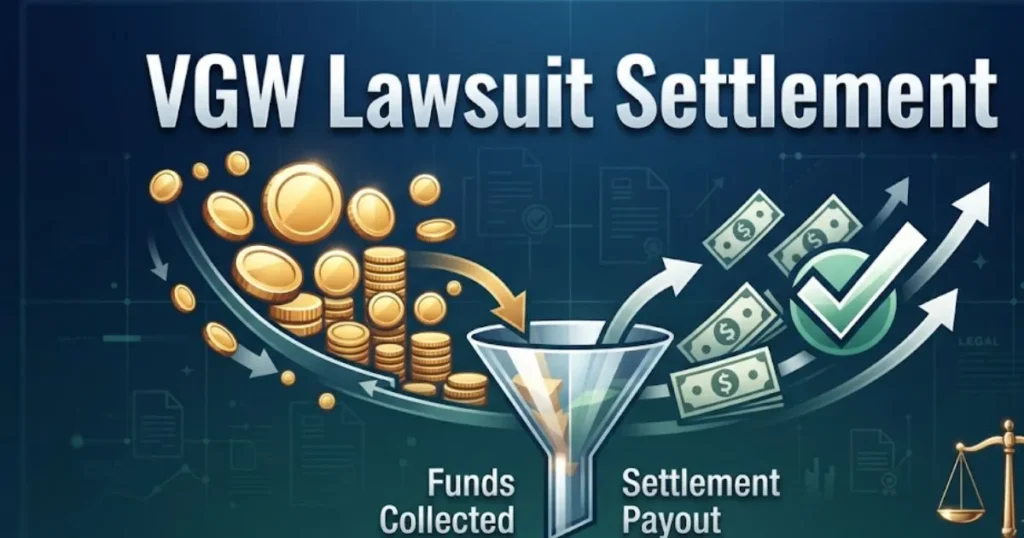
Previous social casino settlements offer clues about what a VGW settlement might look like. In 2021, Big Fish Games settled a similar social casino class action for $155 million. That case involved nearly identical allegations: a social casino using virtual currency that players redeemed for real money.
Comparison of social casino settlements:
| Case | Company | Settlement Amount | Year |
|---|---|---|---|
| Big Fish Casino | Big Fish Games / Churchill Downs | $155 million | 2021 |
| DoubleDown Casino | DoubleDown Interactive | $415 million | 2023 |
| Jackpot Party Casino | SciPlay | Ongoing | 2024-2026 |
| VGW / Chumba Casino | VGW Holdings | TBD | 2026 (expected) |
The DoubleDown Casino settlement of $415 million is especially relevant. It involved a very similar sweepstakes-style model and set a benchmark for how much social casino companies might have to pay. VGW’s revenue from U.S. players is believed to be comparable to or larger than DoubleDown’s.
Legal analysts expect a VGW settlement to fall somewhere in the range of $200 million to $500 million, depending on how many cases are resolved together and what evidence comes out during discovery. These are estimates, not confirmed figures.
If VGW chooses to fight rather than settle, a jury trial could result in an even larger judgment. That risk typically motivates companies to negotiate.
VGW Lawsuit Payout: How Payments Work
VGW lawsuit payouts will be distributed to qualifying class members after a settlement is finalized and approved by the court. The process follows a standard class action payout structure that typically takes several months from approval to distribution.
Here is how the payout process generally works in cases like this:
Step-by-step payout process:
- Settlement agreement is reached between VGW and plaintiff attorneys
- Court reviews the settlement terms for fairness
- Notice is sent to all class members (usually by email and mail)
- Class members submit claim forms with proof of purchases
- Objection and opt-out period (usually 60 to 90 days)
- Final approval hearing
- Settlement fund is established
- Claims are processed and verified
- Checks or electronic payments are issued
Payments in social casino cases have been made through direct deposit, PayPal, Venmo, or physical checks. The method depends on the settlement terms and the claims administrator handling distribution.
Important payout details:
- Attorney fees are deducted from the total settlement (typically 25% to 33%)
- Administrative costs are deducted before distribution
- Remaining funds are split among all valid claimants
- Players who spent more money generally receive larger payouts
- Players with better documentation (receipts, bank statements) may get more
The timeline from final settlement approval to actual checks being mailed is usually 4 to 8 months. For the VGW case, if a settlement is approved in mid-2026, payments could begin arriving in late 2026 or early 2027.
VGW Settlement Amount: Dollar Figures and Ranges
The VGW settlement amount has not been officially announced, but legal experts and industry observers project the total fund could range from $200 million to $500 million based on comparable social casino cases and VGW’s estimated U.S. revenue.
Individual payouts will vary significantly based on how much each player spent. Class action settlements rarely return 100% of losses. Based on precedents from similar cases, here are reasonable estimates.
Estimated individual payout ranges:
| Total Amount Spent on VGW | Estimated Payout Range | Percentage Recovery |
|---|---|---|
| Under $100 | $10 to $30 | 10% to 30% |
| $100 to $500 | $30 to $100 | 15% to 25% |
| $500 to $2,000 | $100 to $400 | 15% to 20% |
| $2,000 to $10,000 | $400 to $1,500 | 12% to 18% |
| Over $10,000 | $1,500 to $5,000+ | 10% to 15% |
These are projections based on similar settlements. Actual amounts will depend on the total settlement fund size, the number of valid claims filed, attorney fees, and administrative costs.
In the DoubleDown Casino settlement, some players received checks ranging from a few dollars to several thousand dollars. The distribution was proportional to spending. Heavy spenders received the largest payments.
One factor that could increase individual payouts: many eligible players never file claims. In most class actions, only 5% to 15% of eligible class members actually submit claim forms. That means the settlement fund gets divided among fewer people, increasing each person’s share.
Key Takeaway: While no official settlement amount has been announced, comparable social casino settlements suggest VGW’s total payout could be in the hundreds of millions, and individual players may recover 10% to 30% of what they spent.
VGW Lawsuit: How Much Will I Get
How much you will get from the VGW lawsuit depends on three main factors: your total spending on VGW platforms, the final settlement amount, and how many other players file valid claims. There is no single answer, but we can estimate ranges.
Your spending history is the biggest variable. VGW has detailed records of every Gold Coin purchase made on its platforms. During the claims process, the settlement administrator will match your account to purchase records. Players who spent more will receive proportionally larger payments.
Factors that affect your individual payout:
- Total spending: How much you paid for Gold Coin packages over the class period
- Platform used: Whether you played on Chumba Casino, Global Poker, or LuckyLand Slots
- Documentation: Bank statements, email receipts, or account records showing purchases
- Claim timing: Filing early versus filing close to the deadline
- Number of claimants: Fewer total claims means a bigger share for each person
If you are a casual player who spent $50 to $200, expect a payout in the range of $10 to $50. That might seem small, but remember it costs you nothing to file a claim.
Heavy spenders who put in $5,000 or more could see payouts of $500 to $2,000 or more, depending on settlement terms. Some high-volume players on social casino platforms have received five-figure settlements in prior cases.
To maximize your payout, gather any documentation of your purchases now. Check your email for VGW purchase confirmations. Review bank and credit card statements for charges from VGW, Chumba Casino, or Global Poker.
VGW Lawsuit Eligibility: Do You Qualify
You likely qualify for the VGW lawsuit if you purchased Gold Coin packages or made any real-money transactions on Chumba Casino, Global Poker, or LuckyLand Slots during the class period. The class period varies by case but generally covers purchases made from 2017 through 2024 or later.
Basic eligibility requirements:
- You are a U.S. resident (specific state requirements may apply)
- You created an account on a VGW platform
- You spent real money on Gold Coin packages or similar purchases
- Your purchases occurred during the defined class period
- You have not previously released your claims against VGW
Even if you only made one small purchase, you likely qualify. There is no minimum spending threshold in most of these class actions. A player who spent $10 has the same right to file a claim as someone who spent $10,000. The payout will differ, but eligibility does not.
Who does NOT qualify:
- Players who only used the free-play option and never spent money
- Players who received Sweeps Coins only through the mail-in method
- Residents of states excluded from the class definition
- VGW employees or their immediate family members
- Players who previously settled individual claims with VGW
| Eligibility Factor | Requirement |
|---|---|
| Residency | U.S. resident |
| Platform | Chumba Casino, Global Poker, or LuckyLand Slots |
| Spending | At least one real-money purchase |
| Time Period | Generally 2017 to present |
| Prior Settlement | Must not have already settled individually |
If you are unsure whether you qualify, check your email for any purchase confirmations from VGW platforms. Even a single $4.99 Gold Coin purchase makes you eligible.
VGW Lawsuit Deadline: Key Dates You Cannot Miss
The VGW lawsuit deadline for filing claims has not been set as a single universal date because multiple cases are proceeding in different courts. However, several important deadlines are approaching or expected in 2026, and missing them could mean losing your right to compensation.
Expected 2026 timeline:
| Event | Estimated Date |
|---|---|
| Settlement negotiations | Q1 to Q2 2026 |
| Preliminary settlement approval | Mid-2026 (if reached) |
| Claim filing window opens | 60 to 90 days after preliminary approval |
| Opt-out and objection deadline | 60 to 90 days after notice |
| Final approval hearing | Late 2026 |
| Payout distribution begins | Late 2026 or Q1 2027 |
Once a settlement is preliminarily approved, class members typically get 60 to 90 days to file claim forms. This window is strict. If you miss it, you generally cannot file late unless the court grants an extension.
Deadlines you should prepare for now:
- Gather all spending records from VGW platforms
- Save email confirmations of Gold Coin purchases
- Download bank or credit card statements showing VGW charges
- Create an account on the settlement administrator’s website (once announced)
- Sign up for case updates through class counsel’s website
The opt-out deadline is equally important. If you want to pursue an individual lawsuit against VGW instead of participating in the class action, you must formally opt out before the deadline. Otherwise, you are bound by the class settlement terms.
Key Takeaway: No single universal filing deadline exists yet, but players should prepare their documentation now so they are ready the moment the claims window opens, likely in mid-to-late 2026.
How to File a VGW Lawsuit Claim
Filing a VGW lawsuit claim is a straightforward process that takes about 10 to 15 minutes once the claims window opens. You do not need a lawyer, and there is no cost to submit a claim form.
Step-by-step filing process:
- Wait for official notice. You will receive an email or letter from the settlement administrator once a settlement is preliminarily approved. This notice will contain your unique claim ID and instructions.
- Visit the claims website. The notice will include a web address for the official claims portal. Only use the official site. Do not respond to emails from unknown parties claiming to help you file.
- Enter your information. You will need your name, address, email, VGW account username, and potentially the last four digits of the payment method you used.
- Verify your purchases. The claims administrator may already have your purchase records from VGW. You may need to confirm them or provide additional documentation.
- Submit the form. Review everything and submit. Save your confirmation number.
Documents to gather before filing:
- VGW account username and email
- Bank statements showing VGW purchases
- Email receipts from Gold Coin purchases
- Credit card statements with VGW charges
- Screenshots of your VGW account purchase history
If you no longer have access to your VGW account, you can still file. The claims administrator will have VGW’s internal records of all purchases linked to your email address and payment methods.
One word of caution: scammers often target class action participants. Never pay anyone to file a claim on your behalf. The process is free. Never share your Social Security number with anyone claiming to be from the settlement.
VGW Lawsuit States: Where Cases Are Active
VGW lawsuit cases are active in multiple states across the United States, with the most significant proceedings happening in federal courts. The geographic scope of these cases reflects VGW’s nationwide operations.
States with the most significant VGW legal activity:
| State | Type of Action | Status |
|---|---|---|
| Washington | State court class action | Active, key rulings issued |
| California | Federal class action | Active, discovery phase |
| Connecticut | Federal class action | Active |
| Pennsylvania | Federal class action | Active |
| Georgia | Federal class action | Active |
| New York | Investigation/complaints | Ongoing |
| Illinois | Federal claims | Active |
| Florida | Individual and class claims | Active |
Washington state has been the most aggressive jurisdiction. The state’s gambling laws are strict, and courts there have issued some of the strongest rulings against VGW’s sweepstakes model. The Washington case could become the template for other states.
States where VGW platforms are restricted or blocked:
VGW has voluntarily blocked access from certain states, likely to reduce legal exposure:
- Washington (after adverse court rulings)
- Idaho
- Some platforms restricted in Nevada and New Jersey (where regulated online gambling already exists)
Even if you live in a state where Chumba Casino is currently blocked, you may still have a valid claim if you used the platform before it was restricted. Your eligibility is based on when you made purchases, not on current access.
Federal cases filed under the Class Action Fairness Act have the broadest reach. These cases can include class members from any state, making them the most likely vehicle for a nationwide settlement.
VGW Lawsuit Update 2026: What to Expect Next
The VGW lawsuit update for 2026 points toward potential settlement resolution in multiple cases. Legal activity has intensified, and both sides appear motivated to reach agreements rather than face costly, unpredictable jury trials.
What has happened so far in 2026:
- Discovery phase completed in major federal cases
- Mediation sessions scheduled or underway
- Class certification granted in key jurisdictions
- VGW’s motions to dismiss largely denied
- Expert witnesses retained by both sides
What to expect for the rest of 2026:
- Q2 2026: Settlement negotiations likely to produce initial offers. If VGW and plaintiffs reach an agreement, preliminary approval filings could happen as early as summer.
- Q3 2026: If a settlement is reached, courts will hold preliminary approval hearings. Notice will go out to class members. The claim filing window will open.
- Q4 2026: Final approval hearings for any settlements reached earlier in the year. If no settlement is reached, trial preparation accelerates.
- Early 2027: First payouts could begin for settlements approved in 2026.
Factors that could speed things up:
- VGW’s desire to avoid a public trial with damaging testimony
- Increasing regulatory pressure from state attorneys general
- The precedent set by the $415 million DoubleDown settlement
- Negative publicity affecting VGW’s ongoing business operations
Factors that could slow things down:
- VGW appealing unfavorable rulings
- Disputes over class definitions or settlement terms
- Courts with backed-up dockets
- Objectors challenging settlement fairness
The bottom line is that 2026 is the most promising year yet for resolution. Players who have been waiting should stay alert for settlement notices and be ready to file claims promptly.
Frequently Asked Questions
How much money can I get from the VGW lawsuit?
Most players can expect to recover between 10% and 30% of their total spending on VGW platforms.
Casual players who spent under $200 might receive $10 to $50, while heavy spenders could see payouts of $500 to $2,000 or more.
Exact amounts depend on the final settlement size and how many people file claims.
Who qualifies for the VGW class action lawsuit in 2026?
Any U.S. resident who purchased Gold Coin packages on Chumba Casino, Global Poker, or LuckyLand Slots during the class period (generally 2017 to present) likely qualifies.
There is no minimum spending amount required.
Even a single purchase makes you eligible to file a claim.
Is Chumba Casino considered illegal gambling?
Multiple courts have ruled that Chumba Casino’s sweepstakes model likely constitutes illegal gambling under state laws.
No final nationwide ruling exists, but the legal trend is moving against VGW.
Players are not at legal risk; the lawsuits target VGW, not individual users.
What is the deadline to file a claim in the VGW lawsuit?
No universal filing deadline has been set yet because settlement negotiations are still underway.
Once a settlement receives preliminary court approval, class members will have 60 to 90 days to submit claim forms.
This window is expected to open in mid-to-late 2026.
How do I file a claim against VGW Holdings?
You will be able to file a free claim through the official settlement website once it launches.
The process takes about 10 to 15 minutes and requires your VGW account information and purchase records.
No lawyer is needed, and you should never pay anyone to file a claim on your behalf.
The VGW lawsuit in 2026 represents a real chance for players to recover money spent on Chumba Casino, Global Poker, and LuckyLand Slots. With settlement talks advancing and multiple courts ruling against VGW, the momentum favors plaintiffs.
Start gathering your purchase records now. Save email receipts, pull bank statements, and note your VGW account details.
When the claims window opens, be ready to file fast. The players who act quickly and have their documentation in order will be in the strongest position to get paid.







