

The chinese drywall lawsuit saga is one of the largest product liability cases in U.S. housing history, and it’s still affecting homeowners in 2026. Between 2001 and 2009, millions of pounds of defective drywall imported from China were installed in an estimated 100,000 American homes. That drywall released toxic sulfur gases that corroded wiring, destroyed appliances, and made families sick.
If you own a home built or renovated during that era, you could still have contaminated walls. Some homeowners collected six-figure settlements. Others never filed at all.
This guide covers every angle of the litigation as it stands in 2026. You’ll find settlement amounts, eligibility rules, health risks, testing methods, and the exact steps to take if you think your home is affected. The clock is ticking on some remaining legal options, so the details here matter.
What Is the Chinese Drywall Lawsuit
The chinese drywall lawsuit refers to thousands of legal claims filed by U.S. homeowners against manufacturers and importers of defective drywall made in China. These cases allege that contaminated gypsum board released hydrogen sulfide and other corrosive gases inside homes, causing both health problems and extensive property damage.
The problem traces back to a construction boom in the early to mid-2000s. A domestic drywall shortage, driven partly by hurricane rebuilding in the Gulf Coast, led builders to import massive quantities of wallboard from Chinese factories. Several of those factories used synthetic gypsum contaminated with sulfur compounds.
Homeowners started noticing a distinct rotten egg smell. Their air conditioning coils corroded within months. Copper wiring turned black. Jewelry tarnished in drawers. Then the health complaints rolled in: persistent headaches, breathing difficulties, nosebleeds, and sinus infections that wouldn’t go away.
| Detail | Info |
|---|---|
| Homes Affected | Approximately 100,000 |
| Years Installed | 2001 to 2009 |
| Primary Toxin | Hydrogen sulfide gas |
| States Most Impacted | Florida, Louisiana, Virginia |
| Legal Category | Product liability, mass tort |
The lawsuits were filed in state and federal courts across the country. Florida alone accounted for more than half of all reported cases. Louisiana, Virginia, Mississippi, and Alabama followed with significant numbers.
Chinese Drywall Lawsuit 2026 Update
Most of the major chinese drywall litigation has been resolved, but 2026 still holds relevance for homeowners who discovered contamination late or never filed claims. The federal MDL No. 2047 in the Eastern District of Louisiana wrapped up its primary docket years ago, but individual actions and state-level cases have continued in smaller numbers.
In recent years, a handful of new claims have emerged from homeowners who purchased properties without knowing they contained defective drywall. These buyers discovered the problem during renovations or home inspections and argued that the statute of limitations should start from the date of discovery, not the date of installation.
Some attorneys are still accepting cases on a limited basis. The key question in 2026 is whether the discovery rule applies in your state. If you genuinely did not know your home had Chinese drywall until recently, you may have a narrow window.
Here’s what matters right now:
- Most federal MDL claims are closed
- State court actions continue in Florida and Louisiana
- Discovery rule exceptions allow late filings in some states
- Knauf Plasterboard settlements were largely distributed by 2020
- Taishan Gypsum cases remain harder to collect due to jurisdictional issues
The practical reality is that new filings in 2026 face an uphill battle. But they’re not impossible, especially if you have clear evidence of recent discovery.
Chinese Drywall Settlement Amounts
Settlement amounts in chinese drywall cases have ranged from $15,000 to over $300,000 per home, depending on the size of the property, the extent of contamination, and whether full remediation was required. Some of the largest individual payouts exceeded half a million dollars when health claims were included alongside property damage.
The Knauf Plasterboard settlement program, which was the largest organized resolution, offered homeowners compensation based on a tiered formula. That formula factored in square footage, remediation costs, and whether the homeowner had already paid out of pocket for repairs.
| Damage Level | Typical Settlement Range |
|---|---|
| Minor (small area affected) | $15,000 to $40,000 |
| Moderate (multiple rooms) | $40,000 to $120,000 |
| Severe (whole-home remediation) | $120,000 to $300,000+ |
| With health claims | Additional $10,000 to $100,000 |
Several factors influenced individual payouts. Homeowners who documented everything, kept receipts for repairs, and had medical records linking symptoms to drywall exposure received significantly more.
Think of it this way: two identical houses on the same street could get wildly different settlements if one homeowner kept a paper trail and the other didn’t. Documentation was the single biggest factor separating a $30,000 check from a $200,000 one.
Key Takeaway: The chinese drywall lawsuit produced real compensation for affected homeowners, but the size of the payout depended heavily on documentation, state of residence, and the manufacturer involved.
Can I Still File a Chinese Drywall Lawsuit
Filing a new chinese drywall lawsuit in 2026 is difficult but not always impossible. The answer depends almost entirely on your state’s statute of limitations and whether the discovery rule applies to your situation.
Most states set a limitation period of 3 to 6 years from the date you knew or should have known about the defect. If your home was built in 2007 and you noticed problems in 2009, the filing window in most states closed years ago.
But here’s where it gets interesting. If you bought a home in 2020 and had no idea it contained Chinese drywall until a 2024 inspection revealed it, you might argue that your clock started in 2024. Some courts have accepted this reasoning.
Scenarios where filing may still be viable in 2026:
- You purchased a home recently and just discovered contaminated drywall
- A previous owner concealed the defect or failed to disclose it during the sale
- You live in a state with a longer limitations period or a broad discovery rule
- You have a separate fraud claim against a seller or builder who hid the problem
An attorney experienced in construction defect cases can evaluate your specific timeline. The facts of when you discovered the problem are everything.
Chinese Drywall Class Action Overview
The chinese drywall class action was not a single case but a collection of related lawsuits consolidated for efficiency. While some cases proceeded as traditional class actions, the bulk of the litigation was handled through multi-district litigation (MDL) rather than a certified nationwide class.
Class actions work well when thousands of people have nearly identical claims. Chinese drywall cases had that element, but the damage varied so much from home to home that individual assessments were often necessary. That’s why the MDL structure was preferred.
In Florida, several class actions were filed on behalf of homeowners in specific developments. These grouped together buyers in the same subdivision who all had drywall from the same manufacturer installed by the same builder.
| Feature | Class Action | MDL |
|---|---|---|
| How claims are grouped | One lawsuit for all | Individual suits, shared pretrial |
| Individual assessment | Limited | Yes, case by case |
| Settlement structure | Uniform payout formula | Varies per plaintiff |
| Used in Chinese drywall cases | Some state cases | Primary federal approach |
The distinction matters because MDL participants often had more control over their individual claims. Class action members typically received a set amount based on a formula, while MDL plaintiffs could negotiate based on their specific damages.
Chinese Drywall MDL Explained
MDL No. 2047, titled In Re: Chinese-Manufactured Drywall Products Liability Litigation, was the federal case that centralized thousands of chinese drywall lawsuits before Judge Eldon E. Fallon in the U.S. District Court for the Eastern District of Louisiana. This MDL became the hub for nearly all federal drywall claims.
Multi-district litigation is like a funnel. Cases filed in federal courts across the country get transferred to one judge for pretrial proceedings. That judge handles discovery, expert testimony, and bellwether trials. Then cases either settle or get sent back to their original courts for trial.
Judge Fallon held several bellwether trials that established key legal precedents. Those trials confirmed that the defective drywall caused property damage and health effects, which pressured manufacturers toward settlement.
Key milestones of the MDL:
- 2009: MDL created, cases consolidated in Louisiana
- 2010: First bellwether trial against Taishan Gypsum
- 2012: Default judgment entered against Taishan Gypsum for $2.6 million in a test case
- 2013: Knauf Plasterboard agreed to a global settlement
- 2014 to 2019: Settlement payments distributed to qualifying homeowners
- 2020 and beyond: Remaining claims and enforcement actions continue
The MDL was effective at resolving claims against Knauf. Collecting from Taishan Gypsum, a Chinese state-owned company, proved far more challenging due to international jurisdictional barriers.
Key Takeaway: The federal MDL resolved the majority of chinese drywall claims, with Knauf settling broadly while Taishan Gypsum fought enforcement and made collection difficult for many homeowners.
Chinese Drywall Settlement Details
The largest chinese drywall settlement came from Knauf Plasterboard Tianjin, which agreed to fund the remediation of affected homes. Under the Knauf settlement, the company paid for complete drywall removal and replacement, electrical rewiring, HVAC system replacement, and other necessary repairs.
This wasn’t a simple check-in-the-mail arrangement. Knauf hired contractors to perform full-home remediations. Homeowners who qualified had their contaminated drywall stripped out, all corroded wiring and copper components replaced, and new drywall installed. The company spent hundreds of millions of dollars on the program.
For homeowners whose cases involved other manufacturers, settlements were less organized. Some reached individual agreements with builders, importers, or their insurance companies. Others received court judgments that proved difficult to collect.
| Settlement Source | Resolution Type | Typical Outcome |
|---|---|---|
| Knauf Plasterboard | Funded remediation program | Full home repair or cash equivalent |
| Taishan Gypsum | Default judgments | Difficult to collect |
| Builders/Contractors | Individual settlements | Varied widely, $20,000 to $150,000 |
| Insurance companies | Policy-based payouts | Often partial coverage only |
Some homeowners accepted cash payments instead of remediation. Those cash amounts generally ranged from $100,000 to $250,000 depending on home size and damage severity.
The settlement program required homeowners to release all future claims against Knauf related to the drywall. That trade-off was worth it for most families who just wanted their homes fixed.
Chinese Drywall Statute of Limitations by State
The statute of limitations for a chinese drywall lawsuit varies by state and by the type of claim being filed. Product liability claims typically carry a different deadline than construction defect claims, and some states treat property damage separately from personal injury.
Here’s a critical point: most states apply a discovery rule that starts the clock when you discovered the defect, not when the drywall was installed. This matters enormously for homeowners who bought affected properties years after construction.
| State | Product Liability Limit | Construction Defect Limit | Discovery Rule |
|---|---|---|---|
| Florida | 4 years | 4 years (15-year repose) | Yes |
| Louisiana | 1 year | 5 years (10-year repose) | Yes |
| Virginia | 2 years | 5 years | Yes |
| Mississippi | 3 years | 6 years | Yes |
| Alabama | 2 years | 6 years | Limited |
| Texas | 2 years | 4 years (10-year repose) | Yes |
Statutes of repose are separate from statutes of limitations. A repose period sets an absolute outer deadline, typically 10 to 15 years from the date of construction. Once that repose period expires, no claim can be filed regardless of when you discovered the problem.
For a home built in 2007 in Florida, the 15-year statute of repose would expire in 2022. That means even the discovery rule can’t save a claim filed in 2026 for that property under Florida’s construction defect statute.
Each situation requires a case-specific analysis. Your installation date, discovery date, state of residence, and type of claim all interact.
Chinese Drywall Health Effects
Chinese drywall health effects stem from the continuous release of hydrogen sulfide, carbonyl sulfide, and carbon disulfide gases from contaminated gypsum board. These gases, even at low concentrations, can irritate the respiratory system, damage mucous membranes, and cause persistent neurological symptoms with long-term exposure.
The CPSC investigated health complaints from thousands of homeowners. Their findings confirmed that defective Chinese drywall emitted sulfur compounds at rates 10 to 100 times higher than domestic drywall.
Health effects reported by affected homeowners include:
- Chronic headaches and migraines
- Persistent sinus infections and congestion
- Nosebleeds, sometimes daily
- Difficulty breathing and asthma-like symptoms
- Skin rashes and irritation
- Eye burning and watering
- Fatigue and difficulty concentrating
- Sore throat that doesn’t respond to treatment
Children and elderly residents reported more severe symptoms. Several homeowners described improvement within days of leaving their homes, only to see symptoms return when they went back inside.
The health effects were not trivial. Some families abandoned their homes entirely because the symptoms were so severe. Medical records documenting these conditions became critical evidence in lawsuit settlements.
Long-term health studies on prolonged hydrogen sulfide exposure at residential levels are still limited. But the acute effects were well-documented and undeniable in court proceedings.
Key Takeaway: Chinese drywall emitted toxic sulfur gases that caused real, documented health problems, and medical records proving those symptoms significantly increased settlement values for affected homeowners.
Chinese Drywall Symptoms to Watch For
The most common symptoms of chinese drywall exposure are persistent respiratory irritation, frequent headaches, and recurring nosebleeds that don’t have another medical explanation. These symptoms tend to worsen when you spend extended time indoors and improve when you leave the home.
Many homeowners initially blamed allergies or seasonal illness. The pattern that pointed to drywall was the cyclical nature: symptoms appeared at home, disappeared on vacation, and came back within hours of returning.
Watch for these physical symptoms:
- Respiratory: coughing, wheezing, shortness of breath, sinus pressure
- Neurological: headaches, dizziness, brain fog, insomnia
- Dermatological: skin rashes, hives, unexplained itching
- Ocular: red eyes, burning sensation, excessive tearing
- ENT: sore throat, metallic taste, frequent nosebleeds
Beyond personal health, your home itself shows symptoms. A rotten egg or sulfur smell is the hallmark sign. Blackened copper wiring behind outlet covers is another telltale indicator. Silver jewelry and silverware tarnishing unusually fast inside the home is a classic red flag.
If you notice both health symptoms and home symptoms together, that combination strongly suggests contaminated drywall. Keep a symptom diary with dates and severity. That record becomes valuable evidence if you pursue a claim.
Chinese Drywall Property Damage
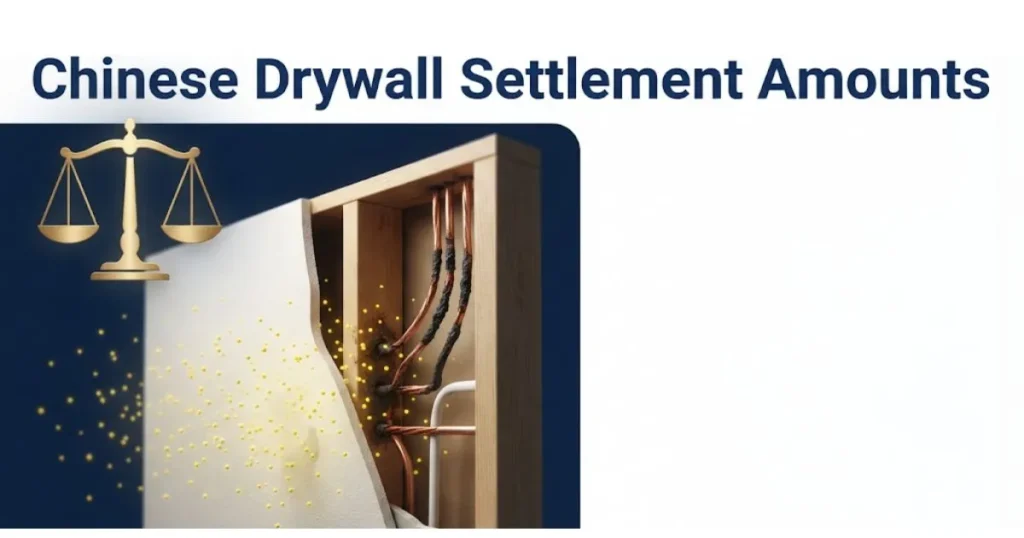
Chinese drywall property damage extends far beyond the drywall itself. The sulfur gases corrode copper, silver, and other metals throughout the home, causing widespread damage to electrical wiring, plumbing components, HVAC systems, and household appliances.
The corrosion is not cosmetic. It’s structural and dangerous. Blackened electrical wiring can create fire hazards. Corroded HVAC coils cause system failure. Gas lines with copper fittings become compromised.
Typical property damage includes:
- Electrical systems: blackened and pitted copper wiring, failed outlets, fire risk
- HVAC systems: corroded evaporator coils, compressor failure, refrigerant leaks
- Plumbing: damaged copper pipes and fittings
- Appliances: premature failure of refrigerators, microwaves, washers
- Personal property: tarnished jewelry, silverware, and electronics
- Structural: drywall itself must be completely removed and replaced
| Damage Category | Average Repair Cost |
|---|---|
| Full drywall replacement | $30,000 to $80,000 |
| Electrical rewiring | $10,000 to $25,000 |
| HVAC replacement | $8,000 to $20,000 |
| Plumbing repairs | $5,000 to $15,000 |
| Personal property loss | $5,000 to $30,000 |
| Total remediation | $60,000 to $200,000+ |
Think of it like termite damage, except the termites are invisible gas molecules eating your home’s metal infrastructure from the inside. By the time you see visible signs, the damage is already extensive.
Full remediation requires gutting the home to the studs. Partial fixes don’t work because the contaminated drywall continues emitting gases as long as it remains.
Chinese Drywall Remediation Cost
Chinese drywall remediation costs typically range from $60,000 to $200,000 or more for a full-home restoration, depending on the size of the home and the extent of contamination. Remediation is not a simple repair job. It requires the complete removal of all contaminated drywall and replacement of every corroded component.
The CPSC issued guidance stating that proper remediation requires these steps:
- Remove all Chinese-manufactured drywall
- Replace all electrical wiring in affected areas
- Replace HVAC evaporator coils and possibly the full system
- Replace all corroded copper plumbing
- Replace fire safety sprinkler heads with copper components
- Install new drywall, tape, and finish
- Repaint entire remediated areas
| Home Size | Estimated Remediation Cost (2026) |
|---|---|
| Under 1,500 sq ft | $60,000 to $100,000 |
| 1,500 to 2,500 sq ft | $100,000 to $150,000 |
| 2,500 to 4,000 sq ft | $150,000 to $250,000 |
| Over 4,000 sq ft | $250,000+ |
Inflation has pushed remediation costs higher than the original estimates from 2010. Homeowners getting quotes in 2026 should expect labor and material prices to be 25% to 40% higher than the costs cited in early court filings.
Some families chose to sell their homes at a loss rather than pay for remediation. Others moved out during the months-long repair process, adding temporary housing costs of $2,000 to $5,000 per month to the total bill.
Homeowners who remediated before filing a lawsuit sometimes recovered those costs in their settlements. But they needed detailed invoices and contractor documentation to prove the expenses.
Key Takeaway: Full chinese drywall remediation is a major construction project that can cost well over $100,000, and homeowners who kept detailed records of every expense recovered significantly more through settlements and court judgments.
How to Identify Chinese Drywall
You can identify chinese drywall by checking for markings on the back of the board, a distinct sulfur smell, and visible corrosion of copper components in your home. The identification process involves both visual inspection and professional testing.
Start with the most accessible method. Remove an outlet cover or light switch plate in your home. Look at the drywall edge visible around the electrical box. If the drywall has Chinese writing, stamps reading “Made in China,” or markings from known manufacturers like Knauf Tianjin or Taishan, that’s a strong indicator.
Check for these physical signs:
- Sulfur or rotten egg smell, especially in closed rooms
- Blackened copper wiring visible behind outlet and switch plates
- Premature HVAC failure, particularly corroded evaporator coils
- Tarnished silver items stored inside the home
- Drywall stamps in Chinese characters or English manufacturer names
- Home built or renovated between 2001 and 2009, particularly in Florida, Louisiana, or Virginia
Not all Chinese drywall is defective. Some Chinese manufacturers produced perfectly fine wallboard. The problematic drywall came from specific factories that used contaminated raw materials.
If you find Chinese markings on your drywall, don’t panic immediately. Get a professional test done to confirm whether the board is emitting elevated sulfur compounds. The presence of Chinese markings alone does not guarantee the drywall is defective.
Chinese Drywall Testing Methods
Professional chinese drywall testing involves air quality sampling, copper strip corrosion testing, and laboratory analysis of drywall samples to determine whether sulfur emissions exceed safe levels. Home testing kits exist, but professional analysis provides the court-admissible evidence needed for a lawsuit.
The CPSC recommended a specific testing protocol that became the standard for legal claims:
| Test Type | What It Measures | Cost Range | Court Admissible |
|---|---|---|---|
| Air quality sampling | Hydrogen sulfide levels in indoor air | $300 to $800 | Yes |
| Copper strip corrosion test | Rate of copper darkening in a sealed chamber | $200 to $500 | Yes |
| XRF analysis | Chemical composition of drywall sample | $150 to $400 | Yes |
| Strontium testing | Presence of strontium (a Chinese drywall marker) | $100 to $300 | Yes |
| Visual inspection | Markings, stamps, and physical condition | $100 to $300 | Supportive only |
The copper strip test is particularly revealing. A small piece of copper is placed in a sealed container with a sample of your drywall for 14 days. If the copper turns black, the drywall is actively emitting corrosive gases.
Strontium content is another reliable marker. Chinese-manufactured drywall often contains elevated levels of strontium compared to domestic products. A lab test on a drywall sample can measure this.
For legal purposes, hire a certified indoor air quality professional or environmental consultant. Their reports carry weight in court. DIY tests might give you a preliminary answer, but they won’t hold up as evidence.
Chinese Drywall Manufacturers
The primary chinese drywall manufacturers identified in U.S. lawsuits are Knauf Plasterboard Tianjin, Taishan Gypsum Co., and Beijing New Building Materials (BNBM). Several other smaller factories also produced contaminated wallboard, but these three companies accounted for the majority of defective product imported into the United States.
| Manufacturer | Country | Legal Outcome |
|---|---|---|
| Knauf Plasterboard Tianjin | China (German parent company) | Settled, funded full remediation program |
| Taishan Gypsum Co. | China (state-owned) | Default judgment, difficult to enforce |
| Beijing New Building Materials | China (state-owned) | Limited U.S. litigation, some settlements |
| Venture Supply Inc. | U.S. (importer) | Sued as distributor, settled some claims |
Knauf is a German multinational that operated a factory in Tianjin, China. Because the parent company had significant U.S. assets and business interests, it was vulnerable to legal action. That’s why Knauf ultimately settled and paid for remediations.
Taishan Gypsum, a subsidiary of the Chinese state-owned CNBM Group, fought U.S. jurisdiction aggressively. Even after courts entered multi-million dollar default judgments against the company, collecting those judgments proved nearly impossible because Taishan’s assets were in China.
Several U.S.-based importers and distributors were also named in lawsuits. Companies like Venture Supply Inc. served as the middlemen who brought the drywall into the country. Some homeowners had better luck recovering from these domestic companies than from the Chinese manufacturers directly.
The manufacturer on your drywall matters a great deal. If it’s Knauf, settlement options were more readily available. If it’s Taishan, collection was and remains a major challenge.
Key Takeaway: Your ability to collect compensation from a chinese drywall lawsuit depended heavily on which manufacturer made the drywall in your home, with Knauf claims being far more successful than Taishan claims.
Chinese Drywall Insurance Claim
Filing a chinese drywall insurance claim has been a frustrating experience for most homeowners, as many insurance companies denied coverage by arguing that drywall contamination falls under pollution exclusions or latent defect exclusions in standard homeowners policies. Some insurers paid claims. Many did not.
The insurance industry’s response to chinese drywall was inconsistent at best. Some carriers treated it as covered property damage. Others classified the sulfur emissions as “pollution” and invoked policy exclusions designed for environmental contamination.
Here’s how different types of insurance responded:
| Insurance Type | Typical Response |
|---|---|
| Standard homeowners policy | Often denied under pollution exclusion |
| Builder’s risk insurance | Sometimes covered construction defects |
| General liability (contractor) | Some policies covered claims against builders |
| Warranty programs | Limited coverage, often capped at low amounts |
Homeowners who successfully recovered from insurance companies often had to sue their insurer. Several “bad faith” lawsuits were filed against carriers that denied clearly valid claims.
If you’re filing an insurance claim in 2026 for recently discovered chinese drywall, document everything before contacting your insurer. Take photos of corroded wiring. Get professional test results. Obtain a written remediation estimate from a licensed contractor. Present a complete package rather than a vague complaint.
Some states passed legislation or issued regulatory guidance directing insurers to cover chinese drywall damage. Florida and Louisiana were particularly active on this front. Check whether your state has specific rules governing insurer obligations for this type of claim.
Chinese Drywall in My Home: What to Do
If you suspect chinese drywall in your home, the first step is to stop guessing and get a professional inspection. An experienced environmental consultant can test your drywall, measure air quality, and give you a definitive answer within two to three weeks.
Here’s a practical action plan for 2026:
Step 1: Visual Inspection
Remove several outlet and switch plate covers in different rooms. Look at the exposed drywall edges for Chinese writing, manufacturer stamps, or markings. Check copper wiring for black discoloration. Note any persistent sulfur smell.
Step 2: Professional Testing
Hire a certified indoor environmental professional to collect drywall samples and perform air quality testing. Budget $500 to $1,500 for a thorough assessment. Keep all test reports for potential legal use.
Step 3: Medical Documentation
If anyone in your household has experienced unexplained respiratory issues, headaches, or nosebleeds, see a doctor. Get those symptoms documented in your medical records. Mention that you suspect indoor air quality issues.
Step 4: Legal Consultation
Contact an attorney who handles construction defect or product liability cases. Many offer free initial consultations. Bring your test results, medical records, and home purchase documents.
Step 5: Preserve Evidence
Do not start remediation before consulting an attorney. Removing contaminated drywall destroys evidence. If you must make emergency repairs for safety, photograph and video everything before, during, and after.
| Action | Timeline | Estimated Cost |
|---|---|---|
| Visual self-inspection | Day 1 | Free |
| Professional testing | Week 1 to 2 | $500 to $1,500 |
| Medical evaluation | Week 1 to 3 | Varies by insurance |
| Attorney consultation | Week 2 to 4 | Usually free |
| Evidence preservation | Ongoing | Free |
The worst thing you can do is nothing. If your home contains defective drywall, every day it stays in place means more corrosion damage and more potential health exposure for your family.
Frequently Asked Questions
How much money can I get from a chinese drywall lawsuit in 2026?
Past settlements have ranged from $15,000 to over $300,000 depending on home size and damage severity.
Homeowners with documented remediation costs and medical records received the highest payouts.
New claims in 2026 face statute of limitations challenges, but discovery rule exceptions may apply.
Is it too late to file a chinese drywall lawsuit?
For most homeowners who knew about the problem years ago, the filing deadline has passed.
However, if you recently discovered contaminated drywall in a home you purchased, the discovery rule may extend your deadline.
State laws vary, so your specific timeline determines whether a 2026 filing is viable.
What are the signs of chinese drywall in my house?
The most common signs are a rotten egg smell, blackened copper wiring, and premature HVAC failure.
You may also find Chinese writing or manufacturer stamps on the back of drywall panels.
Tarnished silver jewelry and persistent respiratory symptoms in household members are strong indicators.
Does homeowners insurance cover chinese drywall damage?
Many insurance companies denied chinese drywall claims under pollution exclusions.
Some homeowners successfully recovered by filing bad faith lawsuits against their insurers.
Coverage depends on your specific policy language and your state’s regulatory stance on drywall contamination claims.
How long does a chinese drywall lawsuit take to settle?
Individual cases have taken anywhere from 1 to 5 years from filing to resolution.
Cases involving Knauf Plasterboard settled more quickly through the organized remediation program.
Claims against Taishan Gypsum and other Chinese manufacturers with no U.S. assets took significantly longer and often resulted in uncollectible judgments.
If your home was built between 2001 and 2009 in a high-risk state, don’t ignore the possibility of contaminated drywall. The health risks and property damage are real, and some legal options may still exist in 2026.
Get your drywall tested. See a doctor if symptoms are present. Talk to an attorney who knows construction defect law.
The homeowners who acted quickly and kept detailed records came out far better than those who waited. Whatever your situation, start with the facts and go from there.







