

Tennessee Attorney General Jonathan Skrmetti filed a lawsuit against predatory towing companies, and it’s one of the biggest consumer protection moves the state has made in years. The tennessee ag skrmetti towing lawsuit targets companies accused of illegal fees, unauthorized tows, and gouging vehicle owners across the state.
If your car was towed in Tennessee and you felt ripped off, this case might directly affect you. Hundreds of consumer complaints fueled this action.
This article covers every angle of the 2026 case. You will learn which companies are named, what laws were allegedly broken, how to file a complaint, and whether you could get money back.
One striking detail: some consumers reported paying fees three to four times higher than what Tennessee law allows. That is exactly the kind of abuse this lawsuit aims to stop.
Tennessee AG Skrmetti Towing Lawsuit Overview
The tennessee ag skrmetti towing lawsuit is a state-led legal action targeting towing companies accused of violating consumer protection laws through excessive fees and unauthorized vehicle seizures. Attorney General Jonathan Skrmetti brought the case under the Tennessee Consumer Protection Act.
This is not a class action filed by private attorneys. It is an enforcement action by the state’s top legal officer. That distinction matters because the AG’s office has subpoena power, investigative resources, and the authority to seek civil penalties on behalf of all Tennessee consumers.
The lawsuit stems from a flood of complaints to the Tennessee Division of Consumer Affairs. Vehicle owners reported being charged hundreds of dollars above legal limits. Others said their cars were towed without proper authorization or notice.
| Detail | Info |
|---|---|
| Lead Plaintiff | State of Tennessee (AG Skrmetti) |
| Case Type | Consumer Protection Enforcement |
| Primary Law | Tennessee Consumer Protection Act |
| Key Allegations | Illegal fees, unauthorized towing, deceptive practices |
| Target Defendants | Multiple towing companies |
Skrmetti’s office described the practices as a pattern, not isolated incidents. The AG framed this as a systemic problem within parts of Tennessee’s towing industry.
The case seeks injunctive relief, civil penalties, and restitution for affected consumers. If successful, it could reshape how towing companies operate statewide.
Tennessee Attorney General Towing Lawsuit 2026 Updates
As of 2026, the Tennessee attorney general towing lawsuit remains active and continues to develop through court proceedings and investigation. The AG’s office has indicated that additional defendants could be added as the probe expands.
Early 2026 brought new filings in the case. The state submitted additional evidence, including consumer affidavits and records of fees charged by the defendant towing companies.
Court hearings are scheduled throughout the first half of 2026. Pretrial motions have been filed by both sides, with defense attorneys arguing that some fees fall within industry norms.
The AG’s office has pushed back hard on that defense. Their position is that “industry norms” do not override Tennessee statutory limits on towing and storage fees.
- January 2026: Additional consumer complaints incorporated into filings
- Spring 2026: Pretrial hearings and discovery phase ongoing
- Mid-2026: Potential for settlement discussions or trial date setting
- Late 2026: Earliest realistic window for resolution or preliminary rulings
Public attention to the case has grown. Media coverage in Nashville, Memphis, and Chattanooga has prompted even more consumers to come forward with complaints. The Division of Consumer Affairs reported a spike in towing-related reports since the lawsuit was announced.
What Is the Skrmetti Predatory Towing Lawsuit About?
The Skrmetti predatory towing lawsuit is about towing companies that allegedly trapped vehicle owners into paying inflated, illegal fees after towing their cars without proper consent or legal basis. It targets a pattern of deceptive and unfair business practices.
Think of it like this: imagine your car is parked in a lot you believed was legal. You come back and it is gone. Then you find out a towing company took it, and now they want $400 or more just to get it back. The charges do not match any posted signs or legal fee schedule.
That is the core of what this lawsuit alleges happened to hundreds of Tennessee residents.
The AG’s complaint outlines several specific predatory tactics:
- Towing vehicles from private lots without proper signage or authorization
- Charging storage fees that exceed Tennessee’s legal caps
- Refusing to release vehicles until inflated fees are paid in full
- Adding hidden administrative or “after hours” fees with no legal basis
- Accepting only cash payments to avoid creating traceable records
The lawsuit also alleges that some companies operated in coordination with property owners or managers who received kickbacks for directing towing business their way. That arrangement, if proven, adds another layer of consumer harm.
Key Takeaway: The Skrmetti towing lawsuit is not about one bad experience; it targets a systematic pattern of illegal fees, unauthorized tows, and deceptive practices that affected hundreds of Tennessee vehicle owners.
Which Towing Companies Are Being Sued in Tennessee?
The Tennessee AG’s lawsuit names specific towing companies that operated primarily in the Nashville metropolitan area and surrounding counties. The state has identified these businesses based on complaint volume and investigative findings.
While the AG’s office has been cautious about publicizing every defendant before court proceedings advance, public filings and press releases have identified towing operators concentrated in Davidson County and nearby jurisdictions.
| Factor | Details |
|---|---|
| Primary Geographic Area | Nashville metro, Davidson County |
| Number of Companies Named | Multiple (expanding investigation) |
| Complaint Volume | Hundreds of consumer complaints |
| Business Type | Private property towing operators |
| Common Feature | Non-consensual towing with inflated fees |
The companies share common traits. Most specialize in private property towing rather than roadside assistance. They contract with apartment complexes, retail lots, and commercial property owners to patrol and tow vehicles.
Some of the named defendants operate under multiple business names. That makes it harder for consumers to track complaints or identify repeat offenders. The AG’s investigation uncovered instances where the same owners ran several towing brands from the same yard.
If your vehicle was towed by a company in the Nashville area and you paid what felt like outrageous fees, the AG’s office wants to hear from you. More defendants could be added as the case progresses.
Predatory Towing Practices in Tennessee Exposed
Predatory towing in Tennessee refers to the practice of towing vehicles primarily to generate revenue through excessive fees rather than to enforce legitimate parking rules. The AG’s lawsuit exposed specific tactics that cross the line from enforcement into exploitation.
The most common predatory practice is “patrol towing.” A tow truck driver cruises private lots, looking for any technical parking violation to justify a tow. Sometimes the violation is as minor as a tire touching a painted line. Other times, there is no violation at all.
Consumers reported that tow trucks arrived within minutes of parking. That speed suggests drivers were watching lots in real time, waiting to hook cars.
Other predatory tactics the lawsuit highlights include:
- Spotting and snatching: Hooking vehicles the moment a driver walks away, even briefly
- Signage games: Using signs that are too small, poorly lit, or hidden behind landscaping
- Fee stacking: Adding charges for “administrative processing,” “gate fees,” or “after-hours access” that are not authorized by law
- Cash-only demands: Refusing credit cards to limit the consumer’s paper trail and leverage
- Holding vehicles hostage: Refusing release until every fee is paid, regardless of legality
One consumer complaint described paying $485 to recover a vehicle that was towed from an apartment complex visitor lot. Tennessee’s fee caps would have placed the legal maximum well below that amount.
These practices disproportionately affect low-income residents, renters, and people who cannot afford to miss work fighting a tow charge.
Illegal Towing Fees at the Center of the Tennessee Lawsuit
Illegal towing fees are the financial backbone of the AG’s case. The lawsuit alleges that defendant companies routinely charged fees far above what Tennessee law permits, sometimes doubling or tripling the legal maximum.
Tennessee law sets specific caps on what towing companies can charge. These limits cover the tow itself, daily storage, and administrative costs. When a company exceeds those caps, it violates state law.
| Fee Type | Tennessee Legal Cap (Approx.) | Alleged Charges |
|---|---|---|
| Non-consent tow fee | $150 to $200 range | $300 to $450 reported |
| Daily storage fee | $25 to $50 per day | $75 to $100 per day reported |
| Administrative fee | Limited or none | $50 to $150 added |
| After-hours release fee | Varies, often capped | $75 to $200 added |
The gap between legal limits and actual charges is staggering. Consumers often paid these inflated fees because they had no choice. They needed their car for work. They needed it to pick up their kids. The towing company held all the leverage.
Some defendants allegedly told consumers that fees would increase each day the car sat in the lot. That created panic and urgency, pushing people to pay immediately without questioning the charges.
The AG’s complaint argues these fee practices constitute willful violations of the Tennessee Consumer Protection Act. Each individual overcharge could result in a separate civil penalty.
Key Takeaway: Tennessee law caps towing fees at specific amounts, and the AG’s lawsuit alleges that defendant companies charged fees two to three times higher than legal limits, trapping consumers into paying under pressure.
Towing Company Overcharging Lawsuit in Tennessee
The towing company overcharging lawsuit centers on the difference between what the law allows and what consumers actually paid. AG Skrmetti’s case frames this overcharging as deliberate, not accidental.
Overcharging was not a billing error. The complaint alleges it was a business model. Companies set their own fee schedules with no regard for Tennessee’s statutory caps. They trained employees to demand full payment before releasing any vehicle.
Consumers who questioned the charges were told, “That’s the price. Take it or leave your car.” Leaving the car meant even higher storage fees the next day. It was a trap by design.
Several consumer accounts describe similar patterns:
- A college student towed from a campus-adjacent lot who paid $375 in cash
- A single mother whose car was towed from her own apartment complex after a parking pass expired by one day, charged $425
- A delivery driver towed during a 10-minute stop, billed $310 for a “non-consent tow” plus fees
These are not wealthy people fighting over principle. They are working Tennesseans who could not afford to lose their only transportation.
The AG’s office has collected fee receipts, complaint forms, and business records during discovery. That paper trail forms the evidentiary backbone of the overcharging claims.
If the state prevails, affected consumers could receive restitution for every dollar charged above the legal cap.
Tennessee Consumer Protection Act Towing Violations Explained
The Tennessee Consumer Protection Act, often shortened to TCPA, is the primary law AG Skrmetti is using in this towing lawsuit. It prohibits unfair or deceptive acts in trade or commerce affecting consumers.
Under the TCPA, a business violates the law when it engages in conduct that misleads consumers or takes advantage of them through fraud, misrepresentation, or coercion. Towing companies that charge illegal fees, tow without authorization, or refuse to provide receipts all fall within the TCPA’s scope.
The TCPA gives the Attorney General specific enforcement powers:
- Injunctive relief: A court order forcing companies to stop illegal practices
- Civil penalties: Fines of up to $1,000 per violation in some cases
- Consumer restitution: Ordering companies to pay back overcharged consumers
- Investigation authority: Subpoena power to obtain business records and financial data
Each individual tow that violated fee caps could count as a separate violation. If a company illegally towed and overcharged 500 people, that could mean 500 separate penalty assessments.
| TCPA Provision | How It Applies |
|---|---|
| Deceptive practices ban | Misleading signage, hidden fees |
| Unfair practices ban | Charging above legal caps |
| AG enforcement authority | Lawsuit, penalties, restitution |
| Per-violation penalties | Up to $1,000 each |
The TCPA is a powerful tool. It does not require individual consumers to hire lawyers or file their own lawsuits. The AG acts on behalf of all affected Tennesseans.
Tennessee Towing Regulations and Consumer Rights
Tennessee towing regulations set clear rules for when and how vehicles can be towed, what fees can be charged, and what rights vehicle owners have during the process. These rules exist under Tennessee Code Annotated Title 55 and related statutes.
Every vehicle owner in Tennessee has specific rights when their car is towed:
- Right to posted notice: Towing signs must be visible, legible, and meet size requirements
- Right to fee caps: Companies cannot charge more than the state-mandated maximums
- Right to a receipt: You must receive an itemized receipt showing every charge
- Right to retrieve personal belongings: Companies cannot hold personal items inside the vehicle hostage
- Right to file a complaint: You can report violations to the Tennessee Division of Consumer Affairs
Tennessee also requires towing companies to notify local law enforcement within a set timeframe after a non-consensual tow. Failure to report the tow is itself a violation.
Property owners who authorize towing must post signs that meet specific standards. The signs must include the towing company’s name, phone number, and fee information. If the signs do not meet these standards, the tow may be illegal from the start.
Quick Facts:
- Towing companies must be registered and insured in Tennessee
- Storage lots must allow vehicle retrieval during reasonable business hours
- Consumers have the right to pay by credit card in most circumstances
- Complaints can be filed with the Division of Consumer Affairs online or by phone
Key Takeaway: Tennessee law gives vehicle owners clear rights when their car is towed, including fee caps, signage requirements, and the ability to file complaints, and the AG’s lawsuit alleges that defendant companies violated nearly every one of these protections.
Are You a Tennessee Towing Lawsuit Affected Consumer?
You may be a Tennessee towing lawsuit affected consumer if your vehicle was towed by one of the defendant companies and you were charged fees that exceeded Tennessee’s legal limits. The AG’s office is actively seeking people who fit this profile.
The broadest group of potential affected consumers includes anyone who:
- Had a vehicle towed in the Nashville metro area by a non-consensual tow operator
- Paid fees that seemed excessive compared to posted rates or state caps
- Was denied a receipt or given a receipt with vague or incomplete fee descriptions
- Had a vehicle towed from a lot where towing signs were missing, hidden, or unclear
- Felt pressured to pay in cash only
You do not need to have filed a complaint to qualify as an affected consumer. The AG’s case covers all consumers harmed by the defendants’ practices, whether they complained or not.
| Eligibility Factor | Details |
|---|---|
| Location | Primarily Nashville metro, expanding statewide |
| Timeframe | Tows occurring within the statute of limitations period |
| Key Indicator | Fees paid above Tennessee’s legal caps |
| Proof Helpful? | Yes: receipts, bank records, photos of signage |
| Already Complained? | Not required, but strengthens the record |
If you still have your receipt, bank statement showing the charge, or photos of the tow scene, hold onto them. That documentation could support a restitution claim if the case results in consumer payouts.
How to File a Complaint Against a Towing Company in Tennessee
Filing a complaint against a towing company in Tennessee starts with the Tennessee Division of Consumer Affairs, which operates under the AG’s office. You can file online, by mail, or by phone.
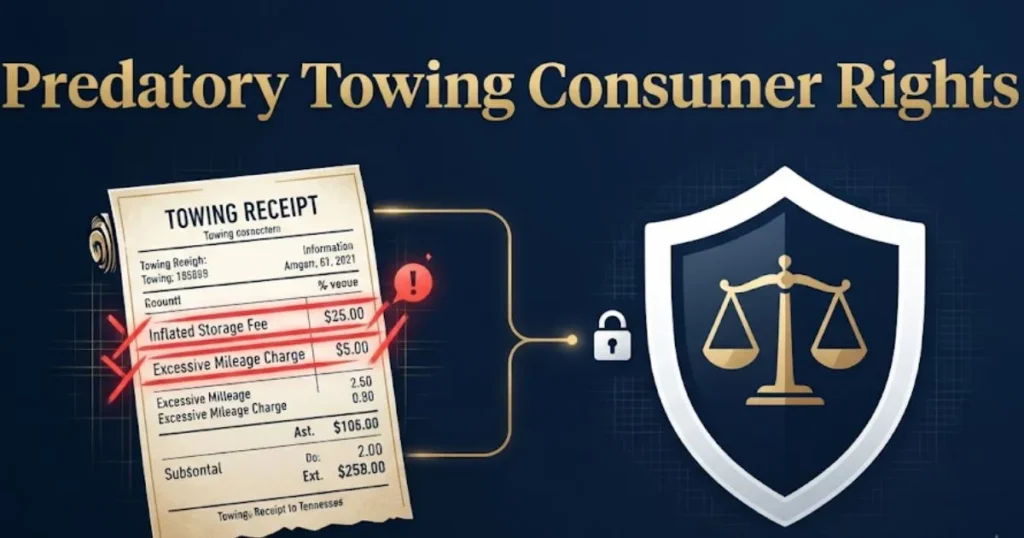
The complaint process is straightforward. You provide your personal information, the towing company’s name, the date and location of the tow, what you were charged, and a description of what happened. Include copies of any receipts or documents you have.
Step-by-step complaint process:
- Gather your towing receipt, payment records, and any photos
- Visit the Tennessee Division of Consumer Affairs complaint portal
- Fill out the complaint form with detailed information about your experience
- Attach copies of all supporting documents
- Submit the complaint and save your confirmation number
- Wait for a response from the Division, which may follow up for more details
You can also call the AG’s Consumer Protection Hotline directly. Representatives can walk you through the process and answer questions.
Filing a complaint serves two purposes. First, it creates a record that could help your individual restitution claim. Second, it strengthens the AG’s case by adding to the body of evidence against defendant companies.
Even if your tow happened months or years ago, file the complaint. Older complaints can still be relevant during the restitution phase of the lawsuit.
Quick Facts:
- Filing a complaint is free
- You do not need a lawyer to file
- Complaints are confidential during investigation
- The more detail you provide, the stronger the record
Tennessee Towing Lawsuit Settlement: What to Expect
A Tennessee towing lawsuit settlement would likely require defendant companies to pay restitution to overcharged consumers, pay civil penalties to the state, and agree to change their business practices going forward. No settlement has been finalized as of early 2026.
Settlement talks in cases like this typically begin after discovery is complete and both sides understand the strength of the evidence. The AG’s office has a strong track record of reaching settlements in consumer protection enforcement actions.
If a settlement is reached, it would probably include three main components:
- Consumer restitution fund: Money set aside to reimburse people who were overcharged
- Civil penalties: Fines paid to the state as punishment for violations
- Injunctive terms: Court-ordered changes to how the companies operate
| Settlement Component | What It Means for Consumers |
|---|---|
| Restitution Fund | Direct payments to overcharged consumers |
| Civil Penalties | Money paid to the state, not directly to consumers |
| Injunctive Relief | Companies must follow fee caps and towing rules |
| Compliance Monitoring | Ongoing oversight to prevent future violations |
The dollar amount each consumer might receive depends on how much they were overcharged and how many total claimants come forward. People who paid the largest amounts above legal caps would likely receive the most.
Do not expect a quick payout. Consumer protection settlements take time to administer. Payments could come in late 2026 at the earliest, more likely in 2027.
Key Takeaway: A settlement in the Tennessee towing lawsuit would likely include a restitution fund for overcharged consumers, civil penalties for the companies, and court-ordered changes to business practices, but no deal has been finalized yet as of 2026.
Predatory Towing Restitution in Tennessee
Predatory towing restitution refers to money paid back to consumers who were overcharged or illegally towed by the defendant companies. The Tennessee AG’s lawsuit specifically requests restitution as a remedy.
Restitution in a case like this works differently from a class action payout. In a class action, you usually need to file a claim form and prove you qualify. In an AG enforcement action, the state can identify affected consumers through business records obtained during discovery.
That means the towing companies’ own records, including receipts, payment logs, and tow reports, could be used to find and reimburse consumers. You may not need to do anything other than file a complaint to be included.
The restitution amount for each consumer would be calculated based on the difference between what they paid and what the law actually allows. If you paid $400 for a tow that should have cost $175, your restitution would be approximately $225.
- Restitution covers the overcharge amount, not the entire tow fee
- Consumers with documentation (receipts, bank records) have the strongest claims
- The AG can use defendant business records to identify victims
- Restitution payments would come after a settlement or court judgment
Think of restitution as getting your overpayment back, not as a windfall. The goal is to make consumers whole for the illegal charges they were forced to pay.
AG Skrmetti Consumer Protection Cases: A Track Record
AG Skrmetti has built a track record of aggressive consumer protection enforcement since taking office. The towing lawsuit fits into a broader pattern of going after businesses that exploit everyday Tennesseans.
Skrmetti’s office has pursued cases across multiple industries. These include actions against deceptive telemarketers, predatory lenders, companies selling fake health products, and businesses that price-gouged during emergencies.
The towing lawsuit is notable because it targets a local industry that affects working-class consumers most directly. People who rely on their cars for daily transportation are the most vulnerable when a towing company holds their vehicle for ransom.
| Case Area | Type of Action |
|---|---|
| Predatory towing | Current lawsuit, seeking restitution and penalties |
| Telemarketing fraud | Enforcement actions, consumer alerts |
| Price gouging | Emergency-related investigations |
| Data privacy | Investigations into tech company practices |
| Deceptive advertising | Actions against misleading health claims |
Skrmetti has publicly stated that consumer protection is a top priority for his office. His willingness to bring enforcement actions rather than just issue warnings sets a tone for how Tennessee handles corporate misconduct.
The AG’s office has a consumer protection division with dedicated investigators and attorneys. This team handles the intake of complaints, conducts investigations, and litigates cases when companies refuse to change their practices.
This track record matters because it shows the towing lawsuit is not a one-off publicity stunt. It is part of a sustained effort to hold bad actors accountable.
Tennessee Towing Company Lawsuit and Consumer Protection
The Tennessee towing company lawsuit represents one of the clearest examples of consumer protection enforcement in action. The state is stepping in because individual consumers often cannot fight towing companies on their own.
When your car is impounded and a company demands cash to release it, you are not in a negotiating position. You pay because you have no real choice. The power imbalance between a towing company and a consumer whose car is locked behind a fence is extreme.
That is exactly why consumer protection laws exist. They set baseline rules so that businesses cannot exploit people in vulnerable moments.
The AG’s lawsuit addresses this imbalance by seeking:
- A court order stopping the illegal fee practices
- Financial penalties that make predatory towing unprofitable
- Restitution that puts money back in consumers’ pockets
- Public accountability that warns other towing companies
Quick Facts:
- The AG can sue on behalf of all affected consumers without individual lawsuits
- Civil penalties apply per violation, creating significant financial exposure for defendants
- Injunctive relief can permanently change how a company operates
- The case sends a message to the entire Tennessee towing industry
This lawsuit could set a precedent for towing regulation enforcement across the Southeast. Other state attorneys general are watching. If Tennessee wins significant penalties and restitution, expect similar actions in neighboring states.
Key Takeaway: The towing company lawsuit is a textbook consumer protection case where the state steps in because individual consumers lack the power to fight illegal practices on their own, and the outcome could influence towing regulation enforcement nationwide.
Tennessee Towing Lawsuit Timeline for 2026
The Tennessee towing lawsuit timeline for 2026 includes continued discovery, pretrial motions, potential settlement negotiations, and a possible trial date. The case is moving through Tennessee courts at a steady pace.
Here is what the projected timeline looks like based on typical AG enforcement case progression and current court scheduling:
| Phase | Expected Timeframe |
|---|---|
| Discovery and document exchange | Q1 to Q2 2026 |
| Pretrial motions and hearings | Q2 2026 |
| Settlement discussions (if any) | Q2 to Q3 2026 |
| Potential trial date | Late Q3 or Q4 2026 |
| Earliest possible resolution | Q4 2026 |
| Consumer restitution payments | Late 2026 to early 2027 |
Several factors could accelerate or delay this timeline. If the defendants agree to settle early, the case could wrap up by mid-2026. If they fight every motion, it could drag into 2027.
The discovery phase is critical. The AG’s office is obtaining internal business records, fee schedules, employee communications, and financial data from the defendant companies. This evidence will determine how strong the state’s case is at trial.
Consumers should keep an eye on updates from the Tennessee AG’s office. Major developments, such as a settlement offer or trial ruling, will be announced publicly.
If you were affected by predatory towing in Tennessee, do not wait until the case ends to file your complaint. The sooner your experience is on record, the better positioned you are for restitution.
Frequently Asked Questions
What is the Tennessee AG Skrmetti towing lawsuit about?
The lawsuit targets towing companies accused of charging illegal fees and towing vehicles without proper authorization.
AG Skrmetti filed the case under the Tennessee Consumer Protection Act.
It seeks restitution for overcharged consumers, civil penalties, and court orders to stop the practices.
Which towing companies are named in the Tennessee lawsuit?
The lawsuit names multiple towing companies that operated primarily in the Nashville metropolitan area.
Specific company names appear in public court filings available through the Tennessee AG’s office.
The investigation is ongoing, and additional defendants could be added in 2026.
How can I file a complaint about predatory towing in Tennessee?
You can file a complaint through the Tennessee Division of Consumer Affairs online portal or by phone.
Include your towing receipt, payment records, and a description of what happened.
Filing is free and does not require a lawyer.
Will consumers get money back from the Tennessee towing lawsuit?
The AG’s lawsuit specifically requests consumer restitution for overcharged vehicle owners.
If the case settles or the state wins at trial, affected consumers could receive the difference between what they paid and the legal fee cap.
Payments are not expected before late 2026 at the earliest.
What is the timeline for the Tennessee towing lawsuit in 2026?
Discovery and pretrial motions are expected through the first half of 2026.
Settlement discussions could begin in mid-2026 if both sides are willing.
The earliest realistic window for consumer restitution payments is late 2026 to early 2027.
The Tennessee AG Skrmetti towing lawsuit is a significant consumer protection case that could change how towing companies operate across the state. If you were towed and overcharged, your experience matters.
File a complaint with the Tennessee Division of Consumer Affairs now. Keep your receipts and payment records safe. Stay informed on case developments through the AG’s office.
This case is moving. Your best move is to get your story on record before it settles.







