

The Pringles lawsuit accuses Kellogg’s (now Kellanova) of misleading consumers about what’s actually inside those iconic cans. If you’ve bought Pringles flavors like Sour Cream and Onion or Cheddar Cheese in the past few years, you might be part of a class that’s owed money.
This case centers on false advertising and deceptive labeling. The packaging suggests certain ingredients are present in meaningful amounts when they’re allegedly not.
In this article, you’ll find everything about the 2026 case status, who qualifies, estimated payouts, filing steps, and key deadlines. One thing that might surprise you: similar food lawsuits have paid out between $5 and $50 per claimant without requiring a single receipt.
Stay with this breakdown. It could put money back in your pocket.
What Is the Pringles Lawsuit About?
The Pringles lawsuit is a consumer fraud case alleging that Kellanova (formerly Kellogg’s) used deceptive product labeling on multiple Pringles chip flavors. Plaintiffs say the packaging promises certain ingredients or flavors that aren’t present in the amounts a reasonable buyer would expect.
For example, “Sour Cream and Onion” Pringles feature images of sour cream on the packaging. But the actual product allegedly contains minimal or no real sour cream. The same applies to other varieties like “Cheddar Cheese” and “Pizza” flavored Pringles.
The legal argument is straightforward. When you see a product with a specific flavor name and matching imagery, you expect the key ingredient to be there. If it’s not, that’s deceptive marketing under state consumer protection laws.
| Detail | Info |
|---|---|
| Defendant | Kellanova (formerly Kellogg Company) |
| Product | Pringles (multiple flavors) |
| Legal Claim | False advertising, deceptive labeling |
| Jurisdiction | U.S. federal and state courts |
| Case Type | Class action |
This isn’t just about chips. It’s about whether food companies can put whatever they want on a package without delivering on those promises.
Think of it like ordering a “leather” jacket online and getting pleather. The label matters.
Pringles Class Action Lawsuit 2026: What’s New
The Pringles class action lawsuit in 2026 has moved past initial filings and into a more active phase of litigation. Several related cases filed in different states are being consolidated or are progressing through discovery.
Courts are taking these food mislabeling claims more seriously than they did five years ago. Judges have increasingly allowed cases like this one to survive motions to dismiss, which means Kellanova hasn’t been able to get the case thrown out early.
What’s significant in 2026 is the growing body of similar rulings. Courts across the country have sided with consumers in nearly identical food labeling disputes. That sets a strong precedent for Pringles plaintiffs.
- Multiple cases filed in New York, Illinois, and California federal courts
- Discovery phase is underway or recently completed in key jurisdictions
- No formal settlement has been announced yet, but negotiations are reportedly ongoing
- Class certification is either granted or pending in most cases
If you’ve been waiting to see whether this case has legs, 2026 is the year it’s proving it does.
Is There a Lawsuit Against Pringles Right Now?
Yes, there is an active lawsuit against Pringles as of 2026. Multiple class action complaints have been filed in federal courts, and the litigation is ongoing.
The cases target Kellanova specifically. As the manufacturer and marketer of Pringles, the company bears responsibility for what appears on the labels.
Some of these lawsuits were first filed in 2023 and 2024. They’ve survived early legal challenges and are now in stages where settlements become possible.
| Case Status | Details |
|---|---|
| Filed | 2023 to 2024 |
| Current Phase (2026) | Discovery and settlement talks |
| Dismissed? | No; motions to dismiss denied |
| Active Courts | SDNY, Northern District of Illinois, Central District of California |
So if someone tells you this case was thrown out or isn’t real, that’s wrong. The lawsuit is alive and progressing.
Key Takeaway: The Pringles lawsuit is a real, active class action in 2026 that accuses Kellanova of misleading consumers about what’s inside their chip flavors.
Pringles False Advertising Lawsuit Explained
The Pringles false advertising lawsuit claims that Kellanova violated federal and state advertising laws by using product names and images that don’t match the actual ingredients. The core argument is that consumers paid a premium for flavors that were essentially fake.
Under the Federal Trade Commission Act and various state consumer fraud statutes, companies cannot make claims about a product that are likely to deceive a reasonable consumer. The plaintiffs argue Pringles packaging does exactly that.
Here’s the key distinction. Nobody is saying Pringles are unsafe. The lawsuit is about honesty. Did the company tell you what you were buying? Plaintiffs say no.
- FTC Act Section 5 prohibits unfair or deceptive acts in commerce
- State laws like New York GBL Section 349 and California’s UCL add extra protections
- Plaintiffs don’t need to prove the company intended to deceive, only that the labeling was misleading
The false advertising angle gives this case teeth. Companies settle these disputes frequently because the cost of losing at trial is far greater than paying out claims.
Pringles Misleading Labeling Lawsuit Claims
The Pringles misleading labeling lawsuit focuses specifically on the gap between what the packaging shows and what the product delivers. The claims boil down to this: the labels create false expectations.
Plaintiffs identified several Pringles flavors where the labeling is allegedly deceptive. The product names suggest a primary ingredient. The images reinforce that suggestion. But the ingredient list tells a different story.
Take “Loaded Baked Potato” Pringles. The can shows a baked potato with toppings. A consumer would reasonably expect potato and flavor ingredients that match. Instead, plaintiffs allege the seasoning relies heavily on artificial flavoring and minimal amounts of the advertised real food.
| Flavor | Packaging Claim | Plaintiff Allegation |
|---|---|---|
| Sour Cream and Onion | Real sour cream imagery | Contains little or no actual sour cream |
| Cheddar Cheese | Cheese imagery on can | Minimal real cheddar; mostly flavoring |
| Pizza | Pizza imagery and name | Artificial pizza flavoring, not real ingredients |
| Loaded Baked Potato | Baked potato imagery | Does not contain meaningful potato toppings |
The labeling issue isn’t trivial. Consumers pay more for products they believe contain real, quality ingredients. That price premium is part of what the lawsuit seeks to recover.
Kellogg Pringles Lawsuit: Who Got Sued and Why
Kellanova, the company formerly known as Kellogg Company, is the defendant in the Pringles lawsuit. The company split from its cereal division in late 2023, and Pringles fell under Kellanova’s umbrella. In 2024, Mars Inc. completed its acquisition of Kellanova, adding another layer to the corporate picture.
Plaintiffs sued Kellanova because it manufactured, marketed, and profited from the allegedly deceptive Pringles labels. The legal theory is simple. If you make the product and design the packaging, you’re responsible when that packaging misleads buyers.
Why did they get sued? Because consumer advocacy attorneys identified a pattern. Multiple Pringles flavors used the same playbook: put appetizing images on the can, give it an ingredient-based name, and then fill the product with cheaper substitutes.
- Kellanova is the named defendant in most filings
- The company reported over $13 billion in annual revenue before the Mars acquisition
- Mars now owns the Pringles brand, which could affect settlement dynamics
- The lawsuit targets corporate marketing decisions, not individual employees
This case sends a message to the entire snack industry. If your label doesn’t match your product, expect a lawsuit.
Key Takeaway: Kellanova got sued because its Pringles labels allegedly promised real ingredients that weren’t actually in the product, and courts have allowed the case to move forward.
Pringles Ingredient Lawsuit Details
The Pringles ingredient lawsuit zeroes in on what’s actually inside the can versus what the branding implies. Plaintiffs say the ingredient lists reveal that advertised flavors come primarily from artificial flavoring agents, not real food.
Court filings detail specific discrepancies. For “Cheddar Cheese” Pringles, the seasoning blend lists items like “cheddar cheese seasoning” far down the ingredient list. Meanwhile, maltodextrin, modified food starch, and artificial flavors appear higher up.
That ordering matters. FDA regulations require ingredients to be listed from highest to lowest quantity. If “cheddar cheese” shows up after a dozen other things, it’s present in very small amounts.
- Plaintiffs hired food scientists to analyze ingredient compositions
- Lab results allegedly showed negligible quantities of the named flavor ingredients
- The FDA does not pre-approve snack food flavor names, creating a regulatory gap
- Kellanova has argued that flavor names are understood as “characterizing flavors,” not ingredient claims
This distinction between a “flavor” and an actual “ingredient” is where the legal battle heats up. Consumers argue they expected real food. The company argues everyone knows it’s just a flavor name.
It’s like calling something “butter flavor” popcorn. Most people still expect at least some butter.
Pringles Lawsuit Settlement: Current Status
The Pringles lawsuit settlement has not been finalized as of early 2026. The case is in active litigation, with settlement negotiations reportedly taking place behind the scenes in at least one jurisdiction.
No court-approved settlement fund exists yet. That means no claims are being paid out right now. But the trajectory of the case suggests a resolution could come within the next 12 to 18 months.
Why the delay? Class action settlements take time. Both sides need to agree on the size of the fund, who qualifies, and how payments get distributed. Then a judge must approve the deal.
| Settlement Stage | Status (2026) |
|---|---|
| Lawsuit Filed | Complete |
| Motion to Dismiss | Denied |
| Class Certification | Pending or granted |
| Discovery | Underway or complete |
| Settlement Negotiations | Reportedly active |
| Court Approval | Not yet |
| Payouts Begin | Estimated late 2026 to 2027 |
If history is any guide, food mislabeling class actions typically settle for $1 million to $10 million in total fund size. Individual payouts depend on how many people file claims.
Pringles Lawsuit Payout: How Much Could You Get?
Most claimants in a Pringles lawsuit payout scenario can expect somewhere between $5 and $50 per person, based on comparable food labeling settlements. Without a receipt, payouts trend toward the lower end. With receipts proving heavy purchasing, they climb higher.
That range might sound small, but it’s standard for consumer class actions involving low-cost products. You’re not suing over a defective car. You’re recovering the price premium you overpaid for misleading packaging.
Here’s how the math typically works. A settlement fund of, say, $5 million gets divided among all approved claimants. If 200,000 people file claims, each person gets around $25. If fewer file, each share grows.
| Payout Scenario | Estimated Amount Per Claimant |
|---|---|
| No receipt, basic claim | $5 to $15 |
| Partial records (loyalty card, bank statement) | $15 to $30 |
| Full receipts for multiple purchases | $30 to $50 |
| Heavy purchaser with documentation | $50+ |
The biggest factor in your payout is how many other people file. Ironically, the less attention the settlement gets, the more each claimant receives.
Pringles Settlement Amount Breakdown
The total Pringles settlement amount will depend on negotiations between the parties and final court approval. Based on similar cases, a fund between $2 million and $8 million is a reasonable estimate.
For context, here are settlement amounts from comparable food labeling class actions in recent years:
| Case | Settlement Amount | Year |
|---|---|---|
| Subway “footlong” class action | $500,000 (initially) | 2017 |
| Skippy peanut butter “natural” claim | $6.6 million | 2023 |
| Tropicana “no added sugar” lawsuit | $3.1 million | 2023 |
| Annie’s “natural” labeling case | $3 million | 2022 |
| Blue Diamond almond milk case | $2 million | 2021 |
The Pringles case covers a widely sold product with massive brand recognition. That could push the fund higher. Pringles generates over $1.5 billion in annual global sales, which gives attorneys leverage to argue for a larger settlement.
Attorneys typically take 25% to 33% of the total fund. The rest goes to claimants and administrative costs. So from a $6 million fund, roughly $4 million would actually reach consumers.
Key Takeaway: While individual payouts may be modest, the total Pringles settlement fund could reach several million dollars based on the scale of the product’s sales and comparable case outcomes.
Pringles Lawsuit Eligibility: Do You Qualify?
You likely qualify for the Pringles lawsuit if you purchased any of the allegedly mislabeled Pringles flavors during the class period, which typically covers purchases from 2020 through 2024 (or later, depending on the jurisdiction).
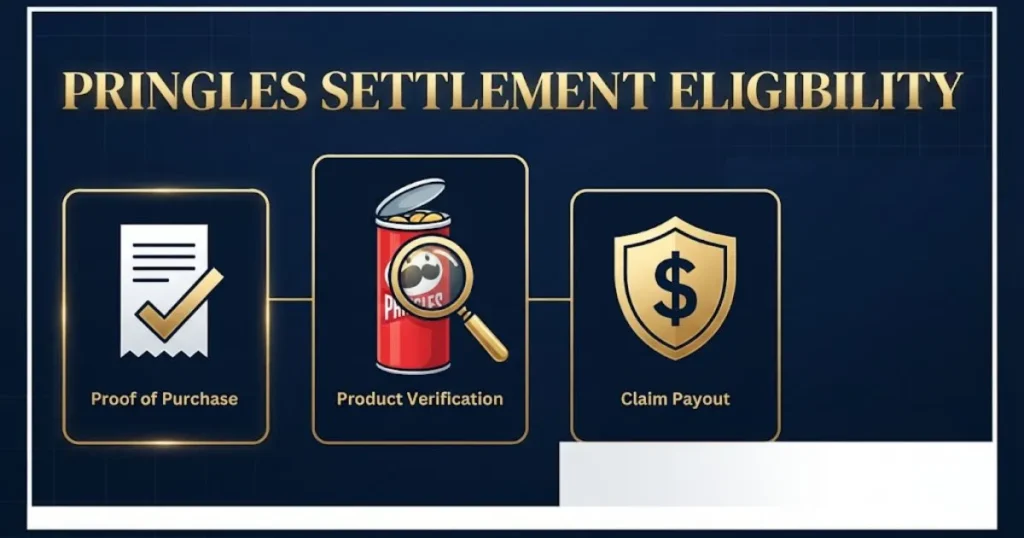
Eligibility in consumer class actions like this one is intentionally broad. The goal is to compensate as many affected buyers as possible. You don’t need to prove you were personally harmed in a dramatic way. You just need to show you bought the product.
Here’s what typically determines eligibility:
- Residency: You must be a U.S. resident (some cases are state-specific)
- Purchase: You bought one or more qualifying Pringles flavors during the class period
- Flavors covered: Sour Cream and Onion, Cheddar Cheese, Pizza, Loaded Baked Potato, and potentially others named in the complaint
- No exclusions: You are not an employee of Kellanova, Mars, or their attorneys
| Eligibility Factor | Requirement |
|---|---|
| Location | U.S. resident |
| Purchase Period | Approximately 2020 to 2024 |
| Product | Named Pringles flavors |
| Proof Needed | Helpful but not always required |
| Excluded Parties | Company employees, legal teams |
If you’ve grabbed a can of Cheddar Cheese Pringles at the grocery store in the last few years, chances are good you’re in the class.
How to File a Pringles Lawsuit Claim
Filing a Pringles lawsuit claim will involve completing an online claim form once a settlement is approved. That form is not available yet, but here’s what you should prepare now so you’re ready the moment it opens.
Step one: save any Pringles receipts you have. Check your email for digital receipts from grocery stores, Amazon, Walmart, or Target. Bank and credit card statements showing purchases at stores where you bought Pringles can also help.
Step two: watch for the official settlement notice. Once a court approves a settlement, a claims administrator sends notices by email, mail, or both. These notices include instructions and deadlines.
Step three: fill out the claim form. This is usually a short online form asking your name, address, when you bought Pringles, and how often.
Filing checklist:
- Gather receipts, bank statements, or loyalty card records
- Note which Pringles flavors you purchased
- Estimate how many cans you bought per month or year
- Watch for official settlement announcement
- Complete the claim form before the deadline
- Do not pay anyone to file for you; it’s free
Filing is free. Any website or person asking you to pay money to join this class action is running a scam.
Pringles Lawsuit Proof of Purchase Requirements
Proof of purchase for the Pringles lawsuit is helpful but likely not mandatory. Most food product class action settlements allow claims without receipts, though the payout is smaller.
Courts understand that normal people don’t keep grocery receipts for years. That’s why claim forms usually include a “no receipt” option where you estimate your purchases under penalty of perjury.
If you do have proof, it strengthens your claim. Here’s what counts:
| Type of Proof | Strength |
|---|---|
| Physical store receipt | Strongest |
| Digital receipt (email) | Strong |
| Bank/credit card statement | Moderate |
| Loyalty card purchase history | Moderate |
| Personal declaration (no receipt) | Accepted but lower payout |
Some grocery chains let you access past purchase history through their apps or websites. Kroger, Safeway, and Walmart all keep transaction records. It’s worth checking those before the claims window opens.
The bottom line: don’t skip filing just because you threw away your receipts. You can still get paid.
Key Takeaway: You don’t need a receipt to file a Pringles lawsuit claim, but having any purchase records will likely increase your payout amount.
Pringles Lawsuit Deadline You Need to Know
The Pringles lawsuit deadline for filing claims has not been set yet because no settlement has been finalized. Once a court approves a settlement, claimants will have a specific window, usually 60 to 120 days, to submit their forms.
Missing the deadline means you get nothing. That’s the hard truth about class actions. Courts are strict about cutoff dates, and extensions are extremely rare.
Here’s a rough timeline of what to expect:
| Milestone | Estimated Timing |
|---|---|
| Settlement announced | Mid to late 2026 |
| Claims period opens | 30 to 60 days after announcement |
| Filing deadline | 60 to 120 days after claims open |
| Objection deadline | Usually 30 days before final approval |
| Final court approval | 3 to 6 months after preliminary approval |
| Payouts distributed | 2 to 4 months after final approval |
The best thing you can do right now is sign up for case updates through legal news outlets. When the deadline drops, you want to know immediately.
Don’t assume someone will notify you. Many class members miss deadlines simply because they didn’t know the clock was ticking.
Pringles Lawsuit Update 2026: Latest Developments
The latest Pringles lawsuit update in 2026 shows the case is progressing through discovery and approaching potential settlement discussions. No final resolution has been reached, but the case is clearly moving forward.
Key developments this year include:
- Discovery phase: Both sides have exchanged documents, including internal marketing materials and ingredient sourcing records from Kellanova
- Expert reports: Plaintiffs have submitted food science expert analyses showing the gap between packaging claims and actual ingredients
- Class certification: At least one court has certified or is considering certifying a class of consumers
- Mars acquisition impact: Mars Inc.’s purchase of Kellanova could accelerate settlement discussions, as Mars may want to resolve legacy litigation quickly
The Mars factor is interesting. When a new parent company takes over, it often prefers to settle old lawsuits rather than fight them in court. That’s good news for claimants.
Court dockets show hearings scheduled throughout mid and late 2026. A preliminary settlement could emerge before year’s end.
This is a case worth watching closely over the next several months.
Pringles Consumer Rights Case: Your Legal Protections
The Pringles consumer rights case is built on state and federal consumer protection laws that prohibit deceptive business practices. These laws exist specifically to protect everyday shoppers from misleading marketing.
Every state has its own version of a consumer fraud statute. Some of the strongest include:
- New York General Business Law Section 349: Prohibits deceptive acts and practices; plaintiffs don’t need to prove intent
- California Unfair Competition Law (UCL): One of the broadest consumer protection statutes in the country
- Illinois Consumer Fraud Act: Covers deceptive advertising with strong enforcement provisions
These laws give consumers the right to sue companies that make false claims about their products. You don’t need to prove the company planned to deceive you. You just need to show the labeling was misleading and you relied on it when making your purchase.
| Legal Protection | What It Covers |
|---|---|
| State consumer fraud statutes | Deceptive advertising and labeling |
| FTC Act | Unfair trade practices nationally |
| FDA labeling regulations | Ingredient list accuracy (limited enforcement) |
| Lanham Act | False advertising between competitors |
Your rights as a consumer are real and enforceable. The Pringles case is a textbook example of those rights being exercised.
Key Takeaway: Strong federal and state consumer protection laws back the Pringles case, and these statutes don’t require you to prove the company intended to mislead you.
Pringles Lawsuit vs Other Food Lawsuits: How It Compares
The Pringles lawsuit fits into a growing wave of food mislabeling class actions that have reshaped how companies think about packaging. Compared to similar cases, this one falls squarely in the middle in terms of scope and potential payout.
Here’s how it stacks up:
| Case | Allegation | Settlement | Per Person Payout |
|---|---|---|---|
| Skippy “Natural” peanut butter | Not actually natural | $6.6 million | Up to $15 |
| Tropicana “No Added Sugar” | Misleading health claims | $3.1 million | $5 to $20 |
| Annie’s “Natural” products | Contained synthetic ingredients | $3 million | $10 to $25 |
| Subway “Footlong” | Sandwiches shorter than 12 inches | $500K (revised) | $0 (vouchers) |
| Blue Diamond almond milk | Low almond content | $2 million | $5 to $10 |
| Pringles (estimated) | Misleading flavor labeling | $2M to $8M (est.) | $5 to $50 (est.) |
The Subway case is the cautionary tale here. That settlement was so poorly structured that class members got essentially nothing. The Pringles case, by comparison, is following a more consumer-friendly path.
Cases involving specific ingredient misrepresentation tend to settle for more than vague “natural” label cases. That works in Pringles claimants’ favor.
The snack industry is paying attention. Several companies have quietly updated their packaging in the last two years to avoid similar lawsuits.
Frequently Asked Questions
How much money can I get from the Pringles lawsuit?
Most claimants can expect between $5 and $50, depending on proof of purchase.
Higher payouts go to consumers with receipts showing frequent purchases.
The total per-person amount depends on how many people file claims.
Do I need a receipt to join the Pringles class action?
No, a receipt is not required to file a claim.
Most food product settlements accept claims based on a personal declaration of purchase.
Having a receipt or bank statement will likely qualify you for a higher payout tier.
When is the deadline to file a Pringles lawsuit claim?
No specific deadline has been set yet because the settlement is not finalized.
Once approved, claimants will typically have 60 to 120 days to submit a form.
Sign up for case updates so you don’t miss the window.
Who qualifies for the Pringles lawsuit settlement?
Any U.S. consumer who purchased qualifying Pringles flavors during the class period likely qualifies.
The class period is expected to cover purchases from approximately 2020 to 2024.
Company employees and their legal teams are excluded.
Is the Pringles lawsuit still active in 2026?
Yes, the Pringles lawsuit is active and progressing through federal courts in 2026.
The case has survived motions to dismiss and is in the discovery or settlement negotiation phase.
A resolution could come in late 2026 or early 2027.
The Pringles lawsuit in 2026 is real, active, and heading toward a resolution that could put money back in your wallet. If you’ve purchased any of the named Pringles flavors in recent years, you’re likely eligible.
Start gathering any purchase records you have now. When the claims window opens, you’ll want to be ready to file immediately.
This case is moving. Don’t let the deadline pass you by.







