

The Shea Homes lawsuit situation in 2026 involves multiple active legal actions against one of America’s largest private homebuilders. Homeowners across several states have alleged construction defects ranging from water intrusion to cracked foundations, and some cases have already resulted in settlements worth millions of dollars.
If you own a Shea home and something doesn’t feel right about your walls, floors, or plumbing, you are far from alone. Thousands of homeowners have raised similar complaints over the past decade.
This article breaks down every angle of the Shea Homes lawsuit for 2026. You will find current case updates, settlement payout ranges, eligibility rules, the arbitration clause problem, and step-by-step filing guidance.
One fact that surprises most people: some Shea Homes communities have seen defect rates affecting more than half the homes in a single development. That is not a small problem, and the legal system has taken notice.
Shea Homes Lawsuit 2026: What You Need to Know Right Now
The Shea Homes lawsuit in 2026 refers to ongoing and newly filed legal actions against Shea Homes for construction defects, warranty failures, and building code violations across multiple states. These are not fringe cases. Shea Homes has faced litigation in California, Arizona, Colorado, Nevada, and several other markets where it builds communities.
Shea Homes is a subsidiary of J.F. Shea Co. Inc., a family-owned company based in Walnut, California. The builder specializes in single-family homes and active adult communities under its Trilogy brand. Despite its premium reputation, the company has drawn repeated legal challenges.
In 2026, the most active litigation involves communities in Southern California, the Phoenix metro area, and parts of Colorado. Several of these cases are in discovery or pre-trial phases, meaning evidence is still being gathered.
| Detail | Info |
|---|---|
| Builder | Shea Homes Limited Partnership |
| Parent Company | J.F. Shea Co. Inc. |
| Headquarters | Walnut, California |
| Active Lawsuit States (2026) | CA, AZ, CO, NV, NC, FL, TX |
| Primary Allegations | Construction defects, water intrusion, warranty disputes |
| Case Types | Class actions, HOA suits, individual claims |
What makes 2026 different from prior years is the volume. More homeowners have organized through their HOAs to bring collective claims. The rise of social media groups dedicated to Shea Homes complaints has also given homeowners more information and more confidence to act.
If your home was built by Shea in the last 10 years, pay close attention. The window to file may be narrowing depending on your state’s statute of limitations.
Latest Shea Homes Lawsuit Update
The latest Shea Homes lawsuit update for 2026 shows several cases advancing through the courts, with at least two major California cases moving toward trial or settlement conferences. Arizona litigation is also active, particularly involving Trilogy at Vistancia and other large-scale developments.

In California, cases filed under SB 800, the state’s Right to Repair Act, continue to be the primary vehicle for homeowner claims. SB 800 allows homeowners to notify builders of defects and give them a chance to repair before filing suit. When builders fail to fix the problems adequately, homeowners then proceed to court.
Several cases that were in mediation during late 2025 are expected to reach resolution in mid-2026. Court dockets in San Diego County and Riverside County show active scheduling for Shea-related construction defect matters.
In Arizona, Maricopa County Superior Court has multiple open cases involving Shea communities. Arizona’s construction defect statute gives homeowners up to eight years from substantial completion for certain claims, so homes built between 2018 and 2022 are prime candidates for 2026 filings.
- California SB 800 cases are the most common pathway
- Arizona cases use the state’s eight-year statute of repose
- Colorado claims involve Right to Repair Act (HB 1394) procedures
- Nevada cases face unique challenges due to NRS Chapter 40 requirements
The trend is clear: more cases are being filed, not fewer. Builders like Shea that expanded rapidly during the housing boom are now seeing the legal consequences of that speed.
Is There a Shea Homes Class Action Lawsuit?
Yes, there have been class action lawsuits filed against Shea Homes, though many Shea Homes construction defect cases proceed as HOA-led collective actions rather than traditional class actions. The distinction matters because it affects how homeowners participate and how money gets distributed.
A true class action means one or more named plaintiffs represent an entire group (the “class”) of affected homeowners. Courts must certify the class, which requires showing that the defects and damages are similar enough across all class members.
Shea Homes has successfully fought class certification in some cases by arguing that each home has unique defect issues. When class certification fails, homeowners typically proceed through HOA lawsuits or individual claims instead.
| Case Type | How It Works | Homeowner Role |
|---|---|---|
| Class Action | One plaintiff represents all affected owners | Passive; you may be included automatically |
| HOA Lawsuit | HOA board sues on behalf of community | Semi-active; HOA makes decisions on your behalf |
| Individual Claim | You file your own case | Fully active; you control all decisions |
| Mass Arbitration | Multiple individual arbitrations filed together | Active; your case is separate but coordinated |
The HOA lawsuit model has become the dominant approach for Shea Homes disputes. When an entire community shares the same builder, the same plans, and the same defects, the HOA can hire a construction defect firm to represent all homeowners at once.
This method has advantages. The HOA can fund the lawsuit through special assessments or contingency fee arrangements, removing the upfront cost burden from individual owners.
Key Takeaway: Most Shea Homes legal actions in 2026 are filed by HOAs on behalf of entire communities, not as individual lawsuits or traditional class actions.
Shea Homes Construction Defects: What Homeowners Report
Shea Homes construction defects reported by homeowners include water intrusion, foundation cracking, improper drainage, faulty HVAC installation, stucco failures, plumbing leaks, and roofing problems. These are not cosmetic annoyances. Many cause structural damage that costs tens of thousands of dollars to repair.
The most frequently cited defect in Shea Homes litigation is water intrusion. When builders cut corners on waterproofing, flashing, or grading, rainwater finds its way into walls, crawl spaces, and living areas. Over time, this causes mold, wood rot, and electrical hazards.
Foundation issues rank second. Homeowners in Arizona and parts of California have reported cracking in slabs and stem walls, often traced to improper soil compaction or inadequate reinforcement during construction.
- Water intrusion through walls, windows, and rooflines
- Foundation cracking and settling
- Improper site grading causing drainage toward the structure
- HVAC ductwork installed incorrectly or undersized
- Stucco applied without proper lath or moisture barriers
- Plumbing connections that leak behind walls
- Roofing materials improperly sealed at penetration points
- Electrical wiring not meeting code specifications
Think of it this way: a home is like a system where every piece depends on the others. When the grading is wrong, water pools near the foundation. When the foundation cracks, pipes shift. When pipes shift, you get leaks inside walls. One defect creates a chain reaction.
Shea Homes has argued in court filings that many reported defects fall within normal building tolerances. Homeowners and their expert witnesses typically disagree, pointing to building code violations and failures to meet the builder’s own specifications.
Shea Homes Settlement: Cases That Reached a Deal
Shea Homes settlements have been reached in multiple cases across California, Arizona, and Colorado, with total settlement values in some cases exceeding $10 million for large community claims. Individual homeowner shares vary widely based on the defects found in their specific home.
Most Shea Homes settlements are confidential, meaning exact dollar amounts are not publicly disclosed. However, court records and news reports provide some reference points. In one Southern California community, a settlement reportedly covered repair costs for more than 200 homes with water intrusion and drainage defects.
Arizona cases involving Trilogy-branded active adult communities have also settled, though many went through arbitration rather than court proceedings. Arbitration awards and settlements in these cases tend to stay private.
| Settlement Factor | Impact on Payout |
|---|---|
| Number of defect types in your home | More defects = higher share |
| Severity of structural damage | Major damage = higher share |
| Cost of repairs already completed | Reimbursement may be included |
| Community-wide vs. individual defects | Shared defects split among all owners |
| State law (right to repair vs. direct suit) | Affects timeline and process |
Colorado settlements have followed the state’s Construction Defect Action Reform Act procedures. These cases often settle after the builder attempts repairs and homeowners reject the results as inadequate.
The pattern across all states is the same. Builders try to fix things cheaply. Homeowners say the fixes don’t hold up. Litigation follows. Settlement happens when both sides realize trial is expensive and unpredictable.
If your community has already settled with Shea, check with your HOA to understand what was covered and what repair work is planned.
Shea Homes Settlement Payout: How Much Can You Get?
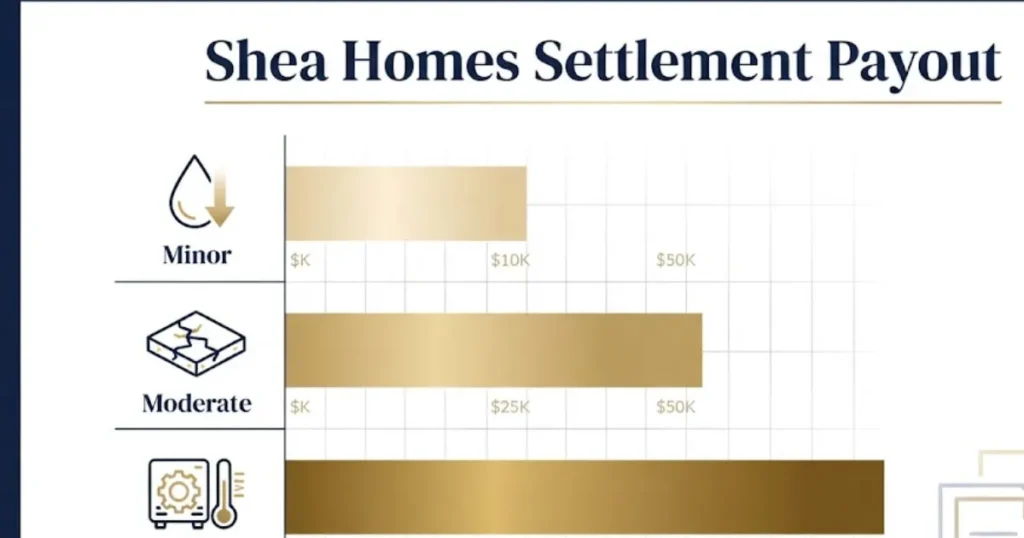
Shea Homes settlement payouts typically range from $5,000 to $80,000 per home, depending on the type and severity of defects, the state where the home is located, and whether the settlement covers direct repairs or cash compensation. Some homeowners with severe structural damage have received more.
It is important to understand that most construction defect settlements are not paid as cash to individual homeowners. Instead, the settlement funds go to the HOA, which then uses the money to hire contractors to repair common area and individual home defects. Your “payout” comes in the form of repair work, not a check.
In cases where homeowners file individual claims, cash payouts are more common. But individual claims also carry more risk and require more personal involvement.
| Defect Type | Estimated Payout Range Per Home |
|---|---|
| Water intrusion (minor) | $5,000 to $15,000 |
| Water intrusion (major, with mold) | $20,000 to $50,000 |
| Foundation cracking | $10,000 to $40,000 |
| Drainage/grading defects | $5,000 to $20,000 |
| HVAC defects | $3,000 to $12,000 |
| Roofing defects | $5,000 to $25,000 |
| Multiple defect types combined | $30,000 to $80,000+ |
These numbers come from reported settlement ranges in similar homebuilder construction defect cases. Actual amounts in your case will depend on expert inspection findings.
One thing that catches people off guard: attorney fees and costs come out of the settlement first. Construction defect attorneys typically work on contingency, taking 25% to 40% of the recovery. After expert fees, that leaves homeowners with roughly 50% to 65% of the gross settlement for actual repairs.
Key Takeaway: Most Shea Homes settlement money goes toward repairing your home, not into your bank account, and attorney fees reduce the total available for fixes by roughly a third.
Who Has Shea Homes Lawsuit Eligibility?
You are likely eligible for a Shea Homes lawsuit if you own or previously owned a home built by Shea Homes and your home has experienced construction defects within the applicable statute of limitations or statute of repose in your state. Both current owners and some former owners may qualify.
The eligibility question has two parts. First, do you have a defective home? Second, are you within the legal time window to file?
For the first part, eligibility usually requires at least one of the following:
- Documented construction defects (water intrusion, cracks, leaks, HVAC issues)
- Building code violations identified by an inspector
- Warranty claims that Shea failed to address properly
- Damage to your property caused by defective construction
For the second part, your state’s statute of limitations and statute of repose control the deadline. We cover those in detail in the statute of limitations section below.
| Eligibility Factor | Qualifies? |
|---|---|
| Current Shea homeowner with defects | Yes |
| Former Shea homeowner (sold within SOL period) | Possibly |
| Homeowner in an HOA already suing Shea | Yes, likely already included |
| Homeowner whose defects were “repaired” by Shea but failed | Yes |
| Homeowner outside statute of limitations | Probably not, with limited exceptions |
| Tenant (renter) in a Shea home | Generally no standing to sue builder |
One overlooked group: homeowners who let Shea “fix” their defects under warranty, only to see the same problems return. These homeowners can often argue that the warranty repair was inadequate and restart the clock on certain claims.
If you are part of a Shea community with an active HOA, check with your board first. You may already be part of a pending action without knowing it.
Shea Homes Water Intrusion Lawsuit Claims
Shea Homes water intrusion lawsuits are the single most common category of legal action against the builder, involving allegations that improper waterproofing, flashing, window installation, and grading allow water to penetrate walls, roofs, and foundations. Water intrusion causes the most expensive damage over time.
Water does not forgive sloppy work. When a builder fails to properly install weather barriers behind stucco or siding, moisture seeps in slowly. You might not notice for years. By the time you see staining on an interior wall or smell something musty, the damage behind the surface can be severe.
In Shea Homes cases, expert witnesses have identified several recurring water intrusion causes:
- Missing or improperly lapped weather-resistant barriers
- Window flanges not sealed to the drainage plane
- Inadequate kickout flashing at roof-to-wall intersections
- Stucco applied directly over sheathing without a drainage gap
- Grading that slopes toward the house instead of away
One California case involving a Shea community in San Diego County documented water intrusion in more than 60% of inspected homes. The defects were traced to a systematic failure in the way the builder’s subcontractors installed flashing and weather barriers across the entire development.
Water intrusion claims often carry the highest repair costs because remediation requires removing exterior cladding, replacing damaged sheathing and framing, treating or removing mold, and reinstalling everything correctly. A single home can require $25,000 to $60,000 in water intrusion repairs.
If you see water stains, bubbling paint, musty odors, or soft drywall in your Shea home, document everything with photos and dates immediately. That documentation becomes evidence.
Shea Homes Foundation Problems and Legal Claims
Shea Homes foundation problems involve cracking, settling, and shifting of concrete slabs and stem walls, typically caused by inadequate soil preparation, insufficient reinforcement, or poor concrete placement during construction. Foundation defects can compromise the entire structural integrity of a home.
Foundation issues show up as cracks in interior walls, doors that won’t close properly, uneven floors, and visible cracks in the slab itself. In severe cases, the foundation shifts enough to crack plumbing lines underneath, creating hidden water damage beneath the home.
Arizona has produced the most foundation-related Shea Homes claims. The desert soil, particularly expansive clay soils in parts of Maricopa County, requires careful preparation before a slab is poured. When builders fail to over-excavate, compact properly, or install adequate moisture barriers, the soil expands and contracts with seasonal changes, stressing the foundation.
| Foundation Issue | Common Cause | Repair Cost Range |
|---|---|---|
| Hairline slab cracks | Normal settling (may not be actionable) | $500 to $2,000 |
| Structural slab cracks | Poor soil compaction or reinforcement | $10,000 to $30,000 |
| Stem wall cracks | Inadequate reinforcement | $5,000 to $20,000 |
| Foundation heaving | Expansive soil not mitigated | $15,000 to $50,000 |
| Under-slab plumbing breaks | Foundation movement | $8,000 to $25,000 |
Not every crack is a lawsuit. Normal settling produces minor hairline cracks that don’t affect structure. The legal threshold kicks in when cracks exceed certain widths, when doors and windows no longer operate properly, or when plumbing is compromised.
Key Takeaway: If your Shea home has cracks wider than 1/8 inch in the foundation or walls that seem to be growing, get an independent structural engineer inspection before Shea’s own warranty team evaluates it.
Common Shea Homes Defect Types Reported in Court
The most common Shea Homes defect types reported in court filings include water intrusion, foundation defects, drainage failures, HVAC installation errors, plumbing defects, roofing deficiencies, stucco and exterior cladding failures, and electrical code violations. Court records reveal patterns that repeat across multiple Shea communities.
What stands out in the litigation record is how similar the defects are from one community to the next. This suggests systemic issues with Shea’s construction practices or its oversight of subcontractors, rather than isolated mistakes at a single job site.
| Defect Category | Frequency in Court Filings | Severity Rating |
|---|---|---|
| Water intrusion | Very high | High |
| Foundation/structural | High | High |
| Drainage/grading | High | Medium to high |
| HVAC systems | Medium | Medium |
| Plumbing | Medium | Medium to high |
| Roofing | Medium | Medium |
| Stucco/exterior | Medium to high | Medium |
| Electrical | Lower | Varies |
| Insulation | Lower | Low to medium |
HVAC defects deserve special attention because they affect daily comfort. Homeowners have reported undersized systems, improperly sealed ductwork, and units that cannot maintain temperature in extreme heat or cold. In Arizona, where summer temperatures exceed 110 degrees, an undersized HVAC system is not just uncomfortable. It’s a health risk.
Plumbing defects often hide behind walls and under slabs. By the time a leak becomes visible, significant damage has already occurred. Court filings have detailed instances where Shea’s subcontractors used improper fittings, failed to properly solder joints, or ran pipes through areas where thermal expansion was not accounted for.
The volume and consistency of these defect reports across different states strengthens legal arguments that Shea has a pattern of inadequate quality control.
The Shea Homes Arbitration Clause Problem
The Shea Homes arbitration clause is a provision in many Shea Homes purchase agreements that requires homeowners to resolve disputes through private arbitration instead of filing lawsuits in court. This clause is one of the biggest obstacles homeowners face when trying to take legal action against Shea.
Arbitration is a private process where a neutral third party (the arbitrator) hears both sides and makes a binding decision. It sounds fair on paper. In practice, it heavily favors the builder.
Here is why arbitration creates problems for homeowners:
- No jury. An arbitrator decides your case alone.
- Limited discovery. You get fewer tools to force Shea to hand over documents and records.
- No appeal. The arbitrator’s decision is almost impossible to overturn.
- Repeat player advantage. The arbitration company handles many builder cases, creating potential bias.
- Confidentiality. Results stay private, preventing other homeowners from learning what happened.
| Court Lawsuit | Arbitration |
|---|---|
| Public record | Private and confidential |
| Jury decides | Single arbitrator decides |
| Full discovery rights | Limited discovery |
| Right to appeal | Very limited appeal rights |
| Precedent benefits other homeowners | No public precedent set |
| Slower but more thorough | Faster but potentially less thorough |
Some homeowners have successfully challenged Shea’s arbitration clauses. Courts in California have occasionally found these clauses unconscionable, meaning they are so one-sided that a court refuses to enforce them. Success depends on the specific language of your contract and your state’s law.
HOA lawsuits sometimes sidestep the arbitration issue entirely. Since the HOA itself did not sign the individual purchase agreements, some courts have ruled that the HOA is not bound by the homeowner’s arbitration clause when suing for common area defects.
If you signed a Shea purchase agreement, pull it out and read the dispute resolution section carefully. Understanding what you agreed to is the first step toward figuring out your options.
How to Sue Shea Homes in 2026
To sue Shea Homes in 2026, you need to document your defects, check your state’s statute of limitations, review your purchase agreement for arbitration clauses, and either join an existing HOA action or hire a construction defect attorney for an individual claim. The process is not simple, but it is well established.
Step one: get an independent home inspection from an engineer or inspector who does not work for Shea. You need objective documentation of every defect. Take photos, keep records of any water damage, and note when you first noticed each problem.
Step two: review your purchase contract. Look for the dispute resolution section. Determine whether you are bound by an arbitration clause and whether your warranty has expired.
Step three: check with your HOA. If your community already has a construction defect case underway, joining it may be your best and cheapest option. Your HOA board or property manager should be able to tell you the status.
Step four: if no HOA case exists, consult a construction defect attorney. Most of these attorneys offer free consultations and work on contingency, meaning they only get paid if you win.
| Step | Action | Timeline |
|---|---|---|
| 1 | Independent home inspection | Week 1 to 2 |
| 2 | Review purchase agreement | Week 1 |
| 3 | Check with HOA for existing case | Week 2 to 3 |
| 4 | Consult construction defect attorney | Week 3 to 4 |
| 5 | Send pre-litigation notice (if required by state) | Month 2 |
| 6 | Builder inspection period | Month 2 to 4 |
| 7 | File lawsuit or begin arbitration | Month 4 to 6 |
In California, SB 800 requires you to give the builder written notice and a chance to inspect and offer to repair before you can file suit. This pre-litigation process typically takes 90 to 150 days. Skipping it can get your case dismissed.
Arizona and Colorado have similar but not identical pre-litigation requirements. Your attorney will guide you through the specific steps for your state.
Key Takeaway: The single most important step is getting an independent inspection early, because your own documentation of defects becomes the foundation of your entire case.
Shea Homes Warranty Claims: What They Cover and Don’t
Shea Homes warranty claims are governed by the builder’s limited warranty, which typically covers workmanship defects for one to two years, mechanical systems for two years, and structural defects for ten years, though the specific terms vary by state and by the version of the warranty in your purchase agreement.
The warranty sounds generous at first glance. Ten years for structural coverage seems like a long time. But the devil is in the details. “Structural” under most builder warranties means only the load-bearing elements of the home. It does not cover water intrusion, cosmetic cracking, HVAC performance, or plumbing unless those issues compromise the structural support.
| Warranty Type | Typical Coverage Period | What It Covers |
|---|---|---|
| Workmanship | 1 to 2 years | Paint, drywall, trim, finishes |
| Mechanical Systems | 2 years | HVAC, plumbing, electrical |
| Structural | 10 years | Load-bearing walls, foundation, roof structure |
Many homeowners file warranty claims with Shea, only to be told the issue falls outside warranty coverage or is considered “normal” settling and wear. This is where disputes begin.
Common warranty claim frustrations include:
- Shea sends its own contractor to inspect, who finds no defect
- Repairs are cosmetic (patching cracks) without addressing the root cause
- Warranty department is slow to respond or stops responding
- Shea claims the defect was caused by homeowner maintenance failures
When warranty claims fail, the next step is the legal process. Your warranty claim history actually helps your legal case. It shows you gave the builder notice and a chance to fix the problem. Every denied or poorly handled warranty request strengthens the argument that Shea failed its obligations.
Save every email, every work order, every response from Shea. Even a non-response is valuable evidence.
Shea Homes HOA Lawsuit Cases
Shea Homes HOA lawsuits are legal actions filed by homeowners associations on behalf of their communities, and they represent the most common and effective way to pursue construction defect claims against Shea. When an HOA sues, it covers both common area defects and individual home defects at the same time.
The HOA model works well for several reasons. First, the cost of litigation is spread across all homeowners through assessments or is handled by the attorney on contingency. Second, the HOA can hire a team of experts to inspect every home in the community, producing a comprehensive defect report. Third, the sheer scale of an HOA case gives homeowners more negotiating power.
In many Shea communities, the HOA transitions from builder control to homeowner control after a certain percentage of homes are sold. Once homeowners control the board, one of the first things they often discover is widespread defects in common areas such as pools, clubhouses, roads, drainage systems, and landscaping infrastructure.
- Pool and spa areas with plumbing or structural defects
- Clubhouse HVAC and waterproofing issues
- Community drainage systems that fail during storms
- Retaining walls that crack or lean
- Street and sidewalk defects from poor subgrade preparation
- Landscape irrigation systems with chronic leaks
Some Shea Homes HOA lawsuits have resulted in settlements exceeding $15 million for large communities. That money funds community-wide repairs managed by the HOA board.
If your HOA is considering legal action against Shea, attend the board meetings. Vote on resolutions related to litigation. Stay informed. Your HOA’s decisions directly affect your property value and your living conditions.
The Shea Homes Complaint Process Explained
The Shea Homes complaint process starts with submitting a warranty service request through Shea’s customer care department, either online or by phone, and Shea is then obligated to respond within the timeframe specified in your warranty agreement. This process is your first formal step before any legal action.
Most Shea communities have a dedicated customer care representative or use an online portal for warranty submissions. When you submit a complaint, include as much detail as possible: photos, dates when you first noticed the issue, location in the home, and any prior repairs attempted.
Here is the typical complaint process flow:
| Stage | What Happens | Expected Timeframe |
|---|---|---|
| Submit complaint | Online form or phone call to Shea customer care | Day 1 |
| Acknowledgment | Shea confirms receipt | 3 to 5 business days |
| Inspection | Shea sends a rep or contractor to evaluate | 1 to 3 weeks |
| Decision | Shea accepts, denies, or partially accepts claim | 1 to 2 weeks after inspection |
| Repair (if accepted) | Shea schedules subcontractor to fix | 2 to 6 weeks after approval |
| Follow-up | Homeowner confirms repair is adequate | Ongoing |
What many homeowners report is that the process stalls at the decision stage. Shea may classify a defect as “within tolerance” or blame the homeowner for lack of maintenance. When this happens, you have two choices: escalate within Shea’s process or move to the legal track.
Before you escalate legally, exhaust the warranty process. Document every interaction. Record the dates of every call and email. Note the names of every Shea representative you speak with.
This paper trail becomes evidence. The more thoroughly you document Shea’s failure to respond or repair, the stronger your eventual legal claim.
Key Takeaway: Treat the Shea Homes complaint process as evidence gathering for a potential lawsuit, not as your only option for getting defects fixed.
Shea Homes Statute of Limitations by State
The Shea Homes statute of limitations varies by state, typically ranging from 3 to 10 years depending on the type of claim, with some states also imposing a statute of repose that sets an absolute deadline regardless of when you discovered the defect. Missing your deadline means losing your right to sue entirely.
This is where timing becomes everything. Two different legal clocks run at the same time in construction defect cases:
Statute of Limitations: The time you have to file after discovering (or when you should have discovered) a defect. Usually 2 to 6 years.
Statute of Repose: The absolute outer limit for filing, measured from when construction was completed. Usually 6 to 12 years. Even if you just discovered the defect, if the repose period has expired, you are likely out of luck.
| State | Statute of Limitations | Statute of Repose | Key Notes |
|---|---|---|---|
| California | 4 years (patent), 10 years (latent) | 10 years | SB 800 applies to homes built after 2003 |
| Arizona | 2 years from discovery | 8 years from completion | Must file notice per ARS 12-1361 |
| Colorado | 2 years from discovery | 6 years (general), 8 years (structural) | CDARA procedures required |
| Nevada | 6 years from completion | 10 years from completion | NRS Chapter 40 notice requirements |
| North Carolina | 3 years from discovery | 6 years from completion | Must prove negligence or breach |
| Florida | 4 years from discovery | 10 years from completion | Recent legislative changes may apply |
| Texas | 2 years from discovery | 10 years from completion | Certificate of merit required |
California homeowners benefit from the longest windows, especially for latent defects. A latent defect is one hidden inside walls or underground that a homeowner could not reasonably discover through ordinary observation. Water intrusion behind stucco is a classic latent defect.
The biggest mistake homeowners make: assuming they have plenty of time. They notice a problem, think about it for a year, then start researching. By the time they contact an attorney, the clock has eaten up precious months.
If you suspect defects, talk to an attorney now. The consultation is almost always free, and knowing your deadline is priceless.
Frequently Asked Questions
How much money can I get from a Shea Homes lawsuit?
Most homeowners receive between $5,000 and $80,000 in repair value or settlement funds, depending on defect severity.
Water intrusion and foundation problems produce the highest payouts.
Attorney fees and costs typically consume 25% to 40% of the total recovery.
Can I still file a Shea Homes lawsuit in 2026?
Yes, if your home’s construction was completed within your state’s statute of repose period.
California homeowners with latent defects have up to 10 years from completion.
Arizona homeowners have 8 years from substantial completion to file.
Does Shea Homes force arbitration on homeowners?
Many Shea purchase agreements contain mandatory arbitration clauses requiring disputes go to private arbitration.
Some courts have refused to enforce these clauses when they are found to be unconscionable.
HOA lawsuits can sometimes bypass individual arbitration agreements entirely.
What construction defects are most common in Shea homes?
Water intrusion is the most frequently reported defect in Shea Homes litigation.
Foundation cracking, drainage failures, and HVAC installation errors are also very common.
These defects often appear together because one problem causes or worsens others.
How long does a Shea Homes lawsuit take to settle?
Most Shea Homes cases take 18 months to 4 years from filing to settlement or judgment.
Pre-litigation notice and inspection periods add 3 to 6 months before a case is even filed.
HOA cases involving large communities tend to take longer due to the number of homes inspected.
The Shea Homes lawsuit picture in 2026 is active and growing. If your home has defects, the time to act is now, not next year.
Start with an independent inspection. Check with your HOA. Pull out your purchase agreement and find the dispute resolution section.
Your evidence matters more than anything else. Document every crack, every stain, every failed warranty request. That paper trail is what turns a complaint into a case.







