

The honey pot tampons lawsuit alleges that The Honey Pot Company sold tampons containing undisclosed harmful chemicals. If you bought or used their products, you may qualify for compensation.
This case has picked up real momentum heading into 2026. Multiple plaintiffs claim the company’s “clean” and “natural” marketing was misleading.
In this article, you will learn exactly what chemicals are involved, who can file a claim, what payouts might look like, and every deadline you need to know. One striking detail: independent lab testing reportedly found substances in these products that never appeared on the label.
That gap between what was promised and what was delivered is the engine driving this entire case forward.
Honey Pot Tampons Lawsuit
The honey pot tampons lawsuit is a legal action accusing The Honey Pot Company of selling feminine hygiene products that contain harmful, undisclosed chemical compounds. Plaintiffs say the company marketed its tampons as safe and natural while hiding potentially dangerous ingredients from consumers.
The Honey Pot Company, founded by Beatrice Dixon, built its brand on the promise of plant-based, clean feminine care products. The company grew rapidly and landed shelf space in Target, Walmart, and other major retailers across the United States.
But the lawsuit tells a different story. According to court filings, independent laboratory testing revealed substances in Honey Pot tampons that were never listed on product packaging.
The allegations center on a basic consumer rights principle. If you sell a product that goes inside someone’s body, you must disclose every ingredient. Plaintiffs argue The Honey Pot Company failed that test.
| Detail | Info |
|---|---|
| Defendant | The Honey Pot Company |
| Product at Issue | Tampons and feminine hygiene items |
| Core Allegation | Undisclosed harmful chemicals |
| Case Type | Product liability / consumer fraud |
| Year Filed | 2024 |
This is not just about one tampon brand. It is part of a growing wave of lawsuits holding feminine care companies accountable for what they actually put in their products.
The Honey Pot Tampons Lawsuit: What Started It All
The honey pot tampons lawsuit began when consumers reported adverse reactions after using the company’s tampon products. These complaints prompted independent testing that allegedly uncovered chemicals absent from the product’s ingredient list.

Some of the earliest complaints surfaced on social media. Women described unusual irritation, infections, and allergic reactions they had never experienced with other tampon brands.
Those complaints caught the attention of consumer advocacy attorneys. Law firms began investigating whether the products contained substances that The Honey Pot Company failed to disclose.
The first formal legal filing came after lab results reportedly confirmed the presence of compounds inconsistent with the “natural” and “plant-based” claims on product labels. That was the spark.
Here is what made this case stand out from typical product complaints:
- The brand specifically marketed itself as a safer alternative to conventional tampons
- Consumers chose Honey Pot products because they wanted to avoid chemicals
- The alleged undisclosed ingredients were the exact type of chemicals buyers were trying to escape
The irony is hard to miss. People paid a premium price specifically to avoid harmful chemicals, and the lawsuit claims they got exactly what they were running from.
Honey Pot Tampons Lawsuit Update 2026
As of 2026, the honey pot tampons lawsuit is progressing through the court system with several significant developments. The case has moved past initial motions, and discovery is underway.
The most notable update involves the volume of plaintiffs. What started as a handful of complaints has grown into a case representing thousands of affected consumers.
In early 2026, the court addressed motions related to class certification. This step determines whether the case can proceed as a class action, which would allow all qualifying buyers to be represented under a single lawsuit.
| Timeline | Development |
|---|---|
| 2024 | Initial complaints and lab testing |
| Late 2024 | First lawsuit filings |
| 2025 | Additional plaintiffs join; discovery begins |
| Early 2026 | Class certification motions heard |
| Mid 2026 | Discovery phase continues |
| Late 2026 | Potential settlement talks or trial date |
The Honey Pot Company has pushed back against the allegations. The company’s legal team has filed motions to dismiss certain claims, arguing that the products meet all applicable safety standards.
Regardless of the company’s defense, the case keeps gaining traction. Consumer interest remains high, and the plaintiff pool continues expanding.
Key Takeaway: The honey pot tampons lawsuit has grown from a small consumer complaint into a major class action moving through federal court in 2026, with class certification as the next critical milestone.
Honey Pot Tampon Class Action Lawsuit
A class action lawsuit allows one or more plaintiffs to represent a large group of people with the same legal complaint. The honey pot tampon class action lawsuit seeks to represent every consumer who purchased Honey Pot tampons during the relevant time period.
Think of it like a carpool. Instead of thousands of people each driving their own lawsuit to court, everyone rides together in one case. It saves time, money, and judicial resources.
For this case to become a certified class action, the court must confirm several things:
- The number of affected consumers is large enough to justify class treatment
- All class members share common legal questions
- The named plaintiffs’ claims are typical of the entire class
- The attorneys can adequately represent everyone’s interests
If the court grants class certification, you would not need to file your own individual lawsuit. Instead, you would be included as a class member and share in any settlement or judgment.
Class certification is a big deal. Without it, each consumer would need to hire their own attorney and file separately. That is expensive and impractical for most people.
The plaintiff attorneys are working to demonstrate that every Honey Pot tampon buyer was exposed to the same misleading labeling and the same undisclosed chemicals.
Honey Pot Tampons Chemicals Found
Independent laboratory testing allegedly found several chemical compounds in Honey Pot tampons that were not disclosed on the product label. These substances reportedly include volatile organic compounds and other potentially harmful agents.
The specific chemicals matter because these products are used internally. The vaginal tissue is one of the most absorbent areas of the human body. Chemicals that might be relatively harmless on your skin can cause serious problems when they contact mucous membranes.
According to the lawsuit allegations, the following types of substances were reportedly detected:
| Chemical Category | Why It Matters |
|---|---|
| Volatile Organic Compounds (VOCs) | Can cause irritation, headaches, and organ damage with repeated exposure |
| Phthalates | Linked to hormone disruption and reproductive issues |
| Undisclosed fragrances | May contain dozens of sub-chemicals not individually listed |
| Potential heavy metal traces | Toxic even in small amounts with cumulative exposure |
It is worth understanding that the FDA does not require tampon manufacturers to list every single chemical in their products. That regulatory gap is part of what makes lawsuits like this one necessary.
The plaintiffs argue that even if full disclosure is not legally required by the FDA, The Honey Pot Company’s own marketing promises created an obligation to be transparent. When you tell customers your product is “clean” and “natural,” you are making a contractual promise.
The chemical findings are the factual backbone of the entire case.
Honey Pot Tampons Side Effects
Consumers involved in the lawsuit reported a range of side effects after using Honey Pot tampons. The most common complaints include vaginal irritation, unusual discharge, yeast infections, bacterial vaginosis, and allergic reactions.
Some users reported symptoms that appeared shortly after using the product. Others say they experienced chronic issues over months of repeated use before connecting the problem to the tampons.
Here are the most frequently reported side effects according to plaintiff filings:
- Persistent vaginal itching or burning
- Unusual or foul-smelling discharge
- Recurrent yeast infections
- Bacterial vaginosis episodes
- Skin rashes around the vaginal area
- Pelvic discomfort or cramping beyond normal menstrual pain
- Allergic contact dermatitis
Not every consumer experienced these problems. And proving that a specific tampon caused a specific health issue is one of the legal challenges in this case.
But the pattern is what matters. When dozens or hundreds of consumers report the same types of reactions to the same product, it becomes harder for the manufacturer to argue coincidence.
The plaintiffs’ legal team has retained medical experts to testify about the connection between the alleged chemicals and the reported symptoms. That expert testimony will be critical as the case moves forward.
If you experienced any of these side effects while using Honey Pot tampons, documenting your medical history and product purchases strengthens a potential claim.
Honey Pot Tampons Health Risks
The health risks associated with Honey Pot tampons, according to the lawsuit, go beyond short-term irritation. Plaintiffs allege that long-term exposure to undisclosed chemicals through tampon use can create serious reproductive and systemic health concerns.
Think about how often tampons are used. A typical menstruating person uses tampons for several days each month, for years or even decades. That is not a one-time exposure. It is repeated contact between sensitive tissue and whatever chemicals are in the product.
| Health Concern | Potential Link |
|---|---|
| Hormonal disruption | Phthalates and endocrine disruptors interfere with natural hormone balance |
| Reproductive issues | Chemical exposure linked to fertility concerns |
| Chronic infections | Irritation from undisclosed substances may alter vaginal microbiome |
| Allergic sensitization | Repeated exposure can develop into chronic allergic responses |
| Systemic absorption | Chemicals absorbed vaginally enter the bloodstream faster than oral ingestion |
One often overlooked fact is that vaginal absorption bypasses the liver’s first-pass metabolism. That means chemicals absorbed through vaginal tissue enter the bloodstream at higher concentrations than if you swallowed them.
The lawsuit argues that The Honey Pot Company knew or should have known about these risks. The plaintiffs contend that basic product safety testing would have revealed these chemical concerns before the products ever reached store shelves.
Key Takeaway: The chemicals allegedly found in Honey Pot tampons pose heightened health risks because vaginal tissue absorbs substances directly into the bloodstream, bypassing the body’s normal filtering systems.
Is The Honey Pot Tampons Safe?
Based on the allegations in this lawsuit, the safety of Honey Pot tampons is seriously in question. Plaintiffs claim the products are not as safe as the company’s marketing suggests.
The Honey Pot Company has maintained that its products are safe and meet all regulatory requirements. The company has pointed to its use of organic cotton and plant-derived ingredients as evidence of its commitment to safety.
But here is the disconnect. Meeting minimum FDA requirements for tampon manufacturing is a low bar. The FDA classifies tampons as medical devices, but it does not require manufacturers to disclose every chemical present in the final product.
So a company can technically comply with FDA rules and still sell a product containing undisclosed substances. That is what the plaintiffs say happened here.
Several factors are relevant to the safety question:
- FDA standards: The Honey Pot Company may meet basic regulatory compliance
- Marketing claims: The brand advertised itself as cleaner and safer than competitors
- Lab results: Independent testing allegedly found chemicals not on the label
- Consumer reports: Hundreds of adverse reaction complaints have been documented
The bottom line is that “safe” and “FDA compliant” are not the same thing. The lawsuit argues that consumers deserve to know exactly what is in a product they use internally, regardless of what the minimum regulations require.
Until the case resolves, consumers must make their own informed decisions about whether to continue using these products.
Honey Pot Tampons Ingredients Controversy
The ingredients controversy surrounding Honey Pot tampons centers on the gap between what the company advertised and what independent testing allegedly found in the products. This discrepancy is the foundation of the entire legal case.
The Honey Pot Company built its reputation on ingredient transparency. The brand’s website and product packaging emphasized plant-based formulas, organic cotton, and herbal infusions. Consumers trusted those claims.
But the lawsuit paints a different picture. According to plaintiffs, third-party lab analysis revealed compounds that had no business being in a product marketed as natural and clean.
Here is where the controversy gets especially heated:
- The company charged premium prices based on “clean ingredient” marketing
- Consumers specifically chose Honey Pot over cheaper options because of these claims
- The alleged undisclosed chemicals directly contradict the brand’s core identity
- Some of the detected substances are the same types of chemicals found in conventional tampons
It is like paying extra for organic produce and finding out it was sprayed with the same pesticides as everything else. The betrayal of trust is what makes this controversy so significant to consumers.
The Honey Pot Company has not confirmed or denied the specific lab findings publicly. The company’s legal response has focused on challenging the testing methodology and the plaintiffs’ standing rather than addressing the chemical allegations head-on.
That approach has not calmed consumer concerns. If anything, it has amplified them.
Honey Pot Tampons Lawsuit Settlement
No final settlement has been reached in the honey pot tampons lawsuit as of early 2026. However, settlement discussions could begin once discovery is complete and class certification is resolved.
Most class action lawsuits involving consumer products settle before going to trial. Companies typically prefer to resolve cases privately rather than risk a public trial that could damage their brand even further.
Based on comparable feminine hygiene product lawsuits, here is what a potential settlement structure might look like:
| Settlement Component | Estimated Range |
|---|---|
| Individual consumer payments | $25 to $500 per claimant |
| Total settlement fund | $5 million to $50 million (depending on class size) |
| Attorney fees | 25% to 33% of total fund |
| Administrative costs | 5% to 10% of total fund |
| Injunctive relief | Required labeling changes and testing protocols |
Several factors will influence the final settlement amount:
- How many consumers file valid claims
- The strength of the lab testing evidence
- Whether the court certifies the class
- The company’s financial resources and insurance coverage
- Public pressure and media coverage
Settlement is not guaranteed. The Honey Pot Company could choose to fight the case all the way to trial. But the financial math usually favors settlement for both sides.
Keep an eye on court filings for any indication that settlement talks have begun. That is usually a sign the case is nearing resolution.
Key Takeaway: While no settlement exists yet, comparable cases suggest individual payouts between $25 and $500, with the total fund potentially reaching tens of millions of dollars depending on the class size.
Honey Pot Tampons Lawsuit Payout
Individual payouts from the honey pot tampons lawsuit will depend on several factors, including proof of purchase, documented health issues, and the total number of claimants. Most consumers can reasonably expect between $25 and $500 if a settlement is reached.
That range might seem wide, and it is. Here is why.
Class action payouts almost always use a tiered system. People with stronger evidence get more money. People with weaker claims get less.
| Payout Tier | Criteria | Estimated Amount |
|---|---|---|
| Tier 1: Basic claim | Purchased the product, no proof required beyond attestation | $25 to $75 |
| Tier 2: Proof of purchase | Has receipts, credit card statements, or retailer loyalty data | $75 to $200 |
| Tier 3: Documented health impact | Has medical records showing treatment for related symptoms | $200 to $500 |
| Tier 4: Severe injury claim | Hospitalization, ongoing treatment, or significant harm | $500 and above (individual cases) |
One thing to understand is that the more people who file claims, the smaller each individual payout becomes. Settlement funds are finite. If a $20 million fund is split among 100,000 claimants, the math changes quickly.
That is a common frustration with class actions. The attorneys may earn millions, while individual consumers receive a check that feels underwhelming. But it is often the only practical path to any compensation.
If you have receipts and medical records, save them now. That documentation could mean the difference between a $30 check and a $300 one.
Who Qualifies for Honey Pot Tampons Lawsuit
You may qualify for the honey pot tampons lawsuit if you purchased or used Honey Pot brand tampons during the relevant time period specified in the class action complaint. The exact dates depend on the court’s final class definition, but purchases from approximately 2020 through 2025 are expected to fall within the qualifying range.
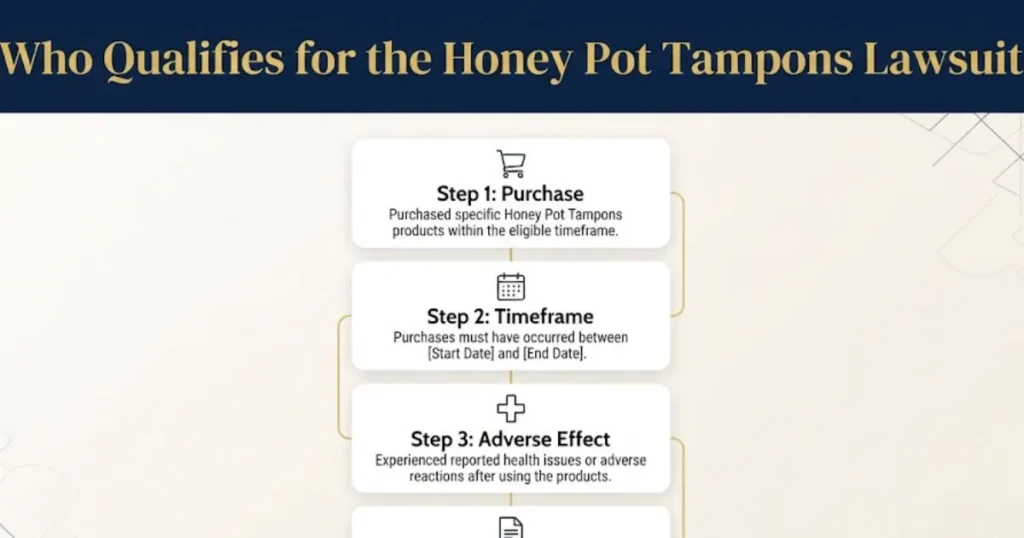
Eligibility is not complicated. Here are the basic criteria:
- You bought Honey Pot tampons during the class period (specific dates to be confirmed by the court)
- You are a U.S. resident (most class actions are limited to domestic consumers)
- You have not previously released claims against The Honey Pot Company for the same issues
You do not need to prove you were physically harmed. In most consumer fraud class actions, simply purchasing the product under misleading marketing is enough to qualify. The argument is that you paid a price based on false promises, so you suffered financial harm.
That said, people who did experience health problems will likely qualify for higher compensation tiers. Medical documentation strengthens your claim significantly.
| Qualification Factor | Required? |
|---|---|
| Purchased Honey Pot tampons | Yes |
| U.S. resident | Yes |
| Proof of purchase | Helpful but not always required |
| Medical records showing side effects | Helpful for higher payout tiers |
| Physical injury | Not required for basic claim |
If you threw away your receipts, do not panic. Many retailers store purchase history in loyalty accounts, and credit card statements can serve as proof.
How to Join Honey Pot Tampons Lawsuit
Joining the honey pot tampons lawsuit is straightforward. If the case achieves class certification, you may be automatically included as a class member if you meet the eligibility criteria.
Here is how the process typically works for class action lawsuits:
Step 1: Determine eligibility. Review the class definition to confirm you bought qualifying products during the specified time period.
Step 2: Wait for class notice. Once a class is certified, the court requires that all potential class members be notified. This notice usually arrives by mail, email, or through published announcements.
Step 3: Do nothing or opt out. In most class actions, you are automatically included unless you actively opt out. If you want to stay in the class, you usually do not need to take any action at this stage.
Step 4: File a claim when prompted. If a settlement is reached, you will receive instructions on how to submit a claim form. This form will ask for basic information and any supporting documentation.
Step 5: Receive payment. After the court approves the settlement and the claims process closes, payments are distributed.
Some consumers also choose to contact the attorneys handling the case directly. You can submit your information to the plaintiff law firms to make sure you are on their radar.
One tip: gather your evidence now. Do not wait until the claims period opens to start looking for receipts or medical records. Being prepared speeds up the process.
Honey Pot Tampons Lawsuit: How to File a Claim
Filing a claim in the honey pot tampons lawsuit involves completing a claim form and submitting supporting documentation. This process opens only after a settlement is reached and approved by the court.
Right now, no settlement has been finalized. That means the formal claims process has not started. But you can prepare.
Here is what you will need when the time comes:
- Personal information: Name, address, email, phone number
- Product details: Which Honey Pot products you purchased and approximate dates
- Proof of purchase: Receipts, online order confirmations, credit card statements, or retailer loyalty records
- Medical records (if applicable): Doctor visits, prescriptions, or treatment records related to symptoms from using the products
- Attestation statement: A signed statement confirming your purchase and experience (often accepted in lieu of receipts for basic claims)
| Filing Step | What You Need |
|---|---|
| Complete claim form | Personal info and product details |
| Attach proof of purchase | Receipts or bank statements |
| Include medical records | If seeking higher tier payout |
| Sign attestation | Confirming truthfulness of claim |
| Submit by deadline | Before the claims deadline closes |
Most claim forms can be completed online through a dedicated settlement website. Paper forms are typically available as an alternative.
The entire process usually takes about 15 to 30 minutes if you have your documents ready. Do not overcomplicate it. Answer the questions honestly and attach whatever evidence you have.
Key Takeaway: You cannot file a formal claim yet, but gathering receipts, purchase records, and medical documentation now will put you in the best position once the claims process opens.
Honey Pot Tampons Lawsuit Deadline
The honey pot tampons lawsuit deadline for filing claims has not been set yet because the case has not reached a settlement agreement. Once a settlement is approved, the court will establish a specific deadline for consumers to submit claims.
Based on how similar class actions operate, you can expect the following timeline:
| Phase | Expected Timing |
|---|---|
| Settlement agreement reached | Late 2026 to mid 2027 (estimated) |
| Court preliminary approval | 1 to 2 months after agreement |
| Class notice distributed | Within 30 to 60 days of preliminary approval |
| Claims period opens | Same time as class notice |
| Claims deadline | 60 to 120 days after claims period opens |
| Final approval hearing | 30 to 90 days after claims deadline |
| Payments distributed | 3 to 6 months after final approval |
Missing the deadline means you lose your right to file a claim. That is non-negotiable. Courts enforce these dates strictly.
The best way to avoid missing the deadline is to register with the plaintiff law firms handling the case. They maintain mailing lists and send notifications about every major development.
You should also monitor court docket entries if you want real-time updates. Federal court filings are publicly accessible, and new entries appear as they are filed.
Do not assume someone will personally remind you. It is your responsibility to file on time.
Honey Pot Tampons Recall 2026
As of 2026, there has been no formal recall of Honey Pot tampons by the FDA or the Consumer Product Safety Commission. The lawsuit and a product recall are separate legal processes.
This is a common point of confusion. A recall happens when a government agency determines that a product poses an unreasonable safety risk. A lawsuit happens when private citizens allege they were harmed.
A product can be the subject of a massive lawsuit without ever being recalled. And a recalled product does not automatically trigger a lawsuit.
Here is how they differ:
| Factor | Recall | Lawsuit |
|---|---|---|
| Who initiates | FDA, CPSC, or manufacturer | Consumers and their attorneys |
| Purpose | Remove unsafe product from market | Seek compensation for harm |
| Outcome | Product pulled from shelves | Financial settlement or judgment |
| Current status for Honey Pot | No recall issued | Active lawsuit in progress |
The absence of a recall does not mean the products are safe. It means the government has not taken action. The FDA’s oversight of tampon ingredients is limited compared to its oversight of pharmaceuticals.
If a recall were issued, it would actually strengthen the lawsuit significantly. It would essentially mean a federal agency agreed the product posed safety concerns. Until that happens, the case relies on independent testing and consumer testimony.
Honey Pot Company Lawsuit Status
The Honey Pot Company lawsuit is currently in the discovery and class certification phase as of 2026. The case remains active in federal court with no dismissal or settlement yet.
Here is a snapshot of where things stand:
| Status Element | Current Position |
|---|---|
| Case filed | Yes |
| Defendant’s motion to dismiss | Partially denied |
| Discovery | Ongoing |
| Class certification | Pending decision |
| Settlement discussions | Not publicly confirmed |
| Trial date | Not yet scheduled |
The discovery phase is where both sides exchange evidence. Plaintiffs’ attorneys can request internal company documents, testing records, manufacturing data, and executive communications.
This phase often produces the most damaging evidence in consumer product lawsuits. Internal emails or memos showing that a company knew about chemical contamination can dramatically shift the case dynamics.
The Honey Pot Company has vigorously defended itself. The company argues that its products are safe, properly labeled, and compliant with all applicable regulations. Its legal team has challenged the plaintiffs’ testing methodology and questioned whether the alleged chemicals could have come from sources other than the tampons.
The next major milestone is the class certification ruling. If the court certifies the class, settlement pressure on the company increases substantially. If certification is denied, individual plaintiffs would need to pursue separate cases.
The legal community is watching this one closely. The outcome could set precedents for how feminine hygiene products are regulated and marketed going forward.
Key Takeaway: The case is in active discovery with class certification pending, and the next few months will determine whether this moves toward a class-wide settlement or individual litigation.
Honey Pot vs Other Tampon Lawsuits
The honey pot tampons lawsuit is part of a broader wave of legal actions targeting the feminine hygiene industry. Comparing it to other tampon lawsuits provides useful context for what consumers can expect.
Several major tampon and feminine care brands have faced similar allegations in recent years. The common thread is chemical contamination, misleading labeling, or failure to disclose ingredients.
| Lawsuit | Brand | Core Allegation | Status | Estimated Payouts |
|---|---|---|---|---|
| Honey Pot | The Honey Pot Company | Undisclosed chemicals in “natural” tampons | Active, 2026 | $25 to $500 (projected) |
| Tampax PFAS lawsuit | Procter and Gamble | PFAS “forever chemicals” detected | Active | TBD |
| Always pads lawsuit | Procter and Gamble | Volatile organic compounds in pads | Settled | $20 to $100 per claimant |
| Thinx settlement | Thinx Inc. | PFAS in period underwear | Settled, 2023 | $7 to $35 per claimant |
| OB tampons complaints | Johnson and Johnson | Allergic reactions and quality issues | Individual cases | Varied |
A few patterns emerge from this comparison.
First, companies that market themselves as “clean” or “natural” face higher legal exposure because they made specific promises. The Honey Pot Company falls squarely into this category.
Second, settlement amounts in feminine hygiene cases tend to be modest on a per-person basis but significant in total. The Thinx settlement paid out millions overall, even though individual checks were small.
Third, cases with strong lab evidence tend to settle faster. If the independent testing in the Honey Pot case holds up under scrutiny, it could accelerate the timeline toward resolution.
The Honey Pot lawsuit has one advantage over some of these comparable cases. The brand’s premium pricing and explicit “natural” marketing claims create a stronger consumer fraud argument than cases involving brands that never claimed to be chemical-free.
Frequently Asked Questions
What is the Honey Pot tampons lawsuit about?
The lawsuit alleges The Honey Pot Company sold tampons containing undisclosed harmful chemicals while marketing them as clean and natural.
Plaintiffs claim independent lab testing found substances not listed on product labels.
The case seeks compensation for consumers who purchased these products under misleading marketing.
How much money can I get from the Honey Pot lawsuit?
Most claimants can expect between $25 and $500 depending on their evidence.
Consumers with proof of purchase and medical records qualifying for higher payout tiers.
Final amounts depend on the settlement total and number of claims filed.
Who qualifies to join the Honey Pot tampons lawsuit?
Any U.S. consumer who purchased Honey Pot tampons during the class period (approximately 2020 to 2025) may qualify.
You do not need to prove physical injury to join the class action.
Proof of purchase strengthens your claim but may not be strictly required for basic tier payouts.
What chemicals were found in Honey Pot tampons?
Independent lab testing allegedly detected volatile organic compounds, phthalates, undisclosed fragrance chemicals, and potential heavy metal traces.
These substances were reportedly not listed on product packaging.
The vaginal absorption of these chemicals makes them potentially more harmful than topical skin contact.
What is the deadline to file a Honey Pot tampons claim?
No formal deadline has been set because the case has not reached a settlement yet.
Once a settlement is approved, consumers will typically have 60 to 120 days to file a claim.
Register with the plaintiff law firms now to receive notifications about deadlines when they are established.
The honey pot tampons lawsuit is a case worth tracking in 2026. Whether you are a current Honey Pot customer or a past buyer, understanding your rights puts you in control.
Start gathering your purchase records and any relevant medical documentation now. When the claims process opens, you will want to be ready.
Stay informed, save your evidence, and file your claim before the deadline. Your preparation today determines your payout tomorrow.
META BLOCK
Meta Title: Honey Pot Tampons Lawsuit 2026: Payouts and Updates
Meta Title Chars: 55/59
Meta Desc: The honey pot tampons lawsuit targets harmful chemicals in feminine products. See 2026 updates, payout estimates, and how to file your claim now.
Meta Desc Chars: 155/159
Focus Keywords: honey pot tampons lawsuit, the honey pot tampons lawsuit, honey pot tampon class action, honey pot tampons settlement, honey pot tampons chemicals
Slug: /honey-pot-tampons-lawsuit/
PHASE 5: IMAGE PROMPTS
Image Prompt 1 (Hero Banner):
A professional editorial-style hero banner with the bold headline text “Honey Pot Tampons Lawsuit” prominently displayed in large white serif typography across the upper left third of the composition. The background features a deep navy blue gradient with subtle gold geometric legal scales of justice iconography on the right side. Below the headline, a thin gold horizontal line separates the title from a smaller subheading area. Abstract silhouettes of legal documents and a gavel appear faintly in the lower right corner. The overall mood is serious, authoritative, and clean. Lighting is dramatic with a soft spotlight effect on the text. Style references Bloomberg Law editorial graphics. Landscape format 1920×1080.
Alt Text 1: Honey pot tampons lawsuit 2026 hero banner with legal scales and gavel on navy background
Image Prompt 2 (Supporting Image):
A mid-article informational graphic with the title text “Who Qualifies for the Honey Pot Tampons Lawsuit” rendered in bold gold typography on a deep navy banner at the top. Below the banner, a clean infographic layout shows four white rounded rectangles arranged vertically, each containing an eligibility step represented by minimalist icons: a shopping cart icon, a calendar icon, a medical cross icon, and a document icon. Subtle gold accent lines connect the steps. The background is a soft off-white with faint navy geometric patterns. No human faces. Professional, modern, editorial quality. High contrast with clean typography. Landscape format 1920×1080 designed for mid-article placement.
Alt Text 2: Who qualifies for honey pot tampons lawsuit eligibility infographic with step icons







