

The discovery phase of a lawsuit is where both sides dig up the facts. It’s the longest part of most civil cases. And it’s where lawsuits are won or lost before trial ever starts.
If you’re heading into a lawsuit in 2026, this is the phase that will demand the most from you. You’ll answer written questions, hand over documents, and possibly sit for a deposition under oath.
Here’s something most people don’t realize: roughly 95% of civil cases settle before trial. A huge reason for that is what comes out during discovery. The evidence uncovered here shapes every settlement offer on the table.
This guide breaks down every part of the discovery process. You’ll learn the tools, the timelines, the costs, and exactly what to expect at each step.
Discovery Phase of Lawsuit
The discovery phase of a lawsuit is the pre-trial period where both sides gather evidence from each other. It begins after the initial pleadings are filed and usually runs for several months.
Think of it like a fact-finding mission. Each party gets to ask questions, demand documents, and take sworn testimony. The goal is to eliminate surprises at trial.
No one walks into a courtroom blind. Discovery exists so both sides know what evidence the other has. This includes witness lists, medical records, financial documents, emails, and physical evidence.
In federal court, discovery is governed by Rules 26 through 37 of the Federal Rules of Civil Procedure (FRCP). State courts have their own versions, but they follow similar principles.
| Discovery Basic | Detail |
|---|---|
| When It Starts | After pleadings are filed |
| Governed By | FRCP Rules 26 through 37 |
| Purpose | Exchange evidence before trial |
| Duration | Typically 3 to 12 months |
| Who Participates | Both plaintiff and defendant |
The discovery phase is not optional. Both sides must participate. Refusing to cooperate can result in court sanctions or even a default judgment.
What Is the Discovery Phase of a Lawsuit
The discovery phase is the formal evidence-gathering stage of a civil lawsuit. It allows each party to obtain facts, documents, and testimony from the opposing side and sometimes from third parties.
This phase serves three big purposes. First, it prevents trial by ambush. Second, it helps both sides evaluate the strength of their case. Third, it encourages settlement by putting all the cards on the table.
Discovery is not a courtroom event. Most of it happens in law offices, conference rooms, and through mail or electronic exchanges. You rarely see a judge during this phase unless there’s a dispute.
The rules require that both sides share relevant information. “Relevant” is a broad term here. It covers anything reasonably calculated to lead to admissible evidence.
- Both parties must cooperate in good faith
- Privileged information (like attorney-client conversations) is protected
- Work product (your lawyer’s strategy notes) is generally off limits
- Third parties can be pulled in through subpoenas
Discovery is the backbone of civil litigation. Without it, neither side could build a case based on facts.
Discovery Process in Civil Litigation
The discovery process in civil litigation follows a structured sequence of steps. It starts with initial disclosures and moves through written discovery, depositions, and expert reports.
Step one is the Rule 26(f) conference. Both sides meet early in the case to plan the discovery schedule. They discuss what evidence exists, how electronic data will be handled, and propose deadlines.
After that meeting, each party files initial disclosures. These include the names of witnesses, copies of relevant documents, damage calculations, and insurance information. You don’t wait to be asked for this. You hand it over.
Then the real work begins. Interrogatories go out. Document requests follow. Depositions get scheduled. Expert witnesses prepare reports.
| Step | What Happens | Typical Timing |
|---|---|---|
| Rule 26(f) Conference | Parties plan discovery | Within 21 days of first meeting |
| Initial Disclosures | Exchange basic evidence | Within 14 days of conference |
| Written Discovery | Interrogatories and document requests | Months 1 through 4 |
| Depositions | Sworn testimony recorded | Months 3 through 8 |
| Expert Reports | Opinions from specialists | Months 6 through 10 |
The judge sets a discovery cutoff date. After that date, no more discovery is allowed unless the court grants an extension.
Key Takeaway: The discovery phase is a structured, rule-governed process that forces both sides to share evidence long before trial begins.
Types of Discovery in a Lawsuit
There are six main types of discovery in a lawsuit. Each one serves a different purpose in gathering evidence and building your case.
The six types are:
- Interrogatories: written questions the other side must answer under oath
- Depositions: live, sworn testimony recorded by a court reporter
- Requests for Production: demands for documents, photos, or other tangible items
- Requests for Admissions: statements the other side must admit or deny
- Physical and Mental Examinations: court-ordered medical evaluations
- Subpoenas to Third Parties: demands for evidence from non-parties
Each tool has specific rules about how many you can use and when. In federal court, you’re limited to 25 interrogatories per party unless the court says otherwise. Depositions are capped at 10 per side and 7 hours each.
Not every case uses all six tools. A simple car accident claim might only need interrogatories and document requests. A complex product liability case could use every tool available.
| Discovery Type | Format | Limit (Federal) |
|---|---|---|
| Interrogatories | Written Q&A | 25 per party |
| Depositions | In-person testimony | 10 per side, 7 hours each |
| Document Requests | Written demand | No set limit |
| Admissions | Written statements | No set limit |
| Medical Exams | Physical evaluation | Requires court order |
| Subpoenas | Third-party demands | No set limit |
Choosing the right combination of tools is a strategic decision. Your attorney picks based on what evidence you need and where it’s likely hiding.
Interrogatories in Discovery
Interrogatories are written questions sent to the opposing party that must be answered under oath. They’re one of the most common and cost-effective discovery tools available.
You can think of interrogatories like a homework assignment. The other side receives a list of questions and has 30 days to respond in writing. Every answer must be truthful because the respondent signs under penalty of perjury.
Common interrogatory topics include:
- Names and contact info of witnesses
- Details about the incident or claim
- Insurance policy information
- Medical treatment history
- Employment and income records
- Prior lawsuits or claims
Interrogatories work best for gathering basic factual information. They’re not great for nuance or follow-up questions because you can’t ask a clarifying question in real time.
One big limitation: the other side’s attorney helps draft the answers. That means responses tend to be carefully worded and sometimes evasive. If an answer seems incomplete, your lawyer can file a motion to compel a better response.
Quick Fact: Federal courts limit interrogatories to 25 per party under FRCP Rule 33. Many state courts set similar caps, though some allow more with court approval.
Interrogatories are usually the first discovery tool used. They lay the groundwork for depositions and document requests that come later.
Depositions During Discovery Phase
A deposition is live, sworn testimony given outside of court and recorded by a court reporter. It’s the most powerful discovery tool because you get to question a witness face to face.
During a deposition, the witness (called the “deponent”) sits in a room with attorneys from both sides. A court reporter transcribes every word. Sometimes a videographer records the session too.
The attorney asking questions can cover almost anything relevant to the case. The witness must answer truthfully. Lying under oath during a deposition carries the same penalties as lying at trial.
Depositions serve several purposes:
- Lock witnesses into specific testimony they can’t change later
- Test how a witness will perform at trial
- Uncover new facts or leads for other discovery
- Preserve testimony if the witness might not be available for trial
| Deposition Detail | Info |
|---|---|
| Who Can Be Deposed | Parties, witnesses, experts, corporate reps |
| Duration Limit | 7 hours per deponent (federal) |
| Number Limit | 10 per side (federal) |
| Recording Method | Stenographic, video, or both |
| Location | Usually a law office or conference room |
Depositions are expensive. Court reporters charge by the page. Videographers charge by the hour. Attorney time adds up fast. A single deposition can cost $1,000 to $5,000 or more depending on the witness.
Quick Fact: Under FRCP Rule 30, a party must give at least 14 days’ notice before taking a deposition.
Request for Production of Documents
A request for production asks the opposing party to hand over specific documents, electronically stored information, or tangible items. It’s how you get the paper trail.
This tool covers an enormous range of materials. Contracts, emails, text messages, photos, surveillance footage, financial records, internal memos, and corporate policies all fall within its reach.
The responding party has 30 days to either produce the documents or object. Objections must be specific. You can’t just say “we don’t want to.”
Common document requests include:
- Medical records and billing statements
- Employment files and personnel records
- Communications (emails, texts, letters)
- Financial statements and tax returns
- Photographs and video recordings
- Maintenance or inspection records
- Internal investigation reports
One critical rule: you must produce documents “as they are kept in the usual course of business.” You can’t reorganize, cherry-pick, or bury important documents in thousands of irrelevant pages (though some parties try).
Quick Fact: Under FRCP Rule 34, there is no numerical limit on document requests. However, courts can restrict them if they become burdensome or disproportionate to the case.
In 2026, most document production happens electronically. Physical paper production is becoming rare. Parties exchange files through secure platforms designed for litigation document sharing.
Key Takeaway: Interrogatories, depositions, and document requests form the core toolkit of discovery, and each one targets a different kind of evidence.
Request for Admissions Discovery
A request for admissions asks the opposing party to admit or deny specific statements of fact. It’s a tool designed to narrow the issues for trial.
Here’s what makes admissions unique: if the other side fails to respond within 30 days, the statements are automatically deemed admitted. That’s a powerful consequence. Silence equals agreement.
Admissions work like this. Your attorney drafts a list of statements. Each one is a clear, factual claim. The other side must respond to each with “admitted,” “denied,” or “unable to admit or deny” with an explanation.
Common uses include:
- Confirming the authenticity of documents
- Establishing undisputed facts (like dates or locations)
- Eliminating issues that don’t need to be argued at trial
- Pinning down the other side’s position on key facts
| Admissions Detail | Info |
|---|---|
| Response Deadline | 30 days (federal) |
| Consequence of Silence | Deemed admitted |
| Limit | No set federal limit |
| Format | Written statements, each numbered |
| Can Be Withdrawn | Only with court permission |
Admissions save time and money at trial. If both sides agree on certain facts, the jury doesn’t need to hear evidence about those points. That makes the trial shorter and more focused.
Strategic tip: admissions can trap the opposing party. If they admit something harmful to their case, that admission can be used against them at trial.
Physical and Mental Examinations Discovery
A physical or mental examination allows one party to have the other examined by a doctor or psychologist. It only applies when someone’s physical or mental condition is directly at issue.
This discovery tool is different from the others. You can’t just request it. You need a court order. FRCP Rule 35 requires the party seeking the exam to show “good cause” and prove the condition is genuinely in controversy.
Personal injury cases are the most common setting for this tool. If a plaintiff claims back injuries from a car accident, the defendant can ask the court to order an independent medical examination (IME).
Key rules about examinations:
- Must be ordered by the court
- Must be conducted by a licensed professional
- The examiner’s report must be shared with both sides
- The examined party can request a copy of the report
- Requesting a report waives privilege over their own medical records on the same condition
| Examination Detail | Info |
|---|---|
| Rule | FRCP Rule 35 |
| Requires | Court order |
| Standard | Good cause, condition in controversy |
| Examiner | Licensed physician or psychologist |
| Report Sharing | Mandatory upon request |
These exams can be contentious. Plaintiffs sometimes feel the defendant’s chosen doctor is biased. Courts try to select neutral examiners, but disputes about bias are common.
Quick Fact: The party requesting the exam typically pays for it. The examined party’s attorney can attend in some jurisdictions.
E-Discovery in Lawsuits
E-discovery refers to the discovery of electronically stored information (ESI). In 2026, it’s the dominant form of evidence exchange in nearly every lawsuit.
ESI includes emails, text messages, social media posts, databases, cloud storage files, metadata, voicemails, and even data from wearable devices. If it’s stored on a computer, phone, or server, it’s potentially discoverable.
The volume of electronic data in modern cases is staggering. A single corporate custodian might produce hundreds of thousands of documents. That’s why e-discovery has become its own industry with specialized software and vendors.
Key e-discovery concepts:
- Litigation hold: a duty to preserve relevant ESI once litigation is anticipated
- Proportionality: discovery must be proportional to the case’s needs and stakes
- Technology-assisted review (TAR): AI tools that help sort through massive document sets
- Metadata: hidden data about files (creation date, author, edit history)
- Forensic imaging: creating exact copies of hard drives or devices
| E-Discovery Element | What It Means |
|---|---|
| ESI | Electronically stored information |
| Litigation Hold | Duty to preserve digital evidence |
| TAR/Predictive Coding | AI-powered document review |
| Metadata | Hidden data within files |
| Cost | Can range from $5,000 to millions |
In 2026, courts increasingly accept AI-assisted review as a standard practice. The landmark cooperation principle from the Sedona Conference guides how parties should handle e-discovery disputes.
E-discovery costs can dwarf all other litigation expenses. In large commercial cases, e-discovery alone can run into the millions. Even in smaller cases, it can cost $10,000 to $50,000.
Key Takeaway: E-discovery is the biggest cost driver and complexity factor in modern lawsuits, making technology literacy a must for any party involved in litigation.
Scope of Discovery in Civil Cases
The scope of discovery in civil cases is intentionally broad. Parties can seek any information that is relevant to a claim or defense, even if it won’t be admissible at trial.
Under FRCP Rule 26(b)(1), information is discoverable if it is relevant to any party’s claim or defense and proportional to the needs of the case. That’s a wide net. You don’t have to prove the information will be used at trial. You just have to show it could lead to something useful.
However, there are clear boundaries:
- Attorney-client privilege: communications between you and your lawyer are protected
- Work product doctrine: your lawyer’s strategy notes, mental impressions, and legal theories are shielded
- Trade secrets: courts may issue protective orders to limit disclosure
- Proportionality: the court weighs the burden and expense against the likely benefit
The 2015 amendments to the FRCP added proportionality as a core factor. Courts in 2026 actively enforce this. Judges will shut down overly broad requests that amount to fishing expeditions.
| Scope Factor | Discoverable? |
|---|---|
| Relevant facts | Yes |
| Non-admissible but leads to evidence | Yes |
| Attorney-client communications | No (privileged) |
| Lawyer’s strategy notes | No (work product) |
| Trade secrets | Limited (protective order) |
| Overly burdensome requests | No (proportionality) |
Third parties can be pulled into discovery too. If a bank, employer, hospital, or tech company has relevant records, a subpoena can compel production.
Quick Fact: Judges have wide discretion to limit discovery. If a request is too expensive, too invasive, or too tangential, the court can narrow it or block it entirely.
How Long Does Discovery Take in a Lawsuit
Discovery typically takes 3 to 12 months in most civil lawsuits. The exact duration depends on the case type, the court’s schedule, and how cooperative both sides are.
Simple cases move faster. A straightforward car accident claim might finish discovery in 3 to 4 months. Both sides exchange medical records, take a couple depositions, and they’re done.
Complex cases take much longer. Mass torts, class actions, and large commercial disputes can have discovery periods stretching 12 to 24 months or even longer. Cases involving multiple parties, technical evidence, or massive e-discovery volumes always take more time.
| Case Type | Typical Discovery Length |
|---|---|
| Simple personal injury | 3 to 6 months |
| Medical malpractice | 6 to 12 months |
| Product liability | 6 to 18 months |
| Class action | 12 to 24 months |
| Complex commercial | 12 to 24 months or more |
| Mass tort | 12 to 36 months |
In 2026, many federal courts are pushing for shorter discovery periods. Several districts have adopted pilot programs that set aggressive deadlines to reduce litigation costs and court backlogs.
Delays are common. Extensions happen when one side needs more time, when disputes arise over document production, or when new parties or claims are added. Every extension must be approved by the court.
Quick Fact: The judge sets the discovery deadline in the scheduling order. Missing it without permission can result in evidence being excluded at trial.
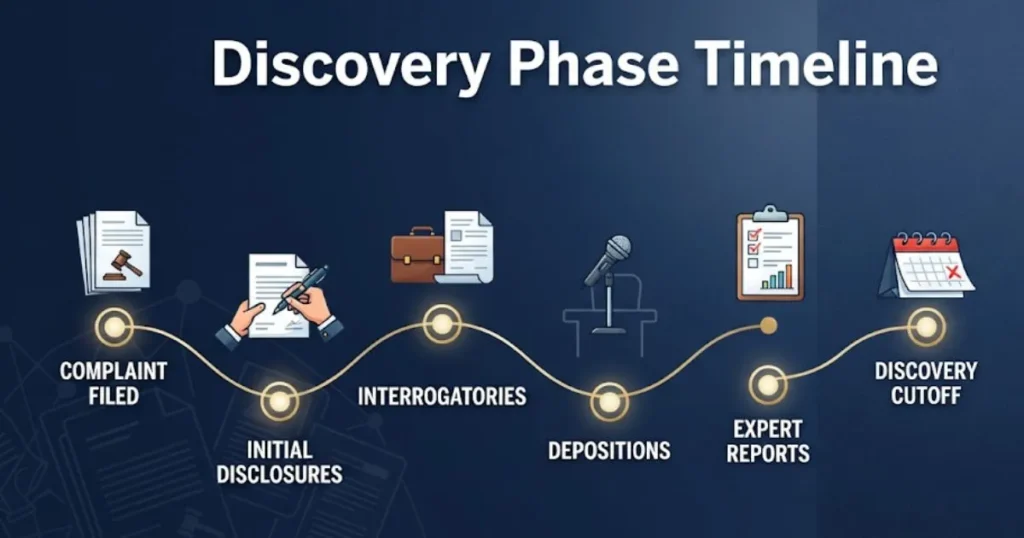
Discovery Phase Timeline
The discovery phase timeline follows a predictable pattern from start to finish. Understanding each stage helps you know what to expect and when.
Here’s how it typically unfolds in federal court:
| Timeline Stage | When It Happens | What Occurs |
|---|---|---|
| Complaint and Answer Filed | Month 0 | Lawsuit officially begins |
| Rule 26(f) Conference | Month 1 | Parties plan discovery together |
| Initial Disclosures | Month 1 to 2 | Basic evidence exchanged |
| Interrogatories Sent | Month 2 to 3 | Written questions sent and answered |
| Document Requests | Month 2 to 4 | Documents demanded and produced |
| Depositions | Month 3 to 8 | Witnesses testify under oath |
| Expert Disclosures | Month 6 to 10 | Expert witnesses identified and reports shared |
| Discovery Cutoff | Month 8 to 12 | All discovery must be completed |
| Summary Judgment Motions | After discovery closes | Parties argue case should end without trial |
State courts follow similar patterns, but timing varies. Some states move faster. Others have longer default timelines.
One important thing to watch: the scheduling order. The judge issues this early in the case. It sets firm deadlines for every stage. Missing a deadline can be devastating.
In 2026, many courts use electronic case management systems. These send automatic reminders about upcoming deadlines. That helps, but it’s still your attorney’s job to manage the calendar.
What Happens After Discovery in a Lawsuit
After discovery ends, the case moves into the pre-trial phase. This is where both sides prepare for trial or, more commonly, negotiate a settlement.
The first major event after discovery is usually a motion for summary judgment. One or both sides ask the judge to decide the case without a trial. The argument is that the discovery evidence is so clear that no reasonable jury could rule the other way.
If summary judgment is denied, the case heads toward trial. Pre-trial activities include:
- Filing motions in limine (requests to exclude certain evidence)
- Submitting witness and exhibit lists
- Preparing jury instructions
- Attending a pre-trial conference with the judge
- Settlement conferences or mediation
| Post-Discovery Event | Purpose |
|---|---|
| Summary Judgment Motion | Ask judge to decide without trial |
| Pre-Trial Conference | Narrow issues, discuss settlement |
| Mediation | Attempt settlement with neutral mediator |
| Motions in Limine | Exclude problematic evidence |
| Trial Preparation | Finalize witnesses, exhibits, arguments |
Here’s the reality: most cases settle during or right after discovery. Once both sides see all the evidence, the likely outcome becomes clearer. Settlement saves everyone the risk and expense of trial.
Quick Fact: According to court statistics, only about 2 to 5% of civil cases filed in federal court actually go to trial. Discovery is often the catalyst that pushes both sides toward resolution.
Key Takeaway: The discovery phase timeline runs on court-imposed deadlines, and what happens during discovery almost always determines whether a case settles or goes to trial.
How to Prepare for Discovery
Preparing for discovery means organizing your evidence, understanding your obligations, and working closely with your attorney from day one. The earlier you start, the better your case will go.
Start by gathering every document that could be relevant. Don’t wait for the other side to ask. Pull together medical records, receipts, contracts, photographs, emails, text messages, and any written communications about the issue.
Here’s the most important rule: do not destroy anything. Once litigation is anticipated, you have a duty to preserve all potentially relevant evidence. Deleting emails, throwing away documents, or wiping your phone can lead to severe sanctions.
Key preparation steps:
- Collect and organize all documents chronologically
- Write down a detailed timeline of events while your memory is fresh
- Identify potential witnesses and their contact information
- Review your social media accounts (the other side will)
- Prepare a list of all medical providers you’ve seen
- Be honest with your attorney about everything, including bad facts
| Preparation Item | Why It Matters |
|---|---|
| Document collection | Forms the evidence foundation |
| Event timeline | Keeps facts straight for depositions |
| Witness list | Supports your version of events |
| Social media review | Opposing counsel will search your profiles |
| Honesty with attorney | Prevents surprises that damage credibility |
Your attorney should prepare you for depositions well in advance. Practice sessions are normal. You’ll review likely questions and learn how to answer clearly without volunteering extra information.
Quick Fact: The best deposition advice ever given: answer the question asked, then stop talking. Don’t explain. Don’t elaborate. Just answer.
Discovery Costs in a Lawsuit
Discovery costs range from a few hundred dollars in simple cases to millions in complex litigation. The biggest cost drivers are depositions, e-discovery, and expert witnesses.
In a typical personal injury case, discovery might cost $2,000 to $15,000. That covers interrogatories, document production, and one or two depositions. Your attorney may absorb these costs upfront if you’re on a contingency fee arrangement.
In a complex commercial case, costs skyrocket. E-discovery alone can cost $50,000 to several million dollars. Deposition transcripts run $3 to $8 per page. Videography adds $500 to $2,000 per session. Expert witnesses charge $300 to $1,000 per hour.
Here’s the breakdown:
| Cost Category | Typical Range |
|---|---|
| Interrogatory preparation | $500 to $2,000 |
| Document production | $1,000 to $50,000 or more |
| Deposition (per witness) | $1,000 to $5,000 |
| Court reporter fees | $3 to $8 per page |
| E-discovery (small case) | $5,000 to $25,000 |
| E-discovery (large case) | $100,000 to millions |
| Expert witness fees | $300 to $1,000 per hour |
If you’re a plaintiff on a contingency fee agreement, your lawyer usually advances discovery costs and recoups them from any settlement or judgment. If you lose, you may or may not owe those costs depending on your retainer agreement.
In 2026, proportionality is a bigger deal than ever. Courts actively limit discovery that costs more than the case is worth. If a $50,000 dispute generates $200,000 in discovery requests, the judge will likely cut it back.
Discovery Disputes and Motions to Compel
Discovery disputes arise when one side refuses to answer questions, produce documents, or cooperate with the discovery process. The primary remedy is a motion to compel.
A motion to compel asks the judge to order the non-cooperating party to respond. Before filing one, most courts require the parties to try resolving the dispute themselves. This is called the “meet and confer” requirement.
Common reasons for discovery disputes:
- One side claims privilege over requested documents
- Responses to interrogatories are evasive or incomplete
- A party refuses to produce certain categories of documents
- A deponent refuses to answer questions during testimony
- ESI production is delayed or incomplete
- One side claims the requests are overbroad or burdensome
| Dispute Type | Common Resolution |
|---|---|
| Privilege claims | Court reviews documents in camera |
| Evasive answers | Motion to compel fuller responses |
| Overbroad requests | Court narrows the scope |
| Refusal to produce | Court orders production with sanctions |
| Deposition misconduct | Court orders new deposition or strikes testimony |
If the court grants a motion to compel, the losing party usually has to pay the winner’s legal fees for bringing the motion. That’s a built-in deterrent against unreasonable resistance.
Quick Fact: Under FRCP Rule 37(a), the court “must” award expenses to the party who wins a motion to compel, unless the opposing party’s position was “substantially justified.”
Discovery disputes can significantly delay a case. Every motion requires briefing, argument, and a court ruling. That can add weeks or months to the timeline.
Key Takeaway: Discovery disputes are common but expensive, and courts penalize parties who refuse to cooperate without good reason.
Discovery Violations and Sanctions
Discovery violations occur when a party disobeys discovery rules or court orders. Courts take these violations seriously and impose sanctions that range from fines to losing the case entirely.
The most common violations include:
- Failing to respond to discovery requests
- Providing false or misleading answers
- Destroying, altering, or hiding evidence (spoliation)
- Violating a protective order
- Disobeying a court order to produce documents
- Failing to preserve electronically stored information
Spoliation is the most serious discovery violation. It means destroying evidence that you knew was relevant. Courts can impose devastating penalties for this, including instructing the jury that the destroyed evidence would have been unfavorable to the spoliator.
| Violation | Possible Sanction |
|---|---|
| Late or incomplete responses | Court orders compliance, awards fees |
| Spoliation of evidence | Adverse inference instruction, case dismissal |
| False answers | Perjury charges, sanctions |
| Disobeying court order | Contempt of court, fines, case-ending sanctions |
| Hiding documents | Adverse presumptions, fee awards |
The case of Zubulake v. UBS Warburg is still a landmark example. The court imposed an adverse inference instruction because UBS failed to preserve emails. That case, decided years ago, continues to shape how courts handle ESI preservation in 2026.
Under FRCP Rule 37(e), if electronically stored information is lost because a party failed to take reasonable steps to preserve it, the court can take a range of remedial measures. If the party acted with “intent to deprive,” the court can presume the evidence was unfavorable, instruct the jury accordingly, or even dismiss the case.
Quick Fact: In 2026, courts are increasingly willing to impose sanctions for social media spoliation. Deleting posts after litigation begins is treated the same as shredding paper documents.
Frequently Asked Questions
How long does the discovery phase of a lawsuit usually last?
The discovery phase typically lasts 3 to 12 months in most civil cases.
Simple personal injury cases may wrap up in 3 to 4 months.
Complex class actions and mass torts can take 12 to 36 months.
Can I refuse to answer discovery questions in a lawsuit?
You can object to specific questions, but you cannot simply refuse to participate in discovery.
Valid objections include privilege, relevance, and undue burden.
If you refuse without a valid reason, the court can compel your answers and sanction you.
What happens if someone destroys evidence during discovery?
Destroying evidence during discovery is called spoliation and carries severe penalties.
Courts can instruct the jury that the destroyed evidence was harmful to the spoliator.
In extreme cases, the court can dismiss the case or enter a default judgment.
Do I have to pay for discovery in my lawsuit?
It depends on your fee arrangement with your attorney.
In contingency fee cases, your lawyer typically advances discovery costs.
In hourly fee cases, you pay discovery costs as they arise.
What comes after the discovery phase in a lawsuit?
After discovery, the case enters the pre-trial phase.
Both sides may file motions for summary judgment to try ending the case without trial.
If the case isn’t resolved, it proceeds to trial preparation and then trial itself.
The discovery phase of a lawsuit is where the real work happens. Every fact, document, and testimony gathered during this period shapes the outcome of your case.
If you’re heading into discovery in 2026, get organized early. Preserve your evidence. Work closely with your attorney. And understand that what you do during this phase matters more than almost anything else in the entire lawsuit.
Stay informed. Stay prepared. And don’t underestimate how much discovery will affect your case.







