

The sage goddess lawsuit refers to growing legal complaints and consumer actions targeting Sage Goddess Inc., the online spiritual products company founded by Athena Perrakis. Customers across the country have reported problems with product quality, billing practices, and refund denials.
By early 2026, hundreds of complaints sit on file with the BBB and consumer agencies. Several consumers have pursued individual legal actions, and talk of class action coordination continues to build.
This article breaks down every angle of the situation. You will learn what the allegations are, who is affected, what legal options exist, and where things stand right now.
One thing that stands out: the BBB currently shows a pattern of complaints that stretches back years, yet the company remains operational. That gap between consumer frustration and legal accountability is exactly what makes this case worth watching.
What Is the Sage Goddess Lawsuit About
The sage goddess lawsuit centers on consumer allegations of misleading product claims, poor product quality, and unfair billing practices by Sage Goddess Inc.
Sage Goddess sells crystals, gemstones, essential oils, and spiritual subscription boxes through its online store. The company markets itself as a premium source for ethically sourced metaphysical products.
Customers began raising red flags when products arrived looking nothing like what was advertised. Stones described as “rare” or “high-grade” turned out to be common, low-quality specimens. Some buyers received items that appeared to be worth a fraction of the listed price.
The legal issues go beyond product quality alone. Multiple consumers report being charged for subscriptions they never authorized or could not cancel. Others say they were denied refunds despite following the company’s own return policy.
| Allegation Type | Description |
|---|---|
| Product Misrepresentation | Items received do not match advertised photos or descriptions |
| Unauthorized Charges | Customers billed for subscriptions without clear consent |
| Refund Denials | Returns rejected or refunds never processed |
| Quality Concerns | Products described as premium arrive damaged or low-grade |
These complaints have built up over several years. What started as scattered online reviews has turned into a pattern that consumer protection advocates and attorneys are now tracking.
Sage Goddess Lawsuit Update for 2026
As of 2026, no single large-scale federal lawsuit against Sage Goddess has been publicly filed in a major court. However, several individual consumer actions and state-level complaints are active or under review.
The most significant development in early 2026 is the growing number of formal complaints submitted to state attorneys general offices. California, where Sage Goddess is based, has received multiple filings.
Consumer attorneys have also been collecting intake forms from affected buyers. At least two law firms are reportedly evaluating whether the volume and consistency of complaints justify a class action filing.
The BBB complaint count continues to rise. New complaints posted in late 2025 and early 2026 describe the same patterns: misleading product photos, difficulty canceling subscriptions, and ignored refund requests.
- State attorney general complaints are increasing in California and other states
- Consumer law firms are actively investigating potential class action viability
- BBB complaints continue to accumulate with consistent patterns
- No major federal class action filing has been confirmed yet
Key development to watch: if a law firm formally files a class action complaint in 2026, it would represent a major escalation from individual disputes to coordinated legal action.
Is There a Sage Goddess Class Action
No certified class action lawsuit against Sage Goddess exists as of early 2026. But the groundwork for one is being laid by consumer attorneys reviewing complaint patterns.
For a class action to happen, a few things need to align. There must be enough plaintiffs with similar claims. The harm must be consistent and provable. And a court must agree that handling the cases together makes more sense than handling them one by one.
Right now, the complaints against Sage Goddess share a lot of common ground. Buyers across different states describe nearly identical problems. That kind of consistency is exactly what class action attorneys look for.
| Class Action Requirement | Current Status |
|---|---|
| Sufficient number of plaintiffs | Growing; hundreds of complaints on record |
| Common legal questions | Yes; product misrepresentation and billing issues |
| Typicality of claims | High; complaints follow similar patterns |
| Adequacy of representation | Under evaluation by law firms |
| Court certification | Not yet filed or certified |
If you purchased from Sage Goddess and experienced any of these issues, keeping your receipts, emails, and photos of received products is critical. That evidence could matter if a class action moves forward.
Key Takeaway: While no class action has been certified yet, the complaint volume and consistency suggest one could be filed in 2026 if current investigation efforts progress.
Sage Goddess Athena Perrakis Lawsuit Details
Athena Perrakis is the founder and CEO of Sage Goddess Inc. She is the central figure in consumer complaints and any legal actions tied to the company.
Perrakis holds a PhD and has positioned herself as an expert in crystal healing and metaphysical practices. She built Sage Goddess into one of the largest online spiritual product retailers, with a loyal following on social media.
But that public persona has come under pressure. Former customers accuse Perrakis of personally overseeing business practices they consider deceptive. Some complaints reference her direct involvement in marketing campaigns that allegedly exaggerated product quality.
No personal lawsuit naming Athena Perrakis as an individual defendant has been publicly confirmed in 2026. Legal actions so far target Sage Goddess Inc. as a business entity.
That said, corporate officers can sometimes face personal liability in consumer fraud cases. If a court determines that a CEO knowingly directed misleading advertising or unfair billing practices, individual liability becomes possible.
- Athena Perrakis founded Sage Goddess and serves as its public face
- Consumer complaints frequently reference her marketing claims
- No confirmed individual lawsuit against Perrakis personally as of 2026
- Corporate liability could extend to officers under certain consumer protection statutes
The distinction between suing a company and suing its founder matters. Right now, the legal focus remains on the corporate entity.
Sage Goddess Fraud Allegations Explained
Fraud allegations against Sage Goddess focus on claims that the company intentionally misrepresented its products to charge premium prices for low-value items.
In legal terms, fraud requires proof that a company knowingly made false statements, that customers relied on those statements, and that customers suffered financial harm as a result.
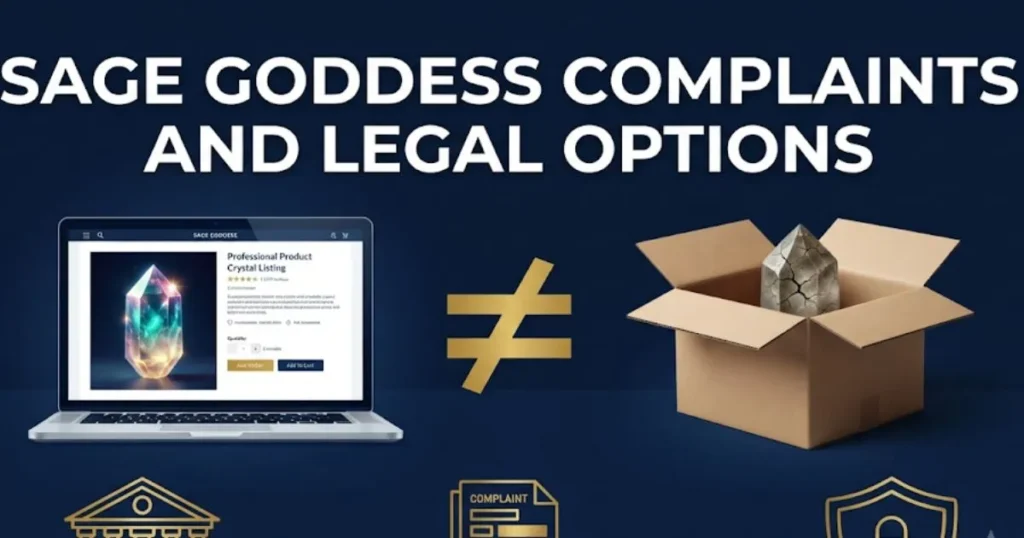
Many complainants say Sage Goddess product listings featured professional photos that bore little resemblance to what arrived. A crystal advertised as deep purple amethyst, for example, might show up as a pale, chipped stone with visible flaws.
Others allege the company used terms like “rare,” “collector grade,” and “ethically sourced” without any verification or certification to back those claims up.
| Fraud Element | Consumer Allegation |
|---|---|
| False Statement | Product descriptions and photos do not match reality |
| Knowledge | Company repeatedly sells mismatched products despite complaints |
| Reliance | Customers purchased based on advertised photos and descriptions |
| Financial Harm | Customers paid premium prices for low-quality items |
Proving fraud in court is harder than proving general unfair business practices. It requires showing intent, which means demonstrating that the company knew its claims were false and made them anyway.
Consumer protection statutes in California, where Sage Goddess is headquartered, offer somewhat easier paths. Under California’s Unfair Competition Law, plaintiffs do not always need to prove intent to win.
Is Sage Goddess a Scam
Whether Sage Goddess qualifies as a “scam” depends on how you define the word, but hundreds of consumers clearly feel deceived by their purchases.
A true scam typically involves a fake business that takes money and delivers nothing. Sage Goddess does ship products. Customers do receive physical items. In that narrow sense, it operates as a real business.
The problem is what customers receive versus what they expected. The gap between advertised products and delivered products is where the accusations gain traction. When a company consistently charges high prices for products that don’t match their descriptions, “scam” becomes a word people reach for naturally.
- Products are shipped, so it is technically an operating business
- Consistent complaints about quality versus advertising suggest deceptive practices
- The company has maintained its operations despite years of consumer backlash
- Whether it meets a legal definition of fraud is still being evaluated
Think of it this way: if a restaurant advertised filet mignon on the menu, charged $60 for it, and then served a microwave burger, you would call that a scam even though you technically received food. That is how many Sage Goddess customers describe their experience.
The legal system does not use the word “scam” in formal proceedings. It uses terms like “deceptive trade practices,” “unfair business conduct,” and “consumer fraud.” Those are the categories under review.
Key Takeaway: Sage Goddess ships products, but the persistent gap between advertised quality and delivered quality is what drives both consumer outrage and legal scrutiny.
Most Common Sage Goddess Complaints
The most common complaints against Sage Goddess involve product misrepresentation, subscription billing issues, and poor customer service responses.
Across review platforms, BBB filings, and social media posts, the same themes appear again and again. These are not one-off bad experiences. The patterns repeat with enough consistency to catch the attention of consumer protection investigators.
Here are the top complaint categories ranked by frequency:
| Complaint Category | Frequency | Typical Description |
|---|---|---|
| Product does not match listing | Very High | Received items look nothing like advertised photos |
| Subscription hard to cancel | High | Cancellation requests ignored or process made confusing |
| Refund denied or delayed | High | Company refuses refund or takes months to process |
| Unauthorized charges | Moderate | Charged for items or renewals not explicitly authorized |
| Customer service unresponsive | Moderate | Emails go unanswered for weeks |
| Damaged products on arrival | Moderate | Crystals arrive broken with poor packaging |
Many customers describe a cycle: they reach out to customer service, get no response, escalate to social media, and then receive a dismissive reply or a partial store credit instead of a cash refund.
The store credit approach is a common complaint. Customers say they do not want credit at a company they no longer trust. They want their money back, and the company’s refusal to provide it fuels the frustration.
Sage Goddess BBB Complaints Breakdown
The Better Business Bureau profile for Sage Goddess Inc. shows a significant complaint history spanning multiple years, with a pattern that has not improved over time.
As of early 2026, Sage Goddess has accumulated over 100 complaints on BBB. The company is not BBB accredited. Its rating reflects ongoing unresolved issues.
Most BBB complaints fall into these categories:
- Product/Service issues: Items not as described or advertised
- Billing/Collection issues: Unauthorized charges and recurring billing problems
- Delivery issues: Late shipments, missing items, or damaged goods
- Refund/Exchange issues: Company fails to honor its stated refund policy
The BBB tracks whether companies respond to complaints. Sage Goddess has responded to some, but a notable percentage remain marked as unresolved. In several cases, the company’s response essentially offered store credit while the customer requested a full cash refund.
| BBB Metric | Details |
|---|---|
| Total Complaints | 100+ as of early 2026 |
| BBB Accreditation | Not accredited |
| Most Common Issue | Product not matching description |
| Resolution Rate | Mixed; many complaints marked unresolved |
| Company Response Pattern | Store credit offered instead of refunds |
BBB complaints carry weight because they create a documented public record. Attorneys investigating potential class actions frequently use BBB data as supporting evidence of systematic business practice issues.
Sage Goddess Subscription Complaints
Subscription complaints against Sage Goddess focus on difficulty canceling auto-renewals and being charged for boxes customers say they never agreed to receive.
Sage Goddess offers monthly subscription boxes featuring curated crystals, oils, and spiritual tools. These subscriptions are a major revenue driver for the company. They are also the source of some of the most heated complaints.
Customers describe signing up for what they thought was a one-time purchase, only to discover recurring monthly charges on their credit card. Others say they tried to cancel and either received no confirmation or were told their cancellation “didn’t go through.”
- Customers report auto-renewal charges they did not authorize
- Cancellation processes described as confusing or unresponsive
- Some customers only stopped charges by contacting their bank directly
- Subscription terms reportedly buried in fine print
California’s automatic renewal law (ARL) requires businesses to clearly disclose subscription terms, get affirmative consent before charging, and provide easy cancellation methods. If Sage Goddess fails to meet any of these requirements, it could face liability under state law.
Several consumers report that the only way they successfully stopped charges was by calling their credit card company and requesting a chargeback. That is never a good sign for a business’s billing practices.
Key Takeaway: Subscription-related complaints represent some of the strongest potential legal claims because California law sets strict requirements for auto-renewal billing, and Sage Goddess appears to be falling short.
Sage Goddess Product Quality Issues
Product quality is the single most frequent complaint about Sage Goddess, with customers consistently reporting that items look nothing like what was advertised.
The company photographs its products with professional lighting, careful staging, and selective angles. When items arrive, customers say the reality is dramatically different. Crystals appear smaller, duller, more chipped, and less vibrant than their online listings suggested.
Common product quality complaints include:
- Crystals significantly smaller than shown in listing photos
- Gemstone colors washed out or completely different from advertised images
- Visible chips, cracks, or damage not mentioned in product descriptions
- Essential oils arriving with broken seals or leaking packaging
- “Rare” items later identified as common, inexpensive stones
The markup is where this becomes a legal issue. Customers paying $40 to $100 for a crystal that retails elsewhere for $5 to $10 feel cheated. And when the product description promises something specific that is not delivered, it crosses into potential misrepresentation.
| Advertised Claim | Common Customer Experience |
|---|---|
| “High-grade amethyst” | Pale, low-quality amethyst with visible flaws |
| “Large specimen” | Item smaller than expected, no size listed |
| “Rare collector piece” | Common stone available at much lower prices |
| “Ethically sourced” | No documentation or certification provided |
Product misrepresentation claims do not require proving fraud intent in many states. Under consumer protection statutes, simply showing that the advertising was misleading can be enough.
How to Get a Sage Goddess Refund
Getting a refund from Sage Goddess requires persistence, documentation, and willingness to escalate beyond the company’s customer service team if needed.
The company’s stated refund policy has varied over time. Some customers report that the policy allows returns within a short window, while others say they were told all sales are final. This inconsistency itself is a problem.
Here is a step-by-step approach that has worked for affected customers:
Step 1: Email customer service with your order number, photos of received items, and a clear refund request. Keep your tone factual.
Step 2: If you get no response within 7 business days, follow up. Screenshot everything.
Step 3: If the company offers store credit but you want cash, decline in writing and repeat your refund request.
Step 4: File a dispute with your credit card company or PayPal. Provide all documentation.
Step 5: File a complaint with the BBB and your state attorney general’s office.
| Refund Method | Success Rate (Based on Consumer Reports) |
|---|---|
| Direct email to company | Low to moderate |
| Credit card chargeback | High |
| PayPal dispute | Moderate to high |
| BBB complaint with company response | Moderate |
| Small claims court | High (if pursued) |
Credit card chargebacks tend to work best. Under federal law, you have 60 days from the billing statement date to dispute a charge. Acting quickly gives you the strongest position.
Sage Goddess and Consumer Protection Laws
Consumer protection laws in multiple states apply to the types of complaints filed against Sage Goddess, with California’s statutes being especially relevant since the company is based there.
California’s Consumer Legal Remedies Act (CLRA) prohibits deceptive practices in consumer transactions. This includes misrepresenting the quality of goods, advertising products with misleading photos, and failing to honor refund policies.
The state’s Unfair Competition Law (UCL) casts an even wider net. It covers any business practice that is fraudulent, unlawful, or unfair. Plaintiffs under UCL can seek restitution without proving the company acted with intent to defraud.
Key consumer protection laws that could apply:
- California CLRA: Prohibits misrepresentation of goods and deceptive advertising
- California UCL: Covers unfair, fraudulent, or unlawful business practices
- California Automatic Renewal Law: Requires clear disclosure and easy cancellation for subscriptions
- FTC Act Section 5: Prohibits unfair or deceptive acts in commerce
- State consumer protection statutes: Most states have their own versions with similar protections
These laws give individual consumers and classes of consumers the ability to seek refunds, damages, and in some cases attorney’s fees. That last part is important because it makes it financially viable for lawyers to take these cases.
Key Takeaway: California’s consumer protection laws are among the strongest in the country, and Sage Goddess’s business practices appear to trigger potential violations under multiple statutes.
How to File a Complaint Against Sage Goddess
Filing a formal complaint against Sage Goddess creates a paper trail that strengthens any future legal action and alerts regulatory agencies to the company’s practices.
You have several options, and filing with more than one agency increases your impact. Each complaint is a data point. When agencies see enough data points, they investigate.
Here is where and how to file:
Better Business Bureau: Go to the BBB website and search for Sage Goddess Inc. Submit a complaint with your order details, what was advertised, what you received, and what resolution you want.
State Attorney General: Every state has a consumer protection division within the attorney general’s office. File online through your state’s portal. Include copies of emails, order confirmations, and photos.
Federal Trade Commission: The FTC collects complaint data through its Consumer Sentinel Network. Individual complaints help build patterns that trigger federal investigations.
| Filing Destination | What to Include | Expected Response Time |
|---|---|---|
| BBB | Order details, photos, desired resolution | 14 to 30 days |
| State Attorney General | Full documentation, financial records | 30 to 90 days |
| FTC | Complaint details, company information | No individual response; data collected |
| Credit Card Company | Billing statements, correspondence | 30 to 60 days |
Pro tip: When filing, use specific language like “misrepresentation of product” and “failure to honor refund policy” rather than just saying “bad experience.” Legal terminology helps agencies categorize and prioritize your complaint.
Filing a Sage Goddess FTC Complaint
You can file an FTC complaint against Sage Goddess through the agency’s online reporting tool at ReportFraud.ftc.gov.
The FTC does not resolve individual complaints. Instead, it collects data from consumers across the country. When enough complaints target the same company, the agency may open a formal investigation.
Your FTC complaint should include:
- The company’s full name (Sage Goddess Inc.)
- Your purchase date and amount
- What was advertised versus what you received
- Any communication with the company about refunds
- Whether you were charged for unauthorized subscriptions
- Screenshots or photos supporting your claim
The FTC has taken action against companies with similar complaint profiles in the past. Online retailers that use misleading product photos, impose hidden subscription terms, or refuse lawful refund requests fall squarely within the FTC’s enforcement priorities.
| FTC Complaint Detail | Why It Matters |
|---|---|
| Volume of complaints | Triggers investigation thresholds |
| Consistency of allegations | Shows systematic practices, not isolated errors |
| Financial harm documented | Supports enforcement action and potential restitution |
| Geographic spread | Enables federal jurisdiction over state-level issues |
Filing takes about 15 to 20 minutes. The more detailed your complaint, the more useful it is. Attach documents if the system allows.
Even if the FTC never contacts you directly, your complaint contributes to the larger picture. Think of it like voting. One complaint may not change anything alone, but hundreds of them together force attention.
Sage Goddess Settlement Prospects
No settlement has been reached in any Sage Goddess lawsuit as of early 2026, but the trajectory of complaints suggests resolution discussions could emerge if formal litigation moves forward.
Settlements in consumer protection cases typically happen after a lawsuit is filed and the company realizes that fighting in court would cost more than settling. Companies facing strong consumer fraud claims often prefer to settle quietly rather than risk a public trial.
If a class action or significant individual lawsuits proceed, here is what settlement scenarios might look like:
| Settlement Scenario | Estimated Range | Likelihood |
|---|---|---|
| Individual small claims judgments | $50 to $500 per plaintiff | Moderate (already happening) |
| Class action settlement (if filed) | $25 to $200 per class member | Possible in late 2026 or 2027 |
| State AG enforcement action | Company-wide refund program | Possible if investigation proceeds |
| FTC consent order | Refunds plus business practice changes | Lower probability in near term |
Several consumers have already won small claims court judgments against Sage Goddess. These individual victories set useful precedent even though they do not carry the force of a class action.
The company’s response to mounting pressure will determine a lot. Some businesses choose to reform their practices and offer voluntary refunds before litigation forces their hand. Others dig in and fight. So far, Sage Goddess appears to be taking the latter approach.
Key Takeaway: No settlement exists yet, but the volume of complaints and ongoing legal investigations suggest that some form of resolution, whether through settlement, enforcement, or reformed business practices, is increasingly likely.
Is Sage Goddess Legit
Sage Goddess is a legally registered business that ships real products, but the legitimacy of its advertising claims and business practices is what consumers and regulators are questioning.
The company is incorporated in California. It has a functioning website, social media presence, and physical operations. In that purely structural sense, it is a legitimate business entity.
But legitimacy in the eyes of consumers means more than just existing on paper. It means delivering what you promise, honoring your refund policies, and treating customers fairly. On those measures, Sage Goddess falls short according to hundreds of documented complaints.
- Legally registered in California: Yes
- Ships actual products: Yes
- Products match advertising: Frequently disputed
- Refund policy honored consistently: No, based on complaints
- BBB accredited: No
- Customer satisfaction ratings: Low across multiple platforms
A company can be legally legitimate while still engaging in practices that violate consumer protection laws. The two are not mutually exclusive. Plenty of real businesses have faced enforcement actions for deceptive advertising or unfair billing.
The question is not really “is Sage Goddess legit” but rather “does Sage Goddess conduct business fairly?” Based on the evidence available in 2026, a significant number of customers would answer no.
Sage Goddess Reviews and Legal Issues
Online reviews of Sage Goddess reveal a split between loyal fans and deeply dissatisfied customers, with the negative reviews increasingly pointing toward legal themes.
On platforms like Trustpilot, Google Reviews, and Reddit, the positive reviews tend to come from customers who received items they were happy with. The negative reviews describe a very different experience.
What makes the negative reviews legally significant is their specificity and consistency. These are not vague complaints about taste or preference. They contain factual claims about measurable discrepancies.
Common themes in legally relevant reviews:
- “The crystal I received was half the size shown in the listing”
- “I was charged three months after I thought I canceled”
- “Customer service stopped responding after my third email”
- “The ‘rare’ stone I paid $80 for sells for $8 on other sites”
| Review Platform | Average Rating | Number of Reviews | Common Legal Theme |
|---|---|---|---|
| Trustpilot | Low | Significant volume | Product misrepresentation |
| BBB | Low | 100+ complaints | Billing and refund issues |
| Mixed | Multiple threads | Quality vs. price concerns | |
| Mixed | Moderate volume | Shipping and service issues |
Courts and regulatory agencies do look at online reviews as evidence of business practices. A pattern of identical complaints across multiple unrelated platforms is harder for a company to dismiss as isolated incidents.
Sage Goddess Business Practices Under Scrutiny
The business practices of Sage Goddess are under scrutiny from consumers, attorneys, and regulatory agencies due to a pattern of complaints about advertising, billing, and customer service.
Several specific practices draw the most criticism:
Aspirational photography: The company uses highly stylized photos that allegedly misrepresent what customers will actually receive. This is not simply good marketing. When the gap between photo and product is extreme, it becomes potential false advertising.
Subscription design: The subscription enrollment process has been called confusing and designed to make cancellation difficult. Under California’s automatic renewal law, this approach can create direct legal liability.
Refund resistance: Multiple customers report that the company’s default response to refund requests is offering store credit rather than returning money. When a product does not match its description, consumers have a legal right to a monetary refund in most states.
Price inflation: Products sold at premium prices that are widely available elsewhere at a fraction of the cost suggest potential price gouging through misleading quality claims.
- Photography that exaggerates product appearance
- Subscription terms that favor the company over the consumer
- Refund policies applied inconsistently or restrictively
- Premium pricing not supported by product quality
These practices, taken individually, might each generate complaints. Taken together, they paint a picture of a business model that relies on information asymmetry. The company knows what it is shipping. The customer does not know what they are getting until the box arrives. By then, the company has their money and the burden shifts to the customer to fight for it back.
Key Takeaway: The scrutiny facing Sage Goddess in 2026 is not about one bad product or one unhappy customer. It is about a pattern of business practices that, collectively, raise serious questions under consumer protection law.
Frequently Asked Questions
Is there an active class action lawsuit against Sage Goddess in 2026?
No certified class action against Sage Goddess exists as of early 2026.
Consumer attorneys are investigating the possibility based on complaint patterns.
A filing could happen later in 2026 if investigations confirm sufficient grounds.
How do I get a refund from Sage Goddess?
Start by emailing customer service with your order number and photos of what you received.
If the company refuses or offers only store credit, file a chargeback with your credit card company.
You have 60 days from the billing statement date to dispute a charge under federal law.
What are the main complaints against Sage Goddess?
The top complaints are product misrepresentation, unauthorized subscription charges, and refund denials.
Customers consistently say received items look nothing like advertised photos.
Poor customer service response times make resolving issues even harder.
Can I file an FTC complaint against Sage Goddess?
Yes, you can file a complaint through the FTC’s online reporting tool.
The FTC collects complaint data and may investigate if enough consumers report similar issues.
Include your purchase details, photos, and any communication with the company.
Is Sage Goddess a legitimate business?
Sage Goddess is a legally registered company in California that ships real products.
However, hundreds of complaints challenge the accuracy of its advertising and fairness of its billing practices.
Being legally registered does not mean a company’s practices are lawful or ethical.
The sage goddess lawsuit situation in 2026 is evolving. Consumer complaints continue to pile up. Legal investigations are active. And the window for filing your own complaint or claim is open right now.
If you bought from Sage Goddess and feel misled, gather your evidence. Save your order confirmations, photos, and emails. File complaints with your state attorney general and the FTC.
Your experience matters. Every documented complaint moves the needle toward accountability. Stay informed as this situation develops through 2026 and beyond.







