

The fosamax lawsuit update for 2026 brings both renewed urgency and new developments for thousands of people harmed by this osteoporosis drug. Fosamax, manufactured by Merck & Co., has been linked to devastating side effects including atypical femur fractures and jaw bone death.
Lawsuits against Merck have been grinding through the courts for over a decade. Some cases have settled. Others are still being fought.
In this article, you’ll learn exactly where these cases stand right now. We’ll cover settlement amounts, who qualifies, how to file, and what the 2026 timeline looks like. One key fact to know: jury verdicts in past Fosamax trials have ranged from $0 to over $8 million per plaintiff.
Whether you took Fosamax for a few months or several years, the information here will help you figure out your options.
Fosamax Lawsuit Update: What You Need to Know
The fosamax lawsuit remains active in 2026 with individual cases still moving through state and federal courts. While the federal multidistrict litigation (MDL No. 1789) in New Jersey saw significant activity in earlier years, the focus has shifted to individual filings and state court proceedings.
Merck has fought these lawsuits aggressively. The company won several bellwether trials, but plaintiffs scored victories too. A 2013 jury verdict awarded $1.5 million to a New York plaintiff who suffered a femur fracture.
The legal situation is complicated by a U.S. Supreme Court ruling from 2013 (Mutual Pharmaceutical Co. v. Bartlett) and subsequent appellate decisions that shaped how failure-to-warn claims can proceed against brand-name drug manufacturers.
| Detail | Info |
|---|---|
| Drug Name | Fosamax (alendronate sodium) |
| Manufacturer | Merck & Co. |
| Federal MDL | No. 1789, District of New Jersey |
| Primary Injuries | Atypical femur fractures, ONJ |
| Lawsuit Status in 2026 | Active, individual cases proceeding |
New filings continue as people discover injuries they didn’t previously connect to their Fosamax use. The statute of limitations clock often starts when you first learn about the connection between the drug and your injury, not when you first took the medication.
That discovery rule is a lifeline for many potential claimants in 2026.
Fosamax Lawsuit 2026: What to Expect This Year
The fosamax lawsuit in 2026 is expected to see continued individual case resolutions and possible new settlement talks. After years of bellwether trials with mixed results, both sides have incentive to resolve remaining claims.
Several factors make 2026 a pivotal year. First, courts are pushing older cases toward resolution. Judges don’t like lawsuits sitting on dockets for a decade.
Second, medical research continues to strengthen the link between long-term bisphosphonate use and atypical fractures. A 2024 study in the Journal of Bone and Mineral Research reinforced that patients on bisphosphonates for more than five years face significantly elevated fracture risk.
Here’s what claimants should watch for this year:
- New case management orders in state courts handling remaining Fosamax claims
- Potential settlement discussions as Merck looks to clear its legal docket
- Statute of limitations deadlines that could expire for late-filing plaintiffs
- Updated medical evidence that strengthens causation arguments
Third, Merck’s patent on Fosamax expired years ago. The drug is now available generically. But the lawsuits target Merck specifically as the original manufacturer that allegedly failed to warn about serious risks.
If you haven’t filed yet, 2026 may be one of your last windows.
What Is the Fosamax Lawsuit About?
The fosamax lawsuit alleges that Merck failed to adequately warn patients and doctors about the risk of serious bone injuries caused by the drug. Fosamax was approved by the FDA in 1995 to treat and prevent osteoporosis in postmenopausal women.
The irony is hard to miss. A drug designed to strengthen bones has been accused of causing them to break.
Specifically, plaintiffs claim Fosamax causes two major injuries. The first is atypical femoral fractures, which are unusual breaks in the thigh bone that happen with little or no trauma. The second is osteonecrosis of the jaw (ONJ), a painful condition where jaw bone tissue dies.
Fosamax works by slowing bone resorption, the natural process where old bone is broken down. The problem is that it slows this process so much that bones can become brittle over time, almost like frozen glass.
| Allegation | Details |
|---|---|
| Failure to Warn | Merck allegedly knew of fracture risks but didn’t update labels fast enough |
| Defective Design | The drug’s mechanism of action allegedly causes bone to become overly brittle |
| Negligence | Merck allegedly ignored early warning signs from clinical data |
Plaintiffs say Merck had internal data showing these risks years before warnings were added to the drug’s label.
Key Takeaway: The Fosamax lawsuits center on Merck’s alleged failure to warn about atypical femur fractures and jaw bone death, and 2026 is shaping up to be a critical year for remaining claims.
Is There a Fosamax Lawsuit Right Now?
Yes, Fosamax lawsuits are still active in 2026. While the federal MDL in New Jersey has wound down significantly, individual cases continue in both federal and state courts across the country.
The MDL was one of the largest pharmaceutical litigations in U.S. history. At its peak, it included thousands of individual claims. Many were resolved through trials, settlements, or dismissals.
But “resolved” doesn’t mean “over.” New cases can still be filed if they fall within the statute of limitations. People who recently suffered a fracture or received an ONJ diagnosis may have fresh claims.
Some states have seen a second wave of filings. Plaintiffs who didn’t know their injuries were linked to Fosamax are coming forward after talking to doctors or seeing information about the lawsuits.
- Cases remain pending in New Jersey, New York, California, and other state courts
- The federal MDL (No. 1789) is largely consolidated but not fully closed
- Individual lawsuits outside the MDL continue to be filed
Think of it like a long concert. The main act may have played, but the encore is still going.
If you were injured by Fosamax and haven’t explored your legal options, the door hasn’t closed yet. But it’s narrowing.
Merck Fosamax Lawsuit: The Company Behind the Drug
Merck & Co. is the pharmaceutical giant that developed, manufactured, and marketed Fosamax starting in the mid-1990s. The company is headquartered in Rahway, New Jersey, and is one of the largest drug makers in the world.
Merck earned billions of dollars from Fosamax sales before its patent expired. At its peak, Fosamax generated over $3 billion in annual revenue for the company. It was one of the best-selling osteoporosis drugs ever made.
Plaintiffs argue that Merck prioritized profits over patient safety. Specifically, they allege Merck had early clinical trial data suggesting that long-term Fosamax use could weaken bones rather than strengthen them.
The FDA asked Merck to update the Fosamax label in 2008 to include warnings about atypical femur fractures. In 2010, the FDA issued a broader safety communication about bisphosphonates and fracture risk.
| Merck Timeline | Event |
|---|---|
| 1995 | Fosamax approved by FDA |
| 2008 | FDA requests label update for fracture warnings |
| 2010 | FDA safety communication on bisphosphonates |
| 2011 | Peak of MDL filings against Merck |
| 2013 | Key bellwether trial verdict ($1.5 million to plaintiff) |
Merck has consistently denied wrongdoing. The company maintains that Fosamax is safe and effective when used as directed. But juries have disagreed in some cases, and the litigation continues.
Fosamax Settlement Amounts: How Much Are They?
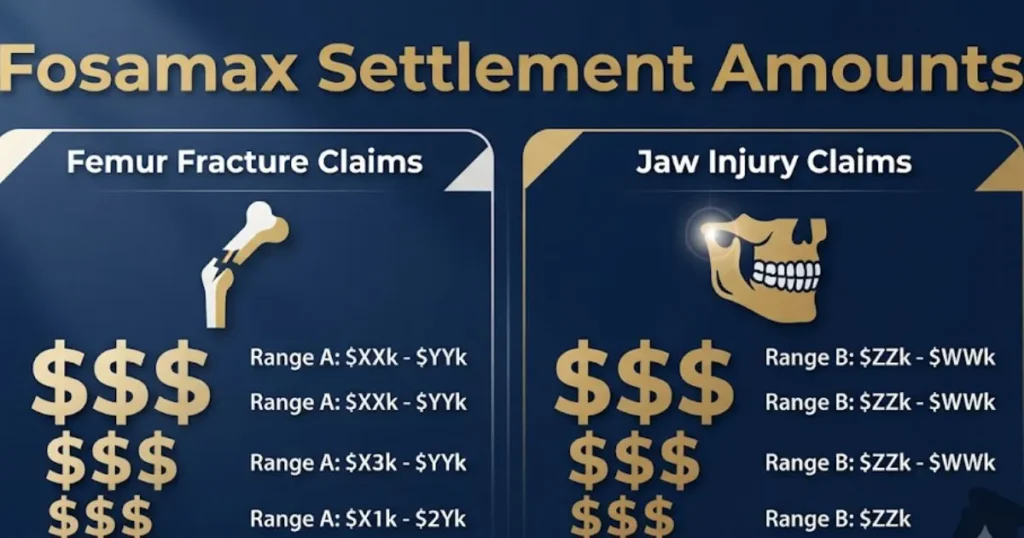
Fosamax settlement amounts have varied widely depending on the type and severity of injury. There has been no single, global settlement covering all Fosamax cases. Instead, cases have been resolved individually or in small groups.
Reported settlement values for femur fracture cases have ranged from roughly $50,000 to over $1 million per plaintiff. ONJ cases have generally settled for different amounts depending on the severity of jaw damage.
It’s important to understand why amounts vary so much. Settlement value depends on several factors unique to each case.
| Factor | Impact on Settlement |
|---|---|
| Injury Severity | More severe injuries (surgery, permanent disability) mean higher payouts |
| Medical Documentation | Strong records linking Fosamax to the injury increase value |
| Duration of Use | Longer use often strengthens the causation argument |
| Age of Plaintiff | Younger plaintiffs with more life impact may receive more |
| State Laws | Some states cap damages or have stricter filing rules |
A case involving a single femur fracture that healed normally will be worth far less than a case involving multiple surgeries, chronic pain, and lost mobility.
Jury verdicts have also influenced settlement negotiations. When juries award large amounts, Merck faces more pressure to settle remaining cases at higher values.
No two Fosamax cases are identical. Your potential settlement depends entirely on your specific facts.
Key Takeaway: Fosamax settlements are handled individually, not as one lump-sum deal, and payouts range from $50,000 to over $1 million based on injury severity and medical proof.
Fosamax Settlement Payout Per Person
The fosamax settlement payout per person depends on the specific injury, the strength of evidence, and how the case is resolved. There is no flat per-person payout because this litigation has not resulted in a single class-wide settlement fund.
For femur fracture claims specifically, individual settlements have reportedly fallen between $75,000 and $500,000 for most resolved cases. Extreme cases involving multiple surgeries or permanent disability have reached higher.
ONJ claims have a different payout structure. Jaw bone death cases can involve extensive dental surgery, bone grafts, and long-term pain. These cases have settled in ranges from $50,000 to $300,000, though severe cases can exceed that.
Here is a general breakdown of what per-person payouts might look like:
| Injury Type | Estimated Payout Range |
|---|---|
| Minor femur fracture (healed) | $50,000 to $150,000 |
| Severe femur fracture (surgery required) | $150,000 to $500,000 |
| Femur fracture with permanent disability | $500,000 to $1,000,000+ |
| Mild to moderate ONJ | $50,000 to $200,000 |
| Severe ONJ (bone graft, multiple surgeries) | $200,000 to $500,000+ |
Keep in mind that attorney fees typically take 33% to 40% of any settlement. Medical liens and case costs are also deducted before you receive your check.
The net amount you take home will be less than the gross settlement figure. Still, for people who suffered serious injuries, these payouts represent meaningful compensation.
Fosamax Femur Fracture Lawsuit Explained
The fosamax femur fracture lawsuit focuses on a specific type of break called an atypical femoral fracture. These fractures happen in the shaft or subtrochanteric region of the thigh bone, often with minimal or no trauma.
What makes these fractures “atypical” is that they don’t follow normal fracture patterns. A healthy thigh bone can withstand enormous force. But bones weakened by long-term Fosamax use can snap during ordinary activities like walking or standing.
The medical term is atypical subtrochanteric and diaphyseal femoral fracture. The FDA formally acknowledged the connection between bisphosphonates and these fractures in October 2010.
Warning signs often appear before the break happens:
- Dull, aching thigh pain weeks or months before the fracture
- Stress fractures visible on imaging before a complete break
- Bilateral risk, meaning both legs can be affected
- Low-energy mechanism, meaning the bone breaks without a fall or impact
Many plaintiffs describe hearing a “snap” while doing something as simple as stepping off a curb. Some fractures require surgical insertion of metal rods or plates. Recovery can take months, and some patients never regain full mobility.
| Femur Fracture Details | Info |
|---|---|
| Medical Term | Atypical subtrochanteric/diaphyseal femoral fracture |
| FDA Acknowledgment | October 2010 |
| Common Warning Sign | Persistent thigh or groin pain |
| Typical Treatment | Surgical rod or plate insertion |
| Recovery Time | 3 to 12 months or longer |
These fractures are the backbone of most Fosamax lawsuits filed to date.
Fosamax Jaw Lawsuit: Osteonecrosis of the Jaw Claims
Fosamax jaw lawsuits involve a condition called osteonecrosis of the jaw (ONJ), where the jaw bone literally dies and becomes exposed through the gums. ONJ is painful, disfiguring, and extremely difficult to treat.
ONJ occurs when blood supply to the jaw bone is disrupted. Bisphosphonates like Fosamax are believed to interfere with the jaw’s ability to heal and regenerate, particularly after dental procedures like tooth extractions.
The first reports linking bisphosphonates to ONJ appeared in medical literature around 2003. By 2005, the FDA had added warnings about ONJ to bisphosphonate labels.
Symptoms of Fosamax-related ONJ include:
- Exposed bone in the mouth that won’t heal
- Pain, swelling, or numbness in the jaw
- Loose teeth without dental cause
- Infection or drainage from the jaw area
- Difficulty eating or speaking
Treatment can involve antibiotics, surgical removal of dead bone, and in severe cases, reconstruction with bone grafts. Some patients require multiple surgeries over several years.
| ONJ Severity | Description | Treatment |
|---|---|---|
| Stage 1 | Exposed bone, no infection | Antibiotics, mouth rinse |
| Stage 2 | Exposed bone with infection and pain | Surgical debridement, antibiotics |
| Stage 3 | Exposed bone with fracture, fistula, or extensive damage | Major surgery, bone graft |
ONJ cases can be worth significant compensation, but they require strong dental records showing the connection between Fosamax use and jaw deterioration.
Key Takeaway: Fosamax has been linked to two catastrophic injuries: thigh bones that snap without warning and jaw bones that die from the inside, and both types of injury form the basis for active lawsuits in 2026.
Fosamax Side Effects That Led to Lawsuits
The fosamax side effects most relevant to lawsuits are atypical femoral fractures and osteonecrosis of the jaw. But the drug has been associated with other serious health problems as well.
Fosamax belongs to a drug class called bisphosphonates. These drugs work by suppressing osteoclasts, the cells responsible for breaking down old bone. While this slows bone loss, it also prevents the normal bone renewal cycle.
Think of it like never replacing old shingles on a roof. Eventually, the whole surface becomes brittle and weak.
Beyond fractures and ONJ, reported side effects include:
- Esophageal damage, including ulcers, erosion, and in rare cases, esophageal cancer
- Severe musculoskeletal pain (bones, joints, muscles)
- Atrial fibrillation (irregular heartbeat)
- Hypocalcemia (dangerously low calcium levels)
- Inflammatory eye conditions (uveitis, scleritis)
The FDA issued a safety review of bisphosphonates and esophageal cancer in 2011, though it concluded the evidence was inconclusive at that time.
| Side Effect | Lawsuit Relevance |
|---|---|
| Atypical femur fracture | Primary basis for most lawsuits |
| Osteonecrosis of the jaw | Second most common claim |
| Esophageal injury | Some lawsuits filed, fewer in number |
| Musculoskeletal pain | Generally not basis for standalone lawsuit |
| Atrial fibrillation | Limited litigation, weaker evidence |
Not every side effect supports a viable lawsuit. The strongest cases involve fractures and ONJ because the medical evidence linking those injuries to Fosamax is most robust.
Who Qualifies for a Fosamax Lawsuit?
You may qualify for a fosamax lawsuit if you took the drug and later developed an atypical femur fracture or osteonecrosis of the jaw. Eligibility depends on several specific criteria that attorneys evaluate case by case.
The most important factor is a documented connection between your Fosamax use and your injury. Medical records showing when you started the drug, how long you took it, and when the injury occurred are critical.
General eligibility criteria include:
- You took Fosamax (brand name or generic alendronate) for an extended period, typically two or more years
- You suffered an atypical femur fracture (subtrochanteric or diaphyseal, not a typical hip fracture from a fall)
- You developed ONJ after dental work or spontaneously while taking Fosamax
- Your injury occurred during or after your period of Fosamax use
- You have medical records documenting both the drug use and the injury
| Qualification Factor | Details |
|---|---|
| Drug Used | Fosamax (alendronate sodium), brand or generic |
| Minimum Use Period | Generally 2+ years, though shorter use may qualify |
| Required Injury | Atypical femur fracture or ONJ |
| Medical Records Needed | Prescription history, imaging, surgical records |
| Statute of Limitations | Must file within your state’s deadline |
If you had a normal hip fracture from a fall, that likely does not qualify. The lawsuits target atypical fractures, the kind that happen with minimal or no trauma.
Your age, overall health, and other medications can also affect case strength. But the core question is straightforward: did Fosamax cause your injury?
Is Fosamax a Class Action Lawsuit?
The fosamax litigation is not a class action lawsuit in the traditional sense. It is primarily handled as a mass tort through multidistrict litigation (MDL) and individual lawsuits filed in state courts.
People often confuse class actions and mass torts. They are different. In a class action, one lawsuit represents everyone, and everyone gets the same payout. In a mass tort, each person files their own case with their own facts.
The Fosamax MDL (No. 1789) consolidated federal cases in the U.S. District Court for the District of New Jersey for pretrial proceedings. This made the process more efficient without merging all cases into one.
| Feature | Class Action | Mass Tort (Fosamax) |
|---|---|---|
| Number of Lawsuits | One lawsuit for all | Individual lawsuits, consolidated |
| Payouts | Same for everyone | Vary by individual case |
| Plaintiff Control | Representative plaintiff decides | Each plaintiff controls their case |
| Settlement | One settlement for the class | Individual settlements negotiated |
This distinction matters because your Fosamax payout depends on your specific injuries and evidence. You’re not just a name on a list getting a $12 check.
Some state-level cases may have class-like characteristics, but the vast majority of Fosamax claims are handled individually. That gives you more control over your case but also means you need your own attorney.
Key Takeaway: Fosamax cases are individual mass tort claims, not class actions, which means your payout depends on your specific injury and evidence rather than a one-size-fits-all formula.
How to File a Fosamax Lawsuit
To file a fosamax lawsuit, you need to contact a qualified attorney, gather your medical records, and have your case evaluated for merit before any paperwork is filed with the court.
The process isn’t as complicated as it sounds. Here’s a step-by-step breakdown of what to expect.
Step 1: Free Case Evaluation. Most attorneys handling Fosamax cases offer free initial consultations. You’ll describe your Fosamax use, your injury, and your medical history.
Step 2: Medical Records Review. Your attorney will request prescription records, imaging reports, surgical notes, and any other documentation connecting Fosamax to your injury.
Step 3: Case Filing. If your case has merit, your attorney files a complaint in the appropriate court. This could be a state court or federal court depending on your location.
Step 4: Discovery and Litigation. Both sides exchange evidence. This phase can take months or years depending on the complexity.
Step 5: Settlement or Trial. Most cases settle before trial. If no agreement is reached, your case goes before a jury.
| Filing Step | What Happens | Typical Timeframe |
|---|---|---|
| Case Evaluation | Attorney reviews your facts | 1 to 2 weeks |
| Records Gathering | Medical and prescription records collected | 1 to 3 months |
| Case Filing | Complaint filed with court | Within days of decision |
| Discovery | Evidence exchange between parties | 6 to 18 months |
| Resolution | Settlement negotiation or trial | 1 to 3 years |
Most Fosamax attorneys work on a contingency fee basis. That means you pay nothing upfront. They only get paid if you win.
Fosamax Lawsuit Statute of Limitations
The fosamax lawsuit statute of limitations varies by state, but most states give you two to three years from the date you discovered (or should have discovered) the connection between Fosamax and your injury.
This is called the “discovery rule.” It’s different from a fixed deadline. The clock starts ticking when you knew or reasonably should have known that Fosamax caused your problem.
For example, if you broke your femur in 2020 but didn’t learn until 2024 that the fracture was atypical and linked to Fosamax, your statute of limitations likely starts in 2024.
| State | Statute of Limitations | Discovery Rule? |
|---|---|---|
| New York | 3 years | Yes |
| California | 2 years | Yes |
| New Jersey | 2 years | Yes |
| Texas | 2 years | Yes |
| Florida | 2 years (changed from 4 in 2024) | Yes |
| Pennsylvania | 2 years | Yes |
These deadlines are strict. Miss yours, and the court will almost certainly dismiss your case. No exceptions.
Some states also have a “statute of repose” that sets an absolute outer deadline regardless of when you discovered the injury. This can be 10 to 15 years from the date of the last exposure to the drug.
Don’t assume you’ve missed your window. Talk to an attorney who can evaluate your specific timeline. Many people are surprised to learn they still have time.
Fosamax Bone Fracture Compensation Breakdown
Fosamax bone fracture compensation covers a range of damages including medical expenses, lost income, pain and suffering, and reduced quality of life. The total value of your claim depends on how the fracture affected your daily existence.
Compensation in these cases falls into two categories: economic damages and non-economic damages.
Economic damages are the measurable financial losses:
- Hospital bills and surgery costs
- Rehabilitation and physical therapy
- Future medical expenses
- Lost wages during recovery
- Home care or assistance costs
Non-economic damages cover the intangible losses:
- Physical pain and suffering
- Emotional distress
- Loss of enjoyment of life
- Loss of mobility or independence
- Disfigurement or permanent disability
| Damage Type | Examples | Estimated Range |
|---|---|---|
| Medical Bills | Surgery, hospital stay, rehab | $20,000 to $200,000+ |
| Lost Income | Time off work during recovery | $5,000 to $100,000 |
| Pain and Suffering | Chronic pain, emotional impact | $25,000 to $500,000 |
| Loss of Mobility | Permanent walking difficulty | $50,000 to $300,000 |
| Future Medical Care | Ongoing treatment needs | $10,000 to $150,000 |
In wrongful death cases where a Fosamax-related fracture led to fatal complications, families may recover additional damages including funeral costs and loss of companionship.
The strongest compensation claims come with detailed documentation. Every doctor visit, every receipt, every record matters.
Key Takeaway: Fosamax compensation covers both financial losses and quality-of-life impacts, and thorough documentation of your medical history and expenses directly increases the value of your claim.
Fosamax Lawsuit Timeline: Key Dates and Milestones
The fosamax lawsuit timeline spans over two decades, from the drug’s original approval to the ongoing litigation in 2026. Understanding this history helps you see where your case fits.
| Year | Milestone |
|---|---|
| 1995 | FDA approves Fosamax for osteoporosis |
| 2003 | First medical reports link bisphosphonates to ONJ |
| 2005 | FDA adds ONJ warning to bisphosphonate labels |
| 2006 | First Fosamax lawsuits filed in federal court |
| 2008 | MDL No. 1789 established in New Jersey |
| 2009 | First bellwether trials selected |
| 2010 | FDA issues safety communication on atypical femur fractures |
| 2013 | Key bellwether trial: $1.5 million verdict for plaintiff |
| 2013 | U.S. Supreme Court rules on related preemption issues |
| 2014 | Merck wins reversal on some verdicts through appeals |
| 2016 to 2019 | Individual settlements negotiated for qualified cases |
| 2020 to 2023 | Ongoing state court proceedings, new filings continue |
| 2024 to 2025 | Updated medical research strengthens causation evidence |
| 2026 | Individual cases continue; potential new settlement activity |
The early years focused on establishing whether Fosamax actually caused the alleged injuries. That scientific battle has largely been won by plaintiffs. The medical evidence supporting the Fosamax-fracture link is now well-established.
The middle years involved bellwether trials with mixed outcomes. Merck won some and lost some. Each verdict influenced how the remaining cases were valued.
Now, in 2026, the remaining cases are working toward individual resolutions. The timeline for your specific case will depend on when you file and which court handles it.
Finding a Fosamax Attorney for Your Lawsuit
Finding the right fosamax attorney means looking for a lawyer with specific experience in pharmaceutical litigation, mass torts, and bisphosphonate injury cases. Not every personal injury lawyer has the knowledge to handle these claims.
A good Fosamax attorney will have handled similar drug injury cases before. They’ll understand the medical science behind atypical fractures and ONJ. They’ll know the legal precedents from the MDL and how courts have ruled on key issues.
Here’s what to look for when choosing an attorney:
- Experience with pharmaceutical lawsuits, especially bisphosphonate cases
- Contingency fee arrangement, so you pay nothing unless you win
- Willingness to go to trial, not just push for quick, low settlements
- Clear communication, keeping you updated without legal jargon
- Resources to fund your case, since these lawsuits require expert witnesses and medical reviews
| Attorney Selection Factor | Why It Matters |
|---|---|
| Pharmaceutical litigation experience | Understands drug injury science and legal strategy |
| Track record with Fosamax or similar cases | Knows the specific precedents and pitfalls |
| Contingency fee structure | No financial risk to you upfront |
| Trial willingness | Forces the other side to negotiate seriously |
| Client communication style | You deserve to understand your own case |
Be cautious of firms that make unrealistic promises about payouts. No honest attorney can guarantee a specific settlement amount before reviewing your case.
Ask questions during your consultation. Find out how many Fosamax cases they’ve handled. Ask about their success rate. Ask what they think your case is worth and why.
Frequently Asked Questions
How much money can I get from a Fosamax lawsuit?
Most Fosamax settlements range from $50,000 to over $500,000 depending on your injury.
Severe femur fractures requiring surgery and causing permanent disability can push values above $1 million.
Attorney fees of 33% to 40% will be deducted before you receive your payment.
Is it too late to file a Fosamax lawsuit in 2026?
It may not be too late if you recently discovered the link between Fosamax and your injury.
The statute of limitations in most states is two to three years from the date of discovery, not from when you took the drug.
Check your state’s specific deadline with an attorney as soon as possible.
What side effects qualify for a Fosamax lawsuit?
The two primary qualifying injuries are atypical femoral fractures and osteonecrosis of the jaw (ONJ).
Some esophageal injury cases have been filed, but fractures and ONJ have the strongest legal support.
Your injury must be documented in medical records and connected to Fosamax use.
Is the Fosamax lawsuit a class action or individual case?
Fosamax lawsuits are individual mass tort claims, not a class action.
Each person files their own case, and payouts depend on individual circumstances.
The federal cases were coordinated through MDL No. 1789, but they remain separate lawsuits.
How long does a Fosamax lawsuit take to settle?
Most Fosamax cases take one to three years to resolve after filing.
The timeline depends on the complexity of your case, the court’s schedule, and whether the case settles or goes to trial.
Cases with strong medical evidence and clear documentation tend to resolve faster.
The Fosamax litigation in 2026 still offers a path to compensation for people seriously harmed by this drug. Whether you suffered a broken femur or jaw bone death, your injury deserves attention.
Check your eligibility now. Gather your medical records. Reach out to a qualified attorney who handles pharmaceutical cases.
Time limits are real, and they don’t bend for anyone. Act before your window closes.







