

The Philips Respironics lawsuit is one of the largest medical device cases in U.S. history. It involves millions of recalled CPAP, BiPAP, and ventilator machines that exposed users to toxic foam particles and dangerous chemical fumes.
Heading into 2026, the case has reached a turning point. An economic loss settlement worth $1.1 billion has been finalized. Personal injury claims involving cancer and serious respiratory conditions are still moving through the courts.
If you used a recalled Philips sleep or breathing machine, this article covers everything you need to know. You will find 2026 updates, settlement figures, eligibility rules, filing deadlines, recalled device lists, and payout timelines.
Roughly 15 million devices worldwide were affected by the June 2021 recall. That’s not a typo. Fifteen million machines people trusted to help them breathe while they slept.
What Is the Philips Respironics Lawsuit About
The Philips Respironics lawsuit is a mass tort case against Philips and its subsidiary, Philips Respironics. It centers on defective sound abatement foam inside CPAP, BiPAP, and ventilator machines.
The foam, known as PE-PUR (polyester-based polyurethane), was designed to reduce device noise. Over time, this foam breaks down. When it degrades, users inhale or swallow tiny foam particles and toxic chemicals.
Philips knew about the foam problem for years before issuing a recall. Internal documents show the company received complaints about black particles as early as 2015. The formal recall did not come until June 2021.
Thousands of users have since reported cancer, respiratory damage, and other serious health conditions. The lawsuits allege Philips prioritized profits over patient safety.
| Detail | Info |
|---|---|
| Defendant | Philips Respironics, Inc. |
| Parent Company | Koninklijke Philips N.V. |
| Product at Issue | CPAP, BiPAP, and ventilator machines |
| Core Defect | Degrading PE-PUR sound abatement foam |
| Recall Date | June 14, 2021 |
| Devices Affected | Approximately 15 million worldwide |
| Court | U.S. District Court, Western District of Pennsylvania |
The case is consolidated as MDL No. 3014 under Judge Joy Flowers Conti. It includes both personal injury and economic loss claims.
Why People Filed a Lawsuit Against Philips Respironics
People filed a lawsuit against Philips Respironics because the company sold breathing machines it knew were dangerous. The degrading foam released particles directly into the airway of sleeping users.
Think about it this way. You strap on a mask every night, trusting it to help you breathe. Instead, it pumps tiny bits of industrial foam and chemical gases into your lungs for months or years.
Users reported finding black specks inside their masks, tubing, and water chambers. Many did not realize these particles came from inside the machine itself. Philips received thousands of warranty claims and complaints but continued selling the devices.
The lawsuits claim Philips committed several failures:
- Knowingly used foam that could degrade in humid, warm conditions
- Ignored years of internal complaints about foam breakdown
- Delayed the recall by at least two years after confirming the problem
- Failed to warn users about cancer risks and respiratory dangers
- Continued marketing the devices as safe for daily use
The anger from affected users is real and justified. These were medical devices prescribed by doctors. People had every reason to trust them.
Philips Respironics Lawsuit Update for 2026
The Philips Respironics lawsuit update for 2026 shows the case has entered its most active phase for personal injury claims. The economic loss settlement has been approved, and bellwether trials for injury cases are now the main focus.
In late 2025, the court finalized the $1.1 billion economic loss settlement. This covered users who suffered financial harm from the recall, such as device replacement costs and out-of-pocket expenses. Payments from that settlement are expected to reach claimants in 2026.
On the personal injury side, bellwether trials are scheduled to begin in 2026. These are test cases that help both sides gauge how juries respond to the evidence. Their outcomes will heavily influence future settlement talks.
| 2026 Milestone | Expected Timing |
|---|---|
| Economic loss settlement payments begin | Early to mid 2026 |
| First personal injury bellwether trials | Mid 2026 |
| Additional bellwether selections | Throughout 2026 |
| Potential PI settlement negotiations | Late 2026 |
| MDL status conference updates | Quarterly in 2026 |
Judge Conti has pushed to keep the case moving at a steady pace. Both sides have exchanged extensive discovery materials. Expert witnesses for the personal injury track have been identified and deposed.
Key Takeaway: The Philips Respironics lawsuit is at a critical juncture in 2026, with economic loss payments starting and personal injury bellwether trials set to shape the future of thousands of claims.
Philips Respironics Settlement Amounts and Estimates
Philips Respironics settlement amounts vary widely depending on the type of claim and the severity of the injury. The economic loss settlement pays different amounts than what personal injury claimants may eventually receive.
For the economic loss track, the $1.1 billion settlement covers financial damages like device costs, replacement expenses, and related out-of-pocket spending. Individual payouts from this fund depend on factors like proof of purchase, the type of device owned, and the duration of use.
Personal injury settlement amounts have not been finalized yet. But legal analysts and attorneys working these cases have projected potential ranges based on injury severity.
| Claim Type | Estimated Settlement Range |
|---|---|
| Economic loss (device replacement) | $100 to $1,000 per claimant |
| Minor respiratory injury | $5,000 to $50,000 |
| Serious respiratory condition | $50,000 to $250,000 |
| Cancer diagnosis (lung, kidney, liver) | $100,000 to $500,000+ |
| Wrongful death | $250,000 to $1,000,000+ |
These figures are estimates based on comparable mass tort cases. Actual amounts will depend on bellwether trial results and any global settlement Philips may agree to.
Some of the highest payouts will likely go to claimants who developed cancer after years of CPAP use. The key factor is proving a direct connection between the foam exposure and the diagnosis.
Who Qualifies for the Philips Respironics Lawsuit
You may qualify for the Philips Respironics lawsuit if you used a recalled Philips CPAP, BiPAP, or ventilator machine and experienced health problems or financial losses as a result.
The eligibility criteria differ slightly depending on whether you are filing an economic loss claim or a personal injury claim. Here is what each track requires.
Economic Loss Eligibility:
- You owned or rented a recalled Philips device
- You incurred costs related to replacing the device
- You purchased accessories, supplies, or alternative equipment
- You can provide proof of ownership or rental records
Personal Injury Eligibility:
- You used a recalled Philips device for a sustained period
- You were diagnosed with a qualifying health condition
- Your diagnosis occurred during or after your use of the device
- A medical professional can link your condition to foam or VOC exposure
Qualifying health conditions include lung cancer, kidney cancer, liver cancer, nasal and sinus cancer, respiratory infections, asthma aggravation, headaches, and skin irritation.
Even if you used the device briefly, you may still have a claim. The strength of your case depends on your medical records and usage history.
Philips CPAP Recall Lawsuit Explained
The Philips CPAP recall lawsuit began after the company issued a Class I recall on June 14, 2021. A Class I recall is the most serious type the FDA issues. It means the product has a reasonable chance of causing serious injury or death.
Philips recalled approximately 5.5 million devices in the United States alone. The global number reaches roughly 15 million. The recall covered CPAP machines, BiPAP machines, and certain mechanical ventilators manufactured between 2009 and 2021.
The core problem was simple but devastating. The PE-PUR foam inside the devices broke down over time. Heat and humidity from the breathing cycle accelerated the degradation. Users then inhaled foam fragments and volatile organic compounds (VOCs) every time they used the machine.
- Foam particles could lodge in the lungs, sinuses, and digestive tract
- VOCs included formaldehyde, toluene, and diethylene glycol
- Some of these chemicals are known or suspected carcinogens
Philips initially offered to repair or replace affected devices. But the repair program moved slowly. Many users waited over a year for a replacement. During that time, some continued using the recalled devices because they had no alternative for their sleep apnea treatment.
The FDA criticized Philips repeatedly for the slow pace of the repair program and for what the agency called inadequate communication with affected users.
Key Takeaway: The Philips CPAP recall was a Class I event covering millions of devices, and the company’s delayed response left users exposed to harmful foam and chemicals for extended periods.
Philips Respironics CPAP Cancer Lawsuit Claims
Philips Respironics CPAP cancer lawsuit claims allege that long-term exposure to degraded PE-PUR foam caused users to develop various forms of cancer. These claims represent the most serious and highest-value portion of the litigation.
The types of cancer most frequently cited in these lawsuits include:
- Lung cancer (the most commonly reported)
- Kidney cancer
- Liver cancer
- Nasal and sinus cancer
- Throat cancer
- Bladder cancer
- Lymphoma and leukemia
Users who developed cancer after years of nightly CPAP use argue that the connection is not coincidental. The foam released chemicals that the International Agency for Research on Cancer (IARC) and the EPA have identified as carcinogenic or potentially carcinogenic.
One challenge in these cases is proving causation. Philips has argued that the foam degradation does not produce enough chemical exposure to cause cancer. Plaintiffs’ experts counter that repeated nightly exposure over years creates a cumulative toxic dose.
The bellwether trials scheduled for 2026 will focus heavily on this causation question. If juries side with the plaintiffs, it could open the door to massive settlement payouts for cancer claimants.
| Cancer Type | Reported Frequency in Claims |
|---|---|
| Lung cancer | High |
| Kidney cancer | Moderate to high |
| Liver cancer | Moderate |
| Nasal/sinus cancer | Moderate |
| Bladder cancer | Low to moderate |
| Lymphoma/leukemia | Low to moderate |
Philips CPAP Toxic Foam Health Risks
The health risks from Philips CPAP toxic foam go beyond cancer. Users have reported a wide range of respiratory, neurological, and systemic health problems linked to inhaling degraded PE-PUR particles and off-gassed chemicals.
When the foam breaks down, it releases two categories of harmful substances. The first is particulate matter, tiny black or gray foam fragments that travel through the device’s air pathway into the user’s lungs. The second is volatile organic compounds (VOCs), chemical gases that off-gas from the deteriorating foam.
VOCs identified in testing include:
- Formaldehyde (a known carcinogen)
- Toluene (causes headaches, dizziness, respiratory irritation)
- Diethylene glycol (toxic to kidneys and liver)
- Phenol (irritates skin, eyes, and respiratory tract)
- Dimethyl diazene (a suspected carcinogen)
Beyond cancer, users have reported these health conditions after using recalled devices:
- Chronic coughing and wheezing
- Shortness of breath
- Recurring sinus infections
- Severe headaches
- Chest pressure and tightness
- Skin rashes on the face
- Nausea and vomiting
- Dizziness and cognitive fog
The FDA received thousands of Medical Device Reports (MDRs) related to these symptoms. Some users reported finding visible foam debris inside their masks and tubing, while others experienced symptoms without realizing the foam was the source.
How to File a Philips Respironics Claim
Filing a Philips Respironics claim in 2026 requires gathering your medical records, device information, and proof of use. The process is straightforward, but the details matter.
Step 1: Confirm your device is on the recall list. Check the serial number on your machine against the official recalled devices list. Affected models include the DreamStation, System One, and several BiPAP and ventilator units.
Step 2: Collect your medical records. If you are filing a personal injury claim, you need documentation showing your diagnosis and treatment. Records should cover the period during and after your use of the recalled device.
Step 3: Gather proof of device ownership or use. This can include purchase receipts, insurance records, prescription records from your doctor, or rental agreements from a durable medical equipment (DME) supplier.
Step 4: Contact a qualified attorney. Mass tort cases are complex. An experienced attorney can evaluate your claim, determine which track you belong on, and file the necessary paperwork with the court.
| Filing Step | What You Need |
|---|---|
| Device verification | Serial number, model name |
| Medical records | Diagnosis, treatment history, doctor’s notes |
| Proof of use | Receipts, insurance records, prescriptions |
| Legal representation | Attorney experienced in mass tort / MDL cases |
| Claim submission | Filed through your attorney to the MDL court |
Step 5: Your attorney files the claim. Once retained, your lawyer submits your case to MDL 3014 in the Western District of Pennsylvania. You do not need to travel to Pennsylvania. Everything is handled through your legal team.
Key Takeaway: Filing a Philips Respironics claim involves verifying your device, collecting medical and purchase records, and working with an attorney to submit your case to the MDL court.
Philips Respironics Recalled Devices List
The Philips Respironics recalled devices list includes CPAP machines, BiPAP machines, and mechanical ventilators produced between approximately 2009 and April 2021. All of these devices contained the problematic PE-PUR sound abatement foam.
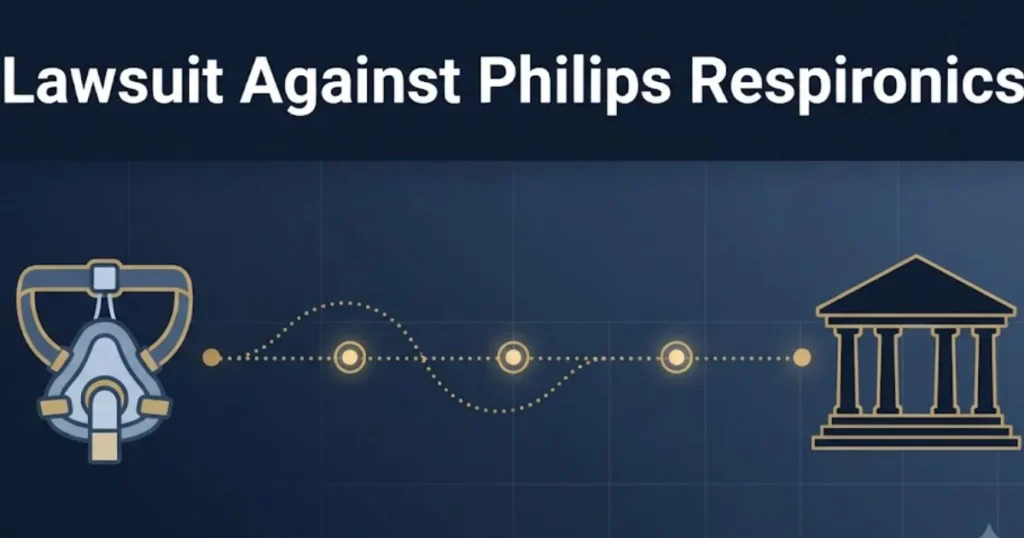
Here is the complete list of recalled device families:
CPAP Devices:
- DreamStation ASV
- DreamStation ST, AVAPS
- DreamStation CPAP, Auto CPAP
- DreamStation Go CPAP, Auto CPAP
- Dorma 400, 500 CPAP
BiPAP Devices:
- DreamStation BiPAP S/T, AVAPS
- DreamStation BiPAP Pro
- REMstar SE Auto CPAP (various models)
- SystemOne ASV4
- SystemOne Q-Series (various models)
- C-Series ASV, S/T, AVAPS
Ventilators:
- Trilogy 100, 200
- Trilogy Evo (certain serial ranges)
- Garbin Plus, Cough Assist T70
- A-Series BiPAP (A30, A40, Hybrid A30)
- E30 emergency use ventilator
- LifeVent
| Device Category | Key Models | Production Period |
|---|---|---|
| CPAP | DreamStation, Dorma 400/500 | 2009 to 2021 |
| BiPAP | DreamStation BiPAP, SystemOne, C-Series | 2009 to 2021 |
| Ventilators | Trilogy 100/200, Garbin Plus, E30 | 2009 to 2021 |
One important note: the DreamStation 2 is NOT on the recall list. It uses a different type of foam. If your device is a DreamStation 2 purchased after April 2021, it is not part of this recall.
Check the label on the back or bottom of your device for the model name and serial number. If you no longer have the device, your DME provider or insurance company may have records.
Philips Respironics Lawsuit Deadline for 2026
The Philips Respironics lawsuit deadline situation in 2026 depends on your state’s statute of limitations and the type of claim you are filing. There is no single nationwide deadline that applies to everyone.
For economic loss claims, the $1.1 billion settlement had specific registration deadlines. If you missed the initial registration window, it may still be possible to file a late claim, but approval is not guaranteed. Check with an attorney about your options.
For personal injury claims, the deadline is typically governed by your state’s statute of limitations for product liability or personal injury cases. These range from one to six years depending on where you live.
| State | Statute of Limitations (Personal Injury) |
|---|---|
| California | 2 years from discovery of injury |
| Texas | 2 years |
| Florida | 2 years (changed from 4 in 2023) |
| New York | 3 years |
| Pennsylvania | 2 years |
| Ohio | 2 years |
| Illinois | 2 years |
The “discovery rule” is important here. In many states, the clock does not start ticking until you knew or should have known that your injury was caused by the defective device. For some users, that clock started with the June 2021 recall announcement. For others who learned about the connection later, the window may still be open.
If you have not filed yet, time is running short. Every month you wait increases the risk that your state’s deadline will pass. Attorneys handling these cases typically offer free consultations to evaluate whether you still have time.
Philips Respironics Personal Injury Claims
Philips Respironics personal injury claims are filed by individuals who developed serious health conditions after using recalled CPAP, BiPAP, or ventilator machines. These claims seek compensation for medical bills, pain and suffering, lost wages, and reduced quality of life.
Personal injury claims are separate from the economic loss track. While the economic loss settlement covers financial damages related to the device itself, personal injury claims cover the human cost of getting sick.
The strongest PI claims share certain characteristics:
- Extended use period of the recalled device (two or more years)
- Documented diagnosis of cancer, respiratory disease, or other qualifying condition
- Medical expert opinion linking the condition to foam or VOC exposure
- Timing alignment between device use and symptom onset
Compensation in personal injury cases can include:
- Past and future medical expenses
- Lost income and earning capacity
- Physical pain and suffering
- Emotional distress
- Loss of enjoyment of life
- Wrongful death damages (for surviving family members)
Bellwether trials in 2026 will test how juries react to the evidence in these cases. If plaintiffs win these early trials, it will put enormous pressure on Philips to settle the remaining PI claims. If Philips wins, it may embolden the company to fight more cases individually.
Key Takeaway: Personal injury claims against Philips Respironics cover cancer, respiratory damage, and other health conditions, and the 2026 bellwether trials will likely determine the trajectory of these cases.
Philips Respironics Economic Loss Settlement
The Philips Respironics economic loss settlement is a $1.1 billion agreement that resolves claims from users who suffered financial harm due to the recall. This settlement was reached in 2024 and received final court approval in late 2025.
This settlement does not cover personal injury claims. It specifically addresses the money users lost because of the recall. That includes the cost of the device, replacement equipment, out-of-pocket expenses for CPAP supplies, and costs related to alternative sleep therapy during the recall period.
Here is how the economic loss payout structure works:
| Claim Category | What It Covers | Estimated Payout |
|---|---|---|
| Device replacement | Cost of recalled device | $50 to $500 |
| Out-of-pocket medical expenses | CPAP supplies, doctor visits | $100 to $1,000 |
| Alternative therapy costs | Rental equipment, dental devices | $200 to $1,500 |
| Medical monitoring | Future health screening costs | Varies by agreement |
The settlement also includes provisions for medical monitoring. This means Philips will fund health screenings for affected users to detect potential foam-related health issues early. The specifics of the monitoring program are still being finalized.
Payments from the economic loss fund are expected to begin reaching eligible claimants in early to mid 2026. The exact timing depends on how quickly the claims administrator processes the submitted paperwork.
If you filed a claim, keep your records organized and watch for communications from the settlement administrator. Payments will not arrive all at once. They will roll out in waves based on claim complexity and verification.
Philips Respironics MDL Update for 2026
The Philips Respironics MDL (Multidistrict Litigation) update for 2026 shows the case is now firmly focused on personal injury bellwether trials. The MDL, designated as Case No. 2:21-mc-1230 (MDL 3014), is overseen by Judge Joy Flowers Conti in the Western District of Pennsylvania.
As of early 2026, here is where things stand:
- The economic loss settlement has been finalized and approved
- Personal injury bellwether cases have been selected
- Expert discovery for PI claims is largely complete
- Daubert hearings (challenges to expert testimony) are underway or completed
- The first PI bellwether trials are expected in mid to late 2026
The bellwether process is like a test run. The court selects a small number of representative cases to go to trial. These trials reveal how juries respond to the scientific evidence, the causation arguments, and the damage calculations.
What bellwether results could mean:
- Plaintiff victories: Likely triggers global settlement negotiations for all PI claims
- Defense victories: May reduce settlement values or extend litigation
- Mixed results: Could lead to tiered settlement offers based on injury type
More than 100,000 individual claims have been filed in the MDL. Trying each one individually would take decades. The bellwether process exists to avoid that and push both sides toward resolution.
Judge Conti has been active in managing the case, setting firm deadlines, and discouraging unnecessary delays. Her approach suggests a desire to move the litigation toward resolution as efficiently as possible.
Philips Respironics Class Action Status
The Philips Respironics case is technically not a class action. It is a multidistrict litigation (MDL), which works differently. Understanding the distinction matters because it affects how your claim is handled and what you can expect.
In a class action, one group of plaintiffs represents everyone who was harmed. You are automatically included unless you opt out. The settlement applies equally to all class members.
In an MDL, each plaintiff files their own individual lawsuit. These cases are grouped together in one court for efficiency during the pretrial phase. But each claim is evaluated on its own merits. Your payout depends on your specific injuries, usage history, and evidence.
| Feature | Class Action | MDL (Mass Tort) |
|---|---|---|
| Individual claim evaluation | No | Yes |
| Automatic inclusion | Yes (unless you opt out) | No (you must file) |
| Personalized payout | Rare | Common |
| Trial format | Representative trial | Bellwether trials |
| Settlement structure | Uniform for all members | Tiered by injury |
The economic loss portion of the Philips case was structured as a class settlement, meaning eligible users could participate in the $1.1 billion fund without filing individual lawsuits. That is the closest this case comes to a traditional class action format.
The personal injury side remains an MDL. Each claimant pursues their own case. This is actually better for seriously injured plaintiffs because it allows for individualized compensation rather than a one-size-fits-all payment.
Key Takeaway: The Philips Respironics litigation is an MDL, not a class action, which means personal injury claimants file individually and receive payouts based on their specific harm rather than a flat amount.
Philips Respironics Lawsuit Payout Timeline
The Philips Respironics lawsuit payout timeline stretches through 2026 and possibly into 2027 or 2028 for personal injury claims. Economic loss payments are closer to distribution, while PI payouts depend heavily on bellwether trial outcomes.
Here is a projected timeline based on current case developments:
| Phase | Expected Timing | Details |
|---|---|---|
| Economic loss claim processing | Early 2026 | Claims administrator reviews submissions |
| Economic loss payments begin | Mid 2026 | First wave of payouts to verified claimants |
| PI bellwether trials begin | Mid to late 2026 | Test cases go before juries |
| PI bellwether verdicts | Late 2026 to early 2027 | Jury decisions on causation and damages |
| PI settlement negotiations | 2027 | If bellwethers favor plaintiffs |
| PI settlement payouts begin | 2027 to 2028 | Dependent on global settlement terms |
Think of it like a funnel. The economic loss claims are further along because they are simpler to prove. You bought a defective device. You lost money. Here is your compensation.
Personal injury claims are harder. They require medical evidence, expert testimony on causation, and individualized damage calculations. That takes longer to resolve, and the bellwether trials are the bottleneck.
If you filed an economic loss claim, keep your contact information updated with the claims administrator. Unclaimed funds can be redistributed or returned. You want to make sure your payment reaches you.
For personal injury claimants, patience is necessary but the end is approaching. The bellwether trials will create the pressure needed to push Philips toward a global PI settlement.
Some attorneys have suggested that a global personal injury settlement could reach several billion dollars given the number of serious injury claims. But that figure remains speculative until trial results come in.
Frequently Asked Questions
How much money will I get from the Philips Respironics lawsuit?
Economic loss claimants may receive between $50 and $1,500 depending on their device and expenses.
Personal injury payouts could range from $5,000 to over $500,000 based on injury severity.
Final PI amounts depend on bellwether trial outcomes expected in 2026.
What is the deadline to file a Philips Respironics claim in 2026?
There is no single nationwide deadline for personal injury claims.
Each state has its own statute of limitations, ranging from one to six years.
The discovery rule may extend your filing window, but acting quickly is critical.
Which Philips CPAP machines were recalled?
The recall covers DreamStation CPAP and BiPAP models, SystemOne series, C-Series devices, Dorma 400 and 500, and Trilogy ventilators.
All recalled devices were manufactured between 2009 and April 2021.
The DreamStation 2 is not included in the recall.
Can I still join the Philips Respironics lawsuit in 2026?
Yes, many people can still file personal injury claims in 2026.
Your ability to join depends on your state’s statute of limitations and the discovery rule.
Contact an attorney for a free case evaluation to confirm your eligibility.
What health problems are linked to Philips CPAP machines?
Users have reported lung cancer, kidney cancer, liver cancer, respiratory infections, chronic coughing, headaches, and skin irritation.
These conditions are linked to inhaled PE-PUR foam particles and volatile organic compounds.
The FDA has classified the recall as Class I, the most serious category.
The Philips Respironics lawsuit enters 2026 with real momentum. Economic loss payments are rolling out, and personal injury bellwether trials are set to begin.
If you used a recalled device, now is the time to act. Gather your records, verify your device model, and speak with an attorney about your options.
Waiting too long could cost you your claim. The deadlines are real, and the window is narrowing.







