

The Marquis Health Services lawsuit centers on allegations that the company’s nursing home facilities failed to provide safe, adequate care to residents. Families across multiple states have filed legal claims involving neglect, abuse, understaffing, and wrongful death.
If you had a loved one in a Marquis facility who suffered harm, this article breaks down everything you need to know. That includes the latest 2026 updates, settlement details, payout estimates, and who qualifies to file.
Here’s a number that puts things in perspective. Federal inspection data has flagged multiple Marquis-affiliated facilities for serious deficiency citations in recent years.
Some of those violations involved immediate jeopardy to patient health. These aren’t minor paperwork issues. They’re failures that directly affected real people.
This article covers 16 specific topics tied to the Marquis Health Services lawsuit. You’ll find eligibility details, claim types, payout ranges, filing steps, and facility-level information all in one place.
Marquis Health Services Lawsuit 2026: What You Need to Know
The Marquis Health Services lawsuit in 2026 refers to a growing number of legal actions filed against Marquis Health Consulting Services and its affiliated skilled nursing facilities. These lawsuits allege a pattern of substandard care that harmed residents.
Marquis operates and manages nursing homes primarily in New Jersey and Connecticut. The company has been linked to dozens of facilities that provide long-term care, rehabilitation, and memory care services.
The lawsuits target a range of problems. Families say their loved ones experienced preventable injuries, infections, falls, bedsores, and even death due to the company’s failure to maintain proper care standards.
| Detail | Info |
|---|---|
| Defendant | Marquis Health Consulting Services and affiliates |
| Primary States | New Jersey, Connecticut |
| Types of Claims | Negligence, abuse, wrongful death, understaffing |
| Status in 2026 | Active litigation with multiple pending cases |
| Who Is Filing | Residents, families, and estates of deceased patients |
What makes the 2026 lawsuits significant is the volume. More families are coming forward as inspection reports and legal victories bring new information to light.
These cases aren’t just about one bad day at one facility. They point to what plaintiffs call systemic failures in how Marquis runs its operations across its network.
Marquis Health Services Lawsuit Update 2026
As of 2026, several lawsuits against Marquis Health Services remain active in state courts. New filings continue to come in from families in both New Jersey and Connecticut.
Some earlier cases filed in 2023 and 2024 have moved through the discovery phase. That means lawyers on both sides are exchanging evidence, depositions, and medical records.
A handful of cases have reached preliminary settlement discussions. Others are headed toward trial dates later in 2026.
The legal pressure on Marquis has increased for a specific reason. CMS inspection data from 2024 and 2025 revealed repeated violations at several Marquis-managed facilities.
- Multiple facilities received citations for immediate jeopardy findings
- State health departments issued follow-up surveys and corrective action orders
- At least three wrongful death cases are pending in New Jersey Superior Court
- New complaints were filed with the Long-Term Care Ombudsman in early 2026
No large-scale settlement has been announced yet. But the trajectory of these cases suggests that more legal action is on the way.
Attorneys representing families say the evidence is strong. Internal staffing records and inspection reports are being used to build negligence arguments.
Marquis Health Services Settlement: Current Status
No global settlement has been reached in the Marquis Health Services lawsuit as of early 2026. Individual cases, however, have settled confidentially.
That’s common in nursing home litigation. Companies like Marquis often prefer to settle individual claims out of court to avoid public trials and large jury verdicts.
When a nursing home case settles, the terms are usually sealed. That means the exact dollar amounts aren’t made public.
| Settlement Status | Details |
|---|---|
| Global Class Settlement | Not announced as of 2026 |
| Individual Settlements | Several cases settled confidentially |
| Settlement Talks | Ongoing in select cases |
| Trial Dates | Some cases scheduled for late 2026 |
What does this mean for families considering a claim? It means the legal door is still open. Cases are being filed and resolved on a rolling basis.
Families who file sooner typically have an advantage. Evidence is fresher, witnesses are available, and medical records are easier to obtain when cases are filed promptly.
If Marquis faces enough individual lawsuits, a broader settlement or resolution could emerge. But that hasn’t happened yet.
Key Takeaway: The Marquis Health Services lawsuit is active in 2026 with multiple pending cases, no global settlement yet, and growing legal pressure from new filings.
Marquis Health Services Lawsuit Payout: What to Expect
Payouts in Marquis Health Services lawsuits vary widely based on the severity of the harm, the type of claim, and the evidence available. There is no single fixed amount.
In general, nursing home negligence lawsuits can result in payouts ranging from $50,000 to over $1 million depending on the case. Wrongful death cases tend to land on the higher end.
Think of it like car insurance claims. A fender bender and a totaled car get very different payouts. The same logic applies here.
Several factors determine how much a family might receive:
- Type of injury: Bedsores, falls, infections, malnutrition, or death
- Duration of harm: How long the resident suffered before action was taken
- Proof of negligence: Staffing records, inspection reports, medical charts
- Economic damages: Medical bills, funeral costs, lost quality of life
- Punitive damages: If the court finds the facility acted with reckless disregard
Families with strong documentation tend to receive larger payouts. That includes photos, medical records, and written complaints submitted to the facility.
Punitive damages are a wildcard. Courts award them when a company’s behavior is so bad that the court wants to send a message. In nursing home cases with documented repeat violations, punitive damages are absolutely on the table.
Marquis Health Services Lawsuit Settlement Amounts by Claim Type
Settlement amounts in Marquis Health Services cases depend almost entirely on the claim type. Here is a breakdown of estimated ranges based on comparable nursing home lawsuits across New Jersey and Connecticut.
| Claim Type | Estimated Settlement Range |
|---|---|
| Bedsore or pressure ulcer | $75,000 to $350,000 |
| Fall resulting in fracture | $100,000 to $500,000 |
| Infection due to poor care | $50,000 to $300,000 |
| Malnutrition or dehydration | $80,000 to $400,000 |
| Medication error | $60,000 to $250,000 |
| Wrongful death | $250,000 to $1,500,000+ |
| Physical or sexual abuse | $200,000 to $2,000,000+ |
These are estimates based on publicly available nursing home verdict and settlement data. Your case could fall above or below these ranges.
Wrongful death claims almost always result in the largest payouts. When a resident dies due to preventable neglect, juries tend to award significant compensation.
Cases involving abuse carry the heaviest emotional weight. Courts and juries often respond with large verdicts when evidence shows a vulnerable person was physically harmed by a caregiver.
One important note: settlements are usually paid as lump sums. But in wrongful death cases involving estates, the money may be distributed according to state probate laws.
Who Qualifies for the Marquis Health Services Lawsuit?
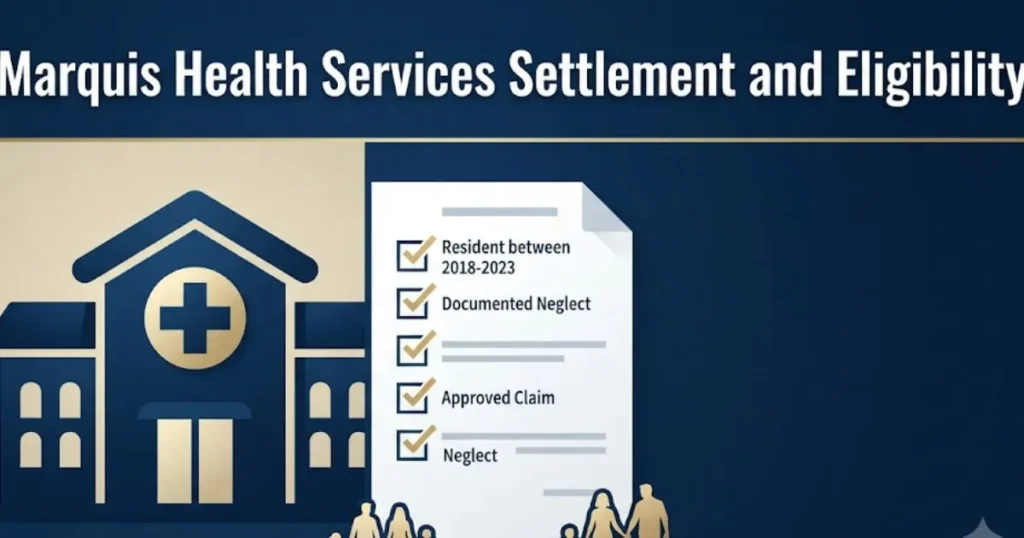
You may qualify for the Marquis Health Services lawsuit if you or a family member lived at a Marquis-managed facility and experienced substandard care that caused harm.
Qualification isn’t limited to current residents. Former residents and the families of deceased residents can file claims too.
Here are the general eligibility criteria:
- The resident was admitted to a facility operated or managed by Marquis Health Services
- The resident experienced neglect, abuse, injury, or death while in the facility’s care
- The harm was caused by the facility’s failure to meet care standards
- The claim is filed within the state’s statute of limitations
| Eligibility Factor | Details |
|---|---|
| Who Can File | Residents, family members, legal guardians, estate representatives |
| Facility Requirement | Must be a Marquis-operated or Marquis-managed location |
| Harm Requirement | Documented injury, neglect, abuse, or death |
| Time Limit (NJ) | Typically 2 years from the date of injury or death |
| Time Limit (CT) | Typically 2 years, with some exceptions |
Family members who noticed a sudden decline in their loved one’s health should take that seriously. Weight loss, unexplained bruising, worsening bedsores, and emotional withdrawal are all red flags.
If your loved one passed away while at a Marquis facility, the estate can file a wrongful death claim. That process usually requires a personal representative or executor to act on behalf of the estate.
Key Takeaway: Residents, former residents, and families of deceased patients at Marquis facilities may all qualify to file a claim, but time limits apply, so acting quickly matters.
Marquis Health Services Class Action: Is There One?
As of 2026, there is no certified class action lawsuit against Marquis Health Services. The current legal actions are primarily individual lawsuits and wrongful death claims.
That might surprise people who assume every big lawsuit turns into a class action. But nursing home cases rarely go that route.
Here’s why. Each resident’s experience is different. One person might have suffered a fall. Another might have developed Stage 4 bedsores. A third might have died from an untreated infection. The injuries, timelines, and evidence are unique to each case.
Class actions work best when a large group of people suffered the same harm from the same action. Think defective products or data breaches. Nursing home abuse doesn’t fit that mold cleanly.
| Lawsuit Type | Applies to Marquis? | How It Works |
|---|---|---|
| Individual Lawsuit | Yes, most common | One plaintiff files against the facility |
| Wrongful Death Claim | Yes, growing | Filed by estate after resident’s death |
| Class Action | Not currently | Group lawsuit with one representative plaintiff |
| Mass Tort | Possible in future | Multiple individual cases managed together |
A mass tort scenario is more likely than a class action. That’s where many individual lawsuits are grouped together for efficiency but each case is evaluated on its own merits.
If enough families file similar claims, attorneys may push for a consolidated approach. But for now, each case stands alone.
Marquis Health Services Nursing Home Abuse Allegations
Nursing home abuse allegations against Marquis Health Services include physical abuse, emotional abuse, and neglect so severe that some advocates classify it as a form of abuse on its own.
These allegations come from families, former employees, and regulatory inspection reports. They paint a troubling picture of what happened inside certain facilities.
Physical abuse claims include reports of residents being handled roughly by staff. In some cases, families reported unexplained bruises, cuts, and injuries that staff couldn’t explain.
Emotional abuse is harder to prove but equally damaging. Families described residents who became withdrawn, fearful, or agitated after interactions with certain staff members.
- Rough handling during transfers and bathing
- Unexplained injuries reported by family visitors
- Verbal intimidation or threats from overworked aides
- Isolation of residents as a behavioral control method
- Failure to respond to call lights for extended periods
Neglect itself can rise to the level of abuse when it’s chronic and systematic. Leaving a resident in soiled clothing for hours, failing to turn bedridden patients, and skipping medication doses all fall into this category.
State regulators have documented some of these issues in official inspection reports. When inspectors confirm the same problems during repeat visits, it strengthens the legal argument that Marquis knew about the issues and failed to fix them.
Marquis Health Services Negligence Claims Explained
Negligence claims against Marquis Health Services are built on a simple legal concept: the facility had a duty to provide reasonable care, it failed to meet that duty, and the failure caused harm.
In legal terms, you need four things to prove negligence:
- Duty of care: Marquis accepted the resident and had a legal obligation to provide proper care
- Breach of duty: The facility failed to meet accepted standards of nursing home care
- Causation: The breach directly caused the resident’s injury or death
- Damages: The resident or family suffered measurable harm as a result
The most common negligence allegations against Marquis involve failures that should have been preventable. Bedsores developing on a resident who wasn’t repositioned regularly. A fall that happened because no one responded to a call light. An infection that spread because wound care protocols weren’t followed.
| Negligence Element | Example in Marquis Cases |
|---|---|
| Duty of Care | Admitting a resident and accepting Medicare payment |
| Breach | Failing to maintain minimum staffing levels |
| Causation | Understaffing led to missed medication doses |
| Damages | Resident hospitalized due to medication error |
These cases often rely heavily on medical records and staffing logs. If a facility was supposed to have 10 nurses on a shift but only had 5, that’s strong evidence of a breach.
Expert witnesses play a big role too. Nursing care experts review the records and testify about what should have happened versus what actually did.
Marquis Health Services Understaffing Lawsuit Details
Understaffing is at the core of many Marquis Health Services lawsuits. Families allege that facilities operated with dangerously low staff-to-resident ratios, leading directly to injuries and deaths.
This isn’t just a family complaint. Federal and state inspection records have documented staffing concerns at multiple Marquis-managed facilities.
When a nursing home doesn’t have enough nurses and aides, everything breaks down. Medications get delayed. Residents don’t get turned in bed. Call lights go unanswered. Meals are missed. Hygiene suffers.
- CMS data shows some Marquis facilities scored below average on staffing metrics
- Certified Nursing Assistant (CNA) hours per resident per day fell below recommended levels at several locations
- Families reported wait times of 30 minutes or more for basic assistance
- Former employees have described working conditions as “impossible” due to workload
| Staffing Metric | Recommended Level | Reported at Some Marquis Facilities |
|---|---|---|
| CNA Hours Per Resident Per Day | 2.5 to 3.0+ hours | Below 2.0 hours at some locations |
| RN Hours Per Resident Per Day | 0.75+ hours | Below 0.5 hours at some locations |
| Overall Staff Rating (CMS) | 3 to 5 stars | 1 to 2 stars at flagged facilities |
Understaffing lawsuits are powerful because the data is publicly available. CMS publishes staffing data for every Medicare-certified nursing home in the country.
That means attorneys don’t have to guess. They can pull the numbers and show exactly how short-staffed a facility was on the days when a resident was harmed.
Key Takeaway: Understaffing at Marquis facilities is documented in federal data, and it forms the backbone of many negligence and abuse lawsuits filed by families.
Marquis Health Services Wrongful Death Lawsuit Cases
Wrongful death lawsuits against Marquis Health Services are filed when a resident dies as a result of the facility’s negligence, abuse, or failure to provide adequate care.
These are the most serious cases in the entire Marquis litigation. A family loses someone they trusted the facility to protect. The legal system allows them to seek accountability and compensation.
In New Jersey, wrongful death claims are governed by the Wrongful Death Act (N.J.S.A. 2A:31-1). In Connecticut, similar statutes apply. Both states allow the estate of the deceased to file suit.
Common causes of death cited in Marquis wrongful death lawsuits include:
- Untreated infections that progressed to sepsis
- Falls resulting in traumatic brain injuries or hip fractures leading to decline
- Bedsores that became infected and led to systemic complications
- Choking incidents due to improper feeding supervision
- Dehydration and malnutrition from inadequate daily care
| Wrongful Death Case Element | Details |
|---|---|
| Who Files | Estate representative, executor, or administrator |
| Statute of Limitations (NJ) | 2 years from date of death |
| Statute of Limitations (CT) | 2 years from date of death |
| Damages Available | Medical costs, funeral expenses, pain and suffering, loss of companionship |
| Punitive Damages | Available if reckless or intentional conduct is proven |
Wrongful death cases carry the highest potential payouts. Jury verdicts in nursing home wrongful death cases in the Northeast have exceeded $1 million in multiple instances.
Families often don’t realize they have a wrongful death claim. If a loved one’s death seemed sudden or unexplained, requesting medical records and an independent review is a reasonable first step.
Marquis Health Services Elder Abuse Claims
Elder abuse claims against Marquis Health Services go beyond standard negligence. They allege intentional or reckless conduct that harmed vulnerable adults in the facility’s care.
Elder abuse in a nursing home setting can take several forms. Physical abuse gets the most attention, but financial exploitation and psychological abuse are also alleged in some Marquis-related cases.
New Jersey’s Adult Protective Services Act and related statutes provide legal protections for elderly residents. Connecticut has similar protections under its elder abuse laws.
- Physical abuse: Hitting, pushing, rough handling, improper restraint use
- Psychological abuse: Threats, intimidation, yelling, isolation
- Neglect as abuse: Willful failure to provide food, water, hygiene, or medical care
- Financial exploitation: Misuse of a resident’s funds or belongings (less common but reported)
What separates elder abuse from negligence is the mental state of the wrongdoer. Negligence is carelessness. Abuse involves intent or reckless indifference to the person’s wellbeing.
This distinction matters for damages. Elder abuse claims can unlock punitive damages and statutory penalties that aren’t available in a simple negligence case.
Families who suspect abuse should document everything. Take photos. Write down dates and times. Report concerns to the facility administrator in writing. File a complaint with the state health department.
How to File a Marquis Health Services Lawsuit
Filing a Marquis Health Services lawsuit starts with gathering evidence and contacting an attorney who specializes in nursing home litigation.
You don’t need to figure out the legal strategy yourself. But there are steps you can take right now to protect your rights and strengthen your case.
Step 1: Collect Records
Request the resident’s complete medical records from the facility. You’re legally entitled to them. Get copies of care plans, medication logs, incident reports, and discharge summaries.
Step 2: Document the Harm
Take photographs of any injuries. Keep a written log of incidents, dates, and conversations with staff. Save any letters, emails, or text messages related to the resident’s care.
Step 3: File a Regulatory Complaint
Contact your state’s health department or Long-Term Care Ombudsman. Filing an official complaint creates an independent record that supports your legal case.
Step 4: Consult an Attorney
Most nursing home attorneys work on a contingency fee basis. That means you pay nothing upfront. The attorney only gets paid if you win or settle.
| Filing Step | What to Do | Why It Matters |
|---|---|---|
| Collect Medical Records | Request from facility and any hospitals | Proves what happened medically |
| Document Injuries | Photos, notes, witness statements | Creates visual and written evidence |
| File State Complaint | Contact health department or ombudsman | Triggers official investigation |
| Hire Attorney | Find a nursing home litigation specialist | Handles legal filings and negotiations |
| File Lawsuit | Attorney files complaint in court | Starts the formal legal process |
Step 5: Your Attorney Files the Lawsuit
Once your attorney reviews the evidence, they file a formal complaint in the appropriate court. After that, the legal process of discovery, depositions, and potential settlement talks begins.
Key Takeaway: Filing a Marquis Health Services lawsuit involves gathering records, documenting harm, filing a state complaint, and working with an attorney who handles nursing home cases on a contingency basis.
Marquis Health Services Complaints: What Families Report
Families of Marquis Health Services residents have reported a consistent pattern of complaints that align with the allegations in pending lawsuits.
These complaints come from multiple sources. Some are filed with state regulators. Others appear in public review forums. Many are shared directly with attorneys during case intake.
The most common complaints include:
- Residents left in soiled clothing or bedding for hours
- Call lights ignored for 20 to 45 minutes or longer
- Meals delivered late, cold, or not at all
- Residents losing significant weight without explanation
- Staff being rude, dismissive, or unavailable
- Prescribed medications not administered on time
- Lack of communication between staff and families
- Visitors finding residents in distressing conditions
What stands out is how many complaints describe the same problems at different Marquis facilities. That pattern supports the legal argument that the issues are systemic rather than isolated.
| Complaint Category | Frequency Reported |
|---|---|
| Hygiene and cleanliness failures | Very common |
| Slow or no response to call lights | Very common |
| Nutrition and hydration concerns | Common |
| Medication administration errors | Common |
| Communication breakdowns with families | Common |
| Staff attitude and professionalism | Moderate |
Families sometimes hesitate to complain because they fear retaliation against their loved one. That fear is understandable but important to overcome. Documentation is the strongest tool available to families seeking accountability.
Written complaints submitted to the facility create a paper trail. That trail becomes evidence if a lawsuit is filed later.
Marquis Health Services Inspection Violations on Record
Multiple Marquis Health Services facilities have received deficiency citations during federal and state inspections. Some of those citations involved the most serious category: immediate jeopardy to resident health or safety.
Every Medicare-certified nursing home in the United States is subject to unannounced inspections. Inspectors evaluate care quality, staffing, infection control, resident rights, and facility conditions.
When a facility fails an inspection standard, it receives a deficiency citation. Citations range from minor (isolated, no harm) to severe (widespread, immediate jeopardy).
- Immediate jeopardy citations mean a resident faced serious harm or death risk
- Actual harm citations mean a resident was hurt but the harm didn’t reach jeopardy level
- Potential for harm citations mean conditions existed that could have caused injury
- Minimal harm citations mean a violation occurred but caused no measurable impact
| Violation Severity | What It Means | Found at Marquis Facilities? |
|---|---|---|
| Immediate Jeopardy | Serious injury or death risk | Yes, at select locations |
| Actual Harm | Resident was harmed | Yes, documented |
| Potential for Harm | Risk existed but no injury yet | Yes, multiple citations |
| Minimal Harm | Technical violation, no impact | Yes, routine |
These inspection reports are publicly available through the CMS Care Compare website. Anyone can look up a specific facility and see its inspection history, staffing data, and quality ratings.
For lawsuit purposes, inspection violations are gold. They’re findings made by independent government inspectors. When those findings match the allegations in a lawsuit, they strengthen the case considerably.
Marquis Health Services Facilities Involved in Lawsuits
Lawsuits against Marquis Health Services involve facilities across multiple states, with the heaviest concentration in New Jersey and Connecticut.
Marquis Health Consulting Services operates or manages a network of skilled nursing facilities. Not every facility in the network faces the same legal exposure, but several have been named in lawsuits or flagged by regulators.
Due to the confidential nature of many individual settlements, a complete public list of every facility with pending litigation isn’t available. However, publicly available inspection data and court records point to specific locations.
| State | Number of Marquis-Affiliated Facilities | Facilities With Known Legal Actions or Serious Citations |
|---|---|---|
| New Jersey | 20+ | Several with active lawsuits or serious inspection violations |
| Connecticut | 5+ | Multiple with documented deficiency citations |
| Other States | Varies | Limited public information available |
Families should check whether their loved one’s facility is operated or managed by Marquis Health Consulting Services. The facility’s Medicare provider information and ownership data are available through CMS.
- Look up the facility on the CMS Care Compare tool
- Check the ownership and management section
- Review the inspection history and any deficiency citations
- Note the facility’s overall star rating and staffing scores
Some facilities have changed names or management over the years. Even if a facility doesn’t currently carry the Marquis name, it may have been under Marquis management when the alleged harm occurred. That’s what matters for legal purposes.
If you’re unsure whether your loved one’s facility is connected to Marquis, an attorney can verify the ownership and management chain quickly.
Key Takeaway: Marquis-affiliated facilities in New Jersey and Connecticut are the primary locations involved in lawsuits, and families can verify facility connections through CMS ownership data.
Frequently Asked Questions
What is the Marquis Health Services lawsuit about?
The Marquis Health Services lawsuit involves claims of nursing home negligence, abuse, understaffing, and wrongful death at facilities managed by the company.
Families allege that residents suffered preventable harm due to systemic care failures.
Cases are active in New Jersey and Connecticut courts as of 2026.
How much money can I get from a Marquis Health Services lawsuit?
Payouts range from $50,000 to over $1 million depending on the type and severity of the claim.
Wrongful death and abuse cases tend to result in the highest compensation.
Settlement amounts are influenced by medical evidence, staffing records, and proof of negligence.
Who qualifies to file a claim against Marquis Health Services?
Any resident, former resident, or family member of someone who was harmed at a Marquis-managed facility may qualify.
The harm must be connected to the facility’s failure to provide adequate care.
Claims must be filed within the state’s statute of limitations, typically 2 years from the date of injury or death.
Is there a class action lawsuit against Marquis Health Services?
There is no certified class action against Marquis Health Services as of 2026.
Current lawsuits are individual claims and wrongful death actions.
A mass tort approach, where cases are grouped but evaluated individually, is more likely than a traditional class action.
What is the deadline to file a Marquis Health Services lawsuit in 2026?
The statute of limitations in New Jersey and Connecticut is generally 2 years from the date of injury or death.
Some exceptions may extend or shorten this window depending on the circumstances.
Filing as soon as possible is important because evidence can deteriorate and witnesses become harder to locate over time.
The Marquis Health Services lawsuit in 2026 is very much alive. Families across New Jersey and Connecticut are holding this company accountable for the care their loved ones received.
If your family was affected, now is the time to gather records and explore your legal options. Don’t let a filing deadline pass while evidence is still available.
Your next step is simple. Collect your loved one’s medical records and reach out to an attorney who handles nursing home cases. The consultation is typically free.







