

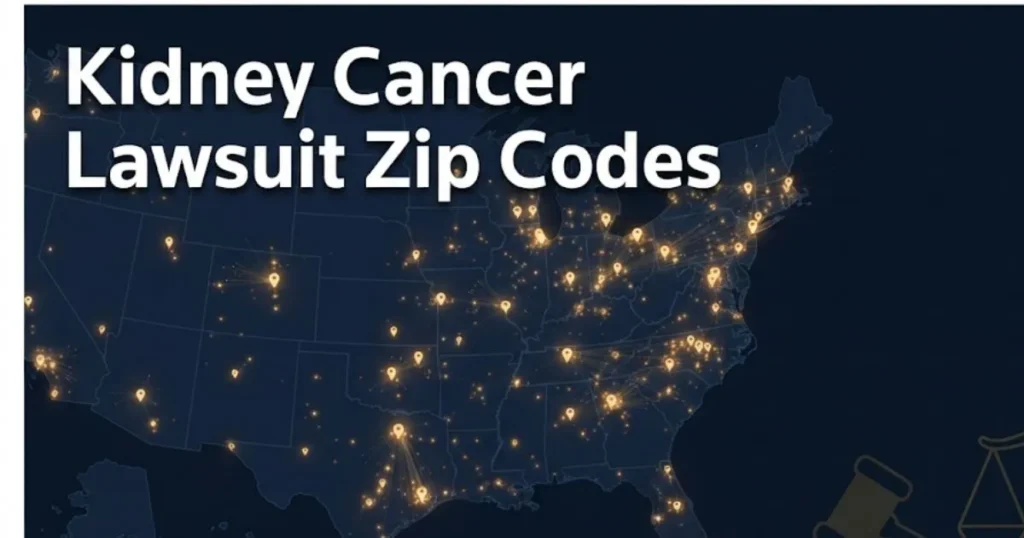
If you live in a zip code near a contaminated military base, Superfund site, or polluted water system, you may qualify for a kidney cancer lawsuit in 2026. Kidney cancer lawsuit zip codes are tied to areas where toxic chemicals like TCE, PFAS, and benzene have been found in drinking water or soil.
This article breaks down which zip codes and contamination zones are linked to active lawsuits. You will learn who qualifies, what settlements look like, and how the filing process works heading into 2026.
Here is something worth knowing: the EPA has identified over 1,300 Superfund sites across the United States, and dozens of them are directly tied to kidney cancer clusters. If your zip code falls within one of those zones, time matters.
We will cover eligibility rules, compensation estimates, deadlines, and every step you need to take.
Kidney Cancer Lawsuit Zip Codes
Kidney cancer lawsuit zip codes are specific geographic areas where toxic contamination has been linked to elevated rates of kidney cancer. These zip codes typically surround military bases, industrial facilities, chemical plants, and municipal water systems that tested positive for carcinogens like trichloroethylene (TCE) or PFAS chemicals.
Your zip code matters because lawsuits are often built around contamination maps. Attorneys and government agencies use EPA data, ATSDR health assessments, and state cancer registry records to draw connections between where people lived and what they were exposed to.
Not every zip code with pollution qualifies. The contamination must involve chemicals with an established link to renal cell carcinoma. Courts look for a scientific connection between the specific toxin and kidney cancer diagnosis.
| Factor | Why Your Zip Code Matters |
|---|---|
| Proximity to Source | Living within the contamination plume of a Superfund site or military base |
| Water System Records | Your municipal water tested positive for TCE, PCE, PFAS, or benzene |
| Duration of Residence | How long you lived in the affected zip code |
| Cancer Cluster Data | State or federal agencies flagged elevated kidney cancer rates in your area |
| Active Litigation | Lawsuits already filed naming your contamination source |
People in states like North Carolina, Michigan, California, Ohio, and New Jersey have some of the highest concentrations of affected zip codes. Many of these areas overlap with known Superfund sites or military installations.
If you are unsure whether your zip code qualifies, checking the EPA’s Superfund site locator or your state’s environmental agency records is a good starting point.
What Is the Kidney Cancer Lawsuit
A kidney cancer lawsuit is a legal claim filed by someone diagnosed with kidney cancer who believes toxic chemical exposure caused their disease. These lawsuits typically fall under the category of toxic tort litigation or mass tort cases.
The central argument is straightforward. A company, government entity, or military installation allowed dangerous chemicals to enter the water, air, or soil. People living or working nearby were exposed. Some of those people developed kidney cancer.
Renal cell carcinoma is the most common type of kidney cancer tied to these cases. Research from the National Cancer Institute and the International Agency for Research on Cancer (IARC) has classified chemicals like TCE and PFAS as probable or known human carcinogens linked to kidney cancer.
These lawsuits are not new. They have been building for years. But 2026 is shaping up to be a major year for new filings and settlements.
- TCE lawsuits target manufacturers and military sites that used the industrial degreaser
- PFAS lawsuits target companies like 3M, DuPont, and Chemours
- Camp Lejeune lawsuits target the U.S. government for decades of water contamination
- Industrial pollution lawsuits target chemical plants, refineries, and factories
Think of it like this: if a factory upstream dumped chemicals into the river your town drinks from, and you got cancer, the lawsuit asks that factory to pay for the damage.
Kidney Cancer Lawsuit Update 2026
The kidney cancer lawsuit landscape is expected to see significant movement in 2026. Several key developments are already taking shape as courts process thousands of claims filed in 2024 and 2025.
Camp Lejeune cases continue to be the largest single source of kidney cancer litigation. The Camp Lejeune Justice Act of 2022 opened the door for veterans and their families to file claims against the federal government. As of late 2025, over 200,000 claims have been submitted, and kidney cancer is among the qualifying conditions.
PFAS litigation is another major front. The multidistrict litigation (MDL) consolidated in South Carolina federal court has expanded to include personal injury claims, with kidney cancer plaintiffs forming a growing subset of those cases.
| 2026 Development | Status |
|---|---|
| Camp Lejeune bellwether trials | Expected to begin mid-2026 |
| PFAS personal injury MDL | New case management orders anticipated |
| TCE Superfund site claims | Additional sites added to EPA priority list |
| State-level water contamination suits | New filings expected in Ohio, Michigan, and California |
| Settlement fund negotiations | Early discussions for PFAS global settlement |
New contamination zones are still being identified. The EPA announced plans to finalize enforceable PFAS drinking water limits, which will likely expose more communities and generate new lawsuits.
For anyone diagnosed with kidney cancer who lived near a contamination source, 2026 represents a critical window to file.
Key Takeaway: Your zip code connects you to a contamination zone, and 2026 is a pivotal year for kidney cancer lawsuits as courts begin major trials and new contamination sites come to light.
Who Has Kidney Cancer Lawsuit Eligibility
You may have kidney cancer lawsuit eligibility if you were diagnosed with kidney cancer and can show you were exposed to specific toxic chemicals in your home, workplace, or community. Eligibility is based on three core factors: diagnosis, exposure, and timing.
The diagnosis must be renal cell carcinoma or another form of kidney cancer recognized in the specific litigation. Transitional cell carcinoma of the renal pelvis also qualifies in certain cases.
Exposure means you lived, worked, or served in an area contaminated by TCE, PFAS, benzene, PCE, vinyl chloride, or other established carcinogens. The exposure must have lasted long enough for courts to consider it significant. For Camp Lejeune claims, the minimum is 30 days of residence or service between August 1953 and December 1987.
Timing is about the statute of limitations. You must file within the legal window allowed by your state or the specific federal legislation governing your claim.
- Diagnosed with kidney cancer (renal cell carcinoma or related type)
- Lived or worked in a contaminated area for a qualifying period
- Exposure involved a chemical with a proven or probable link to kidney cancer
- Filed within the applicable statute of limitations
- Have medical records and proof of residence or employment in the affected zone
Family members of deceased kidney cancer patients may also qualify to file wrongful death claims in many states.
Kidney Cancer Contamination Zones by Zip Code
Kidney cancer contamination zones by zip code are geographic areas mapped by the EPA, state agencies, or litigation teams where toxic chemicals have polluted drinking water or soil at levels linked to cancer. These maps are central to proving your case.
Contamination plume maps show how chemicals spread through groundwater. Your home might be five miles from a chemical plant, but if the groundwater flows toward your well or municipal water source, you could be inside the contamination zone.
Some of the most heavily affected zip codes in the United States fall near these locations:
| Location | State | Primary Contaminant | Estimated Affected Zip Codes |
|---|---|---|---|
| Camp Lejeune | North Carolina | TCE, PCE, benzene, vinyl chloride | 28540, 28542, 28544, 28546 |
| Pease Air Force Base | New Hampshire | PFAS | 03801, 03802, 03803 |
| Wurtsmith Air Force Base | Michigan | PFAS | 48738, 48739, 48747 |
| El Monte/San Gabriel Valley | California | TCE, PCE | 91731, 91732, 91733 |
| Wright-Patterson AFB | Ohio | TCE | 45431, 45432, 45433 |
| Fayetteville Works | North Carolina | GenX/PFAS | 28301, 28303, 28304 |
State environmental agencies maintain databases of contamination sites. Michigan alone has over 300 known PFAS contamination sites. California’s State Water Resources Control Board tracks TCE plumes in the San Gabriel Valley and Silicon Valley regions.
If your zip code borders a Superfund site or a military base with a known contamination history, your odds of qualifying increase substantially.
Kidney Cancer from Contaminated Water Lawsuit
A kidney cancer from contaminated water lawsuit targets the parties responsible for allowing cancer-causing chemicals to enter public or private drinking water supplies. These cases have surged because water contamination affects entire communities at once.
The science behind these claims is strong. TCE, classified as a known human carcinogen by the EPA since 2011, has a well-documented link to kidney cancer. Studies published in the Journal of the National Cancer Institute found that workers exposed to high levels of TCE had a 40% higher risk of developing renal cell carcinoma.
PFAS chemicals tell a similar story. Research from the C8 Science Panel, which studied communities near DuPont’s Washington Works plant in West Virginia, found a probable link between PFOA exposure and kidney cancer.
Water contamination lawsuits work on the principle that the polluter pays. If a company, military base, or municipality knew about contamination and failed to act, they can be held liable.
- Municipal water systems that exceeded safe chemical thresholds
- Private wells contaminated by nearby industrial operations
- Military base water systems that served service members and families
- Agricultural runoff introducing chemicals to community water sources
People who drank contaminated water for years often did not know anything was wrong. That is exactly why these lawsuits exist.
Kidney Cancer Camp Lejeune Lawsuit
The kidney cancer Camp Lejeune lawsuit allows veterans, service members, civilian workers, and their families to seek compensation for kidney cancer caused by decades of water contamination at Marine Corps Base Camp Lejeune in North Carolina.
Between 1953 and 1987, the drinking water at Camp Lejeune contained dangerously high levels of TCE, PCE, benzene, and vinyl chloride. Some contaminant levels were 240 to 3,400 times above safety limits. An estimated one million people were exposed during that period.
The Camp Lejeune Justice Act of 2022, signed as part of the PACT Act, gave affected individuals the right to sue the federal government. Kidney cancer is one of the 15 presumptive conditions listed under the legislation.
| Camp Lejeune Lawsuit Detail | Information |
|---|---|
| Qualifying Dates | August 1, 1953 to December 31, 1987 |
| Minimum Exposure | 30 days living or working on base |
| Primary Contaminants | TCE, PCE, benzene, vinyl chloride |
| Court Handling Cases | U.S. District Court, Eastern District of North Carolina |
| Qualifying Condition | Kidney cancer (renal cell carcinoma) |
| Estimated Claimants | Over 200,000 total claims filed |
Bellwether trials are expected to begin in 2026. These initial cases will set the tone for settlement values across thousands of remaining claims.
If you or a family member served at Camp Lejeune during those years and developed kidney cancer, this lawsuit applies directly to you.
Key Takeaway: Camp Lejeune is the largest single source of kidney cancer lawsuits, with bellwether trials set for 2026 and over 200,000 claims already filed.
Kidney Cancer PFAS Lawsuit
The kidney cancer PFAS lawsuit targets manufacturers of per- and polyfluoroalkyl substances, commonly known as “forever chemicals,” that contaminated drinking water and are linked to kidney cancer. Major defendants include 3M, DuPont, and Chemours.
PFAS chemicals do not break down in the environment or the human body. They accumulate over time. The C8 Science Panel, which studied over 69,000 people exposed to PFOA near DuPont’s plant in Parkersburg, West Virginia, established a probable link between PFOA and kidney cancer in 2012.
In 2024, the EPA set the first-ever enforceable limits for PFAS in drinking water: 4 parts per trillion for PFOA and PFOS individually. Thousands of water systems across the country exceed those limits. Every system that fails to meet the new standard represents a potential source of future lawsuits.
The PFAS MDL in the U.S. District Court for the District of South Carolina has primarily focused on water utility claims. But personal injury claims, including kidney cancer cases, are gaining momentum.
- 3M agreed to a $10.3 billion settlement with public water systems in 2023
- DuPont, Chemours, and Corteva agreed to a $1.185 billion water system settlement
- Personal injury claims, including kidney cancer, are being consolidated separately
- New PFAS contamination sites are identified every month
The personal injury track of PFAS litigation is still in earlier stages. But with the science firmly established and water testing data flowing in, 2026 should bring significant developments for kidney cancer plaintiffs.
Kidney Cancer Toxic Exposure Lawsuit
A kidney cancer toxic exposure lawsuit covers any case where a person developed kidney cancer after being exposed to a carcinogenic substance through their environment, workplace, or consumer products. This is the broadest category of kidney cancer litigation.
Toxic exposure is not limited to water contamination. It includes breathing contaminated air near industrial facilities, handling chemicals at work without proper protection, and living on or near military bases where hazardous materials were used or dumped.
The key chemicals tied to kidney cancer in these lawsuits include:
| Chemical | Common Sources | Cancer Link Strength |
|---|---|---|
| Trichloroethylene (TCE) | Industrial degreasing, military operations | Known human carcinogen (EPA, IARC) |
| PFOA/PFOS | Firefighting foam, nonstick coatings, water repellents | Probable human carcinogen (IARC Group 2B, elevated to Group 1 for PFOA in 2023) |
| Benzene | Gasoline, petrochemical plants, cigarette smoke | Known human carcinogen |
| Perchloroethylene (PCE) | Dry cleaning, metal degreasing | Probable human carcinogen |
| Cadmium | Battery manufacturing, mining, smelting | Known human carcinogen |
| Vinyl Chloride | PVC manufacturing, waste sites | Known human carcinogen |
Proving toxic exposure requires connecting the chemical to your specific environment. That means showing the chemical was present where you lived or worked, during the time you were there, at levels high enough to cause harm.
Occupational exposure cases are especially strong when employers failed to provide safety equipment or inform workers about chemical risks.
Kidney Cancer Class Action Lawsuit
A kidney cancer class action lawsuit groups multiple plaintiffs who share the same exposure source and legal claims into one case. However, most kidney cancer lawsuits in 2026 are structured as mass torts rather than true class actions.
The difference matters. In a class action, one outcome applies to everyone. In a mass tort, each person’s case is evaluated individually, which usually results in different settlement amounts based on the severity of each person’s diagnosis, exposure duration, and damages.
The PFAS litigation and Camp Lejeune litigation are both structured as mass torts with cases consolidated through multidistrict litigation (MDL). This system groups cases for pretrial proceedings but preserves each plaintiff’s individual claim.
- Class action: One verdict or settlement covers all members equally
- Mass tort: Individual claims are grouped for efficiency but settled separately
- MDL: Cases from multiple federal courts consolidated before one judge
For kidney cancer plaintiffs, the mass tort structure tends to produce better results. Someone diagnosed with Stage IV renal cell carcinoma after 20 years of TCE exposure will receive more than someone with an early-stage diagnosis and shorter exposure.
If you see the phrase “kidney cancer class action” online, it usually refers to the mass tort MDL process. The legal outcome is similar, but the payout structure differs significantly.
Kidney Cancer Lawsuit Settlements 2026
Kidney cancer lawsuit settlements in 2026 are expected to range from $100,000 to over $1 million per individual claim, depending on factors like cancer stage, exposure duration, and the strength of evidence linking contamination to the diagnosis.
No global settlement has been finalized yet for kidney cancer personal injury claims in either the PFAS or Camp Lejeune tracks. But several data points give us a reasonable estimate of where values may land.
| Settlement Factor | Impact on Value |
|---|---|
| Cancer Stage at Diagnosis | Stage III and IV claims valued highest |
| Duration of Exposure | Longer exposure periods increase value |
| Age at Diagnosis | Younger plaintiffs typically receive more |
| Medical Expenses | Higher treatment costs increase damages |
| Lost Income | Documented wage loss adds to the claim |
| Pain and Suffering | Significant component of total damages |
| Wrongful Death | Family claims for deceased patients often valued higher |
The Camp Lejeune litigation has proposed tiered settlement tracks. Early estimates suggest kidney cancer claims could fall into the higher tiers, potentially in the $300,000 to $600,000 range for qualifying cases.
In PFAS litigation, personal injury settlements are harder to predict because bellwether trials have not yet occurred. But the multi-billion dollar settlements with water utilities signal that defendants have deep pockets and strong motivation to resolve claims.
Past TCE exposure verdicts in non-military cases have reached $2 million or more for individual kidney cancer plaintiffs.
Key Takeaway: Kidney cancer lawsuit settlements in 2026 could range from $100,000 to over $1 million, with the highest values going to advanced-stage diagnoses and long-term exposure cases.
Kidney Cancer Lawsuit Compensation Amounts
Kidney cancer lawsuit compensation amounts reflect the total financial damages a plaintiff can recover. This includes both economic damages (medical bills, lost wages) and non-economic damages (pain, suffering, loss of quality of life).
The biggest factor driving compensation is the severity of the cancer. A person who underwent a radical nephrectomy (full kidney removal) and chemotherapy will have a stronger claim than someone who had a small tumor removed with no further treatment.
Here is how compensation breaks down by category:
| Compensation Type | Typical Range |
|---|---|
| Medical expenses (past and future) | $50,000 to $500,000+ |
| Lost wages and earning capacity | $30,000 to $300,000+ |
| Pain and suffering | $50,000 to $500,000+ |
| Loss of consortium (spouse claims) | $25,000 to $150,000 |
| Wrongful death damages | $250,000 to $2,000,000+ |
| Punitive damages (if awarded) | Varies widely by jurisdiction |
Keep in mind that these numbers come from historical verdict data and attorney projections. Actual amounts will depend on your individual circumstances and the specific litigation track your case falls under.
Attorney fees in contingency cases typically run between 25% and 40% of the total recovery. That means if you receive $500,000, your attorney’s fee might be $125,000 to $200,000. Most kidney cancer attorneys work on contingency, so you pay nothing upfront.
Kidney Cancer Lawsuit Payout Timeline
The kidney cancer lawsuit payout timeline depends on which litigation track your case is in, but most plaintiffs should expect the process to take 18 to 48 months from the date of filing to the date they receive money.
Mass tort litigation moves slowly. Cases must go through filing, discovery, expert review, bellwether trials, and then settlement negotiations before money reaches plaintiffs. That timeline is the same whether we are talking about Camp Lejeune, PFAS, or TCE claims.
| Phase | Estimated Duration |
|---|---|
| Case filing and intake | 1 to 3 months |
| Discovery and evidence gathering | 6 to 12 months |
| Bellwether trial selection | 3 to 6 months |
| Bellwether trials | 6 to 12 months |
| Settlement negotiations | 3 to 12 months |
| Payout distribution | 2 to 6 months after settlement |
For Camp Lejeune cases, the government has established an administrative claims process that may result in faster payouts for claims that are accepted without going to trial. The Navy’s Office of the Judge Advocate General processes these claims, though the volume of submissions has created substantial backlogs.
Think of it like a pipeline. Early filers are closer to the front. If you file in 2026, you are getting in line behind people who filed in 2023 and 2024. That does not mean you should wait, though. Filing sooner always beats filing later.
How to File a Kidney Cancer Lawsuit
Filing a kidney cancer lawsuit starts with contacting an attorney who handles toxic tort or mass tort cases involving kidney cancer. Most attorneys offer free case evaluations and work on contingency, meaning they only get paid if you win.
The process follows a clear sequence. Here is what to expect:
- Free case evaluation: An attorney reviews your diagnosis, exposure history, and location
- Document gathering: You collect medical records, proof of residence, employment history, and military service records
- Case filing: Your attorney files the complaint in the appropriate court
- Discovery phase: Both sides exchange evidence and expert reports
- Settlement or trial: Your case either settles or proceeds to trial
You do not need to have all your documents ready before contacting an attorney. Most law firms help you obtain medical records and locate contamination data for your area.
The most common mistake people make is waiting too long. Statutes of limitations vary by state and by lawsuit type. Some deadlines are as short as two years from the date of diagnosis.
| Step | What You Need |
|---|---|
| Contact attorney | Basic info about diagnosis and where you lived |
| Medical records | Pathology reports, treatment records, doctor notes |
| Proof of location | Utility bills, tax records, lease agreements, DD-214 military discharge |
| Employment records | Pay stubs, W-2s, HR records showing workplace location |
| Timeline | Dates of residence and dates of diagnosis |
Start by writing down everywhere you have lived and worked. That simple list could be the most important piece of your case.
Key Takeaway: Filing a kidney cancer lawsuit starts with a free attorney evaluation, and you do not need to have all your documents ready before that first call.
Kidney Cancer Lawsuit Evidence Requirements
Kidney cancer lawsuit evidence requirements center on two things: proving you have kidney cancer and proving you were exposed to a carcinogen in a specific location. Without both, your case will not move forward.
Medical evidence is the foundation. You need a confirmed diagnosis of kidney cancer from a qualified physician. Pathology reports carry the most weight because they show the type, grade, and stage of cancer.
Exposure evidence connects you to a contamination zone. This is where zip codes become critical. Your proof of residence or employment in a contaminated area ties your diagnosis to the toxic source.
Medical evidence you will need:
- Pathology report confirming kidney cancer diagnosis
- Treatment records (surgery, chemotherapy, immunotherapy)
- Doctor’s notes linking cancer to potential environmental causes
- Imaging reports (CT scans, MRIs, ultrasounds)
Exposure evidence you will need:
- Proof of residence in a contaminated zip code (utility bills, tax records, lease agreements)
- Military service records showing assignment to a contaminated base (DD-214)
- Employment records at a facility using toxic chemicals
- EPA or state environmental reports documenting contamination in your area
Expert witnesses play a major role. Epidemiologists testify about the statistical link between the chemical and kidney cancer. Toxicologists explain how exposure levels in your area were sufficient to cause disease.
The strongest cases combine long exposure periods, high contamination levels, and a diagnosis that aligns with the known cancer profile of the specific chemical.
Kidney Cancer Lawsuit Statute of Limitations
The kidney cancer lawsuit statute of limitations is the legal deadline for filing your claim. Miss it, and you lose your right to sue, regardless of how strong your case might be.
Statutes of limitations for toxic exposure cases vary significantly by state and by the type of claim. Most states use a “discovery rule,” which means the clock starts when you knew or should have known that your cancer was caused by toxic exposure, not when the exposure actually occurred.
| Jurisdiction | Statute of Limitations | Notes |
|---|---|---|
| Camp Lejeune (federal) | 2 years from CLJA enactment (August 2024 deadline, but extensions may apply) | Some late claims still being reviewed |
| California | 2 years from discovery | Discovery rule applies |
| Texas | 2 years from discovery | Strict enforcement |
| New York | 3 years from discovery | One of the longer state deadlines |
| Florida | 4 years from discovery (reduced to 2 years for negligence as of 2024) | Recent legislative change |
| Ohio | 2 years from discovery | Standard toxic tort deadline |
| Federal PFAS claims | Varies by underlying state law | MDL consolidation may extend certain deadlines |
For Camp Lejeune claims, the original filing deadline was August 10, 2024, two years after the CLJA was signed. However, the massive volume of claims and ongoing litigation means the Navy is still processing late submissions in certain circumstances.
Do not assume you have missed your window. An attorney can evaluate whether exceptions apply to your situation. Tolling provisions, delayed discovery, and ongoing exposure can all affect the deadline.
Kidney Cancer Military Base Lawsuit
A kidney cancer military base lawsuit is filed by service members, civilian workers, or family members who developed kidney cancer after exposure to toxic chemicals at U.S. military installations. Camp Lejeune is the most well-known example, but it is far from the only base involved.
The Department of Defense has identified over 700 military installations with known or suspected PFAS contamination. Many of these bases used aqueous film-forming foam (AFFF) for firefighting training, which released PFAS chemicals into the groundwater.
| Military Base | State | Primary Contaminant | Kidney Cancer Link |
|---|---|---|---|
| Camp Lejeune | North Carolina | TCE, PCE, benzene | Confirmed |
| Pease Air Force Base | New Hampshire | PFAS | Under investigation |
| Wurtsmith AFB | Michigan | PFAS | Under investigation |
| Wright-Patterson AFB | Ohio | TCE | Confirmed |
| Fort Ord | California | TCE | Confirmed |
| Elgin AFB | Florida | PFAS | Under investigation |
| Peterson AFB | Colorado | PFAS, TCE | Under investigation |
Veterans who served at any of these installations and later developed kidney cancer should look into their legal options. The VA already recognizes kidney cancer as a presumptive condition for Camp Lejeune veterans, which means you do not need to prove service connection for VA benefits.
Filing a lawsuit is separate from VA benefits. You can pursue both simultaneously. The lawsuit seeks compensation from the responsible party, while VA benefits provide healthcare and disability payments.
Kidney Cancer Industrial Pollution Lawsuit
A kidney cancer industrial pollution lawsuit targets private companies whose manufacturing, chemical processing, or waste disposal activities contaminated surrounding communities with carcinogens linked to kidney cancer.
These lawsuits differ from military base cases because the defendant is a corporation, not the federal government. That distinction matters because private companies do not have the same legal protections as the government, which can make these cases easier to win in some ways.
Industrial facilities most commonly linked to kidney cancer lawsuits include:
- Chemical manufacturing plants that released TCE or PCE into air and groundwater
- Semiconductor factories that used industrial solvents without proper waste disposal
- Petrochemical refineries that emitted benzene into surrounding neighborhoods
- PFAS manufacturing facilities like DuPont’s Washington Works in West Virginia
- Metal finishing and electroplating shops that used TCE as a degreaser
The San Gabriel Valley in Southern California is one of the most studied examples. TCE contamination from aerospace and electronics manufacturers polluted groundwater serving millions of residents. Multiple Superfund sites in the area have been linked to elevated kidney cancer rates.
| Industrial Source | How Contamination Spreads | Affected Population |
|---|---|---|
| Chemical plant emissions | Airborne particles settle on soil and water | Neighborhoods within 1 to 5 miles |
| Wastewater discharge | Chemicals enter rivers and water treatment systems | Downstream communities |
| Underground storage tanks | Leaks contaminate groundwater | Homes using well water nearby |
| Improper waste dumping | Chemicals seep into aquifers over decades | Wide geographic areas |
If you lived near an industrial facility and were diagnosed with kidney cancer, check whether your area has been flagged by the EPA or your state environmental agency.
Key Takeaway: Military bases and industrial facilities are the two primary sources of contamination driving kidney cancer lawsuits, with over 700 military sites and hundreds of Superfund locations potentially linked to cases.
Frequently Asked Questions
What zip codes qualify for a kidney cancer lawsuit in 2026?
Zip codes near Superfund sites, military bases like Camp Lejeune, and industrial facilities with documented TCE or PFAS contamination qualify.
Common qualifying zip codes include 28540 to 28546 (Camp Lejeune, NC), 91731 to 91733 (San Gabriel Valley, CA), and areas near over 700 military bases with PFAS contamination.
Check the EPA Superfund site locator for your specific zip code.
How much money can I get from a kidney cancer lawsuit?
Most kidney cancer lawsuit settlements are projected to range from $100,000 to over $1 million per claim.
The amount depends on cancer stage, exposure duration, medical costs, and lost income.
Advanced-stage diagnoses and longer exposure periods typically result in higher compensation.
What is the deadline to file a kidney cancer lawsuit in 2026?
Deadlines vary by state and lawsuit type, with most states allowing 2 to 4 years from the date you discovered your cancer was linked to toxic exposure.
Camp Lejeune claims had an original deadline of August 2024, but some late filings are still being reviewed.
Contact an attorney immediately to determine your specific deadline.
Does living near a military base qualify me for a kidney cancer lawsuit?
Living near a military base qualifies you if that base has documented water or soil contamination linked to kidney cancer.
Over 700 U.S. military installations have known or suspected PFAS contamination from firefighting foam.
You must show you lived or worked on or near the base during the contamination period and were later diagnosed with kidney cancer.
What evidence do I need to file a kidney cancer lawsuit?
You need a confirmed kidney cancer diagnosis (pathology report) and proof you lived or worked in a contaminated area.
Medical records, proof of residence (utility bills, tax records), and military service records (DD-214) are the core documents.
Your attorney can help you obtain environmental contamination reports and expert testimony to strengthen your case.
If you live in a zip code tied to toxic contamination and you have been diagnosed with kidney cancer, 2026 is the time to act. Filing deadlines are real, and waiting too long could cost you your right to compensation.
Check your zip code against known contamination sites. Gather your medical records and proof of where you lived. Then reach out for a free case evaluation.
The information is out there. The lawsuits are active. The only thing left is your decision to file.







