

The Elysium Health lawsuit centers on claims that the company misled consumers about its Basis supplement. If you bought Basis believing it would reverse aging or boost your NAD+ levels based on scientific proof, you might be part of this case.
Multiple lawsuits accuse Elysium Health of false advertising, deceptive marketing, and consumer fraud. The company built its brand around Nobel Prize-winning science and prestigious university affiliations. But critics and plaintiffs say the actual evidence behind Basis doesn’t match the bold promises.
As of 2026, the litigation is still active. Settlement talks have progressed, and new filing windows may be opening for affected consumers. This article breaks down everything you need to know: what happened, who qualifies, estimated payouts, deadlines, and how to file a claim.
One striking detail stands out. Elysium Health reportedly generated over $30 million in annual revenue from Basis alone, largely through subscription billing that kept customers locked in month after month.
What Is the Elysium Health Lawsuit About
The Elysium Health lawsuit is a series of legal actions accusing the supplement company of misleading consumers about the benefits of its flagship product, Basis.
Basis is a daily pill containing nicotinamide riboside (NR) and pterostilbene. Elysium marketed it as a clinically proven way to increase NAD+ levels and slow the aging process. The company leaned heavily on its scientific advisory board, which included Nobel laureates and MIT researchers.
Plaintiffs argue those marketing claims went too far. They say Elysium presented preliminary research as settled science. Consumers paid $40 to $60 per month for a subscription product that may not have delivered the promised results.
The legal actions span multiple states. Claims include false advertising, consumer fraud, unjust enrichment, and violations of state consumer protection statutes.
| Detail | Info |
|---|---|
| Company | Elysium Health Inc. |
| Product | Basis (NR + pterostilbene supplement) |
| Key Allegations | False advertising, consumer fraud |
| Price Range | $40 to $60 per month |
| Target Consumers | Health-conscious adults 35+ |
Think of it this way: if a car company advertised a vehicle as getting 50 miles per gallon based on one lab test, then sold millions of those cars, buyers would be angry when they only got 30. That’s essentially what plaintiffs say Elysium did with Basis.
Elysium Health Lawsuit Update for 2026
As of early 2026, the Elysium Health lawsuit remains in active litigation with several key developments.
Court proceedings from late 2025 moved some consumer fraud claims closer to trial readiness. Discovery phases revealed internal communications about how Elysium’s marketing team framed scientific studies. Those documents became central to the plaintiffs’ argument.
Settlement discussions are reportedly underway. While no final agreement has been announced publicly, legal observers expect movement in mid to late 2026. Both sides have signaled willingness to negotiate.
The class certification question is also pending. A successful class certification would mean all qualifying purchasers could be represented together. That would significantly speed up the process and increase pressure on Elysium to settle.
| 2026 Milestone | Expected Timing |
|---|---|
| Discovery completion | Q1 2026 |
| Class certification ruling | Q2 2026 |
| Settlement negotiations | Mid 2026 |
| Potential trial date | Late 2026 or early 2027 |
If you purchased Basis at any point, keep watching for class certification announcements. That ruling will determine how this case moves forward for thousands of buyers.
Elysium Health Class Action Lawsuit Explained
A class action lawsuit against Elysium Health means one legal team represents a large group of consumers who all suffered similar harm.
Instead of each buyer filing a separate case, a class action bundles everyone together. This makes the process more efficient and cost-effective. It also puts more pressure on the defendant company because the total damages add up fast.
In this case, the proposed class includes anyone who purchased Basis supplements during the relevant time period and was exposed to Elysium’s marketing claims. The lead plaintiffs represent the interests of the entire class.
Class actions like this one are common in supplement fraud cases. Companies make big health promises to sell products at premium prices. When the science doesn’t back up the marketing, lawsuits follow.
For the class to be certified, the court must agree on several points:
- Numerosity: Enough affected consumers exist to justify a class
- Commonality: All class members share similar legal questions
- Typicality: The lead plaintiffs’ claims are representative of the group
- Adequacy: The legal team can properly represent the class
If the court certifies the class, you won’t need to do much individually. The legal team handles everything on behalf of all members.
Key Takeaway: The Elysium Health lawsuit is a multi-state legal action targeting the company’s Basis supplement marketing, and 2026 could bring class certification and settlement progress that directly affects consumers who bought the product.
Elysium Health Basis Lawsuit Details
The Elysium Health Basis lawsuit specifically targets the marketing and sale of the Basis supplement product.
Basis was launched in 2015 as a “clinically proven” way to raise NAD+ levels. Elysium charged a premium price and sold it primarily through subscriptions on its website. The company claimed Basis could support cellular health, energy, and longevity.
Plaintiffs say those claims were exaggerated. The clinical study Elysium cited involved just 120 participants and measured NAD+ blood levels over eight weeks. It did not prove any actual health benefits like slower aging or better energy.
The lawsuit also targets Elysium’s use of its scientific advisory board. The company listed researchers from MIT, Harvard, Oxford, and other prestigious institutions. Plaintiffs argue this created a false sense of scientific credibility that went beyond what the actual research supported.
| Basis Product Detail | Info |
|---|---|
| Launch Year | 2015 |
| Active Ingredients | Nicotinamide riboside, pterostilbene |
| Monthly Cost | $40 to $60 |
| Sales Model | Direct-to-consumer subscription |
| Clinical Study Size | 120 participants |
| Study Duration | 8 weeks |
Several plaintiffs reported they subscribed for months or even years. Some spent over $1,000 before questioning whether the product actually worked as advertised.
Elysium Health Lawsuit Settlement Status
No final settlement has been approved in the Elysium Health lawsuit as of early 2026, but negotiations are reportedly progressing.
Settlement talks typically happen behind closed doors. Both sides weigh the costs of going to trial against the benefits of resolving the case early. For Elysium, a settlement avoids a potentially damaging public trial. For plaintiffs, it means faster compensation without years of appeals.
Based on similar supplement fraud settlements, legal analysts expect a total settlement fund in the range of $5 million to $20 million if a deal is reached. The exact amount depends on how many consumers are included in the class and the strength of the evidence.
If a settlement is announced, the court must approve it. That process includes a fairness hearing where class members can object or comment. After approval, the claims process opens and payments follow.
| Settlement Stage | Status |
|---|---|
| Preliminary Negotiations | In progress |
| Settlement Agreement | Not yet announced |
| Court Approval | Pending |
| Claims Window | Not yet open |
| Payment Distribution | Expected late 2026 or 2027 |
Keep in mind that settlements can fall apart. Nothing is guaranteed until a judge signs off on the final deal. But the trajectory here points toward resolution.
Elysium Health Lawsuit Payout Estimates
Individual payouts from the Elysium Health lawsuit will likely range from $20 to $500 depending on how much you spent and what proof you have.
Supplement fraud settlements typically don’t produce life-changing money for individual claimants. The math works like this: a settlement fund gets divided among all qualifying class members. The more people who file claims, the smaller each share becomes.
Claimants with purchase receipts, bank statements, or email confirmations will likely receive higher amounts. Those who file without proof of purchase may still qualify for a smaller base payment.
| Claimant Category | Estimated Payout |
|---|---|
| With full purchase proof (receipts, statements) | $100 to $500 |
| With partial proof (email confirmation only) | $50 to $150 |
| Without purchase proof | $20 to $50 |
To put this in perspective, many similar supplement class actions have paid out between $10 and $100 per person. The GNC supplement settlement paid around $20 per claimant. This case could land higher because Basis was a premium-priced product with recurring subscriptions.
If you still have your Elysium account login, download your order history now. That documentation could make a big difference in your payout.
Key Takeaway: Settlement talks are moving forward in 2026, and individual payouts could range from $20 to $500 based on your purchase history and available documentation, so saving your receipts now is a smart move.
Who Qualifies for the Elysium Health Lawsuit
You likely qualify for the Elysium Health lawsuit if you purchased the Basis supplement during the class period and were exposed to the company’s health claims.
The proposed class generally includes U.S. consumers who bought Basis directly from Elysium’s website or through authorized retailers. The relevant purchase period is expected to cover 2015 through 2024, though exact dates depend on the final class definition.
You don’t need to prove the product harmed you physically. This is a consumer fraud case, not a personal injury case. The claim is that you paid money based on misleading information.
Here’s who likely qualifies:
- Purchased Basis supplement during the class period
- Bought directly from Elysium Health’s website or authorized sellers
- Were a U.S. resident at the time of purchase
- Were exposed to Elysium’s marketing claims about NAD+, aging, or cellular health
And here’s who probably does not qualify:
- Purchased a different Elysium product (not Basis)
- Bought from an unauthorized reseller
- Purchased after the class period ended
- Are not a U.S. resident
| Eligibility Factor | Requirement |
|---|---|
| Product | Basis supplement only |
| Purchase Period | Approximately 2015 to 2024 |
| Location | United States |
| Purchase Source | Elysium website or authorized retailers |
| Proof of Harm | Not required |
Even if you only bought one month’s supply, you may still qualify. The class definition typically includes all purchasers, not just long-term subscribers.
How to File an Elysium Health Lawsuit Claim
Filing a claim in the Elysium Health lawsuit involves submitting a simple form once the claims process officially opens.
Right now, the claims window has not opened because no settlement has been finalized. But you can prepare by taking these steps today:
- Gather your purchase records. Check your email for Elysium order confirmations. Look at your credit card or bank statements for charges from Elysium Health. Screenshot your account history on the Elysium website if you still have access.
- Save marketing materials. If you received emails, ads, or brochures from Elysium making health claims about Basis, save them. Screenshots of website pages are helpful too.
- Register for updates. Many legal firms handling this case allow you to sign up for notifications. When the claims window opens, you’ll be among the first to know.
Once a settlement is approved, the process typically works like this:
| Step | What Happens |
|---|---|
| 1 | Settlement announced and approved by court |
| 2 | Claims administrator creates a filing form |
| 3 | Class members receive notice (email, mail, or both) |
| 4 | You submit the claim form with any supporting documents |
| 5 | Claims are reviewed and verified |
| 6 | Payments are distributed |
The form itself is usually straightforward. Name, address, purchase details, and any proof you can attach. Most forms can be completed online in under 15 minutes.
Elysium Health Lawsuit Filing Deadline
The Elysium Health lawsuit filing deadline has not been set yet because no settlement has been finalized as of early 2026.
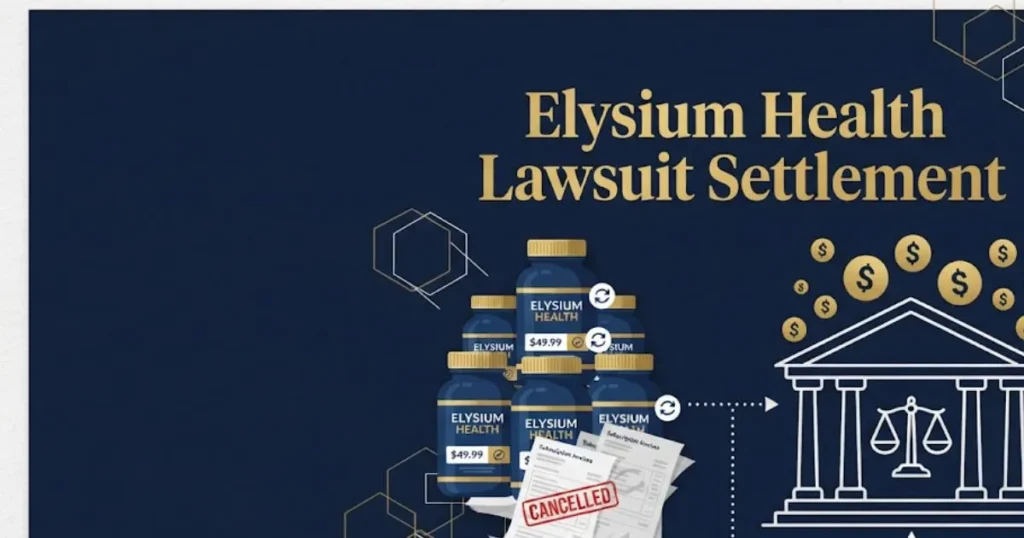
Once a settlement is approved, the court will establish a specific deadline for submitting claims. Based on similar cases, class members typically get 60 to 120 days to file after the claims window opens.
Missing the deadline usually means you forfeit your right to receive any payment from the settlement. Courts rarely grant extensions for individual claimants who simply forgot or didn’t act in time.
| Deadline Detail | Info |
|---|---|
| Current Deadline | Not yet set |
| Expected Timeline | Mid to late 2026 |
| Typical Filing Window | 60 to 120 days |
| Extension Possibility | Very unlikely |
If you think you might qualify, the best thing you can do right now is register with the legal team handling the case. That way, you’ll receive a direct notification when the deadline is announced. Don’t wait until you hear about it secondhand.
Key Takeaway: No filing deadline exists yet, but it could come fast once a settlement is approved; preparing your purchase records now and registering for case updates will keep you from missing the window.
Elysium Health False Advertising Lawsuit
The false advertising claims against Elysium Health argue that the company made health promises it couldn’t scientifically support.
Elysium advertised Basis as a product backed by Nobel Prize-winning research. The company’s co-founder, Leonard Guarente, is a respected MIT biologist who studies aging. That pedigree gave the marketing real credibility.
But the lawsuit argues Elysium stretched the truth. Here are the specific false advertising claims:
- “Clinically proven” language. Plaintiffs say the single clinical trial Elysium conducted was too small and too short to justify this claim. The study measured NAD+ levels in blood, not actual health outcomes like reduced aging or more energy.
- Implied disease prevention. Elysium’s marketing materials connected NAD+ to conditions like Alzheimer’s, heart disease, and diabetes. Plaintiffs say these connections were speculative and violated FTC advertising guidelines.
- Scientific advisory board endorsement. Listing Nobel laureates and top university researchers implied their endorsement of Basis. Some advisors have since distanced themselves from the company.
- Subscription billing practices. Some customers reported difficulty canceling recurring charges, which amplified the financial harm.
False advertising in the supplement industry is notoriously difficult to police. The FDA doesn’t approve supplements before they go to market. That puts the burden on consumers and, eventually, the courts.
Elysium Health Consumer Fraud Allegations
The consumer fraud allegations against Elysium Health go beyond advertising and target the company’s entire sales model.
Plaintiffs claim Elysium engaged in a pattern of deceptive conduct designed to extract maximum revenue from trusting consumers. The company targeted educated, health-conscious adults who were willing to pay a premium for science-backed products.
The fraud allegations include:
- Misleading scientific claims. Using real research to imply benefits that hadn’t been proven for the specific product
- Deceptive pricing. Advertising “discounted” subscription prices that were actually the standard cost
- Difficult cancellation process. Making it hard for subscribers to cancel recurring shipments and charges
- Cherry-picked data. Highlighting positive study results while ignoring limitations and conflicting research
- Omitting supplier disputes. Failing to disclose the bitter legal fight with ChromaDex, which raised questions about ingredient quality
Under New York consumer protection law, where Elysium is headquartered, companies can face penalties for deceptive business practices even if no individual consumer suffered physical harm. The financial harm alone is enough.
| Fraud Allegation | Consumer Impact |
|---|---|
| Misleading science claims | Paid for unproven benefits |
| Deceptive pricing | Overpaid for subscription |
| Difficult cancellation | Charged for unwanted shipments |
| Cherry-picked data | Made purchase based on incomplete info |
Elysium Health NAD+ Supplement Lawsuit
The NAD+ supplement angle of the Elysium Health lawsuit questions whether boosting NAD+ levels actually provides the health benefits the company marketed.
NAD+ (nicotinamide adenine dinucleotide) is a real molecule that plays a role in cellular energy production. As people age, NAD+ levels naturally decline. Elysium built its entire brand around the idea that raising those levels with a pill could slow aging.
The science is real, but the application is disputed. Researchers have shown that NR (the active ingredient in Basis) can increase NAD+ levels in blood. That part is not controversial.
What’s controversial is the leap from “higher NAD+ blood levels” to “you’ll age slower and feel better.” That connection has not been proven in humans with the kind of rigorous, long-term clinical trials that would justify Elysium’s marketing claims.
| NAD+ Claim | Scientific Reality |
|---|---|
| NR raises NAD+ blood levels | Supported by research |
| Higher NAD+ slows aging | Not proven in humans |
| Basis improves energy and health | No clinical evidence for Basis specifically |
| NAD+ decline causes disease | Correlation observed, causation not established |
It’s like saying that because dehydration causes fatigue, drinking extra water will make you a marathon runner. The first statement is true. The second doesn’t follow.
Key Takeaway: The core legal argument is that Elysium took legitimate but preliminary NAD+ science and marketed it as proven health benefits, crossing the line from optimistic science communication into deceptive advertising.
Elysium Health Basis Supplement Claims
The specific marketing claims Elysium made about Basis are central to the lawsuit and worth examining in detail.
Elysium’s website and advertising materials historically made several bold statements about Basis. Plaintiffs collected these claims as evidence of deceptive marketing.
Key claims Elysium made about Basis:
- “Clinically proven to increase NAD+ levels by an average of 40%”
- “Supports cellular health and energy metabolism”
- “Developed by world-leading scientists, including a Nobel laureate”
- “Based on 25 years of aging research”
- “The first cellular health product informed by genomics”
Each of these claims sounds impressive. But plaintiffs break them down one by one.
The 40% NAD+ increase came from a single study with 120 people. “Supports cellular health” is vague enough to be nearly meaningless from a regulatory standpoint. The Nobel laureate connection refers to advisory board members, not the creators of Basis itself. And “informed by genomics” is marketing language that doesn’t translate to proven clinical benefits.
| Marketing Claim | Plaintiff Response |
|---|---|
| “Clinically proven” | Study too small and short |
| “Supports cellular health” | Vague, no specific outcomes measured |
| “Nobel laureate involvement” | Advisory role, not product development |
| “25 years of aging research” | Research is real, product application is unproven |
The gap between what the science shows and what the marketing implies is where this lawsuit lives.
Elysium Health Basis Side Effects Lawsuit
Some plaintiffs have raised concerns about side effects from taking Basis, adding a product liability dimension to the case.
While the primary legal claims focus on false advertising and consumer fraud, a subset of plaintiffs report experiencing adverse effects. Reported side effects include:
- Nausea and stomach discomfort
- Headaches
- Skin flushing and redness
- Elevated liver enzymes in some users
- Digestive issues including diarrhea
Pterostilbene, one of the two active ingredients in Basis, has been flagged in some research for potentially raising LDL cholesterol levels. A 2017 study published in a peer-reviewed journal found that pterostilbene supplementation increased LDL cholesterol in some participants.
Elysium has maintained that Basis is safe for most adults. The company points to its clinical trial data showing the product was “generally well tolerated.” But plaintiffs argue that potential risks were not adequately disclosed.
| Reported Side Effect | Frequency (per complaints) |
|---|---|
| Nausea | Moderate |
| Headaches | Occasional |
| Skin flushing | Occasional |
| Elevated LDL cholesterol | Noted in some studies |
| Digestive issues | Moderate |
The side effects component adds weight to the overall case. Even if physical harm wasn’t the primary complaint, it strengthens the argument that Elysium prioritized sales over full transparency.
Elysium Health vs ChromaDex Lawsuit
The Elysium Health vs ChromaDex lawsuit is a separate but related legal battle that reveals important context about Basis and its ingredients.
ChromaDex is the company that originally supplied Elysium with Niagen, its patented form of nicotinamide riboside. The two companies had a business relationship that fell apart spectacularly around 2016 and 2017.
ChromaDex accused Elysium of failing to pay over $5 million in outstanding invoices for Niagen. Elysium countered that ChromaDex was trying to monopolize the NR market and overcharging for its ingredient.
The dispute got ugly fast. Lawsuits flew in both directions. Allegations included trade secret theft, patent infringement, and breach of contract. The litigation dragged on for years.
For consumers, this fight matters for one big reason: after splitting with ChromaDex, Elysium had to source its nicotinamide riboside from a different supplier. Plaintiffs have questioned whether the new ingredient source is of equal quality and whether Elysium was transparent about the change.
| ChromaDex Dispute Detail | Info |
|---|---|
| Original Supplier | ChromaDex (Niagen brand NR) |
| Alleged Unpaid Invoices | Over $5 million |
| Breakup Timeline | 2016 to 2017 |
| Outcome | Elysium switched NR suppliers |
| Consumer Impact | Questions about ingredient quality |
This supplier drama is like finding out your favorite restaurant switched meat suppliers and didn’t tell you. You’re still paying the same price, but you have no idea what you’re actually getting.
Key Takeaway: The ChromaDex dispute exposed supply chain issues and ingredient sourcing questions that add credibility to the consumer fraud claims in the main Elysium Health lawsuit.
Elysium Health Basis Scientific Evidence Questions
The scientific evidence behind Basis is real but limited, and that gap between real science and marketing claims sits at the heart of this lawsuit.
Elysium funded one primary clinical trial on Basis. Published in 2017 in the journal npj Aging and Mechanisms of Disease, the study showed that Basis increased NAD+ blood levels by an average of 40% over eight weeks in healthy adults aged 60 to 80.
That’s a legitimate finding. The study was peer-reviewed and published in a credible journal. But here’s what it didn’t show:
- No improvement in any measurable health outcome
- No evidence of slower aging
- No data on long-term safety beyond eight weeks
- No comparison to other NAD+ boosting methods like exercise or diet
Independent researchers have pointed out several limitations:
- Small sample size. Only 120 participants is modest for clinical claims.
- Short duration. Eight weeks doesn’t tell you much about long-term effects.
- Surrogate endpoint. NAD+ blood levels are a biomarker, not a health outcome. Raising a number on a blood test doesn’t automatically mean better health.
| Study Detail | Info |
|---|---|
| Participants | 120 |
| Duration | 8 weeks |
| Published | 2017 |
| Journal | npj Aging and Mechanisms of Disease |
| Main Finding | 40% increase in NAD+ blood levels |
| Health Outcomes Measured | None |
The scientific foundation is there, but it’s a foundation, not a finished house. Elysium marketed it as if the house was already built and move-in ready.
Is Elysium Health Still in Business in 2026
Yes, Elysium Health is still operating as of 2026, though the company has faced significant challenges.
The ongoing lawsuits, combined with the ChromaDex supplier dispute and increased competition in the NAD+ supplement market, have put pressure on the business. The company still sells Basis through its website and continues to market it as a cellular health supplement.
However, several changes are worth noting:
- Marketing language has been toned down. Recent product pages use more cautious phrasing compared to earlier claims.
- Subscription model continues. Basis is still sold primarily through monthly subscriptions.
- Competition has increased. Products like Tru Niagen (made by ChromaDex) and other NR supplements have entered the market at lower price points.
- Scientific advisory board changes. Some original advisors have distanced themselves from the company.
| Business Status | Detail |
|---|---|
| Operating | Yes, as of 2026 |
| Product Available | Basis still sold online |
| Pricing | $40 to $60 per month |
| Marketing Tone | More cautious than pre-lawsuit |
| Competition | Growing (Tru Niagen, others) |
The company’s survival doesn’t affect your ability to file a lawsuit claim. Even if Elysium continues operating, consumers who were misled can still seek compensation for past purchases.
If you’re currently subscribed, you may want to review your account and billing history. That information could serve as documentation for a future claim.
Key Takeaway: Elysium Health remains in business in 2026 with a more cautious marketing approach, but its ongoing legal troubles and growing competition have clearly changed the company’s position in the supplement market.
Frequently Asked Questions
What is the Elysium Health lawsuit about?
The Elysium Health lawsuit accuses the company of making false advertising and misleading health claims about its Basis supplement.
Plaintiffs say Elysium overstated the scientific evidence for NAD+ boosting benefits.
The case includes allegations of consumer fraud, deceptive marketing, and unjust enrichment.
How much money can I get from the Elysium Health lawsuit?
Most claimants can expect between $20 and $500 depending on purchase history and documentation.
Claimants with receipts or bank statements will receive higher amounts.
Payments are expected to begin in late 2026 or early 2027 if a settlement is finalized.
Who qualifies to join the Elysium Health class action?
U.S. consumers who purchased the Basis supplement during the class period (approximately 2015 to 2024) likely qualify.
You do not need to prove physical harm to be eligible.
Purchases from Elysium’s website or authorized retailers are included.
What is the deadline to file an Elysium Health lawsuit claim?
No filing deadline has been set yet because the settlement has not been finalized.
Once approved, claimants will typically have 60 to 120 days to submit their forms.
Register with the legal team handling the case to receive deadline notifications.
Is Elysium Health still selling Basis supplements in 2026?
Yes, Elysium Health is still in business and selling Basis through its website as of 2026.
The company has adjusted its marketing language to be less aggressive since the lawsuits began.
You can still purchase Basis, but its pricing and claims have changed.
The Elysium Health lawsuit is heading toward a critical phase in 2026. Settlement talks, class certification, and potential deadlines could all converge in the coming months.
If you bought Basis, start pulling your purchase records together now. Credit card statements, email confirmations, and account screenshots all count.
Stay informed about this case. When that claims window opens, you’ll want to be ready to file quickly and with solid documentation in hand.







