

Breast cancer side effects lawsuit attorneys are helping thousands of people pursue compensation after dangerous drugs and products caused or contributed to their cancer diagnosis. If you were diagnosed with breast cancer and suspect a product played a role, 2026 could be a turning point in your case.
Several major lawsuits are moving toward settlement talks and bellwether trials this year. Hair relaxer cases, Zantac claims, and pharmaceutical drug lawsuits are all advancing through the courts.
This article covers every active breast cancer lawsuit heading into 2026. You will learn who qualifies, what settlements look like, how to file, and which attorneys handle these cases. One key detail: more than 9,000 hair relaxer cancer lawsuits alone are pending in federal court right now.
The numbers are growing fast. Here is what you need to know.
Breast Cancer Side Effects Lawsuit Attorneys
Breast cancer side effects lawsuit attorneys are lawyers who represent people diagnosed with breast cancer after using specific drugs, chemicals, or consumer products. These attorneys work within mass tort and product liability law.
Their job is to prove that a manufacturer’s product was defective, dangerous, or inadequately labeled. When a product causes cancer without proper warnings, the company behind it can be held financially responsible.
Most of these attorneys work on a contingency fee basis. That means you pay nothing upfront. The attorney only gets paid if your case results in a settlement or verdict.
| What These Attorneys Do | Details |
|---|---|
| Case Evaluation | Review your diagnosis and product exposure history |
| Evidence Gathering | Collect medical records, purchase receipts, expert testimony |
| Filing Claims | Submit your lawsuit in the correct jurisdiction |
| Negotiating Settlements | Push for maximum compensation on your behalf |
| Trial Representation | Take your case to trial if settlement talks fail |
| Fee Structure | Contingency basis, typically 33% to 40% of recovery |
These cases are complex. They require attorneys who understand both oncology and toxic tort law. A general practice lawyer down the street probably is not the right fit here.
The best breast cancer side effects lawsuit attorneys have handled hundreds of similar cases. They know the science, the legal precedents, and how to deal with billion-dollar pharmaceutical companies.
Breast Cancer Lawsuit Settlements 2026
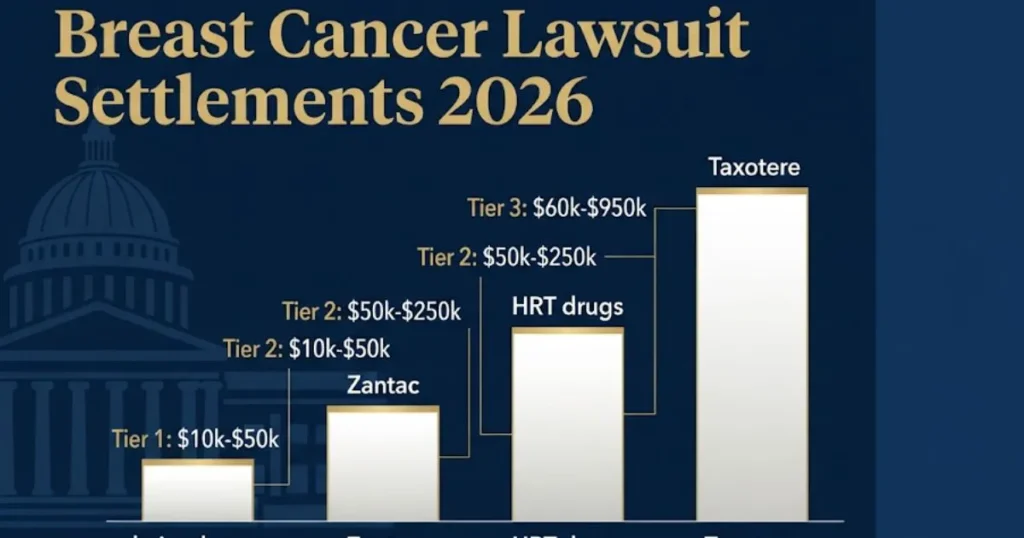
Breast cancer lawsuit settlements in 2026 are expected to range from $100,000 to over $1 million per plaintiff, depending on the specific product involved and the severity of the diagnosis. No global settlement has been finalized yet for most active cases, but the legal momentum is building.
Hair relaxer lawsuits consolidated under MDL 3060 in the Northern District of Illinois are the closest to potential settlement discussions. Judge Mary Rowland has been managing thousands of cases, and bellwether trial selections are shaping the path forward.
Zantac cases have had a rockier road. The Florida MDL saw many claims dismissed at the federal level in 2022, but state-level lawsuits continue in several jurisdictions. Settlement values for those cases remain uncertain.
| Lawsuit Category | Estimated Settlement Range (Per Plaintiff) | Status in 2026 |
|---|---|---|
| Hair Relaxer Cancer Cases | $150,000 to $1,500,000 | Bellwether trials pending |
| Zantac Breast Cancer Claims | $50,000 to $500,000 | Active in state courts |
| Hormone Therapy Drug Cases | $100,000 to $750,000 | Individual settlements ongoing |
| Taxotere Side Effects | $25,000 to $200,000 | Some settlements reached |
These numbers are projections based on comparable mass tort settlements. Every individual case is different. The amount you could receive depends on factors like your cancer stage, treatment costs, lost wages, and the strength of your evidence.
Key point: Settlements in 2026 are not guaranteed. But the trajectory of the litigation suggests that manufacturers are under increasing pressure to resolve these claims.
Who Qualifies for a Breast Cancer Lawsuit
You may qualify for a breast cancer lawsuit if you were diagnosed with breast cancer after regular exposure to a product or drug that is now the subject of litigation. The connection between your product use and your diagnosis is the core of any claim.
Different lawsuits have different eligibility criteria. But some factors are consistent across nearly all breast cancer product liability cases.
General qualifying factors include:
- A confirmed breast cancer diagnosis
- Documented use of the product or drug in question
- Use of the product for a significant period before diagnosis
- Diagnosis occurring within a timeframe consistent with the product’s known cancer risk
- Medical records supporting the connection
For hair relaxer cases specifically, many lawsuits focus on women who used chemical straightening products for four or more years before being diagnosed.
For Zantac claims, plaintiffs typically used the heartburn medication regularly for at least one year before their cancer diagnosis.
Think of it like connecting dots on a map. You need to show that you used the product, that the product is linked to cancer, and that your cancer appeared after meaningful exposure. The stronger those connections are, the stronger your case becomes.
Not every breast cancer diagnosis leads to a valid lawsuit. But if the timeline and product use align, you may have a claim worth pursuing.
Key Takeaway: Breast cancer side effects lawsuit attorneys are actively pursuing cases across multiple product categories in 2026, with potential settlements ranging from $50,000 to over $1 million depending on the product and diagnosis severity.
Breast Cancer Drug Side Effects Lawsuit
A breast cancer drug side effects lawsuit targets pharmaceutical companies that manufactured or marketed drugs linked to breast cancer as a side effect. These are separate from lawsuits about breast cancer treatment drugs that caused other harmful side effects.
The distinction matters. Some lawsuits involve drugs that were prescribed to treat a completely different condition but ended up causing breast cancer. Others involve cancer treatment drugs that caused permanent damage beyond what patients were warned about.
Drugs currently facing breast cancer-related lawsuits:
- Zantac (ranitidine): Contained NDMA, a probable human carcinogen, which formed during storage
- Hormone replacement therapy drugs (Premarin, Prempro): Studies linked long-term use to elevated breast cancer risk
- Taxotere (docetaxel): A breast cancer treatment drug that caused permanent hair loss without adequate warning
- Certain oral contraceptives: Some formulations have been linked to slightly increased breast cancer risk
The science behind these cases often involves years of research. The National Toxicology Program and the International Agency for Research on Cancer have classified several of these chemicals as carcinogenic or probably carcinogenic to humans.
Drug companies have a legal obligation to warn patients about known risks. When they fail to do that, or when they hide evidence of danger, they open themselves up to massive liability.
If you took any of these drugs before your breast cancer diagnosis, your exposure history could form the basis of a lawsuit.
How to File a Breast Cancer Side Effects Lawsuit
Filing a breast cancer side effects lawsuit starts with contacting a qualified attorney who handles pharmaceutical or product liability cancer claims. The process is more structured than most people expect, and your attorney will guide each step.
Here is a simplified breakdown of the filing process:
| Step | What Happens | Typical Timeframe |
|---|---|---|
| Step 1: Free Case Review | Attorney evaluates your diagnosis and product history | 1 to 2 weeks |
| Step 2: Medical Record Collection | Attorney gathers your cancer treatment records | 2 to 8 weeks |
| Step 3: Expert Review | Medical experts review your case for causation | 4 to 12 weeks |
| Step 4: Filing the Complaint | Your lawsuit is formally filed in court | 1 to 2 weeks after review |
| Step 5: Discovery Phase | Both sides exchange evidence | 6 to 18 months |
| Step 6: Settlement or Trial | Case resolves through negotiation or courtroom verdict | Varies widely |
You do not need to have every document ready when you first reach out. A good attorney will tell you exactly what they need and help you obtain it.
Three things to gather before your first call:
- Your breast cancer diagnosis records (pathology reports, biopsy results)
- A list of products or medications you used regularly before diagnosis
- Any purchase receipts or pharmacy records showing your history with the product
The initial consultation is almost always free. Attorneys take these cases on contingency, so there is no billing clock ticking while they evaluate whether you have a valid claim.
Breast Cancer Lawsuit Compensation Amounts
Breast cancer lawsuit compensation amounts vary significantly based on the type of case, the severity of the cancer, and the financial losses the plaintiff suffered. There is no single fixed number, but historical mass tort settlements offer a useful reference point.
Compensation in these cases typically covers several categories of damages.
Economic damages include:
- Past and future medical bills (surgery, chemotherapy, radiation, medications)
- Lost wages and reduced earning capacity
- Cost of home care or assistance during treatment
- Travel expenses for medical appointments
Non-economic damages include:
- Physical pain and suffering
- Emotional distress and mental anguish
- Loss of enjoyment of life
- Disfigurement or permanent physical changes
Potential punitive damages: If a manufacturer knew about cancer risks and deliberately concealed them, courts can award punitive damages on top of compensatory damages. These are designed to punish the company and deter similar behavior.
| Damage Category | Typical Range |
|---|---|
| Medical Expenses | $50,000 to $500,000+ |
| Lost Income | $30,000 to $300,000 |
| Pain and Suffering | $50,000 to $750,000 |
| Punitive Damages | $0 to $2,000,000+ (rare but possible) |
Think of compensation like layers on a cake. Each layer represents a different type of harm. The more layers you can document, the higher the total value of your claim.
Wrongful death cases, where breast cancer caused by a product led to a patient’s death, tend to carry the highest compensation values.
Key Takeaway: Compensation in breast cancer lawsuits can reach six or seven figures when medical costs, lost income, and pain and suffering are combined, especially if the manufacturer acted with reckless disregard for patient safety.
Hair Relaxer Breast Cancer Lawsuit Attorney
A hair relaxer breast cancer lawsuit attorney represents women who developed breast cancer after long-term use of chemical hair straightening and relaxer products. This is one of the largest active mass tort cases in the United States heading into 2026.
The litigation traces back to a landmark October 2022 study published by the National Institutes of Health. That study found that women who used chemical hair straightening products more than four times per year had more than twice the risk of developing uterine cancer. Follow-up research showed elevated breast cancer risks too.
Key details about the hair relaxer lawsuit:
- MDL Number: 3060
- Court: U.S. District Court, Northern District of Illinois
- Judge: Mary Rowland
- Number of Cases: Over 9,200 pending as of early 2025
- Defendants: L’Oreal, Revlon, Softsheen-Carson, Strength of Nature, Godrej, Dabur, and others
- Harmful Chemicals: Formaldehyde, phthalates, parabens, and other endocrine-disrupting compounds
These products were disproportionately marketed to Black women. That fact adds a layer of social justice concern to an already serious public health issue.
If you used chemical hair relaxers or straighteners for several years and were later diagnosed with breast cancer, an attorney specializing in this MDL can evaluate whether your case fits the current litigation criteria.
The bellwether trial process is expected to begin in 2026, which will set the tone for potential global settlement discussions.
Zantac Breast Cancer Lawsuit Attorney
A Zantac breast cancer lawsuit attorney handles claims from people who took Zantac or generic ranitidine and were later diagnosed with breast cancer. The core allegation is that the drug broke down into NDMA, a chemical classified as a probable human carcinogen.
The Zantac story has taken dramatic turns. The FDA requested that all ranitidine products be pulled from the market in April 2020 after testing confirmed unacceptable NDMA levels that increased over time, especially when stored at higher temperatures.
At the federal level, MDL 2924 in the Southern District of Florida saw Judge Robin Rosenberg exclude plaintiffs’ expert witnesses in late 2022, which effectively gutted the federal cases. But that was not the end.
State-level Zantac lawsuits are still alive and active in:
- California
- Illinois
- Pennsylvania
- Delaware
- Several other jurisdictions
A California jury in 2024 heard one of the first Zantac cancer trials, and while that specific case involved a different cancer type, the trial set an important procedural precedent for breast cancer claims moving forward.
| Zantac Lawsuit Detail | Information |
|---|---|
| Product | Zantac / generic ranitidine |
| Harmful Chemical | NDMA (N-Nitrosodimethylamine) |
| Federal MDL Status | Most federal claims dismissed |
| State Court Status | Active in multiple states |
| Key Year | FDA withdrawal in April 2020 |
| Cancer Types Alleged | Breast, bladder, stomach, liver, others |
If you took Zantac regularly before the recall and later received a breast cancer diagnosis, a Zantac-specific attorney can determine which state courts offer the best chance for your claim.
Breast Cancer Lawsuit Eligibility Requirements
Breast cancer lawsuit eligibility requirements depend on the specific product or drug at issue, but all cases share a set of core criteria that attorneys evaluate. Meeting these requirements is the first step toward building a viable claim.
Core eligibility requirements across most breast cancer product lawsuits:
- You must have a confirmed breast cancer diagnosis from a licensed medical professional
- You must have documented exposure to the product in question (purchase records, pharmacy logs, personal testimony)
- Your product use must have occurred before your breast cancer diagnosis
- The product must be one currently subject to active litigation or with established scientific links to cancer
- Your case must fall within the statute of limitations for your state
Some lawsuits have additional specific requirements. For hair relaxer cases, many attorneys look for at least two to four years of regular product use. For Zantac cases, regular use for at least one year is a common threshold.
Quick Eligibility Checklist:
- Diagnosed with breast cancer? Yes/No
- Used a product currently being sued? Yes/No
- Used the product for a meaningful period before diagnosis? Yes/No
- Have medical records and some form of product use documentation? Yes/No
- Filing within your state’s legal deadline? Yes/No
If you answered yes to all five, you likely meet the basic threshold for an attorney to take your case. The attorney’s job from there is to evaluate whether the medical and scientific evidence supports a strong causal link.
Key Takeaway: Eligibility for a breast cancer lawsuit comes down to three pillars: a confirmed diagnosis, documented product exposure, and a timeline that connects the two within your state’s filing deadline.
Breast Cancer Medication Lawsuit
Breast cancer medication lawsuits involve two distinct categories of claims that are often confused. The first targets drugs that caused breast cancer as an unintended side effect. The second targets breast cancer treatment drugs that caused severe side effects patients were never warned about.
Category 1: Drugs that allegedly caused breast cancer
- Hormone replacement therapy (HRT) drugs like Premarin and Prempro
- Ranitidine-based heartburn medications like Zantac
- Certain hormonal contraceptives
The Women’s Health Initiative study, published in 2002, found that combination HRT drugs increased breast cancer risk by approximately 26% in postmenopausal women. Lawsuits followed, and Wyeth (now part of Pfizer) paid billions in settlements.
Category 2: Breast cancer treatment drugs with undisclosed side effects
- Taxotere (docetaxel): Caused permanent hair loss (alopecia) in many patients. Manufacturer Sanofi knew about this risk from European labeling but did not include it on U.S. labels for years.
- Ibrance (palbociclib): Some patients reported severe adverse reactions not adequately disclosed.
| Medication | Type of Claim | Manufacturer | Key Allegation |
|---|---|---|---|
| Premarin/Prempro | Caused breast cancer | Pfizer (Wyeth) | HRT drugs increased cancer risk |
| Zantac | Caused breast cancer | Sanofi, GSK, others | NDMA contamination |
| Taxotere | Treatment side effects | Sanofi | Permanent hair loss not warned |
| Certain contraceptives | Caused breast cancer | Various | Hormonal cancer link |
If you took any of these medications and experienced adverse outcomes, an attorney can assess whether your situation fits an existing lawsuit or justifies a new individual claim.
Breast Cancer Class Action Lawsuit 2026
A breast cancer class action lawsuit in 2026 is not technically what most people think it is. The majority of breast cancer product liability cases are actually handled as multidistrict litigation (MDL) or as individual lawsuits, not traditional class actions.
Here is why that distinction matters to you.
In a class action, everyone gets the same settlement amount, and one representative plaintiff speaks for the entire group. In an MDL, cases are consolidated for pretrial proceedings (like evidence gathering and expert testimony), but each plaintiff retains their own individual case. That means your specific damages, your medical history, and your product usage are all considered individually.
This is a better deal for most breast cancer plaintiffs. Someone with Stage 3 cancer who spent $400,000 on treatment should not receive the same payout as someone with a Stage 1 diagnosis and $30,000 in bills.
What is happening in 2026:
- Hair relaxer cases remain consolidated in MDL 3060 with bellwether trial preparations underway
- Zantac cases continue at the state level after federal MDL setbacks
- HRT drug cases are largely resolved but some individual claims remain open
- Taxotere cases are winding down with most settlements already paid
The confusion between class actions and MDLs is common. Just remember: in most breast cancer lawsuits, your case is yours. You are not lumped into a generic group payout.
Breast Cancer Lawsuit Statute of Limitations
The breast cancer lawsuit statute of limitations is the legal deadline by which you must file your claim, and missing it can permanently bar you from receiving any compensation. Every state sets its own deadline, and they vary significantly.
For most personal injury and product liability cases, the statute of limitations ranges from one to six years depending on the state. But the clock does not always start on the date you used the product. In many states, it starts on the date of diagnosis or the date you discovered (or should have discovered) the connection between the product and your cancer.
This is called the discovery rule, and it is a critical concept in breast cancer lawsuits. If a product’s cancer risk was not publicly known until a study was published, the clock may not start until that study date.
| State | Statute of Limitations (Personal Injury) | Discovery Rule? |
|---|---|---|
| California | 2 years | Yes |
| Texas | 2 years | Yes |
| New York | 3 years | Yes |
| Florida | 2 years (changed from 4 in 2024) | Yes |
| Illinois | 2 years | Yes |
| Pennsylvania | 2 years | Yes |
Do not assume you have run out of time. Many people file successfully years after their diagnosis because the discovery rule extended their deadline. An attorney can analyze your specific dates and determine whether your claim is still viable.
Every month you wait is a month closer to a potential cutoff. That is why early consultation matters.
Key Takeaway: Statutes of limitations for breast cancer lawsuits typically range from one to six years, but the discovery rule can extend your filing window if the cancer link was not publicly known at the time of your diagnosis.
Breast Cancer Lawsuit Evidence Needed
The evidence needed for a breast cancer lawsuit includes medical documentation of your diagnosis, proof of product exposure, and expert analysis connecting the two. Building a strong case is about assembling the right paperwork and testimony.
Essential evidence categories:
Medical Evidence:
- Pathology reports confirming your breast cancer diagnosis
- Biopsy results and imaging records (mammograms, MRIs, CT scans)
- Treatment records (surgery, chemotherapy, radiation therapy notes)
- Your oncologist’s notes about potential causes or risk factors
- Medical bills showing the financial impact of your cancer
Product Exposure Evidence:
- Purchase receipts for the product (store or online)
- Pharmacy records showing prescription fills for the drug
- Photos of products you used (packaging, labels)
- Personal testimony or affidavits about your usage frequency and duration
- Testimony from family members or friends who witnessed your product use
Expert Evidence:
- Expert medical opinions linking the product to your cancer type
- Toxicology reports about the product’s carcinogenic properties
- Epidemiological studies showing a statistical link between the product and cancer
Think of your case like a three-legged stool. Medical evidence, product evidence, and expert evidence each form one leg. If any leg is missing, the stool falls over.
You do not need to have every piece of evidence in hand before contacting an attorney. Most mass tort firms have in-house teams that help plaintiffs track down records and build their case files.
Start with what you have. Your attorney can fill in the gaps.
Best Attorneys for Breast Cancer Lawsuits
The best attorneys for breast cancer lawsuits are experienced mass tort and product liability lawyers who have a track record of handling pharmaceutical cancer cases. Not every personal injury lawyer is equipped for these complex claims.
What to look for when choosing an attorney:
- Mass tort experience: Have they handled MDL cases before?
- Specific case knowledge: Do they have existing breast cancer product cases in their portfolio?
- Resources: Can they afford to advance costs for expert witnesses, medical reviews, and court fees?
- Trial willingness: Are they prepared to take your case to trial, or do they only settle?
- Communication: Will they keep you updated, or will you never hear from them after signing?
- Contingency fees: What percentage do they take, and are there any hidden costs?
Red flags to avoid:
- Attorneys who guarantee a specific settlement amount before reviewing your case
- Firms that pressure you to sign immediately without explaining the process
- Lawyers with no mass tort or product liability experience
- Firms that refuse to answer questions about their fee structure
| Criteria | What to Ask |
|---|---|
| Experience | “How many breast cancer product cases have you handled?” |
| Resources | “Do you advance all case costs?” |
| Fees | “What is your contingency percentage?” |
| Communication | “How often will I get case updates?” |
| Trial Record | “Have you taken a similar case to trial?” |
The attorney-client relationship in these cases can last years. Picking the right firm at the beginning saves you frustration, delays, and potentially lost compensation down the road.
Breast Cancer Lawsuit MDL Updates 2026
Breast cancer lawsuit MDL updates in 2026 center primarily on the hair relaxer litigation (MDL 3060) in the Northern District of Illinois, which is the largest active federal consolidation involving breast cancer claims tied to consumer products.
Hair Relaxer MDL 3060 Update:
Judge Mary Rowland has been overseeing this MDL since it was established in February 2023. As of early 2025, over 9,200 cases were pending. The court has been working through Daubert hearings to determine which expert witnesses can testify, and bellwether trial selections are expected to take shape in 2026.
Bellwether trials are test cases. They do not bind other plaintiffs, but they show both sides what a jury thinks. A strong plaintiff verdict in a bellwether can push defendants toward global settlement. A defense win can weaken settlement leverage.
Zantac MDL 2924 Update:
The federal Zantac MDL in Florida is largely dormant after Judge Rosenberg’s 2022 ruling excluded plaintiffs’ expert causation testimony. However, the case is not dead. State-level claims continue to move forward, and some state courts have been more receptive to the scientific evidence linking ranitidine to cancer.
| MDL | Court | Judge | Cases Pending | 2026 Outlook |
|---|---|---|---|---|
| Hair Relaxer (MDL 3060) | N.D. Illinois | Mary Rowland | 9,200+ | Bellwether trial prep |
| Zantac (MDL 2924) | S.D. Florida | Robin Rosenberg | Minimal federal activity | State courts active |
What to watch for in 2026: Bellwether trial dates, any new scientific studies on hair relaxer chemicals, and whether defendants make settlement offers before trial begins.
Key Takeaway: The hair relaxer MDL is the most active breast cancer lawsuit consolidation heading into 2026, with bellwether trials expected to set the stage for potential mass settlement discussions.
Breast Cancer Lawsuit Timeline 2026
The breast cancer lawsuit timeline in 2026 shows a litigation process that has been building for years and is now reaching critical stages across several product categories. Here is where things stand and what to expect.
Hair Relaxer Lawsuit Timeline:
| Date | Event |
|---|---|
| October 2022 | NIH study links chemical hair straighteners to cancer |
| February 2023 | MDL 3060 established in Northern District of Illinois |
| 2023 to 2024 | Thousands of cases filed; discovery and motions proceed |
| 2025 | Daubert hearings on expert testimony |
| 2026 (Expected) | Bellwether trial selections and possible first trial |
| 2026 to 2027 (Projected) | Settlement negotiations if bellwether favors plaintiffs |
Zantac Lawsuit Timeline:
| Date | Event |
|---|---|
| September 2019 | FDA announces NDMA found in ranitidine |
| April 2020 | FDA requests all ranitidine products withdrawn |
| 2020 to 2022 | Federal MDL proceedings in Florida |
| December 2022 | Judge excludes plaintiffs’ experts; federal cases stall |
| 2023 to 2025 | State-level lawsuits continue |
| 2026 | State court trials expected in California and Illinois |
General individual lawsuit timeline:
Most breast cancer product lawsuits, from filing to resolution, take two to five years. If your case is part of an active MDL, the timeline depends on the pace of that MDL. Individual cases filed in state courts may resolve faster or slower depending on court congestion and the complexity of your claim.
Patience is part of the process. But 2026 is shaping up to be the year where years of preparation start turning into real courtroom action.
What Products Cause Breast Cancer Lawsuits
The products causing breast cancer lawsuits in 2026 span several industries, from pharmaceuticals to personal care to over-the-counter medications. Each product has its own body of scientific evidence and its own litigation track.
Products currently linked to breast cancer lawsuits:
- Chemical hair relaxers and straighteners: Brands like Dark and Lovely, Just For Me, Optimum Salon Haircare, and others containing formaldehyde, phthalates, and parabens
- Zantac and generic ranitidine: Over-the-counter and prescription heartburn medication contaminated with NDMA
- Hormone replacement therapy drugs: Premarin, Prempro, and combination estrogen-progestin therapies
- Taxotere (docetaxel): Breast cancer treatment drug with undisclosed permanent side effects
- Certain hormonal contraceptives: Some oral contraceptive formulations with elevated cancer risk profiles
- Talcum powder products (emerging): While primarily linked to ovarian cancer, some claims allege breast cancer connections
- PFAS-contaminated products (emerging): “Forever chemicals” found in food packaging, cookware, and water supplies are under increasing scientific scrutiny for cancer links
| Product Category | Key Chemical/Compound | Primary Lawsuit Type |
|---|---|---|
| Hair Relaxers | Formaldehyde, phthalates | MDL 3060 |
| Zantac | NDMA | State court lawsuits |
| HRT Drugs | Estrogen, progestin | Individual claims |
| Taxotere | Docetaxel | Individual/mass tort |
| Talcum Powder | Talc (asbestos contamination) | MDL and state cases |
| PFAS Products | PFOS, PFOA | Emerging litigation |
The list is not static. As new research emerges and previously unknown risks come to light, additional products may become the subjects of future lawsuits. Staying informed about product recalls and FDA safety communications is one way to protect yourself.
Individual vs Class Action Breast Cancer Lawsuit
An individual breast cancer lawsuit means you file your own case and your specific damages are evaluated separately. A class action pools all plaintiffs together under one claim with a shared outcome. Most breast cancer product lawsuits in 2026 are handled individually, even when they are part of an MDL.
Here is the practical difference:
| Feature | Individual Lawsuit | Class Action | MDL |
|---|---|---|---|
| Your case is unique | Yes | No | Yes |
| Settlement based on your damages | Yes | Same for everyone | Yes |
| You choose your attorney | Yes | Lead counsel chosen for group | Yes |
| You can opt out | N/A | Yes | Not typically |
| Pretrial work is shared | No | Yes | Yes |
| Trial is separate | Yes | One trial for all | Bellwether trials |
Why most breast cancer cases are individual, not class actions:
Breast cancer diagnoses vary enormously. One person might have Stage 1 ductal carcinoma in situ and undergo a lumpectomy. Another might have Stage 4 metastatic breast cancer requiring years of aggressive treatment. Lumping these two people into the same class with the same payout would be deeply unfair.
MDL proceedings give plaintiffs the best of both worlds. Pretrial work like evidence gathering and expert testimony is shared across all cases, which saves time and money. But each plaintiff retains their own case with their own damages calculation.
If your attorney tells you they are filing your case as part of an MDL, that is typically the best approach for breast cancer product claims. You get the efficiency of group litigation without sacrificing the individual value of your specific case.
Key Takeaway: Most breast cancer product lawsuits are filed as individual cases within MDL proceedings, giving plaintiffs the benefit of shared pretrial resources while preserving their right to individual compensation based on their own medical history and damages.
Frequently Asked Questions
How much can I get from a breast cancer side effects lawsuit in 2026?
Settlement amounts vary from $50,000 to over $1 million depending on your cancer stage, treatment costs, and the specific product involved.
Hair relaxer cases are projected to have higher average payouts due to the large number of pending claims and strong scientific evidence.
No global settlement has been announced yet, so these figures are based on comparable mass tort outcomes.
What is the deadline to file a breast cancer lawsuit?
The deadline depends on your state’s statute of limitations, which typically ranges from one to six years from the date of diagnosis or discovery.
Many states apply a “discovery rule” that starts the clock when you first learned the product could have caused your cancer.
Contact an attorney as soon as possible to confirm your specific deadline.
Do I need to pay an attorney upfront for a breast cancer lawsuit?
No. Nearly all breast cancer side effects lawsuit attorneys work on a contingency fee basis.
You pay nothing upfront and nothing out of pocket during the case.
The attorney takes a percentage, usually 33% to 40%, only if you receive a settlement or verdict.
Which drugs and products are linked to breast cancer lawsuits?
The main products include chemical hair relaxers, Zantac (ranitidine), hormone replacement therapy drugs like Premarin and Prempro, and the chemotherapy drug Taxotere.
Emerging litigation involves PFAS chemicals and certain talcum powder products.
Each product has a separate body of scientific evidence and its own legal track.
How long does a breast cancer lawsuit take from filing to settlement?
Most breast cancer lawsuits take two to five years from filing to resolution.
Cases within an active MDL may take longer because bellwether trials must occur before global settlement talks begin.
Individual state court cases sometimes resolve faster, depending on the jurisdiction and court schedule.
Breast cancer side effects lawsuits in 2026 represent real opportunities for people harmed by dangerous products. The science is strong. The legal groundwork has been laid. And attorneys are actively fighting for compensation.
If you believe a product contributed to your breast cancer diagnosis, now is the time to act. Check your eligibility, gather your medical records, and speak with an attorney who handles these specific cases.
Waiting costs you nothing in the short term but could cost you everything if the statute of limitations runs out.







