

The MB2 Dental lawsuit is heating up in 2026, with patients across the country seeking compensation for alleged overcharging, unnecessary procedures, and insurance fraud. If you were treated at an MB2 Dental affiliated practice and left feeling like something wasn’t right, you’re not alone.
This article breaks down every angle of the case. You’ll learn what the allegations actually involve, how much money people could receive, who qualifies, and exactly how to file.
MB2 Dental operates through hundreds of dental offices in over 30 states. That means this case potentially affects thousands of patients. Some estimates suggest individual payouts could range from a few hundred to several thousand dollars, depending on the type and extent of unnecessary treatment received.
Here is everything you need to know, organized by the questions real people are asking right now.
MB2 Dental Lawsuit 2026: What You Need to Know
The MB2 Dental lawsuit in 2026 refers to a growing wave of legal claims against MB2 Dental Solutions, a large dental service organization accused of pressuring affiliated dentists to perform unnecessary treatments and overcharge patients and insurance companies. These lawsuits include both individual claims and efforts toward class action certification.
MB2 Dental Solutions, headquartered in Carrollton, Texas, was founded by Dr. Hitesh Patel. The company operates as a DSO, which means it handles the business side of dental practices while dentists focus on clinical care. At least, that’s how it’s supposed to work.
The problem, according to lawsuits and former employees, is that MB2’s corporate structure allegedly pushed dentists to meet aggressive revenue targets. That pressure reportedly led to patients receiving treatment they didn’t need.
| Key Fact | Detail |
|---|---|
| Company | MB2 Dental Solutions |
| Headquarters | Carrollton, Texas |
| Founded By | Dr. Hitesh Patel |
| Number of Offices | 400+ across 30+ states |
| Main Allegations | Unnecessary procedures, overcharging, insurance fraud |
| Lawsuit Type | Individual claims and potential class action |
By 2026, legal activity has expanded beyond Texas. Patients in multiple states have come forward with similar stories of questionable treatment plans, surprise bills, and procedures they believe were driven by corporate profit motives rather than genuine dental needs.
MB2 Dental Lawsuit Update for This Year
As of 2026, the MB2 Dental lawsuit has entered a critical phase. Multiple law firms are actively investigating and filing claims on behalf of patients. New plaintiffs continue to join ongoing cases, and the scope of the litigation keeps growing.
Several key developments have shaped the legal picture this year:
- Additional states have seen new filings as patients become aware of the allegations
- Law firms specializing in healthcare fraud have expanded their investigation into MB2 Dental’s billing practices
- Whistleblower complaints from former MB2 dentists and hygienists have added weight to the fraud allegations
- State dental boards in at least three states have opened inquiries related to patient complaints tied to MB2 affiliated practices
The case is still in its pre-trial stages for most filings. No global settlement has been announced yet, but legal experts following the case believe 2026 could be the year significant settlement talks begin.
Think of it like a snowball rolling downhill. Each new complaint, each whistleblower statement, each state investigation adds mass and momentum. The legal pressure on MB2 Dental is heavier now than at any previous point.
Patients who believe they were harmed should pay close attention this year. Filing deadlines vary by state, and waiting too long could mean losing your right to seek compensation.
Is There an MB2 Dental Class Action Lawsuit?
There is not yet a certified class action lawsuit against MB2 Dental as of early 2026, but several lawsuits are working toward class action status. Multiple law firms have filed complaints that seek to represent broad groups of affected patients.
A class action requires a judge to certify that enough people share similar claims. For MB2 Dental, that means proving a common pattern: corporate interference in dental care decisions that led to unnecessary treatment for large numbers of patients across multiple locations.
The challenge here is that dental treatment is inherently individual. What counts as “unnecessary” for one patient might be debatable for another. Defendants in dental fraud cases often argue each case must be evaluated separately.
Still, the sheer volume of complaints paints a pattern. When dozens of former dentists and hundreds of patients describe the same type of pressure and the same kinds of unnecessary procedures, courts tend to take notice.
- Individual lawsuits are active in several states
- Some filings explicitly seek class certification
- Multi-district litigation (MDL) consolidation has been discussed among legal teams
- Even without formal class action status, mass tort claims allow many patients to pursue compensation
Key Takeaway: The MB2 Dental case hasn’t achieved class action certification yet, but the legal infrastructure is building rapidly and 2026 may see a major shift toward consolidated proceedings.
MB2 Dental Settlement: What Has Been Offered?
No public settlement has been reached in the MB2 Dental lawsuit as of early 2026. The case remains in active litigation, and MB2 Dental Solutions has not announced any settlement fund or compensation program for affected patients.
That said, settlement discussions typically happen behind closed doors before any public announcement. Legal observers expect that as more evidence mounts and more plaintiffs join the case, MB2 Dental could face growing pressure to negotiate.
Here’s what typically happens in similar DSO lawsuits:
| Settlement Phase | What Happens |
|---|---|
| Pre-filing investigation | Law firms gather complaints and evidence |
| Active litigation | Lawsuits filed, discovery begins |
| Settlement negotiations | Both sides discuss terms privately |
| Preliminary settlement | Proposed deal submitted to court for approval |
| Final settlement | Court approves, payments distributed |
| Current MB2 Status | Active litigation, no settlement yet |
In comparable dental fraud cases, settlements have ranged from the low millions to over $20 million, depending on the number of affected patients and the severity of the allegations.
For now, the smartest move for affected patients is to file their claims and document their experiences. When a settlement does arrive, having your claim already on file means you won’t be scrambling to meet a deadline.
MB2 Dental Lawsuit Payout: What to Expect
MB2 Dental lawsuit payouts will depend on the nature and severity of unnecessary treatment each patient received. Since no settlement has been finalized, payout figures are projections based on comparable dental fraud and healthcare fraud cases.
In similar cases involving dental service organizations, individual payouts have typically fallen into a tiered structure:
| Tier | Description | Estimated Payout Range |
|---|---|---|
| Tier 1 | Overcharged for routine services (cleanings, X-rays) | $200 to $1,000 |
| Tier 2 | Received unnecessary minor procedures (fillings, sealants) | $1,000 to $5,000 |
| Tier 3 | Received unnecessary major procedures (crowns, root canals, extractions) | $5,000 to $25,000 |
| Tier 4 | Suffered lasting harm from unnecessary treatment (nerve damage, infections, tooth loss) | $25,000 to $100,000+ |
These are estimates based on precedent, not confirmed MB2 figures. Your actual payout depends on your documentation, the type of treatment received, and whether you suffered ongoing harm.
Patients who kept records of their treatment plans, insurance bills, and any second opinions from other dentists will have the strongest claims. Even old receipts and insurance explanation of benefits (EOB) statements can serve as evidence.
How Much Can I Get from the MB2 Dental Lawsuit?
How much you can receive from the MB2 Dental lawsuit depends on three main factors: the type of unnecessary treatment you received, whether you suffered physical harm, and how well you can document your experience.
Most claimants in dental fraud cases receive between $500 and $10,000. Patients with serious complications from unnecessary procedures could see significantly more.
Here’s a practical breakdown:
- Overbilling only (you paid more than you should have for legitimate services): expect the lower end of the payout range
- Unnecessary procedures with no lasting harm (you got a filling or crown you didn’t need but recovered fine): mid-range compensation
- Unnecessary procedures that caused harm (infection, nerve damage, lost teeth, need for corrective surgery): higher payouts possible
- Children who received unnecessary treatment: these cases often receive greater attention from courts and may result in larger awards
Think of it like car insurance claims. A fender bender gets you a smaller check than a totaled vehicle. The more damage, the more documentation, and the clearer the evidence of wrongdoing, the bigger the potential payout.
Keep in mind that if this becomes a class action, administrative fees and legal costs will be deducted from the total settlement before payments reach individuals. That’s standard for any class action.
Key Takeaway: Individual payouts in the MB2 Dental case could range from a few hundred dollars for simple overbilling up to six figures for patients who suffered lasting physical harm from unnecessary procedures.
Who Qualifies for the MB2 Dental Lawsuit?
You may qualify for the MB2 Dental lawsuit if you received dental treatment at any practice affiliated with MB2 Dental Solutions and believe your treatment was unnecessary, improperly recommended, or excessively billed.
The core qualifying criteria, based on current filings, include:
- You received dental work at an MB2 Dental affiliated office
- You were charged for procedures you believe were unnecessary
- You were given a treatment plan that felt aggressive or rushed
- A second opinion from another dentist contradicted the original MB2 treatment plan
- You were billed for services not actually performed
- Your insurance was charged for procedures you didn’t authorize or understand
You don’t need to know for certain that your treatment was unnecessary. If you have a reasonable suspicion, law firms investigating the case will help determine whether your experience fits the pattern.
| Qualification Factor | Details |
|---|---|
| Treatment Location | Any MB2 Dental affiliated practice in 30+ states |
| Time Period | Treatment received within the applicable statute of limitations (varies by state, typically 2 to 6 years) |
| Type of Harm | Overcharging, unnecessary procedures, physical harm, insurance fraud |
| Documentation Needed | Treatment records, billing statements, insurance EOBs, second opinions |
Even if you’re unsure whether your specific dentist was part of the MB2 network, it’s worth checking. MB2 often operates through practices that keep their original names, making it hard for patients to know there’s a corporate parent company involved.
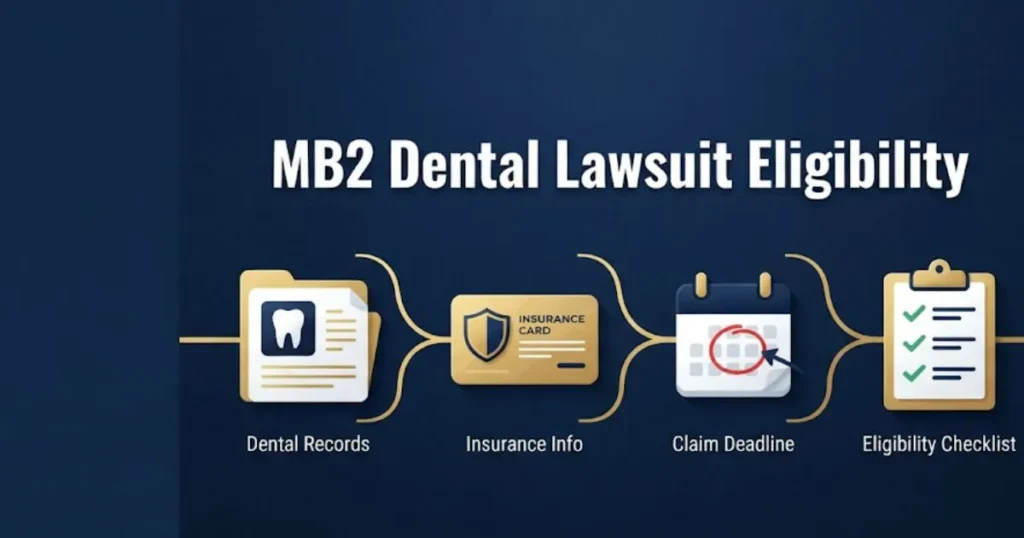
MB2 Dental Lawsuit Eligibility Requirements
Eligibility for the MB2 Dental lawsuit requires meeting a few specific conditions tied to where, when, and how you received dental treatment. The bar for initial eligibility is lower than many people expect.
Here are the primary eligibility requirements:
1. Treatment at an MB2 affiliated practice. MB2 Dental manages or owns practices across more than 30 states. Many of these practices do not use the MB2 name publicly, so you may not realize your dentist was part of the network.
2. Treatment within the statute of limitations. This varies by state. In Texas, the statute of limitations for medical malpractice is two years from the date of treatment or discovery of harm. Other states range from two to six years. Some states apply discovery rules, meaning the clock doesn’t start until you realized the treatment was unnecessary.
3. Evidence of unnecessary treatment or overbilling. You need some basis for your claim. Ideal evidence includes dental records, insurance statements, and second opinions. But even a detailed written account of your experience can get the process started.
4. No prior settlement or release. If you already settled a claim against the specific MB2 practice for the same treatment, you may be barred from filing again.
You do not need a lawyer to check your eligibility. Most firms handling this case offer free case evaluations.
MB2 Dental and Unnecessary Procedures
The heart of the MB2 Dental lawsuit is the allegation that the company pressured dentists to recommend and perform unnecessary procedures on patients who didn’t need them. Former MB2 dentists have described a corporate culture where revenue targets took priority over patient care.
The types of unnecessary procedures most commonly alleged include:
- Dental crowns placed on teeth that could have been treated with simpler fillings or no treatment at all
- Root canals performed on teeth without infection or irreversible damage
- Tooth extractions done prematurely to justify expensive implant or bridge work
- Excessive X-rays ordered at every visit regardless of clinical need
- Deep cleanings (scaling and root planing) billed for patients with healthy gums
- Sealants and fluoride treatments pushed on adult patients who didn’t need them
In one pattern described in complaint filings, new patients would receive a treatment plan totaling thousands of dollars after a single visit. When those same patients sought a second opinion, the other dentist often found that most of the recommended work was unnecessary.
This isn’t a new playbook. Similar allegations have been leveled against other large dental chains, including Aspen Dental, which settled related claims in prior years. The difference with MB2 is the alleged scale and the level of corporate direction involved.
Key Takeaway: The MB2 Dental lawsuit centers on a specific pattern where corporate revenue targets allegedly drove dentists to recommend and perform procedures that patients did not medically need.
MB2 Dental Fraud Allegations Explained
The fraud allegations against MB2 Dental go beyond simply performing unnecessary work. Plaintiffs and whistleblowers allege a systematic scheme that includes misrepresentation to patients, false billing, and corporate manipulation of clinical decision-making.
Here’s what the fraud allegations actually involve:
| Allegation Type | What It Means |
|---|---|
| Unnecessary treatment | Performing procedures patients didn’t need to generate revenue |
| Upcoding | Billing insurance for more expensive procedures than what was performed |
| Unbundling | Breaking a single procedure into multiple billing codes to increase charges |
| Phantom billing | Charging for services that were never actually provided |
| Informed consent violations | Performing procedures without fully explaining risks or alternatives |
| Corporate practice of dentistry | Non-dentist executives making clinical care decisions, which is illegal in most states |
The “corporate practice of dentistry” angle is particularly important. Most states have laws that prohibit non-dentist business owners from directing clinical treatment decisions. If MB2’s corporate leadership set production quotas or required specific treatment recommendations, that could violate these laws.
Whistleblower (qui tam) complaints filed under the False Claims Act could also expose MB2 to federal liability if government-funded insurance programs like Medicaid were billed for fraudulent services. The financial penalties under the False Claims Act can be enormous, often tripling the amount of the false claims submitted.
MB2 Dental Insurance Fraud Claims
MB2 Dental faces allegations of insurance fraud that extend to both private dental insurance carriers and government-funded programs. The claims suggest that the company’s billing practices were designed to maximize revenue from insurance reimbursements, even when the underlying treatment was unnecessary or misrepresented.
Insurance fraud in the dental context typically takes a few forms:
- Billing for procedures not performed: charging an insurer for a service the patient never received
- Upcoding: submitting a claim for a more expensive version of the procedure that was actually done (e.g., billing a three-surface filling as a crown)
- Pre-authorization manipulation: documenting a patient’s condition as worse than it actually is to get insurance approval for expensive procedures
- Duplicate billing: submitting the same claim more than once
For patients, this often shows up as confusing EOB statements. You might notice your insurance was billed for a procedure you don’t remember getting. Or the description on the insurance statement doesn’t match what happened in the chair.
If MB2 Dental submitted false claims to Medicaid or other government insurance programs, the company faces potential prosecution under federal fraud statutes. The penalties for healthcare fraud involving government funds include per-claim fines of up to $11,000 per violation plus treble damages.
Patients who noticed billing irregularities should review their insurance statements carefully. Those records could be key evidence in the lawsuit.
MB2 Dental Overcharging Patients
MB2 Dental is accused of systematically overcharging patients through inflated fees, unnecessary add-on treatments, and aggressive billing practices. For many patients, the first sign of trouble was a bill that seemed wildly out of proportion to the work performed.
The overcharging allegedly happened in several ways:
- Inflated treatment plans: new patients presented with treatment plans totaling $3,000 to $10,000 or more after a single visit
- Charging for premium materials when standard materials were used
- Adding unnecessary procedures to the treatment plan to increase the total bill
- Pressuring patients to agree to treatment on the same day before they could get a second opinion
- Charging out-of-network rates at practices that patients believed were in-network
The pattern described in multiple complaints goes like this: a patient visits an MB2 affiliated office for a routine cleaning. They leave with a treatment plan recommending multiple crowns, fillings, or even root canals. When they visit an independent dentist for a second opinion, most of the recommended work is deemed unnecessary.
| Overcharging Red Flag | What It Looks Like |
|---|---|
| Surprise treatment plan | Massive bill after a routine visit |
| Pressure to treat same day | Staff pushes you to agree immediately |
| No second opinion encouraged | Dentist discourages seeking other opinions |
| Unclear billing codes | You can’t understand what you’re being charged for |
| Insurance discrepancies | EOB shows charges for procedures you don’t recall |
If you experienced any of these red flags at an MB2 affiliated practice, your experience may support a claim.
Key Takeaway: Overcharging patients through inflated treatment plans, upcoded billing, and same-day pressure tactics is a central allegation in the MB2 Dental lawsuit, and patients who experienced these patterns should review their records immediately.
How to File an MB2 Dental Lawsuit
Filing an MB2 Dental lawsuit starts with gathering your dental records and contacting a law firm that handles healthcare fraud or dental malpractice cases. The process is more straightforward than most people assume.
Here’s a step-by-step breakdown:
Step 1: Gather your records.
Collect everything you have related to your MB2 dental treatment. This includes:
- Treatment plans
- Receipts and payment records
- Insurance EOB statements
- X-rays or other imaging
- Any written communications with the dental office
Step 2: Get a second opinion.
If you haven’t already, visit an independent dentist. Ask them to review your records and give an honest assessment of whether the MB2 treatment was necessary. A written second opinion is powerful evidence.
Step 3: Contact a law firm.
Search for firms handling the MB2 Dental lawsuit. Most offer free case evaluations. You can submit your information through their intake process, and an attorney will review your case.
Step 4: File your claim.
Your attorney will prepare and file the legal paperwork. In most cases, you won’t need to pay anything upfront. Dental fraud attorneys typically work on contingency, meaning they only get paid if you receive compensation.
| Filing Step | Action Required |
|---|---|
| Step 1 | Gather dental records, bills, and EOB statements |
| Step 2 | Obtain a second opinion from an independent dentist |
| Step 3 | Contact a law firm for a free case evaluation |
| Step 4 | Attorney files the claim on your behalf |
| Cost to You | Typically $0 upfront (contingency fee basis) |
You don’t need to have every single document to start the process. Attorneys can help you obtain records through legal channels.
MB2 Dental Lawsuit Deadline: When to Act
The deadline to file an MB2 Dental lawsuit depends on your state’s statute of limitations for medical malpractice, fraud, or consumer protection claims. Missing this deadline means losing your right to sue, no matter how strong your case is.
Statutes of limitations vary significantly by state:
| State | Malpractice Statute | Fraud Statute |
|---|---|---|
| Texas | 2 years | 4 years |
| Florida | 2 years | 4 years |
| California | 1 year (3 years from injury) | 3 years |
| New York | 2.5 years | 6 years |
| Pennsylvania | 2 years | 2 years |
| Illinois | 2 years | 5 years |
| Ohio | 1 year | 4 years |
| Georgia | 2 years | 4 years |
Some states apply a “discovery rule.” This means the clock doesn’t start ticking until you discovered (or should have discovered) that the treatment was unnecessary. If you only recently learned that your MB2 procedures were questionable, you may still have time even if the treatment happened years ago.
Here’s the bottom line: do not wait. Even if you think you might be outside the window, talk to a lawyer. Discovery rules, tolling provisions, and fraud-specific statutes often extend deadlines beyond what people expect.
2026 is a critical year. Many patients who received treatment from MB2 practices during the company’s rapid expansion period (2018 to 2023) are approaching or hitting their filing deadlines right now.
MB2 Dental and Corporate Dental Practices
MB2 Dental is part of a growing trend of corporate dental practices, also known as dental service organizations (DSOs), that have transformed how dental care is delivered in America. Understanding this model helps explain why the MB2 allegations exist in the first place.
A DSO handles the non-clinical aspects of running a dental practice. That includes:
- Billing and insurance processing
- Staff hiring and management
- Marketing and patient acquisition
- Office leasing and equipment purchasing
- Setting financial targets and production goals
The idea, on paper, is that dentists can focus on patient care while the DSO handles business operations. The reality, according to MB2 lawsuit plaintiffs, is very different.
When a private equity backed corporation sets revenue targets for each dental chair, the financial pressure flows downhill. Dentists who don’t meet production goals face consequences: reduced bonuses, reassignment, or termination. That creates an environment where recommending a crown instead of a filling becomes a financial decision, not a clinical one.
MB2 Dental grew from a single practice to over 400 locations in roughly a decade. That kind of explosive growth requires each location to generate significant revenue. Critics argue this growth model is fundamentally incompatible with conservative, patient-first dental care.
It’s like asking a mechanic to find something wrong with every car that comes in, regardless of whether there’s actually a problem. When the paycheck depends on finding problems, problems get found.
Key Takeaway: MB2 Dental’s corporate DSO model allegedly created financial incentives that prioritized revenue over patient care, and this structural conflict is at the root of every allegation in the lawsuit.
MB2 Dental and Private Equity Dentistry
MB2 Dental’s rapid expansion was fueled by private equity investment, and this financial structure is a central part of why the lawsuit exists. Private equity firms invest in companies with the expectation of aggressive growth and high returns, and that pressure doesn’t always mix well with healthcare.
Here’s how private equity dentistry works in simple terms:
1. A private equity firm acquires or invests in a dental company like MB2.
2. The PE firm expects to grow the company’s revenue quickly, typically over a 3 to 7 year holding period.
3. To grow revenue, the company acquires more practices and pushes each practice to produce more income per patient visit.
4. When the holding period ends, the PE firm sells the company (ideally at a significant profit) and moves on.
The patient is the last person considered in this equation. Revenue per patient visit becomes the key metric. That creates a perverse incentive to do more work, charge more per visit, and see more patients per day.
| Private Equity Metric | Impact on Patients |
|---|---|
| Revenue per chair per day | Pressure to recommend more procedures |
| Patient volume targets | Shorter appointments, less individualized care |
| Acquisition growth targets | Rapid expansion, inconsistent quality |
| Exit timeline (3 to 7 years) | Short-term profit focus over long-term patient relationships |
MB2 Dental is not the only dental company facing these allegations. The private equity model has drawn criticism across healthcare, from dental chains to nursing homes to emergency rooms. The MB2 case could set an important precedent for how courts handle PE-backed healthcare companies.
MB2 Dental Patient Rights
If you were a patient at an MB2 Dental affiliated practice, you have specific legal rights that may have been violated. Understanding these rights is the first step toward deciding whether to pursue a claim.
Your rights as a dental patient include:
- Informed consent: your dentist must explain proposed treatments, alternatives, risks, and costs before performing any work. You have the right to say no.
- Right to a second opinion: no dental practice can prevent you from seeking another dentist’s evaluation before agreeing to treatment.
- Accurate billing: you have the right to receive clear, accurate bills that reflect only the services actually performed.
- Access to records: federal and state laws guarantee your right to obtain copies of your dental records, including X-rays, treatment notes, and billing statements.
- Freedom from deceptive practices: state consumer protection laws prohibit businesses from using deceptive or unfair practices, including in healthcare settings.
- Right to file complaints: you can file complaints with your state dental board, state attorney general, or insurance commissioner.
If MB2 Dental or its affiliated practices violated any of these rights, you may have grounds for a claim. Violations of informed consent alone can support a malpractice case, even if the procedure itself was performed competently.
| Patient Right | How MB2 May Have Violated It |
|---|---|
| Informed consent | Rushing patients into treatment without full explanation |
| Right to second opinion | Pressuring same-day treatment decisions |
| Accurate billing | Upcoding, phantom billing, inflated charges |
| Access to records | Delaying or obstructing record requests |
| Freedom from deception | Misrepresenting treatment necessity |
Don’t assume you gave up your rights because you signed a consent form. Consent forms are only valid if you were given truthful, complete information. If your MB2 dentist recommended treatment based on false or exaggerated diagnoses, that consent may be legally meaningless.
Frequently Asked Questions
What is the MB2 Dental lawsuit about?
The MB2 Dental lawsuit alleges that MB2 Dental Solutions pressured affiliated dentists to perform unnecessary procedures and overcharge patients and insurance companies.
The claims include accusations of insurance fraud, upcoding, and corporate interference in clinical dental decisions.
Multiple lawsuits are active across several states as of 2026.
How much money can I get from the MB2 Dental lawsuit?
Most claimants in similar dental fraud cases receive between $500 and $10,000.
Patients who suffered serious physical harm from unnecessary procedures could receive $25,000 or more.
Exact payouts depend on your documentation and the severity of unnecessary treatment you received.
Who qualifies to file an MB2 Dental lawsuit?
Anyone who received dental treatment at an MB2 Dental affiliated practice and believes the treatment was unnecessary, overcharged, or improperly billed may qualify.
You do not need absolute proof; a reasonable suspicion and dental records are enough to start the process.
A free case evaluation from a law firm handling the case can confirm your eligibility.
What is the deadline to file an MB2 Dental lawsuit?
The deadline depends on your state’s statute of limitations, which ranges from 1 to 6 years depending on whether the claim is filed under malpractice, fraud, or consumer protection laws.
Many patients treated during MB2’s peak expansion years (2018 to 2023) are approaching their deadlines in 2026.
Contact a lawyer as soon as possible to confirm your specific deadline.
Is MB2 Dental still operating in 2026?
Yes, MB2 Dental Solutions continues to operate dental practices across more than 30 states as of 2026.
The ongoing litigation has not resulted in any court-ordered shutdown or cessation of business.
Patients currently receiving treatment at MB2 affiliated practices should be aware of the allegations and exercise their right to second opinions.
Take Action Now
The MB2 Dental lawsuit represents one of the largest dental fraud cases in recent American history. If you received treatment at an MB2 affiliated practice and something felt off, your instincts may be right.
Gather your dental records and insurance statements. Get a second opinion from an independent dentist if you can. Then reach out to a law firm handling these cases for a free evaluation.
2026 is the year to act. Filing deadlines are approaching for many patients, and early filers will be in the strongest position when settlement negotiations begin.







