

The talc ovarian cancer lawsuit is one of the largest mass torts in American history, and 2026 is shaping up to be the year that real money finally reaches claimants. Tens of thousands of women blamed Johnson & Johnson’s talcum powder for their ovarian cancer diagnoses, and the legal system is now processing billions of dollars in potential settlements.
This article covers everything you need to know right now. You will find updated settlement amounts, eligibility rules, filing deadlines, and step-by-step filing instructions for 2026.
Here is a number worth remembering: J&J has proposed a settlement trust worth roughly $8.9 billion. That money is earmarked for women who used talc products and developed cancer. Whether you get a piece of it depends on a few key factors we will break down below.
If you or someone you love used baby powder for years and was later diagnosed with ovarian cancer, keep reading. The window to act is narrowing.
What Is the Talc Ovarian Cancer Lawsuit
The talc ovarian cancer lawsuit refers to tens of thousands of legal claims filed against Johnson & Johnson. These claims allege that long-term use of talc-based products, primarily Baby Powder and Shower to Shower, caused ovarian cancer in women who applied the powder to their genital area.
The first major lawsuits began gaining traction around 2013 and 2014. Plaintiffs argued that J&J knew for decades that its talc was contaminated with asbestos and that the company hid internal research from the public.
By 2018, a St. Louis jury awarded $4.69 billion to 22 women in a single trial. That verdict sent shockwaves through the legal world and put talc litigation on the national radar.
The cases are consolidated under MDL 2738 in the U.S. District Court for the District of New Jersey. This multidistrict litigation format allows thousands of individual cases to be managed efficiently under one federal judge.
| Detail | Info |
|---|---|
| Primary Defendant | Johnson & Johnson |
| Products Named | Baby Powder, Shower to Shower |
| Main Allegation | Talc contaminated with asbestos caused ovarian cancer |
| MDL Number | 2738, District of New Jersey |
| Number of Pending Claims | Over 60,000 (estimated) |
| Largest Single Verdict | $4.69 billion (St. Louis, 2018) |
The core of every case is the same. Women trusted a household product. They used it daily for hygiene. Then they were diagnosed with a life-threatening cancer. The lawsuits say J&J could have prevented this but chose profits instead.
Talc Cancer Lawsuit Update for 2026
As of 2026, the talc cancer lawsuit has entered its most decisive phase. Johnson & Johnson’s third attempt at a bankruptcy-based settlement plan is under review, and this attempt carries more claimant support than the previous two.
In 2023 and 2024, J&J tried twice to use a legal strategy called the “Texas Two-Step.” The company created a subsidiary, transferred its talc liabilities to that entity, and then filed for bankruptcy. Federal courts rejected both attempts, ruling they were not filed in good faith.
The third attempt through Red River Talc LLC has a different structure. J&J claims that more than 75% of current claimants support the proposed settlement plan, which is a threshold that makes court approval more likely under bankruptcy law.
- The settlement fund has been set at approximately $8.9 billion
- Payments would be distributed over 25 years
- Individual payouts depend on cancer type, duration of talc use, and medical documentation
- A bankruptcy court in New Jersey is overseeing the process
If the plan gets final approval in 2026, it would resolve the vast majority of current and future talc cancer claims. If it fails again, individual trials will resume, which could take years longer.
Think of it like a traffic jam finally being cleared. The road has been blocked since 2021 with bankruptcy filings. If 2026 clears the way, payments start moving.
Johnson and Johnson Talc Lawsuit in 2026
Johnson & Johnson remains the central defendant in every talc cancer case. In 2026, the company is pushing hard for a global settlement through bankruptcy court rather than facing thousands of individual jury trials.
J&J discontinued its talc-based Baby Powder in North America in 2020. By 2023, the company stopped selling talc-based Baby Powder worldwide, switching entirely to a cornstarch formula. That decision was widely viewed as an admission that the product posed real legal risk, even though J&J publicly maintains its talc was safe.
The company spun off its consumer health division into a separate publicly traded company called Kenvue Inc. in 2023. But the talc liabilities stayed with J&J, not Kenvue. That means J&J itself is still the entity responsible for paying out claims.
| Action | Year |
|---|---|
| First major talc lawsuits filed | 2013 |
| $4.69 billion St. Louis verdict | 2018 |
| Baby Powder pulled from North America | 2020 |
| First bankruptcy attempt (LTL Management) | 2021 |
| Second bankruptcy attempt rejected | 2023 |
| Kenvue spinoff | 2023 |
| Worldwide talc Baby Powder discontinued | 2023 |
| Third bankruptcy attempt (Red River Talc) | 2024 |
| Settlement plan vote and court review | 2025 to 2026 |
J&J has reported setting aside billions specifically for talc resolution. The company’s 2025 annual report disclosed talc-related legal reserves exceeding $10 billion, signaling that the company expects to pay substantially.
For claimants, the relevant question is simple. Will J&J’s plan get approved, or will it get rejected again? The answer should come in 2026.
Key Takeaway: The talc ovarian cancer lawsuit involves over 60,000 claims against Johnson & Johnson, and 2026 is the year the company’s third bankruptcy-based settlement plan faces its final court test.
Talcum Powder Lawsuit Settlement in 2026
The talcum powder lawsuit settlement in 2026 hinges on whether the bankruptcy court approves J&J’s $8.9 billion trust fund. If approved, this would create the largest consumer product injury settlement in U.S. history.
Under the proposed plan, the trust would distribute money to claimants over a 25-year period. Payments would not arrive all at once. Instead, the trust would process claims in batches, prioritizing certain categories of illness and claimant circumstances.
Claimants who have already filed in the MDL or joined the bankruptcy process would be first in line. New filers would go through a trust claims process, which is a standardized review rather than a courtroom trial.
- Settlement approval could come as early as mid-2026
- First payments could begin late 2026 or early 2027
- The trust covers ovarian cancer and mesothelioma claims
- Both living claimants and estates of deceased victims are included
One important distinction: this is not a class action. Each person’s claim is evaluated individually based on their own medical records, product use history, and cancer diagnosis. Two people can file the same type of claim and receive very different amounts.
If the plan is rejected a third time, the litigation goes back to individual trials. That would mean slower payouts but potentially higher verdicts for some plaintiffs.
Talc Lawsuit Settlement Amounts Explained
Talc lawsuit settlement amounts vary enormously depending on the individual case. Past jury verdicts have ranged from a few million dollars to billions, though appellate courts have reduced several of the largest awards.
Here is a snapshot of notable talc verdicts and settlements to date:
| Case/Verdict | Amount | Year | Notes |
|---|---|---|---|
| Ingham v. J&J (St. Louis) | $4.69 billion (reduced to $2.12 billion) | 2018 | 22 plaintiffs, ovarian cancer |
| Echeverria v. J&J (California) | $417 million (later overturned) | 2017 | Single plaintiff, ovarian cancer |
| Lanzo v. J&J (New Jersey) | $117 million | 2018 | Mesothelioma case |
| Bankruptcy trust (proposed) | $8.9 billion total | 2025/2026 | Covers all current and future claims |
Individual trial verdicts have awarded anywhere from $25 million to over $100 million per plaintiff. But those are jury verdicts, not guaranteed payments. Appeals often reduce awards.
Under the proposed settlement trust, individual payouts are expected to be significantly lower than trial verdicts. Estimates from legal analysts suggest most ovarian cancer claimants could receive between $50,000 and $500,000, depending on the severity of their illness and the strength of their documentation.
That is a wide range, and here is why. A woman diagnosed with Stage IV ovarian cancer who used Baby Powder daily for 30 years will receive far more than someone with an early-stage diagnosis and shorter use history.
Talc Lawsuit Payout Per Person
The talc lawsuit payout per person depends on a points-based system that the settlement trust will use to evaluate each claim. Not everyone gets the same check.
Factors that determine your individual payout include:
- Type of cancer: Ovarian cancer and mesothelioma are both covered, but payouts differ
- Stage of cancer at diagnosis: Stage III and IV receive higher compensation
- Duration of talc use: Longer use generally means higher payout
- Age at diagnosis: Younger women may receive more due to lost years of life
- Whether the claimant is living or deceased: Wrongful death claims may receive different amounts
- Strength of medical records: Documented diagnosis from oncologists is required
| Payout Factor | Impact on Amount |
|---|---|
| Stage IV ovarian cancer | Highest tier |
| Stage I or II ovarian cancer | Lower tier |
| 20+ years of talc use | Increases payout |
| Under 5 years of talc use | Decreases payout |
| Deceased claimant (wrongful death) | Eligible, evaluated separately |
| No medical records available | Claim likely denied |
Legal experts estimate the median payout for an ovarian cancer claim through the trust could land around $100,000 to $200,000. High-severity cases with strong documentation might reach $500,000 or more. Low-tier claims could receive $50,000 or less.
Compare that to trial verdicts of $20 million or more. The tradeoff is speed and certainty. A trust payout is smaller but guaranteed if your claim qualifies. A trial verdict is bigger but takes years and could be appealed.
Key Takeaway: Individual talc lawsuit payouts in 2026 are expected to range from $50,000 to $500,000 through the settlement trust, based on cancer severity, duration of product use, and quality of medical evidence.
Who Qualifies for the Talc Ovarian Cancer Lawsuit
You may qualify for the talc ovarian cancer lawsuit if you used a talc-based powder product on or near your genital area and were later diagnosed with ovarian cancer. The connection between those two facts is the foundation of every claim.
The lawsuit is not limited to Johnson & Johnson Baby Powder. Other talc products are included in the litigation, though Baby Powder and Shower to Shower are by far the most commonly named.
To qualify, you generally need to meet these criteria:
- You used a talc-based body powder product
- You applied it to your perineal or genital area
- You were diagnosed with ovarian cancer (epithelial ovarian cancer is the most common type in these claims)
- Your talc use preceded your cancer diagnosis
- You can provide medical records showing your diagnosis
Family members of women who died from ovarian cancer after using talc products can also file on behalf of the deceased. These wrongful death claims follow the same basic eligibility criteria.
| Eligibility Factor | Requirement |
|---|---|
| Product Used | Talc-based body powder (Baby Powder, Shower to Shower, or similar) |
| Area of Application | Perineal/genital area |
| Cancer Diagnosis | Ovarian cancer (epithelial type preferred for strongest claims) |
| Timing | Talc use must have occurred before cancer diagnosis |
| Documentation | Medical records, purchase history, or sworn testimony |
Men are generally not part of the ovarian cancer claims, though men exposed to talc through occupational settings have filed mesothelioma claims separately.
Talc Ovarian Cancer Lawsuit Eligibility Requirements
Talc ovarian cancer lawsuit eligibility requires meeting specific medical and product-use criteria. Not every woman who used baby powder will qualify. The strength of your claim depends on how well you can connect your product use to your diagnosis.
The strongest claims share these characteristics:
- Long-term use: Women who used talc products for 10 years or more have the strongest position
- Regular application: Daily or near-daily use carries more weight than occasional use
- Perineal application: The powder must have been applied to the genital area, not just used on feet or other body parts
- Epithelial ovarian cancer: This specific type of ovarian cancer is most closely associated with talc exposure in medical studies
- Medical records: Hospital records, pathology reports, and oncology treatment documents are essential
One area that trips people up is the type of powder. If you used a cornstarch-based powder, that does not qualify. Only talc-based products are part of this litigation. Check the label or ingredient list on the product you used.
If you cannot remember the exact product, sworn testimony about your usage habits can sometimes substitute. Courts have accepted detailed personal declarations about product use in past talc trials.
Women diagnosed with other gynecological cancers, such as fallopian tube cancer or primary peritoneal cancer, may also have viable claims. These cancers are closely related to epithelial ovarian cancer and are often grouped together in medical literature.
Talc Lawsuit Filing Deadline in 2026
The talc lawsuit filing deadline in 2026 depends on whether the bankruptcy settlement plan is approved and what state you live in. Different deadlines apply depending on your filing path.
If the J&J bankruptcy settlement plan is approved, a new claims bar date will be established. This is a hard deadline after which no new claims can be submitted to the settlement trust. Based on prior bankruptcy filings, this bar date could be set 90 to 180 days after final approval of the plan.
For individual lawsuits filed outside the bankruptcy process, each state has its own statute of limitations:
| State | Statute of Limitations for Personal Injury | Notes |
|---|---|---|
| California | 2 years from diagnosis | Discovery rule applies |
| Texas | 2 years from diagnosis | Strict deadline |
| New York | 3 years from diagnosis | |
| Florida | 2 years from diagnosis (4 years prior to 2024 reform) | Recently shortened |
| Illinois | 2 years from diagnosis | |
| New Jersey | 2 years from diagnosis | MDL home state |
The “discovery rule” is important here. In most states, the clock starts ticking from the date you knew or should have known that talc caused your cancer, not from the date you first used the product. If you were diagnosed in 2024 and learned about the talc connection in 2025, your deadline may start from 2025.
If you are worried about missing a deadline, file sooner rather than later. Waiting costs you nothing but could cost you everything.
Key Takeaway: Eligibility for the talc ovarian cancer lawsuit requires documented ovarian cancer, a history of perineal talc use, and filing before your state’s statute of limitations expires or before the settlement trust’s claims bar date in 2026.
How to File a Talc Cancer Lawsuit
Filing a talc cancer lawsuit in 2026 involves a straightforward process, though the specific steps depend on whether you file through the bankruptcy settlement trust or pursue an individual claim.
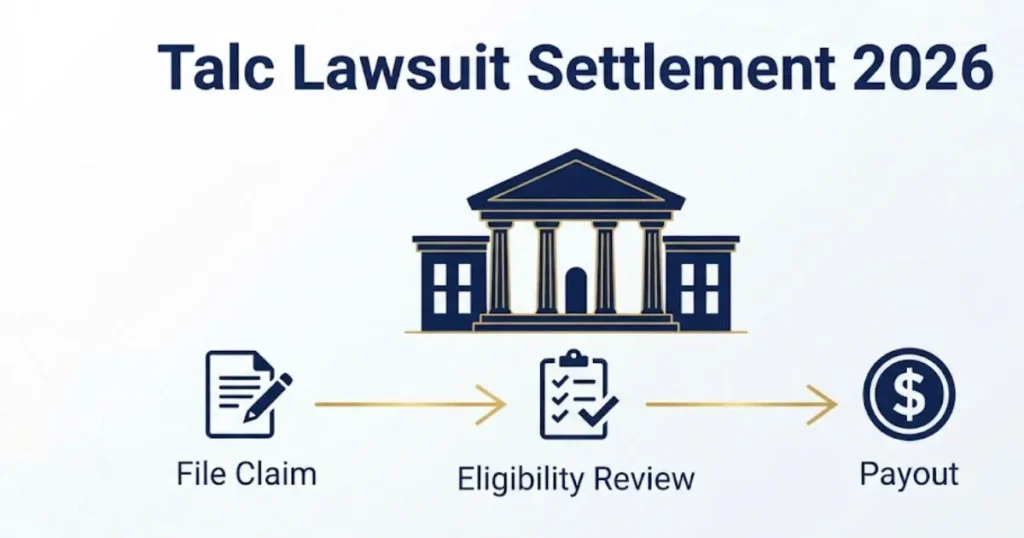
Step 1: Gather your medical records. You need pathology reports confirming your ovarian cancer diagnosis. Hospital records, treatment summaries, and oncology notes all strengthen your claim.
Step 2: Document your talc use history. Write down which products you used, how often, for how many years, and where on your body. If you have old receipts, photos, or even empty containers, save them.
Step 3: Contact a law firm handling talc cases. Most firms work on a contingency basis, meaning you pay nothing upfront. They take a percentage of your settlement or verdict, typically 30% to 40%.
Step 4: Your attorney files the claim. Depending on the current legal path, your claim goes into the MDL, the bankruptcy trust process, or a state court.
Step 5: Wait for processing. Trust claims may take several months to review. Individual cases may take longer.
- You do not need to go to court in most cases
- Most claims are resolved through paperwork and documentation
- Phone interviews or depositions may be required in some situations
- You do not need to live in a specific state to file
The process is not as intimidating as it sounds. Think of it like filing a detailed insurance claim. You provide the evidence, and attorneys handle the legal mechanics.
Baby Powder Cancer Lawsuit Overview
The baby powder cancer lawsuit is the consumer-facing name for the broader talc litigation. When people say “baby powder lawsuit,” they are usually talking about claims against Johnson & Johnson’s iconic Baby Powder product.
Baby Powder was sold for over 100 years. Generations of women used it as part of their daily hygiene routine. Many mothers applied it to their own bodies and their children’s skin, trusting the brand completely.
Internal J&J documents revealed during litigation showed that the company was aware of potential asbestos contamination in its talc supply as early as the 1970s. Despite this, the company continued marketing Baby Powder as pure and safe.
Key facts about the baby powder cancer lawsuit:
- J&J sold Baby Powder in over 100 countries
- The product was marketed directly to women for “freshness” and “feminine hygiene”
- Internal memos discussed strategies to defend talc safety even as test results showed contamination
- The FDA found asbestos in some samples of J&J Baby Powder in 2019
- J&J pulled talc Baby Powder from North American shelves in 2020 and worldwide in 2023
The baby powder lawsuit is not just about one product. Shower to Shower, which J&J sold to Energizer Holdings (now Edgewell Personal Care), is named in many claims as well. Other talc-based cosmetic products from various manufacturers have faced smaller numbers of lawsuits.
What makes this lawsuit so emotionally charged is the betrayal factor. People did not use some obscure industrial chemical. They used a product their grandmothers trusted. That trust was the foundation of J&J’s brand, and this lawsuit alleges the company exploited it.
The Link Between Talc and Ovarian Cancer
Scientific research has established a statistical association between perineal talc use and ovarian cancer. This connection is the medical backbone of every talc cancer lawsuit.
The theory works like this: when talc powder is applied to the genital area, microscopic particles can travel through the vagina, uterus, and fallopian tubes to reach the ovaries. Once there, the talc causes chronic inflammation, which over time may trigger cancerous cell growth.
Key studies supporting the link:
- A 1971 study first identified talc particles embedded in ovarian tumors
- A 1982 study by Dr. Daniel Cramer at Harvard found a 92% increased risk of ovarian cancer among regular talc users
- The 2006 meta-analysis published in Anticancer Research reviewed 16 studies and found a consistent 30% to 60% increased risk
- In 2018, IARC (International Agency for Research on Cancer) classified perineal use of talc as “possibly carcinogenic to humans” (Group 2B)
| Organization | Position on Talc and Cancer |
|---|---|
| IARC (WHO) | “Possibly carcinogenic” (Group 2B) for perineal use |
| American Cancer Society | Acknowledges mixed evidence, recommends caution |
| FDA | Found asbestos in talc samples (2019), no formal ban |
| Johnson & Johnson | Maintains talc is safe (disputes all findings) |
| National Cancer Institute | Notes studies showing increased risk with perineal use |
J&J has consistently argued that the science is not conclusive. The company points to studies that found no significant link. But juries have repeatedly sided with plaintiffs, finding that the weight of evidence supports causation.
The scientific debate is real, but in courtrooms, the pattern has been clear: most juries believe talc contributed to ovarian cancer in regular users.
Key Takeaway: Decades of research show a statistical link between perineal talc use and ovarian cancer, and juries have consistently found this evidence persuasive enough to award billions in damages.
Evidence Used in Talc Cancer Lawsuits
Evidence in talc cancer lawsuits comes from three main sources: medical records, product use history, and internal corporate documents. Strong claims rely on all three.
Medical evidence is the most important. You need:
- A confirmed ovarian cancer diagnosis (pathology reports)
- Treatment records showing chemotherapy, surgery, or radiation
- Oncologist statements or expert medical testimony linking the cancer to talc exposure
Product use evidence tells the court how you were exposed:
- Personal testimony about how often and how long you used talc products
- Identification of specific products (Baby Powder, Shower to Shower, etc.)
- Witness testimony from family members who saw you use the products
- Old product containers, receipts, or photos
Corporate evidence is what makes juries angry:
- Internal J&J memos from the 1970s discussing asbestos in talc
- Company-funded studies that found contamination but were never published
- Marketing materials targeting women for genital use
- Lobbyist communications aimed at preventing regulatory action
This last category has been devastating in trial after trial. When jurors see documents showing that a company knew about a danger and hid it, punitive damages tend to follow.
Expert witnesses play a huge role as well. Plaintiffs typically present epidemiologists, toxicologists, and pathologists. Defense experts counter with their own scientists. The battle of the experts often determines the outcome.
Talc Lawsuit Bankruptcy Plan Explained
The talc lawsuit bankruptcy plan is J&J’s strategy to resolve all talc claims through a single bankruptcy proceeding rather than fighting thousands of individual lawsuits. It is controversial, and understanding it matters if you have a claim.
Here is how it works. J&J created a subsidiary company and transferred all talc-related legal liabilities to that subsidiary. The subsidiary then filed for Chapter 11 bankruptcy. The idea is to create a trust fund that pays all claimants through a structured process, similar to how asbestos trusts work.
J&J tried this approach three times:
- 2021: LTL Management LLC filed for bankruptcy in North Carolina. A federal appeals court dismissed it in 2023, ruling it was not filed in good faith because J&J itself was financially healthy.
- 2023: LTL Management tried again in New Jersey. Dismissed again for similar reasons.
- 2024: Red River Talc LLC filed with a new structure, this time claiming that over 75% of claimants supported the settlement plan.
The 75% threshold matters because federal bankruptcy law (Section 524(g)) allows asbestos-related trusts to bind all claimants if a supermajority agrees to the plan. J&J is arguing that talc claims should qualify under this same rule.
| Bankruptcy Attempt | Entity | Year | Result |
|---|---|---|---|
| First | LTL Management LLC | 2021 | Dismissed by Third Circuit |
| Second | LTL Management LLC | 2023 | Dismissed by bankruptcy court |
| Third | Red River Talc LLC | 2024 | Under review, decision expected 2026 |
Critics call this strategy an abuse of the bankruptcy system. They argue that a profitable company like J&J should not be allowed to use bankruptcy to cap its liability. Supporters counter that a trust provides certainty and faster payments for claimants.
The outcome in 2026 will shape how other large companies handle mass tort liability for decades.
Talc Ovarian Cancer Lawsuit Timeline
The talc ovarian cancer lawsuit timeline spans over a decade and has gone through trial verdicts, appeals, bankruptcy filings, and settlement negotiations. Here is the full chronology.
| Year | Event |
|---|---|
| 2013 | Early talc cancer lawsuits filed in state courts |
| 2016 | First major plaintiff verdicts in Missouri ($72 million to Jacqueline Fox’s family) |
| 2017 | $417 million verdict to Eva Echeverria in California (later overturned) |
| 2018 | $4.69 billion verdict in St. Louis (22 plaintiffs; reduced to $2.12 billion on appeal) |
| 2018 | MDL 2738 established in New Jersey federal court |
| 2019 | FDA announces finding asbestos in J&J Baby Powder samples |
| 2020 | J&J pulls talc Baby Powder from North American market |
| 2021 | LTL Management LLC bankruptcy filing (first attempt) |
| 2023 | First and second bankruptcy attempts dismissed |
| 2023 | Kenvue Inc. spun off as J&J’s consumer health company |
| 2023 | Worldwide discontinuation of talc Baby Powder |
| 2024 | Red River Talc LLC files third bankruptcy attempt |
| 2025 | Claimant vote on proposed $8.9 billion settlement plan |
| 2026 | Bankruptcy court decision expected; possible first payouts |
The pattern here is unmistakable. J&J fought in court, lost repeatedly, and then tried to cap its exposure through bankruptcy. Each bankruptcy rejection pushed the company toward a larger settlement offer.
If everything proceeds as expected, 2026 will be the year the litigation either resolves through the trust or returns to individual trials. Either way, this is the most active period the talc litigation has seen.
Key Takeaway: J&J’s three bankruptcy attempts over five years have delayed payouts, but the 2026 court decision on the Red River Talc plan will likely determine whether claimants receive trust payments or return to individual trials.
Talc Cancer Lawsuit for Deceased Family Members
Families of women who died from ovarian cancer linked to talc use can file wrongful death claims. You do not have to be the person who used the product to have a valid legal case.
Every state allows wrongful death lawsuits, though the rules about who can file vary. Typically, the following people have legal standing:
- Spouses of the deceased
- Adult children of the deceased
- Parents of the deceased (in some states)
- Estate representatives or executors appointed by a court
The claim itself works the same way as a living plaintiff’s case. You need medical records proving the ovarian cancer diagnosis, evidence of talc product use, and documentation showing that the cancer contributed to the person’s death.
| Wrongful Death Filing Details | Info |
|---|---|
| Who Can File | Spouse, children, parents, estate representative |
| Evidence Needed | Death certificate, cancer diagnosis records, talc use history |
| Statute of Limitations | Usually 2 to 3 years from date of death (varies by state) |
| Damages Available | Medical expenses, funeral costs, lost income, pain and suffering, loss of companionship |
One common question: “What if my mother died years ago and I only learned about the talc connection recently?” Many states apply the discovery rule to wrongful death claims, meaning the statute of limitations starts when you learned or should have learned about the connection. This could extend your filing window.
If you are unsure whether the person’s cancer was linked to talc, an attorney can help obtain medical records and consult with experts to evaluate the claim. Many families have successfully filed claims years after their loved one’s death.
Do not assume it is too late. The bankruptcy trust process is designed to include estates and wrongful death claims alongside living plaintiff claims.
Frequently Asked Questions
How much money can I get from a talc ovarian cancer lawsuit in 2026?
Most ovarian cancer claimants can expect between $50,000 and $500,000 through the proposed settlement trust.
The exact amount depends on your cancer stage, duration of talc use, and the strength of your medical records.
High-severity cases with decades of documented use could receive more.
Is it too late to file a talc cancer lawsuit in 2026?
No, it is not too late for most people.
If the settlement trust is approved, a new claims bar date will be set, likely giving claimants several months to file.
Individual state statutes of limitations also apply, so acting quickly is still important.
What proof do I need to file a talc ovarian cancer claim?
You need medical records confirming an ovarian cancer diagnosis and evidence that you regularly used talc-based powder on your genital area.
Pathology reports, treatment records, and personal testimony about product use are the most important documents.
Old product containers or purchase records help but are not strictly required.
Did Johnson and Johnson admit talc causes cancer?
No, Johnson & Johnson has never admitted that its talc products cause cancer.
The company maintains its products were safe and that scientific evidence does not prove a causal link.
However, J&J has proposed an $8.9 billion settlement and discontinued talc Baby Powder worldwide.
Can I file a talc lawsuit if my family member died from ovarian cancer?
Yes, surviving family members can file wrongful death claims on behalf of a deceased loved one.
Spouses, children, and estate representatives typically have legal standing to pursue these claims.
The statute of limitations usually runs from the date of death, though the discovery rule may extend the deadline in some states.
The talc ovarian cancer lawsuit is reaching a turning point in 2026. Whether through the settlement trust or individual trials, billions of dollars are on the table for women and families harmed by talc products.
If you believe you qualify, gather your medical records and contact an attorney handling talc claims. Time matters, and filing sooner gives you the strongest position.
This is not a wait-and-see situation. The deadlines are real, and the opportunity to claim compensation is here right now.







