

The CPAP cancer lawsuit against Philips Respironics is one of the largest medical device mass torts in U.S. history, and 2026 is shaping up to be the year real money starts moving. If you used a recalled Philips CPAP, BiPAP, or ventilator and were later diagnosed with cancer, you may be entitled to significant compensation.
Thousands of claims are now in the system. The cases sit in a federal MDL in Pennsylvania, where bellwether trials and settlement talks are setting the stage for payouts.
This guide covers everything you need to know right now. Settlement estimates, eligibility rules, filing deadlines, the types of cancer that qualify, and what to do if your claim gets denied.
One number worth remembering: Philips has already set aside over $1 billion for legal costs tied to this recall. That figure tells you how seriously they’re taking this.
What Is the CPAP Cancer Lawsuit?
The CPAP cancer lawsuit is a massive wave of legal claims against Philips Respironics for selling sleep apnea machines that contained toxic foam. This foam, called PE-PUR sound abatement foam, was found to break down inside the devices and release cancer-causing chemicals directly into users’ airways.
Philips recalled roughly 5.5 million devices worldwide in June 2021. The recall covered CPAP machines, BiPAP machines, and mechanical ventilators made between 2009 and 2021. The flagship DreamStation was the most widely used device on the list.
The core allegation is straightforward. Philips knew the foam was degrading. They knew users were breathing in tiny particles and toxic gases. And they sold the machines anyway, for years, without warning anyone.
| Detail | Info |
|---|---|
| Defendant | Philips Respironics (Koninklijke Philips N.V.) |
| Products Affected | CPAP, BiPAP, and ventilator devices |
| Number of Devices Recalled | Approximately 5.5 million worldwide |
| Recall Date | June 2021 |
| Toxic Component | PE-PUR sound abatement foam |
| Court | U.S. District Court, Western District of Pennsylvania |
| MDL Number | MDL No. 2913 |
Federal judges consolidated the personal injury cases into MDL No. 2913, assigned to Judge Joy Flowers Conti in Pittsburgh. That consolidation means all federal cases move through one court for pretrial proceedings, which speeds things up considerably.
The lawsuit isn’t just about cancer. Some plaintiffs filed for respiratory injuries, organ damage, and other conditions. But the cancer claims carry the highest potential payouts and the most public attention heading into 2026.
CPAP Lawsuit Update for 2026
As of 2026, the CPAP litigation is entering its most active phase yet. Bellwether trials, which are test cases designed to gauge how juries will react, are producing results that shape settlement negotiations across the entire MDL.
Philips reached a $1.1 billion settlement for the economic loss class in late 2024, covering people who bought recalled devices but did not develop serious health problems. That deal is separate from the personal injury cancer claims, which remain open and carry far higher value.
The personal injury track is where the big money sits. These cases involve real diagnoses, real medical records, and real human suffering. Settlement discussions for cancer claimants have intensified throughout 2025 and into 2026, with both sides under pressure to resolve thousands of cases.
- Bellwether trial results are influencing settlement ranges
- The economic loss settlement of $1.1 billion is already in motion
- Personal injury cancer claims are being evaluated individually
- New case filings continue, though at a slower pace than 2023 and 2024
The MDL court has pushed for case management orders that speed up discovery and expert testimony. Philips has signaled willingness to negotiate rather than face hundreds of individual jury trials, which would be extraordinarily expensive for the company.
If you’ve been waiting on the sidelines, 2026 is the year to pay close attention. The legal machinery is grinding forward, and outcomes are becoming clearer by the month.
CPAP Lawsuit Settlement Amounts in 2026
Settlement amounts for CPAP cancer claims in 2026 are expected to vary widely based on the severity of the diagnosis. Cases involving terminal or aggressive cancers will command the highest payouts, while less severe health claims will fall into lower tiers.
No single universal number exists. But legal analysts and attorneys handling these cases have projected ranges based on bellwether outcomes, prior medical device settlements, and the strength of the evidence against Philips.
| Injury Tier | Estimated Settlement Range |
|---|---|
| Terminal or aggressive cancer (lung, kidney, liver) | $250,000 to $1,000,000+ |
| Non-terminal cancer (bladder, nasal, lymphoma) | $100,000 to $500,000 |
| Serious respiratory injury without cancer | $50,000 to $150,000 |
| Economic loss only (no injury) | $50 to $500 (from class settlement) |
These numbers are estimates, not guarantees. Every case is different. Your payout depends on how long you used the device, what type of cancer you developed, how strong your medical records are, and whether you can link the diagnosis to foam exposure.
Think of it like car accident settlements. A fender bender pays differently than a crash that lands someone in the ICU for a month. The principle is the same here. Severity drives value.
Attorneys typically work these cases on a contingency fee basis, meaning they take a percentage of the settlement, usually 33% to 40%, and you pay nothing upfront.
Key Takeaway: The CPAP cancer lawsuit is in full swing in 2026, with personal injury cancer claims carrying estimated payouts from $100,000 to over $1 million depending on diagnosis severity.
Who Qualifies for the CPAP Lawsuit?
You may qualify for the CPAP lawsuit if you used a recalled Philips CPAP, BiPAP, or ventilator and were later diagnosed with cancer or a serious respiratory condition. The connection between device use and your diagnosis is the critical factor.
Qualification is not automatic. You have to meet specific criteria, and your legal team will need to build a case linking your health problems to the defective foam in your machine.
Basic qualification requirements:
- You used a Philips Respironics CPAP, BiPAP, or ventilator that was on the 2021 recall list
- You used the device for a sustained period (typically months or years, not days)
- You received a cancer diagnosis or developed serious respiratory illness after using the device
- You have medical records documenting both the device use and the diagnosis
People who used ozone-based cleaning products with their CPAP machines may have an especially strong case. The FDA warned that ozone cleaning accelerated foam breakdown, increasing exposure to toxic particles.
Family members of deceased users can also file wrongful death claims if their loved one passed away from a cancer linked to CPAP foam exposure. These cases are handled through the estate.
The key word is “linked.” You don’t have to prove with 100% certainty that the CPAP caused your cancer. You need enough evidence to show it was a substantial contributing factor. That’s a lower bar than most people assume.
CPAP Cancer Lawsuit Payout Breakdown
The CPAP cancer lawsuit payout structure works on a tiered system, where the type and severity of your injury determines your compensation range. This isn’t a flat-rate deal where everyone gets the same check.
Here’s how the tiers generally break down in the personal injury track:
Tier 1: Highest Severity
These are cases involving death or aggressive cancers like renal cell carcinoma, lung cancer, or liver cancer. Projected payouts sit in the $500,000 to $1,000,000+ range. Wrongful death claims from surviving family members fall here too.
Tier 2: Significant Cancer Diagnosis
This tier covers confirmed cancer diagnoses that are serious but treatable. Think bladder cancer, certain lymphomas, or nasal and sinus cancers. Ranges here are estimated at $100,000 to $500,000.
Tier 3: Respiratory and Other Injuries
Plaintiffs with documented respiratory damage, chronic lung disease, or organ damage without a cancer diagnosis fall into this bracket. Estimates range from $50,000 to $150,000.
Tier 4: Economic Loss
If you owned a recalled device but didn’t get sick, you’re in the economic loss class. The $1.1 billion settlement for this group translates to modest individual payments, often $50 to $500 depending on the device model and purchase price.
| Payout Tier | Conditions | Estimated Range |
|---|---|---|
| Tier 1 | Terminal/aggressive cancer, wrongful death | $500,000 to $1,000,000+ |
| Tier 2 | Treatable cancer diagnoses | $100,000 to $500,000 |
| Tier 3 | Respiratory/organ damage (no cancer) | $50,000 to $150,000 |
| Tier 4 | No injury, device ownership only | $50 to $500 |
The better your documentation, the higher your potential payout. Medical records, device serial numbers, purchase receipts, and treatment records all build the strength of your claim.
Philips CPAP Recall and Cancer Risk Explained
Philips announced its massive CPAP recall on June 14, 2021, after determining that the PE-PUR foam inside millions of devices was breaking down and releasing toxic particles and gases. The FDA classified this as a Class I recall, the most serious category, reserved for situations where the product could cause serious injury or death.
The foam was originally placed inside the machines to reduce noise. It sat in the airpath, meaning users breathed air that passed directly over or through this material every single night. When the foam degraded, tiny black particles and invisible chemical vapors traveled straight into users’ lungs.
Lab testing identified several dangerous substances in the degraded foam:
- Benzene (known human carcinogen)
- Toluene (linked to organ damage)
- Formaldehyde (classified as carcinogenic)
- Diethylhexyl phthalate (endocrine disruptor)
- Other volatile organic compounds
The cancer risk is not theoretical. The FDA received thousands of medical device reports describing serious health problems, including cancer diagnoses, after prolonged CPAP use. Philips initially downplayed the risks, then gradually acknowledged the severity as lawsuits piled up.
To put it plainly: people trusted these machines to help them breathe better while they slept. Instead, the machines were quietly poisoning them with every breath. That betrayal of trust is at the core of every lawsuit filed.
Key Takeaway: The Philips CPAP recall was a Class I event involving cancer-causing chemicals like benzene and formaldehyde, and the cancer risk is supported by thousands of adverse event reports to the FDA.
What Cancer Types Are Linked to CPAP Machines?
Several types of cancer have been linked to CPAP foam exposure in the lawsuits filed against Philips Respironics. The cancers most commonly cited involve organs and tissues in the respiratory tract and the urinary system, which makes sense given how the toxic chemicals entered the body.
Cancers most frequently cited in CPAP lawsuits:
- Lung cancer (direct inhalation of carcinogens)
- Kidney (renal) cancer (chemicals filtered through the kidneys)
- Liver cancer (chemical processing by the liver)
- Bladder cancer (carcinogens excreted through urine)
- Nasal and sinus cancer (direct contact with inhaled particles)
- Throat and esophageal cancer (airway exposure)
- Non-Hodgkin lymphoma (systemic chemical exposure)
- Leukemia (benzene exposure specifically linked)
- Brain cancer (some cases filed, though less common)
| Cancer Type | Connection to CPAP Exposure | Case Strength |
|---|---|---|
| Lung cancer | Direct inhalation pathway | Very strong |
| Kidney cancer | Chemical filtration by kidneys | Strong |
| Liver cancer | Chemical processing by liver | Strong |
| Bladder cancer | Carcinogen excretion pathway | Moderate to strong |
| Nasal/sinus cancer | Direct foam particle contact | Very strong |
| Lymphoma | Systemic toxic exposure | Moderate |
| Leukemia | Benzene-specific link | Strong |
Not every cancer automatically qualifies. Your legal team will need medical experts to establish a plausible connection between your specific cancer type and the chemicals released by the CPAP foam. The cancers listed above have the strongest scientific basis for that connection.
If you were diagnosed with a rare cancer type not listed here, it doesn’t mean you’re out of luck. Talk to an attorney who handles CPAP cases. They can evaluate whether your particular situation fits.
CPAP Foam Degradation Health Risks
CPAP foam degradation refers to the physical breakdown of the PE-PUR sound abatement foam inside recalled Philips devices. When this foam breaks apart, it releases both visible black particles and invisible toxic gases into the airstream that users breathe all night.
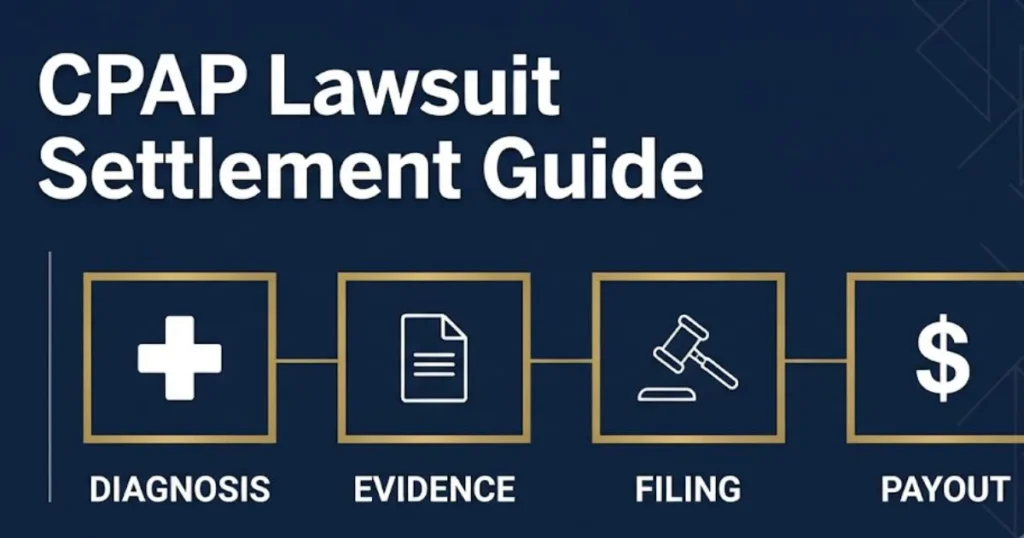
The health risks go beyond cancer. While cancer claims get the most attention, the degraded foam causes a range of serious problems.
Health risks from foam degradation include:
- Cancer (multiple types, as outlined above)
- Chronic respiratory inflammation
- Asthma-like symptoms and breathing difficulty
- Headaches, dizziness, and nausea
- Skin and eye irritation
- Organ damage (liver, kidney)
- Sinus infections and irritation
- Chest pressure and tightness
Heat and humidity accelerate the breakdown. CPAP machines generate warmth, and many users add humidification. That combination created the perfect conditions for the foam to degrade faster. Users in warmer climates or those who used heated humidifiers may have experienced more severe exposure.
Ozone cleaning products made things even worse. Some CPAP users bought aftermarket ozone-based cleaners to sanitize their devices. The FDA specifically warned that ozone exposure breaks down PE-PUR foam at an accelerated rate. If you used an ozone cleaner like SoClean with a recalled Philips device, your exposure risk may be significantly higher.
The cruel irony here is hard to ignore. These were medical devices prescribed to improve health. People used them faithfully, every night, trusting they were doing something good for their bodies. The foam degradation turned that trust into a health hazard.
CPAP Lawsuit Eligibility Requirements
The eligibility requirements for a CPAP cancer lawsuit boil down to three core elements: you used a recalled device, you got sick, and you can connect the two with documentation.
The three pillars of eligibility:
- Device use: You must have used a Philips Respironics CPAP, BiPAP, or ventilator that appears on the June 2021 recall list. Devices from other manufacturers like ResMed are not part of this lawsuit.
- Health impact: You were diagnosed with cancer or another qualifying condition after using the recalled device. The diagnosis must have occurred during or after the period of device use, not before.
- Documentation: You can provide medical records, device purchase records, prescription history, or other evidence that ties your device use to your diagnosis.
| Eligibility Factor | What You Need |
|---|---|
| Device type | Philips Respironics CPAP, BiPAP, or ventilator from recall list |
| Duration of use | Extended use (months to years preferred) |
| Diagnosis | Cancer or serious respiratory condition |
| Diagnosis timing | During or after device use |
| Documentation | Medical records, device records, purchase receipts |
| Statute of limitations | Must file within your state’s deadline |
You do not need to have registered your device with Philips. You do not need to have participated in the recall replacement program. You do not need to still have the physical device, though having it helps.
One common question: “I used my CPAP for only six months. Do I qualify?” Possibly. There’s no official minimum usage period. But longer use generally strengthens the case because it means greater cumulative exposure to the toxic chemicals.
Key Takeaway: To qualify for a CPAP cancer lawsuit, you need three things: proof you used a recalled Philips device, a qualifying diagnosis, and medical records connecting the two.
How to File a CPAP Cancer Claim
Filing a CPAP cancer claim starts with contacting an attorney who handles mass tort medical device cases. You cannot file directly into the MDL on your own without legal representation, and the process requires specific legal filings that only a licensed attorney can prepare.
Step-by-step filing process:
- Contact a mass tort attorney. Look for firms with experience in medical device litigation, specifically Philips CPAP cases. Most offer free case evaluations.
- Gather your records. Pull together medical records showing your diagnosis, treatment history, CPAP prescription records, device purchase information, and any communication from Philips about the recall.
- Case evaluation. Your attorney reviews your situation and determines whether your case meets the threshold for filing. Not everyone who calls will have a viable claim, and a good attorney will be honest about that.
- Filing the complaint. If your case qualifies, your attorney drafts and files a complaint in federal court. The case is then transferred into MDL No. 2913 in the Western District of Pennsylvania for pretrial proceedings.
- Discovery and negotiation. Your legal team exchanges evidence with Philips’ lawyers. Expert witnesses may review your medical records. Settlement discussions may begin.
- Resolution. Your case either settles through negotiation or proceeds to trial. Most mass tort cases settle before reaching a jury verdict.
| Filing Step | What Happens |
|---|---|
| Initial contact | Free case review with attorney |
| Records gathering | Collect medical and device documentation |
| Case evaluation | Attorney assesses viability |
| Complaint filed | Formal legal filing in federal court |
| MDL transfer | Case moved to MDL 2913 in Pittsburgh |
| Discovery | Evidence exchange between parties |
| Resolution | Settlement or trial |
The entire process can take months to years. Patience is part of the deal. But you don’t pay anything upfront. Contingency fees mean your attorney gets paid only if you win.
CPAP Lawsuit Deadline in 2026
The deadline to file a CPAP cancer lawsuit depends on your state’s statute of limitations for personal injury claims. There is no single national deadline. Each state sets its own time limit, and the clock usually starts ticking either from the date of your diagnosis or from the date you learned (or should have learned) that your CPAP caused your condition.
Common state statutes of limitations for personal injury:
| State | Statute of Limitations |
|---|---|
| California | 2 years from discovery of injury |
| Texas | 2 years from injury |
| New York | 3 years from injury |
| Florida | 2 years from discovery (changed in 2024) |
| Pennsylvania | 2 years from injury |
| Illinois | 2 years from discovery |
| Ohio | 2 years from injury |
The “discovery rule” is critical here. Many people didn’t know their CPAP could cause cancer until the recall in June 2021. In states that follow the discovery rule, the clock may have started on the recall date rather than the date of diagnosis. That gives some people more time than they might expect.
But don’t gamble on technicalities. If you’ve been diagnosed with cancer and you used a recalled Philips CPAP, talk to an attorney now. Missing the deadline by even one day can permanently bar your claim, no matter how strong your case is.
Quick fact: Some attorneys report that new CPAP cancer cases are still being accepted in 2026, but the window is narrowing. Every month you wait reduces your options.
Philips Respironics Lawsuit Timeline
The Philips CPAP lawsuit has been building for years. Here’s a chronological look at the major events from the first warnings to where things stand in 2026.
| Date | Event |
|---|---|
| April 2021 | Philips issues initial field safety notice about PE-PUR foam risks |
| June 14, 2021 | Philips announces voluntary recall of 3 to 4 million devices in the U.S. |
| June 2021 | FDA classifies the recall as Class I (most serious) |
| September 2021 | First personal injury lawsuits filed in federal court |
| December 2021 | Judicial Panel on Multidistrict Litigation creates MDL No. 2913 |
| January 2022 | MDL consolidated before Judge Joy Flowers Conti in Pittsburgh |
| Throughout 2022 | Thousands of new cases filed; discovery phase begins |
| 2023 | Philips recalls additional devices; total reaches approximately 5.5 million worldwide |
| Late 2023 | Bellwether case selection process begins |
| 2024 | Philips announces $1.1 billion economic loss class settlement |
| 2024 to 2025 | Bellwether trials proceed; settlement negotiations for cancer claims intensify |
| 2026 | Personal injury cancer settlement framework expected; individual payouts begin |
The pace has picked up significantly since 2024. Early in the litigation, Philips fought hard on causation, arguing that the foam degradation didn’t necessarily cause cancer. But as bellwether trials produced unfavorable results for the company, their posture shifted toward negotiation.
The $1.1 billion economic loss deal was a signal. When a company sets aside that kind of money for people who weren’t even injured, it tells you the cancer claims are worth far more.
By mid-2026, legal experts anticipate that a structured settlement program for personal injury cancer claims will be operational or very close to it.
Key Takeaway: The Philips CPAP lawsuit timeline stretches from the 2021 recall through bellwether trials in 2024 and 2025, with cancer claim settlements expected to begin distributing in 2026.
CPAP Class Action vs. Mass Tort
The CPAP lawsuit is a mass tort, not a class action. That distinction matters because it directly affects how much money you can receive and how your case is handled.
In a class action, one lawsuit represents everyone. Every member of the class gets the same outcome. Your individual story doesn’t really matter. The settlement gets divided equally or by a simple formula, and individual payouts are often tiny.
A mass tort is different. Each person files their own individual lawsuit. Your case is your own. Your medical records, your diagnosis, your usage history, your damages. That means your payout reflects your specific situation, not an average across thousands of people.
| Feature | Class Action | Mass Tort |
|---|---|---|
| Case structure | One lawsuit for everyone | Individual lawsuits per plaintiff |
| Individual consideration | Minimal | High |
| Payout calculation | Formula-based, often small | Based on individual damages |
| Your story matters? | Not much | Yes, significantly |
| Typical payout range | $10 to $500 | $50,000 to $1,000,000+ |
| Legal representation | Class counsel | Your own attorney |
The economic loss claims (people who bought recalled devices but weren’t injured) were handled as a class action. That’s the $1.1 billion deal with relatively small individual payouts.
The cancer and personal injury claims are mass tort cases. Each one is evaluated separately. Your lawyer builds your specific case, and your settlement reflects your unique injuries and losses.
This is why having strong documentation and a good attorney matters so much. In a mass tort, the quality of your individual case determines your individual result. It’s not a lottery where everyone draws the same number.
How the Philips CPAP Settlement Process Works
The Philips CPAP settlement process for cancer claims follows a structured path that begins with case filing and ends with a payout, though the middle steps involve negotiation, evaluation, and patience.
Here’s how the process typically works in mass tort settlements of this size:
Phase 1: Case Intake and Filing
Your attorney files your individual complaint. The case enters MDL 2913. Your medical and device records are compiled into a fact sheet that Philips’ legal team reviews.
Phase 2: Case Evaluation
Both sides assess the strength of your claim. Medical experts may review your records. Philips’ team evaluates causation, severity, and damages. Your attorney does the same.
Phase 3: Settlement Negotiation
If a global settlement framework is established (expected in 2026), individual cases are sorted into tiers based on injury severity. Each tier has a payout range. Your case falls into a tier based on your diagnosis and documentation.
Phase 4: Settlement Offer
You receive an offer based on your tier placement. Your attorney advises you on whether to accept or negotiate further. You have the right to reject any offer and take your case to trial.
Phase 5: Payout
Once you accept a settlement, the processing and payment phase begins. This can take several months. Payments are made after attorney fees and any medical liens are deducted.
| Settlement Phase | Estimated Duration |
|---|---|
| Case filing and intake | 1 to 3 months |
| Case evaluation | 3 to 6 months |
| Settlement negotiation | 6 to 12 months |
| Offer and acceptance | 1 to 3 months |
| Payout processing | 3 to 6 months |
Total timeline from filing to check in hand: roughly 12 to 24 months for most cases, though complex cases may take longer. The good news is that the settlement infrastructure is being built now. Once it’s operational, cases should move through more efficiently.
What Evidence Do You Need for a CPAP Cancer Lawsuit?
Strong evidence is the backbone of a successful CPAP cancer claim. Without documentation, even the most compelling story can fall apart in litigation. Here’s exactly what you need to gather.
Essential evidence for your case:
- Medical records showing your cancer diagnosis, treatment history, and timeline
- CPAP prescription records from your sleep specialist or physician
- Device purchase records (receipts, insurance claims, pharmacy records)
- Device information (model number, serial number, date of purchase)
- Recall notification (if you received one from Philips)
- Sleep study results that led to your CPAP prescription
- Photographs of degraded foam or black particles (if you noticed them)
- Ozone cleaner purchase records (if applicable, as these strengthen causation)
| Evidence Type | Why It Matters | How to Get It |
|---|---|---|
| Medical records | Proves diagnosis and treatment | Request from your doctors and hospitals |
| CPAP prescription | Links you to device use | Request from prescribing physician |
| Device purchase records | Proves you owned a recalled device | Check insurance EOBs, pharmacy, or retailer |
| Device serial number | Confirms your device is on the recall list | Check the device or original packaging |
| Foam degradation photos | Visual proof of the defect | Check your device or prior photos |
If you no longer have the physical device, don’t panic. Your attorney can obtain records from Philips, your insurance company, or the durable medical equipment supplier who sold you the machine.
The strongest cases combine medical records showing a qualifying cancer with clear evidence of prolonged use of a recalled device. If you can also show you used an ozone cleaner, that adds another layer of evidence supporting higher exposure levels.
Key Takeaway: You need medical records proving your diagnosis, proof you used a recalled Philips CPAP, and documentation connecting the two; ozone cleaner use strengthens your case further.
What to Do If Your CPAP Lawsuit Is Denied
Having a CPAP cancer claim denied is frustrating, but it is not necessarily the end of the road. Claims get denied for several reasons, and many of those reasons can be addressed with additional evidence or a different legal strategy.
Common reasons for CPAP claim denial:
- Insufficient medical documentation linking cancer to CPAP use
- Diagnosis occurred before the period of CPAP device use
- The device used was not on the Philips recall list
- The statute of limitations expired in your state
- Weak causation evidence (no expert medical opinion supporting the link)
Steps to take if denied:
- Ask why. Get a specific, written explanation from your attorney about why the claim was denied or rejected. You need to understand the exact problem before you can fix it.
- Gather more evidence. If the issue is weak documentation, go back to your doctors. Request additional records, get a medical opinion letter connecting your cancer to CPAP exposure, or obtain expert testimony.
- Get a second legal opinion. Not all attorneys evaluate cases the same way. A different firm with more CPAP experience might see value in your claim that the first firm missed.
- Consider state court filing. If the MDL rejected your case, you may be able to file in state court depending on your jurisdiction and circumstances.
- Explore appeals or reconsideration. Within the settlement framework, there are often appeal mechanisms for claimants who believe their case was improperly evaluated.
| Denial Reason | Potential Fix |
|---|---|
| Weak medical documentation | Obtain additional records or expert opinion |
| Wrong device | Verify device model against recall list |
| Missed deadline | Check discovery rule applicability in your state |
| Insufficient causation link | Get medical expert to provide opinion letter |
| First attorney declined | Seek second opinion from another firm |
The system isn’t designed to shut people out. It’s designed to process cases efficiently. If your case has merit, persistence and better documentation can often overcome an initial rejection.
Don’t give up after one “no.” Mass tort litigation is messy. Cases get reconsidered all the time.
Frequently Asked Questions
How much money can I get from a CPAP cancer lawsuit in 2026?
Cancer claims against Philips are projected to pay between $100,000 and $1,000,000+ depending on your diagnosis.
The most severe cases involving terminal cancers or wrongful death carry the highest payouts.
Non-cancer respiratory injury claims are estimated at $50,000 to $150,000.
What is the deadline to file a CPAP cancer lawsuit?
The deadline depends on your state’s statute of limitations, which typically ranges from 2 to 3 years from the date you discovered (or should have discovered) your injury.
Many states started the clock from the June 2021 recall date for cases using the discovery rule.
Deadlines are expiring for many claimants in 2026, so acting quickly is critical.
What types of cancer qualify for a CPAP lawsuit?
The most commonly filed cancers include lung, kidney, liver, bladder, nasal, and throat cancers, as well as lymphoma and leukemia.
These cancers are linked to chemicals like benzene and formaldehyde released by degraded PE-PUR foam.
Other cancer types may qualify depending on the specific facts of your case.
Do I need a lawyer to file a CPAP cancer claim?
Yes, you need an attorney to file a personal injury claim in the CPAP MDL.
Mass tort cases require formal legal filings, evidence compilation, and negotiation with Philips’ legal team.
Most CPAP attorneys work on contingency, meaning you pay nothing unless you win.
Is the CPAP lawsuit a class action or a mass tort?
The personal injury cancer claims are a mass tort, not a class action.
Each person files their own individual case, and payouts are based on individual damages.
The economic loss claims (no injury, device ownership only) were handled as a class action with a separate $1.1 billion settlement.
The CPAP cancer lawsuit is reaching a turning point in 2026. If you used a recalled Philips device and received a cancer diagnosis, this is the year to act.
Gather your medical records. Find an experienced mass tort attorney. Get your case evaluated before deadlines close.
The money is on the table. The legal framework is being built. Don’t wait until the window shuts to find out you had a claim worth pursuing.







