

A California mesothelioma lawsuit is one of the strongest legal claims available to asbestos victims in the United States. California has some of the most plaintiff-friendly asbestos laws in the country, and courts here have awarded billions of dollars in verdicts and settlements over the past three decades.
If you or someone in your family received a mesothelioma diagnosis, 2026 is a critical year to understand your options. Filing deadlines are strict. Trust fund payments are shifting. And several major cases are moving through California courts right now.
This article covers settlement amounts, who qualifies, filing steps, trust funds, wrongful death claims, and every other detail that matters. One fact that surprises most people: the average California mesothelioma settlement falls between $1 million and $2.4 million, with some trial verdicts exceeding $30 million.
California Mesothelioma Lawsuit Overview for 2026
A California mesothelioma lawsuit is a legal claim filed by a person diagnosed with mesothelioma due to asbestos exposure that occurred in California. These cases are filed as personal injury or wrongful death claims against the companies responsible for manufacturing, selling, or using asbestos-containing products.
California sees more mesothelioma filings than almost any other state. That is because the state had massive industrial, shipbuilding, and construction activity throughout the 20th century, all industries that relied heavily on asbestos.
In 2026, these lawsuits continue at a steady pace. New diagnoses still happen because mesothelioma has a latency period of 20 to 50 years. Workers exposed in the 1970s, 1980s, and even 1990s are only now showing symptoms.
| Key Fact | Detail |
|---|---|
| Case Type | Personal injury or wrongful death tort |
| Primary Courts | Los Angeles Superior Court, San Francisco Superior Court |
| Typical Defendants | Manufacturers, employers, property owners |
| 2026 Status | Active filings and trials ongoing |
| Latency Period | 20 to 50 years after exposure |
California courts have a special process for asbestos cases. Many are assigned to dedicated asbestos departments. Los Angeles and San Francisco handle the bulk of filings, and both courts have streamlined procedures to move cases faster.
The state also allows expedited trials for plaintiffs with advanced illness. If your doctor confirms a limited prognosis, you can request a preference trial that starts within 120 days of the motion being granted.
California Mesothelioma Settlement Amounts in 2026
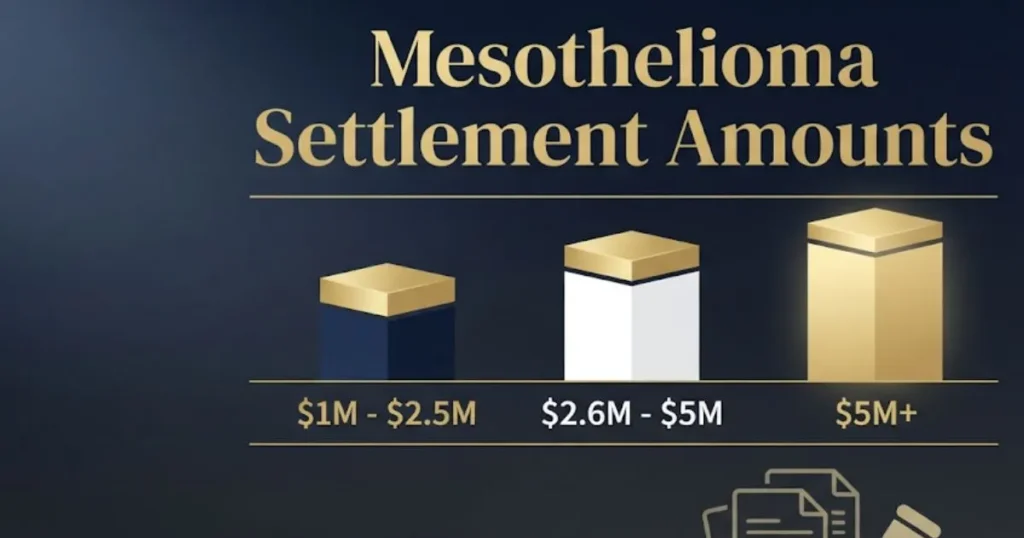
California mesothelioma settlement amounts in 2026 typically range from $1 million to $2.4 million, though some cases settle for significantly more depending on the facts.
Settlement amounts vary based on several factors. The severity of illness, the number of defendants, the strength of exposure evidence, and the plaintiff’s age all play a role. A case with clear documentation of workplace exposure at a major California job site will almost always settle higher.
Some of the largest settlements in recent years have come from California cases. Plaintiffs who can identify multiple responsible companies often recover from each one separately, which pushes total compensation well above the average.
| Settlement Factor | Impact on Amount |
|---|---|
| Strength of Exposure Proof | Higher proof means higher payout |
| Number of Defendants Named | More defendants often means more money |
| Disease Severity | Advanced mesothelioma yields higher settlements |
| Plaintiff Age and Dependents | Younger plaintiffs with families get more |
| Prior Verdicts Against Defendant | Companies with trial losses settle higher |
Confidentiality agreements make it hard to get exact numbers. Most settlements include a clause preventing the plaintiff from disclosing the dollar amount. But data from court filings and attorney reports gives us a reliable range.
One thing worth knowing: California defendants tend to settle before trial more often than in other states. That is partly because California juries have a reputation for awarding large verdicts to asbestos plaintiffs.
Who Qualifies for a Mesothelioma Lawsuit in California?
Anyone diagnosed with mesothelioma who was exposed to asbestos in California may qualify to file a lawsuit. This includes workers, residents, military veterans, and even family members exposed through secondhand contact.
The core requirement is a confirmed mesothelioma diagnosis. You will need medical records showing the diagnosis, ideally with pathology reports. From there, your legal team needs to establish where and how the asbestos exposure happened.
Here are the groups that most commonly qualify:
- Construction workers who handled insulation, drywall, or cement products
- Shipyard workers at Mare Island, Long Beach, Hunters Point, or other California yards
- Navy and military veterans stationed at California bases
- Power plant employees who worked around boilers and pipes
- Refinery workers at oil and gas facilities
- Teachers and school staff in older buildings with asbestos materials
- Family members who inhaled fibers carried home on a worker’s clothing
You do not need to have worked directly with asbestos products. Bystander exposure counts. If you were in the same building, on the same job site, or in the same home as someone who disturbed asbestos, that is enough to support a claim.
California courts have consistently recognized secondhand and environmental exposure as valid bases for lawsuits. This is one of the reasons the state sees so many filings each year.
Key Takeaway: California mesothelioma lawsuits are actively filed in 2026, settlements average $1 million to $2.4 million, and a wide range of workers, veterans, and family members can qualify based on direct or secondhand asbestos exposure.
How to File a Mesothelioma Lawsuit in California
Filing a mesothelioma lawsuit in California starts with hiring an experienced asbestos attorney who then files a complaint in the appropriate California court. The process itself has several distinct phases.
Here is a step-by-step breakdown:
- Get a confirmed diagnosis. You need a pathology report confirming mesothelioma.
- Consult an asbestos attorney. Most work on contingency, meaning no upfront cost.
- Build your exposure history. Your lawyer documents where and when you encountered asbestos.
- File the complaint. Your attorney files the lawsuit in Superior Court, usually in Los Angeles or San Francisco.
- Serve the defendants. Each named company receives formal notice of the lawsuit.
- Discovery phase. Both sides exchange evidence, take depositions, and gather facts.
- Settlement negotiations or trial. Most cases settle. If not, the case goes before a jury.
| Filing Step | Typical Timeframe |
|---|---|
| Initial Consultation | 1 to 3 days |
| Exposure Investigation | 2 to 4 weeks |
| Complaint Filed | Within 30 days of retention |
| Discovery Phase | 6 to 12 months |
| Settlement or Trial | 12 to 18 months total |
One thing many people do not realize: you can file from anywhere. If your asbestos exposure occurred in California but you now live in another state, you can still file in a California court. The exposure location is what determines jurisdiction.
Your attorney handles all the paperwork, court filings, and communication with defendants. You do not need to appear in court for most of the process. If health issues limit your mobility, depositions can happen at your home or by video.
Mesothelioma Lawsuit Payout in California
Mesothelioma lawsuit payouts in California come from three main sources: settlements, trial verdicts, and asbestos trust fund claims. Many plaintiffs receive money from more than one source.
The total payout depends on how many companies were involved in your exposure. Each responsible company or trust fund pays its share. Think of it like having multiple insurance policies that all pay out for the same event.
| Payout Source | Typical Range | Speed of Payment |
|---|---|---|
| Settlement | $1 million to $2.4 million | 6 to 18 months |
| Trial Verdict | $2.5 million to $39 million+ | 12 to 24 months (with appeals) |
| Trust Fund Claim | $50,000 to $400,000 per trust | 3 to 9 months |
| Workers’ Compensation | $75,000 to $250,000 | Varies by claim |
| VA Benefits (veterans) | $3,000+/month | 1 to 6 months |
The largest California mesothelioma payouts come from trial verdicts. Juries in Los Angeles and San Francisco have historically been sympathetic to asbestos plaintiffs. Several verdicts in the past five years have exceeded $20 million.
But going to trial carries risk. If the jury rules against you, you get nothing from that defendant. That is why roughly 95% of mesothelioma cases in California settle before reaching a jury. The settlement is smaller than a potential verdict, but it is guaranteed money.
California Mesothelioma Statute of Limitations
The statute of limitations for a California mesothelioma lawsuit is one year from the date of diagnosis for personal injury claims and two years from the date of death for wrongful death claims.
This deadline comes from California Code of Civil Procedure Section 340.2. It is a “discovery rule” statute, meaning the clock starts when you learn (or should have learned) that your illness is connected to asbestos exposure.
| Claim Type | Filing Deadline | Governing Law |
|---|---|---|
| Personal Injury | 1 year from diagnosis | CCP Section 340.2 |
| Wrongful Death | 2 years from death | CCP Section 340.2 |
One year sounds short, and it is. That is why contacting an attorney quickly after diagnosis matters so much. The investigation, exposure research, and complaint drafting all take time. Waiting even a few months can create unnecessary pressure.
If you miss the deadline, the court will almost certainly dismiss your case. There are very few exceptions. California does not offer much flexibility on this point, even in sympathetic situations.
For people diagnosed late in life or with rapidly progressing disease, the expedited trial preference is available. But you still must file the actual lawsuit within the one-year window. The preference only speeds up the trial date; it does not extend the filing deadline.
Key Takeaway: Mesothelioma payouts in California come from multiple sources, and the total can be substantial, but you only have one year from diagnosis to file a personal injury claim, so timing is everything.
Average Mesothelioma Settlement in California
The average mesothelioma settlement in California falls between $1 million and $2.4 million based on data compiled from court records and attorney-reported case outcomes. Individual results vary widely.
Some cases settle for less than $500,000. Others settle for $5 million or more. The number depends on the specifics of your case: how strong your evidence is, how many defendants you can name, and whether those defendants have a history of losing at trial.
Here is what the ranges look like by case strength:
| Case Strength | Estimated Settlement Range |
|---|---|
| Strong evidence, multiple defendants | $1.5 million to $5 million+ |
| Moderate evidence, few defendants | $750,000 to $1.5 million |
| Limited evidence, one defendant | $250,000 to $750,000 |
| Trust fund claims only (no lawsuit) | $50,000 to $400,000 |
California settlements tend to run higher than the national average. Two big reasons drive this. First, California juries are known for large verdicts, which gives plaintiffs leverage during negotiations. Second, many California exposure sites involve well-known companies with deep pockets or well-funded trust funds.
Keep in mind that settlement money is usually tax-free for the portion covering physical injury. Punitive damages, if any, may be taxable. Your attorney can explain how this applies to your specific situation.
It is also worth noting that settlements from multiple defendants and trust funds stack on top of each other. A plaintiff might settle with three companies for $600,000 each and collect another $200,000 from two trust funds. That brings the total to $2.2 million from what started as five separate claims.
California Asbestos Exposure Sites
California has hundreds of documented asbestos exposure sites, more than almost any other state. These include shipyards, refineries, power plants, factories, schools, and military installations spread across the entire state.
The reason for this concentration is simple. California had a booming industrial economy during the decades when asbestos use was at its peak, roughly the 1940s through the 1980s. Every major industry used asbestos products.
Here are some of the most significant sites:
- Mare Island Naval Shipyard (Vallejo) and thousands of exposed workers
- Long Beach Naval Shipyard used asbestos insulation heavily through the 1970s
- Hunters Point Naval Shipyard (San Francisco) with decades of ship repair work
- Chevron Richmond Refinery where pipe insulation contained asbestos
- PG&E power plants statewide, including Moss Landing and Potrero
- Lockheed Martin facilities in Burbank and Sunnyvale
- Kaiser Permanente steel plants in Fontana
- Los Angeles public schools with asbestos building materials
- University of California campuses with older asbestos-containing buildings
| Region | Notable Exposure Sites | Primary Industries |
|---|---|---|
| San Francisco Bay Area | Mare Island, Hunters Point, PG&E plants | Shipbuilding, energy |
| Los Angeles Area | Lockheed Martin, LA schools, refineries | Aerospace, construction |
| Central Valley | Agricultural facilities, older buildings | Agriculture, manufacturing |
| San Diego | NASSCO shipyard, Naval bases | Military, shipbuilding |
| Sacramento | State buildings, older hospitals | Government, healthcare |
If you worked at any of these locations or lived near them, your exposure history is likely well-documented. Attorneys who specialize in California mesothelioma cases maintain detailed databases of these sites and the asbestos products used at each one.
California Mesothelioma Wrongful Death Lawsuit
A California mesothelioma wrongful death lawsuit is filed by surviving family members after a mesothelioma patient dies. It seeks compensation for the loss of the person’s life, income, companionship, and the suffering they experienced.
Under California law, wrongful death claims can be filed by the deceased person’s spouse, domestic partner, children, or anyone who was financially dependent on them. In some situations, parents and siblings may also qualify.
The filing deadline is two years from the date of death. This is separate from the personal injury statute of limitations. If the patient filed a personal injury lawsuit before dying, the wrongful death claim can proceed alongside or after the original case.
| Wrongful Death Detail | Information |
|---|---|
| Filing Deadline | 2 years from date of death |
| Who Can File | Spouse, children, dependents, domestic partner |
| Types of Damages | Loss of income, loss of companionship, medical bills, funeral costs, pain and suffering |
| Average Settlement | $1 million to $3.5 million |
One important distinction: a wrongful death claim is different from a survival action. A survival action continues the original personal injury claim on behalf of the estate. A wrongful death claim is a brand-new lawsuit filed by the survivors themselves.
Many families pursue both at the same time. The survival action recovers damages the patient would have been entitled to. The wrongful death claim recovers damages for the family’s own losses. Together, they can result in significantly higher total compensation.
Key Takeaway: California has hundreds of documented asbestos exposure sites, and even if the exposed person has passed away, family members can file wrongful death or survival actions within two years of the death.
California Asbestos Trust Funds in 2026
California asbestos trust funds in 2026 hold over $30 billion in combined assets set aside by bankrupt asbestos companies to pay current and future claims. These trusts operate independently from lawsuits and can be filed alongside court cases.
When asbestos companies went bankrupt due to overwhelming lawsuit liability, federal courts required them to establish trust funds. Each trust pays claims based on a set formula. The payment percentage changes over time depending on how many claims the trust receives and how much money remains.
Here are some of the major trusts relevant to California mesothelioma cases:
| Trust Fund | Estimated Payment (2026) | Payment Percentage |
|---|---|---|
| Manville Trust (Johns Manville) | $50,000 to $100,000 | Approximately 5.2% |
| Celotex Trust | $25,000 to $60,000 | Approximately 3.5% |
| Owens Corning/Fibreboard Trust | $40,000 to $150,000 | Approximately 10.9% |
| W.R. Grace Trust | $50,000 to $200,000 | Approximately 40% |
| Armstrong World Industries Trust | $30,000 to $80,000 | Approximately 4.1% |
| USG Corporation Trust | $25,000 to $75,000 | Approximately 6.5% |
Filing a trust fund claim is simpler than a lawsuit. You submit medical records, an exposure history, and supporting documents. Most trusts process claims within 3 to 9 months. There is no trial, no jury, and no courtroom.
You can file claims with multiple trusts simultaneously. If you were exposed to products from five different bankrupt companies, you file five separate trust claims. Each one pays independently. A skilled mesothelioma attorney typically handles all trust claims as part of your overall case.
The payment percentages listed above are estimates for 2026. Trusts adjust their percentages periodically based on remaining funds and projected future claims. Some trusts have reduced payments in recent years, which is another reason not to wait.
California Mesothelioma Trial Verdicts
California mesothelioma trial verdicts have produced some of the largest asbestos-related awards in American legal history. Juries in Los Angeles and San Francisco regularly return verdicts in the tens of millions of dollars.
Only about 5% of mesothelioma cases go to trial. But when they do, California juries tend to side with plaintiffs. The state’s jury pools are generally sympathetic to workers harmed by corporate negligence, especially when evidence shows the company knew about asbestos dangers and failed to warn people.
Here are some notable California mesothelioma verdicts:
| Year | Court | Verdict Amount | Defendant(s) |
|---|---|---|---|
| 2023 | Los Angeles Superior Court | $33 million | Cosmetic talc manufacturer |
| 2022 | San Francisco Superior Court | $25 million | Industrial equipment maker |
| 2021 | Alameda County Superior Court | $29 million | Building products company |
| 2019 | Los Angeles Superior Court | $40 million | Automotive parts supplier |
Punitive damages drive many of these large numbers. When a jury finds that a company acted with malice or conscious disregard for safety, it can award punitive damages on top of compensatory damages. California has no statutory cap on punitive damages in asbestos cases.
Trial is a gamble, but a calculated one. If a defendant refuses to offer a fair settlement, going to trial can result in a much larger payout. Your attorney’s trial experience in California asbestos courts is a major factor in this decision.
California Asbestos Lawsuit Timeline
A California asbestos lawsuit timeline runs approximately 12 to 18 months from filing to resolution for most mesothelioma cases. Expedited cases can move faster; complex multi-defendant cases can take longer.
Here is what the typical timeline looks like:
| Phase | Timeframe | What Happens |
|---|---|---|
| Diagnosis and Attorney Selection | Weeks 1 to 3 | Confirm diagnosis, choose a lawyer |
| Case Investigation | Weeks 3 to 8 | Identify exposure sources and defendants |
| Complaint Filed | Month 2 | Lawsuit officially begins |
| Defendant Responses | Months 3 to 4 | Companies file answers or motions |
| Discovery | Months 4 to 10 | Depositions, document exchanges, expert reports |
| Mediation/Settlement Talks | Months 8 to 14 | Negotiation with defendants |
| Trial (if needed) | Months 14 to 18 | Jury trial in Superior Court |
| Payment | 30 to 60 days after resolution | Funds disbursed after settlement or verdict |
California has a system specifically designed to move asbestos cases efficiently. The San Francisco and Los Angeles Superior Courts each have dedicated asbestos case management programs with experienced judges who handle these cases exclusively.
For plaintiffs with advanced disease, the expedited preference process can compress this timeline significantly. A preference motion under California Code of Civil Procedure Section 36 can set a trial date within 120 days of the motion being granted.
Trust fund claims run on a separate, faster track. Most trust claims are processed within 3 to 9 months without any court involvement.
Key Takeaway: California asbestos trust funds hold over $30 billion, trial verdicts regularly exceed $20 million, and the typical lawsuit timeline is 12 to 18 months with faster options for seriously ill plaintiffs.
How Long Does a Mesothelioma Lawsuit Take in California?
Most mesothelioma lawsuits in California take 12 to 18 months from start to finish. Cases that settle early can wrap up in under a year. Cases that go to trial may take up to two years or more.
Several factors affect the speed:
- Number of defendants. More defendants means more discovery and more scheduling challenges.
- Plaintiff’s health. Courts grant preference motions for seriously ill plaintiffs, speeding up trials.
- Court backlog. San Francisco and Los Angeles handle hundreds of asbestos cases. Timing depends on the court’s calendar.
- Settlement willingness. If defendants want to negotiate early, the case resolves faster.
- Complexity of exposure history. Multiple job sites or decades of exposure require more investigation.
Think of it like a home renovation. A simple job with one contractor finishes fast. A complex project with multiple subcontractors drags on. The same logic applies to mesothelioma litigation.
The fastest California mesothelioma cases involve a single clearly documented exposure site, a cooperative defendant, and a plaintiff willing to accept a reasonable settlement offer. Some of these cases resolve within 6 to 8 months.
The slowest cases involve disputes over medical causation, multiple defendants pointing fingers at each other, and appeals after a trial verdict. These can stretch to 3 years or more, though that is uncommon.
California Mesothelioma Compensation Types
California mesothelioma compensation comes in several forms, and most plaintiffs receive money from more than one category. Understanding the types helps you set realistic expectations.
Here are the main compensation categories:
| Compensation Type | What It Covers | How It Works |
|---|---|---|
| Economic Damages | Medical bills, lost wages, future lost income | Calculated from actual documented expenses |
| Non-Economic Damages | Pain, suffering, loss of enjoyment of life | Jury or settlement negotiation determines amount |
| Punitive Damages | Punishment for corporate misconduct | Awarded at trial when defendant acted recklessly |
| Trust Fund Payments | Claims against bankrupt companies | Filed separately; processed in 3 to 9 months |
| Workers’ Compensation | Workplace injury benefits | Filed through California workers’ comp system |
| VA Benefits | Monthly disability payments for veterans | Filed through the Department of Veterans Affairs |
Economic damages are the easiest to calculate. You add up medical bills, lost income, and projected future costs. Non-economic damages are harder to pin down because they cover intangible losses like pain and emotional suffering.
Punitive damages only apply in cases that go to trial. They are designed to punish defendants, not to compensate you. California allows punitive damages when a company knowingly exposed people to a dangerous substance and did nothing to prevent harm.
Veterans may be eligible for VA disability compensation in addition to lawsuit proceeds. These benefits do not reduce your lawsuit payout. They are entirely separate streams of income.
Mesothelioma Lawsuit After Death in California
Filing a mesothelioma lawsuit after death in California is possible through two legal pathways: a wrongful death claim and a survival action. Both can be filed by the deceased person’s family or estate.
If the person diagnosed with mesothelioma passed away before filing a lawsuit, the family still has legal options. The wrongful death claim has a two-year deadline from the date of death. The survival action continues any personal injury claim the deceased could have filed.
| Legal Pathway | Who Files | Deadline | Damages Available |
|---|---|---|---|
| Wrongful Death Claim | Spouse, children, dependents | 2 years from death | Loss of income, companionship, funeral costs |
| Survival Action | Estate representative | 1 year from death or diagnosis (whichever is later) | Pain and suffering, medical expenses, lost wages prior to death |
A survival action recovers what the patient themselves endured. If they suffered for months before dying, the estate can claim compensation for that suffering. A wrongful death claim covers what the family lost because of the death.
Many families file both. A combined claim is stronger because it captures the full scope of harm, both to the patient and to the surviving family members.
One critical point: the deadlines for wrongful death and survival actions are strict. Families dealing with grief often lose track of time. Having an attorney handle the legal work during this period prevents the loss of valuable rights.
Key Takeaway: California provides multiple compensation types including economic, non-economic, punitive damages, trust fund payments, and VA benefits, and families can still file lawsuits after a loved one’s death through wrongful death claims and survival actions.
How to Choose a California Mesothelioma Lawyer
The right California mesothelioma lawyer has specific experience with asbestos cases, a track record of significant verdicts or settlements, and the resources to take on major corporations. Not every personal injury attorney qualifies.
Mesothelioma law is a niche practice. The science is complex. The defendants are sophisticated. The exposure evidence can span decades. You need an attorney who has done this many times before.
Here is what to look for:
- Asbestos-specific experience. Ask how many mesothelioma cases they have handled.
- California court knowledge. Familiarity with San Francisco and LA asbestos courts matters.
- Contingency fee structure. You should pay nothing upfront. The attorney takes a percentage of the recovery.
- National reach. Many California exposure cases involve companies based in other states. Your lawyer needs a national network.
- Support staff and resources. Mesothelioma cases require investigators, medical experts, and industry researchers.
- Trial willingness. A lawyer who only settles may not get you the best outcome. You want someone ready to go to trial.
| Evaluation Criteria | Why It Matters |
|---|---|
| Years of asbestos litigation experience | Signals deep knowledge of this specific area |
| Past verdicts and settlements | Shows ability to win and recover money |
| Contingency fee percentage | Standard is 25% to 40%; compare offers |
| Client communication style | You want regular updates and honest conversations |
| Resources to fund the case | These cases are expensive to litigate |
Most top mesothelioma firms offer free case evaluations. They review your diagnosis and exposure history at no cost. If they take your case, they front all expenses and only collect a fee if you win.
California Mesothelioma: Class Action vs Individual Lawsuit
California mesothelioma cases are almost always filed as individual lawsuits, not class actions. This is an important distinction that directly affects how much money you can recover.
A class action groups many plaintiffs together into one case. Everyone shares the same settlement pool. Individual lawsuits keep your case separate, allowing your unique damages to be assessed on their own merits.
| Feature | Class Action | Individual Lawsuit |
|---|---|---|
| Number of Plaintiffs | Hundreds or thousands | One person or family |
| Settlement Distribution | Shared among all plaintiffs | All recovery goes to you |
| Control Over Case | Very little | Full control with your attorney |
| Average Payout | Often lower per person | Typically much higher |
| Commonness in Mesothelioma | Very rare | Standard approach |
The reason mesothelioma cases are filed individually is that each person’s exposure history, disease progression, and damages are different. A 45-year-old shipyard worker with two children has vastly different damages than a 75-year-old retired teacher. Grouping them together would not serve either person well.
Filing individually also gives you and your attorney much more control over the case. You choose when to settle. You choose whether to go to trial. You decide which defendants to pursue. In a class action, those decisions are made by lead plaintiffs and class counsel, often without your direct input.
If you see advertisements about “joining” a mesothelioma class action, be cautious. True class actions for mesothelioma are extremely uncommon in California. What you likely want is an individual lawsuit handled by an experienced asbestos attorney.
California Asbestos Laws and Regulations
California has some of the strictest asbestos laws and regulations in the country, which benefits mesothelioma plaintiffs both in terms of liability standards and courtroom protections.
At the state level, several key laws shape the legal environment:
- CCP Section 340.2 sets the statute of limitations at one year from diagnosis for personal injury and two years from death for wrongful death.
- Proposition 65 (1986) requires businesses to warn Californians about significant exposure to chemicals that cause cancer, including asbestos.
- California Health and Safety Code Sections 25915 to 25919.7 govern asbestos abatement, inspection, and notification in buildings.
- Cal/OSHA regulations set workplace exposure limits for asbestos at 0.1 fibers per cubic centimeter over an eight-hour shift.
| Law/Regulation | What It Does |
|---|---|
| CCP Section 340.2 | Sets filing deadlines for asbestos lawsuits |
| Proposition 65 | Requires asbestos exposure warnings |
| Health and Safety Code (asbestos sections) | Governs building inspections and abatement |
| Cal/OSHA Asbestos Standards | Sets workplace exposure limits |
| California Evidence Code Section 452.5 | Allows certain public records as evidence |
California courts apply a “strict liability” standard in many asbestos product cases. This means you do not always have to prove the manufacturer was negligent. You only need to show that the product was defective or unreasonably dangerous and that it caused your injury.
The state also has strong “discovery rule” protections. Since mesothelioma takes decades to develop, the statute of limitations does not start until you know (or reasonably should know) that asbestos caused your illness. This prevents companies from hiding behind the passage of time.
California’s legal framework is one of the main reasons so many mesothelioma cases are filed here. The combination of strict liability, reasonable filing deadlines, plaintiff-friendly courts, and strong regulatory standards makes it one of the best states for asbestos victims to pursue justice.
Key Takeaway: California’s strict liability standard, discovery rule protections, and dedicated asbestos court programs make it one of the most plaintiff-friendly states for mesothelioma lawsuits, but acting quickly within the one-year filing deadline remains essential.
Frequently Asked Questions
How much is a mesothelioma lawsuit worth in California in 2026?
Most California mesothelioma lawsuits settle for $1 million to $2.4 million.
Trial verdicts can exceed $20 million or more depending on the case.
Total compensation increases when trust fund claims are filed alongside the lawsuit.
Can I file a mesothelioma lawsuit in California if the exposure happened decades ago?
Yes, because the statute of limitations starts at diagnosis, not at the time of exposure.
California’s discovery rule recognizes that mesothelioma has a latency period of 20 to 50 years.
You have one year from your diagnosis date to file.
What is the deadline to file a mesothelioma lawsuit in California?
The deadline is one year from diagnosis for personal injury claims.
For wrongful death claims, the deadline is two years from the date of death.
Missing these deadlines almost always results in your case being dismissed.
Can family members file a mesothelioma lawsuit after a death in California?
Yes, surviving spouses, children, and dependents can file a wrongful death claim.
The estate can also file a survival action to recover damages the deceased person experienced.
Both types of claims have strict deadlines and should be filed as soon as possible.
Do most California mesothelioma cases settle or go to trial?
Roughly 95% of California mesothelioma cases settle before reaching a jury.
Settlements are faster and provide guaranteed compensation.
Cases that go to trial carry more risk but often result in significantly higher payouts.
The bottom line on California mesothelioma lawsuits in 2026 is this: the legal system here is built to help victims get real compensation. Settlements, trust funds, trial verdicts, and VA benefits can all stack together.
If you have a mesothelioma diagnosis connected to asbestos exposure in California, the one-year filing deadline makes acting quickly a priority. Get your medical records together. Pull your work history. Talk to an attorney who specializes in asbestos litigation.
The money is there. The legal pathway is clear. The only thing that can stop you is running out of time.







