

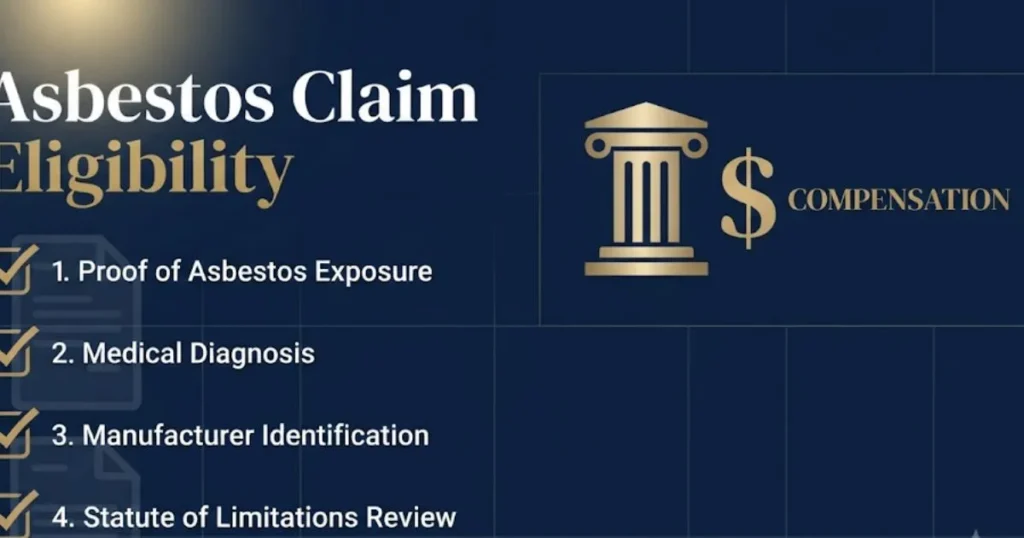
Asbestos lawsuit requirements come down to three things: a confirmed medical diagnosis, proof of asbestos exposure, and filing before your state’s deadline runs out. Miss any one of those, and your case falls apart before it starts.
In 2026, asbestos litigation remains one of the largest mass torts in American history. Over $30 billion still sits in asbestos bankruptcy trusts waiting to pay victims. New diagnoses happen every year because asbestos diseases can take 20 to 50 years to show up.
This guide breaks down every requirement, every deadline, and every step of the process. You’ll learn who qualifies, what evidence you need, how much money is realistic, and what the filing process actually looks like.
Whether you’re a construction worker, a Navy veteran, or a family member who lost someone to mesothelioma, this is written for you. No legal jargon. No runaround. Just what you need to know right now.
What Are Asbestos Lawsuit Requirements in 2026
Asbestos lawsuit requirements in 2026 are a qualifying medical diagnosis, documented proof of asbestos exposure, and compliance with your state’s statute of limitations. Those three pillars haven’t changed for years, but specific rules and deadlines do shift.
You need a doctor to confirm you have an asbestos-related disease. That means mesothelioma, asbestosis, lung cancer linked to asbestos, or certain other conditions caused by inhaling or ingesting asbestos fibers.
You must show when and where you were exposed. That could be a job site, a military installation, a building, or even a consumer product. The exposure must connect to a specific defendant or responsible company.
Your filing must happen within the legal time window your state allows. Some states give you one year from diagnosis. Others give you up to six years. Fall outside that window and the court will throw your case out.
| Requirement | What It Means |
|---|---|
| Medical Diagnosis | Doctor-confirmed asbestos-related disease |
| Proof of Exposure | Documentation of where and when exposure occurred |
| Statute of Limitations | Filing within your state’s legal time limit |
| Identified Defendant | A company, trust, or entity responsible for the exposure |
| Legal Standing | You are the victim, spouse, or legal representative |
The rules sound simple on paper. The hard part is gathering the right documentation and identifying who is legally responsible. That’s where most cases get complicated.
Who Qualifies for an Asbestos Lawsuit
Anyone diagnosed with an asbestos-related illness who can trace their exposure to a specific source may qualify. This includes workers, veterans, family members exposed secondhand, and people who lived near asbestos-contaminated sites.
Construction workers top the list. Electricians, plumbers, pipefitters, boilermakers, insulators, and demolition crews were among the most heavily exposed occupations from the 1940s through the 1980s.
Military veterans, especially those who served in the Navy, face high rates of mesothelioma. Asbestos was used in ships, submarines, barracks, and aircraft components for decades.
Family members who developed illness from secondhand exposure also qualify. Workers carried asbestos fibers home on their clothing, exposing spouses and children to deadly dust.
Here’s a quick look at the groups that most commonly file:
- Construction and industrial workers
- Navy, Army, Air Force, and Marine veterans
- Shipyard workers and mechanics
- Power plant employees
- Teachers and school employees in older buildings
- Family members exposed through household contact
Even if your exposure happened 30 or 40 years ago, you can still file. Asbestos diseases have extremely long latency periods. The clock on your legal deadline starts at diagnosis, not at the time of exposure.
Asbestos Lawsuit Eligibility Criteria Explained
Eligibility for an asbestos lawsuit depends on meeting both medical and legal standards that courts have defined over decades. You can’t file based on exposure alone; you need a disease.
The medical criteria require a diagnosed condition. Courts and trust funds use disease categories to determine what qualifies. Not every asbestos-related condition carries the same legal weight.
| Disease | Eligible for Lawsuit | Typical Trust Fund Category |
|---|---|---|
| Mesothelioma | Yes | Highest payout tier |
| Lung Cancer (asbestos-linked) | Yes | Mid to high tier |
| Asbestosis | Yes | Mid tier |
| Pleural Plaques | Sometimes | Lowest tier or ineligible |
| Pleural Thickening | Depends on state | Low tier |
Mesothelioma opens the most legal doors. Because it is almost exclusively caused by asbestos, proving the connection is straightforward.
Lung cancer requires more documentation. You’ll need medical records showing asbestos as a contributing cause, especially if you have a history of smoking. Courts still allow these cases, but the evidence bar is higher.
Asbestosis qualifies in every state, though compensation amounts tend to be lower than mesothelioma cases. It’s a chronic condition that scars the lungs over time.
Some states require a minimum level of lung impairment before you can file. These are called “medical criteria” or “pleural registry” laws. Check your state’s rules carefully.
Key Takeaway: You must have a diagnosed asbestos disease to file a lawsuit. Exposure alone, without illness, is not enough in any state as of 2026.
How to File an Asbestos Lawsuit in 2026
Filing an asbestos lawsuit in 2026 starts with getting your medical diagnosis documented, then finding a qualified asbestos attorney who works on contingency. The process typically takes four to six steps.
Your first step is to get a written diagnosis from a physician. This needs to be a formal pathology report or clinical diagnosis that specifically names an asbestos-related disease.
Next, you gather your exposure history. Write down every job you’ve held, every building you worked in, and every product you remember handling. Your attorney will use this to identify defendants.
The attorney reviews your case, identifies responsible companies or trusts, and files the complaint in the appropriate court. Most asbestos cases are filed in state court, though some go through federal multidistrict litigation.
Here’s the step-by-step breakdown:
- Get your diagnosis documented by a doctor
- Document your exposure history in writing
- Contact an asbestos attorney for a free case review
- Attorney investigates and identifies defendants
- Complaint is filed in court or with a trust fund
- Discovery, negotiation, or trial follows
Most cases settle before trial. The settlement process takes anywhere from 6 to 18 months after filing. Trust fund claims can sometimes pay faster, within 3 to 6 months.
You don’t need to know which companies are responsible before calling a lawyer. That’s their job. Experienced asbestos firms have databases of products, job sites, and company histories that connect exposure to liable parties.
Asbestos Exposure Lawsuit Requirements You Must Meet
Asbestos exposure lawsuit requirements center on proving that your specific exposure caused your disease. You need to establish who exposed you, when it happened, and how it led to your illness.
Courts apply a standard called “causation.” You must show a direct link between your asbestos exposure and your diagnosed disease. Simply being in a building with asbestos isn’t automatically enough.
Product identification matters enormously. If you can identify the exact asbestos-containing products you worked with, your case becomes much stronger. Brand names, manufacturers, and model numbers all help.
Your exposure has to be “significant.” That doesn’t mean you needed decades of contact. Courts have ruled that even brief but intense exposure can cause mesothelioma. But you do need more than a passing encounter.
| Exposure Factor | What Courts Look For |
|---|---|
| Duration | How long the exposure lasted |
| Intensity | How concentrated the asbestos fibers were |
| Frequency | How often the exposure occurred |
| Product Type | Which asbestos products were involved |
| Proximity | How close you were to the source |
Secondhand exposure cases, like a spouse who washed a worker’s dusty clothes, are harder to prove but absolutely winnable. Several landmark verdicts have awarded millions in secondhand exposure cases.
Proof Needed for an Asbestos Lawsuit
The proof needed for an asbestos lawsuit falls into three categories: medical evidence, exposure evidence, and identification of responsible parties. Without all three, your case weakens significantly.
Medical proof is the foundation. You need pathology reports, imaging scans, biopsy results, and your treating physician’s opinion linking your condition to asbestos. A written medical opinion is especially valuable.
Exposure proof includes employment records, union records, military service records, tax returns showing where you worked, and testimony from coworkers who witnessed the same conditions. Even old photos of job sites can help.
Product identification proof connects your exposure to specific companies. Invoices, purchase orders, building records, and product recall databases all serve this purpose.
Here’s a checklist of what to gather before contacting a lawyer:
- Medical diagnosis and pathology reports
- All imaging scans (CT, X-ray, MRI)
- Complete employment history with dates and locations
- Military service records (DD-214 for veterans)
- Union membership records
- Social Security earnings statements
- Names of coworkers who can provide testimony
- Photos of work sites or products
- Any product labels, manuals, or packaging you still have
Think of it like building a puzzle. Each piece strengthens the picture. Your attorney will help fill in gaps, but the more you bring to the table, the faster and stronger your case becomes.
Key Takeaway: Start gathering your medical records, work history, and any product information now. The sooner you compile this documentation, the stronger your case will be.
What Evidence Is Needed for an Asbestos Lawsuit
Evidence for an asbestos lawsuit goes beyond basic proof to include expert testimony, corporate documents, and historical records that your attorney will obtain during discovery. Courts rely heavily on documentation.
Expert witnesses often make or break asbestos cases. A medical expert testifies about causation. An industrial hygienist testifies about exposure levels. An occupational historian places you at specific job sites with specific products.
Corporate documents from the defendant companies are critical. Many asbestos manufacturers knew their products were dangerous and hid that information. Internal memos, safety reports, and board meeting minutes from companies like Johns Manville and W.R. Grace have been used in thousands of cases.
Depositions from you and your coworkers provide firsthand accounts. You’ll describe what products you used, how dusty the environment was, and whether any protective equipment was provided.
The discovery process in an asbestos case typically uncovers:
- Company safety records and internal memos
- Product testing results
- Insurance and liability documents
- Prior lawsuit settlements involving the same defendant
- Government inspection reports
Your attorney handles most of this evidence gathering. But your personal testimony is irreplaceable. Nobody else can describe your daily work experience the way you can.
Courts have accepted a wide range of evidence over the decades. Even circumstantial evidence, like proving that a specific asbestos product was commonly used at your job site during the years you worked there, can be sufficient.
Asbestos Lawsuit Medical Requirements
Asbestos lawsuit medical requirements mean you must have a physician-confirmed diagnosis of an asbestos-related disease supported by objective medical testing. A suspicion or self-diagnosis does not count.
The minimum standard in most jurisdictions is a diagnosis supported by imaging studies and ideally confirmed by a pathologist. For mesothelioma, a tissue biopsy is almost always required.
Accepted diagnostic methods include:
- Chest X-rays showing pleural abnormalities
- CT scans revealing lung scarring or tumors
- Tissue biopsy confirming mesothelioma or asbestosis
- Pulmonary function tests (PFTs) measuring breathing capacity
- Pathology reports from surgical specimens
Some states have enacted medical criteria laws that set higher bars. In Ohio, Texas, and several other states, you must show a minimum level of physical impairment before your case can proceed.
| State Approach | What It Means |
|---|---|
| Open Filing States | Any confirmed asbestos disease qualifies |
| Medical Criteria States | Must meet minimum impairment thresholds |
| Inactive Docket States | Non-malignant claims placed on hold until impairment worsens |
If your illness doesn’t currently meet the threshold in a medical criteria state, don’t panic. Your claim isn’t dead. It goes on an inactive docket and can be reactivated if your condition gets worse.
For mesothelioma specifically, the medical requirements are the least restrictive. Because mesothelioma is almost always fatal and almost always caused by asbestos, courts fast-track these cases.
Asbestos Lawsuit Statute of Limitations
The statute of limitations for asbestos lawsuits is the legal deadline you must meet to file your claim, and it varies by state, typically ranging from one to six years after diagnosis or discovery of illness.
This is where people lose their right to sue. If you wait too long after your diagnosis, the court will bar your claim entirely. No exceptions, no extensions in most cases.
Most states use the “discovery rule” for asbestos cases. That means the clock starts ticking on the date you were diagnosed, not the date you were exposed. Since asbestos diseases can take 20 to 50 years to develop, this rule is critical.
| Deadline Type | How the Clock Starts |
|---|---|
| Personal Injury | Date of diagnosis or discovery |
| Wrongful Death | Date of death |
| Trust Fund Claims | Varies by trust; some have no firm deadline |
The discovery rule exists because nobody can file a lawsuit for a disease they don’t know they have yet. Once you receive a diagnosis, the countdown begins immediately.
Don’t assume you have plenty of time. Some states give you just one year. Louisiana, for instance, has a one-year prescriptive period. California gives two years. Other states allow three or more.
If your loved one died from an asbestos-related disease, the wrongful death statute of limitations is separate. It starts from the date of death, and it’s often shorter than the personal injury deadline.
Key Takeaway: Check your state’s statute of limitations the moment you receive an asbestos-related diagnosis. Waiting even a few months too long can permanently eliminate your right to compensation.
Asbestos Lawsuit Time Limit by State
Asbestos lawsuit time limits vary dramatically by state, from as short as one year to as long as six years. Knowing your state’s specific deadline is essential before doing anything else.
Here’s a snapshot of deadlines in key states as of 2026. These apply to personal injury claims. Wrongful death deadlines may differ.
| State | Personal Injury Deadline | Wrongful Death Deadline |
|---|---|---|
| California | 2 years | 2 years |
| Texas | 2 years | 2 years |
| New York | 3 years | 2 years |
| Florida | 4 years | 2 years |
| Pennsylvania | 2 years | 2 years |
| Illinois | 2 years | 2 years |
| Ohio | 2 years | 2 years |
| Louisiana | 1 year | 1 year |
| Montana | 3 years | 3 years |
| Maine | 6 years | 2 years |
These deadlines can change through legislation. Several states have introduced bills in recent years to modify asbestos litigation timelines, so confirm the current rules when you’re ready to file.
Where you file matters too. You may have options. Asbestos lawsuits can sometimes be filed in the state where you were exposed, the state where the defendant is headquartered, or the state where you live. Each may have different deadlines.
An experienced asbestos attorney will evaluate all filing options and recommend the jurisdiction that offers the most time and the best legal advantages for your specific case.
The Asbestos Lawsuit Filing Process Step by Step
The asbestos lawsuit filing process in 2026 follows a predictable path from initial consultation through resolution, typically lasting between 12 and 24 months for most claims.
Step 1: Free Case Evaluation. You contact an asbestos law firm and share your diagnosis, exposure history, and work background. This costs nothing and creates no obligation.
Step 2: Investigation. The attorney researches your exposure history, identifies products and companies involved, and determines whether to file in state court, federal court, or with a trust fund.
Step 3: Filing the Complaint. Your attorney drafts and files a formal legal complaint naming the defendants. The complaint lays out your exposure, diagnosis, and the damages you’re seeking.
Step 4: Discovery. Both sides exchange evidence. You may be asked to give a deposition, which is a recorded interview under oath. Your attorney prepares you for this.
Step 5: Settlement Negotiations. The vast majority of asbestos cases settle during or after discovery. Your attorney negotiates with defendants and their insurance companies.
Step 6: Trial or Resolution. If no settlement is reached, the case goes to trial. Jury verdicts in mesothelioma cases have regularly exceeded $10 million in recent years.
- Most cases settle in 6 to 18 months
- Trust fund claims can resolve in 3 to 6 months
- Mesothelioma cases are often expedited due to the severity of the disease
- You typically never need to appear in court
Asbestos Lawsuit Compensation Amounts
Asbestos lawsuit compensation amounts range from tens of thousands of dollars to tens of millions, depending on the type of disease, the strength of the evidence, and whether the case settles or goes to trial.
Mesothelioma cases receive the highest compensation. The average mesothelioma lawsuit settlement in recent years has fallen between $1 million and $1.4 million. Trial verdicts can go much higher.
Asbestosis cases typically settle for less, often in the range of $100,000 to $600,000, depending on the severity of lung impairment.
Lung cancer cases linked to asbestos vary widely. If asbestos was the primary cause, settlements can approach mesothelioma-level figures. If smoking was a contributing factor, the amounts tend to be lower.
| Disease Type | Typical Settlement Range | Typical Trial Verdict Range |
|---|---|---|
| Mesothelioma | $1M to $1.4M | $5M to $30M+ |
| Lung Cancer (asbestos) | $300K to $800K | $2M to $10M |
| Asbestosis | $100K to $600K | $500K to $3M |
| Pleural Disease | $50K to $250K | Rarely goes to trial |
These figures represent broad averages. Your actual compensation depends on your specific exposure history, the defendants involved, your medical expenses, lost wages, and the pain and suffering you’ve experienced.
Many claimants receive money from multiple sources. A person might settle a lawsuit against one company, file trust fund claims against three others, and pursue VA benefits simultaneously.
Key Takeaway: Mesothelioma cases command the highest payouts, with settlements regularly exceeding $1 million. Other asbestos diseases qualify for compensation too, but at lower amounts.
Average Asbestos Lawsuit Settlement in 2026
The average asbestos lawsuit settlement in 2026 is expected to remain in the range of $1 million to $1.4 million for mesothelioma, based on trends from the past several years. Non-mesothelioma settlements average considerably less.
Settlement amounts have remained relatively stable because asbestos litigation is a mature area of law. Defendants know what juries award. Plaintiffs know what cases are worth. Both sides have decades of data to work from.
What drives the settlement amount higher:
- Mesothelioma diagnosis (vs. non-malignant disease)
- Clear, well-documented exposure history
- Multiple identified defendants
- Young age at diagnosis
- High medical expenses and lost income
- Strong witness testimony
What can lower the settlement amount:
- Smoking history in lung cancer cases
- Weak documentation of exposure
- Few identified defendants
- Filing in a state with lower average verdicts
- Late-stage filing near the statute of limitations
Trial verdicts are a different story. Juries have awarded $30 million, $40 million, and even over $100 million in individual mesothelioma cases. These blockbuster verdicts are rare, but they set the upper ceiling that influences all settlement negotiations.
The median is more informative than the mean. The median mesothelioma verdict sits around $2.4 million at trial. Most cases never reach trial, settling for less but avoiding the risk and delay of a jury decision.
How Asbestos Trust Fund Claims Work
Asbestos trust fund claims are filed against bankruptcy trusts that were established when asbestos companies went bankrupt, and they pay victims set amounts based on disease category without requiring a trial.
When companies like Johns Manville, W.R. Grace, and Owens Corning went bankrupt due to overwhelming asbestos liability, courts required them to set up trust funds. These trusts exist solely to compensate asbestos victims.
As of 2026, there are approximately 60 active asbestos bankruptcy trusts holding an estimated $30 billion in combined assets. Some trusts have paid out billions already and continue to accept new claims.
| Trust Fund Name | Estimated Assets | Payment Percentage |
|---|---|---|
| Manville Personal Injury Trust | $4B+ originally | ~5% of claim value |
| Owens Corning/Fibreboard Trust | $3.4B+ | Varies by year |
| USG Asbestos Trust | $4B+ | ~25% |
| W.R. Grace Trust | $4B+ | ~40% |
| Armstrong International | Varies | Varies |
Payment percentages are a critical concept. Most trusts don’t pay 100% of the claim value. They pay a percentage to ensure money lasts for future claimants. That percentage, called the “payment percentage,” is reviewed periodically.
Filing a trust fund claim is simpler than a lawsuit. You submit your diagnosis, exposure evidence, and a claim form. There’s no trial, no depositions, and no courtroom. Many claims are processed within 3 to 6 months.
You can file claims with multiple trusts if you were exposed to products from multiple bankrupt companies. This is common, and an experienced attorney will identify every trust you’re eligible to claim from.
Types of Asbestos Claims You Can File
There are five main types of asbestos claims: personal injury lawsuits, wrongful death lawsuits, trust fund claims, VA claims for veterans, and workers’ compensation claims. Each has different requirements and pays through a different process.
Personal injury lawsuits are filed by living victims against companies that exposed them. These go through the court system and can result in settlements or jury verdicts.
Wrongful death lawsuits are filed by surviving family members after an asbestos victim dies. Spouses, children, and sometimes other dependents can bring these claims.
Trust fund claims go through the bankruptcy trust system described above. They’re faster and require less evidence than courtroom lawsuits.
VA claims are available to veterans whose asbestos exposure occurred during military service. The Department of Veterans Affairs provides disability compensation and healthcare benefits for qualifying conditions.
Workers’ compensation claims provide benefits through your employer’s insurance. These are limited in scope and typically pay less, but they may be the only option in some situations.
| Claim Type | Who Files | Where It’s Filed | Typical Timeline |
|---|---|---|---|
| Personal Injury | Living victim | State or federal court | 12 to 24 months |
| Wrongful Death | Family members | State or federal court | 12 to 24 months |
| Trust Fund | Victim or family | Bankruptcy trust | 3 to 6 months |
| VA Claim | Veterans | Dept. of Veterans Affairs | 6 to 18 months |
| Workers’ Comp | Workers | State workers’ comp board | Varies by state |
You are not limited to one type. Many claimants pursue multiple claim types at the same time. Filing a trust fund claim does not prevent you from also filing a personal injury lawsuit against a different company.
Key Takeaway: Most asbestos victims are eligible for more than one type of claim. Filing across multiple channels, including lawsuits, trusts, and VA benefits, maximizes total compensation.
Asbestos Wrongful Death Lawsuit Requirements
An asbestos wrongful death lawsuit requires proof that the deceased person died from an asbestos-related disease, evidence of exposure, and a filing brought by an eligible surviving family member within the state’s deadline.
Not everyone can file a wrongful death claim. Most states limit it to the surviving spouse, children, or parents of the deceased. Some states allow the estate’s personal representative to file on behalf of all beneficiaries.
The medical evidence requirements are similar to a personal injury case. You’ll need the death certificate listing the cause of death, medical records documenting the asbestos-related disease, and ideally a pathology report.
Key differences from personal injury cases:
- The statute of limitations starts from the date of death, not the date of diagnosis
- Damages can include loss of companionship, funeral expenses, lost future income, and pain the victim endured before death
- Some states allow punitive damages in wrongful death cases if the defendant’s conduct was especially reckless
| Wrongful Death Element | Requirement |
|---|---|
| Who Can File | Spouse, children, parents, or estate representative |
| Deadline | Starts at date of death (1 to 3 years in most states) |
| Proof of Cause | Death certificate and medical records |
| Exposure Evidence | Same as personal injury cases |
| Damages Available | Medical bills, funeral costs, lost income, pain and suffering, loss of companionship |
If the victim filed a personal injury lawsuit before dying, that case can often be converted into a wrongful death claim. The family doesn’t have to start from scratch.
Time matters even more with wrongful death claims. The deadlines are often shorter than personal injury deadlines, sometimes just one year from the date of death. Acting quickly is essential.
Asbestos Lawsuit Costs and Fees
Asbestos lawsuit costs are typically zero for the client upfront because virtually every asbestos attorney in the country works on a contingency fee basis. You pay nothing unless you win.
Contingency fees mean the attorney takes a percentage of your settlement or verdict as their payment. The standard percentage ranges from 25% to 40%, with most asbestos firms charging between 33% and 40%.
You won’t receive a bill for filing fees, expert witnesses, court costs, or travel expenses during the case. The law firm advances those costs and recoups them from your eventual payout.
| Cost Type | Who Pays | When |
|---|---|---|
| Attorney Fees | Deducted from your settlement | After you win |
| Filing Fees | Law firm advances | During case |
| Expert Witness Fees | Law firm advances | During case |
| Travel / Deposition Costs | Law firm advances | During case |
| Medical Record Retrieval | Law firm advances | During case |
| Upfront Cost to You | $0 | Never |
If you don’t win, you owe the attorney nothing. That’s the deal with contingency. The firm takes on the financial risk of pursuing your case.
Red flags to watch for:
- Any firm asking for money upfront
- Fees above 40% without a clear explanation
- Contracts that charge you for costs even if you lose
Trust fund claims sometimes have different fee arrangements. Some attorneys charge lower percentages for trust fund claims because they involve less work than a full lawsuit. Ask about this during your initial consultation.
Key Takeaway: You should never pay a dime out of pocket to pursue an asbestos lawsuit. If any attorney asks for upfront payment, walk away.
Frequently Asked Questions
What are the basic requirements to file an asbestos lawsuit in 2026?
You need a doctor-confirmed diagnosis of an asbestos-related disease, documented proof of asbestos exposure, and your filing must fall within your state’s statute of limitations.
Most states start the deadline clock at the date of diagnosis, not the date of exposure.
These three requirements apply whether you file a personal injury lawsuit, a wrongful death claim, or a trust fund claim.
How long do I have to file an asbestos lawsuit after diagnosis?
It depends on your state, with deadlines ranging from one year to six years after diagnosis.
Louisiana has the shortest window at just one year.
Check your specific state’s statute of limitations immediately after receiving a diagnosis, because once the deadline passes, you lose your right to file permanently.
How much money can you get from an asbestos lawsuit?
Mesothelioma settlements average between $1 million and $1.4 million, while trial verdicts can exceed $10 million.
Asbestosis and lung cancer cases typically settle for $100,000 to $800,000.
Exact amounts depend on your diagnosis, exposure evidence, and the number of responsible defendants.
Can family members file an asbestos lawsuit after a loved one dies?
Yes, surviving spouses, children, and sometimes parents can file a wrongful death lawsuit.
The statute of limitations for wrongful death claims starts from the date of death, not the original diagnosis date.
The estate’s personal representative can also file on behalf of all eligible family members.
Do I have to pay upfront to hire an asbestos lawyer?
No, asbestos attorneys work on contingency, meaning they only get paid if you win.
Standard fees range from 33% to 40% of your total recovery.
All case costs, including filing fees, expert witnesses, and medical record retrieval, are advanced by the law firm and deducted from your settlement.
The requirements for an asbestos lawsuit in 2026 haven’t changed in their core elements. You need a diagnosis, proof of exposure, and a timely filing. What has changed is that billions of dollars remain available through trusts and settlements.
If you or a family member has been diagnosed with an asbestos-related disease, start gathering your medical records and work history today. Time limits are real, and every day counts.
Take the first step by requesting a free case evaluation from a qualified asbestos attorney. The consultation costs nothing, and it will tell you exactly where you stand.







